and Management Studies
ISSN: 2313-7401 Vol. 3, No. 1, 56-74, 2016
http://www.asianonlinejournals.com/index.php/AJSSMS
Corporate Social Responsibility and the Evolution of
Internal Corporate Social Responsibility in 21
st
Century
Mei Peng Low
11Universiti Tunku Abdul Rahman, Malaysia
Abstract
Contents
1. Introduction ... 57
2. The Development of CSR ... 57
3. Definition of Corporate Social Responsibility ... 58
4. CSR Related Themes ... 62
5. CSR and Employees ... 63
6. Theories Underpinning CSR and Employees ... 64
7. The Evolution of Internal CSR and Its Practices ... 67
8. Benefits of Internal CSR Practices ... 70
9. Conclusion ... 70
References ... 70
Bibliography ... 73
Citation | Mei Peng Low (2016). Corporate Social Responsibility and the Evolution of Internal Corporate Social Responsibility in 21st Century. Asian
Journal of Social Sciences and Management Studies, 3(1): 56-74.
DOI: 10.20448/journal.500/2016.3.1/500.1.56.74
ISSN(E) : 2313-7401
ISSN(P) : 2518-0096
Licensed: This work is licensed under a Creative Commons Attribution 3.0 License
Funding: This study received no specific financial support.
Competing Interests: The author declares that there are no conflicts of interests regarding the publication of this paper.
Transparency: The author confirms that the manuscript is an honest, accurate, and transparent account of the study was reported; that no vital features of the study have been omitted; and that any discrepancies from the study as planned have been explained.
Ethical: This study follows all ethical practices during writing.
History: Received: 3 September 2015/ Revised: 28 September 2015/ Accepted: 16 October 2015/ Published: 26 October 2015
Publisher: Asian Online Journal Publishing Group
Corporate Social Responsibility (CSR) received substantial attention since 1950s. The development of
CSR subsequently gain a foothold in both business and academic arenas. The wide acceptance of CSR
is due to its chain benefits toward both shareholders and stakeholders. As the business world evolves
with globalisation and advanced technology, CSR has developed into a multi-facet disciplinary
subject. Consequently, CSR themes emerged from its development. The literatures reveal that there
are many CSR themes developed in the human resource with employees being the stakeholder.
Researcher further explained the evolution of employee focused CSR by relating to relevant theories
namely Stakeholder Theory, Social Exchange Theory and Social Identity Theory. This paper aims to
study the evolution of internal CSR by reviewing past and current literatures in order to provide an
overview of internal CSR and shed light for a better understanding of its current vague definition. The
paper concludes with the benefits of implementation internal CSR practices to enhance organisation
performance through influencing employees’ behaviour.
57
1. Introduction
The concept of CSR can be traced back since 1950s. Since then, CSR has undergo a vast development and
evolution. CSR begins as the topic of charitable giving, which had been in existence since 1980s. To date, CSR is not
a new concept in the field of management. CSR has evolved to a business concept that had been accepted widely.
Business corporations are focusing on CSR due to tremendous pressures from the public. In the society, for instance,
consumers are getting more demanding as a result of increased awareness of green product and buying from
companies that demonstrate social responsibility by not harming the environment. Therefore, when companies able
to deliver what are needed and required by consumers, CSR can emerged as strategic advantage to the business
organisations
(Mebratu, 2001; Englehardt and Simmons, 2002; D’Souza
et al.
, 2007; Hopkins
et al.
, 2008)
. More
significantly, the society has started to believe that organisations must operate in a different way as compared to the
past. This expectation from the public on business organisations has driven them to look into CSR seriously. The
public is expecting business organisations to operate in the society’s best interest and this expectation had grown
rapidly
(McElhaney, 2009)
. In other words, if an organisation able to develop a sound CSR strategy, the organisation
would be able to remain competitive through enhanced customer loyalty and expansion of market share
(D’Souza
et
al.
, 2007)
. Truly, CSR had provided countless benefits to businesses and acquired status within management
education and research
(Pfeffer and Fong, 2004; Starkey
et al.
, 2004)
. However, the heavy focus on the external part
of CSR on society and public has neglected the internal part of every organisation who is continuously playing a
crucial role, i.e., the employee. The absence of well-established research on this area has opened up an avenue to
study CSR in relation to employees, namely internal CSR. The researcher attempts to study this area by reviewing
past and current literatures and aims to shed light for the understanding of internal CSR. The researcher will first go
through the development of CSR before studying how internal CSR evolves from the past research and to establish
its definition.
2. The Development of CSR
The origin of CSR can be traced back to developed countries and reflects the concerns of shareholders in
high-income countries. In this context, the dominant paradigm in any corporate management is to maximize shareholder
value
(Chakraborty
et al.
, 2004)
. According to
Friedman (1970)
there is one and only responsibility of business is to
use its resources and engage in activities to increase its profit. However, the neoclassical economists
(Henderson,
2004; Zajac and Westphal, 2004)
claimed that a focus on social responsibility diverts business from its pursuit of
profitability which ultimately benefits society as a whole. In contrast to Friedman,
Drucker (1997)
a scholarly
authority in the management, provided another perspective on the linkage between management actions and social
impact. In discussing the purpose and objectives of business,
Drucker (2001)
suggested that the concept of profit
maximization is meaningless and may actually cause harm to society by noting that profit is not the explanation,
cause, or rationale of business behaviour and business decisions, but rather the test of their validity. Therefore,
profitability is not a goal but rather a required outcome to ensure the business continues to achieve its primary
purposes of marketing, innovation and sustainability. These discussions started to question the role of business in
society.
Businesses are one of the many other social agents that they must assume responsibilities related to their impact
on society while pursuing their primary financial objectives. Thereon, parties started to understand and describe the
relations between business and society.
In the 1950s,
Bowen (1953)
initially described corporate social responsibility (CSR) as a self-regulation means
for business to informally monitor their behaviours without dependency on coercive authority of governments. The
period from the 1960s to the mid-1970s was significant for CSR in terms of the development of a consensus that
businesses and their executives must be socially responsible
(Buchholz, 1991; Mahon and McGowan, 1991)
. Early in
the 1960s,
Davis (1960)
defined CSR as actions that business persons take or decisions they make for reasons other
than their economic or technical benefits.
McGuire (1963)
distinguished social responsibility which was the early
concept of CSR from ethical, economic, technical, and legal obligations.
Davis (1973)
supported McGuire’s view of
social responsibility 10 years later by defining CSR as the organisations’ responsibilities for issues beyond their
economic, ethical, and legal obligations. These authors’ definition of CSR had excluded the economic component.
Friedman (1970)
also started to question whether organisations should take responsible for social issues. However,
during that time, no agreement on CSR terminology emerged either in the field of academic or business practices yet.
By the mid-1970s, although the literature base of CSR has grown significantly over the last 60 years
(Aguilera
et
al.
, 2007; Godfrey and Hatch, 2007)
there is still no clear defined and universally acceptable definition of CSR by
business executives and business scholars
(Votaw and Sethi, 1969; Preston, 1975)
. For example, a review of the
academic literature by
Carroll (1999)
shows that there are over 25 different conceptual definitions for CSR.
Nevertheless, one significant development was that the issues of CSR had moved from certain philanthropic and
philosophical issues of the 1960s to the specific societal issues of an organisation’s social responsibility commitment.
During the1960s and 1970s, consumer and environmental advocacy groups focused on product and consumer
safety influenced CSR activities. In the 1980s, organisational efforts were focused on establishing internal functions,
such as public affairs and community relations in order to address public perceptions of unethical corporate
behaviours. Since the mid-1990s, it was then accelerated by changes in the business landscape including the shift to
service and knowledge intensive industries and new employment deal expectations. As such, there has been renewed
corporate interest in integrating CSR in business strategy
(Porter and Kramer, 2006; Maxfield, 2008).
In fact,
management focus on CSR activities reflect the specific business needs of a particular timeframe
(Waddock, 2008)
.
Epstein (1989)
viewed these as ongoing corporate business functions; and CSR reflects normal business activities.
Moreover, CSR emphasised corporate action and highlighted specific social issues to stakeholders of a corporation
(Freeman, 1984; Buono and Nichols, 1990)
.
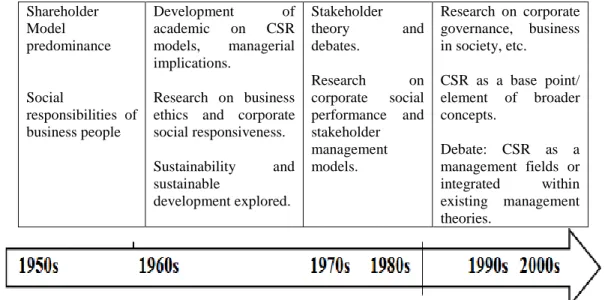
1953)
) revealed an intellectual impasse concerning CSR, due to their different interpretations of CSR. In the 1980s
there were dramatic changes in CSR evolution, whereby stakeholders’ strategic responses to social issues were
identified and actively debated. During this period, conceptual models of corporate social performance (CFP) gained
acceptance and were developed
(Ullmann, 1985; Wartick and Cochran, 1985; Wood, 1991)
. During the conceptual
evolution of CSR, a parallel development in CSR meaning was taken place. CSR became a broader concept and
resulted in much terminology and analogy.
Shareholder Model predominance
Social
responsibilities of business people
Development of academic on CSR models, managerial implications.
Research on business ethics and corporate social responsiveness.
Sustainability and sustainable
development explored.
Stakeholder theory and debates.
Research on corporate social performance and stakeholder management models.
Research on corporate governance, business in society, etc.
CSR as a base point/ element of broader concepts.
Debate: CSR as a management fields or integrated within existing management theories.
The growing trend towards CSR is driven by a few important factors
(Lunt, 2001; Lantos, 2002)
. Social and
ethical issues certainly had received increasing public attention, and therefore a growing market pressure from
customers, employees and various stakeholders exerts some form of market preferences. This situation indicates how
much importance the public is emphasizing on the social and ethical behaviour of organisations. Indeed, regulatory
pressure in term of business standards and procedures are forcing all sizes of organisations to conform. The standards
include provisions such as ethical behaviour, health and safety regulations, and minimum wages and working hours
(Davies, 2003)
. Furthermore, the advent of the new era of modern technologies such as the internet and multimedia
have provided a way for consumers and pressure groups to observe organisations’ activities. This will compel
organisations to be ethically and socially aware. Furthermore, organisations which are perceived to be ‘socially
responsible’ can strengthen their brand and enhance their organisation performance. Therefore, their commitment to
CSR will make their organisations’ performance more profitable and gain competitive advantage.
3. Definition of Corporate Social Responsibility
Over the past 40 years, scholars have debated the definition of corporate social responsibility (CSR) and the
constructs of the CSR paradigm (e.g.
(Bowen, 1953; Carroll, 1979; Clarkson, 1995; Brown and Dacin, 1997; Carroll,
1999)
). Defining CSR is an difficult task because it means something, but not always mean the same thing to
everybody
(Van Marrewijk, 2003)
. Various management disciplines have recognised that CSR fits their purposes.
Therefore, a variety of CSR definitions have been adopted by different groups, specific to their own interests and
purposes.
Table 1
displays CSR definitions from the first generation of CSR scholars, starting from the 1950s and
definitions from representatives of business and civil society. These definitions were gathered through a literature
review and most of the definitions are also referred to in the works of
Carroll (1999)
;
Dahlsrud (2008)
and
Kakabadse
et al.
(2005)
.
Table-1. CSR Definitions from 1950s to the Present
Year Author(s) Definition
1953 Bowen Social Responsibility refers to the obligations of businessmen to pursue those policies, to make those decisions, or to follow those lines of action which are desirable in terms of the objectives and values of our society.
1960 Davis Iron Law of Responsibility, which held that social responsibilities of businessmen need to be commensurate with their social power
1960 Frederick Social Responsibility mean that businessmen should oversee the operation of an economic system that fulfils the expectations of the public. And this means in turn that the economy’s means of production should enhance total socio-economic welfare. Social Responsibility in the final analysis implies a public posture toward society’s economic and human resources and a willingness to see that those resources are used for broad social ends and not simply for the narrowly circumscribed interests of private persons and firms
1963 McGuire The idea of social responsibilities supposes that the corporation has not only economic and legal obligations but also certain responsibilities to society which extend beyond these obligations.
The corporation must take an interest in politics, in the welfare of the community, in education, in the ‘happiness’ of its employees, and, in fact, in the whole social world about it. Therefore, business must act ‘justly’ as a proper citizen should
Continue Figure-1. Evolution of CSR Research since 1950s.
59
1966 Davis and
Blomstrom
Social responsibility, therefore, refers to a person’s obligation to consider the effects of his decisions and actions on the whole social system. Businessmen apply social responsibility when they consider the needs and interests of others who may be affected by business actions. In so doing, they look beyond their firm’s narrow economic and technical interest
1967 Walton The new concept of social responsibility recognizes the intimacy of the relationships between the corporation and society and realizes that such relationships must be kept in mind by top managers as the corporation and the related groups pursue their respective goals
1970 Heald The idea of social responsibility as businessmen themselves have defined and experienced it.
The meaning of the concept of social responsibility for businessman must finally be sought in the actual policies which they were associated
1971 Johnson A socially responsible firm is one whose managerial staff balances a multiplicity of interest. Instead of striving only for larger profits for its stockholders, a responsible enterprise also takes into account employees, suppliers, dealers, local communities, and the nation.
Social responsibility states that business carry out social programs to add profits to their organization.
The third approach of social responsibility assumes that the prime motivation of the business firm is utility maximization; the enterprise seeks multiple goals rather than only maximum profits.
A socially responsible entrepreneur or manager is one who has a utility function of the second type, such that he is interested not only in his own well-being but also in that of the other members of the enterprise and that of his fellow citizens.
The goals of the enterprise, like those of the consumer, are ranked in order of importance and that targets are assessed for each goal. These target levels are shaped by a variety of factors, but the most important are the firm’s past experience with these goals and the past performance of similar business enterprises; individuals and organizations generally want to do at least as well as others in similar circumstances 1971 Community for Economic
Development (CED)
The inner circle includes the clear-cut basic responsibilities for the efficient execution of the economic function-products, jobs and economic growth.
The intermediate circle encompasses responsibility to exercise this economic function with a sensitive awareness of changing social values and priorities: for example, with respect to environmental conservation; hiring and relations with employees; and more rigorous expectations of customers for information, fair treatment, and protection from injury.
The outer circle outlines newly emerging and still amorphous responsibilities that business should assume to become more broadly involved in actively improving the social environment. (For example, poverty and urban blight)
1971 Steiner Business is and must remain fundamentally an economic institution, but...it does have responsibilities to help society achieve its basic goals and does, therefore, have social responsibilities. The larger a company becomes, the greater are these responsibilities, but all companies can assume some share of them at no cost and often at a short-run as well as a long-run profit.
The assumptions of social responsibilities is more of an attitude, of the way a manager approaches his decision-making task, than a great shift in the economics of decision making. It is a philosophy that looks at the social interest and the enlightened self-interest of business over the long run as compared with the old, narrow, unrestrained short-run self-interest.
1972 Manne and
Wallich
I take responsibility to mean a condition in which the corporation is at least in some measure a free agent. To the extent that any of the foregoing social objectives are imposed on the corporation by law, the corporation exercises no responsibility when it implements them.
1973 Davis CSR refers to the firm’s consideration of, and response to, issues beyond the narrow economic, technical, and legal requirements of the firm.
It is the firm’s obligation to evaluate in its decision making process the effects of its decisions on the external social system in a manner that will accomplish social benefits along with the traditional economic gains which the firm seeks.
It means that social responsibility begins where the law ends. A firm is not being socially responsible if it merely complies with the minimum requirements of the law, because this is what any good citizen would do.
1973 Eilbert and Parket
Proposed a better way to understand social responsibility is to think of it asgood neighbourliness. The concept involves two phases. On one hand, it means not doing things that spoil the neighbourhood. On the other, it may be expressed as the voluntary assumption of the obligation to help solve neighbourhood problems.
Those who find neighbourliness an awkward or copy concept may substitute the idea that social responsibility means the commitment of a business or Business, in general, to an active role in the solution of broad social problems, such as racial discrimination, pollution, transportation, or urban decay.
1973 Votaw The term social responsibility is a brilliant one; it means something, but not always the same thing, to everybody. To some it conveys the idea of legal responsibility or liability; to others, it means socially responsible behaviour in an ethical sense; to still others, the meaning transmitted is that of responsible for, in a causal mode; many simply equate it with a charitable contribution; some take it to mean socially conscious; many of those who embrace it most fervently see it as a mere synonym for ‘legitimacy’, in the context of ‘belonging’ or being proper or valid; a few see it as sort of fiduciary duty imposing higher standards of behaviour on businessmen than on citizens at large
1974 Eells and Walton
In its broadest sense, corporate social responsibility represents a concern with the needs and goals of society which goes beyond the merely economic. Insofar as the business system as it exists today can only survive in an effectively
functioning free society, the corporate social responsibility movement represents a broad concern with business’ role in supporting and improving that social order. 1975 Backman Social responsibility usually refers to the objectives or motives that should be given
weight by business in addition to those dealing with economic performance (e.g., profits).
Employment of minority groups, reduction in pollution, greater participation in programs to improve the community, improved medical care, improved industrial health and safety-these and other programs designed to improve the quality of life are covered by the broad umbrella of social responsibility.
1975 Sethi Social responsibility implies bringing corporate behaviour up to a level where it is congruent with the prevailing social norms, values, and expectation of performance. 1975 Preston and Post Generally, there is a large number of differences, as it is not always consistent with its
usages. We restrict our own use of the term social responsibility to refer only to a vague and highly generalised sense of social concern that appears to underlie a wide variety of ad hoc managerial policies and practices. Most of these attitudes and activities are well-intentioned and even beneficent; few are patently harmful. They lack, however, any coherent relation to the managerial unit’s internal activities or to its fundamental linkage with its host environment.
1975 Bowman and Haire Represented CSR as opposed to those that were strictly ‘business’.
1976 Fitch CSR is defined as the serious attempt to solve social problems caused wholly or in part by the corporation
1979 Carroll The social responsibility of business encompasses the economic, legal, ethical, and discretionary expectations that society has of organisations at a given point in time. 1980 Jones CSR is defined as the notion that corporations have an obligation to constituent groups
in society other than stockholders and beyond that prescribed by law or union contract, indicating that a stake may go beyond mere ownership.
1983 Carroll CSR involves the conduct of a business so that it is economically profitable, law abiding, ethical and socially supportive. To be socially responsible... then means that profitability and obedience to the law are foremost conditions to discussing the firm’s ethics and the extent to which it supports the society in which it exists with contributions of money, time and talent. Thus, CSR is composed of four parts: economic, legal, ethical and voluntary or philanthropic.
1986 Murray and Montanari A socially responsible firm is one that accomplishes and is perceived to accomplish the desired ends of society in terms of moral, economic, legal, ethical, and discretionary expectations.
1987 Epstein CSR relates primarily to achieving outcomes from organisational decisions concerning specific issues or problems which (by some normative standard) have beneficial rather than adverse effects on pertinent corporate stakeholders. The normative correctness of the products of corporate action has been the main focus of corporate social responsibility.
1991 Carroll For CSR to be accepted by the conscientious business person, it should be framed in such a way that the entire range of business responsibilities is embraced. It is suggested here that four kinds of social responsibilities constitute total CSR: economic, legal, ethical and philanthropic. Furthermore, these four categories or components of CSR might be depicted as a pyramid. To be sure, all of these kinds of responsibilities have always existed to some extent, but it has only been in recent years that ethical and philanthropic functions have taken a significant place.
1994 Reder An all-encompassing notion, (corporate) social responsibility refers to both the way a company conducts its internal operations, including the way it treats its work force, and its impact on the world around it.
1998 Hopkins CSR is concerned with treating the stakeholders of the firm ethically or in a socially responsible manner. Stakeholders exist both within a firm and outside. Consequently, behaving socially responsibly will increase the human development of stakeholders both within and outside the corporation
1999 Kilcullen and Kooistra CSR is the degree of moral obligation that may be ascribed to corporations beyond simple obedience to the laws of the state.
1999 World Business Council for Sustainable Development
The commitment of business to contribute to sustainable economic development, working with employees, their families, the local community and society at large to improve their quality of life.
1999 Khoury, Rostami, and Turnbull
CSR is the overall relationship of the corporation with all of its stakeholders. These include customers, employees, communities, owners/investors, government, suppliers and competitors. Elements of social responsibility include investment in community outreach, employee relations, creation and maintenance of employment, environmental stewardship and financial performance.
1999 Woodward-Clyde CSR has been defined as a „contract‟ between society and business wherein a community grants a company a license to operate and in return the matter meets certain obligations and behaves in an acceptable manner.
2000 World Business Council for Sustainable Development
CSR is the continuing commitment by business to behave ethically and contribute to economic development while improving the quality of life of the workforce and their families as well as the local community and society at large.
2000 Business for Social
Responsibility
Business decision making linked to ethical values, compliance with legal requirements and respects for people, communities and the environment.
Operating a business in a manner that meets or exceeds the ethical, legal, commercial and public expectations that society has of business. Social responsibility is a guiding principle for every decision made and in every area of a business.
2001 UK Government CSR recognises that the private sector’s wider commercial interests require it to manage its impact on society and the environment in the widest sense. This requires it to establish an appropriate dialogue or partnership with relevant stakeholders, be they employees, customers, investors, suppliers or communities. CSR goes beyond legal obligations, involving voluntary, private sector-led engagement, which reflects the priorities and characteristics of each business, as well as sectoral and local factors.
61
2001 Pinney CSR or corporate citizenship can most simply be defined as a set of management practices that ensure the company minimizes the negative impacts of its operations on society while maximizing its positive impacts.
2001 Commission of the European Communities
A concept whereby companies integrate social and environmental concerns in their business operations and in their interaction with their stakeholders on a voluntary basis. Corporate social responsibility is essentially a concept whereby companies decide voluntarily to contribute to a better society and a cleaner environment.
2001 Foran CSR can be defined as the set of practices and behaviours that firms adopt towards their labour force, towards the environment in which their operations are embedded, towards authority and towards civil society.
2001 Jackson and Hawker Corporate social responsibility is how you treat your employees and all your stakeholders and the environment.
2001 Van Marrewijk Companies with a CSR strategy integrate social and environmental concerns in their business operations and in their interactions with their stakeholders and demonstrate openly their triple P performances.
2001 Marsden CSR is about the core behaviour of companies and the responsibility for their total impact on the societies in which they operate. CSR is not an optional add-on nor is it an act of philanthropy. A socially responsible corporation is one that runs a profitable business that takes account of all the positive and negative environmental, social and economic effect it has on society.
2001 Foran CSR can be defined as the set of practices and behaviours that firms adopt towards their labour force, towards the environment in which their operations are embedded, towards authority and towards civil society.
2001 McWilliams and Siegel Actions that appear to further some social good, beyond the interests of the firm and that which is required by law.
2001 Kok, Wiele, McKenna and Brown
The obligation of the firm to use its resources in ways to benefits society, through committed participation as a member of society, taking into account the society at large, and improving welfare of society at large independently of direct gains of the company.
2002 Commission of the European Communities
CSR is about companies having responsibilities and taking actions beyond their legal obligations and economic/business aims. These wider responsibilities cover a range of areas but are frequently summed up as social and environmental-where social means society broadly defined, rather than simply social policy issues. This can be summed up as the triple bottom line approach: i.e. economic, social and environmental 2002 Lea CSR can be roughly defined as the integration of social and environmental concerns in
business operations, including dealings with stakeholders.
CSR is about business and other organizations going beyond the legal obligations to manage the impact they have on the environment and society. In particular, this could include how organizations interact with their employees, suppliers, customers and the communities in which they operate, as well as the extent they attempt to protect the environment.
2002 Amnesty International
Business Group (UK)
Companies (have) to recognise that their ability to continue, to provide goods and services and to create financial wealth will depend on their acceptability to an international society which increasingly regards protection of human rights as a condition of the corporate license to operate.
2002 Lea CSR can be roughly defined as the integration of social and environmental concerns in business operations, including dealings with stakeholders.
CSR is about business and other organizations going beyond the legal obligations to manage the impact they have on the environment and society. In particular, this could include how organizations interact with their employees, suppliers, customers and the communities in which they operate, as well as the extent they attempt to protect the environment.
2003 Baker CSR is about how companies manage the business processes to produce an overall positive impact on society.
2003 IndianNGOs.com CSR is a business process wherein the institution and the individuals within are sensitive and careful about the direct and indirect effect of their work on internal and external communities, nature and the outside world.
2003 International Business Leader Forum (IBLF)
Open and transparent business practices based on ethical values and respect for employees, communities and the environment, which will contribute to sustainable business success.
2003 Commission of the European Communities
CSR is the concepts that an enterprise is accountable for its impact on all relevant stakeholders. It is the continuing commitment by business to behave fairly and responsibly and contribute to economic development while improving the quality of life of the work force and their families as well as of the local community and society at large.
2003 CSR Europe CSR is the way in which a company manages and improves its social and environmental impact to generate value for both its shareholders and its stakeholders by innovating its strategy, organisation and operations.
2003 CSRwire CSR is defined as the integration of business operations and values, whereby the interest of all stakeholders including investors, customers, employees and the environment are reflected in the company’s policies and actions.
2003a Business for Social Responsibility
Socially responsible business practices strengthen corporate accountability, respecting ethical values and in the interests of all stakeholders. Responsible business practices respect and preserve the natural environment. Helping to improve the quality and opportunities of life, they empower people and invest in communities where a business operates.
2003b Business for Social Responsibility
CSR is achieving commercial success in ways that honour ethical values and respect people, communities and the natural environment.
2003 Hopkins CSR is concerned with treating the stakeholders of the firm ethically or in a responsible manner. ‘Ethically or responsible’ means treating stakeholders in a manner deemed acceptable in civilised societies. Social includes economic responsibility.
Stakeholders exist both within a firm and outside. The wider aim of social responsibility is to create higher and higher standards of living, while preserving the profitability of the corporation, for peoples both within and outside the corporation 2003 Ethical Performance At its best, CSR is defined as the responsibility of a company for the totality of its
impact, with a need to embed society’s values into its core operations as well as into its treatment of its social and physical environment. Responsibility is accepted as encompassing a spectrum from the running of a profitable business to the health and safety of staff and the impact on the societies in which a company operates.
2003 Global Corporate Social Responsibility Policies Project
Global corporate social responsibility can be defined as business practices based on ethical values and respect for workers, communities and the environment.
2003 Ethics in Action Awards CSR is a term describing a company’s obligation to be accountable to all of its stakeholders in all its operations and activities. Socially responsible companies consider the full scope of their impact on communities and the environment when making decisions, balancing the needs of stakeholders with their need to make a profit. 2003 Strategies CSR is generally seen as the business contribution to sustainable development, which has been defined as development that meets the needs of the present without compromising the ability of future generations to meet their own needs, and is generally understood as focusing on how to achieve the integration of economic, environmental and social imperatives.
2003 World Business Council for Sustainable Development (WBCSD)
CSR is business’ commitment to contribute to sustainable economic development working with employees, their families, the local community, and society at large to improve their quality of life.
2003 Organisation for Economic
Co-operation and
Development (OECD)
Corporate Responsibility involves the ‘fit’ business develop with the societies in which they operate. (...) The function of business in society is to yield adequate returns to owners of capital by identifying and developing promising investment opportunities and, in the process, to provide jobs and to produce goods and services that consumers want to buy. However, corporate responsibility goes beyond this core function. Businesses are expected to obey the various laws which are applicable to them and often have to respond to societal expectations that are not written down as formal law. 2003 Corporate Responsibility
Coalition (CORE)
As an ‘organ of society’, companies have a responsibility to safeguard human rights within their direct sphere of operations as well as within their wider spheres of influence.
2003 Novethic Linked to the application by corporations of the sustainable development principle, the concept of CSR integrates three dimensions: an economic dimension (efficiency, profitability), a social dimension (social responsibility) and an environmental dimension (environmental responsibility). To respect these principles, corporations must pay more attention to all the stakeholders (...) which inform on the expectations of civil society and the business environment.
2003 Unilever Social responsibility is the impact or interaction we have with society in three distinct areas: (i) voluntary contributions, (ii) impact of (businesses direct) operations, and (iii) impact through the value chain.
2003 Novo Nordisk Social responsibility is about caring for people. This applies to our employees and the people whose healthcare needs we serve. It also considers the impact of our business on the global society and the local community. As such, social responsibility is more than a virtue-it is a business imperative.
2003 Van Marrewijk In general, corporate sustainability and CSR refer to company activities-voluntary by definition-demonstrating the inclusion of social and environmental concerns in business operations and in interactions with stakeholders.
2005 GAP The first one is this whole idea of sustainable solutions in our supply chain. This consists of working on a four-part strategy to improve working conditions, monitor factories, integrate labour standards into our business practices, and the whole idea of collaborating with outside partners to drive industry-wide change. The second is with our employees and making Gap inc., a place where people can really flourish and build their careers in a positive work environment. The third is community involvement, including everything from our foundation to our volunteerism. And the fourth key area in corporate social responsibility for us is environment, health and safety. This is everything from the average store energy consumption to the safety of our stores for customers and employees to a high-level environmental impact assessment for all of our business operations. So, we define it broadly, then. Supply chain, employees, community involvement, and environment.
2007 Antal and Sobczak CSR includes cultural and socioeconomic concepts
2008 Dahlsrud CSR includes environmental, social, economic, stakeholder and voluntariness 2008 Matten and Moon CSR reflects social imperatives and social consequences of business success. These
consist of articulated and communicated policies and practices of corporations that reflect business responsibility for societal good deeds.
2009 GjØlberg CSR cannot be separated from contextual factors.
Source:Compilation by Researcher
The exhaustive list of CSR definition shows that the descriptions of CSR are ranging from highly conceptual to
highly practical. The definitions also derived from a variety of themes such as social responsibility, sustainable
development, business ethics, corporate citizenship, triple-bottom line, corporate philanthropy and corporate
governance. CSR is a multi-disciplinary concept and it is defined according to the context to which it is employed.
4. CSR Related Themes
63
are eight stakeholder-based categories, namely: (1) Human resources; (2) Shareholders and financial community; (3)
Customers; (4) Suppliers;(5) Financial partners; (6) Public authorities; (7) Community; (8) Environment which is
consistent with past studies by
Niskala and Pretes (1995)
;
Gray
et al.
(1995)
and
Adams (2002)
.
Perrini (2005)
presented CSR key themes emerge in this decade based on the stakeholder-based categories in
Table 2
.
Table-2. CSR Key Themes
C S R T h em es Stakeholder-Based Categories Human Resources
Shareholders Customers Suppliers Financial
Partners
Public Authorities
Community Environment
Staff compositio n Turnover Equality of treatment Training Working hours Schemes of wages Absence from work Employee’s benefits Industrial relations In-house communica tions Health and Safety Personnel’s satisfaction Workers rights Disciplinar y measures and litigation Capital stock formation Shareholders’/ partner’s pay Rating performance Corporate governance Benefit and services Investor relations General characteristi cs Market development Customer satisfaction Customer loyalty Product/ Services information and labelling Ethical & Environment al product & services Promotional policies Privacy Supplier manageme nt policies Contractu al conditions Relations with banks Relations with insurance companies Relations with financial institutions Taxes and duties Relations with local authorities Codes of conducts and compliance with laws Contribution benefits or easy-term financing Corporate giving Direct contribution the different intervention fields Stakeholder engagement Relations with the media Virtual community Corruption prevention Energy consumption Material emissions Environmental strategy and relations with the community
Source:Perrini (2005)
The stakeholder-based categorisation by
Perrini (2005)
clearly shown that there are many themes developed in
the human resource with employees being the stakeholder. Among the CSR themes under human resource aspects,
health and safety, protection of workers’ right, equality of treatment, training, turnover and personnel’s satisfaction
received the most attention in the CSR non-financial disclosure reporting among the European companies. This
finding undercovers a new leaf for CSR, instead of reviewing on the financial performance of a corporation, human
resource aspect is another arena that gains a foothold. The concern of CSR towards employees begins thereafter.
5. CSR and Employees
Majority of the past scholarly research on CSR and sustainability focus on the macro level of analysis
(Devinney, 2009; Siegel, 2009; Aguinis and Glavas, 2012)
and these research emphasis on institutional levels, such
as addressing regulatory elements, normative and cultural-cognitive elements shaped by external stakeholders
(Scott,
1995)
. Despite the wide dissemination of CSR and its cross-disciplinary nature
(Lockett
et al.
, 2006)
potential
relevance for employee management
(Brammer
et al.
, 2007)
organisational behaviour and human resource
management researchers have under-investigated CSR
(Rupp
et al.
, 2006; Aguilera
et al.
, 2007)
.
In 21
stcentury, growing attention is directly to the internal stakeholders, specifically the employee, through the
field of organisational behaviour and human resource management
(Aguinis and Glavas, 2013)
. Even though some
studies of CSR are adopted in organisational behaviour perspective
(Albinger and Freeman, 2000; Greening and
Turban, 2000)
but these studies focused on how CSR affecting prospective employees to increased corporate
attractiveness. Based on few empirical studies investigating the internal impact of CSR on employees, they tend to
focus on specific dimensions of organisational commitment
(Maignan and Ferrell, 2001; Paterson, 2004; Brammer
et
al.
, 2007)
. As the nature of CSR is multidimensional
(Husted, 2000)
it can also influence a wide range of
organisational attitudes and behaviour beyond organisational commitment. To this point, there is absent of sufficient
theoretical consolidation and synthesis the impacts of CSR on employees attitudes and behaviour which is then
ultimately affect the organisation sustainability.
Employee is often a central feature of stakeholder theory and CSR research and practice. According to
Barnett
(2007)
CSR is a form of corporate investment characterised by a dual orientation towards the improvement of social
welfare and stakeholder relations. Stakeholder relations explain why employees being the stakeholder impact the
CSR policy. Firstly, employees can act as agents for social change when they pressure corporations to adopt socially
responsible behaviour
(Aguilera
et al.
, 2007)
. Secondly, environmental policy demonstrates that employees’ support
Rupp
et al.
, 2006)
. From a theoretical perspective, employees are the stakeholders, can be seen as an independent
variable that explain the emergence of CSR
(Aguilera
et al.
, 2007)
and as a dependent variable that influenced by
CSR
(Maignan and Ferrell, 2001; Paterson, 2004)
.
Employees as a unit of analysis have not been receiving much attention in the past CSR research
(Rupp
et al.
,
2006; Aguilera
et al.
, 2007)
. Majority of past CSR and human resource management research focussed on the
relationships between leadership and corporate social behaviour
(Waldman
et al.
, 2006; Swanson, 2008)
. There are
also some corporate social performance models that explicitly included employees as a level of analysis (e.g.
(Wood,
1991)
) few studies have investigated CSR’s influence on employees’ attitudes and behaviours.
Table 3
illustrates
studies conducted in the past in CSR research in relation with employees. Studies conducted focus on the external
aspect by looking at the influence of CSR on prospective employees which based on social identity theory. These
studies show how a socially responsible reputation of organisation influence the corporate attractiveness for
prospective employees
(Albinger and Freeman, 2000; Greening and Turban, 2000)
. Past research also demonstrated
that by enhancing corporate image and reputation, CSR can be a magnet for prospective employees. However, all
these research say little about CSR influence on incumbent employees. Indeed,
Riordan
et al.
(1997)
used external
corporate image as a proxy for social performance and found that employees’ perception of corporate image can
positively influence job satisfaction, and negatively influence turnover and turnover intentions.
Previous research on socially responsible behaviour explains the present of knowledge gap on CSR’s influence
on actual employees
(Swaen
et al.
, 2003)
. Macro-level research by
Margolis
et al.
(2007)
and
Margolis and Walsh
(2003)
examined organisations as the main unit of analysis which focused on CSR’s financial impact. Meanwhile,
the micro-level approach that took individuals as the unit of analysis did not refer explicitly to employees’ socially
responsible behaviour
(Schneider
et al.
, 2004; Treviño
et al.
, 2006)
. These past research pointed out the absent of
established research in the micro-level analysis by examine the CSR practices on actual employees’ attitudes and
behaviour.
Followed by the past CSR research in relation to employees, the researcher attempts to fill up the existing
knowledge gap on the influence of CSR practice towards employees. In the following section, theories underpinning
CSR and employees are being explored to establish the theoretical background for the understanding of internal
CSR.
6. Theories Underpinning CSR and Employees
In an attempt to study CSR and employees, past research in relation of CSR and employees are scrutinised with
Table 3
summarising the major findings. With reference to
Table 3
several theoretical frameworks have been used to
examine CSR in relation with employees. In line with the evolution of CSR, Stakeholder Theory has emerged as the
dominant paradigm in CSR discussion. According to Stakeholder Theory,
Freeman (1984)
asserts that firms have
relationships with many constituent groups which have an interest in the activities and outcomes of a firm
(Donaldson and Preston, 1995; Margolis and Walsh, 2003)
. These stakeholders both affect and are affected by the
actions of the firm and balancing the needs of the multiple stakeholders in the activities and outcomes of a firm is
crucial. Among others, these groups include employees, customers, suppliers, environmentalists, the community as
whole, and owners/shareholders. Adding on, Stakeholder Theory perspective on the morality of CSR implies that
managers should recognize and serve the interests of a broader set of constituent groups
(Jones
et al.
, 2007; Aguinis,
2011)
. Hence, Stakeholder Theory marks as an important theory that should not be omitted in the CSR and
employees’ discussion.
Social Exchange Theory is applicable in present context in relation to CSR and employees. According to the
motivational processes of Social Exchange Theory and the norm of reciprocity
(Homans, 1961; Blau, 1964)
it
explains the relationships among human resource practices, trust-in-management and employee commitment
(Eisenberger
et al.
, 1990; Settoon
et al.
, 1996; Wayne
et al.
, 1997)
. CSR practises in an organisation that focuses on
the well-being of employees will create trust in the employee toward the organisation and in turns, high employee
commitment.A well-established stream of research rooted in Social Exchange Theory has shown that employees’
commitment to the organisation derives from their perceptions of the employers’ commitment to and support of them
(Eisenberger
et al.
, 1990; Shore and Tetrick, 1991; Shore and Wayne, 1993; Hutchison and Garstka, 1996; Settoon
et
al.
, 1996; Wayne
et al.
, 1997)
. The research suggested that employees interpret organisational actions such as human
resource practices
(Settoon
et al.
, 1996; Wayne
et al.
, 1997)
and the trustworthiness of management
(Eisenberger
et
al.
, 1990; Settoon
et al.
, 1996)
as indicative of the personified organisation’s commitment to them. They reciprocate
their perceptions accordingly in their own commitment to the organisation, which is then affecting the organisation
sustainability.
Table-3. Studies of CSR in relations of Employees
Author(s), Year Turban and
Greening (1997)
Maignan et al. (1999) Maignan and Ferrell
(2001)
Paterson (2004)
Title Corporate social
performance and organisational attractiveness to prospective
employees. Academy of Management Journal, 40(3): 658-673.
Corporate citizenship: Cultural
antecedents and business benefits. Journal of the
Academy of Marketing Science, 27(4): 455-469.
Antecedents and benefits of corporate citizenship:
an investigation of French businesses. Journal of Business Research, 51(1): 37-51.
The relationship between perceptions of corporate citizenship and organizational commitment.
Focus External External and Internal Internal/ External Internal
65
Theory Social Identity
Theory (Ashforth and Mael, 1989)
Signaling Theory
(Rynes, 1991)
Resource based view of competitive advantage
Resource based view of competitive advantage
Social identity theory
Independent Variables (IV) Corporate social performance Corporate Citizenship (CC) Corporate Citizenship (CC) Corporate Citizenship (CC) Measurements of IVs KLD rating (original
9 dimensions) 5 dimensions : community relations, treatment of women and minorities, employee relations, treatment of the environment, quality of services and products
18 item scale developed by the authors and based on the CSR typology of
Carroll (1979) 's model
of CSP : Economic, Legal, Ethical, Discretionary citizenship
18 item scale developed by the authors and based on the CSR typology of
Carroll (1979) 's
model of CSP (economic, legal, ethical, discretionary)
18 items scale of CC (economic, legal, ethical, discretionary) adopted from (Maignan and Ferrell, 2000)
Dependent Variables (DV) Organisational Reputation Organisational Attractiveness as employer Employee Commitment (EC) Employee Commitment (EC) Employee commitment (EC)
Measurement of DVs OR – developed by author
5 point scale : 1 (very poor reputation) – 5 (very good
reputation) OA - developed by author thru asking students on employer attractiveness 5 point scale : 1 (unattractive
employer) – 3 (cannot judge) 5 (one of most attractive employer)
EC- 7 items scale developed by
Jaworski and Kohli (1993)
5 point Likert Scale
EC- 7 items scale developed by
Jaworski and Kohli (1993)
5 point Likert Scale
EC: 9 items version of the
Mathieu and Farr
(1991) scale
(Croncbach alpha – 0.88)
Eg :I am proud to tell others that I am
part of this organisation. I really care about the fate of this organisation.
Method of Analysis Regression Structural Equation Modelling
SEM Hierarchical
Multiple Regression
Tool Survey Survey Survey Survey
Sample Students (N=114) Marketing executives (N=210)
French Manager (N= 120)
Business Professionals (N=278) Key findings CSP is positively
related to corporate reputation and attractiveness as an employer
Positive influence of CC on EC by marketing executives
Positive influence of CC on EC
Only the discretionary component of CC is strongly
correlated to EC
CC perceptions are positively related to OC; stronger link among
employees who believe in CSR. The effect of Ethical CC is stronger. There is a gender effect for Discretionary CC.
Table-3. Studies of CSR in relations of Employees (con’t)
Author(s), Year Brammer et al.
(2007)
Carmeli et al. (2007) Valentine and
Godkin (2009)
Valentine et al.
(2011)
Title The contribution of
corporate social responsibility to organizational commitment. International Journal of Human Resource
Management, 18(10): 1701-1719.
The role of perceived organizational performance in organizational identification, adjustment and job performance. Journal of Management Studies, 44(6): 972-992.
Ethics, Social Responsibility, and Ethical Reasoning in an Education-Based Health Science Centre: When Doing Good Results in Good Employees, Journal of Leadership,
Accountability and Ethics
Ethics Programs, Perceived Ethical Context, and A positive Work Attitude, Academy of Management
Focus Internal Internal/ External Internal/ External Internal
Theory Social Identity Theory
Organizational Identification
Social Identity Theory
Cognitive dissonance and social desirability
Independent Variables (IV) Corporate Social Responsibility (CSR)
Perceived social responsibility and Development
CSR Ethics programs
(ethics training & ethics codes) Measurements of IVs Internal perceptions
of CSR =
procedural justice (6 items scale from
Moorman (1991)
and training (3 items scales); External
perceptions of CSR captured through one deigned designed item . Eg:
The decision management make about employees are usually fair. I believe the
company offer equal opportunity to all the
employees. (Cronbach alpha 0.87)
Eg:
The company is a socially responsible member of the community. There are sufficient
opportunities to develop and improve my skills in current job. (Cronbach alpha 0.81)
4 items scale based on
Delaney and Huselid
(1996): Quality of
products, services and programs;
Development of new product, services and programs;
Ability to retain essential employees; Relations between
management and other employees
1. I work for a socially responsible
organization that serves the greater community. 2. My organization gives time, money, and other resources to socially responsible causes.
3. The organization I work for upholds generally accepted ethical business standards. 4. My organization takes care of its customers, employees, suppliers, and
investors.
5. I work for a firm that does its best to enhance the financial well-being of its stakeholders.
Ethics training - one question asked subjects
approximately how many hours of ethics training they had received in the last year, and the availability of an ethics code was evaluated with an item that asked subjects if their company had ever shared with them an ethics code that governed work conduct in the organization (1 = no, 2 = yes)
Dependent Variables (DV) Organizational Commitment (OC)
Job Performance (JP) Importance of ethics and social
responsibility
Positive work attitude (Job satisfaction & intention to stay) Measurement of DVs Internal perceptions
of CSR =
procedural justice (6 items scale from
(Moorman, 1991)
and training (3 items scales); External
perceptions of CSR captured through one deigned designed item . Eg:
The decision management make about employees are usually fair. I believe the
company offer equal opportunity to all the
employees. (Cronbach alpha 0.87)
Eg:
The company is a socially responsible member of the community. There are sufficient
4 items scale based on
Delaney and Huselid
(1996): Quality of
products, services and programs;
Development of new product, services and programs;
Ability to retain essential employees; Relations between
management and other employees
1. I work for a socially responsible
organization that serves the greater community. 2. My organization gives time, money, and other resources to socially responsible causes.
3. The organization I work for upholds generally accepted ethical business standards. 4. My organization takes care of its customers, employees, suppliers, and
investors.
5. I work for a firm that does its best to enhance the financial well-being of its stakeholders.
Ethics training - one question asked subjects
67
opportunities to develop and improve my skills in current job. (Cronbach alpha 0.81)
Method of Analysis Regression Confirmatory factor analysis (CFA) and SEQ
Confirmatory factor analysis (CFA) and AMOS
Confirmatory factor
analysis (CFA) and SEM
Tool Survey of
employees
Survey of employees & supervisor
Survey of employees Survey
Sample Employees from a
financial services company (N=4,712
N=161 matched surveys of
supervisors/employees from elect./media companies in Israel
N = 781professionals employed in a four-campus health science center.
N = 781 individuals employed in a large, university-operated health science center Key findings Positive influence
of external forms of CSR on OC subject to important gender variations
Positive influence of external social performance perceptions on identification, and JP
Perceptions of corporate social responsibility and the believed importance of ethics and social responsibility were positively related, and that these factors were at least marginally associated with different steps of ethical reasoning.
Ethical programs function through ethical
environment to enhance positive feelings on the job
Source: Compilation by Researcher