International Journal of Research in Engineering & Applied Sciences 57 http://www.euroasiapub.org
PEAK TO AVERAGE POWER REDUCTION USING PSO
Rajnish Kumar*
Davinder Prakash**
ABSTRACT
In OFDM dividing the total bandwidth into many narrow sub-channels which are transmitted in parallel, the effects of multipath delay spread can be minimized. Peak to average power ratio (PAPR) and symbol loss rate (SLR) are two challenges of multicarrier based communications that have recently drawn much attention. In OFDM PAPR causes nonlinear distortions after amplified by power amplifier. Many methods proposed to reduce PAPR. There are rich literatures studying these two issues separately but, unfortunately, only a few works have studied simultaneous reductions of PAPR In this paper a partial transmit sequence (PTS) based technique using PSO for the reduction of PAPR has been proposed.
Keywords: PAPR, OFDM, PTS, PA
*K.I.T.M. Kurukshetra, India
International Journal of Research in Engineering & Applied Sciences 58 http://www.euroasiapub.org
1.
INTRODUCTION
Orthogonal frequency division multiplexing (OFDM) is becoming the chosen modulation
technique for wireless communications [1-5]. OFDM can provide large data rates with
sufficient robustness to radio channel impairments. Many research centres in the world have
specialized teams working in the optimization of OFDM for countless applications. Wireless
technologies, such as satellite, cellular, and wireless internet are now commercially driven by
ever more demanding consumers, who are ready for seamless integration of communication
networks from the home to the car, and into the office. OFDM is an effective multicarrier
technique that has the ability to cope with the severe channel characteristics without requiring
high complexity equalization receivers. OFDM, custom-designed for broadband channels,
converts the wideband frequency selective channel into multiple narrowband flat channels.
One of the main advantages of multicarrier systems is that it permits transmission over
frequency-selective channels at a low receiver implementation cost. OFDM is therefore
commonly accepted as being the most effective transmission technology for the downlink of
future high data rate broad-band systems. A widely known problem of multicarrier
transmission is its vulnerability to synchronization errors. The Doppler shift, caused by high
mobility, introduces Inter-Carrier Interference (ICI), while long multipath delay profiles
create Inter-Symbol Interference (ISI). OFDM poses a broad area of challenges that need to
be more efficiently tackled. Peak to Average Power Ratio (PAPR) reduction algorithms are
required to obtain enhanced power efficiency
2. OFDM AND PAPR
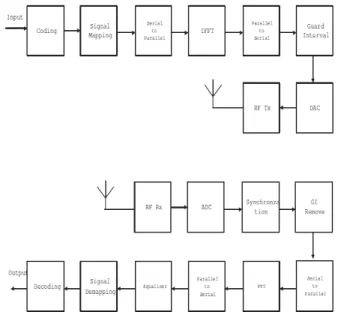
In the OFDM design, the serial to parallel (S/P) converter is considered to realize the concept
of parallel data transmission. A serial to parallel block arranges the complex symbols into
blocks of N symbols, where N is the number of subcarriers in one OFDM block. The key
component of the OFDM modulation is the Inverse FFT (IFFT) transform which is used to
modulate the symbols after signal mapping to different subcarriers. After the modulation, the
samples of the OFDM signal can be expressed as:
(1)
Figure 1 shows the complete OFDM transceiver where each block has its own significant and
International Journal of Research in Engineering & Applied Sciences 59 http://www.euroasiapub.org
Figure 1: Block diagram of the OFDM transceiver
At the receiver, the synchronization is very important since the OFDM system is very
sensitive to the synchronization errors. More details are discussed in next Section. Another
component of the receiver is the equalizer. Due to the facts that the OFDM system is robust
to the ISI and each sub-channel is almost flat fading, time domain equalization is not needed.
So a simple one tap frequency domain equalizer is applied to equalize the channel.
One reason why the nonlinearity of power amplifiers (PA) should be considered seriously is
that the large peak power of the OFDM signal sometimes makes the PA inefficient. When
adding up subcarriers with the same phases, the peak power is N times than the average power of the signal on each subcarrier. This results in a high Peak-to-Average Power Ratio
(PAPR). Such high PAPR problem associated with multicarrier signals is one of the principal
drawbacks of OFDM. A high PAPR makes the PA work with large IBOs, resulting in
inefficient use of the amplifier. High PAPR also increases the complexity of the ADC and
DAC [21]. The PAPR is defined as:
(2)
Where max0<t<T │ x(t) │2 is the maximum power of the signal and E[│ x(t) │2] is the average
power. Another factor used is the Crest Factor (CF) which is defined as the square root of
PAPR:
International Journal of Research in Engineering & Applied Sciences 60 http://www.euroasiapub.org
From Eq. (2), it can be seen that the high PAPR can be reduced either by reducing the
maximum signal power or by increasing the average power. In reality, reducing the
maximum signal power is used in most cases because increasing the average power causes
more interference. Several approaches have been proposed to reduce the high PAPR and they
can be divided into three main categories [10]. The first approach relies on coding technique
which uses a special coding, i.e. Forward Error Correct (FEC), to reduce the large PAPR.
This approach does not cause interference but it increases the complexity of the transmitter
and decreases the transmission rate. The second approach is the signal distortion technique,
which simply reduces the signal amplitude by distorting the signal. Clipping technique and
peak windowing, for instance, belong to this approach. The last one is based on scrambling
each OFDM symbol with different scrambling sequences and then selecting the sequence that
gives the smallest PAPR. Although there are many techniques for reducing high PAPR, all
these approaches have some corresponding disadvantages, such as signal distortion and
complexity of the implementation. These approaches also cannot guarantee that the signal
after processing can avoid PA nonlinear distortion.
3. BASICS OF PSO
Particle Swarm Optimization was introduced by Dr. Russell C. Eberhart and Dr. James
Kennedy in 1995 [18], [19]. As described by Eberhart and Kennedy, Particle Swarm
Optimization (PSO) is a population based search algorithm based on the simulation of the
social behaviour of birds within a flock. The initial intention of the particle swarm
optimization concept was to graphically simulate the behaviour of a bird flock, with the aim
of discovering patterns that govern the ability of birds to fly synchronously, and to suddenly
change direction with a regrouping in an optimal formation. From this initial objective, the
concept evolved into a simple and efficient optimization algorithm. It is widely used for
many problems solving method in engineering.
3.1 PSO ALGORITHM
In PSO, individuals, referred to as particles, are “flown” through hyper dimensional search
space [20]. Changes to the position of particles within the search space are based on the
social-psychological tendency of individuals to emulate the success of other Individuals. The
changes to a particle within the swarm are therefore influenced by the experience, or
knowledge of its neighbours. The search behaviour of a particle is thus affected by that of
other particles within the swarm. Particle Swarm has two primary operators:
International Journal of Research in Engineering & Applied Sciences 61 http://www.euroasiapub.org
• Position update
During each generation each particle is accelerated toward the particles previous best position
(pbest) and the global best (gbest) position and new velocity value for each particle is
calculated based on its current velocity, the distance from its previous best position, and the
distance from the global best position. The new velocity value is then used to calculate the
next position of the particle in the search space. In PSO, each potential solution is assigned a
randomized velocity and is “flown” through the problem space. Each particle adjusts its
flying according to its own flying experience and its companion flying experience [11].
[ ] + [ ] (4)
(5)
where,
vit is velocity of ith particle at iteration t,
w is weight inertia.
c1, c2 is Acceleration Constants.
r1, r2 is random number between 0 and 1.
Xit is current position of ith particle at iteration t,
pbesti is personal best of ith particle,
gbest is global best value of the group.
4.
RESULTS AND DISCUSSION
As PAPR is a big problem a method has been implemented using PSO. Initial data has been
taken while doing this experiment as follow QPSK signal constellation 4, data points 128,
size of each OFDM block 8, and 128 points for the FFT/IFFT. Different number of Particles
(NOP) and number of iterations (NOI) have been chosen for algorithm.
4 6 8 10 12 14
0 0.1 0.2 0.3 0.4 0.5 0.6 0.7 0.8 0.9 1
papr, x dB
P
robabi
lit
y
, X
<
=
x
CDF plots of PAPR 128
PSO simple cliping
International Journal of Research in Engineering & Applied Sciences 62 http://www.euroasiapub.org
4 6 8 10 12 14
0 0.1 0.2 0.3 0.4 0.5 0.6 0.7 0.8 0.9 1
papr, x dB
P
robabi
lit
y
, X
<
=
x
CDF plots of PAPR 128
PSO simple cliping
Figure: 3 CDF v/s PAPR for NOP=2 and NOI=4
Comparison between simple transmission, clipping method, and PSO techniques has been
given. Results shown that at CDF 0.3 PSO manage 5.5, clipping 6.5 and simple 7.5 PAPR for
number of particles 1 and number of iteration 1.
Clipping technique not gave good results all time but PSO may give good results if NOP and
NOI properly chosen.
5. REFERENCES
1. Wu, Y. and Zou, W. Y. 1995. Orthogonal frequency division multiplexing: a
multicarrier modulation scheme. IEEE Transactions on Consumer Electronics, 41 (3),
392–399.
2. Armstrong, J. 2002. Peak-to-average power reduction for OFDM by repeated clipping
and frequency domain filtering. Electronics Letters, 38 (5), 246-247.
3. Chen, H. S and Liang, H. Y. 2007. Combined selective mapping and binary cyclic
codes for PAPR reduction in OFDM systems. IEEE Transactions on Wireless
Communications. 6 (10), 3524-3528.
4. Baunml, R. W., Fischer R .F. H. and Huber, J. B. 1997. Reducing the peak to average
power ratio of multi carrier modulation by selected mapping. Electronics Letters, 32
(22), 2056-2057.
5. Yang, L., Chen, R. S. and Siu, Y.M. 2006. PAPR reduction of an OFDM signal by
use of PTS with low computational complexity. IEEE Transactions on Broadcasting.
52 (1), 83-86.
6. Lim, D.W., Heo, S. J. and No, J.S. 2006. A new PTS OFDM scheme with low
International Journal of Research in Engineering & Applied Sciences 63 http://www.euroasiapub.org
7. SJayalath, A.D. and Tellambura, C. 2000. Adaptive PTS approach for reduction of
peak-to-average power ratio of OFDM signal. Electronics Letters. 36 (14), 1226-1228.
8. Seung, H. H. and Jae, H. L. 2004. PAPR reduction of OFDM signals using a reduced
complexity PTS technique. IEEE Signal Processing Letters. 11 (11), 887-890.
9. Cimini, L. J. and Sollenberger, N. R. 2010. Peak-to-average power ratio reduction of
an OFDM signal using partial transmits sequences. IEEE Communications Letters,
4(3).
10.Van Nee, R. and Prasad, R. 2000. OFDM for wireless multimedia communications,
Artech House.
11.Petrovic, D., Rave, W. and Fettweis, G. 2007. Effects of Phase Noise on OFDM
systems With and Without PLL: Characterization and Compensation. IEEE Trans.
Communications. 55 (5).
12.Tomba, L. 1998. On the Effect of Wiener Phase Noise in OFDM systems. IEEE Trans.
Communications. 46 (5).
13.Armada. 2001. Understanding the Effects of Phase Noise in Orthogonal Frequency
Division Multiplexing (OFDM). IEEE Trans. Broadcasting. 47 (2).
14.Petrovic, D., Rave, W. and Fettweis, G. 2004. Common Phase Error due to Phase
Noise in OFDM - Estimation and Suppression. IEEE Proc. PIMRC.
15.Wu, S. and Bar-Ness, Y. 2004. OFDM Systems in the Presence of Phase Noise:
Consequences and Solutions. IEEE Trans. Communications. 52 (11).
16.Tarighat and Sayed, A. 2007. Joint Compensation of Transmitter and Receiver
Impairment in OFDM systems. IEEE Trans. Wireless Communications. 6 (1).
17.Liu. 1998. Impacts of I/Q imbalance on QPSK-OFDM-QAM detection. IEEE Trans.
Consumer Electronic. 44 (3).
18.Kenndy, J. and Eberhart, R. C. 1995. Particle Swarm Optimization. Proceedings of
IEEE International Conference on Neural Networks. 1942-1948.
19.Tubbax, J., Come, B., Van der Perre, L., Donnay, S., Moonen, M. and De Man, H.
2004. Compensation of Transmitter IQ Imbalance for OFDM Systems. IEEE
International Conference on Acoustics, Speech, and Signal Processing (ICASSP).
20.Tarighat, Baghari, R. and Sayed, A. 2005 Compensation Schemes and Performance
Analysis of IQ imbalances in OFDM Receiver. IEEE Trans. Signal Processing. 53 (8).
21.Ding, Y., Liu, Y., Nilkhamhang, I. and Sano, A. 2006. Adaptive Linearization for