Hungarian Association of Agricultural Informatics European Federation for Information Technology in Agriculture, Food and the Environment
Journal of Agricultural Informatics. Vol. 7, No. 2 journal.magisz.org
Analysis of ICT Support in Hungarian Meat Sector
István Füzesi1, Péter Lengyel2, Katalin Csobán3, Róbert Szilágyi4
I N F O
Received 29 Jun. 2016 Accepted 12 Aug. 2016 Available on-line 15 Aug. 2016 Responsible Editor: M. Herdon
Keywords:
Food safety, traceability, identification
A B S T R A C T
Food safety and quality are keys to companies' business survival and great efforts and resources are devoted to them. Through the quick development of computer technology, a number of new and innovative methods have been elaborated to solve this problem. A full traceability of products can be realized by the adaptation of numbering and bar code systems, as well as by electronic and biological marking systems, on the basis of their appropriate combination. Identification technologies make the traceability of a product in a product chain possible and their use is relevant during almost every phase of the product line, as it is necessary to provide for the unambiguous identification of each individual product. In order to compare the identification technologies, we have to consider several factors. While there are numerous advantages and disadvantages for each solution in comparison with the other techniques, we still cannot unanimously choose the one that conforms to the requirements of the meat industry product chain the best, as there are different challenges on each step of the product chain. We performed the comparison of the identification technologies on the basis of different characteristics. Our objective was to explore, systemize and analyze those identification technologies applicable for meat industrial product chains. The regulations of identification provide for the continuity and reliability of tracing among independent partners. Our research focused on food tracing systems, utilized identification systems and those which may become applicable in the future. We also studied information technology tools and examined the establishment of Hungarian meat industry enterprises. Based on our survey, we established that the bar code technique is currently the absolute leader in the sector, although modern solutions provide numerous advantages, their profitable application is not possible for the time being.
1. Introduction
In our days food safety plays an important role in all areas of the food industry. In the last three decades, foodborne disease outbreaks were not uncommon due to several biological agents such as the zoonoses infections (BSE, avian influenza, streptococcus, salmonella etc.) in addition to physical and chemical residues and contamination in various stages of agricultural production, food processing and transporting. These food-borne health risks and problems have revealed the need for food safety related regulations that should be enforced to protect public health and to increase the trust of consumers (Cebeci, Alemdar & Guney 2008).
Food production and processing are separated from each other in space and time. Foodstuffs produced in large quantities may reach a great number of consumers in a short period of time on the global market. The manufacture, distribution and retailing of foodstuffs became an extraordinarily
1 István Füzesi
University of Debrecen, Faculty of Economics and Business [email protected]
2 Péter Lengyel
Lengyel 2016). Problems of food safety can be solved by keeping (and enforcing) applicable regulations, by introducing modern quality management systems, by making possible the traceability of products and their identification - beyond any doubt. The safety of product lines and tracing of products cannot be solved without using information systems of a certain level. In any case, one could greatly improve the level of food safety and the information supply by installing the newest technologies and informatics facilities at every participant in a product line in the food industry. Information technologies (IT) have the potential to support the meat sector in coping with the challenges but they are also key enablers for some of the developments to take place (Herdon, Pető, Botos & Várallyai 2014). Today’s drive towards globalisation builds on modern communication technology, but it is also accelerated by the technology’s communication ability. From this dual perspective, the adoption of IT by members of the meat sector is no longer a question of choice but of survival (Schiefer & Zazueta 2003).
Implementation of effective traceability systems improves the ability to implement verifiable safety and quality compliance programs (Gál, Nagy, Dávid, Vasa & Balogh 2013). The resulting visibility of relevant information enables agri-food businesses to better manage risks (Soltész, Szőke & Balogh 2013) and allows for quick reaction to emergencies, recalls, and withdrawals. These systems significantly reduce response times when an animal or a plant disease outbreak occurs, by providing more rapid access to relevant and reliable information that helps determine the source and location of implicated products. Thus, information (about animal and plant health, country of origin etc.) at any point in the chain from producer to consumer has become crucial (International Trade Center 2015).
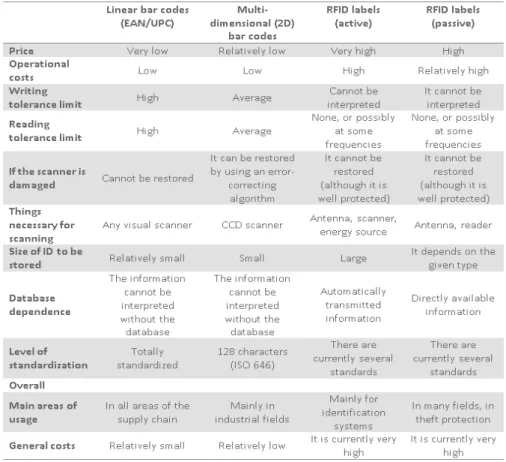
Figure 1. Comparison of identification techniques
At present the bar code systems offer the best solutions in the meat supply chain, therefore it is the most popular automatic identification technology. The problems of manual identification can easily be overcome by a relatively low investment (Fraza 2000), furthermore several checkpoints may be established. However, if the special processes of production require or the environmental factors necessitate, RFID technologies may be a viable option. Traceability operations become more efficient, although RFID needs a great investment.
In addition to the analysis of IT support and development of quality management systems in the meat industry (as refers to meat industrial product enterprises, the poultry industry is also involved), our research focused on food tracing systems, utilized identification systems and those which may become applicable in the future. We also studied information technology tools and examined the establishment of Hungarian meat industry enterprises. The basis of the present study was a survey in 2009; we aim to investigate how the above mentioned factors have changed for the last seven years.
2. Applied methods
•
What are the expectations concerning the introduced or planned quality assurance and traceability systems?•
At what levels of the product chain are traceability information stored?•
In what detail do enterprises store the traceability data required by law?•
What product identification technologies are used?•
What percent of the annual revenue do the companies spend on the maintenance of their IT system each year?•
Do the enterprises have IT systems supporting their economic activities, traceability of their products and quality control?The target group of the questionnaire survey included all the enterprises of the Hungarian meat industry which had the legal permission to operate in Hungary. The companies consisted of meat cutting factories, cold storage, processing factories, slaughterhouses, and factories producing minced/separated/prepared meat. The list of the enterprises and their contact details were provided by the Central Agricultural Office in 2009, while the latest data of the licensed companies on the website of the National Food Chain Safety Office were used for the purpose of the analysis in 2016.
In the database the enterprises are categorized on the basis of the types of animals processed and the scope of the activities of the businesses. First of all, the redundant data, as well as the incorrect or incomplete addresses were removed. The companies dealing with bivalves, frog legs and snails were not included in the analysis, as they may cause false results due to their sectorial characteristics, even if their number is very low.
The firms were contacted by post or by using their e-mail addresses, if it was available. On the basis of this, the response rate was above 21% in the case of both surveys. The questionnaire survey was basically anonymous, as there were not any notes taken which could have identified the respondents, however almost half of the companies provided their e-mails address, requesting information about the results of the survey.
Figure 2. Sectorial distribution
As far as the sectorial distribution is concerned (Figure 2), we can conclude that the firms dealing with pork processing were overrepresented (~35%), which was followed by the firms dealing with food processing (20%) and commerce (18%). Obviously, an enterprise may be involved in several areas, thus some businesses categorized themselves into more than one group. It can clearly be seen that the distributions are similar in both surveys, which reflect the sectorial distributions, thus it is a good representation of the Hungarian situation.
Most of the businesses in the survey are involved in meat processing (approximately 70%), while the proportion of the firms dealing with animal husbandry is the lowest (Figure 3). When analysing the distribution of the companies’ activities, it must be taken in account that the firms involved in animal husbandry only, did not belong to the target group of the survey. Similarly, in the case of the distributors of ready-to-eat products retailers and wholesalers were not included in the survey.
0% 10% 20% 30% 40% 50% 60% 70% 80%
15% 27%
38%
79%
20%
5% 16%
32%
68%
32% 2009 2016
Figure 3. Distribution of the companies’ activities
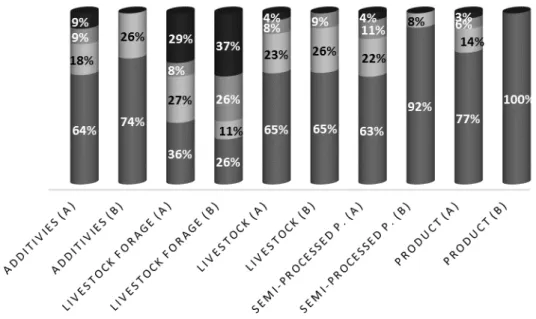
trail of their products. According to the 178/2002 directive of the European Union the direct partners of the food supply chain are required to fulfil traceability tasks. We investigated what kind of information the businesses have besides the required data concerning the complete product trail (Figure 4).
The results indicate that the biggest information gap is at the traceability of the fodder, 29% of the surveyed enterprises do not have any information about the forage of the processed animals, moreover this rate further increased to 37% by 2016.
In the case of the other ingredients the information provision is approximately at the same level, however as we are approaching the end of the supply chain, the firms possess more, and more exact information, which demonstrates a great improvement for the last seven years.
Figure 4. Traceability information supply in 2009 (A) and in 2016 (B)
According to our data the frequency of product recalls is increasing towards the end of the product chain, which is not a surprising result. On the one hand, food safety problems are most often experienced by the consumer, on the other hand the more ingredients a product has and the ore processed it is, the more probable it is that problems arise.
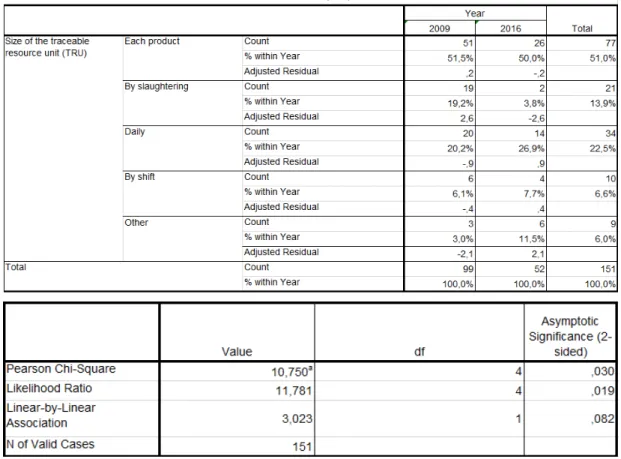
Both analyses indicate that approximately 50% of the Hungarian meat enterprises have individual traceability data, which is by far the most expensive to store, however a product recall is definitely less costly, as only the product with the problem must be recalled and not a larger quantity. According to our case studies (Table 1), the daily TRU is more typical, which ranked as the second in our analysis.
Table 1. Size of the traceable resource unit (TRU)
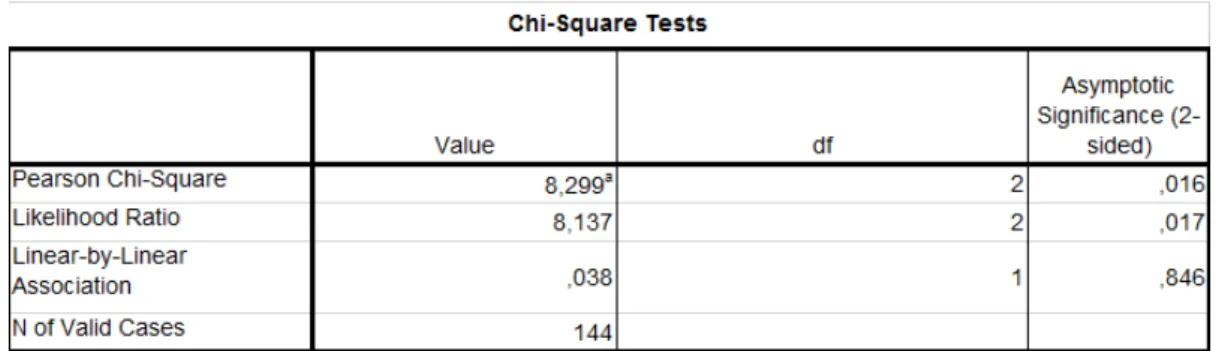
The survey of the Hungarian meat enterprises highlighted the fact that in 2009 only the firms with a large revenue could afford the ERP systems (Table 2), their proportion did not reach 28%, and the revenue of these firms was above 2 million Euros. As opposed to this, by 2016 their number grew to more than 50% of all the surveyed firms, which results from two factors. First, there were available funding resources for introducing ERP systems, which contributed to the substantial decrease of the investment and license costs. Second, the expectations of the multinational companies concerning their suppliers considerably grew, in several cases the suppliers are required to use information systems furthermore, they are expected to use the opportunities provided by EDI. The results of the survey demonstrate the proportion of the companies that use integrated systems. It can clearly be seen that the number of companies using only individual, separated systems is decreasing.
Resulting from the above mentioned data we investigated what percent of their annual revenue the companies devote to the maintenance and improvement of their IT systems, and if they plan investments in IT, what amount they are going to spend on it. In the case of the first survey some exceptional cases were found, when some companies claimed that they were willing to spend 10-20% of their annual revenue on their IT systems. However, their number was very low, and these were such extreme instances that they were neglected during the analysis. These mistakes probably arise from the incorrect completion or the misinterpretation of the questionnaire.
In 2009 the amount spent on the IT systems was approximately 0.6% of the revenue, which changed to 0.7% by 2016. The amount to be spent on the planned investments and development of the IT systems very slightly grew. The rate is extremely low, it must be emphasized that IT investments should be increased to increase the competitiveness of the sector.
Identification technologies make the traceability of a product in a product chain possible and their use is relevant during almost every phase of the product line, as it is necessary to provide for the unambiguous identification of each individual product. Most traceability initiatives rely on technologies to provide efficient, accurate ways to track and trace products and their movement across the supply chain. This includes technology for product identification, information capture, analysis, storage and transmission of data as well as overall systems integration. Such systems include hardware such as measuring/sensing equipment, identification tags and labels, with software. Technologies for identification can be groupped according to the method by which the encoded data is stored (Figure 5).
The following main groups can be distinguished:
• primary identification (based on the use of biological markers and feature extraction based upon anatomical, physiological, biochemical or molecular, including DNA, methods of identification), magnetic storage, optical storage, electronic storage,
• secondary or data carrier-based identification techniques in which a number or alphanumeric string is used for identification purposes.
In the course of our questionnaire, we also examined product identification technologies (Figure 6). Data collection using tools such as bar code and RFID is exceptionally accurate (>99%). These tools scan, record product codes, lot numbers, invoice data, order numbers, and other information in less than a second.
Figure 6. Data carriers of traceability information by Hungarian meat companies
3. Conclusion
Today various traceability systems are already in service for establishing safety in the food supply chain. In fact, many food processors had traceability systems for meeting their specific needs including management of recall mechanisms even before food safety regulations came into force. But these systems have been mostly developed as ERP-based systems, and work as standalone applications within the company itself. Since quick tracing of the origin of foods and recalling in a short time are very difficult and costly with this kind of scattered and distributed traceability systems, integrated and full traceability systems will be more efficient. The demand can only responded by using modern ERP systems, which may be able to solve the problems of today’s quality food industry problems (Cebeci et al., 2009). For the realization of expected traceability a lot of technology is available. Trends in technology development are towards smaller and cheaper devices. The challenge is to put the type of technology in place that best fits the goals set by quality management.
devices greatly help RFID technology becoming widely known.
References
Balogh, P, Bai, A, Popp, J, Huzsvai, L & Jobbágy P 2015 ‘Internet-orientated Hungarian car drivers' knowledge and attitudes towards biofuels’ Renewable and Sustainable Energy Reviews, 48, pp. 17-26.
doi: 10.1016/j.rser.2015.03.045
Balogh, P, Békési, D, Gorton, M, Popp, J & Lengyel P 2016 ‘Consumer willingness to pay for traditional food products’ Food Policy 61, pp. 176-184. doi: 10.1016/j.foodpol.2016.03.005
Cebeci, Z, Alemdar, T & Guney, I 2008 ‘Designing a Conceptual Production Focused and Learning Oriented Food Traceability System’ Proceedings of the 4th International Conference on Information and Communication Technologies in Bio and Earth Sciences, (Ed. T. Tsiligiridis), 18-20 Sep 2008, Agric. Univ. Of Athens, Greece. pp. 206-213.
Dupuy, C, Botta-Genoulaz, V & Guinet A 2005 ‘Batch dispersion model to optimize traceability in food industry’ Journal of Food Engineering, Special Issue: Operational Research and Food Logistics, v70 i3. pp. 333-339.
Fraza, V 2000 ‘Ending inventory errors in 60 days’ Modern Materials Handling, Vol. 55, No. 3, p. A11.
Gál, T, Nagy, L, Dávid, L, Vasa, L & Balogh P 2013 ‘Technology planning system as a decision support tool for dairy farms in Hungary’ Acta Polytechnica Hungarica, 10(8): pp. 231-244.
GS1 2009 http://www.gs1.org/traceability
Herdon, M, Pető, K, Botos, Sz & Várallyai, L 2014 “The Rules of ICT in Regional Development Related to the Agri-Food and Tourism Sectors” Journal of Ecoagritourism, pp 174-181.
International Trade Centre 2015 ‘Traceability in Food and Agricultural Products’ Bulettin No 91/2015 pp. 1-48.
Kim, H.M, Fox, M,S & Gruninger M 1995 ‘An Ontology of Quality for Enterpise Modeling, Enabling Technologies’ Infrastructure for Collaborative Enterprises, 1995., Proceedings of the Fourth Workshop Berkeley Springs, WV, pp. 105-116.
Schiefer, G & Zazueta, F 2003 “Information Technology for Food Security in a Global Environment” In: Schulz (ed.) Food Security and Globalization (forthcoming).
Soltész, A, Szőke, Sz & Balogh P 2013. ‘Analysis of economic risks in sow production’ Journal of Agricultural Informatics, 4(2): pp. 10-21.
Szakály, Z, Balogh, P, Jasák, H, Szabó, S & Szente, V 2014 ‘The Influence of Personal Values on the Transition towards Health-conscious Diet: a Segmentation Approach’ Journal of Food and Nutrition Research, 2(8): pp. 476-484. doi: 10.12691/jfnr-2-8-8
Pico, Y 2012 ‘Chemical Analysis of Food: Techniques and Applications’ Academic Press, San Diego, USA.