6
TACKLING THE EXPLORATION OF FOOTBALL PLAYER DISC PROFILES
Kerren L. Kollock
A thesis proposal submitted to the faculty of the University of North Carolina at Chapel Hill in partial fulfillment of the requirements for the degree of Master of Arts in the Department of
Exercise and Sport Science (Sport Administration).
Chapel Hill 2020
Approved by:
Erianne Weight
Barbara Osborne
iii ABSTRACT
Kerren L. Kollock: Tackling the Exploration of Football Player DiSC Profiles (Under the direction of Erianne Weight)
The purpose of this particular study was to examine the DiSC styles of intercollegiate
football players. This study observed the DiSC assessment results of 127 collegiate football
players, categorized into Dominance (D), influence (i), Steadiness (S), and Conscientiousness
(C). There were 127 points of data used to analyze DiSC style based on the eight different
positions as well as offense compared to defense. After completing chi-square analyses, there
were two outputs that were significantly different from the sample mean. Most notably, it was
shown that the Dominance based quarterbacks were significant. While no significance was found
between offensive and defensive units. Overall, this study adds to the literature demonstrating
iv
TABLE OF CONTENTS
LIST OF FIGURES ... vi
LIST OF TABLES ... vii
CHAPTER ONE: INTRODUCTION ... 1
Introduction ... 1
Statement of Purpose ... 2
Significance of Study ... 2
Research Questions ... 3
CHAPTER TWO: REVIEW OF LITERATURE ... 4
Assessment Tools ... 4
Assessments and Sports ... 8
DiSC Tool ... 12
Importance of Coach-Athlete Relationship ... 18
CHAPTER THREE: METHODOLOGY ... 26
Instrument ... 26
Participants ... 26
v
Grouping of Positions ... 27
Data Analysis ... 29
CHAPTER FOUR: RESULTS ... 30
CHAPTER FIVE: DISCUSSION... 34
Limitations ... 38
Recommendations for Future Research ... 38
vi
LIST OF FIGURES
vii
LIST OF TABLES
1
CHAPTER ONE: INTRODUCTION
Introduction
For many years, researchers have attempted to understand the differences among people,
by creating assessments in order to categorize these variances. These assessments, such as the
Myers Brigs Type Indicator have shown to be effective tools in the workplace, with relevance
related to training, team building, and decision making (Coe, 1992). Many studies have looked at
these assessments and have found correlations in relation to higher work performance, greater
levels of communication, or even how to create optimal teams (Bullock, 2019; Macht &
Nembhard, 2015). These assessments have been used for research outside of the workplace as
well, as many studies have been done in application to college students, and athletes at many
different levels (Drucker, 2005; Booth, 2013). Research has even shown differences between
team-sport-oriented athletes and individual-oriented athletes within the world of sports (Nia &
Besharat, 2010). Additionally, there have been a few studies completed related to athletes in
different positions, compared to their results from assessments such as the MBTI and Big Five.
(Kirkcaldy, 1982; Schurr et al., 1984).
One Division I university in the southeastern part of the United States has been using the
DiSC assessment with student-athletes, coaches, and staff for over eight years. Similar to other
assessments, after a series of questions, an individual is placed into a primary style (D, I, S, or
C). In addition to simply taking the assessment, the university also provides learning and training
2
importance of their results. Because the DiSC has not been as widely utilized as other popular
assessments, there are some gaps in the research surrounding this tool.
Statement of Purpose
The purpose of this study is to examine the DiSC styles of intercollegiate football players.
Significance of Study
Coaches have been found to be very impactful sources of personal growth and life skills
for athletes, so it is important for them to create strong relationships (Tomlinson & Yorganci,
1997). As the International Council for Coaching Excellence has shown, building relationships is
one of the most important skills for a successful coach, as the effectiveness of a coach is found to
be more than just the outcome of the games and competitions within the sport (International
Council for Coaching Excellence, 2013; Prophet, Singer, Martin & Coulter, 2017). But in order
for a coach to provide more than just athletic instruction, they need to understand the athlete’s
preferences and needs, while maintaining an awareness of their leadership and communication
tendencies (Wang, Jin, & Ramsey, 1997). Because every team, no matter the level, includes
many individuals who vary depending on personality, physical ability, and social background
(Chelladurai, 1984). A coach must have all the necessary tools in their kit in order to connect
with all their individual athletes, and truly address the needs of each one’s preferences
(Thompson, 2014). Because coaches only have a short period of time with these athletes, they
need to maintain the strength of the coach-athlete relationship, which can be done by clarifying
their communication and adjusting to the needs and tendencies of each individual athlete
(McNamara, 1980).
The importance of communication and strong individual connections in the coach-athlete
3
football players and other assessments, there haven’t been any studies done relating the DiSC
assessment and styles to specific positions within football (Greenwood, 1983). We see this as a
current gap in literature because it can potentially help to strengthen the coach-athlete
relationship and overall experience. By understanding the DiSC styles of players within positions
on a football team, after some training coaches should be able to understand how to adjust their
communication styles with individuals in those positions, in order to optimize the message being
delivered.
Research Questions
RQ1: Are there significant differences in DiSC styles by football player position based on the
following groupings:
Independent positions: quarterback, wide receiver & tight end, running back, offensive line,
kicker, defensive tackle & defensive end, linebacker, cornerback & safety.
4
CHAPTER TWO: REVIEW OF LITERATURE
Assessment Tools
By nature, human beings are both incredibly different, yet rather like each other in many
ways. For years, psychologists have developed assessments to attempt to profile, define, and
categorize humans so we can build an understanding of who we are, and how we vary. One of
the most popular ways of doing this, has been through personality, leadership, or strength-related
assessments. Merriam-Webster defines personality as “the complex set of distinctive
characteristics that distinguishes an individual” (Merriam-Webster, n.d.). Research shows that
personality is influenced by both biological and environmental factors and are relatively constant
from a very young age (Gorlow, 1957). Within this section, we will examine the most common
assessment tools and breakdowns, before we further dive into the DiSC tool used for our
research.
Myers-Briggs Type Indicator (MBTI)
One of the most widely recognized assessments is the Myers-Briggs Type Indicator
(MBTI). This full assessment includes a set of 96 questions, used to categorize an individual into
one of 16 personality types. The 16 different personality types are derived from the results of
four dimensions, which are made up of two extremes. A person falls into one of the four
extremes: Extroversion/Introversion (how energy is gained), Sensing/Intuition (how information
5
interface and organize the outside world)—and the individual is then given a code describing
their type, for example, ISTJ (Hanson, 2014).
Without a doubt, the MBTI can be a positive tool for training, team building, decision
making, and more in the workplace (Coe, 1992). Companies now have the tools and resources to
use the MBTI as a way to help members of an organization develop and promote the
appreciation of differences throughout the organization (Riceout & Richardson, 1989). The
MBTI’s validity has been sustained across different barriers, such as location and country
(Panait, Cristian & Bucinschi, 2018). It is important to note that various cultures might differ in
how they view or expect various personality types. It has been shown that managers across
multiple countries do demonstrate strong correlations to personality preferences, but those
specific preferences differ based on the actual country (Furnham, Adrian & Stringfield, 1993). In
the world of business and the workplace, some career paths might have stronger correlations
with specific MBTI preferences, such as counselors tending to be I’s and S’s (Passmore,
Holloway & Rawle-Cope, 2010). Before young adults even reach the workforce, the MBTI can
be used to determine potential differences among individuals and academic success. For
example, Ayoubi and Ustwani (2014) found that INTJ and ENFJ students achieved higher GPA
marks, and even more specifically, those leaning toward N tended to have higher grades than S’s
(Ayoubi & Ustwani, 2014). Accordingly, MBTI might help indicate what specific area of study a
young adult should pursue. As Kim and Han (2012) showed, nursing students were most
commonly ESFJ and ESTJ, and that satisfaction among students was much higher for E’s than it
was for I’s (Kim & Han, 2012). We will discuss studies which have utilized MBTI in the
athletics industry as a foundation for the current research within the assessments and sport
6 Big Five
One of the other most well-known personality categorizations is referred to as the “Big
Five”. There are many tools created which pose a series of questions to derive where on a scale
people fall within five recognized dimensions. Most commonly, the five dimensions in this
classification are: Openness (imagination and insight), Conscientiousness (thoughtful and detail
oriented), Extroversion (how energy is gained), Agreeableness (cooperation and care), and
Neuroticism (stability and emotional resiliency) (Costa & McCrae, 1995).
The Big Five can be used in relation to job performance, as conscientiousness is found to
be the strongest predictor of job performance across various cultures (Van Arde, Meiring &
Wiernik, 2017). Conscientiousness is not only a strong predictor of individual performance, but
it is also shown as a positive predictor of team-level performance in the workplace, as multiple
studies have looked at how to blend personalities to create optimal teams (Bullock, 2019;
O’Neill & Allen, 2011). Studies have looked at communication as an indicator of higher
performance, as it has been found that the higher scores of the Big five extraversion and
openness are associated with greater levels of communication, leading to a higher potential of
team performance (Macht & Nembhard, 2015). Similar to levels of communication, the Big Five
has been used in studies related to comfort with social settings, as extraversion and agreeableness
lead to a more positive experience in social settings (Wilt & Revelle, 2019). The Big Five has
been used to discover and prevent negative behaviors such as workplace deviance,
cyber-bullying, and in-person workplace bullying (Balakrishnan et al., 2019; Pletzer et al., 2019;
Wilson & Nagy, 2017). Both inside and outside of the workplace, research has shown that
7
which could potentially be related to the passion of student-athletes both on and off the field
(Dalpé, Demers, Verne-Filion & Vallerand, 2019).
CliftonStrengths
One of the newer assessments is the CliftonStrengths, formerly Clifton Strengths Finder
through Gallup. This very in-depth 1-hour assessment asks users to choose between paired
statements that best describe them over 177 questions. This assessment is used to measure talents
and natural patterns of thinking, feeling, and behaving (Rath, 2007). At the end of the
assessment, the results are categorized into the 34 CliftonStrengths themes, which can then be
broken down into four domains (Rath, 2007). A Signature Theme report is created for each user,
which expresses a deeper explanation of that individual’s top five most dominant themes.
Although CliftonStrengths is newer and more time consuming than Myers-Briggs and
Big Five association, a lot of research has been completed surrounding the assessment. In 2018,
Busch and Davis utilized the CliftonStrengths to help undergrad and graduate students develop
self-awareness and understand their personal brands, specifically to prepare for the workplace.
Drucker (2005) notes that true self-awareness is the foundation for creating a personal brand, so
this research looked to use the CliftonStrengths to discover their greatest strengths and attributes
(Drucker, 2005). After completing the CliftonStrengths, participants in Busch and Davis’ 2018
study found that students became more self-aware, and as such, 100% of graduate students and
83% of undergraduate students recommended using the assessment (Busch & Daivs, 2018).
These tools are presented in order to help the reader understand a variety of assessments
and tools that have been used in previous research. Understanding the basic concepts of these
8
athletics. At this point, the aforementioned assessment tools have been much more commonly
used than the DiSC assessment, although they are not specifically the same tool. It’s important to
see the research that has been done in relation to these tools, in order to better understand the
potential for research around DiSC and athletics.
Assessments and Sports
Since the early 1900’s, many researches have been intrigued about the differences
between elite athletes and non-athletes (Carter & Shannon, 1940; Chalfin, P., Weight, E.,
Osborne, B., Johnson, S., 2015; Shulman & Bowen, 2001). Researchers have examined the
differences of personality traits among athletes and non-athletes at both the collegiate and
professional level of sports, because studies have shown that these trait tendencies strengthen as
the competitive level increases (Booth, 2013). Research has also shown significant differences
in personality traits between competitive athletes, and individuals who don’t participate in sports
(Chalfin et al., 2015; Booth, 2013). As time progressed from the 1940’s, more and more studies
have centered around personality and the world of athletes. At the prime of introducing women’s
basketball in the 1980’s, researchers found that women’s basketball players were significantly
more tough-minded than those women who did not participate in sports. In addition to being
more tough-minded, it has been shown that athletes score higher in categories related to
leadership and sociability compared to non-athletes (Evans & Quarterman, 1983). These findings
seem intuitive, as athletes often face high-pressure situations in their sport where they have the
need to be outgoing leaders among their peers, and the success of their team depends on their
ability to communicate and be social with each other (Carter & Shannon, 1940).
Given that there is research indicating athletes’ tendencies and preferences can differ
9
examine additional potential differences within the athletes themselves. Unfortunately, there has
been limited research related to personality and specific sports, but from the studies that have
been conducted, there seems to be unique intra-sport variances worth examining further. In a
study of American football players (Greenwood, 1983), it was found that offensive players tend
to have a greater sense of anxiety control compared to defensive players (Greenwood, 1983).
In teams where positions can be broken down into attacker, defensive, and midfield
positions, Kirkcaldy (1982) found attackers tend to have a higher rating in both extraversion and
psychoticism (e.g., tough minded, dominant) compared to midfielders. His work also shows that
attackers were less emotionally stable in comparison to defensive players (Kirkcaldy, 1982).
Although this work is relevant to different sports, a lot of research has also been done revolving
around positions in American football, as there are a variety of positions. It’s been found that
both offensive and defensive “backs” have greater skills in relation to concentration and
confidence, compared to the offensive and defensive “linemen” (Cox & Yoo, 1995). Further, the
backs tend to be Js (Judging) on the MBTI category of structure, whereas the linemen tend to be
Ps (Perceiving) (Schurr et al., 1984). It might be worthy to note that if we look too far at the
micro level within positions, we won’t find much statistical significance, as shown in
Greenwood’s study. While comparing “central” and “non-central” defensive positions within a
baseball team, the only result showed that non-central players had a significantly higher sense of
responsibility compared to those in central positions (Greenwood, 1983).
It’s note-worthy to propose that trait differences between positions in a sport might not
always be self-identifiable, but rather observed tendencies by those within the group. One 2012
study suggests that personality traits may be in the eye of the beholder, which can be seen and
10
came up with many uniform descriptions for tendencies across their positions. For example,
forwards are thought to be more extraverted, while defensemen are the most emotionally stable
(as shown by Kirkcaldy), and goalies were found to be more conscientious (Cameron, Cameron,
Dithurbide & Lalonde, 2012). These types of peer-identified tendencies and characteristics might
help researchers to shape their questions and hypothesis regarding self-identified personalities of
athletes.
This type of work done by Cameron et al. (2012) informed Kim’s work of looking at
informal roles within a team (Kim et al., 2018). As with any group or team, informal roles and
inclinations are expected to emerge in response to the group’s formal structure, which is why
Kim found many results by asking teammates to peer-report about 10 different informal roles
and identities within their teams. For example, “team comedians” are more extraverted; “team
mentors” are more emotionally stable; and “non-verbal leaders” are less extraverted yet more
agreeable (Kim et al., 2018). It’s worthwhile to note that most of the population (70%) of
athletes tend to be extraverted (Schurr, Nisbet & Wallace, 1984).
Once it is determined that personality traits can differ between positions on a team, it’s
logical that researchers would want to know which of those specific characteristics and
tendencies lead to success in the actual sport. If one can predict which traits enable athletes to
perform better, they would then focus on improving those qualities, and ensure the team is
composed of the most ideal collection of athletes as possible. From a macro level, we have
learned that female basketball players are more successful when they are slightly less trusting,
especially if they have their guard up in a very fast-paced sport where things could change at any
second (Evans & Quarterman, 1983). Taking this personality-success idea a step further, Garland
11
stability, and extraversion were all significantly related to performance on the field. Although
this study related specifically to collegiate football, it’s hypothesized that those four traits could
be a prediction of greater performance in many sports (Garland & Barry, 1990). Research has
also led to us pin-pointing the exact Myers-Briggs combination (Extraversion-Sensing-Thinking)
that leads to success, as Schurr et al. (1984) showed that the combination of
Extraversion-Sensing-Thinking led to successful linemen in American football, 86% of the time (Schurr et al.,
1984). If that exact combination isn’t achievable, rest assured if a team has some
Thinking-tended players, as they were 2.04 times more likely to be successful than a Feeler in Schurr’s
study (Schurr et al., 1984).
Just as different jobs might attract different varieties of individuals, there’s the idea that
people with various tendencies might prefer a team-sport or an individual-sport. Nia and
Besharat (2010) showed that individual-sport athletes are significantly higher in the realm of
autonomy and conscientiousness, as they need to be able to make decisions and perform without
teammates nearby (Nia & Besharat, 2010). They also found that team-sport athletes tended to
score higher in relation to agreeableness and sociotropy, which is evident in their ability to
constantly communicate and come to decisions with their teammates (Nia & Besharat, 2010).
Although it was shown earlier that extraversion tends to be common in athletes, it was found that
a smaller percentage of those in an individual competition (56%) leaned toward extraversion
compared to other studies surrounding team-sports (Clitsome, Teresa & Kostrubala). Lakie
(1962) has also shown that individual-sport athletes scored higher on the “social maturity” trait
compared to other sports, as they tended to be more independent and less compulsive than
12
score higher on the “liberalism” trait, as they are more flexible and willing to assume risks
compared to individual-sport athletes (Lakie, 1962).
While this section is to serve as a review of the literature surrounding personality
assessments in sport, it’s important to note that a lot of work is still left to be done. Recently in
2013, Allen, Greenlees and Jones (2013) completed a full comprehensive review of personality
and sport research. Although they found a lot of progress has been made in relation to
personality and sport, they believe that a lot of work is still needed, and there are many gaps to
be filled (Allen, Greenlees & Jones, 2013). Among these many gaps is the suggestion for
researchers to explore personality differences in relation to issues outside of just competition and
focus on the athletes to consider the role of personality in social interactions and group
processes. Although this study will not specifically focus on personality traits, but rather DiSC
styles, it will still be a step in the right direction to fill these gaps and shed light for future
coaches, administrators, and athletes to understand and accommodate different communication
preferences.
DiSC Tool
The DiSC model of behavior was originally created by William Moulton in 1928. His
book, Emotions of Normal People, described the general differences in behavior among people
and how individuals’ behavior may change over time, or be flexible with practice (Marston,
1928). The objective of Moulton’s work was to help people understand in simple and practical
ways, how to manage their experiences, relationships, and reactions. Moulton was the first to
categorize these behavior tendencies into the four categories of D, I, S, and C. After this
13
concepts. Based on the pre-established model, Clarke created a checklist of adjectives in which
people identified the descriptors relevant to themselves (Walter, 1956). This process began being
utilized in 1956 as a way to assist in business personnel selection. About ten years after the initial
release, Walter Clarke Associates slightly modified the assessment tool, and switched from using
a simple checklist, to a system of presenting two choices, forcing the respondents to make a
decision between the two factors. In the 1970s, John Geier adapted this system to create the
DiSC assessment to be published by Inscape Publishing (Geier Learning International). Over the
years, the scale has been modified in order to continue to improve the reliability of this tool. As
of 2013, the DiSC assessment tool is at the peak of its reliability, optimizing the ability to
provide a detailed report after someone completes the typical 79-item assessment.
Once a participant completes the assessment, scores are tallied electronically. The reports
are then available for review and are often encouraged to be shared and discussed by a DiSC
facilitator in a group setting. This report allows the individual to read about their unique
behavioral style, their tendencies, needs, preferred environment, and strategies for effective
behaviors and communication (DiSC Profile). This allows people to learn about their strengths
and weaknesses, and recognize where there might be blind spots. The report also contains
information about the other styles, in addition to that of the participant, so the information can be
used for comparison, and to better understand coworkers, and teammates. By understanding the
other styles, participants can be better equipped to adapt their behaviors and modify their actions
and communication in certain settings. By understanding their own DiSC profile, an individual
can begin to recognize potential obstacles in their own lives, and ways to continue to develop
and interact with others (Ritchey & Axelrod, 2002). The DiSC assessment itself measures an
14
better grasp of their own style, and those of the people around them, participants have the ability
to learn to adapt their own responses depending on the person and situation they’re facing (DiSC
and Teambuilding). Findings have suggested that using the DiSC as a tool in the workplace has
increased communication effectiveness, by allowing individuals to understand others’
characteristics and traits, specifically related to their team or group (Lykourentzou, Antoniou,
Naudet, & Dow, 2016). The use of this DiSC tool has assisted teams in establishing a common
language between coworkers, as members continue to understand the preferences and
characteristics of their counterparts (Kerr, 2009). Studies have shown that understanding the
DiSC profiles of co-workers can lead to improved collaboration results (Lykourentzou, et al.,
2016; Stephens, 2017).
The explanation of one’s DiSC results can be described in the four categories of:
Dominance, influence, Steadiness, and Conscientiousness (Marble, 1997). Note the use a
lowercase i for influence, as over time companies could not truly trademark “DISC”, and the
lowercase i is the way to separate the current assessment tool from other assessments. It’s
important to mention that no one style is considered superior or better to the others, and in fact
it’s been shown that a balance of styles among work teams leads to lower levels of conflict, and
higher levels of satisfaction and performance on collaborative tasks (Lykourentzou, et al., 2016).
In order to better understand the tendencies and preferences of those in each category, a brief
summary is provided below. The below explanations of the four DiSC styles have been pulled
from the DiSC profile overview webpage (DiSC Profile).
Dominance
These individuals place emphasis on accomplishing results, the bottom line, and confidence.
15
• Is motivated by winning, competition and success.
• Prioritizes accepting challenges, taking action, and achieving immediate results.
• Is described as direct, demanding, forceful, strong willed, driven, determined, fast-paced,
and self-confident.
• May be limited by lack of concern for others, impatience, and open skepticism.
• Values competency, action, concrete results, personal freedom, and challenges.
influence
These individuals place emphasis on influencing or persuading others, openness, and
relationships.
A person with an i style:
• Is described as convincing, magnetic, enthusiastic, warm, trusting, and optimistic.
• Prioritizes taking action, collaboration, and expressing enthusiasm.
• Is motivated by social recognition, group activities, and relationships.
• Values coaching and counseling, freedom of expression and democratic relationships.
• May be limited by being impulsive and disorganized and having lack of follow-through.
Steadiness
These individuals place emphasis on cooperation, sincerity, and dependability.
A person with an S style:
• Is motivated by cooperation, opportunities to help, and sincere appreciation.
• Prioritizes giving support, collaborating, and maintaining stability.
16
• May be limited by being indecisive, overly accommodating, and a tendency to avoid
change.
• Values loyalty, helping others, and security.
Conscientiousness
These individuals place emphasis on quality, accuracy, and competency.
A person with a C style:
• Is motivated by opportunities to gain knowledge, show their expertise, and produce
quality work.
• Prioritizes ensuring accuracy, maintaining stability, and challenging assumptions.
• Is described as careful, cautious, systematic, diplomatic, accurate, and tactful.
• May be limited by being overcritical, overanalyzing, and isolating themselves.
• Values quality and accuracy.
The current version of the DiSC assessment provides a visual representation of an
individual’s profile. It breaks the four primary styles down into quadrants of a circle, and the
individual will have a dot where they fall on the circle. This dot could land in a large variety of
locations, which correlates with information for the participant. If it lands for example in the S
section, but near the line with the C section, that means the individual has rather strong
tendencies of both categories. If the dot is toward the outside of the circle, the individual may
need to put forth more effort in order to adapt and make adjustments, compared to someone with
a dot that is closer toward the center.
The report created for individuals provides the tools to comprehend their personal style,
17
have strategies to increase their effectiveness with each style, and an overall summary for
increasing effectiveness (Using DiSC Classic). Groups that participate in the DiSC assessment
ultimately facilitate a common language through which organizational stakeholders are able to
not only have a better understanding of themselves, but also how to interact with everyone else
on their teams and work groups on a daily basis. Participants who have completed the DiSC and
have received training note how important it is to learn how to best communicate with team
members, and understand how their own preferences might impact their ability to be adaptive to
change (Hunt, 2019). Not only has DiSC been shown to be relevant in the workplace
(Bryant-Robinson, 2016), but research has shown a relation between certain DiSC styles and levels of
adaptation and collaboration within a college course setting (Chahino, 2011).
The creation and validation of psychological assessments can prove to be difficult, mainly
because these assessments are measuring abstract qualities that can’t actually be seen or touched.
With that being said, it’s very important to look at the stability of a tool, to observe if the results
are similar over time. With tools such as the DiSC, it’s nearly impossible to have a perfect
test-retest, even if an individual’s tendencies and qualities don’t change. This is largely in relation to
the time between the multiple tests. Research has demonstrated an individual’s overall profile
generally stays similar over the years once they reach adulthood (Everything DiSC Research
Report, 2013). For student-athletes dealing with exposure to many new experiences, stressors,
and people, there’s the chance that they might experience slight shifts throughout college. Many
factors can affect how someone answers a question, such as mood, location, or sleep levels.
Therefore, in order to have the most accurate testing for stability, it’s best to test and re-test
within a short period of time. In order to demonstrate the reliability of the DiSC, the Wiley
18
between 0 and 1, with .7 being considered acceptable, and anything above .8 considered very
good. To do so, 599 participants took the DiSC assessment twice, over a two-week period
(Everything DiSC Research Report, 2013). The results for the DiSC styles ranged from .85 to
.88, all which are well over the .8 scale, representing very good stability. Therefore, the DiSC
assessment should be viewed as a highly reliable tool, which is why we can easily justify
continuing to use it for assessment (Everything DiSC Research Report, 2013).
Research has provided a solid foundation of DiSC reliability and validity, especially in
relation to the workplace. However, there are gaps in our knowledge related to DiSC styles
across positions within sports. Therefore, we pursue this research to make strides surrounding
DiSC styles for collegiate football players in order to bring more research to the world of
athletics.
Importance of Coach-Athlete Relationship
Coaching effectiveness and success are found to be more than just win-loss records
(Prophet, Singer, Martin, & Coulter, 2017). In fact, one of the six functional coaching
competencies as outlined by International Council for Coaching Excellence (2013), is “building
relationships”. With this being said, it’s crucial to look at the coach-athlete relationship as the
foundation of coaching, which enables these leaders to address the basic psychological needs of
players, while teaching the sport, and bringing together the whole team as a cohesive unit
(Newman, Kim, & Alvarez, 2018). The coach-athlete relationship is defined as a situation in
which coaches’ and athletes’ emotions, thoughts, and behaviors are mutually interconnected
(Jowett & Wylleman, 2006). When the coach-athlete relationship first begins, the coach is
19
1989). The coach immediately becomes such an important mentor in the lives of many very
impressionable student-athletes (Potts, 2002). Especially in college, the coach is responsible for
molding and motivating these young players during a time of great change, when these young
adults are at a highly sensitive point in their lives (Potts, 2002). It’s important for coaches to
nurture strong relationships, because they have been found to be important non-parent sources of
influence, with the ability to strongly impact personal growth and teach life skills (Tomlinson &
Yorganci, 1997). Once a coach takes the time and effort to develop these strong relationships
with the individual players, it is easier to create a positive team dynamic and cohesion among the
group in order to work toward success in the particular sport (Wang, Jin, & Ramsey, 1997).
Because a coach serves the role of mentor, teacher, and organizer, they have a large
power advantage, and need to be sure to act correctly as they have a power over the athlete’s
sense of safety, trust, and fulfillment of needs (Davis and Jowett, 2014). This is particularly
important for relationships between male coaches and female athletes, as the power dynamics in
these relationships are heightened even further (Tomlinson & Yorganci, 1997). If the
relationship isn’t strong, the athlete can experience great frustration, and their perception of their
skills, competence, and guidance can rapidly drop (Felton & Jowett, 2014). When athletes feel
that their coach demonstrates empathetic attention and individual understanding, they are more
motivated to trust that leader, which can ultimately lead to success (Camiré, Turgeon, Stephanie,
& Kendellen, 2019). In order to reach the optimal level of leadership and coaching effectiveness,
a coach must have a high level of awareness for the athlete’s needs, emotions, and preferences,
but also a self-awareness of their own leadership and communication tendencies (Wang et al.,
20
It has been shown that taking a servant-leader approach in a coach position can have a
very positive impact on individual motivation and team cohesion (Kim, Kim, & Won, 2018).
People with servant-leadership tendencies often show empowerment to individuals, as they
appreciate and encourage personal development, which is specific to each unique individual
(Kim, et al., 2018). As Zhang, 2004 showed, the athlete’s commitment to a coach can be
described through three facets: 1) level of acceptance of a coach’s principles, 2) the willingness
to support their coach, and 3) valuing the relationship with the coach (Zhang, 2004). These facets
can be heightened when a coach takes a servant-leadership approach, by showing commitment to
the growth and success of each player on an individual level (Kim, et al., 2018).
In addition to helping with life skills and success in the sport, a coach is also an
incredibly important member of the athlete’s social environment, with a great potential impact on
the psychological health of each athlete (Jowett, 2009). Part of this is the ability for a coach to
have a large potential impact on an athlete’s perceptions of engagement and burnout, which not
only can impact the athlete’s physical performance, but their mental stability (McGee &
DeFreese, 2019). The coach-athlete relationship (when partnered with a strong team network)
was found by to be one of the most profound protective factors against mental health symptoms
for an athlete (Armstrong and Oomen-Early, 2009).
Individual Preferences
When a student is being recruited to play a sport, they often feel they are being sought
after for their skills, abilities, and assets as an individual. However, they’re often being looked at
as a moving piece of the overall team puzzle. No matter the amount of people, whether it’s a
small tennis team, or a large football squad, there are going to be differences between every
21
personality, ethnicity, physical ability, and social background (Chelladurai, 1984). A coach’s
task is to somehow find a way to blend different individuals together into one cohesive unit and
develop the best human relation skills to understand the needs and preferences of their players,
and then be successful as a whole unit (Chelladurai, 1984). In order to foster the best possible
coach-athlete relationships, coaches must gain a deep understanding of each individual athlete,
and how that person is potentially similar, yet very different, to everyone else on the team
(Kluckhohn & Murray, 1953). It isn’t until the coach grasps this ability that an athlete will have a
strong rapport with that coach, as they feel the coach sees them as a unique person and is
sensitive to them as an individual (McNamara, 1980). The coach-athlete relationship can be
looked at very similarly to a student-teacher relationship. Just like being a student in the
classroom, student-athletes display different individual learning preferences that influence their
ability to learn techniques and plays (Thompson, 2014). Although it is not always possible to
have individual time with athletes, it’s important to note Fleming’s work, showing that
individuals should be taught and addressed in ways that complement their natural preferences
and learning tendencies in order to achieve the highest success in understanding (Fleming &
Baum, 2006). For a coach to successfully reach all of their athletes, it’s important for them to
have all of the tools in their kit to address the needs of each individual preference (Thompson,
2014).
Communication
As shown by Miller, et al. (1988), active listening skills are the most powerful techniques
used to build relationships between individuals at any level. If a coach is attempting to create a
better communication channel with their athlete, it’s important for them to clarify the message
22
attempting to explain it (McNamara, 1980). In athletics, communication breakdowns can occur
often, especially if there is a misunderstanding of what someone is trying to say, which can be
avoided if the coach takes the time to understand the individual athlete’s preferences and
tendencies (McNamara, 1980). Additionally, by having effective communication skills and
understanding everyone’s preferences, a coach will have a better chance of melding together
those differences to achieve a common goal (Anshel, 1997). By taking the time to become aware
of each athlete’s feelings, preferences, and tendencies, the coach’s communication can be much
more effective, as long as they understand that appropriate communication for certain people
might not be appropriate communication for everyone (Wang et al., 1997) It’s important to
recognize that a collegiate coach only has a short period of guaranteed time with these young
adults, and if they lack the ability to effectively communicate, the coach-athlete relationship
could easily fall apart, which could hinder the entire team’s success (McNamara, 1980).
CCC’s of Relationships
As already explained, the coach-athlete relationship is a situation where the interpersonal
feelings, thoughts, and behaviors are interdependent on both the coach and the athlete involved,
which is looked at as a dynamic state (Jowett, Yang, & Lorimer, 2012). Jowett (2006) is one of
the leading researchers in the world of the coach-athlete relationship, and has instilled the idea
that closeness, commitment, complementarity are the key elements of relationship quality within
this coach-athlete relationship (Jowett & Wylleman, 2006). Closeness relates to the feelings of
mutual trust, care, respect, and appreciation between the coach and athlete. When closeness is
heightened, both the coach and athlete feel cared for, liked, valued, and trusted (Phillips, 2017).
Closeness between a coach and athlete is such a crucial factor for engagement, that closeness is a
23
DeFreese, 2019). Commitment is the intention or dedication to maintain the highly
interdependent relationship over time, which often can span years after the athletic coach-athlete
relationship ends (Jowett et al., 2012). Complementarity then refers to the corresponding and
co-operative behaviors such as readiness, easiness, and responsiveness to each other (Jowett et al.,
2012). When complementarity is heightened, the coach and athlete accept and respect each
other’s roles and responsibilities (Phillips, 2017). It is highly believed that when an athlete feels
their relationship with their coach is underlined by trust, respect, and co-operation that they are
more likely to be satisfied with their training because they feel their coach is more attune with,
sensitive to, and knowledgeable of their individual needs (Jowett et al., 2012). This cohesion of
closeness, commitment, and complementarity can lead to not only greater athletic success, but
can also create an environment where the athlete is willing to learn teamwork, goal setting, social
skills, leadership, and problem solving from their coach (Camiré et al., 2019).
Big Five and the Coach-Athlete Relationship
In our world today, every relationship is made up of two personalities, and both partners’
personality traits jointly and uniquely shape the quality of their relationships (Robins, Caspi, &
Moffitt, 2000). This can be held true both in and outside the world of athletics. As we know,
each person’s personality traits are different and tend to contribute independently to their
perceived relationship quality (Copper, 2002). However, it has been shown that similarities in
these traits can provide a buffer against relationship distress by reducing conflict and facilitating
effective communication (Barelds & Barelds-Dijkstra, 2007). These potential links between
people’s personality and preferences have been used as a platform from which interpersonal
behaviors and interactions successfully occur and unfold (Copper, 2002). Specifically, in relation
24
relationship satisfaction (Luo & Klohnen, 2005). Even if a coach and athlete aren’t completely
similar in their tendencies, preferences, and personality styles, much research has shown that
various levels of the Big Five traits can predict relationship ease and satisfaction (Hulyaasci,
Kelecek, & Altintas, 2015). Multiple studies have found a strong positive correlation when high
levels of agreeableness were present, as athletes are more committed to the strength of their
relationship when their coach was also highly agreeable (Jackson & Beauchamp, 2010). This
heightened sense of agreeableness is directly tied to less relationship distress as well as to a more
supportive, satisfying, and non-conflictual relationship atmosphere (Cuperman & Ickes, 2009).
Similarly, a strong effect has been shown for conscientiousness in relation to the relationship
commitment: every one-point increase in an individual’s conscientiousness was directly
associated with a .34 increase in that person’s commitment to the relationship (Jackson,
Dimmock, Gucciardi, & Grove, 2011). Cuperman & Ickes (2009) also showed that higher levels
of openness led to adaptive, close, empathetic, and an overall more positive perception of the
relationship. As we’ve previously discussed, extraversion tends to run high in athletes, which is
also a strong predicter of relationship commitment and satisfaction for coaches and athletes
(Jackson et al., 2011). Extraversion leads to positive interpersonal experiences and effective
conflict resolution, with athletes viewing their relationships as positive, supportive, and trusting
(Hulyaasci et al., 2015). In contrast to the other four factors, high levels of the factor neuroticism
are associated with a negative perception of the coach-athlete relationship (Pierce, Sarason,
Sarason, Solky-Butzel, & Nagle, 1997). When one of the two individuals show high levels of
neuroticism, the relationship tends to be conflictual, dissatisfying, and stressful for both the
25
relate to both the athletic success and the success of the interpersonal relationships between the
26
CHAPTER THREE: METHODOLOGY
Instrument
In order to test the DiSC styles of football players, we utilized the Everything DiSC
Workplace and DiSC Classic by Wiley, as previously described (DiSC Profile). This typical
79-question assessment, is completed by participants complete online via a computer or cell phone.
Once the DiSC assessment is completed, the participant information is scored and the program
provides an interpretation to the participant with their preferences falling within one of the four
primary behavioral styles (Dominance, Influence, Steadiness, Conscientiousness). Although
participants are able to fall into a secondary style, only their given primary styles were utilized
for the purpose of this study.
Participants
A convenience sampling methodology was utilized for the study. Participants included
football players from the time span of 2011-2020 participating at a large public institution whose
athletes participate in NCAA the Division I Football Bowl Subdivision . All football players in
this study are males. From the years 2011-2020, there were 421 different individuals on the
football team rosters. Of this total, there were 127 who completed the DiSC assessment.
Therefore, this study will encompass almost 30% of the institution’s football player population.
Because this study is completed only with football players from a single institution, this data may
not be generalizable for college football players on a whole. The football players within this
27
some fluctuation in what each coach was looking for in different positions. As participation in
DiSC was optional over the years, it is possible those who chose to participate have a stronger
tendency for leadership, which could create a difference in DiSC styles.
Collection
The data for the nine years of collection has been stored in the online Wiley EPIC
Administrator website. In this website it is possible to search for DiSC results based on name,
date, or previously created sub-folder. Each of the 421 individuals from the rosters in the
designated years were manually searched for in the Wiley EPIC Administrator database to
determine if any of those individuals completed the assessment.
Grouping of Positions
Although there are many positions found within a football team, for the purpose of this
research, we examined nine different positions/groupings to determine any potential tendencies
related to DiSC styles. We also collectively grouped by offensive and defensive positions, but
not special teams as a whole (Kickers are included). The groupings utilized within analyses are
detailed below.
Offense
Quarterback: This is often looked to as the leader of the offense within Football, as they are the
individual who is responsible for reading the field and passing or handing off the ball to make
plays (KRT News Graphics, 2009).
Wide Receiver and Tight End: Although these two positions are not identical, they are very
28
small portion of blocking when needed. Whereas the Tight End’s job is approximately half
blocking, and half catching the ball, depending on the individual player (Hall, 2019).
Running Back (Fullback, Tailback, Halfback): Depending on where the Running Back lines up,
they can be referred to as a handful of names. However, the overall purpose of this individual is
to run the ball, and occasionally assist in blocking (Hall, 2019).
Offensive Line (Center, Guards, and Tackles): These positions are all similar, just dependent on
where they line up. Their primary role is to block the defensive players (Hall, 2019).
Kicker: This individual is responsible for kicking field goals and extra point attempts (KRT
News Graphics, 2009).
Defense
Defensive Tackle and Defensive End: These two positions are generally the same, just depending
on where the individual is lining up. They are responsible for stopping the run game, and
occasionally rushing the Quarter Back (Hall, 2019).
Linebacker: Similar to the Quarter Back on offense, this position is often looked to as a leader of
the defense, as they are responsible for seeing the entire field, and communicating to their
teammates, while stopping both the run and the pass (Hall, 2019).
Cornerback and Safety: Although not completely identical positions, these two have the
responsibility of stopping the pass game. The Cornerback is usually assigned a specific
individual to stay with, whereas the Safety has a little bit more freedom to make decisions as to
29 Data Analysis
The DiSC profiles and athlete positions were organized in an excel spreadsheet. The list
in the spreadsheet contained the position, and primary DiSC style for each individual. From
there, the data was sorted based on position. Chi-Square analyses were utilized to assess whether
there were significant differences between DiSC styles (dependent variable), and football
position (independent variable as described above) utilizing SPSS statistical software. The data
was inputted based on position (coded as 1-8) and DiSC style (coded as 1-4). Once entered into
SPSS, a 4x8 chi-square analysis was run to address research question one. Then a 4x2 chi-square
analysis was run to address research question two. In order to add a visualization of the spread of
the data, dots have been approximately placed over the DiSC circles as shown in the figures
30
CHAPTER FOUR: RESULTS
There were 127 data points used to analyze DiSC style based on the eight different
positions as well as offense compared to defense. After completing chi-square analyses, there
were two outputs that were significantly different from the sample means. Analyses by specific
research questions are explained below.
Research Question 1: Are there significant DiSC style differences based on positions among football players?
As shown in Table 1, there were varied numbers of respondents based on positions within
the overall population. The sample size for each position ranged from eight to 28 based on the
number of DiSC assessments completed through the convenience sampling. Overall, the DiSC
styles of football players significantly differend by position χ2(1, N=127) = 29.73, p = .097
utilizing an alpha of α < .10. Within post-hoc tests, two positions revealed adjusted standard
residuals greater than 1.96 which indicates greater than two standard deviations from the sample
mean equivalent to p < .05. Quarterback D’s yielded an adjusted residual of 2.4, p > .05. Within
this position, six of the eight quarterbacks were had Dominance styles, with one an i and one a C.
There was also significance uncovered within the Running Back (S) position, with an adjusted
residual of 2.1, p > .05. This emerged because 33% of Running Backs were Sensing based. This
is perhaps explained through the notion that not many of the individuals from the overall
population were S’s, so there was a greater proportion of S’s within the running back position
than in any other. Because the DiSC assessment is usually explained to participants through a
31
in Figure 1 to demonstrate the overall distribution of DiSC profiles by position. The Offensive
Line position was approaching significance, where the adjusted residual was 1.9, p > .05 for both
the D and i styles. None of the other positions yielded a prevalence of styles significantly
different than an expected distribution through the adjusted residuals, which is why there was not
an overall difference in DiSC styles based on positions across football players in this chi-square
33
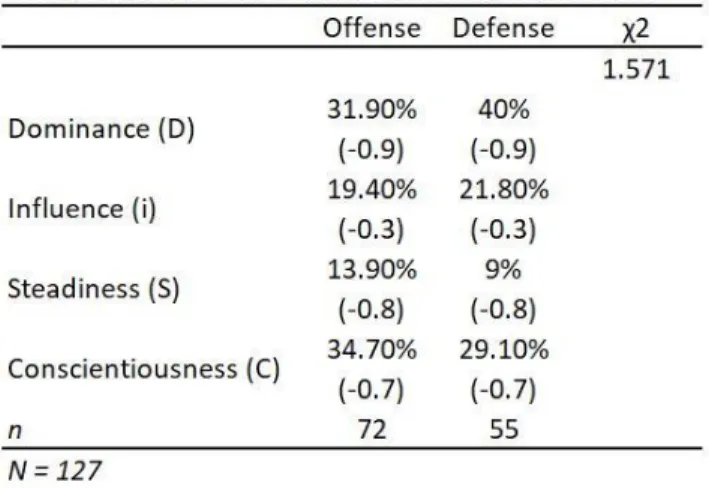
Research Question 2: Are there significant DiSC style differences between offensive and defensive football players?
As shown in Table 2, the Offensive player DiSC styles were compared to the Defensive
player DiSC styles. Analysis revealed that the DiSC styles of football players did not differ
significantly based on Offensive or Defensive positions, χ2(1, N = 127) = 1.57, p = .66. None of
the adjusted residuals for the DiSC styles were approaching significance, as all of the four styles
were similarly represented in the overall percentage of Offensive or Defensive data points.
Similar to Research Question 1, the approximate results of Offensive and Defensive DiSC styles
are visualized within the traditional DiSC circles in Figure 2 below.
34
CHAPTER FIVE: DISCUSSION
Many studies have been done over the years in relation to personality and behavioral
assessments of college students and athletes at many different levels (e.g. Drucker, 2005; Booth,
2013). As time has gone on, researchers have found interest in these assessments related to
athletes, and have even broken the assessment studies down based on positions within teams
(Nia & Besharat, 2010; Kirkcaldy, 1982; Schurr et al., 1984). The purpose of this particular
study was to examine the DiSC styles of intercollegiate football players and how those styles
may differ based on position. Within this research we sought out to answer two different
questions. First, are there significant differences based on positions among football players based
on eight different groupings: quarterback, wide receiver & tight end, running back, offensive
line, kicker, defensive tackle & defensive end, linebacker, and cornerback & safety. Secondly,
are there significant differences between offensive and defensive football players. This study is
significant because the effectiveness of the coach-athlete relationship is highly dependent on
trust and communication (Chelladurai, 1984; McNamara, 1980; Thompson, 2014), and if there
are prevalent trends in communication styles and preferences within a team, this information
could prove quite useful. This understanding could help to improve the coach-athlete relationship
based on awareness and adaption to various DiSC styles among athletes. In order to accomplish
this task, this study observed the DiSC assessment results of 127 collegiate football players,
categorized into Dominance (D), influence (i), Steadiness (S), and Conscientiousness (C). It was
35
toward one of the DiSC styles. The following section further explains the results of this study
and how these results build upon foundational literature.
Overall, this study adds to the literature demonstrating the vast heterogeneity of members
of a football team. While previous research has used assessments where athletes can be
categorized as one or another type, such as high levels of extraversion for athletes (Schurr,
Nisbet & Wallace, 1984), this study explored DiSC profiles wherein athlete data can fall all over
the DiSC circle, determined by many different factors. Someone high in extraversion, for
example, could end up anywhere across the circle.
Addressing Research Question 1, DiSC style differences based on football positions were
explored. This study shows similar parallels to previous work surrounding attackers and
midfielders. As Kirkcaldy’s (1982) study found attackers to be higher in extraversion and
psychoticism, it’s fitting the Quarterbacks show relations to the Dominance style. Typically,
those within the primary Dominance style tend to be extraverted, independent, and dominant
(DiSC Profile). Quarterbacks and attackers can relate as they are both looking to offensively
score and lead their teams to success. These results appear very fitting the further we explore the
qualities of someone in the Dominance style and a typical Quarterback. Those with the primary
D style place an emphasis on accomplishing results, the bottom line, and confidence (DiSC
Profile). They are often motivated by winning, competition, and success; while they prioritize
challenges, taking action, and achieving immediate results (DiSC Profile). These traits and skills
all align with the quarterback of a football team, as that individual is looked to as the play-maker
and leader within an offense. They need to exude the confidence and motivation to lead their
team, and very frequently see immediate results on the field related to their actions and decisions
36
football, they might naturally be inclined to pursue a quarterback position. By continuing to play
in the quarterback position, these traits could be heightened and observed during competition.
It’s important to note that there are typically very few quarterbacks on a collegiate roster, so
there’s the potential excellent quarterbacks (D or not) in high school could end up switching
positions by the time they reach collegiate football. These are some of the competencies that
football coaches automatically expect to see in their leaders and therefore it’s logical that our
results showed a strong significance for Quarterbacks be D styles. If coaches have the
understanding that a large portion of their quarterbacks are primarily D’s, they can alter their
communication to the group in order to get their point across in the most effective way possible.
To do so, they’ll need to focus on being very direct, assertively explaining the results they’re
seeking, and demonstrating the actions necessary to be successful (DiSC profile). However, it’s
important to note that individual attention might be needed for those quarterbacks who don’t
align with the majority D styles in order to best communicate and effectively present the
messaging.
It’s interesting to note that this study did not confirm significant differences between
defensive backs and lineman, as multiple previous studies found slight differences in relation to
other assessments within these positions (Cox & Yoo, 1995; Schurr et al., 1984). There is the
potential we could have seen DiSC styles approaching significance for these positions if we
would have had a greater sample size available. Our findings support the notion, rather, that there
is tremendous heterogeneity within positions and coaches need to understand individual
communication styles and preferences in order to maximize communication and motivation
37
The second research question addressed differences between offensive and defensive
players. Although some studies, such as Greenwood’s (1983) did find differences between
offensive and defensive players, the results of this study could not statistically conclude similar
findings. The lack of significant findings could be related to the sport involved, as that 1983
Greenwood study examined a baseball team, which is considerably smaller than the size of a
football team, as examined in this study. Because there are so many different positions within
both the offense and defense, it does make sense to not see significant differences in DiSC styles
between the offensive and defensive units. Both sides of the ball, whether trying to score, or
attempting to stop the opponent from scoring, would benefit from the traits within all four of the
DiSC styles.It’s perhaps a positive finding to show a mixture of DiSC styles throughout both
offense and defense, as the variety of styles could be one component of success within a large
group of people. As Lykourentzou, et. all showed in their 2016 study, the balancing of traits
could lead to higher performance on a collaborative task (Lykourentzou, et. all, 2016).
Furthermore, Kirkcaldy (1982) found that personality heterogeneity within a team may serve a
positive function related to team success (Kirkcaldy, 1982). Therefore, an offensive or defensive
unit as a whole could potentially benefit from no significant tendencies within their DiSC styles.
Because we see that offensive and defensive squads are made up of a mixture of the DiSC styles,
it’s important for a coach to understand all of the different tendencies and preferences related to
these styles. As we’ve seen in previous research, it is imperative for a coach to find ways to
blend together various individuals into a cohesive unit, while understanding the needs and
preferences of the individuals involved (Chelladurai, 1984). A coach will therefore need to tailor
and adjust their communication and motivation styles when working with an entire offensive or
38
common goal (Anshel, 1997). Once a coach grasps how to foster these relationships through
communication skills, it is then that the trust and comfort will be heightened, increasing the
potential for success (Newman, Kim, & Alvarez, 2018).
Limitations
The ability to generalize these results is limited by many factors. Because a convenience
sample was taken specifically from one university for one sports team, the sample size was not
as large as would ideally be used for this research. The choice to use a convenience sample was
constrained to one school in regard to a lack of a budget or access to DiSC reports from other
institutions. The ability to have a large and more evenly spread out sample size for each position
would have enhanced the results of this study. A greater amount of data could have potentially
made a difference with the findings that were approaching significance, and could perhaps lead
to showing true significance. If this study was expanded to a greater sample size across multiple
teams, there’s the potential that more significant findings could be explored.
Recommendations for Future Research
Due to the explained limitations of this study, there are many potential paths for future
research. This study could be replicated with a greater sample size. It could also be replicated
using individuals from multiple institutions, instead of just one. Researchers could continue to
explore many other sports, such as: men and women’s soccer, field hockey, lacrosse, basketball,
volleyball, fencing, and more. It could also be done to include the styles of coaches for each
position, in order to create additional dialogue surrounding the hope of strengthening the
coach-athlete relationship. Furthermore, studies could be done regarding captains or official leaders’
39
been done specifically related to DiSC styles for collegiate athletes, there are many gaps that can
be filled in the future. The basis of this research was to help enhance and improve the
coach-athlete relationship through the observation of DiSC styles related to position. All of the
previously mentioned future studies could still aim to achieve the same goal. It is highly
suggested to use these studies to foster conversations and improve relationships between coaches
40
REFERENCES
Allen, M. S., & Laborde, S. J. P. (2014) The role of personality in sport and physical activity.
Current Directions in Psychological Science, 23 (6), 460 - 465.
Anshel, MH (1997). Sport Psychology From Theory To Practice. Scottsdale, AZ; Gorsuch Scansbruck Publishers.
Armstrong, S., & Oomen-Early, J. (2009). Social connectedness, self-esteem, and depression symptomatology among collegiate athletes versus nonathletes. Journal of American College Health, 57, 521-526.
Ayoubi, R. and Ustwani, B. (2014), "The relationship between student's MBTI, preferences and academic performance at a Syrian university", Education + Training, Vol. 56 No. 1, pp. 78-90.
Balakrishnan, V., Khan, S., Fernandez, T., & Arabnia, H. R. (2019). Cyberbullying detection on twitter using Big Five and Dark Triad features. Personality and Individual
Differences, 141, 252–257.
Barelds, D. P. H., & Barelds-Dijkstra, P. (2007). Love at first sight or friends first? Ties among partner personality trait similarity, relationship onset, relationship quality, and
love. Journal of Social and Personal Relationships, 24(4), 479–496.
Booth, E.G. “Personality Traits of Athletes as Measured by the MMPI.” Research Quarterly. American Association for Health, Physical Education, and Recreation, vol. 29, no. 2, Mar. 2013.
Brocato, R. (2003). Coaching for Improvement: An Essential Role for Team Leaders and Managers. The Journal for Quality and Participation, 26(1), 17-22.
Bryant-Robinson, L. (2016). Leaders' personality profiles and employee engagement in a high growth multilevel marketing company.
Bullock, K. T. (2019). Examining the associations between collaboration and nonprofit
managers’ personality types. Dissertation Abstracts International Section A: Humanities and Social Sciences. ProQuest Information & Learning.
Busch, P. S., & Davis, S. W. (2018). Inside Out Personal Branding (IOPB): Using Gallup Clifton StrengthsFinder 2.0 and 360Reach. Marketing Education Review, 28(3), 187–202.
Cameron, J. E., Cameron, J. M., Dithurbide, L., & Lalonde, R. N. (2012). Personality Traits and Stereotypes Associated with Ice Hockey Positions. Journal of Sport Behavior, 35(2), 109–124.
Camiré, M., Rathwell, S., Turgeon, Stéphanie, & Kendellen, K. (2019). Coach–athlete