Volume 71 (2015)
Graph Computation Models
Selected Revised Papers from GCM 2014
Distributed execution of bigraphical reactive systems
Alessio Mansutti, Marino Miculan Marco Peressotti
21 pages
Guest Editors: Rachid Echahed, Annegret Habel, Mohamed Mosbah Managing Editors: Tiziana Margaria, Julia Padberg, Gabriele Taentzer
Distributed execution of bigraphical reactive systems
Alessio Mansutti, Marino Miculan†Marco Peressotti‡
Laboratory of Models and Applications of Distributed Systems Department of Mathematics and Computer Science, University of Udine, Italy
Abstract: The bigraph embeddingproblem is crucial for many results and tools about bigraphs and bigraphical reactive systems (BRS). Current algorithms for com-puting bigraphical embeddings arecentralized, i.e. designed to run locally with a complete view of the guest and host bigraphs. In order to deal with large bigraphs, and to parallelize reactions, we present adecentralized algorithm, which distributes both state and computation over several concurrent processes. This allows for dis-tributed, parallel simulations where non-interfering reactions can be carried out con-currently; nevertheless, even in the worst case the complexity of this distributed algorithm is no worse than that of a centralized algorithm.
Keywords: Concurrent and distributed graph transformations, Models of graph transformation, Formal graph languages, Multi-agent systems.
1
Introduction
Bigraphical Reactive Systems(BRSs) [JM03,Mil09] are a flexible and expressive meta-model for ubiquitous computation. In the last decade, BRSs have been successfully applied to the formalization of a wide range of domain-specific calculi and models, from traditional program-ming languages to process calculi for concurrency and mobility, from business processes to systems biology; a non exhaustive list is [BDE+06,BGH+08,BGM09,DHK12,MMP14a]. Re-cently, BRSs have found a promising applications instructure-aware agent-based computing:
the knowledge about the (physical) world where the agents operate (e.g., drones, robots, etc.) can be conveniently represented by means of BRSs [PKSS13,SP14]. BRSs are appealing also because they provide a range of general results and tools, which can be readily instantiated with the specific model under scrutiny: simulation tools, systematic construction of compositional bisimulations [JM03], graphical editors [FPH13], general model checkers [PDH12], modular composition [PDH11], stochastic extensions [KMT08], etc.
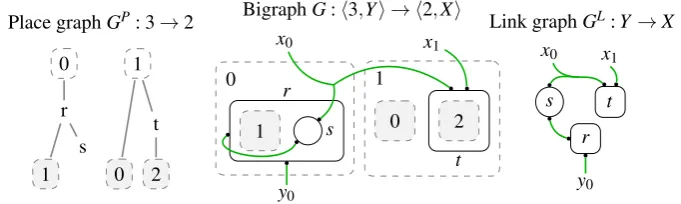
This expressive power stems from the rich structure of bigraphs, which are the states of a bigraphic reactive system. A bigraph is a compositional data structure describing at once both the locations and the connections of (possibly nested) system components. To this end, bigraphs combine two independent graphical structures over the same set ofnodes: a hierarchy ofplaces, and a hypergraph oflinks. Intuitively, places represent (physical) positions of agents, while links represent logical connections between agents. A simple example is shown in Figure1.
0
1 s
r 1
0 2
t
x0 x1
y0
BigraphG:h3,Yi → h2,Xi
0 1
0
1 2
r
t s
Place graphGP: 3→2
r
s t
x0 x1
y0
Link graphGL:Y →X
Figure 1: Forming a bigraph from a place graph and a link graph.
Current bigraph Available embeddings
Execution policies
Embedding engine Reaction engine
State
Figure 2: The open cycle of an abstract bigraphical machine.
rule’sredexand replace it with the correspondingreactum. Thus, BRSs can be run (or simulated) by the abstract machine depicted in Figure2. This machine is composed by two main modules: theembedding engineand thereaction engine. The former keeps track of available redex em-beddings into the bigraph in the current machine state; the latter is responsible of carrying out the reactions, in two steps: (a)choosing an occurrence of a redex among those provided by the embedding engine and(b)updating the machine state by performing the chosen rewriting.
The choice of which reaction to perform is driven by user-provided execution policies. A possible simple policy is the random selection of any available reactions, while in [MMP14a] execution policies are based on agent beliefs, intentions and goals. Execution policies are outside the scope of this paper, and we refer the reader to [Per13] for other examples. Here we mention LibBig, an extensible library for bigraphical reactive systems (available athttp://mads.uniud.it) which offers easily customizable execution policies in the form of cost-based embeddings where costs are defined at the component level viaattached properties.
Therefore, computing bigraph embeddings (i.e., finding the occurrences of a bigraph, called
Bigraph chunk
Available embeddings Execution
policies
Embedding engine Reaction
engine
Local state
Bigraph chunk
Available embeddings
Execution policies
Embedding engine Reaction
engine
Local state
transaction
suggest/retract
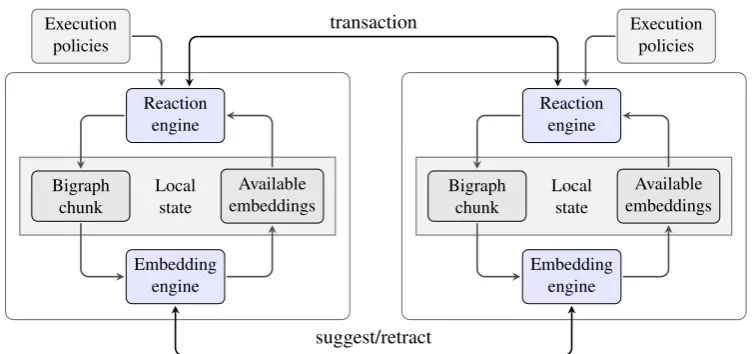
Figure 3: D-BAM: Distributed bigraphical abstract machine.
In this paper, we aim to overcome these problems, by introducing an algorithm for computing bigraphical embeddings in distributed settings where bigraphs are spread across several coop-erating processes. This decentralized algorithm does not require a complete view of the host bigraph, but retains the fundamental property of (eventually) computing every possible embed-ding for the given host. Thanks to the distributed nature of the algorithm, this solution can scale to bigraphs that cannot fit into the memory of a single process, hence too large to be handled by existing implementations. Moreover, the algorithm is parallelized: several (non-interfering) reductions can be identified and applied at once. In this paper we consider distributed host bi-graphs only since guest bibi-graphs are usually redexes of parametric reaction rules and hence small enough to be handled even in presence of scarce computational resources.
This algorithm is the core of a decentralized version of the abstract bigraphical machine illus-trated above. The architecture of this newdistributed bigraphical (abstract) machine(D-BAM) is in Figure3. Both computation and states are distributed over a family of processes. Each process has only a partial view of the global state and negotiates updates to its piece of the global bigraph with its “neighbouring processes”. We assume reliable asynchronous point-to-point communication between reliable processes; this is a mild assumptions for a distributed system and can be easily achieved e.g. over unreliable channels.
This work extends and improves [MMP14b] in several ways. First, we introduce a new com-pact representation of partial embeddings, reducing both network and memory footprint of the distributed embedding algorithm; secondly, messages are routed across the overlay network only to processes that can benefit from their content (in [MMP14b] messages were forwarded to the entire neighbourhood). Moreover, we discuss some other heuristics and partition strategies.
Synopsis In Section 2 we briefly recall bigraphical reactive systems and bigraph embeddings. In Section 3 we introduce the notion of partial bigraph embedding and the weaker notion of
2
Bigraphs and their embeddings
In this section we briefly recall the notion of bigraphs, Bigraphical Reactive Systems (BRS), and bigraph embedding; for more detail we refer to [Mil09].
2.1 Bigraphical signatures and bigraphs
The idea at the core of BRSs is that agents may interact in a reconfigurable space, even if they are spatially separated. This means that two agents may be adjacent in two ways: they may be at the sameplace, or they may be connected by alink. Hence, the state of the system is represented by abigraph, i.e., a data structure combining two independent graphical structures over the same set ofnodes: a hierarchy ofplaces, and a hyper-graph oflinks. An example can be found in Figure1. Each node belongs exactly to one place, presents an ordered sets of “link endpoints” calledports, and is decorated with a “type”, calledcontrol, drawn from a given set calledsignature.
Definition 1(Signature [Mil09, Def. 1.1]) A (bigraphical)signatureΣis a set whose elements
are kinds of nodes calledcontrolseach associated with a natural number calledarity.
Following the traditional approach to bigraphs we present their substructures first and then formalize bigraphs as their composition.
Definition 2 (Place graph [Mil09, Def. 2.1]) A place graphGover a given signatureΣis an
object(VG,ctrlG,prntG):nG→mGwherenGandmGare finite ordinals whose elements are called
sitesandrootsrespectively,VGis a finite set ofnodeseach assigned a control by the control map
ctrlG:VG→Σ; roots, nodes and sites are organised, by theparent mapprntG:VG]nG→VG]mG, into a forest such that elements ofnGoccur as leaves and elements ofmGare precisely all roots. Roots and sites form the outer and innerinterfaces, respectively.
Definition 3(Link graph [Mil09, Def. 2.2]) A link graphGover a given signatureΣis an object (VG,EG,ctrlG,linkG):XG→YGwhere then inner and outer interfaces,XGandYG, are finite sets whose elements are calledinner namesandouter names, respectively;EGis a finite set disjoint fromYGwhose elements are callededges;VGis a finite set ofnodeseach assigned as manyports as the arity of its control; Ports, inner names, edges and outer names are organised, by thelink maplinkG:PG]XG→EG]YG, into an hyper-graph whose hyper-edges are preciselyEG]YG.
Then, a bigraph is just given by a place and a link graph sharing nodes and control maps.
Definition 4(Bigraph [Mil09, Def. 2.3]) Abigraph GoverΣis an object
(VG,EG,ctrlG,prntG,linkG):hnG,XGi → hmG,YGi
composed by two substructures (cf. Figure1): a place graphGP= (VG,ctrlG,prntG):nG→mG and a link graphGL= (VG,EG,ctrlG,linkG):XG→YGsharing their nodes.
Example1 (Ambient Calculus: signature) The signatureΣAC for Ambient Calculus is:
ΣAC={amb: 1,in: 1,out: 1,open: 1}
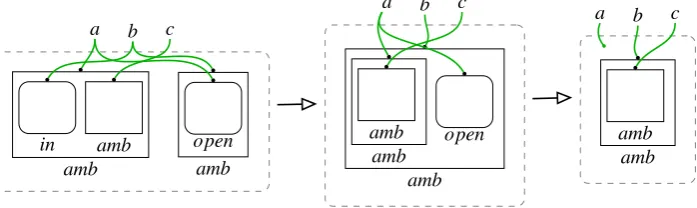
Ambients are encoded as nodes with control amb, whereas nodes labeled with in, out, open represent the three main operations of Ambient Calculus. Since each control is unary, each node has one port that is used to univocally identify ambients and the operations associated with them. For example, the first bigraph in Figure5 represents the term a[in(b).0|c]|b[open(a).0], where the process0is defined as the empty bigraph with typeh0,/0i → h1,/0i.
2.2 Bigraphical Reactive Systems
The dynamic behaviour of a system is described in terms ofreactionsof the forma_a0 where
a,a0are agents, i.e. bigraphs with inner interfaceh0,/0i. Reactions are defined by means of graph rewrite rules, which are pairs of bigraphs(RL,RR)equipped with a functionηfrom the sites of
RRto those ofRLcalledinstantiation rule.
A rule fires when its redex can be embedded into the agent; then, the matched part is replaced by the reactum and the parameters (i.e. the substructures determined by the redex sites) are instantiated accordingly withη.
Definition 5(Bigraphical Reactive System (BRS)) A bigraphical reactive systemBG(Σ,R)is defined by a signatureΣand a setR of rewrite rules. LetAg(Σ)be the set of all agents over the
signatureΣ. A BRSBG(Σ,R)can be seen as a function that, given an agentA∈Ag(Σ)returns
the smallest set closed underRthat containsA– that is, every agents reachable fromAthrough
R– and each reaction between agents of this set.
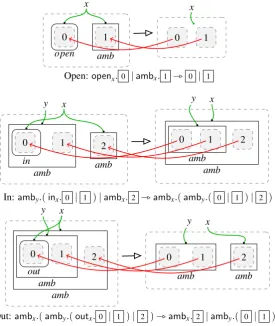
Example2 (Ambient Calculus: reaction rules) Figure4shows a bigraphical encoding of the three reaction rules (in, out andopen) of the Ambient Calculus. For each rule, its redex and reactum are the bigraphs on the left and on the right respectively and the instantiation rule is drawn in red. LetBG(ΣAC,RAC)be the BRS defined from the signature of Example1and the
rewrite rules of Figure4. As an example, Figure5shows two consecutive reactions that simulate the dynamics of Ambient Calculus: using the rules of Figure4, from the initial state(leftmost bigraph in the figure) the ambient namedamoves inside the ambientb (Inrule). Afterwards, the ambientbcan access the ambient namedcby openingawith theOpenrule. Since no more reactions can occur from the three states of Figure5, these states and reactions represent the application ofBG(ΣAC,RAC)on theinitial state.
2.3 Bigraph embeddings
0
open 1
amb x
0 1
x
Open:openx. 0 |ambx.1 _ 0 | 1
0
in
1
amb
2
amb x
y
0 1
amb
2
amb x y
In:amby.(inx.0 | 1 )|ambx.2 _ambx.(amby.( 0 | 1 )| 2 )
0 1
out amb
2
amb x y
0 1
amb
2
amb x
y
Out:ambx.(amby.(outx.0 | 1 )| 2 )_ambx.2 |amby.( 0 | 1 )
Figure 4:RAC: Bigraphical reaction rules foropen,inandoutrules of Ambient Calculus.
Link graph Intuitively an embedding of link graphs is a structure preserving map from one link graph (the guest) to another (the host). As one would expect from a graph embedding, this map contains a pair of injections: one for the nodes and one for the edges (i.e., a support translation). The remaining of the embedding map specifies how names of the inner and outer interfaces should be mapped into the host link graph. Outer names can be mapped to any link; here injectivity is not required since a context can alias outer names. Dually, inner names can mapped to hyper-edges linking sets of points in the host link graph and such that every point is contained in at most one of these sets.
Definition 6(Link graph embedding [Høj12, Def 7.5.1]) LetG:XG→YGandH:XH→YH be two concrete link graphs. Alink graph embeddingφ:G His a mapφ,φv]φe]φi]φo (assigning nodes, edges, inner and outer names respectively) subject to the following conditions:
(LGE-1) φv:VGVHandφe:EGEHare injective;
in amb amb
open amb b
a c
amb open amb
amb b
a c
amb amb b
a c
Figure 5: Application of reaction rules.
(LGE-4) img(φe)∩img(φo) =/0 andimg(φport)∩S
img(φi) =/0; (LGE-5) φp◦link−G1
EG=link −1 H ◦φe; (LGE-6) ctrlG=ctrlH◦φv;
(LGE-7) ∀p∈XG]PG:∀p0∈(φp)(p):(φh◦linkG)(p) =linkh(p0)
whereφp,φi]φport,φh,φe]φoandφport:PGPHisφport(v,i),(φv(v),i)).
The first three conditions are on the single sub-maps of the embedding. Condition(LGE-4) ensures that no components (except for outer names) are identified; condition(LGE-5)imposes that points connected by the image of an edge are all covered. Finally, (LGE-6)and(LGE-7) ensure that the guest structure is preserved i.e. node controls and point linkings are preserved.
Place graph Like link graph embeddings, place graph embeddings are just a structure pre-serving injective map from nodes along with suitable maps for the inner and outer interfaces. In particular, a site is mapped to the set of sites and nodes that are “put under it” and a root is mapped to the host root or node that is “put over it” splitting the host place graphs in three parts: the guest image, the context and the parameter (which are above and below the guest image).
Definition 7(Place graph embedding [Høj12, Def 7.5.4]) LetG:nG→mGandH:nH→mH be two concrete place graphs. Aplace graph embeddingφ:G H is a mapφ,φv]φs]φr (assigning nodes, sites and regions respectively) subject to the following conditions:
(PGE-1) φv:VGVHis injective;
(PGE-2) φs:nG℘(nH]VH)is fully injective; (PGE-3) φr:mG→VH]mH in an arbitrary map; (PGE-4) img(φv)∩img(φr) =/0 andimg(φv)∩S
img(φs) =/0; (PGE-5) ∀r∈mG:∀s∈nG:prnt∗H◦φr(r)∩φs(s) =/0;
(PGE-6) φc◦prnt−G1
VG =prnt −1 H ◦φv; (PGE-7) ctrlG=ctrlH◦φv;
(PGE-8) ∀c∈nG]VG:∀c0∈φc(c):(φf◦prntG)(c) =prntH(c0); whereprnt∗H(c) =S
Conditions in the above definition follows the structure of Definition6, the main notable dif-ference is(PGE-5)which states that the image of a root cannot be the descendant of the image of another. Conditions(PGE-1),(PGE-2)and(PGE-3)are on the three sub-maps composing the embedding; conditions(PGE-4) and(PGE-5) ensure that no components are identified; (PGE-6)imposes surjectivity on children and the last two conditions require the guest structure to be preserved by the embedding map.
Bigraph Finally, bigraph embeddings can now be defined as maps being composed by an embedding for the link graph with one for the place graph consistently with the interplay of these two substructures. In particular, the interplay is captured by a single additional condition ensuring that points in the image of an inner name reside in the parameter defined by the place graph embedding (i.e. are inner names or ports of some node under a site image).
Definition 8 (Bigraph embedding [Høj12, Def 7.5.14]) LetG:hnG,XGi → hmG,YGi andH: hnH,XHi → hmH,YHibe two concrete bigraphs. Abigraph embeddingφ:G His a map given by a place graph embeddingφP:GP HPand a link graph embeddingφL:GL HLsubject to the consistency condition:
(BGE-1) img(φi)⊆XH] {(v,i)∈PH| ∃s∈nG:k∈N:prntkH(v)∈φs(s)}.
3
Partial and candidate partial bigraph embeddings
In this Section we introduce the notion ofpartial bigraph embeddings. We show that for a given pair of guest and host bigraphs, the set of their partial embeddings is endowed with an “almost atomic” meet-semilattice. This structure will play a central rˆole in the algorithm presented in Section5. We then consider also the situation when we know only a part of the codomain of a partial embedding, by introducing the notion ofcandidate partial embedding.
3.1 Partial bigraph embeddings
Basically, a partial bigraph embedding is a partial map subject to the same conditions of a total embedding (Definition8) up-to partiality.
Definition 9 (Partial bigraph embedding) Let G:hnG,XGi → hmG,YGi and H :hnH,XHi → hmH,YHi be two concrete bigraphs. Apartial bigraph embedding φ :G H is a partial map subject, where defined, to the same conditions of Definition8.
As we will see in Section 5, partial embeddings represent the partial or intermediate steps towards a total embedding. This notion of “approximation” is reflected by the obvious ordering given by the point-wise lifting of the anti-chain order to partial maps. In particular, given two partial embeddingsφ,ψ:G Hwe say that:
This definition extends, for any given pair of concrete bigraphsGandH, to a partial order over the set of partial bigraph embeddings ofGintoH. It is easy to check that the entirely undefined embedding∅is the bottom of this structure and that meets are always defined:
φuψ,λx. (
φ(x) ifφ(x) =ψ(x) ⊥ otherwise
Likewise, joins, where they exist, are defined as follows:
φtψ,λx.
φ(x) ifφ(x)6=⊥ ψ(x) ifψ(x)6=⊥ ⊥ otherwise
Clearlyφ andψ have to coincide where are both defined and their joinφtψ is defined iff it does not violate any condition in Definition9.
The set of partial embeddings for a given guest Gand host H is ameet-semilattice. More-over, an embedding can be represented as the join of a finite set of “basic” elementary partial embeddings, i.e. suitable elements fromG×H. This suggests to use these elementary partial embeddings as a compact representation for (partial) embeddings. Although elementary par-tial embeddings may remindatomic elements in meet-semilattices, they are not really atomic. In fact, a partial embedding whose domain contains a site (or an inner name) has to map it to the emptyset in order to be minimal (and hence an atom); for this reason, a partial embedding mapping a site to something different than /0 could not be described as the join of atoms.
This observation leads us to introduce the following definition.
Definition 10((Almost) atomic partial embedding) A partial embeddingα :G His said to be(almost) atomicwhenever the following implication holds true:
ψ@α =⇒ ψ=∅∨ ∃!s∈nG]XG.ψ(s) =/0.
The set of atoms below a partial embeddingφ is calledbase ofφ and is denoted asAt(φ). The set of all atomic partial embeddings ofGintoHis denoted asAtG,H(we shall drop the subscripts when confusion seems unlikely).
Proposition 1(Base) Letφ:G H be a partial embedding. There exists a minimal and finite
family At(φ)of (almost) atomic partial embeddings whose join isφ.
Proof. LetAt(φ)be the set of (almost) atomic partial embeddings given by the following union:
φ
u
u∈nG]XG =⇒ φ(u) =/0 ∪ {u7→ {w} |u∈nG]XG∧w∈φ(u)}. ThenF
At(φ) =φandFS@φfor anyS⊂At(φ).
3.2 Candidate partial embeddings
The notion of candidate partial embedding is accessory to the decentralized algorithm we presents in Section5. In fact, families of partial embeddings are sent over the network as graphs whose vertexes are atoms and whose edges represents admissible joins. Joins are not transitive and some of the conditions of bigraph embeddings cannot be checked by only looking at pairs of atoms and their immediate neighbourhood, as we show in Theorem1and Theorem2.
Before we present this result let us rephrase(LGE-5)and(PGE-6)in a more convenient (but equivalent) form, that points out the conditions failing to be “locally verifiable”.
(LGE-5a) ∀e∈EG∀x∈PG]XG(x∈link−G1(e) ⇐⇒ φp(x)⊆link −1
H (φe(e))) (LGE-5b) ∀e∈EG∀y∈link−H1(φe(e))∃x∈PG]XG(y∈φp(x))
(PGE-6a) ∀v∈VG∀s∈nG]VG(s∈prntG−1(v) ⇐⇒ φc(s)⊆prnt−H1(φe(v))) (PGE-6b) ∀v∈VG∀y∈prnt−H1(φv(v))∃s∈nG]VG(y∈φc(s))
Theorem 1 Letρ :G→H be a candidate embedding and letα1, . . . ,αnthe atoms forming it. ρ:G→H satisfies conditions(LGE-1-5a,6,7)and(PGE-1-4,6a,7,8)if, and only if,
(a) ∀iαisatisfies(LGE-3),(LGE-6),(PGE-3), and(PGE-7);
(b) ∀i,j s.t. the candidateαitαj satisfies(LGE-1,2,4,5a,7)and(PGE-1,2,4,6a,8);
and each check involves at most the components of H adjacent to the image ofαi andαj.
Proof (Sketch). Obviouslythe above conditions can be falsified by providing at most two atoms and that the negated formula of each condition involves at most one step alongprntH orlinkH. As an example we detail the case of(LGE-5a)leaving the others to the reader. Ifρ does not satisfy(LGE-5a), then there aree∈EGandx∈PG]XGsuch that:
(x∈link−G1(e)∧ρp(x)6⊆link−H1(ρe(e)))∨(x6∈link−G1(e)∧ρp(x)⊆link−H1(ρe(e))) (†) Let ¯e∈EG and ¯x∈PG]XG two witnesses of (†) and consider the atomic partial embeddings α1=ρ
¯ e
andα2=ρ ¯ x
. Clearlyα1,α2vρ and either ¯x∈link−G1(e¯)∧α2(x)¯ 6∈linkH−1(α1(e)¯ )or ¯
x6∈link−G1(e¯)∧α2(x)¯ ∈link−H1(α1(e)¯ ).
Theorem 2 Verifying whether a candidate satisfies conditions (BGE-1), (LGE-5b), (PGE-5)
and(PGE-6b)may require more than two atoms or the neighbourhood of their images.
Proof (Sketch). Conditions(PGE-5)and(BGE-1)contain the transitive closure ofprntH. Con-ditions(LGE-5b)and(PGE-6b)contain existential and universal quantifications at once.
Definition 11 Conditions(LGE-1-5a,6,7)and(PGE-1-4,6a,7,8) are called locally checkable, and the candidates satisfying them are calledlocally checked. Conditions(PGE-5)and(BGE-1) are calledancestor checkable, and the candidates satisfying them are calledancestor checked.
4
State, overlay and reactions
partition of the global system state defines asemantic overlay network. The rˆole of this network is crucial for the embedding algorithm since communication will follow this structure. Finally, we describe how reactions are carried out concurrently and consistently.
In the following, letProcdenote the family of processes forming the distributed bigraphical machine under definition and letH be a generic concrete bigraph (VH,EH,ctrlH,prntH,linkH): hnH,XHi → hmH,YHiover a given signatureΣ.
4.1 State partition
Intuitively, a partition of the shared stateHis a map assigning each component of the bigraphH
to the process in charge of maintaining it.
Definition 12(State partition) A partition of (the shared state)HoverProcis a mapP:H→
Procassigning each component ofHto some process. In particular,Pis given by the (sub)maps Pv,Pe,Ps,Pr,Pi, andPoon vertices, edges, sites, roots, inner names, and outer names respec-tively. Every component ofHin the pre-image of a process is said to beheld byorlocal tothat process. Ports are mapped into the process holding their node i.e.P((v,i)),P(v).
State partitions define a notion of locality or ownership for bigraphs distributed across the given family of processes by a partition. This notion extends directly to embeddings.
Definition 13(Local partial embedding) Letφ:G Hbe a partial embedding and letP:H→
Procbe a partition. Theownersofφare the processes inimg(P◦φ). Ifφ has exactly one owner then it is said to belocalto it. We denote the restriction ofφto the portion of bigraph held by a set of processesS⊆Procasφ
P,S; we shall drop the partitionPwhen confusion seems unlikely. Given a processQ, every partial embeddingψvφ
P,{Q}is local toQ–except for the undefined embedding∅since the setimg(P◦∅)will always be empty. Therefore, the set of atoms
At
φ{
Q}
,nα ∈At
αvφ
{
Q} o
below the restriction ofφ toQcan be thought as thesupport ofφ local to Q; any change in the bigraph held byQthat affects one of these atoms will necessarily invalidateφ. This observation is at the hearth of the retraction phase of the embedding algorithm (cf. Section5).
The notion of adjacency for bigraph components lifts to the family of processes along the given partition map. Here hyper-edges of the link graph are considered as treeswithout internal nodeswhere the root is the hyper-edge handle (i.e. an edge or an outer name) and leaves are all the points (i.e. ports or inner names) it connects.
Definition 14 LetQ,R∈Proc. The processQis said to beadjacent (w.r.t. the partitionP) to
Rwhenever one of the following holds:
(ADJ-P) there exists a node, port or sitecs.t.P(c) =QandP(prntH(c)) =R; (ADJ-L) there exists a pointps.t.P(p) =QandP(linkH(p)) =R;
A partial embeddingφ is said to be adjacent to a processR(w.r.t.P) iff its image is. Adjacency ofQorφtoRw.r.t.Pis denoted byQ◦→P Randφ◦→P Rrespectively (with the option to dropP when no confusion may arise).
The adjacency relation defines a directed graph with vertices in Procand hence a directed
overlay networkNP. This network carries a specific semantic meaning because it reflects adja-cency of the bigraphical elements held by each process forming the network: two processes are adjacent if, and only if, they hold components that are adjacent in the distributed bigraphH. The networkNPis such that shortest paths connecting processes in it cannot exceed in length shortest paths between the components ofHthey hold.
Lemma 1 Let c1,c2∈H. The length of shortest path inNP connectingP(c1) andP(c2) is limited by the length of the shortest path in H connecting c1and c2.
Proof (sketch). Definition14characterizes the quotient induced byPonH.
The last observation is crucial to our purposes sinceitrelates routing through the overlayNP with walks and visits ofHused e.g. to compute embeddings intoH in non-distributed settings. Notice that the restriction ofNP toimg(P) will always be connected i.e. for any two processes inimg(P)thereare(at least) two paths starting from them and ending in the same node. This ensures that there is always a “rendezvous” point for two messages (and in particular two par-tial embeddings to be combined). Connectedness is ensured by(ADJ-T) but this condition is sufficient and can be relaxed by assuming the adjacency relation to contain a directed-complete partial order (dCPO) onimg(P). Note that each process is aware to its neighbouring processes and the nature of their adjacency because each process knows parents, children, etc. of each component it hold.
Remark 1 In [MMP14b] we considered, for the sake of simplicity, an undirected graph as overlay network. However, the additional information of a directed overlay network allows for more efficient routing strategies hence reducing duplicated computations of partial embeddings (cf. Section5). In fact, edge direction reflects the structure of the bigraph and can be leveraged also by partition strategies to distribute the bigraph privileging locality of reactions.
Example3 (Multi-Agent Systems) In [MMP14a] we described how BRS can be used to both design and prototype multi-agent systems (MAS). In loc. cit. BRS are used to model the appli-cation domain lending helpful formal verifiappli-cation tools (e.g. model checkers) to the designer as long as simulation ones. Then entities forming each bigraph are divided as subjectsandobjects
accordingly to their rˆole in the model (e.g. node controls); with the former being the agents in the systems. When agents are identified with processes of a D-BAM this yield a prototype of the system where agent cooperation and reconfiguration correspond to negotiation of execution strategies and reactions respectively.
4.2 Distributed reactions
Letφbe an embedding ofGinto the bigraphHdistributed across the processes in the system and letr:G_G0 be a parametric rewriting rule for the given BRS. Processes holding elements of
G’s image throughφor its parameters have to negotiate the firing ofrand coordinate the update of their state. The negotiation phase is related to the specific execution policy and hence is left out from the present work (see [MMP14a,Per13] for an example). The update phase involves a distributed transactionandis handled by established algorithms liketwo-phase-commit[Coo82]. Each process concurrently enacts two roles: one active and one passive. In the first case:
(1a)it selects a reaction (e.g.-rewriting rule, edit script) and a suitable embedding among those provided by its embedding engine;(1b)starts a transaction with all the processes involved in the embedding (i.e.img(P◦φ));(1c)waits for them to either approve or reject the reaction and com-pletes the transaction protocol accordingly. In the second case:(2a)it waits for other processes to propose a reaction;(2b)votes for acceptance or rejection (execution strategy);(2c)executes the reaction iff each other participant agrees on committing the transaction. Note that consistency of the current bigraph is guaranteed by the correctness of the distributed transaction protocol, even in presence of outdated embeddings or concurrent transactions.
In [MMP14a] reactions correspond to agent reconfigurations. These may result in agent cre-ation or termincre-ation requiring alife-cyclefor processes of the D-BAM too–since the latter are identified with the former. Although we assumed a fixed family of processes, to simplify the ex-position, the D-BAM supports churns that are contextual to reactions, especially when partitions are implicitly adapted by partition strategies of the like of [MMP14a].
5
Distributed embedding
In this Section we introduce a decentralized algorithm for computing bigraphical embeddings in the distributed settings outlined in Section4and Figure3. Intuitively, each process running this algorithm maintains a private collection of partial embeddings for the guests it has to look for and cooperates with its neighbouring processes to complete or refute them.
For the sake of simplicity we assume that all processes are given the same set of guests (e.g. the redexes of parametric rewriting rules defining the BRS being executed by the D-BAM), that this set is fixed over the time and does not contain the empty bigraph. However, these mild assumptions can be dropped with minor changes to the algorithm. Likewise, we assume causally ordered communication and refer the reader to [MMP14b] for a version of the algorithm where message causality and group communication are explicitly implemented on reliable point-to-point channels by means suitable logical clocks (i.e. internal counters that every process attach to the information it generates).
5.1 Computing and updating partial embedding
Event handleronRetract(G, RA, RE)
(A,E)←ΓQ,G
(A0,E0)←(A\RA,E\RE) ifA6=A0∨E6=E0then
ΓQ,G←(A0,E0)
removeEmbeddings(RA∪ {αtα0|{α,α0} ∈RE}) send retracthG,RA,REito{P|Q◦→P}
end
(Note that overlay network NP is implicitly and consistently updated during each distributed transaction wrapping a reaction.) On the other side, the module provides a collection of avail-able embeddingsi.e. a partial view of all the embeddings computed by the machine. This defines the output of the module. Although processes often have an incomplete view, the algorithm guarantees that each embedding is computed by at least one of them.
Reactions may invalidate embeddings which then have to be collected by this module. Each embedding engine operates on its local collection of available embeddings by means of two procedures:addEmbedding(φ)andremoveEmbeddings(Ψ)where the second removes all
embeddingsφs.t.ψvφfor someψ∈Ψ. High consistency of available embeddings collections
is not mandatory (reactions are consistent) allowing us to trade some of it for performance and adopt an asynchronous garbage collection scheme for sweeping invalidated embeddings.
An embedding may be owned by more than one process forcing their execution engines to exchange information in order to compute/invalidate it. The data being exchanged consists of suggestions or retractions of partial embeddings and is conveyed by two kind of messages:
suggestandretract. The former kind push newly discovered partial embeddings to other processes and the latter propagate invalidations. For efficiency reasons, partial embeddings are sent in batches encoded as irreflexive undirected graphs (calledatom graphs) whose nodes are the atoms composing them (cf. Proposition1) and whose edges are checkable joins in the sense of Theorem1. Atom graphs implicitly describe candidates but, by Theorem2embeddings can-not be singled out without looking at more than two atoms or their images; information that is available at suitable stages of the algorithm only.
The same encoding is used by each process to store the set of (candidate) partial embeddings forming its partial view of those existing in the system. To simplify the exposition we assume this structure as indexed over the set of guests (hence duplicating information relative to their overlaps). We shall denote this structure byΓQ,G, whereQis the owning process andGis the guest bigraph, and drop the subscripts when clear from the context. Each processQimplicitly keeps track of which processes it received an atom from; this set will be denoted assrcQ(α).
Writes on ΓQ,G are triggered by Q receiving retract orsuggest messages. The two events are handled byonRetract and onSuggest respectively. Retractions remove from
ΓQ,Gall invalidated atoms and edges–note that these are collections, not an actual graph. If any change is made the informationispropagated to the neighbourhood ofQand to the collection of available embeddings resulting in the removal of embeddings incoherent with the current bigraph
Event handleronSuggest(G, A0, E0)
(A,E)←ΓQ,G
A00←A∪A0
E00←E∪E0∪{{α,α0} |αtα0∈AFA0islocally checkedandancestor checked} ifA6=A00∨E6=E00then
ΓQ,G←(A00,E00)
forφ∈getCandidateEmbeddings(A”, E”)do ifφsatisfies(LGE-5b)and(PGE-6b)then
addEmbedding(φ)
end end
send suggesthG,A0,E0ito{P|Q◦→P} end
Event handleronUpdate()
forG∈Guestsdo (A,E)←ΓQ,G
(A0,E0)←getLocalAtoms(G)
RA← {α∈A\A0|img(P◦α) ={Q}}
RE← {{α1,α2} ∈E|α1∈A∩A0∧(α2∈A∩A0 =⇒ {α1,α2}∈/E0)}
send retracthG,RA,REito self waitOverlayUpdate()
send suggesthG,A0\A,E0\Eito self
end
the message payloadE0or computed byQfrom its view of the bigraph (recall that every process knows parents, children, etc. of every component it holds). Whenever changes to ΓQ,G are made, these are propagated to the process neighbourhood. Contextually, candidate embeddings (i.e. cliques inΓQ,Gwhose atoms coverGwith their domains) are checked to single out any new embedding to be added to the collection of available ones. Alllocallyandancestorcheckable conditions are encoded as edges leaving (LGE-5b) and (PGE-6b) to be checked right before executingaddEmbedding. Ancestor checkable conditions require some extra care since the transitive closure of the place graph is involved. In general, processes have only a partial view of
prnt∗H but this is sufficient under mild conditions on how atoms for roots, sites and inner names ofGarerouted. In fact, if this kind of atoms travel alongprntH then, theleast ancestorof their images (cf. Lemma3) can check(PGE-5) and(BGE-1)by knowing the source of the message containing them (besides its atom graph and the one in the message).
The mechanism offered byonRetractandonSuggestis also used by the event handler
atoms local toQ. The new graph can be computed applying the algorithm described in [MP14] (with minor adaptations to restrict the solution to atomic partial embeddings only). Then, the graph is compared toΓQ,G (note thatΓQ,Gmay contain also atoms local to other processes) to find atoms and edges that have to be added or removed. Changes are passed toonRetract
andonSuggest. Note that propagation of retracts to processes involved in the update has to be completed before any change to the overlay network is applied (i.e. between transaction commit approval and finalization) since this allows retracts to be dispatched along the same route of the atoms they are collecting. Concurrent reaction may still prevent every invalidated atom to be collected by this mechanism, however consistency of the machine state is still preserved by reactions being wrapped by distributed transaction. Another viable approach is offered by remote references and leasing times: atoms whose leasing is not renewed are considered retracted and automatically removed from the system. However, more messages would be exchanged in order to periodically renew leasing times.
5.2 Enhancements and heuristics
Routing To simplify the presentation of the algorithm suggestions and retractions are sent indistinctly to the entire neighbourhood resulting in part of them being discarded by receivers. In particular, candidates that are not adjacent to a receiver are always discarded since the receiving process cannot contribute to or benefit from them in any way.
Therefore, atom graphs have to parted and dispatched only to thoseprocessesadjacent to the candidates they describe. Formally, an atom graph is adjacent to a process whenever it can be covered by cliques each containing an atom adjacent to the process.
Definition 15 An atom graph(A,E)is said to beadjacentto a processQif, and only if, there exists a family of cliques{(A1,E1), . . . ,(Ak,Ek)}such that: (a)(A,E) =
S
i(Ai,Ei);(b)there is α∈Ais.t.α◦→Qfor each 1≤i≤k;(c)for eachα ∈A, ifdom(α)∈mG]nGthenα ◦→Q.
Adjacency based routing is handled at the communication level, like causal ordering of mes-sages. which sends to each recipient of a multicast send only the greatest sub-graph adjacent to it. Henceforth, we assume messages to be parted and dispatched following this routing protocol.
Isomorphisms The network footprint of the algorithm suffers from combinatorics due to in-ternal isomorphisms of guest and host bigraphs (cf. Section5.4). Here we suggest an heuristic aimed to mitigate the impact of this phenomenon.
Consider the relation on atomic partial embeddings defined, for any twoα,β ∈AtG,H, as:
α≡β ⇐⇒4 α∼=β and∀γ∈AtG,H\ {α,β}αtγ ⇐⇒ βtγ
5.3 Adequacy
Reactions change the current bigraph and can be though of resetting the embedding engine with the latter then checking and updating its state coherently. Reworded, reactions are perturbations the embedding engine has to stabilize from and restoring the equilibrium produces traffic over the network. Traffic stops only when the equilibrium is reached i.e. the machine stabilizes.
Theorem 3(Completeness) When the system is stable, every embedding can be found in the collection of available embeddings of some process.
By causally ordered communication we can assume, w.l.o.g., that the system stabilized before the last reaction. Then completeness is equivalent to the fact that for eachφ :G H there is someQs.t.φ∈(ΓQ,G)?where(ΓQ,G)?is the set of partial embeddings whose atoms are inΓQ,G Lemma 2 Ifφ is a partial embedding for G then there is a process Q s.t.φ∈(ΓQ,G)?.
Proof. The proof is given by induction on the size of{Q1, . . . ,Qk}=img(P◦φ). Ifk=1 then the embedding is local toQ1 and henceφ ∈(ΓQ,G)?. Otherwise, letφi=φ
{Q
i} for 1≤i≤k.
By inductive hypothesis eachφi∈(ΓQi,G)
?. By connectedness hypothesis there is at least one process Qreachable by each Qi. Messages are routed to all, and only, the processes that can benefit from or contribute to them, in particular toQ. All edges that are locally checked and ancestor checked are added while messages travel the network. We only have to prove that there is always a process that can add each edge along the paths toQ. By Theorem1, the only cases left are ancestor checkable. We conclude by Definition15and by Corollary1.
Lemma 3 Let r∈mG, s∈nG,α :r7→u,α0:s7→ {u0}two atoms, and v,v0be the roots above
u and u0respectively. If Q is the process to receive/computeα andα0earlier then at least one of the following is true:
(a) Q holds the least ancestor of u and u0; (b) Q holds both v and v0;
(c) Q holds either v or v0and the process holding the other sent the embedding.
Let i∈XG,(u00,p)∈VH,1≤p≤ar◦ctrlH(u00), andα00:i7→ {(u00,p)}. There is a process Q that
holds u0and an ancestor of u00.
Proof (Sketch). Atoms for guest sites and roots are dispatched followingprntH only. Atoms for host ports are dispatched following bothprntHandlinkH.
Corollary 1 (Ancestor checks) For any two ancestor checkable atoms involving host ports, guest roots or sites there is a process that computes their edge before the system stabilizes.
Theorem 4(Soundness) If the system stabilizes then each embedding in the collection of avail-able ones is valid w.r.t. the current bigraph.
Proof. Effects of reactions are computed locally to each embedding engine and then propagated through the network. Propagation stops as soon as it stops producing changes in eachΓ. By
network connectedness and stabilization of the machine each invalid embedding is eventually computed and removed byonRetract. Embeddings are added only byonSuggest which filters out candidate and partial embeddings.
5.4 Complexity
The arity of the set of all embeddings ofGintoHis inO(|G||H|)since, in the worst case, guest and host encode two finite sets with a root for each element. On the other hand, by Proposi-tion1, the same set is described by families inAtG,Hor, following the representation used by the algorithm, by a suitable graph onAtG,H. Because elements of AtG,H are essentially pairs from
G×Hthe spatial complexity of the graph representation is inO(|G|2· |H|2)without any partic-ular encoding. The same bound holds for the size of each message sent on the overlay network. However, a process sends over the network only nodes and edges it adds or removes from hisΓG and messages are dispatched on the base of their semantic adjacency. Therefore, between two reactions, every edge travels a link at most once (either inside a suggest or retract message).
Lemma 4 The number of links inNPis inO(|H|).
Proof. The numberL of links in NP is bounded by the size of H since the NP is a quotient ofH. Hence, the worst case network isNIwhereI:HProcis the finest possible partition (i.e each component is assigned a distinct process). Except for the clique induced by roots and handles,NIis a directed acyclic graph where each vertex has at most 1+maxv∈VH(ar◦ctrlH)(v) outgoing edges and therefore is bounded by the maximal aritykoccurring in the given signature
Σwhich is a fixed parameter of the D-BAM, hence a constant. The remaining case is given by
the clique of roots and handles; their outgoing degree may exceedk but their topology can be easily reorganized to into a tree that satisfies the bound and the above reasoning. Therefore,Lis bounded by the number of components ofH.
The algorithm generates, in theworst case scenario, as much traffic as a centralized one in its
best case scenario.
Theorem 5 The traffic generated overNPwhile finding all embedding, between two reactions, is inO(|G|2· |H|3).
This scenario corresponds to bigraphs and partitions forcing information to be traverse all the network. In fact, the algorithm sends atoms only to processes that can effectively benefit from it and hence their propagation is stopped as soon as possible while retaining correctness and completeness.
6
Conclusions and future work
In this paper we have presented a D-BAM, an abstract machine for executing BRSs in a dis-tributed environment. The core novelty of this machine is an algorithm for computing bigraph embeddings in a distributed environment where the host bigraph is spread across several coop-erating peers. Differently from existing algorithms [GDBH07,MP14,SUC10], this one is com-pletely decentralized and does not to have a complete view of the global state in any process in the system; hence it can scale to handle bigraphs too large to reside on a single process/machine. In the line of the usual analysis of distributed algorithms, the complexity of our algorithm is rendered by the number and the size of exchanged messages (i.e., thenetwork footprint). On one hand, the number of messages needed for computing an embedding is linearly bounded by the size of the embedded bigraph (which usually is constant during execution) and the depth of the parent map of the host. The worst case (Theorem5) is when the overlay network of processes is a list, and atoms have to traverse it entirely. This case happens for bigraphs and embeddings that can be seen as “pathological” in the context of BRS; this suggests to consider different encodings of the model into the BRS in order to improve locality of reactions. On the other hand, the size of messages depends on internal isomorphisms in the guest and host bigraphs: these symmetries yield a combinatorial explosion of the possible embeddings, leading to larger messages to be exchanged between processes. This is mitigated by the heuristics presented in Section5.2. A possible future work is to perform a formal analysis of locality and isomorphisms and their impact in the context of smoothed complexity.
When a reaction is applied, it alters the distributed state possibly invalidating some of the par-tial embeddings computed by each process. Consistency of the state is guaranteed by reactions being wrapped inside distributed transactions, but invalidated embeddings are an unnecessary burden. To this end, we used a retraction mechanisms which can be seen as a form of asyn-chronous distributed garbage collection; moreover, embeddings that are not affected by a reac-tion are not recomputed. We think that this approach is a good trade-off between performance and consistency. An alternative solution is to collect invalidated embeddings during the reaction commit phase; this offers the highest consistency (the set of available embeddings will never contain invalid ones) at the cost of slower reactions. On the other extreme, invalidated embed-dings can be collected only when an inconsistency is found by some process. Reactions are as fast as in presence of asynchronous retractions but process data structures are heavily polluted by invalid embeddings resulting in a higher rate of aborted transactions i.e. failed reactions.
An interesting feature of the bigraphical framework is that, we can calculate the minimal contexts(called IPOs) needed to complete a given bigraph in order to match a redex. Leveraging this property, a different, “semi-distributed” implementation of the bigraphical abstract machine has been proposed in [MMP14a]. According to this algorithm, a process willing to perform a rewrite has to(1)collect a (suitable) view of the host bigraph from its neighbour processes;
(2)compute locally all the embeddings (i.e. all possible reactions for the given rewriting rule);
A direct application of the distributed embedding algorithm is to simulate, or execute, multi-agent systems. In [MMP14a] the authors propose a methodology for designing and prototyping multi-agent systems with BRSs. Intuitively, the application domain is modelled by a BRS and entities in its states are divided as “subjects” and “objects” depending on their ability to actively perform actions. Subjects are precisely the agents of the system and reactions are reconfigura-tions. This observation yields a coherent way to partition and distribute a bigraph among the agents, which can be assimilated to the processes of the distributed bigraphical machine (exe-cution policies are defined by agents desires and goals). Therefore, these agents can find and perform bigraph rewritings in a truly concurrent, distributed fashion, by using the distributed embedding algorithm presented in this paper.
Finally, we observe that the performance of the algorithm (and hence of the D-BAM) depends on how the bigraph is partitioned and distributed. An extreme situation is when relatively small guests require the cooperation of several processes, say nearly one for each component of the guest. It would be interesting to study the relation between guests, partitions, and performance in order to develop efficient distribution strategies. Moreover, structured partitions lend themselves to ad-hoc heuristics and optimizations. As an example, the way bigraphs are distributed among agents in [MMP14a] takes into account of their interactions and reconfigurations.
Acknowledgements: We thank Edel Sherratt, the GCM’14 participants and reviewers for their fruitful observations and discussions on the workshop version of this paper. This work is partially supported by MIUR PRIN project 2010LHT4KM,CINA.
Bibliography
[BDE+06] L. Birkedal, S. Debois, E. Elsborg, T. Hildebrandt, H. Niss. Bigraphical Models of Context-Aware Systems. In Aceto and Ing´olfsd´ottir (eds.),Proc. FoSSaCS. Lecture Notes in Computer Science 3921, pp. 187–201. Springer, 2006.
[BGH+08] M. Bundgaard, A. J. Glenstrup, T. T. Hildebrandt, E. Højsgaard, H. Niss. Formal-izing Higher-Order Mobile Embedded Business Processes with Binding Bigraphs. In Lea and Zavattaro (eds.), Proc. COORDINATION. Lecture Notes in Computer Science 5052, pp. 83–99. Springer, 2008.
[BGM09] G. Bacci, D. Grohmann, M. Miculan. Bigraphical models for protein and membrane interactions. In Ciobanu (ed.),Proc. MeCBIC. EPTCS 11, pp. 3–18. 2009.
[BMR14] G. Bacci, M. Miculan, R. Rizzi. Finding a forest in a tree. InProc. TGC. Lecture Notes in Computer Science. Springer, 2014.
[CG98] L. Cardelli, A. D. Gordon. Mobile Ambients. InProc. FOSSACS ’98. Pp. 140–155. Springer, 1998.
[DHK12] T. C. Damgaard, E. Højsgaard, J. Krivine. Formal Cellular Machinery.Electronic Notes in Theoretical Computer Science284:55–74, 2012.
[FPH13] A. J. Faithfull, G. Perrone, T. T. Hildebrandt. BigRed: A Development Environment for Bigraphs.ECEASST 61, 2013.
[GDBH07] A. Glenstrup, T. Damgaard, L. Birkedal, E. Højsgaard. An Implementation of Bi-graph Matching.IT University of Copenhagen, 2007.
[Høj12] E. Højsgaard.Bigraphical Languages and their Simulation. PhD thesis, IT Univer-sity of Copenhagen, 2012.
[JM03] O. H. Jensen, R. Milner. Bigraphs and transitions. In Aiken and Morrisett (eds.),
POPL. Pp. 38–49. ACM, 2003.
[KMT08] J. Krivine, R. Milner, A. Troina. Stochastic Bigraphs. In Proc. MFPS. Electronic Notes in Theoretical Computer Science 218, pp. 73–96. 2008.
[Mil09] R. Milner.The Space and Motion of Communicating Agents. CUP, 2009.
[MMP14a] A. Mansutti, M. Miculan, M. Peressotti. Multi-agent systems design and prototyping with bigraphical reactive systems. In Magoutis and Pietzuch (eds.), Proc. DAIS. Lecture Notes in Computer Science 8460, pp. 201–208. Springer, 2014.
[MMP14b] A. Mansutti, M. Miculan, M. Peressotti. Towards distributed bigraphical reactive systems. In Echahed et al. (eds.),Proc. GCM’14. P. 45. 2014. Workshop version.
[MP14] M. Miculan, M. Peressotti. A CSP implementation of the bigraph embedding prob-lem. In Hildebrandt (ed.),Proc. MeMo. 2014.
[PDH11] G. Perrone, S. Debois, T. T. Hildebrandt. Bigraphical Refinement. In Derrick et al. (eds.),Proc. REFINE. EPTCS 55, pp. 20–36. 2011.
[PDH12] G. Perrone, S. Debois, T. T. Hildebrandt. A model checker for Bigraphs. In Os-sowski and Lecca (eds.),Proc. SAC. Pp. 1320–1325. ACM, 2012.
[Per13] G. Perrone.Domain-Specific Modelling Languages in Bigraphs. PhD thesis, IT Uni-versity of Copenhagen, 2013.
[PKSS13] E. Pereira, C. M. Kirsch, J. B. de Sousa, R. Sengupta. BigActors: a model for structure-aware computation. In Lu et al. (eds.),ICCPS. Pp. 199–208. ACM, 2013.
[Roz97] G. Rozenberg (ed.).Handbook of graph grammars and computing by graph trans-formation. Volume 1. World Scientific, River Edge, NJ, USA, 1997.
[SP14] M. Sevegnani, E. Pereira. Towards a Bigraphical Encoding of Actors. In Hildebrandt (ed.),Proc. MeMo. 2014.