THE NEWSPAPER INTERNSHIP GAME: HOW TO BE A WINNER
Caroline K. Hauser
A thesis submitted to the faculty of the University of North Carolina at Chapel Hill in partial fulfillment of the requirements for the degree of Master of Arts in the School of Journalism and Mass Communication.
Chapel Hill 2006
ABSTRACT
CAROLINE K. HAUSER: The Newspaper Internship Game: How To Be A Winner (Under the direction of Professor Jan Yopp)
Students, educators and journalism professionals agree that internships are the surest route to post-graduation employment in the newspaper industry. The three groups dedicate significant amounts of time and money to ensuring appropriate internship placements, but frustration persists on all sides.
Using the newsgathering method outlined by Yopp and McAdams in 2003, this nontraditional thesis examines several structural factors of newspaper internships.
iii
CONTENTS
Page
LIST OF FIGURES ... v
LIST OF TABLES ...vi
Chapter I INTRODUCTION ... 1
II LITERATURE REVIEW... 3
Experiential Education ... 3
Internships ... 5
Newspaper Internships ... 7
Research Questions ... 10
III METHOD ... 11
Reporting Method ... 11
Participants ... 11
Analysis ... 12
Medium ... 13
Reflexivity ... 13
Strengths... 14
IV THE BROAD MIX OF NEWSPAPER INTERNSHIPS... 16
Supply and Demand ... 17
The Diversity Factor ... 20
Expensive Experience ... 23
V THE FIRST ASSIGNMENT: WHERE TO GO FOR INFORMATION... 28
VI DEADLINE PRESSURE: APPLYING EARLY AND OFTEN ... 32
VII INTERNSHIP PHILOSOPHIES: THE DISCONNECT IN EXPECTATIONS ... 35
VIII CONCLUSION: REMEDIES FOR IMPROVEMENT... 39
APPENDICIES... 49
v
LIST OF FIGURES
Figure Page
LIST OF TABLES
Table Page
CHAPTER I
INTRODUCTION
Every fall, hundreds of students apply for newspaper internships for the following
summer. Every winter, the 1,500 daily newspapers in this country choose anywhere from
zero to 24 students to work as interns. Every summer, some of these matches delight and
some disappoint both employers and employees. What’s the solution to the internship
equation that allows the best experience for both sides? Are there specific aspects that
determine what will make or break an internship?
The purpose of this thesis is to examine the newspaper internship experience. The
subject is complex. Professional journalists, educators, and students all know that internships
are a crucial component of a new graduate’s résumé, but all internship experiences are not
created equal. Some internships don’t pay, some pay $350 per week, and some pay $925 per
week. Some newspapers assign mentors to their interns; others introduce students to their
assigning editors, who then send them out the door to find a story. Some offer enrichment
programs, such as brown bag lunches, guest speakers, and field trips, while others
incorporate no educational programs.
On the other hand, some interns have years of experience from college publications
and previous internships, while others have trouble talking to strangers. Some have a
command of spelling and grammar, while others don’t know what the Associated Press is, let
chronically late to work. Some launch national internship searches that include dozens of
newspapers, while some never even apply outside their home state because they can’t afford
to pay rent in two places for three months.
This thesis does not reveal which newspapers have the best internship programs or
what types of students are destined to fail in their summer work. Rather, it examines the three
areas of potential trouble for newspaper internships: the application and hiring process,
logistical factors related to the internship, and the internship itself. A broad look at the
experiences of students, educators, and internship coordinators could help all the players
CHAPTER II
LITERATURE REVIEW
Donald Trump did not invent the apprenticeship. Thinkers in ancient Greece fretted
about whole person education and the interplay between learning and working. By the
Middle Ages, craft guilds had established a system of apprenticeship under which youths
could learn a trade from a master craftsman. The apprentice got the training he needed to
make a living; in return, the craftsman got cheap labor. In the 1800s, U.S. ideals gave rise to
pragmatism, a school of thought that links theoretical significance to real world application.
Prominent pragmatist John Dewey further developed the philosophy, laying the theoretical
foundation for the modern internship.
Experiential Education
In his pedagogic creed, Dewey announced, “I believe that the only true education
comes through the stimulation of the child’s powers by the demands of the social situations
in which he finds himself.” He elaborated, “I believe accordingly that the primary basis of
education is in the child's powers at work along the same general constructive lines as those
which have brought civilization into being. I believe that the only way to make the child
conscious of his social heritage is to enable him to perform those fundamental types of
activity which make civilization what it is” (Dewey, 1897/2005). Under this model, the
formal education process becomes something of an apprenticeship for citizenship. Dewey’s
education (Scannell and Simpson, 1996). Scannell and Simpson (1996) posit this definition
of experiential learning:
Simply stated, experiential education provides the opportunity and the environment for students to experience first-hand, outside the classroom, activities and functions which relate directly to the application of knowledge. (14)
This application of theoretical knowledge became increasingly important as professional
training, including science, medicine, and law, proliferated in colleges and universities
(Stanton and Ali, 1982).
Experiential education is not limited, however, to application. Ciofalo (1992) argues
that students actually acquire knowledge through experiential education and that experience
is the precursor to rather than the derivative of theory. In both the mental work (acquisition
of knowledge, comprehension, application, analysis, synthesis, and evaluation) and the social
work (the definition, creation, use, and transformation of knowledge, as well as the taking on
of responsibility and complex expectations) it requires, experiential education can “spark
forms of learning that are fully as developed, sound, and rigorous as anything encountered in
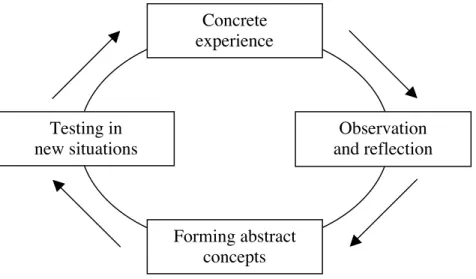
classrooms” (Moore, 1992, 19). Kolb (1984) developed a model, depicted below, for
5
Testing in new situations
Forming abstract concepts
Observation and reflection Concrete
experience
Figure 1. Kolb’s experiential education model
Experiential education takes many forms in secondary and post-secondary education.
These include but are not limited to internships, cooperative education, service learning, field
work, volunteer work, externships, shadowing programs, apprenticeships, and work-study
programs (Green, 1997). For this thesis, the experiential learning model in question is the
internship.
Internships
Dewey’s pedagogy notwithstanding, the evolution of American internships “has been
determined more by socioeconomic-political issues than by consideration of educational
objectives” (Wentz & Ford, 1984). The working definition of “internship” for this paper
comes from Stanton and Ali (1982):
[An internship is] any experience wherein students learn by taking on
responsible roles as workers in organizations and observing and reflecting on what happens while they are there. (1)
Hellweg and Flacione (1985) list five goals of student internships: (1) to acquire first-hand
knowledge about the field of work; (2) to explore new professional activities and
experience the problems and successes of efficiently and effectively communicating within a
complex organization; and (5) to learn by doing. This educational and reflective aspect is
what sets an internship apart from traditional summer jobs such as waiting tables or tearing
movie tickets. Expected outcomes of internships include increased self-esteem, acquisition of
particular skills and knowledge, and exposure to real-world career options. But the fluid
nature of experiential education may make these outcomes a challenge to achieve. Stanton
and Ali (1992) point out:
Internships are delicate balances between putting out through work and service and taking in through the learning derived from such experiences. If the work or service element seriously outweighs learning in an internship, the experience may become boring and repetitive and lose its educational value. If learning seriously outweighs working or serving, the internship may lose its unique participatory element and resemble a “field trip” rather than an experiential learning experience. (42)
Part of what determines whether an internship maintains that balance is the track it follows.
Green (1997) identifies five common internship tracks: observer, odd jobs, prime function,
project centered, and apprentice. The observer track “emphasizes watching and assessing
rather than hands-on participation” (128). The odd jobs track is characterized by the use of
interns as “a cost-effective means of adding staff while, incidentally, giving students the
benefit of exposure to their field of choice” (132). The prime function track allows interns to
become competent in and perhaps relied upon to do a particular task, but attempts to broaden
the scope of the internship are likely to be met with resistance (135). Interns on the project
track may be responsible for the entirety of a special project, but may face a lack of
7
allow interns to achieve Sweitzer and King’s (2004) competency stage. Sweitzer and King
found that students and employers can anticipate five developmental stages during
internships: (1) anticipation, (2) disillusionment, (3) confrontation, (4) competence, and (5)
culmination. While internships are not usually formulaic – dependent as they are on
participating parties – it is useful to consider that some concerns, while not necessarily
universal, occur frequently enough to generalize from.
Newspaper Internships
Editors, students, and journalism faculty seem to be on the same page about the
importance of internships. Horowitz (1996) found that internships pay off tangibly in higher
starting salaries for recent journalism and mass communication graduates, and Heider (1996)
found that students “generally hold more realistic views of their practical, applied skills after
internships.” But a couple of sample internship opportunity listings immediately show that at
least some newspaper internships are at odds with theoretical definitions of the internship
experience:
Our internship program seeks college juniors, seniors, and graduate students who thrive in a “sink or swim” atmosphere. This is not a classroom situation. The emphasis is on doing, not teaching. Applicants must have at least one previous internship at a daily newspaper other than college. We set the same high performance standards for interns as we do for our regular staff
members. We do not have make-work, trivial “intern assignments.” Tribune interns must be able to – and often do – cover major stories their first few days on the job. (From The Chicago Tribune)
The Times offers hands-on journalism work experience. However, little training is provided, so previous newspaper internship experience is preferable. (From The Los Angeles Times)
These internship listings are particularly interesting in their emphasis that they are not
teaching situations and, therefore, only students with previous internship experience will be
the land, and they have many resources, including full-time recruiting and development staff.
It seems these two prominent papers are saying that students should have done their
“learning” at smaller newspapers – many of which are able to offer much less in the way of
summer internship programs. Such listings – far from rare – can be contrasted with others to
see the wide range in internship programs:
The first week of the internship is an orientation program to New York City and the newsroom. (From The New York Times)
During the first week, we have a welcome lunch to introduce interns to senior editors, a daylong bus tour of the Washington metropolitan area and computer training. We also have seminars on surviving the summer, legal and libel issues, and newsroom online operations. Weekly lunches with senior editors and reporters as guest speakers enhance understanding of The Washington Post and the industry. (From The Washington Post)
The question is whether internship designs like the ones above affect students’ experiences,
and this question is addressed in the literature only in passing. Getz (2002) found that
journalism students described their internship experiences in positive terms and
recommended such experiences to peers.
Daugherty (1998) provides a thorough review of the literature available on journalism
and mass communication students’ internships, the upshot of which is this: Commentaries on
existing internship programs and arguments about the usefulness of internships far outweigh
information about students’ actual experiences. Even this limited literature is subdivided into
studies of public relations internships, advertising internships, broadcast internships, and
print journalism internships. In fact, with the exception of Grimm’s extensive Web site for
9
students, “coping with unfamiliarity in a fast-paced environment where people are ‘too busy
for you’ was the emerging theme.” Similarly, “Trying to know what supervisors assume you
should know already” was a challenge for one student because “sometimes they assume you
know a lot when you don’t.”
Given the internship descriptions above, this theme is likely as to be true with
newspaper interns as with the broadcast and public relations interns Daugherty surveyed. As
Stanton and Ali (1982) found, “One of the greatest pitfalls of interns is a tendency to assume
that supervisors know everything an intern is doing and how he or she feels about it. There is
a propensity to see supervisors as all-seeing and superhuman” (48). Another insightful
finding by Daugherty was how interns perceive supervisors and what characteristics they
think make a supervisor helpful or not – the difference usually coming down to how much
attention the intern is given. The trait supervisors most wanted to see in their interns was a
strong work ethic, and the biggest challenge they said they faced in facilitating the internship
was “making the time to ensure the intern is truly learning and growing from the experience
rather than it being a part-time job.”
That distinction is no less than the heart of this thesis. The difference between an
internship and a more generic summer job is in the educational component. This educational
component includes both the application of knowledge and, through reflection and
interaction, the creation of knowledge. The key words in the internship experience are
learning, doing, and reflecting.
Newspaper internships take place in deadline-driven organizational settings. A
affects internship experiences, particularly considering the transitional nature of internships
and the fact that supervisors admit to finding difficulty in achieving the educational aspect.
Research Questions
This series of articles will explore the following questions:
1. Do students get a mix of learning, doing, and reflecting in summer internships at
newspapers? If so, what is the breakdown of the mix, and how is it achieved?
2. To what extent do structural factors such as pay, location, newspaper size, school
support and other considerations affect newspaper internship experiences from
students’ and editors’ perspectives?
3. What are the disconnects, if any, between students’ and newspapers’ expectations
CHAPTER III
METHOD
This thesis uses traditional newsgathering and news writing techniques to explore the
research questions posed in the previous section. This section will explain the reporting
method, describe the participants, preview the analysis techniques, propose publication
outlets, and identify reflexivity issues for this thesis.
Reporting Method
Good interviewing requires skill, practice, and preparation (Yopp & McAdams,
2003). For this thesis, I used the conventional interviewing method outlined by Yopp and
McAdams: Do research, obtain access, formulate questions, conduct the interview, and select
the most useful information. I became familiar with each school and newspaper before I
visited so I could ask questions relevant to my research questions. When appropriate, I
allowed participants to guide the conversation toward aspects I might not have previously
considered. The reporting piece fits into a larger process of writing the story: information
gathering, thinking and planning, listing, drafting, rewriting, sharing, and polishing (Yopp &
McAdams, 2003).
Participants
Because this series of articles deals with a narrow topic, it is important to use as wide
an angle as possible to examine the topic. I tried to get the widest cross-section of internship
and career services personnel: DePaul University, Northwestern University, the University of
Missouri at Columbia, and the University of Nebraska at Lincoln. This represents a breadth
of structural factors, including geographical diversity and school affiliation. Each of these
schools has an award-winning student newspaper and/or an established journalism program.
On the industry side, the following newspapers were targeted for interviews with
recruiters, intern coordinators, and editors who work with interns: The Atlanta
Journal-Constitution, The Charlotte Observer, The Chicago Tribune, and The Detroit Free Press.
These are all newspapers with renowned internship programs and editors who focus on
recruitment. In addition, I e-mailed scores of newspapers to find out how many interns they
are having this year, how many they had last year, how many applications they typically
receive, and how much they pay their interns.
I also identified and interviewed an expert on internships and experiential learning.
Analysis
Journalism’s power is in the dissemination of information. After collecting
information, a reporter determines the angle and focus of the story (Yopp & McAdams,
2003). During the interview and concurrent drafting process, I constantly analyzed and
scanned for important points and appropriate angles. As I interviewed students and industry
professionals, common themes emerged, from which I formulated new questions for
subsequent interviews. In the product of this thesis – a series of articles – the information I
gleaned from interviews and research is distilled to a timely, informative, and publishable
13
Medium
This series of articles was created for a print publication. To target an audience of
newspaper editors and recruiters as well as journalism educators and students, this series will
be pitched to a trade publication. Appropriate venues for this series include Columbia
Journalism Review, American Journalism Review, and Editor & Publisher.
Columbia Journalism Review is an especially appropriate venue because it aims to
examine “not only day-to-day press performance but also the many forces — political,
economic, technological, social, legal, and more — that affect that performance for better or
worse” (CJR, 2005). The bimonthly magazine has a paid circulation of about 20,000, of
whom 57 percent are newspaper professionals, and it accepts unsolicited queries. This series
of articles would be helpful in the May/June issue, when newspapers and students are
preparing for summer internship programs. All material for the May/June 2006 issue must be
submitted by April 7, and the issue goes on sale May 1. I will query Columbia Journalism
Review about the possibility of publication as soon as this thesis is approved.
Reflexivity
Reflexivity examines the researcher’s personal involvement in the topic at hand and
explains how the researcher’s personal investment leads him or her to avoid or emphasize
certain views (Gergen & Gergen, 2000). The source of my bias related to this thesis is my
past work as a newspaper intern. I believe internship programs are the single most effective
recruiting tool newspapers have and are therefore crucial to staff development. I also believe
internship programs are students’ best option for exploring the field and “sampling” a variety
of companies and locales. I have run the internship application gantlet three times. My first
Newspaper Fund internship program. My second internship was at the Oregonian, and my
third internship will be at the Washington Post. For each of those internships, I have dozens
of rejection letters to show. Because of my experiences, I am invested in optimizing the
internship experience for newspapers and students, hence, my interest in this topic for my
thesis.
Strengths
The greatest strength of this study is its potential to contribute to the body of
information available to student journalists who are seeking newspaper internships. In the
literature reviewed above, I found little practical information beyond tip lists for applicants.
This series of articles illuminates the internship experience from both the students’ and
newspapers’ perspectives, and it addresses disconnects between those views. If I secure
publication of these articles in a trade journal, the information I gather will be equally
available to and accessible by industry professionals, career services administrators and
students.
Limitations
Limitations for this project include presenting a story that is broad enough to be
useful to the average student or industry professional. On one hand, it was important to find
enough shared experiences and ideas to be useful for my audience. On the other hand, even
when examining a small piece of a small business, the anecdotes and experiences are
innumerable. As with all news stories, this thesis succeeds only to the extent that it provides
15
internal research done by newspapers (internship evaluations, for example), is proprietary
information. Despite these limitations, I believe this thesis contributes to the information
CHAPTER IV
THE BROAD MIX OF NEWSPAPER INTERNSHIPS
Internships are critical for students jumping into the job market, but it’s increasingly
difficult for students to find those jobs as newspapers cut back their internship programs.
Add to that earlier deadlines to make those hiring decisions, the difficulty students
say they have in finding information about internships online, persistent diversity issues and
the pressure to stand out among hundreds of applicants, and the process can freak out even
the most dedicated young journalist.
“Having internships, in this day and age, is imperative,” said Phou Sengsavanh,
assistant director of career services at the University of Missouri. “It’s not a résumé
enhancer; it’s a necessity.”
That necessity – already a fiercely sought after prize – is in short supply this year
because many papers continue to cut intern positions or entire intern programs for financial
reasons. Recent ownership changes at newspapers and the overall decline of available
newspaper jobs aren’t helping the situation. The Chicago Tribune, the Oregonian and the
Cincinnati Enquirer are among the papers that will not have summer interns, slashing the
17
students don’t get a chance to apply the theory they’ve been taught. Newspapers lose the
chance to evaluate prospective employees and cover all that summer vacation without paying
overtime.
Students, universities and newspapers understand the benefits, but they agree that
internships are harder than ever to get. Savvy students also realize that different papers offer
different experiences: Expectations, training and pay vary dramatically. Newspapers’
emphasis on diversity varies as well, and where it is strong, minority and non-minority
students sometimes question the hiring process. With fewer spots available this year than
usual, tensions are high.
Supply and Demand
Recruiters say this is one of the tightest years in recent memory for internships.
“Normally I would have chosen and announced my interns by mid-December,” said Tribune
recruiter Shelia Solomon, who usually chooses 10 paid summer interns from an applicant
pool of more than 2,000. “It would be behind me. But the hiring freeze last year and this year
has gotten in the way of that.”
In Cincinnati, this summer will be the second in a row without interns, and this year is
the second time in four years the Oregonian has cut its program. The (Raleigh, N.C.) News &
Observer had 12 interns in 2005; this year, it will host six. The Los Angeles Times has 10
slots this year, compared with last year’s 14, and Knight Ridder’s corporate internships are
gone. Students have noticed the shift in hiring practices.
“It seems like it’s just a bad year for newspapers,” said Jenna Johnson, a junior at the
hiring one or two. I mean, if you’re looking at Knight Ridder, don’t even bother applying.
It’s a really big issue.”
Jim Walser is the senior editor for staff development at one of those Knight Ridder
papers, the Charlotte (N.C.) Observer. When he got involved with the Observer’s internship
program 20 years ago, the paper offered eight or nine paid summer internships.
“The last couple of years, because of Knight Ridder’s situation and our own budget
situation, we’ve had almost no purely paid Charlotte Observer internships,” Walser said.
“What we’ve done is sought out partnerships with universities.” Each of the four students
interning at the Observer this summer will be affiliated with or funded by a non-newspaper
source: the Kaiser Family Foundation, the Dow Jones Newspaper Fund, the Donald W.
Reynolds Foundation and the University of North Carolina’s M.S. Van Hecke Award.
“We’re having to look at the cost of it,” Walser said, “and that’s a real shame,
because I think internships are incredibly valuable for the business, they’re valuable for the
individual, they’re valuable for the university.
“It’s one of the downsides of papers saving the relative pennies that they save by
cutting out internships,” he continued. “It saves us 5,000 bucks to cut a 10-week internship.
And we would rather save that 5,000 bucks than lay off somebody.”
The dwindling number of internships has only magnified the increase in applications.
“Journalism school enrollment is up,” observed Detroit Free Press recruiter Joe Grimm. This
year, Grimm fielded 500 applicants for four of the most competitive internship spots in
19
Most students apply to more than one paper, so a newspaper that picks its interns
early increases the odds for applicants at other papers. But that doesn’t mean everyone is
finding a place to work. Grimm said he knew a student who sent out 120 applications to
small papers without any luck. More commonly, a student will send out 20 to 30
applications, though a batch that size may not yield results.
“I have a lot of friends that are extremely, extremely talented journalists that can’t
find an internship for the summer just because there really aren’t that many,” Nebraska
student Jenna Johnson said.
“With newsrooms cutting staff, you’d think that they’d try to compensate for that a
little by bringing in a couple more interns, but instead they’re just cutting [programs] all
together. This is the generation that they’re going to need to be filling those reporting slots,”
she added.
As a secondary benefit, internships are valuable to universities as an admission tool,
said Scott Winter, who recruits for Nebraska’s journalism school. “If internships dry up, it’s
going to be a big blow to places like us, because to get them to come out to Lincoln, Neb., is
a hell of a feat anyway,” he said. “But internships are my wild card – that we’re sending kids
to New York, we’re sending them to Denver, we’re sending them all over.”
Winter also has an industry perspective. As an editor at the Bismarck (N.D.) Tribune,
he saw the difference interns could make in a newsroom. “Often our interns wrote the best
stories,” he said. “Unquestionably. Because they weren’t limited to some paradigm of what
some story should be, like grizzly reporters were. If a concert was coming to town, instead of
entertainment reporter would do, this kid would be really excited about talking to Trent
Reznor.
“They don’t know what they’re supposed to do, so they do everything. Seven bucks
an hour, and they’re getting section front stories or getting on the front page on a Saturday
night when they had to be the night reporter,” Winter said. “That’s a hell of a deal for a
newspaper that’s shutting down internships.”
The Diversity Factor
Even where internships are available, the competition is intense. When a recruiter has
1,000 applications for 10 internships, she can be pretty picky. A perfect cover letter, a
flawless résumé and killer clips are the bare minimum for consideration. As internships
dwindle, some students are on edge about what gives them – or their competition – an edge.
“A lot of the non-minority students feel as if the minority students have an advantage,
and of course the minority students don’t feel like they do have an advantage, just because a
lot of them feel they have more to prove,” said Sengsavanh from her career services office at
Missouri.
“I think for the most part there is this common misconception that minority students
have just the minority status and they’re not qualified. That’s not true, because when you’re
recruiting, I’ve seen plenty of well-qualified minorities not get positions,” she added.
Madison Park, a recent graduate of Northwestern University’s Medill School of
Journalism, noted: “A lot of non-minority people … seem to have this underlying feeling that
21
for minority kids and if they’re not one of them, they’re not going to get a prestigious
internship.
“I think it’s bullhonkey, but I actually hear it a lot.”
A number of journalism programs, internships and scholarships are aimed specifically
at minority students. “For a white kid to get an internship is really, really tough,” said Winter,
who focuses heavily on raising minority enrollment at Nebraska’s journalism school. “In
terms of internships, a minority student who is performing well has a really good shot.
“I’m not going to discount the quality of their work. Every single one of our
minorities is doing great work, but it just shows what minorities can do if they get in this
field. They’ve pretty much gotten every internship they’ve gone after,” he noted.
That can be a tough thing to hear for a non-minority student who is also doing good
work but has a harder time getting internships. Nebraska junior Johnson said: “It’s nothing
against minority students because everyone that’s gotten an internship is qualified for that
internship and has worked really hard for that internship. But a lot of times there are people
just as qualified who have a lot more experience who just aren’t getting internships at all.”
Johnson was reminded of the need for diversity when she saw she was the only
female daytime intern at her last internship. “It’s a hard thing to juggle,” she said. “That can
kind of be kind of a tension point. You hear snide comments here and there, which is really
disappointing, just because it shouldn’t be like that.”
For some, the issue is felt more than heard.
“It’s not explicitly said to me or to my fellow minority journalism students,” Park
sometimes, it’s like, yes, I totally get that feeling, like how did you get X, Y, Z when I didn’t
get X, Y, Z?”
Park noted that non-minority students might be frustrated that “it’s these big names
like the L.A. Times that have a program specifically for minorities. If the Bucktown Courier
had a program specifically for minorities, I don’t think there’d be too much fuss about it.”
Atlanta Journal-Constitution recruiter Sarah Hicks knows minority recruitment is a
delicate balance. “You do have to work hard at creating a diverse pool of candidates,” she
said. “You have to be thinking about that all the time. How am I going to bring a diverse
mixture of people to this group? And what do you do to do that?”
One way Hicks and other recruiters attract a diverse applicant pool is by making the
summer round of conventions. “If you look at my year,” Hicks said, “if I went to the NABJ,
NAHJ, AAJA and the gay and lesbian gathering in September, I am probably going to come
out of those four conventions with a good short list of potential intern candidates.”
Despite non-minority students’ unhappiness about what they see as a somewhat
skewed system, recruiters will continue to seek out minority students who know to network
at conventions or apply to targeted programs. Part of that focus comes from a push to
diversify the industry as a whole. According to a survey by the American Society of
Newspaper Editors, in 2004, 13.42 percent of working journalists in the United States were
minorities. “The number of minority interns increased by nearly a hundred to 948 or 33.2
percent of all interns hired in summer 2004,” the report said. “This is the largest number of
23
doesn’t have an American male as an intern. I’d also like to have an
African-American woman, I’d also like to see a Hispanic person, I’d like to see an Arab-African-American
person, I like to see men and women. And I’d like to see about half the people from here and
half the people from not here. As you go through the process, each decision influences a later
decision.”
The diversity push has a flip side: Minority students who do land prestigious
internships or receive multiple offers may wonder whether they are earning the attention
because of talent – or race. Grimm said he hears minority students say, “‘Am I as good as
that guy? I hate that I felt that way because I know I went to a great school and I’ve worked
really hard and I’ve had three internships, but I had that doubt. I know I shouldn’t feel that
way, but I did.’ [The feeling of insecurity] doesn’t go away.”
At the Journal-Constitution, Hicks is quick to reassure students. “You’ve got 500
résumés sitting in front of you, and these are good students. I actually think that the skill
level [of the applicants regardless of race] is very similar. I sort of have to stop myself – you
could choose 50 of them who are phenomenal.”
Expensive Experience
As sensitive as it is, racial diversity is at least visible on the recruitment radar.
Socioeconomic status as a factor in internship hiring is more subtle, and the relative dearth of
newspaper internships available this year exacerbates the economic realities of the summer
internship search.
A summer internship, even one that is paid, can be an expensive undertaking. A
her chances of adding an internship to the résumé. Next year, that student will have an edge
when looking for another internship or a job.
“I’ve gone through $20 or $30 with just two or three applications,” said University of
Missouri senior Diego Sorbara. Between postage and photocopying, applying for 20
internships – a number Detroit Free Press recruiter Joe Grimm says is common – easily costs
$100.
“I sometimes misuse copiers here because I’m a student and I’m poor and I don’t
want to go to Kinko’s again and get into any further debt,” Sorbara said.
Jenna Johnson used the same tactic. “I did a lot of copying here at work, but you buy
the résumé paper, which is a good 10 bucks there. You buy the envelopes. It costs two bucks
to mail each one. I bet mine was probably 60 to 80 bucks.”
From the outset, candidate pools can be limited by economic means. “Students of
privilege tend to be the ones who know the game,” said Sengsavanh.
Beyond the cost of applying, a student’s family circumstances may shape his or her
internship possibilities. Some students can swing an unpaid internship only by living at
home; others can rely on parental support for a cross-country move. As a result, those who
can afford to take an internship with little or no pay build experience.
Walser has seen how that works. A few years ago, a student “pretty much begged
me” for an unpaid internship, he said. Walser obliged, and the student’s parents kicked in
money for housing and meals. “His parents were willing to throw him some extra money
25
Unpaid internships typically mean students get academic credit, but that’s hardly
compensation.
“We do offer credit for internships, but I try to discourage that because then students
have to pay for the experience,” said Sengsavanh. “It’s a Catch-22 because a lot of the
students who don’t have the money and have to work summer jobs to pay this year’s tuition
bill can’t find time to take those internships. You’re leaving a lot of students out due to
economics.”
Joe Grimm agreed. “A university will charge you three credit hours so that you can
get credit for your internship,” he said. “Did they earn the money? No.”
Even among paid internships, all are not created equal. Dow Jones Newspaper Fund
business reporting and copy editing interns at the News & Observer receive $350 a week. A
copy editing intern at the Washington Post makes $925 a week. N&O reporting interns earn
$500 a week; Post reporting interns get $825.
An intern at the Buffalo News makes $390 a week. An intern at the (Cleveland) Plain
Dealer gets $692 a week plus some impressive benefits.
“I know somebody who got her teeth fixed in Cleveland last summer because she had
health insurance,” Grimm said.
Grimm’s paper helps the income situation by providing interns with cars to use on
assignment. “Not everybody can rent a car,” he said. “That keeps out the poor people. They
have to say, hey, this is no joke. I don’t have any money. My parents don’t have any money.
I’m barely making school. How can I get a car? Sorry, I have to turn down your internship.”
That situation has come up in Atlanta. “We had to walk away from the idea of doing
get down to that moment of, well, the economics just doesn’t work out for you, even though
long term would it have been good for her? Yes, it would have been.”
Madison Park has dealt with the rental car issue. “If I’m from California and I’m
going to work in Raleigh, I’m going to have to rent one, because I’m not going to drive my
parents’ car from California, and I don’t have a car. That gets expensive.”
The other major expense – and, often, a major source of stress – for summer interns is
housing. “Everyone wants to go to Austin because they pay you and they subsidize your
housing,” Park said.
Married Missouri student Bob Britten was looking for a good graphics internship last
year, and he found one at the Seattle Times. Pay “was one of the things I looked for,” he said.
Interns at the Times make $525 a week.
“Still, we came out behind because we were paying rent on two apartments,” he said.
“We weren’t crippled by it. But that was a tricky part of it. We talked about sub-leasing to
recoup some of that, but we weren’t crazy about the idea of someone living in our house for a
summer that we’d never met before. And it’s a tough market.”
Grimm said he knows it’s tough to sublease in a college town, but people do it. “How
much should we pay people to cover two apartments and health insurance? I tell them what
their take-home pay will be. I’m not embarrassed that we pay students $541 a week to work
for us.”
The economic strain of renting an apartment in two towns is compounded by the
27
Diego Sorbara’s housing situation in Hartford didn’t help him acclimate to his
temporary home. Knowing he would be working the night shift, Sorbara signed on to live
with a photographer about four blocks from the shop.
“One of the first nights I was there,” he said, “they had me edit a graphic. It was a
full-page map of metro Hartford with little stars placed on where there were shootings. White
stars for nonfatal, black stars for fatal, and there were about three white stars either on my
block or a block or two from where I lived. So I was pretty freaked out about where I lived.”
Grimm has heard even worse stories. “I talked to one person who moved into a trailer
that had been owned by a guy who had a dog, and the trailer was infested with fleas. When
she complained to the editor, they just laughed at her and said, ‘Last summer’s intern lived in
his car. What are you complaining about?’”
While he doesn’t control where his interns live, Grimm said he tries to keep an eye on
it. “We try to give them good advice so they don’t end up in an icky place,” he said. “There
have been horror stories of interns who have ended up in horrible situations because the
editors wouldn’t take any time out. They just said, oh, find a place.”
When they can afford to be, students are savvy about what 10 weeks of Ramen
noodles can do for their career. Johnson bunked with a local family when she interned at the
Norfolk (Neb.) Daily News after her first year of college. She made about $7 an hour.
“It was the experience for that one,” she said, laughing. “Once you factor out living
expenses and food and gas money and things like that, getting an internship isn’t going to
CHAPTER V
THE FIRST ASSIGNMENT: WHERE TO GO FOR INFORMATION
Knowing that internships are a critical factor in finding a job after graduation,
journalism students are on the hunt early for information about what newspapers want. A
handful of papers have clear links to internship information, while many bury the guidelines
or requirements on their Web sites. Some rely primarily on face-to-face meetings at
conventions, despite the fact that most students start their searches online. Many students say
finding internship information for newspapers is a constant source of frustration.
“The application [information] is almost always really, really difficult to find,”
Missouri graduate student Bob Britten said. “It’s almost never easy to find through the Web
site. You really have to dig to … ferret this stuff out.”
Missouri senior and application veteran Diego Sorbara agreed. “I would always have
questions and really it’s even hard to find out who to call or who to contact with questions,”
he said.
Someone interested in interning at the Birmingham (Ala.) News, for example, might
type “Birmingham News internship” into an Internet search engine and find listings on the
29
prospective applicants to assistant managing editor Randy Henderson. Henderson died in
February.
Other newspapers request that students apply to their human resources department. In
the case of the San Francisco Chronicle, not even a name, telephone number or e-mail
address is given as a contact.
“The places should list clearer definitions of interns and dates and deadlines and who
interns should call if they have questions,” Missouri senior Graham Johnston said. “We
might be scared to call up the editor of a publication we don’t know because editors are
always pissed off and busy.”
While many if not most students conduct their internship searches exclusively online,
newspapers put considerable resources into conveying internship information in person. “We
tend to plug the internship program all year round,” said Sarah Hicks, news personnel
manager for the Atlanta Journal-Constitution. “You really are sort of drumming up business
all year long, just to make people aware of it. I certainly do that at the conventions; in the
fall, though, I go to a specific college and spend a day just talking to potential interns.”
Talking to a dozen students in one day, however, can’t compare with the reach of a
detailed and easily found Web page. Hicks’ paper, the Atlanta Journal-Constitution,
complements her shoe-leather recruiting with just such a site, but few newspapers have such
an organized cyber presence.
“Probably Austin is the best paper that really explains what the interns do,” Sorbara
said. “With most, it’s just a vague notion that, oh, you’re going to be an intern here. They
Atlanta and Austin’s Web sites exhibit all of the characteristics that students say they
like to see in internship listings. First, they are hard to miss. If you Google “Austin
American-Statesman internship” or “Atlanta Journal-Constitution internship,” the first hit
links to a newspaper-generated Web page specifically about the internship program, rather
than a database listing or a school’s career services page.
Second, good internship listings give details. Students want to know exactly when
internships start, how long they last, how much they pay, how fierce the competition is, what
positions are available and what perks the program offers. Perks range from mentoring to
housing to dental coverage.
Non-reporting interns face additional challenges in finding information.
“Sometimes they’ll go into a great deal of information for their reporting candidates,
and they’ll really gloss over the fact that they have copy editors, too,” Sorbara said. “They’ll
say, ‘We offer reporting in city government, minority affairs, education, features.’ And then
they’ll say and copy editing and photography, which is like, great, you value us that much
less. A bunch of times they just don’t explain what you can do. Can I do news copy editing?
Can I be a features copy editor? Can I be a sports copy editor? Will I get to do design?
They’re just very vague.”
Finding internship details falls on the student, both recruiters and students agreed, and
some students said they think their peers aren’t working hard enough to find out about
opportunities. “They’ll sign up to see the recruiter, but that’s all they do,” University of
31
“I was looking online all the time. I know where I want to go,” she added. “But most
people don’t. If you don’t have that motivation, you’re not going to get an internship.”
Johnston takes an optimistic view of the difficulty in finding internship information.
“Maybe that’s their recruiting tactic,” he said. “If you can’t find it, you’re not a good
CHAPTER VI
DEADLINE PRESSURE: APPLYING EARLY AND OFTEN
In the life of a journalism student, the internship calendar is at least as important as
the academic calendar. Diego Sorbara, a senior at the University of Missouri, described on
his blog the anxiety of the annual newspaper internship mating dance as “a freak-out that has
stretched itself slowly into a week-long panic attack.”
When applying to colleges, students watch the acceptances and rejections roll in
before they have to make a decision. With internships, it’s not quite that simple. A student
may send out 20 applications and get an offer before hearing from 17 of the others. That
student may also feel pressure from a recruiter eager to nail down his or her intern list.
“If they do get offered something pretty early, they have this dilemma of should I take
it or should I hold out for something better?” Missouri junior Conning Chu said.
Given the fierce competition for internships, especially in the current economic
climate, the maxim about a bird in the hand may seem like an obvious answer, but
internships are business decisions for students, too.
Laura Girresch was happy to score a gig at the Belleville News-Democrat last
33
Would holding out for a bigger paper with more resources have helped? Maybe, she
said. “I still think it was a great experience. It was just a little unorganized and by the fly.”
The matching process is complicated by the fact that application deadlines vary
wildly, even among similar-size newspapers, and they have been creeping earlier in the fall
for years.
Atlanta Journal-Constitution recruiter Sarah Hicks lost some candidates with a Dec. 1
deadline. “I’m actually going to move it to Nov. 15,” she said, “partially because an
unscientific survey of other papers has shown me that many, many, many people are making
their choices and they’re already done by Dec. 1. If you get into the Christmas holiday,
people have already made their choices. The interns have other offers.”
Getting an offer in October or November, while heartening, can cause more worry
than joy, at least initially. Chu received an early offer last fall. “It was between take this one
and possibly miss out on something better or still dig around and maybe not get anything,”
she said. “So I ended up taking it.”
In some cases, students are given only a day or two to make their decisions. Chicago
Tribune recruiter Sheila Solomon gives students a week, but understands the logic of the
quick deadlines.
“In most instance, the reason why I won’t give you more than a week is because I’m
going to lose somebody else,” she said. “I’m going right to my No. 2, and I need to be able to
that quickly because there are a lot of people who want to be interns and not as many who are
as prepared to be as successful as some others. And there are a lot of us, comparatively
When she advises students who come into Missouri’s career services office, Phou
Sengsavanh sees the toll early deadlines and early offers can take. “Pressure tactics [are] not
uncommon,” she said. “For the newspaper industry, at least with the recruiters, if they want
somebody, they will try to get them because they know everybody else will want that person,
too.”
Sometimes that means a paper will have an intern picked a year in advance.
Sengsavanh said that illustrates the need for students to apply early and apply often. “This is
where getting contacts and information early on helps you plan your moves,” she said. “I’m
not trying to say it’s all a game, but to some extent, it is. And the more information you have,
the better you can figure out what works for you and what doesn’t.”
A student fielding multiple offers should be frank, Solomon said. “They should be
honest. They should be very honest with us as recruiters. They should be honest enough to
say, gee, I really appreciated that offer, I’m waiting to hear from so-and-so, or I’ve heard
from so-and-so and now they’ve given me however much time to make a decision.”
For the students, it comes down to a gamble. “You have to weigh, what internships do
I actually have a good chance of getting?” Chu said. “I’m not talking about a 50 or 60
percent chance. I mean an 80 percent chance of getting. And if I were to get them, would
CHAPTER VII
INTERNSHIP PHILOSOPHIES: THE DISCONNECT IN EXPECTATIONS
Academic research has found that internships pay off tangibly in higher starting salaries
for recent journalism graduates and that students hold more realistic views of their skills after
they complete internships. Experiential education advocates say that nothing solidifies
classroom learning like practical application.
But a couple of sample listings immediately show even the biggest newspapers in the
country have very different perspectives on what an internship involves:
• Our internship program seeks college juniors, seniors, and graduate
students who thrive in a “sink or swim” atmosphere. This is not a classroom situation. The emphasis is on doing, not teaching. Applicants must have at least one previous internship at a daily newspaper other than college. We set the same high performance standards for interns as we do for our regular staff members. We do not have make-work, trivial “intern assignments.” Tribune interns must be able to – and often do – cover major stories their first few days on the job. (From the Chicago Tribune)
• The Times offers hands-on journalism work experience. However,
little training is provided, so previous newspaper internship experience is preferable. (From the Los Angeles Times)
• The first week of the internship is an orientation program to
New York City and the newsroom. (From the New York Times)
• During the first week, we have a welcome lunch to introduce interns to
senior editors and reporters as guest speakers enhance understanding of The Washington Post and the industry. (From the Washington Post)
Tribune recruiter Sheila Solomon explains her paper’s stance. “We really do expect
that on day two you will be given an assignment and you will be able to do the assignment,
and it may be a page one story, you never know,” she said. “And that’s by virtue of
experience that we’ve seen you’ve had from your prior internships and my conversations
with those editors who edited you in the past.”
That’s not to say interns aren’t cared for. “Even though we don’t call this a teaching
program, I know as a senior editor that you are still in the learning phase, I mean very much
so,” Solomon said. “Not that the rest of us aren’t, but you definitely are. And so I’m going to
be paying attention while you’re here.”
Interns don’t have a formal educational component at the Detroit Free Press, either.
“They just came out of college,” recruiter Joe Grimm said. “They don’t want to spend the
summer sitting around with a bunch of editors who think they’re professors. They just got
done with it.”
Not so, said Karen Roloff, director of the communications department internship
program at DePaul University and president of the National Society for Experiential
Education. “In terms of being given assignments and having to conform to standards and
having to really pass muster, they would be learning and progressing and that’s good,” Roloff
said. “And through the experience of writing and having some editor rip it up, they would be
37
At some newspapers, that opportunity to reflect comes in the form of weekly
seminars or brownbag lunches. Jenna Johnson, a junior at the University of
Nebraska-Lincoln, encountered just such a program at the Omaha World-Herald last summer. “The
investigative reporter came in and talked about heading out on some of these dangerous
assignments and things she did to protect herself while reporting,” Johnson said. “The cops
reporter talked about ways to get police reports they don’t want you to have. We had a
business reporter come in and teach us basic statistics to make sure we don’t screw up
numbers when we’re calculating things for stories.
“Some interns will kind of drag their feet about it, but I thought that was really, really
well done. I learned a lot from it,” she said.
Recruiters and editors can learn from those gatherings, too. “It’s a great opportunity
to do a little bit of generic brainstorming,” said Atlanta Journal-Constitution recruiter Sarah
Hicks, who organizes a luncheon every Tuesday for her interns. “It’s more of a check-in time
because I’ve realized that the 10-week internship goes so fast that even if you’re just working
a normal 40-hour shift, as an intern, you’re taking in so much information that you need time
to process it.”
Still, one size doesn’t fit all. Diego Sorbara was a Dow Jones Newspaper Fund copy
editing intern last summer at the Hartford Courant. “The intern program was geared more
toward the reporting interns, which was frustrating, because it was held on a Tuesday, my
day off, and at noon, which is usually when I wake up,” he said. “They would bring in a
speaker from the paper. A reporter, sometimes an editor. Never a designer or copy editor, so
you could tell it was really geared toward people who wrote. I mainly went because they had
For students making their first foray into the working world, knowing what questions
to ask can be hard, but the more informed they are, the better the internship is likely to be for
both the student and the newspaper.
“Internship is a word like jabberwocky,” Roloff said. “It can mean whatever you want
CHAPTER VIII
CONCLUSION:
REMEDIES FOR IMPROVEMENT
The students, faculty and university staff members interviewed for this thesis are all
at highly regarded journalism programs. In such programs, significant resources are spent
informing students about internships, preparing them for interviews, and facilitating
one-on-one interviews with newspaper recruiters. Similarly, the recruiters interviewed are from
papers that have a full-time position devoted to recruitment and staff development, and each
of these individuals devotes a substantial part of his or her year specifically to an internship
program. Thus, the sources used in this thesis a limited and fairly similar perspective of the
internship process.
Despite this, the information contained here can be useful to students at any college
or university, even those that do not have journalism programs, and to newspapers of all
sizes, even those that do not have recruiters. Any student would benefit from knowing how
competitive journalism internships are and how much they vary in structure and
compensation. This information could even serve as a wake-up call to students who are
apathetic toward their internship searches. For a copy chief or city editor charged with
selecting a group of interns – on top of his or her regular duties – knowing that internship
application deadlines are moving ever earlier and that students are weighing issues like pay
handled. On a small but significant scale, any employee at any newspaper could read this
thesis, note student concerns about compensation and the availability of information about
internships, then propose changes to the paper’s internship Web site and/or adjust the intern
pay scale, to attract a stronger group of applicants.
Awareness – and even better – change would be the greatest outcome of this project.
This thesis put forth a series of research questions with the hope of finding not only insight
into but also new ideas for newspaper internships.
To that extent, the research proved successful and answered the research questions:
1. Do students get a mix of learning, doing, and reflecting in summer internships at
newspapers? If so, what is the breakdown of the mix, and how is it achieved?
2. To what extent do structural factors such as pay, location, newspaper size, school
support and other considerations affect newspaper internship experiences from
students’ and editors’ perspectives?
3. What are the disconnects, if any, between students’ and newspapers’ expectations
of internship programs? How can these be remedied?
Time and money will always limit what newspapers can do, and both will limit what
students do. The following ideas, gleaned from the interviews, are meant to go beyond
awareness and inspire change.
• Newspapers should realize that many students conduct their internship searches
almost exclusively online and should tailor their Web sites accordingly. An Internet search
41
housing subsidized? How long is the program, and what are the start and end dates? How
many applications are usually received? How many positions are available? What beats are
available for reporters and what specializations are available for editors, photographers, and
designers? When are hiring decisions made? The more information, the better.
• Newspapers should also be clear about what they want from students. “Six to10 clips”
is not always a useful phrase. From reporters, does the paper want to see mostly breaking
news? Feature stories? Raw copy? From copy editors, do they want six headlines or six fully
edited stories? “Before” and “after” versions? Front-page packages? Local copy? The answer
is usually a combination, but newspaper recruiters can be clear about what they want to see
in the combination. Beyond clips, a cover letter, résumé, and references should be enough. If
letters of recommendation are requested, specifics about whom to ask for a letter – faculty
members, campus newspaper editors, professional newspaper editors, or longtime family
friends – are helpful.
• Each paper should have someone responsible for recruiting or at least designated as
the go-to person for internship information. A full-time recruiter is a luxury few newspapers
can afford, but even a small paper can give an editor a half-day off to visit a local university
or community college. Good recruiters help attract the best applicants. Over time, students
build relationships with recruiters and may apply to papers they wouldn’t otherwise have
considered based on a personal interaction. Editors should make sure the newspaper’s
recruiter understands his or her role. Recruiters should show respect and keep students in the
loop. To the extent possible, newspapers should keep applicants informed of where they are
in the process, when finalists will be chosen, when interviews will be conducted, and when
are trying to find the best internship they can. They have questions. They want to be
interviewed and given a chance to ask those questions. Again, to the extent possible, they
want to know why they were or were not chosen. Recruiters can also help students learn to
negotiate the interview process by offering tips about appropriate dress, advice on what
materials to bring to an interview, and perhaps even a list of their pet peeves.
• Once a newspaper selects its intern class, a few simple things can help make the
experience a good one. Recruiters or editors should know where interns are living. In many
cases, students move to an unfamiliar city to do an internship, and they may have to arrange
their housing sight unseen. If the newspaper is not providing housing, say, at a local
university, it should at least ensure that students are in safe and affordable places. A student
paying rent in his or her college town may not be able to afford a suitable apartment for an
internship. Editors and intern coordinators should also be sensitive to the difficulty of living
alone in an unfamiliar city. Inviting an intern to a yoga class or a movie goes a long way. As
University of Missouri senior Diego Sorbara said: “I loved the job, but I was pretty miserable
when I wasn’t working. There’s only so much you can do by yourself.”
• Optimize the internship experience by providing as much stability as is possible in a
newsroom. An intern who can spend the entire summer at one desk with a computer and a
phone is going to feel more settled in his or her job, particularly when he or she may be
working under several different editors during a vacation-laden summer internship. Give
them the same days off every week, and leave them on the same desk. Jim Walser, a recruiter
43
somewhere they can get their feet under them and learn some names and learn how the
system works and learn how to go about getting a story and learn what their editors’
idiosyncrasies are. It’s hard to learn a newsroom.”
• Finally, feedback, feedback, feedback. Students crave attention. They want to know
what they’re doing right, what they’re doing wrong and what aren’t doing that they should.
Matching interns with mentors is a great way for them to have some consistency and have an
intermediary who can pass along those kinds of messages. Group meetings of the interns can
be a place to brainstorm about techniques and compare experiences. Tom Warhover, a
professor at the University of Missouri, suggested setting up a reading club for interns and
having staff writers drop in. “It doesn’t always have to be the hierarchy that’s doing the
coaching and mentoring,” he said. At smaller papers, he said, newspapers in a chain can pool
resources and set up an iChat videoconference among interns or contract out the
coaching/mentoring job to a local professor either in person or online.
Students can also follow some strategies to be proactive in landing internships:
• First and foremost, students should apply early and apply often. There is no logic to
what newspapers want. A student who is rejected by a dozen newspapers may well end up as
an intern at the Washington Post. The best applicants are aggressive about finding out what’s
available, so students should do plenty of research and double-check the information they
find online.
• Students should involved with organizations like the National Association of Black
Journalists, the National Lesbian and Gay Journalists Association, the Society of Professional
Journalists, or the American Copy Editors Society. They should attend their conventions for
• Once an internship is secured, a student should study maps of the new city and start
reading the newspaper.
• Students should negotiate some kind of mentorship even before arriving at the
newspaper. Students can also coordinate videoconference feedback sessions with a
journalism professor back home. “I did a hard edit with my son in which I had his face on the
left side of the screen, his story in the middle of the screen, and a keyboard instant messaging
on the right, so he would write a sentence and say, ‘Does this look right?’” Missouri
professor Warhover said. “And I’d see his face when I’d say, ‘No, that’s awful.’ You know,
you’d get that personal relationship.”
Ultimately, there is no formula and there are few rules when it comes to newspaper
internships. While this thesis reinforces that internships are essential to students, colleges,
and newspapers, it also underlines the need for further research in this area. A more
comprehensive survey of students, recruiters, and campus career services personnel could
yield more comprehensive data on the state of newspaper internships; of particular interest
would be the business side as to the cost and benefits of providing or participating in
45
Table 1:
Internship Competition for Summer 2006*
Newspaper Number of applicants for summer 2006
Internships spots available in 2006
Percent of applicants hired for summer 2006
Hartford Courant 80 20 25
The Buffalo News 75 to 100 14 16
St. Petersburg Times 350 to 400 20 to 22 5.6
The Arizona Republic, Phoenix
300 16 5.33
The Orange County Register,
Santa Ana
175 to 200 10 5.33
The Honolulu Advertiser
100 5 5
The Washington Post 450 to 500 22 4.63
San Antonio Express-News
200 9 4.5
Tulsa World 200 9 4.5
The News & Observer, Raleigh
150 6 4
San Francisco Chronicle more than 100 4 <4
The Courier-Journal, Louisville
200 7 3.5
Houston Chronicle more than 200 7 <3.5
Star Tribune, Minneapolis
400 12 3
The Denver Post 350 10 2.86
The Virginian-Pilot 300 to 500 12 2.66
The Fresno Bee 114 3 2.63
Orlando Sentinel 300 7 2.33
The Plain Dealer, Cleveland
400 9 2.25
The Tampa Tribune 300 6 2
The Salt Lake Tribune, Salt Lake City
more than 200 4 <2
Los Angeles Times more than 500 10 <2
The Seattle Times 400 to 600 8 to 10 1.8
The Boston Globe 950 17 1.79
The News Journal, Wilmington
500 7 1.4
The Blade, Toledo 300 4 1.33
Seattle Post-Intelligencer
150 to 300 2 to 4 1.33
Detroit Free Press more than 500 4 <.08
*The information for this table was obtained by e-mailing about 80 of the 100
highest-circulation newspapers in the United States on March 13, 2006. Newspapers that responded