End-of-Course Assessment
Test Item Specifications
notice at the bottom of this page must be included in all copies.
All trademarks and trade names found in this publication are the property of their respective owners and are not associated with the publishers of this publication.
Permission is NOT granted for distribution or reproduction outside of the Uniform System of Public K–12 Florida Schools or for commercial distribution of the copyrighted materials without written authorization from the Florida Department of Education. Questions regarding use of these copyrighted materials should be sent to the following:
The Administrator Office of Assessment Florida Department of Education
Origin and Purpose of the Specifications Scope of this Document
Overall Considerations
3 Criteria for Geometry End-of-Course Assessment Items
Use of Graphics Item Style and Format Scope of Test Items
Guidelines for Item Writers
8 Item Difficulty and Cognitive Complexity of Geometry End-of-Course Assessment Items
Item Difficulty Cognitive Complexity Universal Design
15 Review Procedures for Geometry End-of-Course Assessment Test Items
Review for Potential Bias
Review for Community Sensitivity Review of Test Items
16 Guide to the Individual Benchmark Specifications
Benchmark Classification System
Definitions of Benchmark Specifications General Content Limits for EOC Assessments Item Contexts
21 Benchmarks Assessed on Algebra 1 End-of-Course Assessment and Geometry End-of-Course Assessment
C–1 Appendix C: Reporting Categories for FCAT 2.0 Mathematics and End-of-Course
Assessments
D–1 Appendix D: Mathematics Glossary, Algebra 1 EOC and Geometry EOC
E–1 Appendix E: Instructions for Item Review and Geometry EOC Item Rating Form
F–1 Appendix F: FCAT 2.0 Mathematics, Algebra 1 EOC, and Geometry EOC Test
Design Summary
G–1 Appendix G: Algebra 1 End-of-Course and Geometry End-of-Course Assessments
Reference Sheet
suggested that the benchmark language offer greater specificity to indicate clearly what teachers should teach and what students should be able to do. Second, federal legislation through the
No Child Left Behind Act of 2001 (NCLB) holds schools and school districts accountable for
how well each child is learning, which further emphasized the need to hone expectations for all students.
In January 2006, the Department of Education (DOE) committed to a six-year cycle of review and revision of the K–12 content standards. The mathematics standards were rewritten and the Next Generation Sunshine State Standards (NGSSS) for mathematics were adopted by the Florida State Board of Education in September 2007 (available online at
http://www.floridastandards.org/Standards/FLStandardSearch.aspx).
The NGSSS are subdivided into benchmarks that identify what a student should know and be able to do. This document, Geometry End-of-Course Assessment Test Item Specifications (Specifications), provides information about the benchmarks, the stimulus types, and the test items.
The Florida Comprehensive Assessment Test® 2.0 (FCAT 2.0) measures achievement of Florida students in writing, reading, mathematics, and science. End-of-course (EOC) assessments measure achievement of Florida students who have completed coursework in Algebra 1, Biology 1, Civics, Geometry, and U.S. History. The Geometry EOC Assessment measures achievement of Florida students enrolled in Geometry, or an equivalent course, by assessing student progress on benchmarks from the NGSSS that are assigned to Geometry course descriptions.
Origin and Purpose of the
Specifications
The Florida Department of Education and committees of experienced Florida educators developed and approved the Specifications. The Specifications is a resource document that defines the content and format of the test and test items for item writers and reviewers. Each
Specifications document indicates the alignment of items with the NGSSS. It also serves to
provide all stakeholders with information about the scope and function of the FCAT 2.0 and end-of-course assessments.
Scope of this Document
The Specifications for the Geometry EOC Assessment provides general guidelines for the development of all test items used in the Geometry EOC Assessment. Three additional
Specifications documents provide the same information for FCAT 2.0 Mathematics grades 3–5
and grades 6–8 and for the Algebra 1 EOC assessment.
The Overall Considerations section in this Introduction provides an explanation of the mathematics elements assessed by the test. The Criteria for Geometry End-of-Course
Overall Considerations
This section of the Specifications describes the guidelines that apply to all test items developed for the Geometry EOC Assessment.
Overall considerations are broad item-development issues that should be addressed during the development of test items. Other sections relate more specifically to one aspect of the
development (e.g., item types or content limits).
1. Each test item should be written to measure primarily one benchmark; however, other benchmarks may also be reflected in the item content.
2. When benchmarks are combined for assessment, the individual specification indicates which benchmarks are combined.
3. Test items should be course appropriate for students in terms of difficulty, cognitive development, and reading level.
4. Test items will exhibit a varied range of difficulty.
5. Test items should not disadvantage or exhibit disrespect to anyone in regard to age, gender, race, ethnicity, language, religion, socioeconomic status, disability, or geographic region.
6. For the Algebra 1 End-of-Course Assessment, a four-function calculator will be allowed. For the Geometry End-of-Course Assessment, a scientific calculator will be allowed.
7. Test items may require the student to apply mathematical knowledge described in NGSSS benchmarks from lower grades; however, the benchmarks from lower grades will not be assessed in isolation.
8. Test items should provide clear and complete instructions to students. 9. Each test item should be written to clearly elicit the desired response.
10. A reference sheet containing appropriate formulas and conversions is provided to students taking the Algebra 1 EOC Assessment and the Geometry EOC Assessment for use during testing. Copies of the reference sheets are included in Appendix G of this document.
criteria:
• Use of Graphics • Item Style and Format • Scope of Test Items
• Guidelines for Item Writers
• Item Difficulty and Cognitive Complexity of Geometry End-of-Course Assessment Items
• Universal Design
Use of Graphics
Graphics are used extensively in the Geometry EOC Assessment to provide both necessary and supplemental information. That is, some graphics contain information that is necessary for answering the question, while other graphics illustrate or support the context of the question. All artwork must be high quality.
Most of the individual benchmark specifications in the Specifications indicate the extent to which graphics should be used to support test items developed for the benchmark. When no reference is made to the use of graphics, graphics are not required, although they may be used.
Item Style and Format
This section presents stylistic guidelines and formatting directions that should be followed while developing test items. Guidelines are provided separately for each item type to be developed.
General Guidelines
1. Items should be clear and concise, and they should use vocabulary and sentence structure appropriate for the assessed grade level.
2. The final sentence of any MC or FR item stem must be expressed as a question. 3. If an item or task asks a question involving the word not, the word not should be
emphasized by all uppercase letters (e.g., “Which of the following is NOT an example of . . .”).
4. For MC and FR items that refer to an estimate (noun), lowercase letters should be used.
5. As appropriate, boldface type should be used to emphasize key words in the test item question (e.g., least, most, greatest, percent, mode, median, mean, range, etc.).
1 51 zero.
10. Metric numbers should be expressed in a single unit when possible (e.g., 1.4 kilograms instead of 1 kilogram 400 grams).
11. Decimal notation should be used for numbers with metric units (e.g., 1.2 grams instead of grams).
12. The comma should be used in a number greater than or equal to 1,000 when the number is given in the context of the problem. If a number greater than or equal to 1,000 is presented in an equation or an algebraic expression, no comma should be used. Metric numbers with four digits should be presented without a comma or a space (e.g., 9960 meters). For metric numbers with more than four digits, a thin space should be inserted in place of a comma (e.g., 10 123 kilograms). Dollar amounts of $1,000 or more should include commas.
13. Units of measure should be spelled out, except in graphics where an abbreviation may be used (e.g., ft or yd). Abbreviations that also spell a word must be
punctuated to avoid confusion. For example, to avoid confusion with the
preposition in, the abbreviation in. should include a period and should be used for the unit of measure inches. If an abbreviation is used in a graphic, an explanation of the meaning of the abbreviation should be included in the stem.
14. In titles for tables and charts and in labels for axes, the units of measure should be included, preferably in lowercase and in parentheses, e.g., height (in inches). 15. Fractions should be typed with a horizontal fraction bar. The numerator and
denominator should be centered with respect to each other. The bar should cover all portions (superscripts, parentheses, etc.) of the numerator and denominator. In a mixed number, a half space should appear between the whole number and the fraction. If a variable appears before or after a fraction bar, the variable should be centered with respect to the fraction bar. If a stimulus, stem, or set of responses contains a fraction in fractional notation, that portion of the item should be 1.5-spaced.
16. In general, numbers zero through nine should be presented as words, and numbers 10 and above should be presented as numerals. In the test item stem, any numbers needed to compute answers should be presented as numerals.
17. In MC items where is used in the stem, the question or answer options should address which form of should be used or if the answer will be kept in form. In FR items, the question should address which form of should be used or the key answer should account for using 22/7 or 3.14.
3. MC items should have four answer choices (A, B, C, and D). 4. The correct response should be indicated.
5. During item development and review, the rationale for distractors (incorrect answer options) should be indicated and set off in brackets.
6. In most cases, answer options should be arranged vertically beneath the item stem. 7. If four graphics are labeled horizontally or vertically and horizontally, the labeling
should be as follows:
A. B. C. D. or A. C.
B. D.
Figure 1 Figure 2 Figure 3 Figure 4 or Figure 1 Figure 3 Figure 2 Figure 4
8. If the answer options for an item are strictly numerical, they should be arranged in ascending or descending order, with the place values of digits aligned. When the item requires the identification of relative size or magnitude, options should be arranged as they are presented in the item stem.
9. If the answer options for an item are neither strictly numerical nor denominate numbers, the options should be arranged by the logic presented in the question, by alphabetical order, or by length.
10. Distractors should represent computational or procedural errors commonly made by students who have not mastered the assessed concepts. Each distractor should be a believable answer for someone who does not really know the correct answer. 11. Outliers (i.e., answer choices that are longer phrases or sentences than the other
choices, or choices with significantly more/fewer digits than the other choices) should NOT be used.
12. Responses such as “None of the Above,” “All of the Above,” and “Not Here” should not be used.
13. Responses such as “Not Enough Information” or “Cannot Be Determined” should not be used unless they are a part of the benchmark being assessed. They should not be used as distractors for the sake of convenience.
14. If a response is a phrase, the phrase should start with a lowercase letter. No period should be used at the end of a phrase.
3. FR items are worth one point each.
4. Multiple formats (e.g., equivalent fractions and decimals) are acceptable for items as long as each form of the correct response can be recorded in the grid.
5. FR items may have a negative answer.
6. FR items should include instructions that specify the unit in which the answer is to be provided (e.g., inches). If several units of measure are in the item (e.g., in an item involving a conversion), the final unit needed for the answer should be written in boldface.
7. FR items are written with consideration for the number of columns in the response box.
8. The Algebra 1 EOC and Geometry EOC Assessments are computer based and will use a seven-column fill-in response box for items not assessed by multiple choice.
Scope of Test Items
The scope of Geometry EOC Assessment test items is presented in Appendix B, which gives the benchmarks for Geometry. The benchmarks serve as the objectives to which the test items are written. There may be additional specifications or restrictions by grade level or course; these are given in the General Content Limits section of the Specifications.
Some of the benchmarks are assessed across grades 3–8, Algebra 1, and Geometry. These benchmarks are introduced at one grade with the understanding that they will be assessed at higher levels of difficulty in each succeeding grade. Florida’s NGSSS are available at
contribute to the goal of developing test content that allows students to perform at their best. Item writers are also expected to use their best judgment in writing items that measure the mathematics benchmarks of the NGSSS without introducing extraneous elements that reflect bias for or
against a group of students.
Item writers for Geometry EOC must submit items in a particular format and must include the following information about each item. Because items are rated by committees of Florida educators following submission to the DOE, familiarity with the directions for rating items (found in Appendix E) would prove useful to all item writers.
Format Item writers must submit test items in the agreed-upon template. All
appropriate sections of the template should be completed before the items are submitted.
Sources Item writers are expected to provide sources of all verifiable
information included in the test item. Acceptable sources include up-to-date textbooks, magazines and journals respected by the mathematics community, and Internet sites maintained by reputable organizations such as universities. It may be necessary to provide sources verifying why a correct answer is correct, as well as why other responses are incorrect.
Correct Response
Item writers must supply the correct response.
• For multiple-choice items, this includes an explanation of why each distractor is incorrect.
• For fill-in response items, this includes explanations of why the correct answer is correct and an explanation of additional possible correct answers.
Submission
of Items
When submitting items, item writers must balance several factors. Item submissions should
• include test items of varying difficulty;
• include test items of varying cognitive complexity;
• have an approximate balance, for multiple-choice items, of the correct response among the four answer options;
• have an equal balance of male and female names; and
and also on the complexity of knowledge required. The Geometry EOC Assessment items, while assessing Florida’s NGSSS, must also reflect this goal and standard. It is important to develop items that elicit student responses that demonstrate the complexity of knowledge and skills required to meet these objectives. The degree of challenge of FCAT 2.0 and EOC items is currently categorized in two ways: item difficulty and cognitive complexity.
Item Difficulty
The difficulty of FCAT 2.0 and EOC items is initially estimated by committees of educators participating in Item Content Review meetings each year. As each test item is reviewed, committee members make a prediction of difficulty based upon their knowledge of student performance at the given grade level. The classification scheme used for this prediction of item difficulty is based on the following:
Easy More than 70 percent of the students are likely to respond correctly.
Average Between 40 percent and 70 percent of the students are likely to respond correctly.
Challenging Fewer than 40 percent of the students are likely to respond correctly.
background of the students responding to the item. Beginning in 2004, the DOE implemented a new cognitive classification system based upon Dr. Norman L. Webb’s Depth of Knowledge (DOK) levels.2 The rationale for classifying an item by its DOK level of complexity focuses on the expectations made of the item, not on the ability of the student. When classifying an item’s demands on thinking (i.e., what the item requires the student to recall, understand, analyze, and do), it is assumed that the student is familiar with the basic concepts of the task. Test items are chosen for the FCAT 2.0 and EOC assessments based on the NGSSS and their grade-level or course appropriateness, but the complexity of the items remains independent of the particular curriculum a student has experienced. On any given assessment, the cognitive complexity of a multiple-choice item may be affected by the distractors (answer options). The cognitive
complexity of an item depends on the grade level of the assessment; an item that has a high level of cognitive complexity at one grade may not be as complex at a higher grade.
The categories— low complexity, moderate complexity, and high complexity—form an ordered description of the demands an item may make on a student. For example, low-complexity items may require a student to solve a one-step problem. Moderate-complexity items may require multiple steps. High-complexity items may require a student to analyze and synthesize information. The distinctions made in item complexity ensure that items will assess the depth of student knowledge at each benchmark. The intent of the item writer weighs heavily in determining the complexity of an item.
The pages that follow illustrate some of the varying demands that items might make at each complexity level for Geometry. Note that items may fit one or more descriptions. In most instances, these items are classified at the highest level of complexity demanded by the item. Caution must be used in referring to the chart of descriptors that is provided for each cognitive complexity level. This chart is provided for ease of reference, but the ultimate determination of item complexity should be made considering the overall cognitive demand placed on a student. A table also provides the breakdown of the percentage of points by cognitive-complexity level.
Below is an example of a low-complexity test item that is based on Benchmark MA.912.G.5.4. For more information about this benchmark, see page 58.
The dimensions and shape of a rectangular volleyball court are shown in this picture.
9 meters
18 meters
What is the approximate distance of a serve that is hit diagonally from one corner of the court to the other?
A. 27.0 meters
B. 20.1 meters
C. 15.6 meters
D. 12.7 meters
Below is an example of a moderate-complexity test item that is based on Benchmark MA.912.G.2.2. For more information about this benchmark, see page 37.
In the figure below, BD and AF intersect at point C.
x°
132.8°
62.7°
46.9°
A
F B
C
D
E
What is the value of x?
6 6 . 8
points, abstract reasoning, or analysis.
Below is an example of a high-complexity test item that is based on Benchmark MA.912.G.7.5. For more information about this benchmark, see page 68.
Tobias is restoring an antique lamp like the one pictured below. The base of the lamp is cylindrical with a height of 19 1 2 inches and a diameter of 1 1 4inches. He will use gold leaf to cover the lateral surface area of the base of the lamp.
TOBIAS’S LAMP
Base of lamp
The gold-leaf material Tobias will use comes in square pieces that measure 3 3 8 inches by 3 3 8 inches. What is the least number of these pieces of gold-leaf material Tobias will need to completely cover the lateral area of the lamp’s base?
7
Examples of FCAT 2.0 and EOC Mathematics Activities across Cognitive-Complexity Levels
Low Complexity Moderate Complexity High Complexity
• Recall or recognize a fact, term, or property.
• Identify appropriate units or tools for common measurements.
• Compute a sum, difference, product, or quotient.
• Recognize or determine an equivalent representation. • Calculate the value of an
expression, given specific values for the variables. • Solve a one-step problem. • Retrieve information from
a graph, table, or figure. • Perform a single-unit
conversion (e.g., feet to inches).
• Solve a problem requiring multiple operations. • Solve a problem involving
multiple transformations of a figure or spatial
visualization or reasoning. • Retrieve information from a graph, table, or figure and use it to solve a problem. • Compare figures or
statements.
• Determine a reasonable estimate.
• Extend an algebraic or geometric pattern.
• Explain steps of a solution process.
• Translate and solve a routine problem, given data and conditions.
• Represent a situation mathematically in more than one way.
• Solve real-world problems using multiple steps and multiple decision points. • Describe how different
representations can be used for different purposes. • Solve a nonroutine
problem (as determined by grade-level
appropriateness).
• Analyze similarities and differences between procedures and concepts. • Generalize an algebraic or
geometric pattern. • Formulate an original
problem, given a situation. • Solve a problem in more
than one way.
• Provide a mathematical explanation and/or
justification to a problem. • Describe, compare, and
contrast solution methods. • Formulate a mathematical
model for a complex situation.
abstract reasoning.
The table below presents the range for the percentage of raw-score points by cognitive-complexity level on each mathematics assessment.
Percentage of Points by Cognitive-Complexity Level for FCAT 2.0 and EOC Mathematics
Grades/Courses Low Moderate High
3–4 25 –35 50–70 5–15
5 10–20 55–75 10–20
6–8 10–20 60–80 10–20
Algebra 1 10–20 60–80 10–20
Geometry 10–20 60–80 10–20
Universal Design
The application of universal design principles helps develop assessments that are usable by the greatest number of test takers, including those with disabilities and nonnative speakers of English. To support the goal of providing access to all students, the test maximizes readability, legibility, and compatibility with accommodations, and test development includes a review for potential bias and sensitivity issues.
The DOE trains both internal and external reviewers to revise items, allowing for the widest possible range of student participation. Item writers must attend to the best practices suggested by universal design including, but not limited to
• reduction of wordiness; • avoidance of ambiguity;
• selection of reader-friendly construction and terminology; and • consistently applied concept names and graphic conventions.
part of the development process. Florida educators and citizens, in conjunction with the DOE and assessment contractors, scrutinize all material prior to accepting it for placement on the tests.
Review for Potential Bias
Mathematics items are reviewed by groups of Florida educators generally representative of Florida’s geographic regions and culturally diverse population. Items are reviewed for the following kinds of bias: gender, racial, ethnic, linguistic, religious, geographic, and
socioeconomic. Item reviews also include consideration of issues related to individuals with disabilities.
Review for Community Sensitivity
Florida citizens associated with a variety of organizations and institutions review all items for issues of potential concern to members of the community at large. The purpose for this review is to ensure that the primary purpose of assessing mathematics achievement is not undermined by inadvertently including in the test any materials that parents and other stakeholders alike may deem inappropriate. Reviewers are asked to consider the variety of cultural, regional,
philosophical, political, and religious backgrounds throughout Florida, and then to determine whether the subject matter will be acceptable to Florida students, their parents, and other members of Florida communities. Test items are written to meet Geometry EOC criteria.
Review of Test Items
The DOE and the assessment contractors review all test items during the item-development process.
Groups of Florida educators and citizens are subsequently convened to review the test items for content characteristics and item specifications. The content review focuses on validity,
determining whether each item is a valid measure of the designated NGSSS benchmark, as defined by the course specifications for test items. Separate reviews for bias and sensitivity issues are also conducted as noted above.
Each benchmark in the NGSSS is labeled with a system of numbers and letters.
• The letters in the first two positions of the code identify the Subject Area (e.g., MA for mathematics).
• The numbers in the third, fourth, and fifth positions represent the Grade Levels to which the benchmark belongs.
• The letter in the sixth position of the code represents the Body of Knowledge to which the benchmark belongs.
• The number in the seventh position represents the Standard to which the benchmark belongs.
• The number in the last position of the code states the specific Benchmark under the grade-level Standard.
MA. 912. G. 1. 1
Standard
Understand geometric concepts, applications, and their representations with coordinate systems. Find lengths and midpoints of line segments, slopes, parallel and
perpendicular lines, and equations of lines. Using a compass and straightedge, patty paper, a drawing program or other techniques, construct lines and angles, explaining and justifying the processes used.
Benchmark
Find the lengths and midpoints of line segments in two-dimensional coordinate systems.
Subject Area Mathematics
Grade Levels Grades 9–12
Body of Knowledge Geometry
Grades 9–12 Body of Knowledge Geometry Standard 1: Points, Lines, Angles, and Planes
Understand geometric concepts, applications, and their representations with coordinate systems. Find lengths and midpoints of line segments, slopes, parallel and perpendicular lines, and equations of lines. Using a compass and straightedge, patty paper, a drawing program or other techniques, construct lines and angles, explaining and justifying the processes used.
Body of Knowledge
refers to eight general categories of mathematics standards at the high school level: Algebra, Calculus, Discrete Mathematics, Financial Literacy,
Geometry, Probability, Statistics, and Trigonometry. These Bodies of Knowledge do not comprise courses. Standards and benchmarks were pulled from the various Bodies of Knowledge to write specific high-school level courses (such as Geometry) in mathematics.
Reporting Category
is a grouping of related benchmarks from the NGSSS that is used to summarize and report achievement for FCAT 2.0 Mathematics, the
Algebra 1 EOC Assessment, and the Geometry EOC Assessment.
Standard refers to the standard statement presented in the NGSSS.
Benchmark refers to the benchmark statement presented in the NGSSS. The
benchmarks are specific statements of expected student achievement. The benchmarks are different for the different grade levels or courses assessed (as described at the beginning of this section). In some cases, two or more related benchmarks are grouped together because the assessment of one benchmark addresses another benchmark. Such groupings are indicated in the statement.
Item Types are used to assess the benchmark or group of benchmarks. The types of
items used on the assessment are described in the Item Style and Format section of the Specifications. In the Sample Items section that follows, the item types are abbreviated as MC for multiple choice and FR for fill-in response.
Benchmark Clarification
explains how the achievement of the benchmark will be demonstrated by students for each specific item type. The clarification statements explain
what students are expected to do when responding to the question.
Content Limits define the range of content knowledge and degree of difficulty that should be assessed in the test items for the benchmark.
Benchmark content limits are to be used in conjunction with the General Content Limits identified in the Specifications. The content limits defined in the Individual Benchmark Specifications section may be an expansion or further restriction of the General Content Limits specified earlier in the
presented in a format like that used in the test. The correct answer for each sample item is identified in the following manner:
• For MC items, the correct answer is indicated with a five-point star. • For FR items, the acceptable answers are given.
and Geometry End-of-Course Assessments; however, the content limits defined in the Individual Benchmark Specifications can supersede these general content limits.
Whole numbers
Addition
• Items should not require the use of more than six addends. • Addends should not exceed six digits.
Subtraction
• Subtrahends, minuends, and differences should not exceed six digits.
Multiplication
• Products should not exceed eight digits.
Division
• Divisors should not exceed three digits. • Dividends should not exceed five digits.
Decimals
Addition
• Items should not require the use of more than six addends. • Addends should not exceed six digits.
Subtraction
• Subtrahends, minuends, and differences should not exceed six digits.
Multiplication
• Products should not exceed eight digits.
Division
• Divisors should not exceed three digits, unless dealing with currency. • Dividends should not exceed five digits, unless dealing with currency. • Quotients should not exceed seven digits.
Fractions
• Items should not require the use of more than three addends or factors.
Percent
the Individual Benchmark Specifications. For more information about item contexts, refer to the DOE website at http://fcat.fldoe.org/fcat2/pdf/MathematicsAppendixA.pdf.
1. The item content should be designed to interest students at the tested levels. 2. The item context should be designed to incorporate subject areas other than
mathematics. Specifically, topics from the NGSSS should be used where
appropriate. For example, items may require students to work with topics related to The Arts, Language Arts, Literature, Social Studies/Consumerism, Science, Foreign Language, or Health/Physical Education.
3. As often as possible, items should be presented in real-world contexts or should be related to real-world situations.
4. Items including specific information or data should be accurate and documented against reliable sources. It may be necessary to obtain copyright permissions. 5. The item content should be timely but not likely to become dated too quickly. 6. Information should be presented through written text and/or through visual material,
such as graphs, tables, diagrams, maps, models, and/or other illustrations.
7. All graphs provided to the students should be complete with title, scale, and labeled axes, except when these components are to be completed by the student.
8. All graphics in items should be uncluttered and should clearly depict the necessary information. Graphics should contain relevant details that contribute to the student’s understanding of the item or support the context of the item. Graphics should not introduce bias to the item.
Algebra 1 EOC Geometry EOC
Body of Knowledge: Algebra
MA.912.A.1.8 Use the zero product property of
real numbers in a variety of contexts to identify solutions to equations. (Assessed with
MA.912.A.7.2.)
MA.912.A.2.3 Describe the concept of a function,
use function notation, determine whether a given relation is a function, and link equations to functions. (Also assesses MA.912.A.2.13.)
MA.912.A.2.4 Determine the domain and range
of a relation. (Also assesses MA.912.A.2.13.)
MA.912.A.2.13 Solve real-world problems
involving relations and functions. (Assessed with MA.912.A.2.3 and MA.912.A.2.4.)
MA.912.A.3.1 Solve linear equations in one
variable that include simplifying algebraic expressions. (Also assesses MA.912.A.3.2.)
MA.912.A.3.2 Identify and apply the distributive, associative, and commutative properties of real numbers and the properties of equality. (Assessed with MA.912.A.3.1.)
MA.912.A.3.3 Solve literal equations for a
specified variable.
MA.912.A.3.4 Solve and graph simple and
Algebra 1 EOC Geometry EOC
Body of Knowledge: Algebra (Continued)
MA.912.A.3.5 Symbolically represent and solve
multi-step and real-world applications that involve linear equations and inequalities.
MA.912.A.3.7 Rewrite equations of a line into
slope-intercept form and standard form. (Assessed with MA.912.A.3.10.)
MA.912.A.3.8 Graph a line given any of the
following information: a table of values, the x-and y-intercepts, two points, the slope x-and a point, the equation of the line in slope-intercept form, standard form, or point-slope form. (Also assesses MA.912.A.3.12.)
MA.912.A.3.9 Determine the slope, x-intercept,
and y-intercept of a line given its graph, its equation, or two points on the line.
MA.912.A.3.10 Write an equation of a line given
any of the following information: two points on the line, its slope and one point on the line, or its graph. Also, find an equation of a new line parallel to a given line, or perpendicular to a given line, through a given point on the new line. (Also assesses MA.912.A.3.7, MA.912.A.3.12, and MA.912.G.1.4.)
MA.912.A.3.11 Write an equation of a line that
Algebra 1 EOC Geometry EOC
Body of Knowledge: Algebra (Continued)
MA.912.A.3.12 Graph a linear equation or
inequality in two variables with and without graphing technology. Write an equation or inequality represented by a given graph. (Assessed with MA.912.A.3.8 and MA.912.A.3.10.)
MA.912.A.3.13 Use a graph to approximate the
solution of a system of linear equations or inequalities in two variables with and without technology. (Assessed with MA.912.A.3.14.)
MA.912.A.3.14 Solve systems of linear
equations and inequalities in two and three variables using graphical, substitution, and elimination methods. (Also assesses MA.912.A.3.13 and MA.912.A.3.15.)
MA.912.A.3.15 Solve real-world problems
involving systems of linear equations and
inequalities in two and three variables. (Assessed with MA.912.A.3.14.)
MA.912.A.4.1 Simplify monomials and
monomial expressions using the laws of integral exponents.
MA.912.A.4.2 Add, subtract, and multiply
polynomials.
MA.912.A.4.3 Factor polynomial expressions.
(Also assesses MA.912.A.5.1.)
MA.912.A.4.4 Divide polynomials by monomials and polynomials with various techniques,
including synthetic division.
MA.912.A.5.1 Simplify algebraic ratios.
Algebra 1 EOC Geometry EOC
Body of Knowledge: Algebra (Continued)
MA.912.A.5.4 Solve algebraic proportions.
MA.912.A.6.1 Simplify radical expressions.
(Assessed with MA.912.A.6.2.)
MA.912.A.6.2 Add, subtract, multiply, and divide radical expressions (square roots and higher). (Also assesses MA.912.A.6.1.)
MA.912.A.7.1 Graph quadratic equations with
and without graphing technology. (Also assesses MA.912.A.7.8.)
MA.912.A.7.2 Solve quadratic equations over the
real numbers by factoring and by using the quadratic formula. (Also assesses MA.912.A.1.8 and MA.912.A.7.8.)
MA.912.A.7.8 Use quadratic equations to solve
real-world problems. (Assessed with MA.912.A.7.1 and MA.912.A.7.2.)
MA.912.A.10.1 Use a variety of problem-solving
strategies, such as drawing a diagram, making a chart, guessing-and-checking, solving a simpler problem, writing an equation, working
backwards, and creating a table. (Assessed throughout.)
MA.912.A.10.2 Decide whether a solution is
Body of Knowledge: Discrete Mathematics
MA.912.D.7.1 Perform set operations such as
union and intersection, complement, and cross product.
MA.912.D.6.2 Find the converse, inverse, and contrapositive of a statement. (Also assesses MA.912.D.6.3.)
MA.912.D.7.2 Use Venn diagrams to explore
relationships and patterns and to make arguments about relationships between sets.
MA.912.D.6.3 Determine whether two propositions are logically equivalent. (Assessed with MA.912.D.6.2.)
MA.912.D.6.4 Use methods of direct and indirect proof and determine whether a short proof is logically valid. (Assessed with MA.912.G.3.4 and MA.912.G.4.6.)
Body of Knowledge: Geometry
MA.912.G.1.4 Use coordinate geometry to find
slopes, parallel lines, perpendicular lines, and equations of lines. (Assessed with MA.912.A.3.10.)
MA.912.G.1.1 Find the lengths and midpoints of line segments in two-dimensional coordinate systems.
MA.912.G.1.3 Identify and use the relationships
between special pairs of angles formed by parallel lines and transversals. (Also assesses MA.912.G.8.5.)
MA.912.G.2.1 Identify and describe convex, concave, regular, and irregular polygons. (Assessed with MA.912.G.2.3.)
MA.912.G.2.2 Determine the measures of
interior and exterior angles of polygons, justifying the method used.
MA.912.G.2.3 Use properties of congruent and similar polygons to solve mathematical or real-world problems. (Also assesses MA.912.G.2.1, MA.912.G.4.1, MA.912.G.4.2, MA.912.G.4.4, and MA.912.G.4.5.)
MA.912.G.2.4 Apply transformations (translations,
reflections, rotations, dilations, and scale factors) to polygons to determine congruence, similarity, and symmetry. Know that images formed by
translations, reflections, and rotations are
Algebra 1 EOC Geometry EOC
Body of Knowledge: Geometry (Continued)
MA.912.G.2.5 Explain the derivation and apply formulas for perimeter and area of polygons (triangles, quadrilaterals, pentagons, etc.). (Also assesses MA.912.G.2.7.)
MA.912.G.2.7 Determine how changes in
dimensions affect the perimeter and area of common geometric figures. (Assessed with MA.912.G.2.5.)
MA.912.G.3.1 Describe, classify, and compare
relationships among quadrilaterals including the square, rectangle, rhombus, parallelogram, trapezoid, and kite. (Assessed with MA.912.G.3.4.)
MA.912.G.3.2 Compare and contrast special
quadrilaterals on the basis of their properties. (Assessed with MA.912.G.3.4.)
MA.912.G.3.3 Use coordinate geometry to prove
properties of congruent, regular, and similar quadrilaterals. (Also assesses MA.912.G.8.5.)
MA.912.G.3.4 Prove theorems involving
quadrilaterals. (Also assesses MA.912.D.6.4, MA.912.G.3.1, MA.912.G.3.2, and
MA.912.G.8.5.)
MA.912.G.4.1 Classify, construct, and describe
triangles that are right, acute, obtuse, scalene, isosceles, equilateral, and equiangular. (Assessed with MA.912.G.2.3.)
MA.912.G.4.2 Define, identify, and construct
altitudes, medians, angle bisectors, perpendicular bisectors, orthocenter, centroid, incenter, and circumcenter. (Assessed with MA.912.G.2.3.)
MA.912.G.4.4 Use properties of congruent and
similar triangles to solve problems involving lengths and areas. (Assessed with MA.912.G.2.3.)
MA.912.G.4.5 Apply theorems involving
Algebra 1 EOC Geometry EOC
Body of Knowledge: Geometry (Continued)
MA.912.G.4.6 Prove that triangles are congruent
or similar and use the concept of corresponding parts of congruent triangles. (Also assesses MA.912.D.6.4 and MA.912.G.8.5.)
MA.912.G.4.7 Apply the inequality theorems:
triangle inequality, inequality in one triangle, and the Hinge Theorem.
MA.912.G.5.1 Prove and apply the Pythagorean
Theorem and its converse. (Assessed with MA.912.G.5.4.)
MA.912.G.5.2 State and apply the relationships
that exist when the altitude is drawn to the hypotenuse of a right triangle. (Assessed with MA.912.G.5.4.)
MA.912.G.5.3 Use special right triangles
(30°–60°–90° and 45°–45°–90°) to solve problems. (Assessed with MA.912.G.5.4.)
MA.912.G.5.4 Solve real-world problems
involving right triangles. (Also assesses MA.912.G.5.1, MA.912.G.5.2, and MA.912.G.5.3.)
MA.912.G.6.2 Define and identify:
circumference, radius, diameter, arc, arc length, chord, secant, tangent, and concentric circles. (Assessed with MA.912.G.6.5.)
MA.912.G.6.4 Determine and use measures of
arcs and related angles (central, inscribed, and intersections of secants and tangents).
(Assessed with MA.912.G.6.5.)
MA.912.G.6.5 Solve real-world problems using
measures of circumference, arc length, and areas of circles and sectors. (Also assesses
Algebra 1 EOC Geometry EOC
Body of Knowledge: Geometry (Continued)
MA.912.G.6.6 Given the center and the radius,
find the equation of a circle in the coordinate plane, or given the equation of a circle in center-radius form, state the center and the center-radius of the circle. (Also assesses MA.912.G.6.7.)
MA.912.G.6.7 Given the equation of a circle in
center-radius form or given the center and the radius of a circle, sketch the graph of the circle. (Assessed with MA.912.G.6.6.)
MA.912.G.7.1 Describe and make regular,
non-regular, and oblique polyhedra, and sketch the net for a given polyhedron and vice versa. (Also assesses MA.912.G.7.2.)
MA.912.G.7.2 Describe the relationships
between the faces, edges, and vertices of polyhedra. (Assessed with MA.912.G.7.1.)
MA.912.G.7.4 Identify chords, tangents, radii,
and great circles of spheres. (Assessed with MA.912.G.7.5.)
MA.912.G.7.5 Explain and use formulas for
lateral area, surface area, and volume of solids. (Also assesses MA.912.G.7.4 and
MA.912.G.7.6.)
MA.912.G.7.6 Identify and use properties of
congruent and similar solids. (Assessed with MA.912.G.7.5.)
MA.912.G.7.7 Determine how changes in
dimensions affect the surface area and volume of common geometric solids.
MA.912.G.8.1 Analyze the structure of Euclidean geometry as an axiomatic system. Distinguish between undefined terms,
definitions, postulates, and theorems. (Assessed throughout.)
Algebra 1 EOC Geometry EOC
Body of Knowledge: Geometry (Continued)
MA.912.G.8.3 Determine whether a solution is reasonable in the context of the original situation. (Assessed throughout.)
MA.912.G.8.4 Make conjectures with
justifications about geometric ideas. Distinguish between information that supports a conjecture and the proof of a conjecture.
MA.912.G.8.5 Write geometric proofs, including proofs by contradiction and proofs involving coordinate geometry. Use and compare a variety of ways to present deductive proofs, such as flow charts, paragraphs, two-column, and indirect proofs. (Assessed with MA.912.G.1.3, MA.912.G.3.3, MA.912.G.3.4, MA.912.G.4.6, and MA.912.G.6.5.)
Body of Knowledge: Trigonometry
MA.912.T.2.1 Define and use the trigonometric
High school assessments are constructed using the Bodies of Knowledge (BOK). Algebra 1 and Geometry are assessed in end-of-course (EOC) formats.
100000423207
Body of Knowledge Discrete Mathematics
Reporting Category
Trigonometry and Discrete Mathematics
Standard Standard 6 Develop an understanding of the fundamentals of
propositional logic, arguments, and methods of proof.
Benchmark MA.912.D.6.2 Find the converse, inverse, and contrapositive of a statement.
Also assesses MA.912.D.6.3 Determine whether two propositions are logically equivalent.
Item Type This benchmark will be assessed using MC items.
Benchmark Clarifications
Students will identify the converse, inverse, or contrapositive of a given statement.
Students will determine whether two propositions are logically equivalent.
Content Limits Truth tables or validity of a given statement will not be assessed. Items must present propositions as a sentence, and not by using symbols, e.g., p → q or 3x 1 = 7 → x = 2.
Sample Item 1 MC
Which of the following is the converse of the following statement? “If today is Sunday, then tomorrow is Monday.”
A. If tomorrow is Monday, then today is Sunday. B. If tomorrow is not Monday, then today is Sunday. C. If today is not Sunday, then tomorrow is not Monday. D. If tomorrow is not Monday, then today is not Sunday.
★
Body of Knowledge Geometry
Reporting Category
Two-Dimensional Geometry
Standard Standard 1 Understand geometric concepts, applications, and
their representations with coordinate systems. Find lengths and midpoints of line segments, slopes, parallel and perpendicular lines, and equations of lines. Using a compass and straightedge, patty paper, a drawing program or other techniques, construct lines and angles, explaining and justifying the processes used.
Benchmark MA.912.G.1.1 Find the lengths and midpoints of line segments in two-dimensional coordinate systems.
Item Types This benchmark will be assessed using MC and FR items.
Benchmark Clarification
Students will find the length or midpoint or one of the endpoints of a segment.
Content Limits Items may require multiple steps.
Items may include both distance and midpoint.
The circle shown below is centered at the origin and contains the point (-4, -2).
y
(-4, -2)
x
Which of the following is closest to the length of the diameter of the circle?
A. 13.41 B. 11.66 C. 8.94 D. 4.47
★
Item Context Science, Technology, Engineering, and Mathematics
Sample Item 3 FR
On a coordinate grid, AB has endpoint B at (24, 16). The midpoint of AB is P(4, -3). What is the
y-coordinate of Point A?
- 2 2
Body of Knowledge Geometry
Reporting Category
Two-Dimensional Geometry
Standard Standard 1 Understand geometric concepts, applications, and
their representations with coordinate systems. Find lengths and midpoints of line segments, slopes, parallel and perpendicular lines, and equations of lines. Using a compass and straightedge, patty paper, a drawing program or other techniques, construct lines and angles, explaining and justifying the processes used.
Benchmark MA.912.G.1.3 Identify and use the relationships between special pairs of angles formed by parallel lines and transversals.
Also assesses MA.912.G.8.5 Write geometric proofs, including proofs by contradiction and proofs involving coordinate geometry. Use and compare a variety of ways to present deductive proofs, such as flow charts, paragraphs, two-column, and indirect proofs.
Item Types This benchmark will be assessed using MC and FR items.
Benchmark Clarification
Students will recognize, represent, apply, and/or explain relationships of angles formed by parallel lines and transversals.
Content Limits Items may have multiple sets of parallel lines.
Items will not include more than six lines in the graphic. Items should not be set in the context of a parallelogram.
Response Attributes Fill-in response items may require that students provide an angle measure.
In the figure shown below, a||b||c.
115°
28° a
b 1
c
not to scale
What is the measure of ∠1?
A. 53° B. 87° C. 115° D. 143°
★
Highlands Park is located between two parallel streets, Walker Street and James Avenue. The park faces Walker Street and is bordered by two brick walls that intersect James Avenue at point C, as shown below.
A Walker St. B
Highlands Park
brick wall
brick wall
60° 36°
James Ave. C
What is the measure, in degrees, of ∠ACB, the angle formed by the park’s two brick walls?
8 4
Sample Response 84
Body of Knowledge Geometry
Reporting Category
Two-Dimensional Geometry
Standard Standard 2 Identify and describe polygons (triangles,
quadrilaterals, pentagons, hexagons, etc.), using terms such as regular, convex, and concave. Find measures of angles, sides, perimeters, and areas of polygons, justifying the methods used. Apply transformations to polygons. Relate geometry to algebra by using coordinate geometry to determine transformations. Use algebraic reasoning to determine congruence, similarity, and symmetry. Create and verify tessellations of the plane using polygons.
Benchmark MA.912.G.2.2 Determine the measures of interior and exterior angles of polygons, justifying the method used.
Item Types This benchmark will be assessed using MC and FR items.
Benchmark Clarification
A regular hexagon and a regular heptagon share one side, as shown in the diagram below.
x
Which of the following is closest to the measure of x, the angle formed by one side of the hexagon and one side of the heptagon?
A. 102.9° B. 111.4° C. 120.0° D. 124.5°
★
Item Context Science, Technology, Engineering, and Mathematics
Sample Item 7 FR
Claire is drawing a regular polygon. She has drawn two of the sides with an interior angle of 140°, as shown below.
140
˚
When Claire completes the regular polygon, what should be the sum, in degrees, of the measures of the interior angles?
1 2 6 0
Sample Response 1,260
Body of Knowledge Geometry
Reporting Category
Two-Dimensional Geometry
Standard Standard 2 Identify and describe polygons (triangles,
quadrilaterals, pentagons, hexagons, etc.), using terms such as regular, convex, and concave. Find measures of angles, sides, perimeters, and areas of polygons, justifying the methods used. Apply transformations to polygons. Relate geometry to algebra by using coordinate geometry to determine transformations. Use algebraic reasoning to determine congruence, similarity, and symmetry. Create and verify tessellations of the plane using polygons.
Benchmark MA.912.G.2.3 Use properties of congruent and similar polygons to solve mathematical or real-world problems.
Also assesses MA.912.G.2.1 Identify and describe convex, concave, regular, and irregular polygons.
Also assesses MA.912.G.4.1 Classify, construct, and describe triangles that are right, acute, obtuse, scalene, isosceles, equilateral, and equiangular.
Also assesses MA.912.G.4.2 Define, identify, and construct altitudes, medians, angle bisectors, perpendicular bisectors, orthocenter,
centroid, incenter, and circumcenter.
Also assesses MA.912.G.4.4 Use properties of congruent and similar triangles to solve problems involving lengths and areas.
Also assesses MA.912.G.4.5 Apply theorems involving segments divided proportionally.
Item Types This benchmark will be assessed using MC and FR items.
Benchmark Clarifications
Students will use properties of congruent and/or similar polygons to solve problems.
Students will identify characteristics of a triangle based on given information.
Students will identify characteristics of a polygon based on given information.
Students will apply theorems involving segments divided proportionally in triangles and parallel lines.
Content Limit Items may require statements and/or justifications to complete formal and informal proofs.
Sample Item 8 MC
Point D is in the interior of ABC with some angle measures given in terms of x. This triangle is shown below.
B
(2x + 8)°
A
D
C
(2x + 20)° (6x – 4)°
(3x + 2)° (6x + 2)°
(10x – 22)°
Using the given information, which term best describes point D?
A. centroid B. circumcenter C. incenter D. orthocenter
★
The diagram below shows the intersections of several roads. Each of the roads is straight. The roads First Avenue (Ave.), Second Ave., and Third Ave. are parallel.
Broad St. First Ave.
Grand Blvd.
A
B
C
118 m
120 m 180 m
200 m
406 m
Second Ave.
Third Ave.
Marisa drives from point A to point B along Broad St. and then from point B to point C along Third Ave. What distance, to the nearest meter, did she drive?
1 0 5 8
Sample Response 1058
Body of Knowledge Geometry
Reporting Category
Two-Dimensional Geometry
Standard Standard 2 Identify and describe polygons (triangles,
quadrilaterals, pentagons, hexagons, etc.), using terms such as regular, convex, and concave. Find measures of angles, sides, perimeters, and areas of polygons, justifying the methods used. Apply transformations to polygons. Relate geometry to algebra by using coordinate geometry to determine transformations. Use algebraic reasoning to determine congruence, similarity, and symmetry. Create and verify tessellations of the plane using polygons.
Benchmark MA.912.G.2.4 Apply transformations (translations, reflections, rotations, dilations, and scale factors) to polygons to determine congruence, similarity, and symmetry. Know that images formed by translations, reflections, and rotations are congruent to the original shape. Create and verify tessellations of the plane using polygons.
Item Types This benchmark will be assessed using MC and FR items.
Benchmark Clarifications
Students will describe a transformation applied to a polygon. Students will apply one or more transformations and/or use the result(s) to determine congruence or similarity.
Students will use symmetry to plot a congruent polygon.
Students will describe the transformation used to create a tessellation of the plane using polygons.
Content Limit Items may include using coordinate geometry to perform transformations in the plane.
Stimulus Attribute In items that assess dilations, the dilation should be centered at (0, 0).
A top view of downtown Rockford is shown on the grid below, with Granite Park represented by quadrilateral ABCD. The shape of a new park, Mica Park, will be similar to the shape of Granite Park. Vertices L and M will be plotted on the grid to form quadrilateral JKLM, representing Mica Park. Downtown Rockford y -1 -1 -2 -3 -4 -5 -6 1 1 2 3 4 5 6
3 4 5 6 7 8 -2 -3 -4 -5 -6 -7 -8 Amethyst Street Bear A venue Diorite Street Agate Dri v e J K Granite Park A D B C x
Which of the following coordinates for L and M could be vertices of JKLM so that the shape of Mica Park is similar to the shape of Granite Park?
A. L(4, 4), M(4, 3) B. L(7, 1), M(6, 1) C. L(7, 6), M(6, 6) D. L(8, 4), M(8, 3)
★
Pentagon ABCDE is shown below on a coordinate grid. The coordinates of A, B, C, D, and E all have integer values.
y
10 9 8
B 7
6
C 5
4 3 2 1
D A
-10 -9 -8 -7 -6 -5 -4 -3 -2 -1-1 1 2 3 4 5 6 7 8 9 10 -2
-3
E -4
-5 -6 -7 -8 -9 -10
x
If pentagon ABCDE is rotated 90º clockwise about point A to create pentagon A'B'C 'D'E ', what will be the x-coordinate of E '?
- 3
Sample Response -3
Body of Knowledge Geometry
Reporting Category
Two-Dimensional Geometry
Standard Standard 2 Identify and describe polygons (triangles,
quadrilaterals, pentagons, hexagons, etc.), using terms such as regular, convex, and concave. Find measures of angles, sides, perimeters, and areas of polygons, justifying the methods used. Apply transformations to polygons. Relate geometry to algebra by using coordinate geometry to determine transformations. Use algebraic reasoning to determine congruence, similarity, and symmetry. Create and verify tessellations of the plane using polygons.
Benchmark MA.912.G.2.5 Explain the derivation and apply formulas for perimeter and area of polygons (triangles, quadrilaterals, pentagons, etc.).
Also assesses MA.912.G.2.7 Determine how changes in dimensions affect the perimeter and area of common geometric figures.
Item Types This benchmark will be assessed using MC and FR items.
Benchmark Clarifications
Students will find the area or perimeter of a polygon or a composite of common geometric figures by using a formula or deriving the formula.
Students will determine how changes in dimensions affect the perimeter or area of common geometric figures or composite of common geometric figures.
Marisol is creating a custom window frame that is in the shape of a regular hexagon. She wants to find the area of the hexagon to determine the amount of glass needed. She measured
diagonal d and determined it was 40 inches. A diagram of the window frame is shown below.
Custom Window Frame
d
Which of the following is closest to the area, in square inches, of the hexagon?
A. 600
B. 849
C. 1,039 D. 1,200
★
A square with an area of 144 square centimeters was increased in length, but not in width, until the resulting rectangle had a perimeter that was 4 times the perimeter of the original square. By how many square centimeters did the area of the figure increase?
8 6 4
Sample Response 864
Body of Knowledge Geometry
Reporting Category
Two-Dimensional Geometry
Standard Standard 3 Classify and understand relationships among
quadrilaterals (rectangle, parallelogram, kite, etc.). Relate geometry to algebra by using coordinate geometry to determine regularity, congruence, and similarity. Use properties of congruent and similar quadrilaterals to solve problems involving lengths and areas, and prove theorems involving quadrilaterals.
Benchmark MA.912.G.3.3 Use coordinate geometry to prove properties of congruent, regular, and similar quadrilaterals.
Also assesses MA.912.G.8.5 Write geometric proofs, including proofs by contradiction and proofs involving coordinate geometry. Use and compare a variety of ways to present deductive proofs, such as flow charts, paragraphs, two-column, and indirect proofs.
Item Type This benchmark will be assessed using MC items.
Benchmark Clarifications
Students will use coordinate geometry in applying properties of quadrilaterals and determining characteristics of quadrilaterals. Students will use coordinate geometry to classify a quadrilateral. Students will use coordinate geometry to determine congruency or similarity of quadrilaterals.
Content Limits Items may include statements and/or justifications to complete formal and informal proofs.
On the coordinate grid below, quadrilateral ABCD has vertices with integer coordinates.
y
5
4 6 7 8 9 10 3 2 1 1 2 3 4 5 6 7 8 10 9 -1 -1 -2 -3 -4 -5 -6 -7 -10 -8 -9 -2 -3 -4 -5 -6 -7 -10 -9 -8
A B
D C
T S
x
Quadrilateral QRST is similar to quadrilateral ABCD with point S located at (5, -1) and point T located at (-1, -1). Which of the following could be possible coordinates for point Q ?
A. (6, -4)
B. (7, -7)
C. (-3, -7)
D. (-2, -4) ★
Body of Knowledge Geometry
Reporting Category
Two-Dimensional Geometry
Standard Standard 3 Classify and understand relationships among
quadrilaterals (rectangle, parallelogram, kite, etc.). Relate geometry to algebra by using coordinate geometry to determine regularity, congruence, and similarity. Use properties of congruent and similar quadrilaterals to solve problems involving lengths and areas, and prove theorems involving quadrilaterals.
Benchmark MA.912.G.3.4 Prove theorems involving quadrilaterals.
Also assesses MA.912.D.6.4 Use methods of direct and indirect proof and determine whether a short proof is logically valid. Also assesses MA.912.G.3.1 Describe, classify, and compare relationships among quadrilaterals including the square, rectangle, rhombus, parallelogram, trapezoid, and kite.
Also assesses MA.912.G.3.2 Compare and contrast special quadrilaterals on the basis of their properties.
Also assesses MA.912.G.8.5 Write geometric proofs, including proofs by contradiction and proofs involving coordinate geometry. Use and compare a variety of ways to present deductive proofs, such as flow charts, paragraphs, two-column, and indirect proofs.
Item Types This benchmark will be assessed using MC and FR items.
Benchmark Clarifications
Students will apply properties of special quadrilaterals to determine measures.
Students will classify a quadrilateral based on its properties.
Students will use properties and theorems involving quadrilaterals to complete proofs.
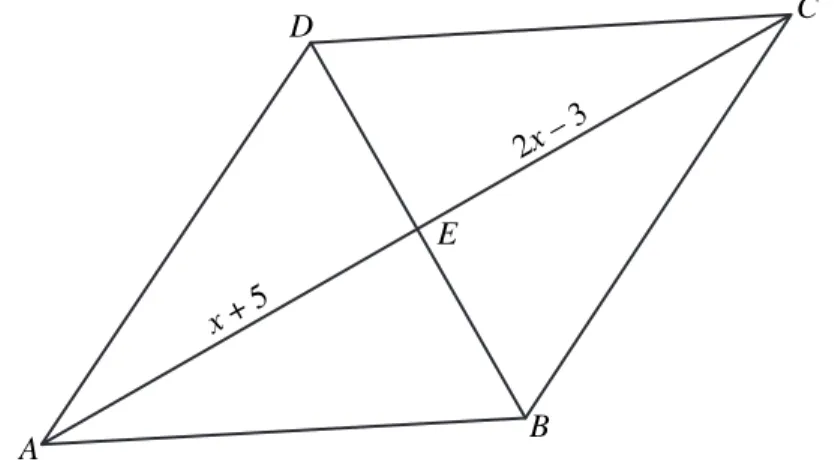
Figure ABCD is a rhombus. The length of AE is (x 5) units, and the length of EC is (2x 3) units.
A B
E D
x+ 5
2x– 3
C
Which statement best explains why the equation x 5 = 2x 3 can be used to solve for x ?
A. Opposite sides of a rhombus are parallel. B. Diagonals of a rhombus bisect each other. C. Diagonals of a rhombus are perpendicular. D. All four sides of a rhombus are congruent.
★
Mrs. Linder gave her students the following proof to complete.
Given: ST TQ PS QR
TSR
∠ ∠TQP
S
T
R
P Q
Prove: PQRS is a parallelogram
Statement Reason
1. PS QR 1. Given
2. ST TQ 2. Given
3. TSR ∠ ∠TQP 3. Given
4. QTP ∠ ∠RTS 4.
5. ∆QTP ∆STR 5.
6. 6. Corresponding parts of congruent triangles are congruent.
7. PQRS is a parallelogram. 7. If both pairs of opposite sides of a quadrilateral are congruent then the quadrilateral is a parallelogram.
Which is the correct statement 6 for this proof ?
A. PQ SR
B. ST TR
C. PT TR
D. PR QS
★