Demand and Consumer Behavior
R. Larry Reynolds
(2005)
© R. Larry Reynolds 2005 Alternative Microeconomics – Part II, Chapter 9– Demand and Consumer Behavior Page 1 R. Larry Reynolds
Demand and Consumer Behavior
emand is a model of consumer behavior. It attempts to identify the factors
that influence the choices that are made by consumer. In Neoclassical
microeconomics, the objective of the consumer is to maximize the utility that
can be derive given their preferences, income, the prices of related goods and
the price of the good for which the demand function is derived. An individual’s
demand function can be thought of as a series of equilibrium or optimal
conditions that result as the price of a good changes. There are two approaches
that may be used to explain an individual’s demand function; utility analysis
and indifference analysis. The two approaches are compatible.
A. Consumer Choice and Utility
tility is the capacity of a good (or service) to satisfy a want. It is
one approach explain the phenomenon of value. Utilitarianism is the
ethical foundation of Neoclassical microeconomics. Jeremy Bentham
[1748-1832] formalized “utilitarianism.” Utility is a subject evaluation ofvalue. Bentham seemed to intuitively grasp the notions of total an
marginal or incremental utility. However, it was not until 1844 that
Dupuit [1804-1866] linked marginal utility to the concept of demand.
Heinrich Gossen [1810-1858] developed the “law of satiable wants”
which is considered to be a forerunner of the “law of diminishing
marginal utility. In 1871 William Stanley Jevons [1835-1882] used the
term “final degree of utility” and Carl Menger [1840-1921] recognized
that individuals rank order their preferences. It was Friedrich von
Wieser, [1851-1926] who first used the term “marginal utility.”
(1)
Utility
Since utility is subjective and cannot be observed and measured
directly, it use here is for purposes of illustration. The objective in
microeconomics is to maximize the satisfaction or utility of individuals
given their preferences, incomes and the prices of goods they buy.
a. Total Utility (TU) and Marginal Utility (MU)
Total utility (TU) is defined as the amount of satisfaction or utility that one derives from a given quantity of a good. Marginal utility (MU) is defined as the change in total utility that can be attributed to a change in the quantity consumed.
Q TU MU
Utility Marginal
) s, preference (Q,
f TU Utility
Total
D
Source URL: http://web1.boisestate.edu/econ/lreynol/web/Micro.htm
As a larger quantity of a good is consumed in a given period we expect that the TU will increase at a decreasing rate. It may eventually reach a maximum and then decline. Remember the last time you went to an all you can eat pizza place and ate too much? This is shown in Figure IV.A.1. As the quantity of pizza/day consumed increases, the TU derived from the pizza increases at a decreasing rate until the maximum or 27 is reached at the 5th pizza.
Total Utility can be displayed in table form. The information contained in Figure IV.A.1 is shown in Table IV.1
Marginal utility (MU) is the change in TU that is “caused” by a change in the quantity consumed in the particular period of time. MU was defined:
Q TU MU
In Table IV.1 marginal utility is calculated by subtraction. The change in quantity from row to row is 1 ( Q = 1). Therefore the change in total utility can be calculated be subtracting the TU associated with each quantity from that associated with the next quantity. In Table IV.1 the total utility (TU) derived from 1 unit of the good is 10. The TU derived from 2 units is 18; the change in total utility ( TU) attributable to a one unit change in quantity ( Q) is 8.
8 1 8 TU MU
Q The MU of the third unit is 6
6 1 6 1
18 24 Q TU MU3 TABLE IV.1
TOTAL & MARGINAL UTILITY
Quantity
TU MU0 0 --
1 10 10
2 18 8
3 24 6
4 26 2
5 27 1
6 26 -1
Figure IV.A.1
TUP
Pizza/day TUP
1 2 3 4 5
10 18 24 26 27
TU is a function of the individual’s
preferences and the quantity consumed. In
the illustration to the right, 10 units of utility
are obtained by consuming 1pizza/day. The
consumption of 2 pizzas/day results in a
total of 18 units of satisfaction. The
maximum satisfaction that can be derived
from the consumption of pizza is 27. This
occurs at 5 pizzas. If the individual eats
more than 5 pizzas their total satisfaction
declines.
When the MU is calculated by subtraction, it can be visualized as the slope of the TU between two points. This is shown in Figure IV.A.2
Marginal utility can be graphed, however remember that the MU calculated by subtraction is “between” successive units of the good. It is the slope of an arc defined by two points on a total utility function. This is shown in Figure IV.A.3
The relationship between total utility (TU), marginal utility (MU) and average utility can be shown graphically. In Figure IV.A.4 the TU function has some peculiar characteristics so all-possible circumstances can be shown. In this example the total utility (TU) first increases at an increasing rate. Each additional unit of the good consumed up to the Q* amount causes larger and larger increases in TU. The MU will rise in this range. At Q* amount there is an inflection point in TU. This is consistent with the maximum of the MU. When AU is is a maximum, MU = AU. When TU is a maximum, MU is 0. This is shown in Figure IV.A.4
Figure IV.A.2
TUP
Pizza/day TUP
1 2 3 4 5
10 18 24 26 27
The MU can be visualized as the slope of
the TU between successive units of the
good. In the graph to the right the MU of
the third unit of Pizza is the slope of the TU
between points A and B.
Think of the slope of a line as rise over run.
TU rise and Q is the run. In this example
the Q is 1 ( from the third to the fourth
unit is 1). The TU is 6 (24-18). rise over
run or the slope of TU between points A and
B is 6.
Q
TU
MU =
TU
Q
A
B
Figure IV.A.3
5
10
15
20
25
30
35
40
1
2
3
Q/ut
TU
Q =1
run
rise
T
U
=
1
2
G’
G
In the graph to the right, one unit of the
good yields 18 units of satisfaction while 2
units of the good result in 30 units of
satisfaction. Marginal Utility (
Q TU
MU
)
can be shown as the slope of a line from
point R to B. this is the red “arc” between
the two points. The actual TU is shown by
the curved blue line between R and B.
TU of slope 1 12 Q TU run rise MU
MU can be calculated as a derivative. At 2
units of the good the MU will be the slope
of the line GG’ tangent to TU at point B.
B
Source URL: http://web1.boisestate.edu/econ/lreynol/web/Micro.htm
TU
Q/ut
Q/ut
MU
AU
TU
Q
Q*
Q
MMU
AU
Figure IV.A.4
In the graph to the right, TU increases at an
increasing rate from 0 to Q* units of the good. At
Q* there is an inflection point in TU. This is
consistent with the maximum of the MU. Beyond
Q* amount the TU increases at a decreasing rate.
MU (the slope of TU) decreases. Q* is the “point
of diminishing MU.”
When MU > AU, AU is “pulled up.” When MU <
AU, AU is “pulled down.” When MU = AU, AU is a
maximum. (AU is unchanged, its slope is 0, AU
is a maximum)
At Q
Mthe TU is a maximum. At this output the
slope of TU is 0. MU is the slope of TU MU = 0.
b. Diminishing Marginal Utility
It is believed that as an individual consumes more and more of a given commodity during a given period of time, eventually each additional unit consumed will increase TU by a smaller increment, MU decreases. This is called “diminishing marginal utility.” As a person consumes larger quantities of a good in a given time period, additional units have less “value.” Adam Smith recognized this phenomenon when he posed this “diamond-water paradox.” Water has more utility than diamonds. However, since water is plentiful, its marginal value and hence its price is lower than the price of diamonds that are relatively scarce.
c. Budget Constraint
When goods are “free,” an individual should consume until the MU of a good is 0. This will insure that total utility is maximized. When goods are priced above zero and there is a finite budget, the utility derived from each expenditure must be maximized.
An individual will purchase a good when the utility derived from a unit of the good X (MUX) is greater than the utility derived from the money used to purchase the good (MU$). Let the price of a good (PX) represent the MU of money and the MUX represent the marginal benefit (MBX) of a purchase. When the PX > MBX, the individual should buy the good. If the PX < MBX, they should not buy the good. Where PX = MBX, they are in equilibrium, they should not change their purchases.
Given a finite budget (B) and a set of prices of the goods (PX , PY, PN) that are to be purchased, a finite quantity of goods (QX, QY, QN) can be purchased. The budget constraint can be expressed,
good N of quantity Q
good N of price P
budget B
Where
Q P Q
P Q P B
th N
th N
N N Y
Y X X
For one good the maximum amount that can be purchased is determined by the budget and the price of the good. If the budget were 80€ and the price was 5€, it would be possible to buy 16 units. The amount that can be purchased is the budget (B) divided by the price of the good (PX).
X X that can be purchased BudgetPrice PB Q
The combinations of two goods that can be purchased can be shown graphically. The maximum of good X that can be purchased is
Y
X P
B is Y good of amount the , P
B . All possible combinations of good X and
Y that can be purchased lie along (and inside) a line connecting the X and Y intercepts. This is shown in Figure IV.A.5
I
n order to maximize the utility derived from the two goods, the
individual must allocate their budget to the “highest valued use.” This is accomplished by the use of marginal analysis. There are two steps to this process. First, the marginal utility of each unit of each good is considered. Second, the price of each good (or the relative prices) must be taken into account.
It is believed that as a person consumes more and more of a
(homogeneous) good in a given period of time, that eventually the total utility (TU) derived from that good will increase at a decreasing rate; the point of diminishing marginal utility (MU) will be reached.
When there are two (or more) goods (with prices) and a budget, the individual will maximize TU by spending each additional dollar (euro, franc, pound or whatever monetary unit) on the good with the greatest
marginal utility per unit of price X
X P
MU .
Consider the two goods in Table IV.2.
In the graph to the right, the budget is 80€. When the price of good Y (PY) is 4€, a maximum of 20 units of good Y can be purchased. This is shown as point A on the Y-axis. If the price of good X is 5€, a maximum of 16 units of X can be purchased. This is point H on the X-axis. The line AH represents the maximum combinations of goods X and Y that can be bought given the budget and prices. Any combination of goods that lies in the triangle OAH (yellow area) can be purchased. An increase in the budget will “shift” the budget constraint out. A decrease in the budget will shift it in.
A change in the relative prices will “rotate” the constraint (change its slope).
Budget constraint when B = 80€,
PX = 5€ PY = 4€
Q
XQ
Y20 4 80 Y P
B
16 5 80 X P
B
A
H
O
Source URL: http://web1.boisestate.edu/econ/lreynol/web/Micro.htm
TABLE IV.2
Maximizing TU of Two Goods Given Prices and Budget (B = $5) Xebecs (Good X)
PX = $1 - PX1 = $.50
Yawls (Good Y) PY = $1
QX TUX
X X
X
P MU
MU
X1 X
P
MU Q
Y TUY MUY MUYPY
0 0 -- -- 0 0 -- --
1 10 10 20 1 16 16 16
2 18 8 16 2 28 12 12
3 24 6 12 3 36 8 8
4 28 4 4 4 40 4 4
5 30 2 2 5 40 0 0
6 30 0 - 2 6 36 - 4 - 4
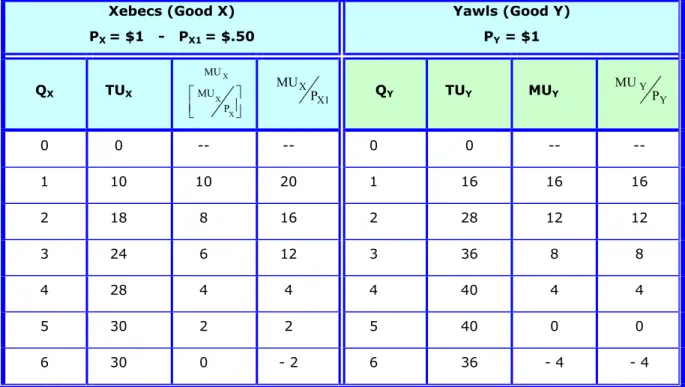
In Table IV.2 the preferences for two goods (good X, xebecs and good Y, yawls) is shown. The preferences determine the Total Utility (TU) and marginal utility (MU) that is derived from various units of the two goods. A change in preferences will change the utility as expressed by TU and/or MU. A preference state is one table. A change in preferences would be shown as a different table. Remember that for demand analysis preferences are subject to ceteris paribus.
The effects of a change in price (of either good) or the budget can be shown within the given table. In Table IV.2 the preferences are given, the budget is $5, the PX is $1 and PY is $1. The marginal utility per dollar
(price) is calculated N
N
P MU
for each good. The agent then spends each monetary unit ($, €, or. . . ) on the good that has the highest MUN/PN.
In Table IV.2 the individual would first buy a unit of good Y (yawls) to get 16 units of satisfaction. If they had bought a unit of good X (xebecs) they would have gotten 10 units of satisfaction for the dollar
expenditure.
The consumer decides on their next purchase. They can by an additional unit of yawls (for $1) and get 12 units of satisfaction or a unit of xebecs to get 10 units of satisfaction. They will by the second unit of yawls. The third dollar is spent on xebecs (10 units of satisfaction is preferred to 8). The fourth dollar is spent on either xebecs or yawls; the buyer is
indifferent between the second xebec and third yawl. They have the same satisfaction. If the second xebec is purchased, the fifth dollar will be spent on the third unit of yawls.
Given the preferences, PX = $1, PY = $1 and a budget of $5; the consumer
will purchase 2 units of xebecs and three of yawls. The quantity of X purchased at $1 given PY, budget and preferences can be shown as
point G in Figure IV.A.6.This is an equilibrium point for the consumer. When they buy two units of good X (2X) and three unit of good Y (3Y), they obtain 54 units of satisfaction (TUX for 2X is 18 and TUY of 3Y is
and 2Y their TU is 52. Clearly they cannot increase their utility by altering their purchases.
A second point on the demand for good X can be derived by changing the price of good X while holding preferences, budget and Py constant. Decrease the price of xebecs (PX) from $1 to (PX1)$.50. This will increase the marginal utility per dollar spent on good X. This is shown in Table IV.2 in the column [MUX/PX1]. Following the same logic above the consumer would purchase 4 units of xebecs and 3 units of yawls with their $5 budget. Note that this results in 64 units of satisfaction. Reduce the amount of X by 2 units to buy one more unit of good Y and utility falls to 58. If the consumer tried to buy more X and less Y we will interpolate so 2.5 units of Y and 5 units of X can be purchased to yield 62 units of satisfaction.
Given preferences in Table IV.2, B = $5, P
Y= $1 and P
X1= $.50,
the consumer will purchase 4X. This can be shown as point W in
our graph for the demand of xebecs in Figure IV.A.6. A portion of
the demand function for xebecs has been mapped and is shown
as the line segment between points G and W.
It is important to note that the demand function represents a series
of equilibrium conditions for the consumer as the price of xebecs
changes while other parameters remain constant. If P
Y, Budget
or preferences changed, the demand for xebecs would shift.
d. Equimarginal Principle
The process demonstrated in the previous section may be referred to as the equimarginal principle. It is a useful tool and can be used to optimize (maximize or minimize) variables in marginal analysis. It will be used again to find the minimum cost per unit combination of inputs into a production process.
The rule for maximizing utility given a set of price and a budget is straightforward; if the marginal utility per dollar spent on good X is greater that the marginal utility per dollar spent of good Y, buy good X. If the marginal utility per dollar spent on good X is less that the
marginal utility per dollar spent of good Y, buy good Y. Utility is
maximized when the marginal utility per dollar spent is the same for all goods. This can be expressed for as many goods as necessary. Since there is a budget constraint, if the marginal utility per dollar of one good is greater than the MU/$ of another and the budget is all spent, the individual should buy less of one to obtain more of the other. The equi-marginal principle can be expressed;
Q
X/ut
Pri
ce
.50 1.00 1.50
1 2 3 4 5 6
G
[Xebecs]
Figure IV.A.6
Given the individual’s preferences shown in Table IV.2, a budget of $5 and PX =$1 and PY = $1, the individual will buy 2 units of good X.
This is a point on the demand function for good X. A point on the demand for good Y could be shown on another graph. Here we will develop the demand for good X.
Note that point G (2 units of X at $1) represents an equilibrium condition for the consumer. They cannot alter their purchases without reducing the total utility they derive from the $5 budget. Point W is derived by lowering the price of xebecs
Source URL: http://web1.boisestate.edu/econ/lreynol/web/Micro.htm Pn MUn = = Py MUy = Px
MUx
,
subject to the constraint, B > PxQx + PyQy + ... + PnQn Where Pni = price of ith good, Qni = quantity of ith good and B = budget
(2)
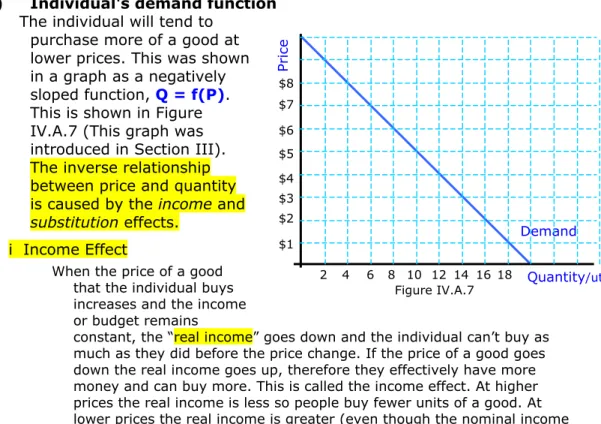
Individual's demand function
The individual will tend to
purchase more of a good at
lower prices. This was shown
in a graph as a negatively
sloped function,
Q = f(P)
.
This is shown in Figure
IV.A.7 (This graph was
introduced in Section III).
The inverse relationship
between price and quantity
is caused by the income and
substitution effects.
i Income Effect
When the price of a good that the individual buys increases and the income or budget remains
constant, the “real income” goes down and the individual can’t buy as much as they did before the price change. If the price of a good goes down the real income goes up, therefore they effectively have more money and can buy more. This is called the income effect. At higher prices the real income is less so people buy fewer units of a good. At lower prices the real income is greater (even though the nominal income is constant) and they can buy more.
ii Substitution Effect
Individuals react to higher prices by looking for relatively lower priced substitutes. Or, conversely they will react to lower prices of a good by substituting it for a relatively higher priced good.
The income and substitution effects may be greater of smaller
depending on the good being considered. Some goods may have a
large income effect. Autos, computers and the like may have great
income effects. In other cases the substitution effect may be larger.
When considering the demand for soft drinks the substitution effect
may be important.
(3)
Market Demand
If the good has nonattenuated property rights (they are exclusive), the
individuals’ demand functions can be summed horizontally to obtain
the market demand function. This was described in Section III to
review the idea note Figure IV.A.8
(Displayed originally as Figure III.A.2).
Figure IV.A.7
Demand Quantity/ut
Pri
ce
$1 $2 $3 $4 $5 $6 $7 $8
(4)
Consumer Surplus
The demand function can be viewed as the maximum that someone is
willing an able to pay for each unit of a good. In Figure IV.A.9
someone is willing and able to pay $9 or more for the first 2 units. If
the market price were at equilibrium ($5 in this graph), the consumer
would pay $5 while they were willing to pay in excess of $9 for each of
the two units. Therefore, they received more utility (that they were
willing and able to pay for) than they had to pay. The difference
between the reservation price of the buyer (the maximum the buyers
are willing and able to pay for each unit) and the market price is called
consumer surplus.
(5) Producer Surplus
The welfare of the producers can be shown in a similar manner. The
supply function represents the minimum price the sellers will accept
for each unit. Therefore, the difference between the market price and
the reservation price of the seller (the minimum the seller will accept
for each unit) represents producer surplus. This is represented by area
CEP in Figure IV.A.9.
(6) Elasticity
Elasticity is a tool that is used to describe the relationship between two
variables. Decision makers would like to describe how a change in
price might alter the quantity demanded. A measure of this
Market DemandD
MQ/ut
Price
1 2 3
D
AD
BD
C8
P
1P
2P
3Figure IV.A.8
Figure IV.A.9
Demand Quantity/ut
Pri
ce
$1 $2 $3 $4 $5 $6 $7 $8
2 4 6 8 10 12 14 16 18
Supply
E
R
P
C
Q
In the graph to the right, the supply and demand functions establish the equilibrium price at $5. Consumers are willing and able to pay more than $5 for all units up to the 10th unit. The difference between the market price and what the consumers are willing and able to pay is called consumer surplus. The area PER (in yellow) can be visualized as consumer surplus.
If the market price were $5, note that the sellers are willing to produce and offer for sale the first 10 units at a cost less than $5. This is called producer surplus. It is area CEP (in blue).
The sum of consumer surplus and producer surplus is a measure of social welfare. The market has maximized the well being of both consumers and producers.
Source URL: http://web1.boisestate.edu/econ/lreynol/web/Micro.htm
relationship is called the “
own” price elasticity
of demand. It is also
useful to describe how a change in buyers’ income shifts the demand
function for a good; this measure is called
income elasticity
. When
the price of a related good (substitute or compliment) changes, the
demand for a good will shift.
Cross elasticity
is a measure of the
responsiveness of buyers of a good to changes in the prices of related
goods.
Elasticity is defined as
variable t independen
the of change percentage
variable dependent
the of change percentage
E ,
This is the percentage change in the dependent variable caused by a
percentage change in the independent variable.
(a)
"Own" price elasticity of demand [E
Por
p]
i. Definition of E
PThe “own” price elasticity of demand is sometimes called price elasticity or price elasticity of demand. The price elasticity of demand measures the responsiveness of buyers to changes in the goods “own” price. It reflects a movement along a given demand function or a change in quantity demanded. For illustrations of elasticity the demand function will be a linear function; Q = 10 – 1P. This simple demand function can also be expressed P = 10 – 1Q. It is important to note that less simple functions may not have this property. The graphical representation of this demand function (Q = 10 –1P) is shown in Figure IV.A.10.
ii. Calculation of E
PPrice elasticity measures the percentage change in the quantity demanded “caused” by a
percentage change in the price. In Figure IV.A.10, when the price of the good is $4 (at point B), six units will be purchased. Should the price increase to $8 (point A), the quantity purchased will decrease to 2 units. A decrease in price to $2 will cause
an increase in the quantity demanded to 8 units of the good (point C). Notice that as the price increases from $4 to $8 (a + 100% P), there is a
change in quantity from 6 units to 2 units (a - 67% Q). Using the definition of price elasticity,
67 . % 100
% 67 %
%
P Q EP
At the price of $4, the coefficient of “own” price elasticity of demand is -.67. This is the elasticity at a point on the demand (point B) for a specific price ($4) and quantity (6 units).
Figure IV.A.10
Price
Q/ut $
1 2 3 4 5 6 7 8 9 10
1 2 3 4 5 6 7 8 9
10 Q = 10 –1P
P = 10 – 1Q
Demand A
B C
A formula for calculating point price elasticity is: 1 1 1 1 Q P x P Q P P Q Q = P P P Q Q Q = E 1 2 1 1 2 1 P
Calculating the EP for a price change from $4 to $2 in Figure IV.A.10 , a move from point B to point C:
67 . 6 4 1 6 4 2 2 2 , 2 2 $ , 8 4 $ , 6 1 1 2 2 1 1 Q P P Q E P Q P units Q P units Q P
Note that the EP is the same whether the price is increased from $4 to $8 or
decreased from $4 to $2. The magnitude of the change does not affect the EP
either. The coefficient of “own” price elasticity is unique to each point on the demand function. To calculate EP as the price falls from $8 to $4 (a move from point A to point B in Figure IV.A.10):
2 1 4 1 2 8 4 4 4 , 4 4 $ , 6 8 $ , 2 1 1 2 2 1 1 Q P P Q E P Q P units Q P units Q P
EP at $8 is –2, at $4 it is -.67. The coefficient is different at every point on the demand function even though the slope of the demand function is the same at every point. EP is determined by the slope of the demand
P
Q and the location on the demand 1 1
Q
P .
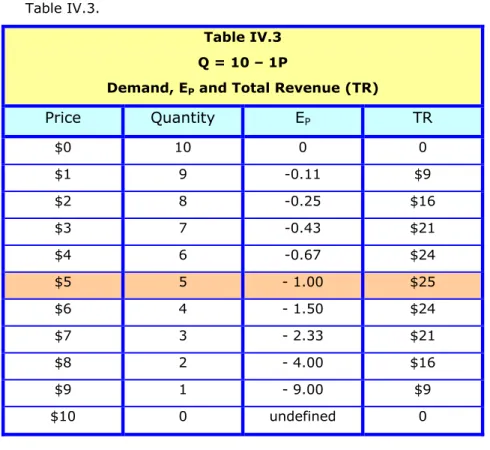
The demand, EP at every price, and total revenue (TR) are displayed in Table IV.3.
Table IV.3 Q = 10 – 1P
Demand, EP and Total Revenue (TR)
Price
Quantity
E
PTR
$0 10 0 0
$1 9 -0.11 $9
$2 8 -0.25 $16
$3 7 -0.43 $21
$4 6 -0.67 $24
$5 5 - 1.00 $25
$6 4 - 1.50 $24
$7 3 - 2.33 $21
$8 2 - 4.00 $16
$9 1 - 9.00 $9
Source URL: http://web1.boisestate.edu/econ/lreynol/web/Micro.htm
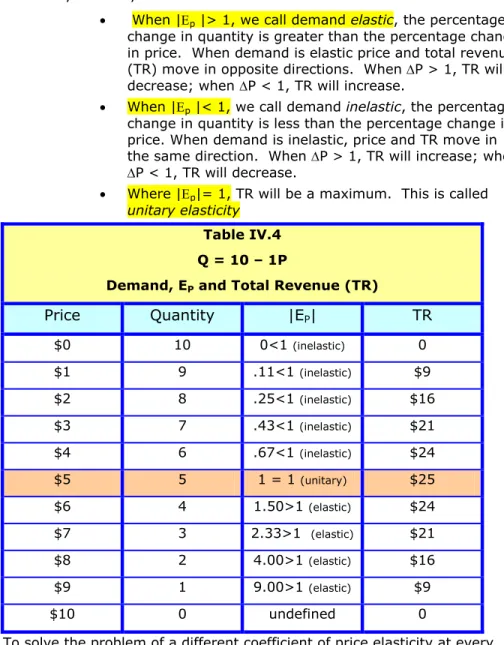
The information in Table IV.3, The absolute value of EP can be categorized by its relationship to 1. Table IV.4 shows the categories of elastic, unitary elasticity and inelastic coefficients.
When | p |> 1, we call demand elastic, the percentage change in quantity is greater than the percentage change in price. When demand is elastic price and total revenue (TR) move in opposite directions. When P > 1, TR will decrease; when P < 1, TR will increase.
When | p |< 1, we call demand inelastic, the percentage change in quantity is less than the percentage change in price. When demand is inelastic, price and TR move in the same direction. When P > 1, TR will increase; when
P < 1, TR will decrease.
Where | p|= 1, TR will be a maximum. This is called unitary elasticity
Table IV.4 Q = 10 – 1P
Demand, EP and Total Revenue (TR)
Price
Quantity
|E
P|
TR
$0 10 0<1 (inelastic) 0$1 9 .11<1 (inelastic) $9
$2 8 .25<1 (inelastic) $16
$3 7 .43<1 (inelastic) $21
$4 6 .67<1 (inelastic) $24
$5 5 1 = 1 (unitary) $25
$6 4 1.50>1 (elastic) $24
$7 3 2.33>1 (elastic) $21
$8 2 4.00>1 (elastic) $16
$9 1 9.00>1 (elastic) $9
$10 0 undefined 0
To solve the problem of a different coefficient of price elasticity at every price, average or “arc” elasticity between two prices will be used. The two prices should represent reasonable upper and lower bounds that the price might be expected to fall between.
The average or “arc” price elasticity is calculated by;
2 1
2 1 arc
P QP QP QP E
If the price of the good in the example were expected to generally be between $2 and $4, the average elasticity would be calculated;
43 . 14
6 1 8 6
2 4 2 2 2 ,
2
2 $ , 8
4 $ , 6
2 1
2 1
2 2
1 1
Q Q
P P P Q E
P Q
P units Q
P units Q
P
The average elasticity between $2 and $4 is - .43 and is inelastic. An increase in the price in this range will increase TR. A decrease in price will decrease TR.
iii Mid-point and E
PA useful short cut to understanding the relative elasticity along a demand function is to use the mid-point. For any linear demand function the mid-point can be located by dividing the Q-intercept (or P-intercept) by 2. In Figure IV.A.11 the mid-point is at 5 units and $5. At this quantity (and price), EP will be
unitary or its absolute value is 1. This will also be the maximum of the total revenue (TR). The “top” half the linear demand function (at higher prices) will be elastic. The “lower” half the demand function (lower prices) will be inelastic.
iv Price Elasticity and Total Revenue
The demand function is a relationshipbetween price and quantity. Price elasticity is determined by the slope of the demand function and the location (price and quantity) on the demand function. Total Revenue (TR) is the product of price and quantity. (TR = PQ). As a
consequence, demand, EP and TR
are related. Table IV.4 shows the relationships. The demand function is elastic in the upper portion. At the mid-point of a linear demand
function, EP is unitary (EP = -1). It is
also at this mid-point that TR will be at a maximum.
In Figure IV.A.11.5, the demand (or average revenue, AR) has a
Q-intercept of Q1 and a P-intercept of P1. At point H (the mid-point of the
demand at one half P1 and Q1) the value of EP is –1. The upper portion
of the demand is elastic. Note that the demand has a negative slope and TR has a positive slope. This will help you remember that price and TR move in the opposite directions. As price rises, TR will decrease. As price decreases, TR will increase. In the lower portion, the demand is
inelastic. Both TR and demand have negative slopes. As price increases, TR will rise. As price falls, TR will decrease. The maximum value of TR will occur at the quantity were EP is unitary. The maximum value of TR
is at point J. The slope of TR at this point is 0.
Price elasticity is useful to explain the relationship of price and TR. It does not provide information about profits. Profits ( ) are defined as total revenue minus total costs ( TR – TC). To determine the output and price that result in maximum profits, we must know both TR and TC. Demand (D) is a functional relationship between price and quantity that will
be purchased. Total revenue (TR) is the product of price and quantity. (TR = PQ). Therefore, the demand for a firm’s product determines the revenues the firm obtains from the sale of its output.
|EP| < 1,
inelastic
range
|E
P| > 1, elastic range
|EP| = 1
1 2 3 4 5 6 7 8 9 10 1
2 3 4 5 6 7 8 9 10
Figure IV.A.11
Price
Q/ut $
D
Q
/ut
$
H
Q
1Q
12
P
1P
12
D = ARTR
J
Source URL: http://web1.boisestate.edu/econ/lreynol/web/Micro.htm
Q 2 20 Q
2Q 20Q Q TR
AR 2
The average revenue (AR) and marginal revenue (MR) are also of interest in the analysis of a firm’s behavior. AR is the revenue per unit sold. It is calculated by dividing the total revenue by the quantity,
Q TR AR Revenue Average
Marginal revenue (MR) is the change in TR caused by a (1 unit) change in the quantity sold.
Q TR MR Revenue Marginal
Consider an example demand function P = 20-2Q (shown in Figure IV.A.11.5a).
Total revenue is TR = PQ, and P=20-2Q. By substitution,
TR=(20-2Q)Q = 20Q-2Q2
Average revenue the revenue per unit,
Notice that the AR is the same as the demand function. This will always be true.
Marginal revenue (MR) is defined as the change in TR caused by a one unit change in the quantity.
4Q 20 dQ dTR Q TR
MR Notice that the MR function (MR = 20 – 4Q) has twice the slope as the demand (D) and AR functions. Since MR
decreases twice as fast as AR (or D), it will intersect the Q axis halfway between the origin and the intercept of the AR function. Note that if the slope of the Demand were 0, and the MR fell at twice the rate, the slope of MR would also be 0 (2 times 0 is still 0). As a result when the demand is perfectly elastic (has a slope of 0, demand is horizontal) the AR and MR will coincide.
Profits ( ) are defined as the difference between the total revenue (TR) and total cost (TC), = TR –TC. The relationship between demand an revenue
v Determinants of E
PPrice Elasticity of demand is influenced by:
a. Availability of substitutes
Generally, the more substitutes that are available, the more elastic the demand for a good. The demand for a class of goods (soft drinks) is usually more inelastic than the demand for a specific brand of the good (Pepsi or Coca-Cola). A Firm may try to differentiate their product to make the demand relatively more inelastic.
b. Proportion of item in budget
When the expenditures on a product are a relatively small portion of a budget, the demand is relatively more elastic.
c. Time available to adapt
The longer that consumers or buyers have to make adjustments Q/ut P, $
Demand 20
10 5
MR AR
in their behavior, the more elastic the demand is likely to be. The absolute value of the short run price elasticity of demand for gasoline would be smaller than the absolute value of the long run price elasticity of demand. The longer time allows consumers more opportunity to adjust to price changes.
vi Interpretation of E
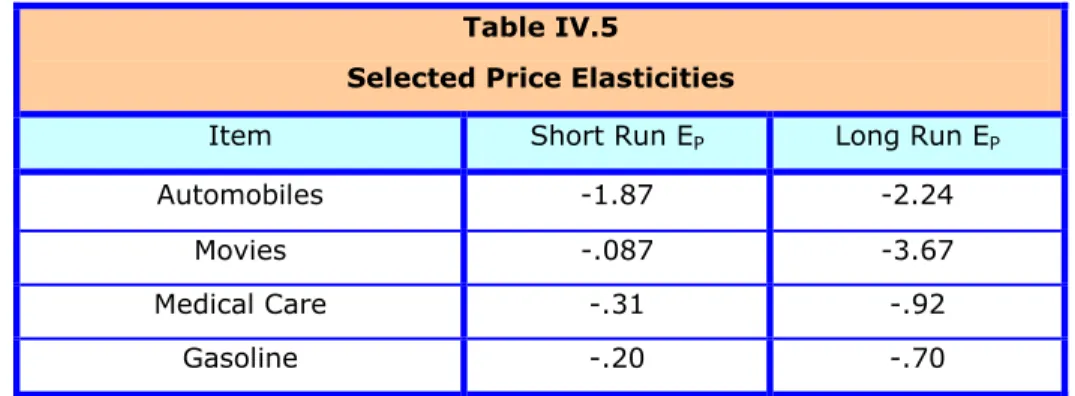
PSome examples of price elasticities of demand reported in Microeconomics for Today, [Tucker, p 123, South-Western College Publishing, 1999. Sources Archibald and Gillingham, Houthakker and Taylor, Voith] are presented in Table IV.5. Note
that the demand is relatively more elastic for longer periods. Some goods, like movies, are inelastic in the short run and elastic in the long run.
The coefficient or price elasticity can be used to estimate the percentage change in the quantity that consumers are willing and able to buy given a percentage change in the price. It is important to understand that this measure does not apply to the equilibrium conditions in the market.
In Table IV.5 the short run EP for gasoline is -.2. This suggests that a 1%
increase in price will reduce the quantity demanded by .2%. A 10% decrease in price would increase the quantity demanded by 2%. In the case of movies, a 1% increase in the price would change the quantity demanded by 3.67% in the long run.
(b) Income Elasticity of Demand
The responsiveness of
buyers to changes in
their incomes is
measured by income
elasticity. While EP
measures a
movement along a
demand function as
the price changes,
income elasticity (EM)
measure a shift of the
demand function
caused by a change in
income.
Income elasticity (E
M) is
defined:
Income %
Q % EM
In Figure IV.A.12 the original demand function is represented as
D
.
D
1represents a decrease in demand (at each price a smaller quantity is
Table IV.5
Selected Price Elasticities
Item Short Run EP Long Run EP
Automobiles -1.87 -2.24
Movies -.087 -3.67
Medical Care -.31 -.92
Gasoline -.20 -.70
D
D
1D
2Price
Q/ut $
1 2 3 4 5 6 7 8 9 10
1 2 3 4 5 6 7 8 9 10
A B C
Figure IV.A.12
(D) Q = 10 – 1P
(D1) Q1 = 7 - 1P
Source URL: http://web1.boisestate.edu/econ/lreynol/web/Micro.htm
purchased. When a larger quantity is purchased at each price, this will
represent an increase of demand to
D
2.
Given the original demand function (
D
), consumers are willing and able
to purchase 5 units of the good. If income increased by 50% and
“caused” the demand to shift to
D
2,
where 8 units are purchased at
$5. This is a 60% increase in demand. Income elasticity (EM) is
calculated:
1.2
% 50
% 60 %
% M
Q EM
In this case, an increase in income resulted in an increase in demand. A
decrease in income might decrease the demand (to
D
1). In this case
income elasticity would be
1.2
% 50
% 60 %
% M
Q EM
When EM is positive, the good is called a normal good. If an increase in
income reduces demand (or a decrease in income increases demand),
E
Mwill be negative and the good is categorized as an inferior good.
a.
EM < 0
means the good is inferior, i.e. for an increase in income the
quantity purchased will decline or for a decrease in income the
quantity purchased will increase
b.
1 >
M> 0
means the good is a normal good, for an increase in
income the quantity purchased will increase but by a smaller
percentage than the percentage change in income.
c. For
E
M> 1
the good is considered a superior good.
(c) Cross elasticity
Cross elasticity (EXY) is used as a measure of the relationship between
two goods. EXY is defined as:
P
%
Q
%
E
y x XY
Consider two goods that are substitutes; butter and margarine. Cross
elasticity cam be used to measure the relationship between the price
of butter and the demand for margarine (E
Margarine- butter) or the
relationship between the demand for butter and the price of margarine
(E
butter-margarine). The value of E
XYis not the same as or equal to E
YX. In
Figure IV.A.13 the concept of E
XYis shown.
I
Panel A Figure IV.A.13 Panel BQM/ut PM
DM
Q
MP
MP
MHQ
MH QB/utD
BQ
BHIn panel A, the demand for margarine (D
M) is shown. At a price of P
M,
the quantity demanded is Q
M. In Panel B, the demand for butter (D
B) is
shown. At a price of P
B, the quantity demanded is Q
B
. If the price of
margarine increased to P
MH(in Panel A), the quantity of margarine
demanded decreases to Q
MH. Since less margarine is purchased, the
demand for butter increases to D
BH(in Panel B). Given the higher
demand for butter the butter demanded (given the higher price of
margarine) has increased. A decrease in the price of margarine would
shift the demand for butter to the left (decrease). The coefficient of
cross elasticity would be positive.
In the case of complimentary goods, an increase (decrease) in the price
of tennis balls would reduce (increase) the demand for tennis rackets.
The coefficient of cross elasticity would be negative. If E
XYis close to
zero, that would be evidence that the two goods were not related. If
E
XYwere positive or negative and significantly different from zero, it
could be used as evidence that the two goods are related. It is possible
that E
XYmight be positive or negative and the two goods are not
related. The price of gasoline has gone up and the demand for PC’s
has also increased. This does not mean that gasoline and PC’s are
substitutes.
When xy > 0, [a positive number] this suggests that the two goods are substitutes
When xy < 0, [a negative number] this suggests that the two goods are compliments