A Biologically Inspired
Routing Algorithm for Mobile Ad
Networks
Zhenyu Liu and Marta
Z.
Kwiatkowska
School
of
Computer Science
Constantinou
Electronic Electrical and Computer Engineering
The University
of
Birmingham
Birmingham, England B15
2TT
@cs.bham.ac.uk
Abstract
This paper presents a improved version of swarm-intelligence inspired ad routing algorithm EARA introduced in [ I I ] . In this algorithm, we use the principle of swarm intelligence to maintain routing The biological concept of stigmergy is used to reduce the amount of control A light-weight
scheme is proposedto provide
control. The simulation results show that this novel routing algorithm well in a variety of network conditions.
1 Introduction
Mobile ad networks (MANETs) are wireless mobile networks formed spontaneously. Communication in such a decentralised network typically involves temporary hop relays, with the nodes using each other as the relay routers without any fixed infrastructure. This kind of net-work is very flexible and suitable for applications such as temporary information sharing in conferences, military ac-tions and disaster rescues.
However, multi-hop routing, random movement of mo-bile nodes and other features unique to MANETs lead to enormous overhead for route discovery and maintenance. Furthermore, this problem is worsened by the resource con-straints in energy, computational capacities and bandwidth. Many approaches have been proposed to solve the
rout-ing challenge in MANETs, for example[ These
previous works only provide a basic routing functionality that is sufficient for conventional applications such as file transfer or download.Tosupport applications such as in MANETs, which have a higher requirement for de-lay, jitter and packet losses, support for Quality-of-Service is needed in addition to basic routing functionality. At present, the most fundamental challenges of sup-port in MANETs concern how to obtain the available band-width and maintain accurate values during dynamic
The University of Birmingham
Birmingham, England B15 2TT
bham.ac.uk
lution of such a network Inspired by common tech-niques for provision in Internet, some researchers pro-posed the integration of provision into the routing pro-tocols[14,151. However, since these works implicitly as-sumed the same link concept as the one in wired networks, they still do not address the problem for MANETs.
In this paper, we propose a new version
ofthe Emergent Ad Routing Algorithm
(EARA)enhanced with EARA is inspired by the foraging behaviour of biological ants. The biological concept ofstigmergyis used to reduce the amount of con-trol traffic. Local wireless medium information from the MAC layer is used as the artificialpheromone (a chemi-cal used in ant communications) to reinforce
optimal paths without knowledge of the global topology. In this algorithm adopts the cross-layer design ap-proach by using from different layers to make rout-ing decisions. These multi-criteria routrout-ing decisions allow for the better usage of network characteristics in selecting best routes among multiple available routes.
In in addition to the basic routing
func-tionality, a light-weight provision scheme is also in-tegrated into the algorithm. In this scheme, traffic flows are classified into service classes based on their relative de-lay bounds. Dede-lay sensitive traffic is given higher priority than other insensitive traffic flows. Atoken bucket queueing scheme is used to provide high priority to real-time traffic, and protect the lower-priority traffic from starvation. The results from simulation of mobile ad networks show that this algorithm performs well over a variety of environ-mental conditions, such as network size, nodal mobility and traffic loads.
2 Background
In this section, we give a brief introduction to swarm in-telligence and the parameters from the MAC layer.
One famous example of biological swarm social haviour is the ant colony foraging Many ant species have a trail-laying, trail-following behaviour when forag-ing: individual ants deposit a chemical substance called
pheromoneas they move from a food source to their nest, and foragers follow such pheromone trails. Subsequently, more antsareattracted by these pheromone trails and in turn reinforce them even more. As a result of this catalytic effect, the optimal solution emerges rapidly. In this food searching process a phenomenon called stigmergy
plays a key role in developing and manipulating local infor- mation. It describes the indirect communication of individ-uals through modifying the environment.
From the self-organisationtheory point of view, the haviour of the social ant can be modelled based on four elements: positive feedback, negative feedback, random- ness and multiple interactions This model of social ants using self-organisation theories provides powerful tools to transfer knowledge about the social insects to the design of intelligent decentralised problem-solving systems.
2.2 Quality-of-Servicein
MANETs
To support in a network, the link characteristics such as bandwidth, delay, loss rate and error rate should beavailable and manageable. In wired networks, pro-vision relies on the possibility to make bandwidth reserva- tions. Twodistinct classes of are implemented based on this assumption. Integrated Services (IntServ) [6] pro-vides guaranteed bandwidth for flows, while Differentiated Services [4]provides hard guarantees for service classes.
However, the situation in MANETs is completely dif- ferent from that in wired networks. In wireless networks, the available bandwidth undergoes fast time-scale variations due to channel fading and errors from physical obstacles. These effects are not present in wired networks. Further-more, the wireless channel is a shared-access medium, and the available bandwidth also varies with the number of hosts contending for the channel. Applying the concepts from wired approaches directly to wireless ad networks is difficult, because many assumptionsin wired networks do not apply in wireless networks.
Consequently, IntServ based approaches are not appli-cable in MANETs. As an alternative to IntServ, the Serv approach classifies flows into several service classes whose packetsare treated differently at the routing nodes. Although it is not practical to provide a hard separation of different service classes in MANETs, relative prioritisation is possible in such a way that traffic of a certain class is given a higher or lower priority than traffic of other ser-vice classes. One solution would be to divide the traffic into a predefined set of service classes that are defined by
time)and insensitive (bulk)traffic. traffic should be given higher priority than bulk traffic. No absoluteband-width grarantees are provided. Some work based on service differentiation rather than resource reservations already ex-ists
3
Description of
EARA-QoS
EARA-QoS is an on-demand multipath routing algo-rithm for MANETs, inspired by the ant foraging intelli- gence. This algorithm incorporates positive feedback, neg-ative feedback and randomness into the routing computa-tion. Positive feedback originates from destination nodes to reinforce the existing pheromone on good paths. Ant-like packets, analogous to the ant foragers, are used to locally find new paths. Artificial pheromone is laid on the commu-nication links between nodes and data packets are biased towards strong pheromone, but the next hop is chosen abilistically. To prevent old routing solutions from remain-ing in the network status, exponential pheromone decay is adopted as the negative feedback.
Each node using this algorithm maintains aprobabilistic
routing table. In this routing table, each route entry for the destinationd is associated with a list of neighbour nodes A probability value in the list expresses the goodness of nodej as the next hop to the destination d. For each neighbour, the shortest hop distance to the destination and the largest sequence number seen so far are also recorded.
The routing table is updated as follows. In addition to the routing table, each node also possesses apheromone ta-ble. This table tracks the amount of pheromone on each neighbour link. The table may be viewed as a matrix with rows corresponding to neighbourhood and columns to destinations. There are three threshhold values control-ling the bounds on pheromone in the table. They are the
upper pheromone that prevents extreme differences in pheromone, the lowerpheromone below which data traf-fic cannot be forwarded, and theinitial pheromone that is assigned when a new route is found.
The routing probability value is computed by the composition of the pheromone values, the local heuristic values and the link delays as follows:
wherea, and (a, 0) arethree tunable
parame-ters that control the relative weight of pheromonetrail heuristic value and the link delay is the
neigh-bours of node
>
data traffic can only beforwarded following a valid route.
The queue length at the MAC layer is a key factor that can affect the queueing delay in the buffer of nodei,which is a measure of congestion in a node, or packet drop due to
... Path Reinforcement Local Repair (a) Initial Pheromone Setup
Figure 1. Illustrating Working Mechanism of
the size limit on the queue length. The heuristic value is calculated with the network interface queue length in node
where is the length (in bits waiting to be sent) of the outgoing queue of the link are the neighbours of nodei.
Incorporating the heuristic value and link delay in the routing computation makes this algorithm possess the con-gestion awareness property. Based on the probabilistic rout-ing table, data traffic will be distributed accordrout-ing to the probabilities for each neighbour in the routing table. The routing algorithm exhibits load balancing behaviour. Nodes with a large number of packets in the bufferare avoided.
The following control packets are used in to
perform routing computation:
Route Request Packet (RQ) containing destination ad-dress, source address and broadcast ID.
Route Reply Packet (RP) containing source address, destination address, sequence number, hop account and life-time.
Reinforcement Signal (RS) containing destination
ad-dress, pheromone sequence number.
Local Foraging Ant (LFA) containing source address (the node that sent LFA), the least hop distance from the source to the destination, stack of intermediate node address and hop count.
Hello Packet (HELLO) containing source (the node that sent Hello) addressand hop count (set to0).
The algorithm consists of several
compo-nents. Multiple routesare found with the route
discoveryprocedure. floods RQ packets to lo-cate destination nodes. After the route discovery procedure sets up the initial pheromone trails to destination nodes, which is illustrated in Figure destination nodes use
RS
packets as positive feedback signals to "pull"more data traf-fic through the good in the route maintenance pro-cedure (refer to Figure This procedure is also useful to enable the local repair of degraded links. For instance, if an intermediate node idetects a link failure from one of its upstream links it can apply the reinforcement rules to discover an alternativepath as shown in Figure
In a dynamic network like the changes of the network topology create opportunities for new good paths to emerge and existing paths to fail. In order to make better use of this phenomenon, this algorithm launches LFA pack-ets to locally search new routes whenever all the pheromone trails of a node towards some destination drop below the threshhold. The advantage of using LFA packets to locally search new routes is that this mechanism can save more con-trol packets than the flooding technique and responds to the topology changes more quickly.
Route failures are handled with thelocal connectivity management. In case of a route failure occuring at node
i, i sends a RS message that sets the tag
to inform upstream nodes of the link failure. This RS signal assigns to the corresponding links the lower bound Here, RS plays the role of an explicit negative feedback signal to negatively reinforce the upstream nodes along the failure path. This negative feedback avoids causing buffer over- flow due to caching on-flight packets from upstream nodes.
Moreover, the use of HELLO packets can also help to ensure that only nodes with bidirectional connectivity are deemed as neighbours. For this purpose, the HELLO packet sent by a node has an option to list the nodes from which it has heard HELLO packets, and nodes that receive the HELLO check to ensure that it uses only routes to bours that have sent HELLO packets.
3.1
Considerations
This section describes a light-weight approach to The basic idea is to classify flows into a predefined set of service classes by their relative delay bounds. Admission control only works at the source node. There is no session or flow state information maintained at intermediate nodes.
Once a realtime session is admitted, its packets are marked as RT (realtime service) and otherwise they are considered
asbest-effort bulk packets. As depicted in Figure2, each of these traffic classes is buffered in a logically separate queue. A simple novel queueing strategy provides high priority to realtime traffic, and also protects the lower-priority traffic from starvation. No absolute bandwidth guarantees are pro-vided in this scheme.
The queues are scheduled according to atoken bucket scheme. In this scheme, prioritisation is achieved with to-ken balancing. Each traffic class has a balance of toto-kens, and the class with higher balance has a higher priority when dequeuing the next packet for transmission. For each trans-mission of a packet of class s,an amount of tokens is subtracted from the class’s token balance and an equal fraction thereof is added to every other class’s balance such that the sum of all tokens is always the same. The weight value reflects the delay sensitivity assigned to the dif-ferent classes. A higher weight value corresponds to a lower delay sensitivity. The size of the token balance to-gether with the value wsdetermines the maximal length of a burst of traffic from one class. In this scheme, as long as the amount of delay-sensitive traffic does not grow too large, it is forwarded asquickly as possible, and if it does grow too large, starvation of other traffic classes is prevented. Setting the upper bound of a class’s token balance depending on its delay-sensitivity enables further tuning of the described method.
In this packet schedule scheme, routing protocol packets are given unconditional priority before other packets. More-over, realtime applications normally have stringent delay bounds for their traffic. This means that packets arriving too lateareuseless. From the applications point of view, there is no difference between late and lost packets. This implies that it is actually useless to forward realtime pack-ets that stay in a router for more than a threshold amount of time, because they will be discarded at the destination any-way. Dropping those packets instead has the advantage of reducing the load in the network.
4
Preliminary Evaluation
Toevaluate the performance of the protocol, we carried out a series of simulations with the simulator
4.1
The Simulation Configurations
We use the IEEE 802.11Distributed Coordination Func-tion (DCF) as the MAC layer protocol. The radio model
simulates Lucent’s with a nominal bit rate of
and a nominal transmission range of 250 meters. The radio propagation model is the two-ray ground model.
The mobility model we use is the Random
Model Each node independently chooses a random starting point and waits there for a duration called the pause time. It then randomly chooses a destination, and moves there at a velocity chosen uniformly between a minimum
velocity and a maximum velocity of When the
node arrives at this destination, it again waits for the pause time and then moves to a new randomly chosen destination at a new randomly chosen velocity. Each node indepen-dently repeats this movement pattern through the simula-tion.
We performed two sets of simulations to study the per-formance of the routing algorithm in different load regimes. The first set was performed using 50 nodes in a rectangular
field of x and the other set was performed
us-ing50nodes in an area of In both sets, we
define the as 1 Forthe first set, we define the as 2 to simulate a conference scenario with par-ticipants wandering randomly. For the second set we define the as 10 to simulate vehicles travelling along a road. For both sets we use various pause timesasthe inde-pendent variable to simulate different mobility as
listed in the graphs.
The traffic consists of realtime and bulk packets. Re-altime traffic is modelled as phone calls using bidi-rectional CBR sessions with a data rate 9.6 The inter-arrival time of calls was exponentially distributed with a mean of 10 seconds. The length of a call was modelled
1.2, 1.5
I I
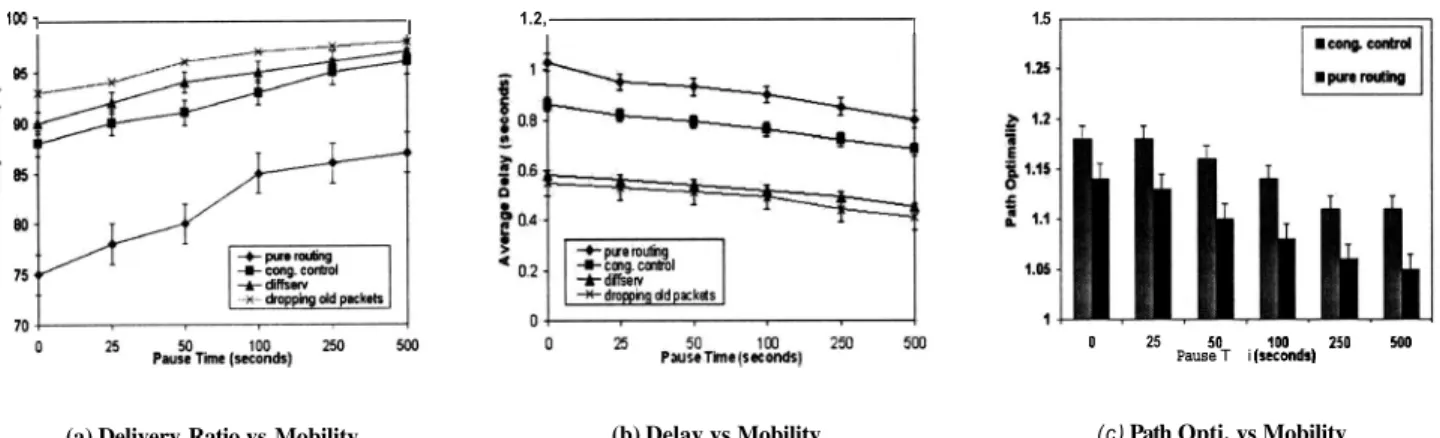
(a) Delivery Ratio vs Mobility (b) Delay vs Mobility
25
PauseT i
(c)Path Opti. vs Mobility
Figure 3. Simulation of50 nodes in an area of with 2
according to a lognormal distribution with =3.287 and =0.891, resulting in an average call length of about 40 seconds. According to a delay of over 150ms in a voice transmission is felt as disturbing by most users, and a de-lay above 250 ms is felt as unbearable. Thus in our sim-ulations, real-time packets exceeding this maximum delay of 250 ms are considered to have arrived too late and are dropped. Bulk traffic was modelled as the transmission of
a random amount of data with TCP uniformly
distributed between 100,000 and bytes. The time between the initiation of data transfers was exponentially distributed with a mean of30 seconds.
The different routing strategies simulated were:
0 No congestion control and service differentiation. 0 With congestion control (incorporating network
inter-face queue length in routing computation).
0 Congestion control and differentiation of realtime and bulk traffic, with
0 Differentiation of realtime and bulk traffic, with
= = and discarding of realtime
packets queued for more than 0.1 seconds.
We evaluate the performance of our algorithm with four metrics, namely
0 Packet delivery ratio, that is, the fraction of packets sent by a source node to that received by the corre-sponding destination node.
0 AverageETEdelaythat reflects the total time needed to successfully deliver a packet by a source node till it is received by the corresponding destination node. 0 Path that is, the fraction of delivered data
packets that were routed by the protocol over routes of various lengths relative to the shortest optimal route (the shortest optimal route is determined by the simu-lator).
Each scenario uses the same simulation parameters as in In addition, we set as 1. The simulation time is 500 seconds and we executed 20 runs of the simulations.
4.2
Results and Discussion
The results from the experiments are shown in Figure 3 and Figure
4.
In these graphs, the error bars represent the standard deviation of the mean out of 20runs.From Figure we see that the pure routing algorithm can deliver about 80%data at moderate nodal motion. This relatively good delivery is rooted in the multi-path nature of the algorithm. With congestion control, the packet de-livery ratio can be improved by about 10%. This is due to the route discovery that avoids the congestion areas, which results many packets being delayed in queues and eventu-ally dropped. Incorporating a differentiation scheme can also enhance the packet delivery ratio. This is mainly be-cause the differentiation scheme prioritises service classes, which forwards as much realtime traffic as possible before the bulk traffic. Thus, realtime traffic traffic rarely drops due to blockage by bulk traffic. As the pause time decreases, which presents higher nodal motion, the data delivery ratio decreases for all the routig schemes. This indicates that our approach of service differentiation is limited by the mobil-ity of nodes in a wireless ad network. Route failures caused by the nodal motion account for a certain number of packet losses, which cannot be reduced by any of these approaches.
Figure indicates that the packet delay is similar for the pure routing and congestion control routing, but integrating differentiation scheme with old realtime traffic droping can reduce much of the packet delay. This is be-cause discarding packets that are delayed by more than ms in an intermediate node's queue saves resources that benefit other packets, further improving the overall packet delivery ratio.
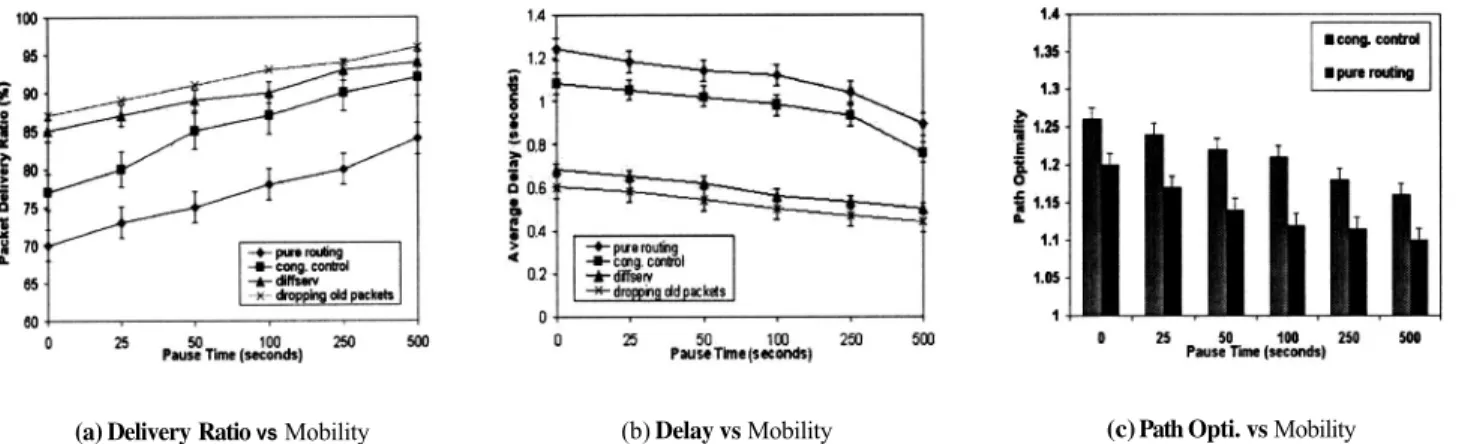
Figure 4. Simulation of 50 nodes in an area
of
with 10routing scheme, the average path length is about12% longer than the optimal one for the high nodal mobility and about 6% for the low nodal mobility. This indicates that, as nodal motion increases, the link errors increase. The local re-pair of the error links resulted in significant increase in sub-optimal routes. For the congestion control scheme, the aver-age routeisabout5%longer than that of pure routing. This can be explained by the fact that the algorithm tries to build longer routes to avoid congestion areas.
In the second set of results shown in Figure4,as both the network area and nodal mobility aregreater than those in the first set, the average performance of the algorithm is slightly worse in terms of packet delivery ratio and trans-mission delay. When the nodal motion is low, the results of the two sets are close. As the nodal motion increases, the performance in the second set drops more than that of the first set. As the network area increases, the path optimality also increases slightly.
The limitation of this simulation presented here is that we choose all the algorithm parameters based on previous experience. Therefore, these preliminary simulation results cannot reflect the sensitivity of the algorithm. More elabo-rate experiments need tobe done to investigate how to
timisethe algorithm parameters and how these parameters
arerelated to the network size and nodal mobility.
5
Conclusions
In this paper we present a biologically inspired routing algorithm for mobile multi-hop ad networks. Through the concept of stigmergy, inspired by the biological ants, local optimal routes emerge without the global connectivity information. A light-weight isintegrated to pro-vide simple support. The resultsof early simulations show that this algorithm performs fairly well under situa-tions of various nodal mobility, network density and data loads.
References
[ A Collaboration between UC Berkeley, LBL, and Xerox PARC.The Manual,2002.The VINT Project.
[2] Ahn,A.T.Campbell, A. Veras, and L.-H.Sun. Sup
porting service differentiation for real-time and best-effort traffic in stateless wireless ad networks (swan). IEEE
TransactionsonMobile 192-207,2002.
[3]R.Beckers, J. L. Deneubourg,an% S. and turns in the selection of the shortest path by the ant
er. o Theoretical Biolo y 1992.
[4] D. M. Z.Wang, and
W. Weiss. An architecture for differentiated services. RFC
[5] M.Dorigo, and G. Swarm
pence: From Natural to Oxford
sity Press,1999.
R. D.Clark, andS.Shenker. Integrated services in
e 'nte e C 63
[7] Y.C. Hu,
J.Yetcheva. A performance companson of multi-hop wire-lessad network routing InProceeding; of the International Conference on Mobile
.
-andNetworking 1998.
M. Gerharz, C. aal,M.Frank, and James. Apractical view on quality-of-service support in wireless ad net-works. InProceedingsofthe 3rd IEEE Workshopon Appli-cations and Services in Wireless Networks pages
[9] G.114.One Way Transmission
and D. Maltz. Dynamic source routing inad wireless networks.Mobile utin ,353,1996.
Z.Liu, M.Z.Kwiatkowska, Aswarm
intelligence routing algonthm for InProceedingsof the IASTED International Conference onCommunications Internet
C.E. and P. Bhagwat. dynamic
sequenced distance-vector routing (dsdv) for mobile com-puters. ACM SIGCOMM: Computer Communications
Re-view, 1994.
C.E. and Royer. Ad-hoc on-demand distance
vector routing. IntheSecond IEEE WorkshoponMobile Computing systems and Applications,pages90-100,1999.
[ R.Ramanathan and M. Steenstrup.
multihop wireless networks for quality-of-service support. ACM Mobile Networks and Applications,
P. andV.Bharghavan. A
extraction distributed ad routing algorithm. IEEEJour-nal Selected in Communications, Special on