University of Vermont
ScholarWorks @ UVM
Graduate College Dissertations and Theses Dissertations and Theses
2017
Exploring The Reciprocal Relationship Between A
Comprehensive Living-Learning Program And
Institutional Culture: A Narrative Inquiry Case
Study
Christopher Paul Marquart
University of Vermont
Follow this and additional works at:https://scholarworks.uvm.edu/graddis
Part of theHigher Education Commons, and theHigher Education Administration Commons
This Dissertation is brought to you for free and open access by the Dissertations and Theses at ScholarWorks @ UVM. It has been accepted for inclusion in Graduate College Dissertations and Theses by an authorized administrator of ScholarWorks @ UVM. For more information, please contact [email protected].
Recommended Citation
Marquart, Christopher Paul, "Exploring The Reciprocal Relationship Between A Comprehensive Living-Learning Program And Institutional Culture: A Narrative Inquiry Case Study" (2017).Graduate College Dissertations and Theses. 736.
EXPLORING THE RECIPROCAL RELATIONSHIP BETWEEN A COMPREHENSIVE LIVING-LEARNING PROGRAM
AND INSTITUTIONAL CULTURE: A NARRATIVE INQUIRY CASE STUDY
A Dissertation Presented
by
Christopher P. Marquart to
The Faculty of the Graduate College of
The University of Vermont
In Partial Fulfillment of the Requirements for the Degree of Doctor of Education
Specializing in Educational Leadership & Policy Studies May, 2017
Defense Date: March 10, 2017 Dissertation Examination Committee: Deborah E. Hunter, Ph.D., Advisor Stuart L. Whitney, Ed. D., RN, Chairperson Jason C. Garvey, Ph.D. Vijay Kanagala, Ph.D. Cynthia J. Forehand, Ph.D., Dean of the Graduate College
ABSTRACT
Over the past 50 years, living-learning programs (LLPs) have emerged as a dynamic curricular innovation in higher education. These programs are residentially based, seeking to seamlessly integrate the classroom and residence hall environments and blur the traditional boundaries between the academic and residential experiences for students (Kuh, 1996; Inkelas & Soldner, 2012). However, efforts to implement LLPs at some campuses have been met with resistance; this is not surprising, as institutions of higher education are often charged in part with preserving cultural and social norms, therefore making them naturally resistant to change (Shapiro & Levine, 1999). One of the most common challenges facing colleges and universities that seek change is a tendency for institutional culture dynamics to be potentially divisive and foster internal conflict (Kuh & Whitt, 1988). Such conflict impacts faculty, students, and administrative subcultures. Institutional partnerships that can overcome divisive cultural dynamics have the potential to greatly enhance the campus climate (Nash et al., 2016).
This qualitative research study asks the overarching question, “How does institutional culture influence the creation and development of an LLP and, in turn, can an LLP reciprocally shape institutional culture?”
This case study examines the internal conflict and cultural implications related to the founding of a comprehensive first-year residential college system at St. Lawrence University – a small, private liberal arts institution in the Northeast. Utilizing Kuh’s & Whitt’s (1988) Framework for Analyzing Culture in Higher Education, as well as Schein’s (2004) Conceptual Model for Managed Culture Change, this study collected data through historical document analysis, as well as narrative inquiry interviews
focusing on the artifacts, values, assumptions, and beliefs of the campus community. In-depth interviews were conducted with faculty and administrators who played key roles in the foundational years of this LLP, as well as with faculty who opposed the program. The findings of this study demonstrate how preexisting cultural conditions heavily influenced the creation and development of the LLP. This study also identifies the ways in which several deeply entrenched cultural conditions changed, indicating this
comprehensive LLP fostered a relational capacity to facilitate institutional culture change.
ii
DEDICATION
To Wesley and Colby
The two of you are my inspiration.
At some point in each of your lives, you will have to ask yourselves the question, “What does success look like for me?”
I hope this endeavor, and the story it tells, proves to be helpful in some small way for each of you as you seek to find your answers.
iii
ACKNOWLEDGEMENTS
This long and rewarding journey would not have happened without the love and support of my family. I would especially like to thank you, Emily, as you are my rock. I could not have done this without your unyielding support. We made it. I would also like to thank my parents, and Bob and Cathy, for all of your efforts and sacrifices throughout the years.
I would like to acknowledge Larry Casey and Coach John Casserly, two very special people from a much earlier time in my life. Each of you saw something in me at a time when not many others did. Your faith empowered me, shaped my path in life, and influenced my worldview in immeasurable ways. While much time has passed, please know that I would not have even considered starting this journey were it not for both of you and all you have done for me. Thank you.
This effort would not have been possible without the assistance and support of my amazing colleagues from St. Lawrence. I owe a huge debt of gratitude and thanks to President Bill Fox and Dean Val Lehr for consenting to this study. Jenny Hansen
deserves all of the credit for rounding up an impressive group of interview participants; I have no doubt someone else will one day write a history of her career accomplishments. I would also like to recognize the help of Debbie Bishop, Elaine White, Mark McMurray, and Paul Haggett for digging up primary source documents for me, as well as the support
iv
of Joe Tolliver and the entire Residence Life team for enabling me the flexibility to balance work commitments with this research effort.
Thank you to all of my interview participants for volunteering your time and sharing your memories. This proved to be a story of transformation with passion for students and learning at its core. I hope I was able to tell it in a holistic and accurate way that also captures the essence of how special this period of time was for so many of you.
Finally, I would like to thank my advisor, Deb Hunter, for her warm support and encouragement from day one. You supported me since before I was even accepted into UVM, and have been there for me every step of the way. To my defense committee, Vijay Kanagala, Jay Garvey, and Stuart Whitney, as well as Judith Aiken; each of you have been so supportive and helpful throughout this process and I could not have done it without you. Thank you!
v TABLE OF CONTENTS Page DEDICATION ... ii ACKNOWLEDGEMENTS ... iii LIST OF TABLES ... xi
LIST OF FIGURES ... xiii
CHAPTER 1: INTRODUCTION ... 1 1.1. Statement of Problem ... 2 1.2. Significance of Study ... 4 1.3. Local Context... 8 1.4. Purpose of Study ... 9 1.5. Research Questions ... 10 1.6. Conceptual Framework ... 11
1.7. Definition of Relevant Terms ... 13
1.8. Background and Role of Researcher ... 14
1.9. Organization of Study ... 17
CHAPTER 2: LITERATURE REVIEW ... 20
2.1. Theoretical Frameworks ... 22
vi
2.1.2. Schein’s Conceptual Model for Managed Culture Change ... 24
2.2. Institutional Culture ... 25
2.2.1. Student Cultures ... 26
2.2.2. The “Distinctive College” ... 29
2.2.3. Expanding the Scope of Institutional Culture ... 30
2.3. Organizational Change ... 32
2.4. A Historical Overview: Residential Liberal Arts Colleges & Culture ... 38
2.4.1. European Influences ... 39
2.4.2. Colonial America ... 40
2.4.3. Antebellum Period ... 42
2.4.4. The Industrial Revolution & Educational Reform ... 45
2.4.5. The Post-War Era ... 48
2.4.6. Academic Curriculum: The Evolving Definition of Scholarship ... 52
2.4.7. Guiding Philosophies of the Student Affairs Profession ... 58
2.5. History of Living-Learning Programs ... 61
2.6. Living-Learning Programs... 68
2.6.1. Foundational Research for LLPs ... 69
2.6.2. National Study of Living-Learning Programs ... 74
2.6.3. Implementation of Learning Communities ... 77
2.7. Analysis of Literature ... 80
CHAPTER 3: METHODOLOGY ... 85
3.1. Research Questions ... 87
3.2. Research Paradigm ... 87
vii 3.4. Research Design ... 90 3.5. Setting ... 92 3.6. Sample Population ... 94 3.7. Access to Site ... 96 3.8. Instrumentation ... 97
3.9. Trustworthiness and Dependability ... 97
3.10. Data Collection Procedures ... 100
3.10. Data Analysis Procedures ... 102
3.11. Ethical Considerations ... 107
3.12. Limitations and Delimitations ... 108
CHAPTER 4: INSTITUTIONAL SETTING ... 111
4.1. “A Candle in the Wilderness” Is Founded, 1856 ... 112
4.2. The Early Years, 1858 – 1887 ... 115
4.3. Campus Change and the “Epoch of Expansion,” 1888 – 1918 ... 121
4.4. Transformation into a Residential College, 1919 – 1939 ... 130
4.5. World War II and the Post-War Boom, 1940 – 1969 ... 139
4.6. Student Activism and Emerging Concerns with Greek Life, 1969 – 1978 ... 148
CHAPTER 5: FINDINGS ... 161
viii
5.2. Research Question 1: Preexisting Culture Conditions... 166
5.2.1. Student Culture ... 167
5.2.2. Faculty Culture ... 171
5.2.3. Administrative Culture ... 173
5.2.4. The BASK Program ... 174
5.2.5. Committee on the Academic Environment ... 176
5.2.6. The Beta House Fire and the Ad Hoc Report ... 177
5.2.7. The “Flying Blue Max” ... 180
5.2.8. The Departure of Van de Water ... 182
5.2.9. The Gulick White Paper ... 183
5.2.10. East College and the Experimental Residential Colleges ... 186
5.2.11. Greek Debate Continues: Reciprocal Standards vs. CAGS ... 190
5.2.12. The Committee on Residential Life ... 195
5.3 Research Question 2: Reasons for a Residential College Model ... 197
5.3.1. Reasons for a Residential Model ... 197
5.3.2. The Summer Study Group ... 199
5.3.3. The 1986 Proposal for Calendar and Curriculum Change ... 200
5.4. Research Question 3: Implementation and Initial Development of FYP ... 202
5.4.1. Implementation Efforts and “The Great Land Grab” ... 202
5.4.2. A Summer of Change ... 205
5.4.3. The Pilot Year, 1987 - 1988 ... 210
5.4.4. The FYP Expands ... 213
5.4.5. The Departure of Howison ... 215
5.4.6. Assessment of the FYP ... 216
5.4.7. The Spring 1992 Debate ... 221
5.4.8. Cultural Perspectives of the FYP Debates ... 224
5.4.9. A New First-Year Dean and Program Changes ... 229
5.4.10. “REC 26” ... 233
ix
5.5. Research Question 4: Perceived Culture Change ... 240
5.5.1. Relationships Strengthened ... 240
5.5.2. The Fall of Greek Life ... 243
5.5.3. More Support for Sexual Assault Survivors ... 244
5.5.4. Increase in Interdisciplinary Efforts ... 245
5.5.5. Professional Development of Faculty ... 246
5.5.6. Unified Administrative Focus for the Institution ... 247
CHAPTER 6: DISCUSSION, CONCLUSIONS, AND IMPLICATIONS ... 251
6.1. Discussion of Findings ... 253
6.2. Conclusions: Fostering Relational Capacity for Culture Change ... 257
6.3. Revisiting Limitations ... 262
6.4. Implications for Future Practice ... 263
6.5. Implications for Future Research... 269
REFERENCES ... 272
APPENDICIES ... 286
Appendix A. Letter Seeking Access to Research Site ... 286
Appendix B. Sample Letter to Interview Participants ... 288
Appendix C. IRB Consent Form ... 290
Appendix D. Interview Protocol ... 295
Appendix E. Coding Legend – Research Questions #1 and #2 ... 296
x
Appendix G. Coding Legend – Research Question #4 ... 298 Appendix H. New Student Affairs Structure for 1987-88 ... 299 Appendix I. FYP Pilot Year Faculty-Staff Roster, 1987-88 ... 300
xi
LIST OF TABLES
Table Page
Table 1: Principles of the Conceptual Model for Managed Culture Change ... 25
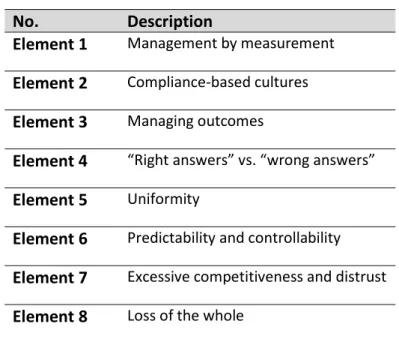
Table 2: Senge’s Elements of the Prevailing System of Management ... 34
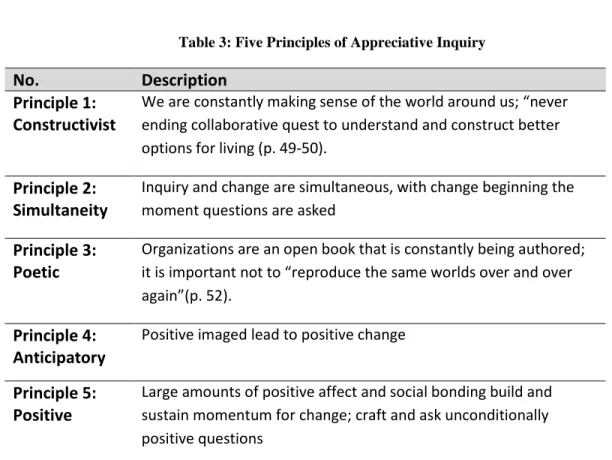
Table 3: Five Principles of Appreciative Inquiry ... 36
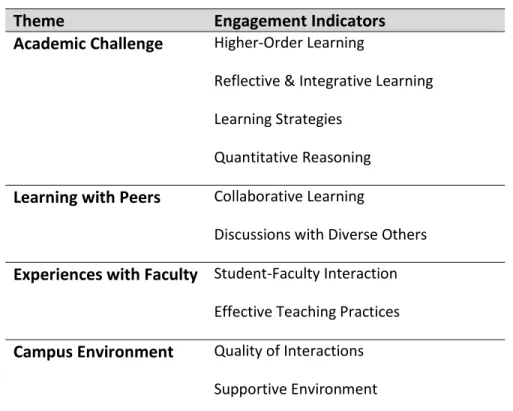
Table 4: NSSE Engagement Indicators ... 73
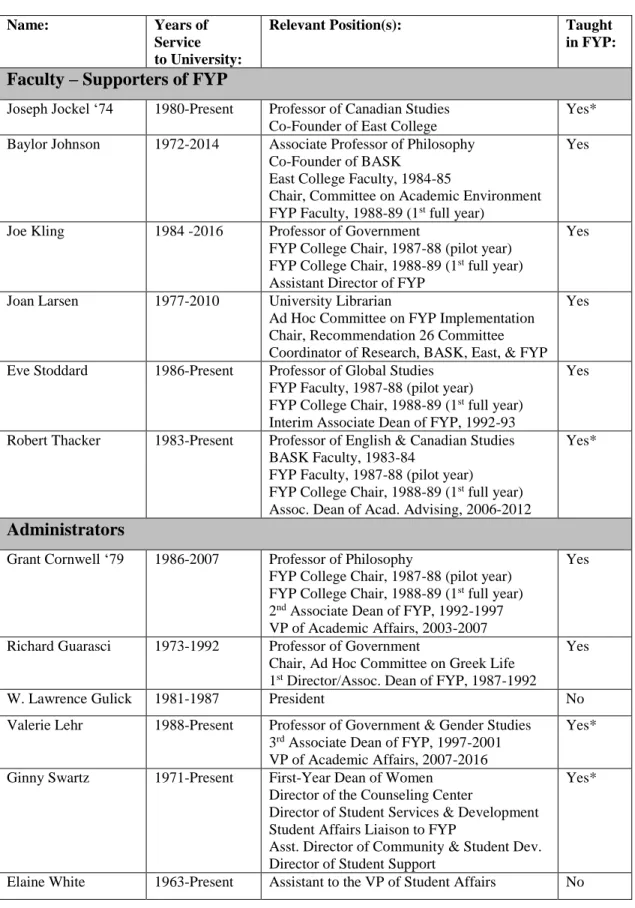
Table 5: Interview Participants ... 95
Table 6: A-Priori Coding ... 104
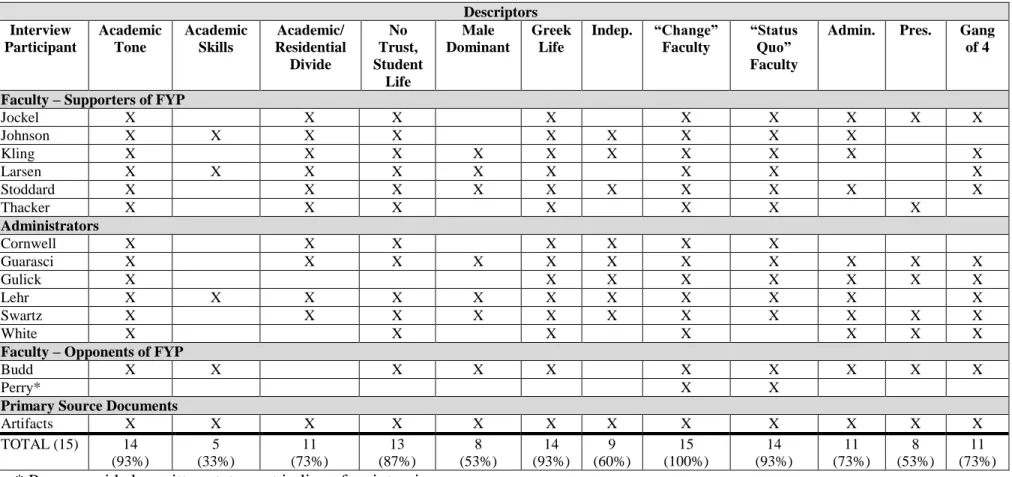
Table 7: Causational Culture Conditions ... 163
Table 8: Cultural Factors of Implementation and Development ... 164
Table 9: Perceived Change in Institutional Culture ... 165
Table 10: Axial Coding ... 166
Table 11: Recommendations of Ad Hoc Committee on Greek Life ... 179
Table 12: Shared Goals of Experimental Residential Colleges ... 189
Table 13: Obligations Identified by Committee on Residential Life ... 196
xii
Table 15: Approved Greek Organization Parties, Fall 1991 vs. Fall 1992 ... 234
Table 16: REC 26 Committee Recommendations ... 235
xiii
LIST OF FIGURES
Figure Page
Figure 1: Conceptual Framework ... 12
Figure 2: Theoretical Framework ... 23
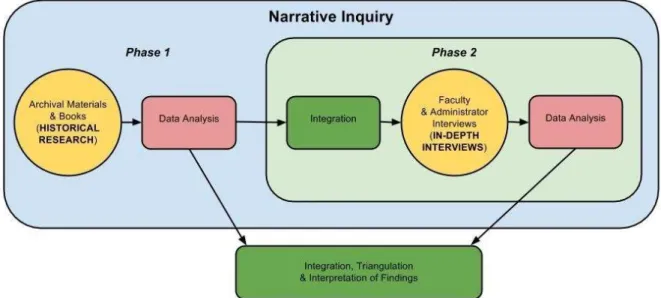
Figure 3: Research Design ... 91
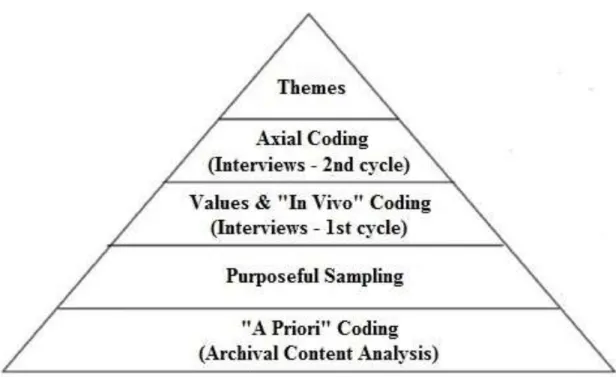
Figure 4: Data Analysis Cycles ... 103
Figure 5: Organizational Chart, Second Generation of FYP ... 231
1
CHAPTER 1: INTRODUCTION
On December 12, 1986, a memo containing the following announcement was released by Dr. G. Andrew Rembert, Dean of Academic Affairs, on behalf of the faculty at St. Lawrence University:
In a series of seven meetings this fall, the St. Lawrence faculty has completed its present work on curriculum and calendar reform. The specific resolutions, each one approved by a large majority, are listed below. In essence, the faculty adopted a new Freshman Program…These faculty resolutions raise various
implementation questions…We basically hope to offer a pilot version of the Freshman Program as an elective in 1987-88, and move to full implementation for all entering students in Fall 1988. (p. 1)
A list of eight specific resolutions from an ad hoc committee chaired by Dean Rembert followed, detailing how this initiative would be a “two-semester, multi-disciplinary freshman program which will have the purpose of promoting a habit of active intellectual inquiry among first year students and introducing them to significant human questions;” another fundamental component was “the freshman program [would] be taught within the residential college system” (Rembert, 1986, p. 2). This decision by the faculty
represented a fundamental shift in how the University would transition first-year students into the academic and residential community of the university. This program would have broad implications not only on the academic curriculum, but also on the residential environment and pre-existing relational dynamics between faculty, students, and
administrators at the university. In other words, the proposed “Freshman Program” was poised to have a transformational impact on the institutional culture of St. Lawrence University.
2
1.1. Statement of Problem
One of the most common, yet complex challenges facing colleges and universities across the United States is a historically-rooted tendency for institutional culture
dynamics to be potentially divisive and foster inherent conflict (Kuh & Whit, 1988). The most visible form of cultural conflict typically exists between students and the academy, as is clearly evident when analyzing the history of traditional “campus life” in America. It is a history that has long been dominated by what Horowitz (1987) identifies as “college men” and “college women” subcultures, often resulting in a student focus on vibrant social life, grade obsession, and a lack of intellectual adventure. A student culture dominated by anti-intellectualism is at odds with the values, assumptions and beliefs of faculty and administration (Horowitz, 1987). Despite striving to achieve a shared institutional mission, faculty and administrators at many colleges and universities often struggle to establish effective collaborate efforts successfully blending classroom learning with the residential experience. This cultural conflict is rooted in the
philosophical and structural disconnects between academic and residential life on
campus, with the result being faculty and administration forming adversarial relationships (Doyle, 2004). Furthermore, similar culturally-based conflict can also exist between different subcultures within the faculty (Kuh & Whitt, 1988; Bergquist, 1992). Each of these conflicting institutional culture dynamics can negatively impact the student experience and inhibit learning.
Students face a number of defining challenges during their first year in college. These challenges can be overcome through the personal relationships they develop with
3
faculty and other members of the campus community (Chambliss & Takacs, 2014). It is important for institutions to change in ways that provide a more seamless living-learning experience, thereby enabling students to successfully transition into college life.
Institutional culture has a significant impact on these relationships, as it influences practically all aspects of college life (Kuh & Whit, 1988). Specifically, institutional culture has an incredibly deep and reciprocal impact in shaping the history, artifacts, fundamental values, basic assumptions, and beliefs shared by a campus community (Tierney, 1988; Kuh & Whitt, 1988). If cultural conflicts exist between faculty and administrators, or if the organizational structure inhibits relationship-building
opportunities between academic and residential life on campus, the natural pathways students need to build critical relationships may be impeded.
One potential solution to the problem of divisive institutional culture dynamics being compounded by structural disconnects of academic and residential life are
residentially based living-learning programs (LLPs). As explained by Kuh (1996), LLPs integrate the classroom and residence hall environments, blurring the traditional
boundaries between the classroom and co-curricular experience. This integrated
residential experience has the capability of facilitating a cohesive cultural bridge between faculty, students, and administrators (Levin Laufgraben, O’Connor, & Williams, 2007). When faculty and administration are able to partner in ways that overcome divisive cultural dynamics, opportunities are created to better educate the whole student and greatly enhance the campus climate (Nash et al., 2016). Unfortunately, institutions of higher education are well-known for being naturally resistant to change; colleges and
4
universities identify strongly with their own cultural heritage and are often charged in part by society to preserve cultural and social norms (Shapiro & Levine, 1999). Not surprisingly, efforts to implement LLPs at some campuses have been met with resistance (Watts, 1999). This case study seeks to provide a thick description of one such
implementation effort that was met with resistance, illuminate the cultural implications of the conflict, and identify ways in which the LLP fostered cultural change.
1.2. Significance of Study
The value of a college degree – and the role higher education plays in preparing students to be well-educated, actively engaged citizens – is more important than ever in today’s culturally diverse democratic society. Learning occurs both inside and outside of the classroom with each playing an important role in providing a holistic educational experience (Kuh, 1996). Unfortunately, the fact remains many colleges and universities in the United States struggle to foster learning environments successfully blending academic and residential life and engaging students in holistic ways (Nash, 2016). This dynamic perpetuates potentially divisive institutional culture dynamics between faculty, students, and administrators (Kuh & Whitt, 1988). It also inhibits institutions of higher education from cultivating college graduates who are fully prepared for tomorrow’s real world challenges, while at the same time negatively impacting student retention efforts. Since this study seeks to understand the cultural implications related to the founding and implementation of a comprehensive LLP, its findings may positively contribute to efforts of addressing these systemic problems within higher education.
5
College plays a critical role in the economic health of our nation, as well as the mental and moral health of the individual; at its core it must facilitate the study and transmission of knowledge to the next generation (Delbanco, 2012). America’s shift from an industrial economy to a knowledge-based economy has created an increased need for a well-educated workforce possessing strong written and oral communication skills. Recent developments both globally and nationally have transformed our world into a more complex, interconnected community, requiring the need for critical thinkers who can understand and approach problems from multiple perspectives and successfully promote cultural pluralism (Guarasci & Cornwell, 1997). A recent study conducted by the Association of American Colleges and Universities (AACU) found that 96% of
employers “agreed that, regardless of their chosen field of study, all students should have experiences in college that teach them how to solve problems with people whose views are different from their own” (AACU, 2015, p. 4). Students who participate in LLPs are best prepared for this quickly-evolving and diverse world, as research shows they not only find meaning with regard to obtaining social and academic support, yet are also more likely to engage in multicultural experiences and become leaders (Spanierman et al., 2013). As confirmed by the memorandum issued by Dean Rembert in the fall of 1986, the faculty at St. Lawrence University shared these same concerns. In response, they proposed and implemented the First-Year Program, a comprehensive LLP that sought to change student culture in positive ways – both in and out of the classroom – so learning could become more interdisciplinary and meaningful.
6
In order to fully capitalize on a collegiate experience promoting personal growth, critical thinking, and cultural pluralism, it is essential for students to feel supported by their campus community, develop a sense of belonging, and actually graduate.
According to the U.S. Department of Education’s (2015) National Center for Education Statistics most recent findings, only 59% of undergraduate students who began their pursuit of a bachelor’s degree in 2007 at a 4-year institution graduated by 2013, or within six years. Furthermore, a recent study conducted by the JED Foundation (2015) found students who feel emotionally unprepared for college are more likely to report poor academic performance and have a negative college experience – and that 60% of
incoming first-year students reported they did not feel emotionally prepared for college. Significant research exists demonstrating the effectiveness of LLPs on a broad spectrum of student outcomes that can help strengthen the student experience and reduce attrition. Astin (1977) demonstrated how positive experiences in the residence halls lead to an increase in student involvement with co-curricular activities, academic involvement, and faculty-student interactions, all of which foster a higher level of individual student satisfaction. Contemporary research also shows how students who are part of LLPs perceive “a culture [promoting] seamless learning, a scholarly environment, and an ethos of relatedness among faculty, staff, and peers” (Wawrzynski, Jessup-Anger, Stolz, Helman, Beauliue, 2009, p. 138). Two separate national studies on LLPs have found they facilitate the social and academic transition to college, enhance individual student self-confidence in college success, increase levels of co-curricular engagement, and create a stronger sense of belonging (Inkelas & Associates, 2008; Mayhew et al., 2016).
7
Finally, the focus of this case study is significant as it also seeks to describe the evolving institutional culture conditions and how they ultimately shaped interpersonal relationships at St. Lawrence. Its findings may provide educational leaders with insight into better navigating complex and challenging cultural conflict. Every college and university in the United States faces its own set of complex, multifaceted challenges; they are not only influenced by powerful external factors such as demographics, economics, and politics, yet are also challenged and shaped by internal forces (Tierney, 1988). How educational leaders interpret and understand these challenges is a key factor in how successful their efforts for organizational change end up being. As explained by Kuh & Whitt (1988), it is also beneficial to analyze student behavior through the lens of culture, which allows student actions often perceived as negative to be “viewed as an interpretive framework for understanding and appreciating events and actions in colleges and
universities rather than a mechanism to influence or control behavior” (p. 3). This is an important consideration, as there exist many documented cases throughout history of institutions failing to “control” student behavior in response to perceived negative student behavior – with rebellion, student protests, or violence often being the end result
(Rudolph, 1990; Horowitz, 1987; Leslie, 1992; Lucas, 2006; Thelin, 2004). Furthermore, when implementing decisions, educational leaders should possess not only a
comprehensive understanding of the challenges facing their organization and the options available to them, but also strive to develop a complete, nuanced understanding of their organization’s culture and how each decision may be interpreted – and therefore impact – their respective campus community (Tierney, 1988). Those who successfully pursue
8
such a culturally-sensitive course of action often see their efforts flourish into what Burton Clark (1970) describes as an “organizational saga” – when a successful mission is enacted and transforms a theme and/or program into a “powerful legend” that stands the test of time (p. 8). The First-Year Program, a comprehensive LLP approved by St. Lawrence University faculty in the fall of 1986, ultimately proved to be a compelling chapter in that institution’s organizational saga. This case study may help illuminate the way for others.
1.3. Local Context
St. Lawrence University is a small, private liberal arts college located in a rural community in upstate New York. The total undergraduate enrollment in the 2015-2016 academic year was approximately 2,400 students, 99% of whom live in university-owned on-campus housing or recognized Greek-affiliated housing. It is a selective institution, with an acceptance rate of 42% for the Class of 2020. Founded in 1856 by the
Universalist Church, it is recognized as the oldest continuously coeducational institution of higher education in New York State. While predominately a residential undergraduate college today, the institution at one time also housed a theological school, and
agricultural college, a graduate college, and an off-site law school located in Brooklyn. St. Lawrence has “university” status today due to the presence of a small graduate college with approximately 100 students enrolled in three graduate programs. A comprehensive history of the institutional setting for this case study is outlined in Chapter 4.
The comprehensive LLP at the center of this case study, the First-Year Program (FYP), was formally launched as a pilot at St. Lawrence in the 1987-1988 academic year.
9
Approximately one third of the incoming first-year class enrolled in the FYP during its inaugural year. The following year, the FYP became a requirement for all incoming first-year students at the University. It continues to be a cornerstone of the academic
curriculum at St. Lawrence to this day. Over the years, the University has conducted extensive assessment on the FYP in an effort to understand the program’s impact on student learning. External and internal reviews were performed within the first five years of the program’s existence and are discussed in Chapter 5. Ongoing assessment efforts have also been conducted by the Office of the First-Year, the Office of Institutional Research, and the University’s Assessment Committee. Survey instruments utilized include the National Survey of Student Engagement (NSSE), the Cooperative
Institutional Research Program (CIRP) Freshman Survey, the Higher Education Research Institute (HERI) College Senior Survey, and the Higher Education Data Sharing
Consortium (HEDS) Senior Survey. Several in-house survey instruments are also utilized to assess the effectiveness of the FYP. These collective efforts help explain why this case study focuses on the FYP’s influence on institutional culture, rather than seeking to assess its effectiveness on specific student learning outcome(s).
1.4. Purpose of Study
This case study provides a thick description of the internal conflict and cultural implications related to the founding and implementation of St. Lawrence University’s First-Year Program, a comprehensive LLP aimed at supporting the first-year student transition. Through historical document analysis, as well as qualitative research focusing on the fundamental values, basic assumptions, and shared beliefs of the campus
10
community, this case study seeks to understand why this program was founded, how it was ultimately able to sustain within the organization, and identify ways in which its presence has shaped institutional culture for faculty, students, and administrators. The literature review topics I review include institutional culture, organizational change, and living-learning programs. I also provide a historical overview of liberal arts colleges and incorporate the evolution of academic curriculum, scholarship, and the student affairs profession.
To study this problem, this case study adopted a two-phase approach. First, I analyzed public institutional archive documents and artifacts to gain a comprehensive understanding of the history of the university, as well as the evolution of the FYP. I then utilized a narrative inquiry approach to conduct in-depth interviews with faculty and administrators who played key roles in the foundational years of this LLP, as well as with faculty who opposed the program.1 The findings of this study demonstrate how
preexisting cultural conditions heavily influenced the creation and development of the FYP. This study also identifies the ways in which several deeply entrenched cultural conditions changed, indicating this comprehensive LLP fostered a relational capacity to facilitate cultural change
1.5. Research Questions
Two key research questions guide the overall methodology of this study.
Utilizing Kuh & Whitt’s (1988) Framework for Analyzing Culture in Higher Education, this study seeks to illuminate:
1 My access to the setting of this case study enabled me to interview multiple subjects who have been
11
1. How does institutional culture influence the creation and development of an LLP? 2. In what ways can an LLP reciprocally shape institutional culture?
Four sub-questions also guide this study. Based on Schein’s (2004) Conceptual Model for Managed Culture Change, these sub-questions were utilized as a guiding framework for the interview protocol and helped clarify the focus of relevant content to be
researched:
1. What were the institutional culture conditions at St. Lawrence University in the 1970’s and 1980’s and how did they contribute to the formation of the FYP? 2. Why was a residential college model adopted for the FYP?
3. What cultural factors influenced the implementation and initial development of the FYP?
4. In what ways do faculty and administrators perceive institutional culture
conditions have changed at St. Lawrence since the implementation of the FYP?
1.6. Conceptual Framework
The conceptual framework of this study embraces an interpretivist paradigm while at the same time employing a multi-lens theoretical framework to research. An interpretive approach believes individuals seek to understand their world through the process of developing subjective meanings of their life experiences (Creswell, 2013). These subjective meanings “are varied and multiple, leading the research to look for the complexity of views rather than narrow the meanings into a few categories or ideas (Creswell, 2013, p. 24). This conceptual approach accurately explains the root problems
12
identified above, while at the same time bridging a natural connection with the narrative inquiry research methodology utilized by this case study.
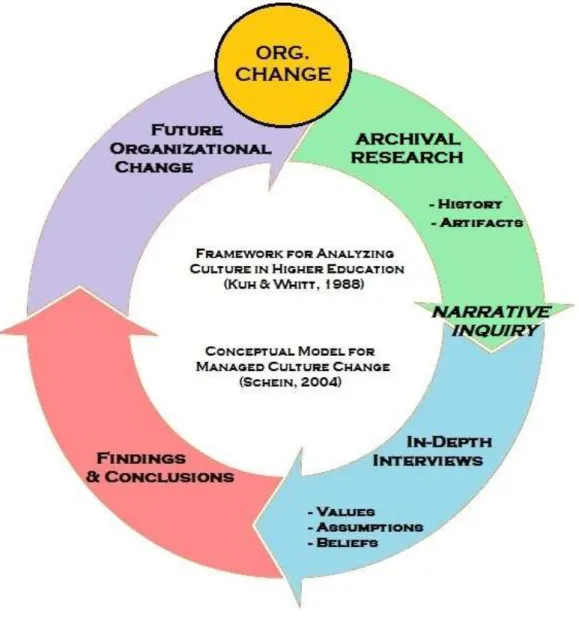
Figure 1: Conceptual Framework
The research methodology and research questions of this study are framed around a multi-lens theoretical framework, outlined in Figure 1. Kuh & Whitt’s (1988)
13
culture. Since this definition specifically describes institutional culture as “a process as well as a product” (Kuh & Whitt, 1988, p. iv), the scope of this study will focus not only on the development and implementation of St. Lawrence University’s FYP, yet also seek to understand how the program was able to sustain itself and reciprocally impact
intuitional culture beyond its foundational years. This study will also adopt Schein’s Conceptual Model for Managed Culture Change, and his concept of “unfreezing” and “refreezing,” as a theoretical mechanism to construct the cultural change documented in this case study. Both theoretical frameworks will be discussed in-depth in Chapter 3.
1.7. Definition of Relevant Terms
The three central concepts of this case study are institutional culture,
organizational change, and living-learning programs. I have adopted Kuh & Whitt’s (1988) definition of institutional culture, which is described as:
The collective, mutually shaping patterns of norms, values, practices, beliefs, and assumptions that guide the behavior of individuals and groups in an institute of higher education and provide a frame of reference within which to interpret the meaning of events and action on and off campus. (p. 12-13)
This study focuses on organizational change resulting in cultural shifts, and therefore can best be understood through Schein’s (2004) definition of organizational culture:
A pattern of shared basic assumptions learned by a group as it solved its problems of external adaption and internal integration that has worked well enough to be considered valid, and therefore to be taught to new members as the correct way to perceive, think and feel in relation to those problems (p. 12). I will also provide a general definition for LLPs, and further clarify what I mean when I refer to St. Lawrence’s program as a comprehensive LLP. This study defines an LLP by assuming the same definition adopted by the National Study of Living-Learning
14
Programs (Inkelas & Associates, 2008), as well as the Study of Integrated Living-Learning Programs (Mayhew et al., 2016). This constitutes any program in which students, “live together on campus, take part in a shared academic endeavor, use resources in their residence environment designed specifically for them, and have structured social activities in their residential environment that stress academics” (Inkelas, Zeller, Murphy & Hummell, 2006, p. 11). However, as Inkelas & Associates (2008) explain, the types of LLPs offered across the country vary greatly. Therefore, this study embraces the empirically-derived structural typologies identified by Inkelas,
Soldner, Longerbeam, & Brown Leonard (2008) and identifies St. Lawrence’s FYP as a “comprehensive” LLP. Such programs are defined as “large, comprehensively resourced, student affairs/academic affairs collaboration programs…students in this type of living-learning program had access to a wide range of resources as well as programs” (Inkelas et al., 2008, p. 503).
1.8. Background and Role of Researcher
My connection to this topic is rooted in my personal experience during my
undergraduate years, as well as my professional experience as an educator. As a student, I transferred between two colleges with very different institutional cultures. When I
originally chose to attend college, I planned to be an engineer and attended an institution focusing exclusively on math, science, and technical training. This school aggressively promoted the educational paradigm of career preparation. A cornerstone of its
curriculum was a year-round academic calendar featuring a comprehensive “co-op” program beginning freshman year and continuing through senior year; my fellow
15
classmates and I would spend six months of every year spread throughout the country, working for our respective engineering firms. The intended goal of this integrated co-op experience was true hands-on, practical job training. As a result, the six months spent on-campus taking classes proved to be a very rigid, academically-focused experience. It offered little flexibility in the curriculum and did not incorporate opportunities for
personal reflection of the co-op experience. Even less attention was devoted to integrated co-curricular activities or student life, as on-campus residential housing was only offered to first-year students. All upperclass students were forced to find off-campus housing beginning sophomore year or join a Greek organization and live in a chapter house.
During this time in my life, I found myself visiting other college campuses to connect with old high school friends. I quickly recognized a stark difference between their college experience and mine. Many of my friends were exploring different academic interests, participating in intercollegiate athletics, and getting involved with student clubs and organizations. They were also forming deeper connections with their classmates than I was, all within a vibrant campus life environment. Such are the
opportunities readily available when an individual spends the bulk of a calendar year in a shared residential environment with the same community of people. It was clear to me that my friends’ out-of-classroom experiences were playing an equally large role in their education and complimenting their academic growth in ways my “college experience” was not. I soon began to question the holistic quality of the education I was receiving.
At the conclusion of my sophomore year, I chose to transfer to a liberal arts institution and changed my major to history and education. At my new school, I also
16
chose to enroll in a broad spectrum of humanities courses, competed as an intercollegiate athlete, and became a Resident Assistant. I was encouraged by those around me to embrace all of these opportunities. This self-directed personal journey taught me how significantly institutional culture can impact the college experience. I also learned how critical the role of residential and co-curricular experiences can be in positively shaping an individual student’s academic and social growth. This life experience drives my passion and conceptual approach to this topic.
My connection to this particular case study site is rooted in my childhood upbringing, as I grew up in the same small, rural town in upstate New York where St. Lawrence University is located. My family moved to this community in November of 1986, at approximately the same time the faculty voted to approve the “Freshman
Program.” This commonality creates within me a feeling of intangible connection, for as I was growing up just a few miles down the road from this campus, the FYP was
undergoing a similar transformation of growth and development. This LLP was taking shape and making an impact on the first-year student transition, while at the same time reciprocally shaping the institutional culture of the university.
During the early stages of my professional career in student affairs, I was fortunate to help lead development efforts of new LLPs at two separate institutions. However, in both cases these programs were met with resistance by faculty who held strong reservations or opposed the program outright. The presence of such deep-seeded cultural tensions have always intrigued me. I have since returned to my hometown and currently serve as the Assistant Dean of Student Life and Director of Residence Life &
17
Housing at St. Lawrence University. In this professional role, I work directly with the current Associate Dean of the First Year in identifying ways to further strengthen academic and residential connections for first-year students.
My personal self-directed life journey, as well as my unique, full-circle connection to St. Lawrence University’s FYP, drives my passion for this research. I sincerely believe this is an important narrative to share. However, my specific role as a researcher in this process is to be a learner and reflect upon the research process and its findings; it is crucial to “learn from and with research participants” and not approach this process as an expert or authority figure (Glesne, 2011, p. 60). Furthermore, the
interviewer must become an attentive listener who shapes the process into a familiar and comfortable form of social engagement, or conversation (Patton, 2002). Through this approach, I seek to illuminate the cultural implications behind this LLP’s initial founding, why it was able to ultimately sustain, and how it has reciprocally shaped institutional culture.
1.9. Organization of Study
This introductory chapter has provided a brief summary of the problem that will be examined, in addition to explaining its significance. The purpose of this case study was then stated, along with an outline of the conceptual framework and corresponding research questions. Relevant terms were then identified, in addition to a brief description of my background and role as a researcher in this study. I also shared my personal background and reasons for choosing this particular study.
18
The next chapter of this case study provides a comprehensive review of literature in the areas of institutional culture, organizational culture change, and living-learning programs. Since the narrative inquiry structure of this particular study provides a thick description of St. Lawrence University’s history, as well as a detailed history of the FYP, my literature review also provides a brief history of liberal arts colleges in America. This history specifically focuses on trends in student culture over time, in addition to
developments in academic curriculum, scholarship, LLPs, and the profession of student affairs.
Chapter 3 focuses on the methodology of this case study and outlines a clear research design proposal. I discuss the value of utilizing narrative inquiry approach and why individual interviews are appropriate for this particular qualitative study, in addition to data collection and analysis procedures. The setting of this case study will also be described, including the overall and sample populations, and all factors associated with access to the site. I will also address reliability and validity concerns, limits and delimitations, and ethical considerations.
Chapter 4 provides an in-depth description of the institutional setting of this case study. It is a summary of the first half of my document analysis, focusing on the history of St. Lawrence University beginning with its founding in 1856 through the late 1970’s. This historical overview provides not only concrete facts – dates, people, and events – but also provides a “cultural roadmap” for the reader. The narrative shared throughout Chapter 4 clarifies precisely how the history of this unique institution created and shaped the values, assumptions, and beliefs of the campus community over the course of its first
19
125 years, ultimately leading to the cultural conditions that necessitated the faculty to take action and advocate for the creation of the FYP in the early 1980’s.
The findings of this case study are shared in Chapter 5. I present them by integrating the second half of my document analysis with quotes from the in-depth narrative inquiry interviews, highlighting key themes and cultural artifacts. The time period discussed in Chapter 5 are the foundational years of the FYP, beginning in the late 1970’s, through the summer of 1996. I also highlight the ways in which faculty and administrators perceive the FYP has reciprocally shaped the institutional culture of the University.
Finally, Chapter 6 of this case study provides a comprehensive discussion and analysis of the research questions. Connections to the literature review are made, and transferable conclusions are drawn based on the research findings. Limitations of this case study are reviewed once again, and I also discuss implications for future practice as well as implications for future research.
20
CHAPTER 2: LITERATURE REVIEW
Students face a number of defining challenges during their first year in college. These challenges can be overcome through the personal relationships they develop with faculty and other members of the campus community (Chambliss & Takacs, 2014). It is important for institutions to change in ways that provide a more seamless living-learning experience, thereby enabling students to transition successfully into college life.
However, one of the most common challenges facing colleges and universities that seek change is a tendency for institutional culture dynamics to be potentially divisive and foster internal conflict (Kuh & Whitt, 1988). Such conflict impacts faculty, students, and administrative subcultures.
One potential solution to the problem of divisive institutional culture dynamics being compounded by structural disconnects of academic and residential life are
residentially based living-learning programs (LLPs). As explained by Kuh (1996), LLPs integrate the classroom and residence hall environments, blurring the traditional
boundaries between the classroom and co-curricular experience. This integrated
residential experience has the capability of facilitating a cohesive cultural bridge between faculty, students, and administrators (Levin Laufgraben, O’Connor, & Williams, 2007). When faculty and administration are able to partner in ways that overcome divisive cultural dynamics, opportunities are created to better educate the whole student and greatly enhance the campus climate (Nash et al., 2016). Unfortunately, institutions of higher education are well-known for being naturally resistant to change; colleges and universities identify strongly with their own cultural heritage and are often charged in
21
part by society to preserve cultural and social norms (Shapiro & Levine, 1999). It is important for educational leaders to understand these complex, culturally-based conflicts and possess the ability to interpret and overcome these challenges (Tierney, 1988).
This case study provides a thick description of the internal conflict and cultural implications related to the founding and implementation of St. Lawrence University’s First-Year Program (FYP), a comprehensive LLP aimed at supporting the first-year student transition. Through historical document analysis, as well as qualitative research focusing on the fundamental values, basic assumptions, and shared beliefs of the campus community, this case study seeks to understand why this program was founded, how it was ultimately able to sustain within the organization, and identified ways in which its presence shaped institutional culture for faculty, students, and administrators.
Before the findings of a study can be discussed, it is important to place them within the proper context and establish a thorough understanding of relevant scholarly literature. This chapter will provide a comprehensive review of literature and research in the areas of institutional culture, organizational change, and living-learning programs (LLPs). First, I will discuss the two scholarly works serving as the theoretical
frameworks for this study – Kuh & Whitt’s (1988) Framework for Analyzing Culture in Higher Education, as well as Schein’s (2004) Conceptual Model for Managed Culture Change. Second, I will outline key research in the field of institutional culture within higher education. A review of relevant organizational change theory will then be discussed. I will then provide a brief history of residential liberal arts colleges in America. This historical overview specifically focuses on intersecting trends between
22
student culture, academic curriculum, scholarship, and student affairs; it is important to provide this historical perspective so the narrative of St. Lawrence University can be placed into proper context. The final topic of focus in this literature review is LLPs. I will first provide a brief history documenting the evolution of the LLP concept. I will then highlight key scholarly work already conducted within this field and identify where potential gaps in the research exist. I will conclude this chapter by analyzing the literature discussed in this review.
2.1. Theoretical Frameworks
This case study will embrace a multi-lens theoretical framework approach. Specifically, I will utilize Kuh and Whitt’s (1988) Framework for Analyzing Culture in Higher Education, as detailed in their book The Invisible Tapestry, to define and interpret institutional culture. This framework was used when coding the qualitative data in this study and was helpful in analyzing the intersection of academic and residential life within the context of St. Lawrence’s FYP. To better understand how organizational culture change was facilitated through a series of events over a long period of time, Schein’s (2004) Conceptual Model for Managed Culture Change, as outlined in his book
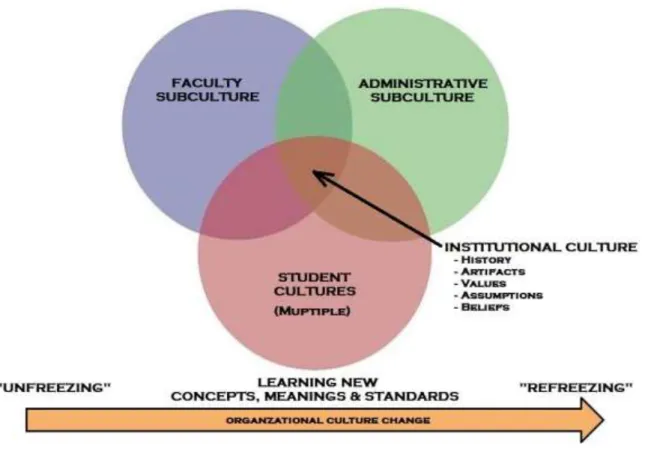
Organizational Culture and Leadership, was also utilized as a secondary theoretical lens. This framework was implemented to define the period of transition and development of the FYP, which proved to be helpful when conducting narrative inquiry interviews. How these two theories intersect with one another in this study is illustrated in Figure 2. Each theoretical framework contains several key concepts that ultimately shaped the literature review, methodology, and research design of this case study.
23
Figure 2: Theoretical Framework
2.1.1. Kuh & Whitt’s Framework for Analyzing Culture in Higher Education
Institutional culture is a process as well as a product (Kuh & Whitt, 1988). This process can be described as reciprocal in that it shapes – and is shaped by – the
interpersonal interactions and relationships formed between various members of a campus community (Kuh & Whitt, 1988). These interpersonal connections ultimately produce a cultural “product” by influencing the institution’s future artifacts, espoused and enacted values, and core beliefs and assumptions, which are shared and embraced by faculty, students, and administrators (Kuh & Whitt, 1988). This interdependent relationship of process and product shapes the research questions of this study. Rather
24
than simply seeking to understand how the 1986 proposal for a “Freshman Program” was developed and implemented, it is equally important to research how this organizational change was able to sustain – as well as reciprocally influence culture – throughout its foundational years. Kuh & Whitt (1988) also contend culture can effectively convey a sense of identity, facilitate a commitment to an entity other than one’s self, can enhance stability of a social system, and provide a sense-making device that can guide and shape behavior. Each of these factors help to explain how institutional culture can be an effective lens through which one can better understand organizational change and also analyze and construct a bridge between academic and residential life.
2.1.2. Schein’s Conceptual Model for Managed Culture Change
Since this case study focuses on a specific event on a college campus that
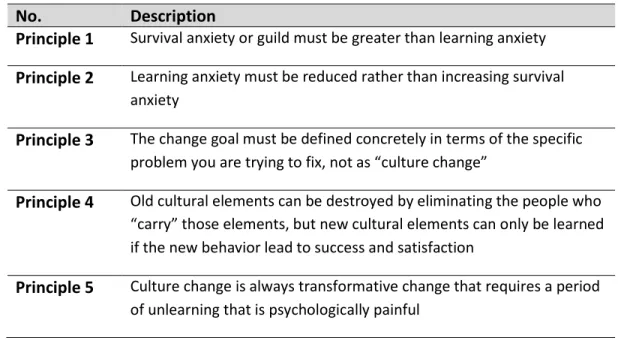
fundamentally changed the organization, it is critical to also identify and discuss the work of Edgar Schein. His conceptual model for managed cultural change involves three stages and five key principles, which are detailed in Table 1. The first stage of managed organizational change, labeled “unfreezing,” focuses on creating the motivation for change. This initial phase must have three separate conditions met. Specifically, Schein (2004) contends that “disconfirming data” must exist to cause a disruption to the status quo, this disruption must cause anxiety and/or guilt on the part of community members, and that the environment must lend itself to a sense of “psychological safety” so that a sense of “survival anxiety” can overcome the “learning anxiety” that inevitably
accompanies a situation of change (p. 301). The second stage of managed organizational change focuses on learning new concepts, new meanings for old concepts, and new
25
standards for judgement (Schein, 2004). In other words, community members must go through a period in which they make sense of their new environment, identify with their new emerging role models, and learn how to navigate the new cultural norms through trial-and-error. The final stage of managed organizational change is the “refreezing” process, focusing on internalizing the new concepts, meanings, and standards (Schein, 2004). This three-phase conceptual model for organizational change will be utilized during the data analysis phase of this study and can be an effective tool to help better understand and more clearly outline the in-depth, complex narrative of organization change to be explored in this study.
Table 1: Principles of the Conceptual Model for Managed Culture Change
No. Description
Principle 1 Survival anxiety or guild must be greater than learning anxiety
Principle 2 Learning anxiety must be reduced rather than increasing survival anxiety
Principle 3 The change goal must be defined concretely in terms of the specific problem you are trying to fix, not as “culture change”
Principle 4 Old cultural elements can be destroyed by eliminating the people who “carry” those elements, but new cultural elements can only be learned if the new behavior lead to success and satisfaction
Principle 5 Culture change is always transformative change that requires a period of unlearning that is psychologically painful
2.2. Institutional Culture
The term “culture” is a commonly used phrase often applied in over-simplified, inaccurate ways to describe organized groups of people. The literature outlined here, consisting of seven scholarly works, will seek to clarify this term, specifically within the
26
context of higher education. First, I will highlight the concept of group dynamics. I will then review scholarship focusing on student culture, discuss the concept of what makes a college or university “distinct,” and conclude by expanding into institutional culture research focusing not only on students, but faculty and administration, as well.
When considering the concept of culture in any setting, it is critical to mention the work of Lewin, who is credited with identifying the concept of “group dynamics.” Lewin (1947) defined this concept as the way in which groups and individuals interacted to changing circumstances. His work demonstrated how an individual’s personal characteristics are directly influenced by the environmental factors of a group, its members, and the particular situation in question (Lewin, 1947). Through his research, Lewin was able to prove that group phenomena exists and has a direct influence on behavior.
2.2.1. Student Cultures
Early research on institutional culture in higher education focused solely on student culture. This included the work of Newcomb and Wallace. In his study of students at Bennington College during the years 1934-1939, Newcomb (1943) utilized a mixed methods research approach to demonstrate how students conformed to patterns in the collegiate environment. Specifically, the purpose of his study was to “discover factors associated with different degrees and rates of change by individuals;” he was able to conclude that “community forces” do influence student attitudes, beliefs, and interests (Newcomb, 1943, p. 23). Newcomb’s (1943) research is notable in that it specifically
27
discussed incoming first-year student perceptions to socialization factors and how they are influenced:
The histories and personal characteristics of entering freshmen are such that they are impelled to varying degrees of leadership and prestige, and that within a few weeks of entering college they have already ‘sized up’ the dominant community trends, toward which they adapt themselves in proportion to their habits of seeking leadership and prestige. (p. 149)
This demonstrated that students at Bennington College as far back as the 1930’s naturally developed social hierarchies and placed different values on the attitudes, values, and interests of different subcultures. Incoming first-year students entered this new world, quickly adapted to it, and often pursued what were perceived as prestigious endeavors. It is important to note Newcomb’s (1943) research also indicated students “show a
significant change in social attitudes…between freshman and senior years in college,” with senior attitudes most often persisting after graduation (p. 146). Newcomb was able to triangulate his data by gathering similar results from students at nearby Williams College and Skidmore College.
In his study of students at Beloit College in the late 1950’s, Wallace (1966) also focused on student socialization factors, yet examined the impact of informal social structures on students’ academic values, achievement, and aspirations. Through a
quantitative case study, he sought to understand how incoming first-year students react to two distinct subcultures – adolescent upper-class student groups and adult faculty
members. Wallace’s (1966) findings concluded faculty interactions have a positive influence on academic achievement and grades, while interactions with student peers – in particular, Greek organizations – often deemphasized academic achievement and had a
28
negative impact on student success. Another critical finding was that most negative academic attitude changes among incoming first-year students occurred within the first seven weeks of their college experience (Wallace, 1966). Furthermore, Wallace (1966) contends these detrimental changes in values and norms are influenced by upperclass students within the campus community – and not other freshmen peers. This work further validates Newcomb’s findings and highlights just how vital a healthy,
academically-focused transition experience into college is for incoming new students. Any discussion of student culture must consider the work of Horowitz (1987) and her book Campus Life: Undergraduate Cultures from the End of the Eighteen Century to the Present. Horowitz identifies key historical student subcultures while demonstrating how interconnected relationships between faculty and students were often in conflict and steadily evolved throughout the eighteenth, nineteenth, and twentieth centuries.
According to Horowitz (1987), the dominant student culture on American college campuses are “college men” and “college women,” who tend to focus on vibrant social life and grade obsession while at the same time devaluing academic and intellectual attainment. This traditional “college life,” however, has never included all students. Horowitz (1987) also identified two other student subcultures, the “Outsiders” and the “Rebels.” The “Outsiders” are recognized as academically-engaged students who
“accepted the hard discipline of study and its stimulating challenges…[and] connected to their teachers, perceiving them as mentors and allies, not as antagonists” (Horowitz, 1987, p. 15). “Outsider” students operate largely outside the dominant social culture of the campus and often view success in college as a means to better life; throughout history
29
they have been comprised largely of first-generation college students and individuals from lower socio-economic backgrounds (Horowitz, 1987). The other student
subculture, the “Rebels,” do not gravitate in a particular direction in regard to classroom performance or the party culture – they are defined by their commitment to breaking conventions, fighting the social distinctions present on most campuses, and “revel in difference, not uniformity” (Horowitz, 1987, p. 16). As outlined in Chapter 4, each type of student subculture has been present in the history of St. Lawrence University.
2.2.2. The “Distinctive College”
In 1970, Clark published The Distinctive College, which proved to be a ground-breaking study. Focusing on the historical narratives of three private liberal arts colleges – Antioch, Reed, and Swarthmore – with qualitative research conducted between 1958-1963, Clark (1970) sought to “study the general organizational character, especially distinctive character, and to understand its initiation and development” (p. 6). His research identified the phenomenon of the “organizational saga,” which is the “central ingredient” that makes each of the three colleges involved in this study the special, distinct institutions as they have come to be known (Clark, 1970, p. 234). The concept of an organizational saga can be described as:
All organizations have a social role, ways of behaving linked with defined positions in the larger society, but only some have seized their role in the
purposive way that we call a mission. Then, among those that have been strongly purposive, only some are able to sustain and develop the mission over time to the point of success and acclaim. The mission is then transformed into an embracing saga. We are able to speak then of colleges…that become legendary, even heroic, figures on the social stage. (Clark, 1970, p. 8)
30
Clark’s focus on organizational sagas, and how belief and loyalty within a college community can be a powerful tool, played a key role in shifting the focus of research on culture within higher education. Specifically, future researchers began looking at other subcultures within higher education, including faculty and administrative cultures, as well as the entire system of higher education as its own distinct organizational culture.
2.2.3. Expanding the Scope of Institutional Culture
Tierney was one researcher who began to focus on other aspects of institutional culture beyond students. In his qualitative study of Penn State College in 1984-1985, Tierney (1988) explained how institutions are not only influenced by powerful external factors such as demographics, economics, and politics, but are also shaped by internal factors, as well. Tierney (1988) argued these internal dynamics can trace their roots to the organizational histories of each respective college or university, deriving their forces from the values, processes, and goals held by individuals and groups directly involved in the organization’s day-to-day planning and development. Therefore, organizational culture exists in part through the individual and group interpretations of historical and symbolic forms. Furthermore, people often develop a sense of belonging and admiration for their institution through the interactions, communications, and development of
interpersonal relationships built across a campus community (Tierney, 1988). As Tierney (1988) explained, a strong understanding of this powerful dynamic can greatly assist educational leaders in the decision-making process:
The culture of an organization is grounded in the shared assumptions of
individuals participating in the organization. Often taken for granted by the actors themselves, these assumptions can be identified through stories, special language, norms, institutional ideology, and attitudes that emerge from individual and
31
organizational behavior…Thus, an analysis of organizational culture of a college or university occurs as if the institution were an interconnected web that cannot be understood unless one looks not only at the structure and natural laws of that web, but also at the actors’ interpretations of the web itself. (p. 4)
The research of Bergquist built off Tierney’s work and sought to provide a detailed analysis of collegiate culture. His qualitative study was developed over the course of twenty years, during which time Bergquist (1992) conducted interviews and consultations at over 300 colleges and universities and ultimately identifies four distinct subcultures – collegial, managerial, developmental, and advocacy/negotiating. Collegial culture is what many consider to be traditional “faculty culture” and can be categorized as a campus group that finds meaning in academic disciplines, values research, scholarship, and shared governance, and views the role of a university as that of generating,
interpreting, and disseminating knowledge (Bergquist, 1992). Managerial culture is commonly referred to as “administrative culture” and is best defined by its adherence to organization, implementation, and evaluation of work directed at specific institutional goals, values associated with fiscal responsibility and effective supervision, and views the role of a university as a mechanism to impart specific knowledge, skills, and attitudes in students so they may become successful and responsible citizens in society (Bergquist, 1992).
The remaining two subcultures – developmental and advocacy/negotiating – can include faculty or administrators. Developmental culture seeks to create programs and activities that further the personal and professional growth of all members within the collegiate community and has a strong degree of passion for all to grow as individuals (Bergquist, 1992). Members of the advocacy/negotiating subculture focus on being
32
agents for social justice and social change. They seek to establish policies that distribute resources and benefits of the institution in an equitable way, yet often hold inherently conflicting views on the role of the college as an “undesirable promulgation of existing and often repressive social structures or the establishment of new and more liberating social attitudes and structures” (Bergquist, 1992, p. 5). How each of these institutional subcultures engage with one another, compromise, and craft policy is a fundamental theme of this study.
2.3. Organizational Change
Organizations were created as a solution designed to meet a challenge or satisfy a need of society (Cooperrider & Whitney, 2005). How leaders interpret the cultural impact of these societal needs while at the same time effectively managing and adapting their organizations to address these needs is at the heart of this study. Identifying effective ways to enact positive organization change is critical in today’s society for a multitude of reasons. The world is smaller and more interdependent and requires inspired teams that achieve and learn together, while at the same time tapping into their full
capacities in a way traditional authoritarian hierarchies fail to accomplish (Senge, 1990). The literature outlined here, consisting of five literary works, will seek to establish clarity in regard to these efforts. First, I will outline the research of Weick, who presents an organizational framework that is most commonly found in higher education. I will then provide a summary of contemporary organizational change theory, focusing on
33
inquiry, adaptive leadership, and the link between human emotions and organizational change.
Before discussing the concept of organizational change, one must first understand the predominant organizational structure currently dominating American higher
education. The work of Weick (1976) and his theory of educational organizations as “loosely coupled systems” provides an accurate framework. Weick (1976) argues that since modern colleges and universities are comprised of separate divisions, each of which have independently managed departments and offices, what happens within one
department does not always influence – or even have an impact on – what happens in other offices. Weick’s research is applicable to academic subculture, as well as
administrative subculture. This theoretical framework helps explain the central problem of this study – institutional culture dynamics which can be potentially divisive and foster inherent conflict. It also helps to better understand the polarizing perspectives between faculty, students, and administrators on the issue of institutional “control,” as well as their respective views on academic scholarship later outlined in this literature review.
The work of Senge (1990) and his conceptual framework of “systems thinking” is important research to discuss when considering perspectives on organizational change. Systems thinking can be defined as, “a conceptual framework, a body of knowledge, and tools that have been developed over the past fifty years, to make the full patterns clearer, and to help us see how to change them effectively” (Senge, 1990, p. 7). Senge (1990) made the observation we are taught to make sense of the world through fragmentation. However, he argues there are hidden costs associated with this incomplete, disjointed