Exchange
Doctoral Dissertations Graduate School
5-2017
Self-control effect during a reduction of feedback
availability
Aaron Dean von Lindern
University of Tennessee, Knoxville, [email protected]
This Dissertation is brought to you for free and open access by the Graduate School at Trace: Tennessee Research and Creative Exchange. It has been accepted for inclusion in Doctoral Dissertations by an authorized administrator of Trace: Tennessee Research and Creative Exchange. For more information, please [email protected].
Recommended Citation
von Lindern, Aaron Dean, "Self-control effect during a reduction of feedback availability. " PhD diss., University of Tennessee, 2017. https://trace.tennessee.edu/utk_graddiss/4506
during a reduction of feedback availability." I have examined the final electronic copy of this dissertation for form and content and recommend that it be accepted in partial fulfillment of the requirements for the degree of Doctor of Philosophy, with a major in Kinesiology and Sport Studies.
Jeffrey T. Fairbrother, Major Professor We have read this dissertation and recommend its acceptance:
Jeffrey T. Fairbrother, John G. Orme, Joshua Weinhandl, Angela Wozencroft
Accepted for the Council: Dixie L. Thompson Vice Provost and Dean of the Graduate School (Original signatures are on file with official student records.)
A Dissertation Presented for the Doctor of Philosophy
Degree
The University of Tennessee, Knoxville
Aaron Dean von Lindern May 2017
AKNOWLEDGEMENTS
I would like to thank a number of individuals who contributed to the successful completion of my doctoral program. I would like to first thank my doctoral advisor and
dissertation committee chair Dr. Jeffrey Fairbrother for inviting me into the program here at the University of Tennessee, and for his support and guidance over the past three years. Second, I would like to thank my dissertation committee members; Dr. John Orme, Dr. Joshua Weinhandl, and Dr. Angela Wozencroft for their support and contributions throughout the dissertation process. Third, I would like to thank my fellow graduate students in the motor behavior lab; Andy, Joe, Kaylee, Lacey, and Mike. You have provided motivation, support, insight, and friendship throughout my time here in Knoxville. Finally, I would like to thank my family; including my parents Paula and Sean von Lindern, my brother Drew, his wife Britt, and the entire Beatty clan for their tireless support. And last but certainly not least, I would like to thank my partner in crime Brooke Beatty for dropping everything and moving across the country with me to help realize this goal. She has been here for all of the ups and downs through the entirety of this process and I could not have done it without her, nor could I ever pay her enough respect and gratitude for all she has done for me. I am forever grateful to all of those mentioned above and surely countless others who have given me the tools, support, and life experiences that have made me the person I am today and set the foundation for my future growth in the years to come. Thank you, you are all greatly appreciated.
ABSTRACT
A growing body of recent research has pointed to the potential value of allowing learners to have some autonomy in shaping their learning environment. Studies of this so-called self-control effect have demonstrated that allowing learners to control some aspect of the instructional setting facilitates motor learning compared to conditions that are controlled externally. The purpose of the present study is to examine how learners ostensibly provided self-control over feedback behave when the actual availability of feedback is constrained by a predetermined schedule of coach availability to provide feedback. Furthermore, an investigation into potential underlying mechanisms will be examined through a self-determination theory (SDT) lens. Participants were assigned to one of four feedback groups – 100% feedback group (KR100), 50% feedback group (KR50), self-controlled feedback group (SC), and yoked group (YK) – in order to learn a key-pressing task. Post training measures of basic need satisfaction were obtained through a modified version of the Basic Psychological Needs Satisfaction Survey (BPNS). The acquisition phase consisted of 72 practice trials of the key-pressing task. Approximately 24 hours after acquisition, each participant returned to complete tests of retention and transfer. Results revealed a
significantly lower absolute constant error (ACE) score for the SC group during transfer (p <
.05). There were also no significant differences between group BPNS sub-category scores. The results of this study suggest evidence for the robustness of the SC effect in a reduced feedback availability environment as well as evidence supporting underlying mechanisms other than motivation as driving the effect. Secondly, the results provide some evidence for the role of scarcity in elevating the number of feedback requests in a reduced autonomy environment.
TABLE OF CONTENTS
CHAPTER 1: Introduction ... 1
Statement of the Problem ... 4
Purpose of the Study ... 5
Hypothesis... 5
Assumptions ... 5
Delimitations ... 5
Limitations ... 6
Definition of Terms ... 6
CHAPTER 2: Review of Literature ... 10
Role of Feedback in Motor Learning ... 10
Reducing Feedback Frequency ... 12
Self-Control ... 15
Understanding Motivation within Self-Control ... 20
Self-Determination Theory ... 21
Basic Psychological Needs ... 22
Autonomy ... 22 Competence ... 22 Relatedness ... 22 Practical Considerations ... 22 Summary ... 23 CHAPTER 3: Method ... 24 Participants ... 24
Task and Apparatus ... 24
Instruments ... 24
Procedure ... 26
Data Treatment and Analysis ... 27
Temporal Accuracy ... 27
Basic Psychological Needs Satisfaction (BPNS) ... 29
CHAPTER 4: Results ... 30
Performance Measures ... 30
Acquisition ... 30
Feedback vs No Feedback ... 36
After Feedback Trials vs After No Feedback Trials ... 36
Retention ... 38
Transfer ... 41
Errors ... 42
Needs Satisfaction Measures ... 42
Basic Psychological Needs Satisfaction Survey (BPNS) ... 42
CHAPTER 5: Discussion ... 45
Summary of Procedures ... 45
Summary of Findings ... 47
Hypotheses ... 47
Additional Findings ... 47
Discussion and Conclusions ... 48
Future Research ... 52 REFERENCES ... 54 APPENDICES ... 62 Appendix A ... 63 Appendix B ... 66 Appendix C ... 71 VITA ... 76
LIST OF FIGURES Figure 1. Figure 2. Figure 3. Figure 4. Figure 5. Figure 6. Figure 7. Figure 8. Figure 9.
Task diagram depicting the sequence of keys used in the experimental task
(S = start key, E = end key)..………
Mean CE scores for self-control (SC), yoked (YK), and 100% feedback (KR100) groups during acquisition, retention, and transfer phases (ms)……. Mean ACE scores for self-control (SC), yoked (YK), and 100% feedback (KR100) groups during acquisition, retention, and transfer phases (ms)……. Mean AE scores for self-control (SC), yoked (YK), and 100% feedback (KR100) groups during acquisition, retention, and transfer phases (ms)……. Mean VE scores for self-control (SC), yoked (YK), and 100% feedback (KR100) groups during acquisition, retention, and transfer phases (ms)……. Mean ACE scores for self-control (SC) and yoked (YK) groups after
feedback (FB) and no-feedback (No FB) trials during acquisition (ms)…….. Mean AE scores for self-control (SC) and yoked (YK) groups after
feedback (FB) and no-feedback (No FB) trials during acquisition (ms)…….. Mean VE scores for self-control (SC) and yoked (YK) groups after
feedback (FB) and no-feedback (No FB) trials during acquisition (ms)…….. Mean number of errors for self-control (SC), yoked (YK), and 100%
feedback (KR100) groups during retention and transfer……….. 25 31 33 34 35 37 39 40 43
CHAPTER 1
Introduction
Identifying and understanding the factors that facilitate motor learning is a keystone goal in motor behavior research. Traditionally, the experimenter has determined all aspects of
instructional settings in motor learning research (e.g., Nicholson & Schmidt, 1991; Schmidt, 1991; Yao, Fischman, & Wang, 1994). A growing body of research, however, points to the potential value of allowing learners to have some autonomy in shaping their experience. Studies of so-called self-control effects have demonstrated that allowing learners to control some aspect
of the instructional setting (e.g., the administration of feedback) facilitates motor learning compared to conditions that are controlled entirely by the researcher. Self-control experiments most often include acquisition, retention, and transfer phases. Typically, the latter two phases occur after a delay (usually 24 hours). The basic experimental design compares two groups. One group is the self-control group and the other is a yoked control group whose schedule of
instructional assistance (e.g., a feedback schedule) is created by matching each participant to a self-control counterpart. The yoking procedure originated from studies examining augmented feedback effects (e.g., Janelle et al., 1997) to ensure equivalent feedback frequencies across groups – a variable known to affect motor learning – but has been widely adopted even in studies examining other forms of instructional assistance (e.g., physical guidance or demonstrations).
Self-control effects have been found to facilitate motor learning using a number of different modes of instructional assistance, including video modeling (e.g., Ste-Marie, Vertes, Law, & Rymal,, 2013; Wulf, Raupach, & Pfeiffer, 2005), physical guidance (e.g., Chiviacowsky, Wulf, Lewthwaite, & Campos, 2012; Wulf, Shea, & Park, 2001; Wulf & Toole, 1999), practice schedule (e.g., Keetch & Lee, 2007; Wu & Magill, 2011), amount of practice (e.g., Post,
Fairbrother, & Barros, 20110) and augmented feedback (e.g., Chiviacowsky & Wulf, 2002; Huet, Jacobs, Camachon, Goulon, & Montagne, 2009; Janelle, Kim, & Singer, 1995; Lim et al., 2015; Patterson & Carter, 2010). The most commonly used manipulation of instructional assistance has been self-control over augmented feedback.
A number of different explanations have been forwarded to account for the effects of the self-control manipulations on motor learning. One of these explanations (e.g., Chiviacowsky & Wulf, 2002) argues that the self-control allows the learner to tailor their own feedback schedule to more optimally meet their learning needs and preferences. Such tailoring may lead to more effective learning strategies compared to externally controlled schedules (Chen, Hendrick, & Lidor, 2002; Sanli, Patterson, Bray, & Lee, 2013). Another explanation (Janelle et al., 1997) notes that self-control may lead to deeper information processing or greater task engagement. Some studies have indicated that self-control was associated with longer preparation times (Post, Fairbrother, & Barros, 2011) or more references to instructional materials (Aiken et al., 2012). A third explanation posits that the provision of control increases the learner’s motivation, self-efficacy, autonomy, and perceived competence (e.g., Saemi, Wulf, Varzaneh, & Zarghami, 2011; Chiviacowsky, Wulf, & Lewthwaite, 2012; Chiviacowsky, 2014; Wulf, Chiviacowsky, Cardozo, 2014; Grand et al., 2015). Wulf and Lewthwaite (2016) have argued that enhanced expectancies result in positive preparatory effects and that feedback delivered after so-called good trials
potentially creates dopaminergic reinforcement cycles. This argument, however, neglects the findings showing that self-control participants do not always show preferences for feedback that confirms success (i.e., after good trials) over feedback that identifies errors (e.g., Aiken et al., 2012).
The research exploring the role of motivation in self-control effects has largely been conducted within one of two theoretical frameworks – Bandura’s conceptualization of self-efficacy (Bandura, 1977) and Self-Determination Theory (SDT; Deci & Ryan, 1985). Research using adaptations of Bandura’s self-efficacy scale (Bandura, 2006) has found enhancement of self-efficacy in self-control groups both during and after practice (Saemi et al., 2013; Ste-Marie et al., 2013). Similarly, research using the Intrinsic Motivation Inventory (IMI) from SDT has found higher perceived competence and intrinsic motivation in self-control groups during and after practice (Saemi et al., 2011; Chiviacowsky et al., 2012; Ste-Marie et al., 2013; Grand et al., 2015). Thus far, this area of inquiry has been limited by the independent or disjointed use of multiple theoretical frameworks to explain findings. A more fruitful approach would be to adopt a single encompassing framework such as that provided by SDT in an effort to understand how self-control manipulations influence participants’ experiences when learning motor skills.
SDT is a meta-theory that describes the forces that drive intrinsic motivation within an individual. Within this theoretical framework, intrinsic motivation is said to be a basic lifelong psychological growth function that is driven by the satisfaction of key psychological needs inherent to all humans. These are the need to feel competence, the need to feel relatedness, and the need to feel autonomous. Feelings of competence emerge from the need to engage in challenges that result in experiences of mastery or effectiveness. Relatedness is the need that drives individuals to seek attachments so they experience feelings of security, belongingness, and intimacy with others. Autonomy is the need to intrinsically self-regulate and self-organize one’s own behavior. Individual differences and social conditions that support the satisfaction of these basic needs lead to higher levels of intrinsic motivation, whereas those that thwart the
use of SDT as the theoretical framework provides a more comprehensive understanding of the combined and independent effects of the three basic psychological needs on motivation when participants learn motor skills. Additionally, SDT provides a viable avenue for the identification of potential psychological mechanisms underlying self-control effects.
Statement of the Problem
Research on the effects that self-control has on motor learning have yet to produce substantive theoretical insight into the phenomenon. This limitation arises from the relatively narrow scope of the existing literature that has focused on establishing the self-control effect and the vague nature of the proposed explanations due to post hoc speculation and a lack of
theoretically grounded research designs. Considerations of real-world constraints are also limited within the domain, posing problems in applicability with respect to the self-controlled effect. Current research within self-control has consistently given self-control participants control to request feedback at any time throughout the entirety of practice. With the exception of the Andrieux, Boutin, and Thon (2015) study that imposed a fifty percent self-control and fifty percent prescribed practice condition, no other study has examined the effects of a partial self-control schedule. Furthermore, no study has considered the logical argument of the real-world constraint of the randomness and limitation of coach availability during practice or the empirical argument of how this constraint may effect perceptions of autonomy, competence, and
relatedness during skill acquisition. Many studies have vaguely suggested that autonomy may be the driving mechanism behind the self-control effect; however, presently no study has directly measured autonomy with a validated instrument of measure. Providing such considerations through the SDT lens could lead to a better understanding of the theoretical mechanism driving the self-control effect.
Purpose of the Study
The purpose of the present study is to examine how learners ostensibly provided self-control over feedback behave when the actual availability of feedback is constrained by a predetermined schedule of coach availability to provide feedback. More specifically, the present study was designed to investigate if the self-control effect persists in a reduced autonomy environment.
Hypotheses
Based on the existing body of literature within self-control, the following hypotheses were tested:
1. The self-control group will show better learning than all other groups, as inferred through 24-hour tests of retention and transfer.
2. The self-control group will show higher scores for perceived competence than all other groups.
3. The self-control group will show higher scores for perceived autonomy than all other groups.
Assumptions
1. Participants had no prior experience with the experimental task.
2. Participants performed to the best of their abilities through the entirety of the study. 3. Participants were honest in their responses to all questions on the questionnaires.
Delimitations
1. The study was completed in a laboratory setting. 2. Participants were naïve to the purpose of the study. 3. Participation was voluntary.
Limitations
1. The experimental task was a simple motor task involving a key press. 2. The data collector was not blind to the study.
3. Measures for all questionnaires (autonomy, competence, training, and post-experiment) were self-reported measures.
Definition of Terms
Absolute Constant Error (ACE). The average absolute deviation for a block set of scores from a target value.
Absolute Error (AE). The average absolute deviation of each of a set of scores from a target value; a measure of overall error (Schmidt & Lee, 2014).
Acquisition. The initial phase of a motor learning study during which the participant practices the motor task (Janelle, Kim, & Singer, 1995).
Augmented feedback. Information about a movement that is provided to the learner from an outside source (Fairbrother, 2010).
Autonomy. An individual’s experience of choice in their ability to regulate themselves in pursuit of self-selected goals (Deci & Ryan, 1985)
Average feedback. A type of augmented feedback that presents a statistical average of two or more trials, rather than results on any one of them (Schmidt & Lee, 2014).
Bandwidth feedback. A procedure for delivering feedback in which errors are signaled only if they fall outside some range of correctness (Schmidt & Lee, 2014).
Basic psychological needs (BPN). The needs for autonomy, competence, and relatedness that specify innate psychological nutriments, essential for ongoing psychological growth, integrity, and well-being (Deci & Ryan, 1985).
Competence. The basic psychological need to feel efficacious with respect to a performed activity, analogous to self-efficacy (Ryan & Deci, 2000).
Constant error (CE). The signed difference of a score on a given trial from a target value; a measure of bias for that trial (Schmidt & Lee, 2014).
Dopaminergic system. System associated with the reward or motivation system which subserves brain activity relevant to motor, cognitive, and motivational functioning (Wulf & Lewthwaite, 2016).
Enhanced expectancies. Raising performer’s expectancies by informing them that their peers performed well on a certain task or that they themselves were likely to perform well under pressure (Wulf et al., 2011)
Extrinsic feedback. See augmented feedback.
Faded feedback. The practice in delivering feedback whereby the frequency of feedback is decreased systematically across trials (Schmidt & Lee, 2014).
Feedback. Sensory information in regards to a movement (Magill, 2007).
Guidance. A procedure used in practice in which the learner is physically or verbally directed through the performance in order to improve performance (Schmidt & Lee, 2014).
Guidance hypothesis. Viewpoint that feedback guides the learner toward the desired movement, and can also lead to dependence when always present (Salmoni, Schmidt, & Walter, 1984).
Inherent feedback. Information provided as a natural consequence of making an action; sometimes called intrinsic feedback (Schmidt & Lee, 2014).
Individual differences. Stable, enduring differences among people in terms of some measurable characteristic or performance of some task (Schmidt & Lee, 2014).
Intrinsic motivation. A non-drive-based form of motivation, where the energy to act and/or behave is intrinsic to the nature of the organism (Deci & Ryan, 1985).
Knowledge of performance (KP). Augmented feedback about the nature of a movement
(Fairbrother, 2010).
Knowledge of results (KR). Augmented feedback about the outcome of a movement
(Fairbrother, 2010).
Modeling. A practice procedure in which another person demonstrates the skills to be learned (Schmidt & Lee).
Motor learning. A set of processes associated with practice or experience leading to relatively permanent changes in the capability for movement. (Schmidt & Lee, 2011).
Perceived locus of causality (PLOC). Interpersonal perception of how one infers the motives and intentions of others (Ryan & Connell, 1989).
Relatedness. The basic psychological need to feel connected to other human beings (Ryan & Deci, 2000).
Retention. A test of a practiced skill that a learner performs to assess learning following an interval of time after practice has ceased (Magill, 2010).
Self-control effect. Giving a learner some degree of control over the learning environment (Janelle, Barba, Frehlich, Tennant, & Cauraugh, 1997).
Self-efficacy. A form of self-confidence that refers to beliefs about one’s capability to plan and execute the behaviors needed for successful production of the outcomes
(Bandura, 1997).
Sequential-timing task. A task requiring participants to press a series of keys in a prescribed temporal sequence (Chiviakowsky & Wulf, 2002).
Summary feedback. Information about the effectiveness of performance on a series of trials that is presented only after the series has been completed (Schmidt & Lee, 2014).
Transfer. A test in which a person performs a skill that is similar yet different from the skill that he or she has practiced (Magill, 2010).
Variable error (VE). The standard deviation of a set of scores about the subject’s own average (CE) score; a measure of movement (in)consistency (Schmidt & Lee, 2014).
Yoked. A control group that is matched to a self-control group with respect to the schedule and type of feedback requested (Janelle, Kim, & Singer, 1995).
CHAPTER 2
Review of Literature
The purpose of this chapter is to provide a review of the existing research in the domains of feedback and self-determination theory as they relate to self-control effects on motor learning. This chapter will describe the functions of feedback during motor learning and examine how these functions have been studied in the existing literature. Topics to be explored will include types of feedback, scheduling of feedback, and control over the feedback schedule. Additionally, this chapter will present an overview of Self-Determination Theory (Deci & Ryan, 1985) and its potential role in understanding the underlying mechanisms of self-control effects on motor learning.
Role of Feedback in Motor Learning
Feedback is an essential component of the motor learning process. It can emerge in many forms; some that may be obvious to the learner and some that may not be so obvious.
Researchers classify feedback into two distinct types. Inherent or intrinsic feedback is information about the performance that arises as a natural consequence of the action or movement itself. Extrinsic or augmented feedback is information that is not available to the performer unless it is relayed from an outside source such as an instructor or device (Schmidt & Lee, 2014). Augmented feedback is meant to provide new information to the learner and not simply state what has already become redundant through inherent feedback sources. Examples of inherent feedback include the feel of a bat striking the ball, seeing a basketball shot go into the hoop, or hearing a tennis racket make contact with the ball. In each of these cases, information is perceived directly by the performer and is an inherent consequence of completing the task. Examples of augmented feedback include a coach telling a softball hitter that a swing was too
early, a video replay depicting a golf shot, or an official making a call on a tennis ball that hit close to the line. All of this information is delivered by an outside source and is not normally available to the performer without assistance.
Augmented feedback can be reduced further into two different types based on whether it is focused on the movement technique or the movement outcome. If the information relayed to the learner has to do with information about the outcome or success of the action in relation to the defined goal of said action, then the feedback is called knowledge of results (KR). On the other hand, if the information relayed to the learner has to do with the quality of the movement kinematics or movement characteristics, then the feedback is called knowledge of performance (KP; Magill, 2007; Schmidt & Lee, 2014). A clear example of both KR and KP can be derived from a single golf fairway shot for which the golfer cannot see the final landing point (e.g., an elevated green). The golf coach telling the learner that his ball is on the green is an example of KR, whereas the coach giving information about swing mechanics is an example of KP.
Augmented feedback is a variable that has been assumed to have a number of functional properties that are influential in motor learning. Two of the most important and most cited include motivational properties and informational properties (Schmidt & Lee, 2014). Learners seem to like feedback, and those who are kept informed of their progress usually translate that feedback into more effort on the task. Due to this phenomenon, motivational properties of
feedback can be used directly by praising effort and other similar statements designed to energize the learner. Similarly, it is thought that augmented feedback can provide an indirect motivational benefit when it is designed for its informational properties. Traditional thought in motor learning is that the most important function of augmented feedback stems from the informational property (Schmidt & Lee, 2014). Feedback can provide information about patterns of movement and
magnitude and direction of errors in movement outcomes, and thereby gives direction on how to modify future performance. Recognizing that augmented feedback is largely informational and also carries with it motivational properties raises questions as to the best way to take advantage of each of these properties and create an environment in which an optimization of learning can take place (Schmidt & Lee, 2014).
Entangled along with the beneficial properties of augmented feedback is another property that points to potential drawbacks associated with producing dependency. The dependency producing property of augmented feedback has been forwarded in the guidance hypothesis
(Salmoni, Schmidt, & Walter, 1984), which states that learners can come to rely so heavily on augmented feedback that they fail to fully develop necessary internal error detection and
correction capabilities. This failure to develop these capabilities is thought to result in degraded performance once augmented feedback is removed. A variety of approaches have been examined to determine if the dependency-producing property of augmented feedback can be mitigated. These have included considerations of when to give feedback, what feedback to give, and how much feedback to give.
Reducing Feedback Frequency
One of the most researched areas testing the guidance hypothesis has been the work examining scheduling frequency of augmented feedback during skill acquisition. A reduction in feedback frequency, either absolute or relative, has been shown to either have little to no impact on motor skill performance during acquisition (Winstein & Schmidt, 1990, Experiment 1) or to have a significant positive effect on motor skill learning as displayed by delayed tests of
retention (e.g., Winstein & Schmidt, 1990, Experiments 2 & 3; Wulf, Schmidt, & Deubel, 1993). Several different approaches to reducing feedback frequency have been explored including;
fading the schedule of feedback in which feedback is provided frequently early in practice and gradually reduced as practice continues, providing feedback according to a bandwidth range of error in which a predetermined range of acceptable error is allowed and feedback is provided when performance is outside that range, summarizing or averaging feedback after a number of practice trials, and allowing learners to control their own feedback scheduling (Schmidt & Lee, 2014).
Nicholson and Schmidt (1991, Experiment 2) examined the effects of a faded feedback schedule on motor performance and learning of a lever-positioning task. This type of schedule is based on the notion that providing relatively high frequency of feedback early in practice then gradually reducing the frequency later in practice should both optimize the beneficial effects of feedback while at the same time prevent dependency. They compared three groups with reduced feedback schedules that were held at 50%. The groups consisted of a faded feedback group which received high frequency feedback early and gradually tapered off, a uniform reduced feedback group which received feedback on every other trial, and a reversed-faded feedback group which received low frequency feedback early and gradually increased as practice
continued. Results indicated that the faded feedback group was most proficient during the no-KR delayed tests of retention, followed by the uniform and reverse-faded groups; demonstrating that there was an advantage to receiving feedback more frequently early in practice and fade back frequency later on throughout the practice session.
A second approach to facilitate reducing feedback is providing feedback based on a bandwidth of acceptable error. In this type of scheduling, feedback is only given to the learner when their errors fall outside of a predetermined acceptable range. Due to the nature of learning a novel task, this type of schedule often ends up mirroring that of a faded feedback schedule as
learner’s make larger errors more frequently early in practice and fewer of these errors as practice continues (Schmidt, 1991). Sherwood (1988) examined the effects of different size bandwidths of KR compared to a 100% KR group on a lever positioning task. Participants in this study were assigned to groups featuring either a 5% error bandwidth, a 10% error bandwidth, or a 100% KR schedule control group. In delayed transfer tests, the 10% error bandwidth group displayed less variability than the other groups indicating that error bandwidth KR can enhance movement consistency and facilitate motor skill learning. Lee and Carnahan (1990) further investigated the effects of bandwidth error feedback showing evidence that this type of
scheduling contains benefits outside of simply reducing feedback scheduling. This study used the same 5% and 10% error bandwidth groups, as well as yoked counterparts for each of the error bandwidth participants. This yoking procedure was employed to control for KR frequency scheduling. Results showed a reduction in error and an increase in performance consistency throughout practice by both bandwidth groups, as well as better performance during delayed retention tests compared to the yoked counterparts. These findings indicated an additional advantage of error bandwidth feedback beyond the reduced frequency of feedback effect.
A third approach in reduction of feedback frequency is to summarize or average
augmented feedback after a number of completed trials. Young and Schmidt (1992, Experiment 2) provided evidence to the advantages of averaging feedback after a number of trials. Their study compared performance of a group receiving average feedback after every five trials against that of a group receiving feedback after every trial. Results indicated that the average feedback group outperformed the every-trial feedback group during both one-day and one-week no-KR retention tests. Further investigation by Yao, Fischman, and Wang (1994) compared summary and average feedback schedules based on either 5-trials or 15-trials to an every-trial KR
schedule. Delayed tests of no-KR retention indicated a strong advantage for the 5-trial summary and average groups as compared to all other groups.
A fourth and final approach that will be the subject of the rest of the chapter is that of a learner-determined feedback schedule. Pioneered in the motor domain by Chen and Singer (1992), this idea actively involved participants in the learning process. Janelle, Kim, and Singer (1995) later called this idea a “self-controlled situation” and implemented it by giving learners control over feedback KP schedule while learning an underhand ball toss. This study compared the performance of the self-controlled group to that of a no-KP control, a yoked group whose KP schedules matched those created by counterparts in the self-control group, and several other predetermined schedule groups including a 50% relative KP group and a 5-trial summary KP group. Delayed retention tests indicated more accurate throwing by the self-control group compared to all other groups. Interestingly, the self-control group requested feedback on an average of only 7% of the total trials, which was far lower than the frequencies used by researches examining reduced frequency effects.
Self-Control
The ideas first raised in the motor domain by Chen and Singer (1992) about actively involving the learner stem from earlier research in the cognitive domain in the area of social-cognitive psychology. This research was focused on the idea of giving students more autonomy in an educational classroom setting and how that in turn would affect learning. The term self-regulated learner was used to identify students who were able to use self-self-regulated learning strategies, respond to self-regulated feedback about effectiveness, and display independent motivational processes (Zimmerman, 1990). An early study by Zimmerman and Pons (1986) identified fourteen self-regulation strategies dealing with six learning contexts displayed by high
school sophomores. Students that belonged to a high achievement track (based on standardized achievement test scores) displayed significantly greater use of each of these identified self-regulation strategies than their low achievement track counterparts. Furthermore, student
achievement track membership could be predicted with 93% accuracy based on their use of these self-regulation strategies, indicating the importance of self-regulation in cognitive learning environments.
Based on the evidence for the benefits of self-regulated learning in cognitive learning environments, Chen and Singer (1992) argued that more effective use of such strategies should be employed in sports training. As described previously, this concept was tested by Janelle, Kim, and Singer (1995). A follow-up study by Janelle et al. (1997) further examined this phenomenon with a more complex overhand throwing motion. Results indicated that the self-control KP group showed significantly higher form scores than all other feedback groups, and the relative
frequency of feedback requests was again quite low at 11% of the total trials. From these observations, the authors speculated that the self-controlled learners were able to process
information more efficiently and retain information more effectively than the learners placed on a fixed feedback schedule. Self-controlled learners were also thought to benefit from
motivational influences based on their added responsibility for acquiring the motor skill proficiency due to the self-regulated nature of the learning environment.
Subsequent studies have also provided evidence to the learning benefit of giving the learner control over KR. An early study providing such evidence was the work done by
Chiviacowsky and Wulf (2002) which investigated the role of KR within the self-control effect using a sequential timing key-pressing task. With this task, each participant was asked to
goals for each segment (200 ms, 400 ms, 300 ms) which combined for an overall timing goal for the entire sequence of 900 ms. Results of this study showed that the self-control group performed with significantly less absolute error than their yoked counterparts during a 24-hour delayed transfer test consisting of the same task with slightly modified segment times (300-600-450 ms). In addition to providing evidence for self-control effects on learning, results from a post-training questionnaire revealed evidence about the nature of when learners requested feedback.
According to their responses, learners tended to request feedback after mostly good trials
suggesting that feedback was being used to confirm successful performances. This finding was in contrast to the error correction idea forwarded in the guidance hypothesis (Salmoni, Schmidt, and Walter, 1984). Chiviacowsky and Wulf interpreted the questionnaire results as indicating that motivation may play a central role as an underlying mechanism of self-control effects.
Further evidence supporting the learning benefit of self-control over KR was provided by a follow-up study by Patterson and Carter (2010) in which learners were asked to learn three different sequential timing tasks in either a self-controlled or yoked condition. Each task required a 5-key sequence to be completed in an overall goal time. Participants followed a procedure similar to that of Chiviacowsky and Wulf (2002) in which they completed acquisition on the first day and then returned 24 hours later for tests of retention and transfer. This procedure also incorporated a post-training questionnaire that participants completed at the end of the first day. Results were consistent with previous findings. The self-control group outperformed the yoked group on both delayed tests of retention and transfer. Learner preference for feedback after perceived good trials was also found to be independent of task difficulty. The authors speculated that feedback after successful trials allowed self-controlled learners to decrease the amount of effort in making adjustments to their movements and increased their motivation.
To investigate the effect of requesting feedback after good or bad trials and the impact such requests had on motivation, Bademi et al. (2011) used a protocol that included the
measurement of intrinsic motivation. Participants learned a golf putting task in either a “KR on good trials” group or a “KR on poor trials” group. Those in the “KR on good trials” group received feedback on their three best putts for each block of six trials, and those in the “KR on poor trials” group received feedback on their three poorest putts for each trial block. Following acquisition, each participant completed an adapted version of the Intrinsic Motivation Inventory (IMI; McAuley et al., 1989). The adapted version of the IMI included three of the six IMI subscales: Interest/Enjoyment; Perceived Competence; and Effort/Importance. Results indicated that receiving feedback after good trials was consistent with higher scores for both the perceived competence subscale and overall intrinsic motivation.
In another examination of the good versus poor trial contrast, Saemi et al. (2012) assessed performance and learning as well self-efficacy. Similar to Bademi et al. (2011) participants were assigned to either a KR after good trials or a KR after poor trials group. Prior to each trial block and after the delayed retention test, participants completed a self-efficacy assessment based on the approach advocated by Bandura (2006). Results indicated that the KR after good trials group outperformed the KR after poor trials group during no-KR delayed tests of retention. The KR after good trials group also showed higher self-efficacy scores throughout the study.
Additionally, the self-efficacy scores increased across assessments for the KR after good trials group while they decreased for the KR after poor trials group.
Later research has challenged the generalizability of the learning benefit of receiving feedback after good trials and the idea that learners prefer feedback mainly for success confirmation. Aiken, Fairbrother, and Post (2012) examined the effects of self-control over
video-based feedback while learning a basketball set-shot. The self-control group was given the opportunity to request video feedback of their shot after each attempt during practice, whereas the yoked group was given video feedback according to the same schedule of views as their self-control counterpart. After practice, all participants completed a post-training questionnaire that focused on the timing of feedback requests (i.e., after perceived good or poor trials). Results revealed a self-control benefit for form score during a delayed transfer test. More interestingly, the post-training questionnaire did not show any preference for requests after good trials
compared to after poor trials. The authors suggested that the information-rich nature of the video feedback along with the more complex nature of the task may have influenced the way the learners used feedback compared to what was shown in previous studies using relatively simple tasks and feedback sources. Because the complex task and resulting video feedback for any given attempt could contain information about both well-executed aspects as well as poorly-executed elements, learners had simultaneous opportunities for using the feedback for both success confirmation and error correction.
Further investigation into the use of self-controlled video feedback was completed by Ste-Marie et al. (2013) in a protocol that also included measurements of self-efficacy and intrinsic motivation. Prior to each day of practice, both groups were shown a video of a skilled model performing a trampoline sequence. Each participant then completed a self-efficacy
assessment. At the end of the acquisition phase, participants completed an assessment of intrinsic motivation (IMI). Self-efficacy and intrinsic motivation were assessed again on the day of the delayed retention tests. Results showed that the self-control group outperformed their yoked counterparts during retention testing. Furthermore, the self-control group showed greater increases in self-efficacy scores and higher IMI scores. Together, the studies examining
motivation and self-efficacy in self-control protocols indicate that self-control benefits for motor learning are due in part to positive psychological and affective changes prompted by giving learners the autonomy to make choices about some aspect of the instructional experience.
Understanding Motivation within Self-Control
Throughout the self-control literature, there has been widespread speculation that increased motivation is an underlying mechanism driving beneficial learning effects (e.g., Chiviacowsky, Wulf, & Lewthwaite, 2012; Ste-Marie, Vertes, Law, & Rymal, 2013; Wulf, Chiviacowsky & Cardozo, 2014). Several studies have sought to measure motivation and related psychological or affective variables using Bandura’s (2006) model of self-efficacy (e.g., Saemi, Porter, Ghotbi-Varzaneh, Zarghami, & Maleki, 2012; Ste-Marie, Vertes, Law, & Rymal, 2013; Wulf, Chiviacowsky & Cardozo, 2014) or the Intrinsic Motivation Inventory (IMI; e.g., Bademi et al., 2011; Chiviacowsky, Wulf, & Lewthwaite, 2012; Saemi, Wulf, Varzaneh, & Zarghami, 2011; Ste-Marie, Vertes, Law, & Rymal, 2013). This approach has raised some problematic issues. First, the use of measurement tools stemming from two distinct theories can be difficult to interpret if they produce inconsistent findings that highlight misalignments of the different theoretical viewpoints. Second, several studies have argued that autonomy plays a key role in the observed motivational benefits (e.g., Chiviacowsky, 2014; Wulf, Chiviacowsky & Cardozo, 2014). Although the provision of autonomy is a de facto element in self-control protocols, there
has been no attempt to measure whether or not there are corresponding differences in perceived
autonomy on the part of participants. Accordingly, Self-Determination Theory (Deci & Ryan, 2000), from which the IMI has emerged, may prove to be the most fruitful theoretical framework for future work because it provides theoretically based measures of autonomy as well as of the various dimensions of motivation.
Self-Determination Theory
Self-Determination Theory (SDT; Deci & Ryan, 2000) is a meta-theory that organizes a series of mini theories related to human motivation into an overarching theoretical framework for understanding human needs, motivation, and goal pursuits. The SDT framework is based on the assumptions that people have a set-point for engaging in growth-oriented activity and that the belief that behaviors will lead to the achievement of desired outcomes drives initiation and persistence. Having self-determination within these basic assumptions involves an
internalization of the locus of causality with respect to these behaviors. An internal locus of causality results from one’s capacity to make choices, and have these choices be the
determinants of behaviors rather than being externally reinforced. The degree of internalization depends on the degree in which basic fundamental needs are fulfilled as the individual engages in the relevant behavior. Due to the phenomenon that individuals will internalize values and regulations of the social groups of which they belong, the fulfillment of relatedness and competence will be enough to facilitate lower ends of internalization (introjection and identification). However, for regulations to become completely internalized and become
perceived as self-regulated, it is imperative to satisfy the need for autonomy along with those for relatedness and competence. When individual’s behavior is perceived as more autonomous, positive results are seen in behavior quality, health, and well-being (Deci & Ryan, 2000). SDT also contends that goal-directed behavior, well-being, and psychological development can only be understood through considerations of each of the basic psychological needs of autonomy, competence, and relatedness. Each of these needs contribute to growth-oriented behaviors and all three must be considered to improve the likelihood of positive outcomes (Deci & Ryan, 2000).
Basic Psychological Needs
Autonomy
The need for autonomy is related to the desire to regulate and organize personal behavior. It is often related to acting out of one’s own interest and values. For autonomous individuals, behavior is an expression of the self and connected to feelings of value and initiative (Deci & Ryan, 2002).
Competence
The need for competence is related to the desire to experience social and physical
mastery or success when facing challenges. This often drives people to pursue challenges that are well-suited to their capabilities and that result in confidence (Deci & Ryan, 2002).
Relatedness
The need for relatedness is related to the desire to connect with others in terms of attachment and intimacy and to experience a sense of security associated with belonging. It reflects an aspect of life that compels individuals to connect with and be accepted by others (Deci & Ryan, 2002).
Practical Considerations
In addition to the underlying mechanisms, a number of practical considerations have also yet to be fully explored. One of these considerations is the limitation of coach/instructor
availability during practice. The majority of self-control motor learning studies have involved a comparison between a SC group that has the opportunity to request augmented feedback at any time during the practice session and their yoked counterpart (e.g., Chiviacowsky & Wulf, 2002; Patterson and Carter, 2010; Grand et al., 2015). These studies represent a case in which the coach/instructor is available to give feedback after 100% of the attempts during a practice
session, which is not often the case within practical constraints. Instead, a more useful
investigation should include a SC group that has access to SC over feedback administration on a schedule that better represents coach/instructor availability during a practice session.
Summary
The preceding review of the literature provides a brief background into the role of feedback in motor learning. Topics within the review include the positive learning benefits produced by schedules that reduce the amount of augmented feedback to the learner. This includes a priority focus on the reduction of feedback scheduling through the use of learner-determined feedback schedules, termed control, and the role of motivation within the self-control effect. Preliminary research has found that self-self-control over augmented feedback benefits learners during practice, and that motivation may play a pivotal role in driving the self-control effect. The present study is designed to test the self-control effect in a more realistic learner-coach paradigm, in which the learner-coach is available to provide augmented feedback on a reduced random schedule. Measurements of the three basic psychological needs (autonomy, competence, relatedness) will be gathered to provide evidence of the satisfying or thwarting/neglecting nature of a self-controlled augmented feedback schedule.
CHAPTER 3
Method Participants
Participants consisted of 48 men and women (20 men, 28 women) of at least 18 years of age (M = 21.31, SD = ± 2.82). Prior to participation, each provided informed consent using a form approved by the University of Tennessee Institutional Review Board (IRB). All participants were naïve to the purpose of the study and had no prior experience with the experimental task.
Task and Apparatus
The experimental task was a sequential key-pressing task with movement-time goals adapted from Chiviacowsky and Wulf (2002). Figure 1 shows a task diagram depicting the sequence of keys used in the task. For this task, participants were seated in front of a PC-compatible computer with a monitor, mouse, and keyboard (Dell Optiplex 960). The task
required participants to press the 2, 4, 8, and 6 keys on the keyboard’s numeric keypad in the order listed using their index finger. For each trial during the acquisition and retention phases, participants were given an overall movement time goal of either 900 ms, 1200 ms, or 1500 ms to complete the sequence. During the transfer phase, participants were given an overall movement time goal of either 1300 ms, 1600 ms, or 1900 ms. A customized software routine written in E-Prime 2.0 (Psychology Software Tools, Inc., Pittsburgh, PA) controlled the presentation of stimuli, collection of data, and presentation of feedback.
Instruments
An adapted version of the Basic Psychological Needs Satisfaction (BPNS) at work scale (Deci, Ryan, Gagné, Leone, Usunov, & Kornazheva, 2001; Ilardi, Leone, Kasser, & Ryan, 1993;
Figure 1. Task diagram depicting the sequence of keys used in the experimental task (S = start
Kasser, Davey, & Ryan, 1992) was used to measure participants’ perceived levels of autonomy, competence, and relatedness before and after completion of the acquisition phase. The BPNS was modified with respect to wording to be relevant to the experimental setting and task (e.g., “I feel pressured at work” became “I felt pressured while engaged in this activity”). The instrument included 21 statements – seven related to perceived autonomy, six related to perceived
competence, and eight related to perceived relatedness. Each of the statements was rated using a seven-point Likert scale ranging from not true at all (1) to somewhat true (4) to very true (7). A
sample of the adapted BPNS can be found in Appendix B.
Procedure
Upon arrival at the laboratory, participants were welcomed and asked to provide voluntary informed consent. They were then quasi-randomly assigned to one of four groups – KR100, KR50, SC, and YK. The KR100 group received knowledge of results (KR) after every trial during acquisition (i.e., a relative feedback frequency of 100%). The KR50 group received KR on an evenly distributed quasi-randomly determined schedule after 50% of the trials. The SC group had the opportunity to request KR after 50% of the trials during acquisition. The choice trials were presented according to the same scheduled used for KR administration in the KR50 group. The YK (i.e., yoked) group received KR according to the schedule of requests made by counterparts in the SC group. Following group assignment, participants were seated in front of the apparatus and the experimenter explained the experimental task and procedures. One aspect of the procedures was the use of a virtual coach who provided feedback. All participants were instructed that the coach will be helping them throughout practice by providing feedback, but that he might not always be available because he is also working with other learners.
trials consisted of 24 practice trials for each goal time (900 ms, 1200 ms, 1500 ms). The practice trials were presented in an unsystematic order so they would appear to the participant that they were randomly scheduled. Prior to practice and after completion of Trial 72, participants were asked to complete the adapted BPNS. Prior to beginning acquisition, each participant was reminded of their task goals and objectives. Participants were instructed to begin each trial by placing their index finger on the Start (S) key without depressing it, and to move through the sequence when ready. Movement Times (MT) were recorded from the moment the Start key was depressed until the End (E) key was depressed. At the conclusion of each trial; self-control participants were either given the opportunity to request feedback or were given no feedback, while participants in the other three groups were either given feedback or were given no
feedback. On feedback trials, coach presented the participants with their MT for the trial. On no feedback trials, participants were advanced to the next practice trial. Approximately 24 hours after acquisition, participants returned to the laboratory to complete tests of retention and transfer. The retention test consisted of 15 no-KR trials of the acquisition tasks (five trials for each goal time – 900 ms, 1200 ms, 1500 ms). The transfer test consisted of 15 no-KR trials with new time goals (1300 ms, 1600 ms, 1900 ms).
Data Treatment and Analysis
Temporal Accuracy
Data were collected using a customized program written within the E-prime 2.0 software package (Psychological Software Tools, Inc.). MT was defined as the time between the
depression of the Start and End keys. Raw data were exported as a CSV file for further
processing using a custom routine written with the Matlab software package (The MathWorks,
Temporal accuracy measures were calculated for each block of trials. Constant error (CE) scores were the block means of the differences between each trial MT and target time ( [(MT% − 𝑇)/𝑛]; where T is the target time for a trial and n is the number of trials in the block). Absolute constant error (ACE) scores were the absolute values of each CE mean (|CE|). Absolute error (AE) scores were the block means of the absolute differences between each trial MT and target time [|MT% − 𝑇|/𝑛]. Temporal variability was also calculated for each block of trials using variable error (VE), which was the standard deviation of all trials in the block, ([ 𝑀𝑇% − M ./
𝑛]); where M represents the mean CE for the block). CE indicated the average magnitude and direction of the difference between the participant’s MT on a given trial (MTi) and the goal
target time (T) for the number of trials in the block (n). ACE indicated the absolute value of the
CE to account for canceling of errors between subjects who achieved positive and negative CE scores. AE indicated the average magnitude without regard to direction of the participant’s absolute deviation between MT for a given trial (MTi) and the goal target time (T) for the
number of trials in the block (n). VE indicated the participant’s variability in temporal accuracy
(CE).
Performance measures for acquisition trials were grouped into six blocks of 12 trials for data analysis. CE, ACE, AE, and VE were analyzed using separate 4 (group) × 6 (trial block) repeated measures analysis of variance (ANOVA). Data related to performance on trials after feedback vs. trials after no-feedback during acquisition were investigated using a 2 (group: SC vs. YK) × 2 (trial type: FB vs no-FB) repeated measures ANOVAs for each measure of
performance. For retention and transfer, each performance measure was grouped into a single trial block for each test and analyzed using separate one-way univariate ANOVAs. All measures were calculated across all three tasks such that an equal number of trials on each task was
included in each block. All data was screened for outliers and influential scores. All outlying scores were counted as errors and were analyzed separately using a negative binomial regression. Alpha levels were all set at 0.05. Post hoc analyses employing a Bonferroni procedure were used whenever significance was obtained, and effect sizes were reported through partial eta-squared values (η2). Additionally, any violations of sphericity were handled through the use of a Greenhouse-Geisser correction.
Basic Psychological Needs Satisfaction (BPNS)
Scores for the BPNS items were averaged across the subcategories for perceived autonomy, competence, and relatedness. Group differences were analyzed using separate univariate ANOVAs. All data was screened for outliers and influential scores. Alpha level was set at 0.05. Post hoc analysis employing a Bonferroni procedure was used whenever significance was obtained, and effect sizes were reported through partial eta-squared values (η2).
CHAPTER 4
Results
Group comparisons were modified due to the fact that each member of the self-control (SC) group requested feedback (KR) every time the option was presented. Due to the fact that the schedule for choices matched the schedule for KR administration in the KR50 group, this resulted in the YK and KR50 groups receiving identical feedback schedules. The identical feedback schedules made it inappropriate to compare between these groups as there was no independent variable manipulation that distinguished them. Accordingly, the YK and KR50 groups were combined into a single large yoked group.
Performance Measures
Tables including the means and standard deviations for each performance measure are located in Appendix C.
Acquisition
Separate 3 (group) × 6 (trial block) repeated measures ANOVAs were run for each performance variable in order to examine any group or block differences. Performance measures included CE, ACE, AE, and VE.
CE
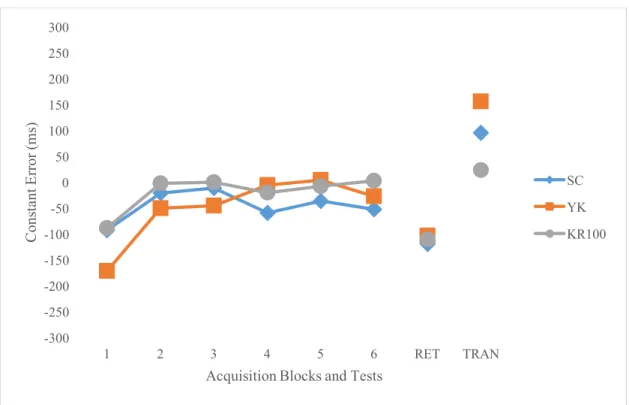
Figure 2 shows the mean CE scores for the SC, YK, and KR100 groups during acquisition. All three groups showed similar accuracy and all improved across acquisition blocks. These observations were supported by a significant main effect for block, F (5, 215) =
8.94; p < .001; η2 = .17. Post hoc comparisons revealed that Block 1 CE was significantly larger
Figure 2. Mean CE scores for self-control (SC), yoked (YK), and 100% feedback (KR100) groups
during acquisition, retention, and transfer phases (ms).
-300 -250 -200 -150 -100 -50 0 50 100 150 200 250 300 1 2 3 4 5 6 RET TRAN C ons ta nt E rr or (m s)
Acquisition Blocks and Tests
SC YK KR100
differ from one another. There was no significant main effect for group, F (2, 43) = .66; p = .523,
nor was there a significant Group × Block interaction, F (10, 215) = 1.69; p = .112.
ACE
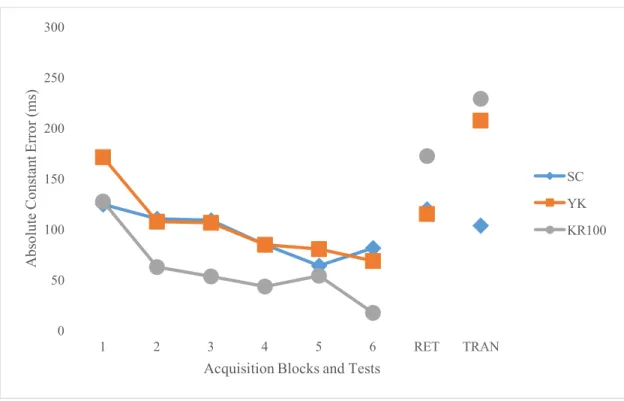
Figure 3 shows the mean ACE scores for the SC, YK, and KR100 groups during acquisition. All three groups showed similar accuracy and all improved across acquisition blocks. These observations were supported by a significant main effect for block, F (5, 215) =
10.93; p < .001; η2 = .20. Post hoc comparisons revealed that Block 1 ACE was significantly
larger than all other block ACE scores (p < .05 for all comparisons) but that the other blocks did
not differ from one another. There was no significant main effect for group, F (2, 43) = 2.75; p =
.075, nor was there a significant Group × Block interaction, F (10, 215) = .73; p = .668.
AE
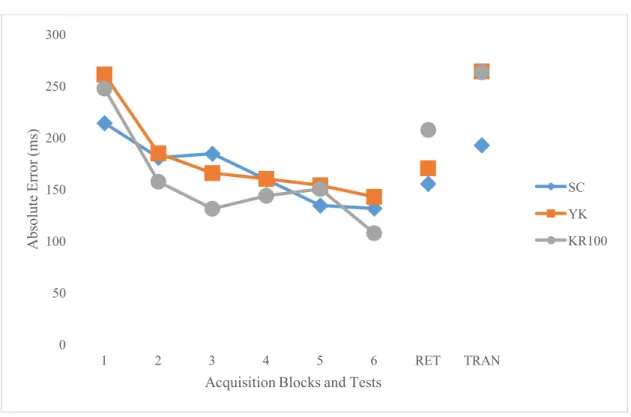
Figure 4 shows the mean AE scores for the SC, YK, and KR100 groups during acquisition. All three groups showed similar accuracy and all improved across acquisition blocks. These observations were supported by a significant main effect for block, F (5, 215) =
29.75; p < .001; η2 = .41. Post hoc comparisons revealed that Block 1 AE was significantly
larger than all other block AE scores and Block 6 AE was significantly smaller than Blocks 1-4 (p < .05 for all comparisons) while all other blocks did not differ from one another. There was no
significant main effect for group, F (2, 43) = .83; p = .445, nor was there a significant Group ×
Block interaction, F (10, 215) = 1.50; p = .170.
VE
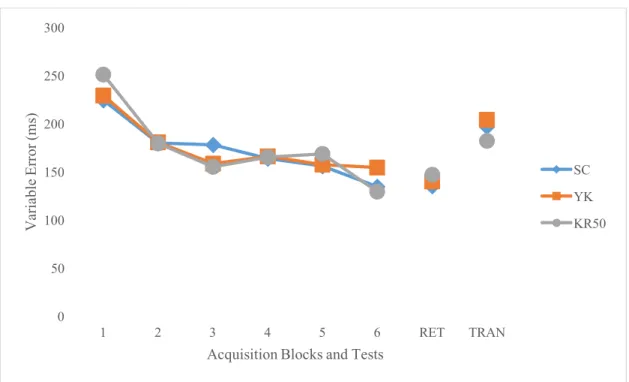
Figure 5 shows the mean VE scores for the SC, YK, and KR100 groups during acquisition. All three groups showed similar variability in accuracy and all improved across acquisition blocks. These observations were supported by a significant main effect for block,
Figure 3. Mean ACE scores for self-control (SC), yoked (YK), and 100% feedback (KR100)
groups during acquisition, retention, and transfer phases (ms).
0 50 100 150 200 250 300 1 2 3 4 5 6 RET TRAN A bs ol ut e C ons ta nt E rr or ( m s)
Acquisition Blocks and Tests
SC YK KR100
Figure 4. Mean AE scores for self-control (SC), yoked (YK), and 100% feedback (KR100) groups
during acquisition, retention, and transfer phases (ms).
0 50 100 150 200 250 300 1 2 3 4 5 6 RET TRAN A bs ol ut e E rr or (m s)
Acquisition Blocks and Tests
SC YK KR100
Figure 5. Mean VE scores for self-control (SC), yoked (YK), and 100% feedback (KR100) groups
during acquisition, retention, and transfer phases (ms).
0 50 100 150 200 250 300 1 2 3 4 5 6 RET TRAN V ar ia bl e E rr or (m s)
Acquisition Blocks and Tests
SC YK KR50
F (5, 215) = 51.66; p < .001; η2 = .35. Post hoc comparisons revealed that Block 1 VE was
significantly larger than all other block VE scores and Block 6 VE was significantly smaller than Blocks 1-3 (p < .05 for all comparisons) while all other blocks did not differ from one another.
There was no significant main effect for group, F (2, 43) = .01; p = .992, nor was there a
significant Group × Block interaction, F (10, 215) = .82; p = .577.
Feedback vs No Feedback
Separate 2 (group: SC vs. YK) × 2 (trial type: FB vs no-FB) repeated measures ANOVAs were run for each performance variable in order to examine any group or trial type differences. Performance measures included CE, ACE, AE, and VE. There were no significant main effects for any of the performance measure analyses for condition, F (1,32)< 1.0, group, F (1,32) < 1.0,
or Group × Condition interaction, F (1,32) < 1.0.
After Feedback trials vs After No Feedback trials
Separate 2 (group: SC vs. YK) × 2 (trial type: after FB vs after no-FB) repeated measures ANOVAs were run for each performance variable in order to examine any group or trial type differences. Performance measures included CE, ACE, AE, and VE.
CE and ACE
Differences in temporal accuracy after feedback trials vs. after no-feedback trials were found within the ACE, AE, and VE performance measures, while CE showed no significant effects F (1, 32) = .32; p = .571; η2 = .01. Figure 6 shows the mean ACE scores after feedback
trials and after no-feedback trials for the SC and YK groups during acquisition. Both groups showed better performance after feedback trials compared to after no-feedback trials. These observations were supported by a significant main effect for condition, F (1, 32) = 10.37;
Figure 6. Mean ACE scores for self-control (SC) and yoked (YK) groups after feedback (FB) and
no-feedback (No FB) trials during acquisition (ms).
61 55 92 113 0 50 100 150 200 250 300 SC YK A bs ol ut e C ons ta nt E rr or ( m s) Groups After FB After No FB
p =.003; η2 = .25. There was no significant main effect for group, F (1, 32) = .09; p = .340, nor
was there a significant Group × Condition interaction, F (1, 32) = .94; p = .340.
AE
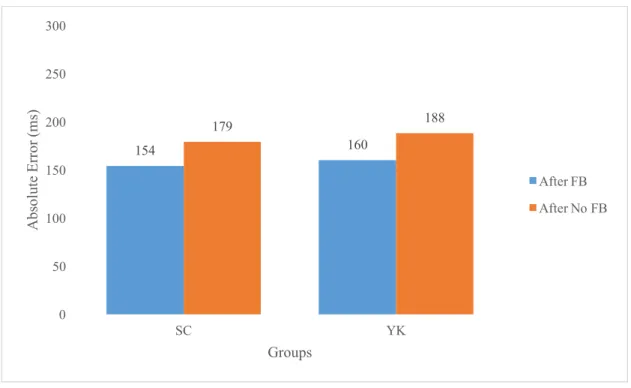
Figure 7 shows the mean AE scores after feedback trials and after no-feedback trials for the SC and YK groups during acquisition. Both groups showed better performance after
feedback trials compared to after no-feedback trials. These observations were supported by a significant main effect for condition, F (1, 32) = 17.15; p < .001; η2 = .35. There was no
significant main effect for group, F (1, 32) = .17; p = .685, nor was there a significant Group ×
Condition interaction, F (1, 32) = .03; p = .868.
VE
Figure 8 shows the mean VE scores after feedback trials and after no-feedback trials for the SC and YK groups during acquisition. Both groups showed better performance after
feedback trials compared to after no-feedback trials. These observations were supported by a significant main effect for condition, F (1, 32) = 7.37; p = .011; η2 = .19. There was no
significant main effect for group, F (1, 32) = .96; p = .334, nor was there a significant Group ×
Condition interaction, F (1, 32) = 1.85; p = .183.
Retention
Separate one-way univariate ANOVAs were run for each performance variable during retention in order to examine any group differences. Performance measures included CE, ACE, AE, and VE.
CE
Figure 2 shows the mean CE scores for the SC, YK, and KR100 groups during retention. There was no significant main effect for group F (2, 43) = .05; p = .950.
Figure 7. Mean AE scores for self-control (SC) and yoked (YK) groups after feedback (FB) and
no-feedback (No FB) trials during acquisition (ms).
154 160 179 188 0 50 100 150 200 250 300 SC YK A bs ol ut e E rr or (m s) Groups After FB After No FB
Figure 8. Mean VE scores for self-control (SC) and yoked (YK) groups after feedback (FB) and
no-feedback (No FB) trials during acquisition (ms).
172 171 203 266 0 50 100 150 200 250 300 SC YK V ar ia bl e E rr or (m s) Groups After FB After No FB
ACE
Figure 3 shows the mean ACE scores for the SC, YK, and KR100 groups during retention. There was no significant main effect for group F (2, 43) = 1.11; p = .340.
AE
Figure 4 shows the mean AE scores for the SC, YK, and KR100 groups during retention. There was no significant main effect for group F (2, 43) = 1.15; p = .325.
VE
Figure 5 shows the mean VE scores for the SC, YK, and KR100 groups during retention. There was no significant main effect for group F (2, 43) = .20; p = .816.
Transfer
Separate one-way univariate ANOVAs were run for each performance variable during transfer in order to examine any group differences. Performance measures included CE, ACE, AE, and VE.
CE
Figure 2 shows the mean CE scores for the SC, YK, and KR100 groups during transfer. There was no significant main effect for group F (2, 43) = 1.84; p = .172.
ACE
Figure 3 shows the mean ACE scores for the SC, YK, and KR100 groups during transfer. The three groups differed in accuracy during the transfer test. These observations were supported by a significant main effect for group, F (2, 43) = 4.04; p = .025; η2 = 0.16. Post hoc
comparisons revealed that SC ACE was significantly smaller than both the YK and KR100 groups (p < .05 for all comparisons) while the YK and KR100 groups did not differ from one
AE
Figure 4 shows the mean AE scores for the SC, YK, and KR100 groups during transfer. The three groups approached significant differences in accuracy during the transfer test, however there were no significant main effects for group, F (2, 43) = 3.02; p = .059.
VE
Figure 5 shows the mean VE scores for the SC, YK, and KR100 groups during transfer. There was no significant main effect for group, F (2, 43) = .88; p = .424.
Errors
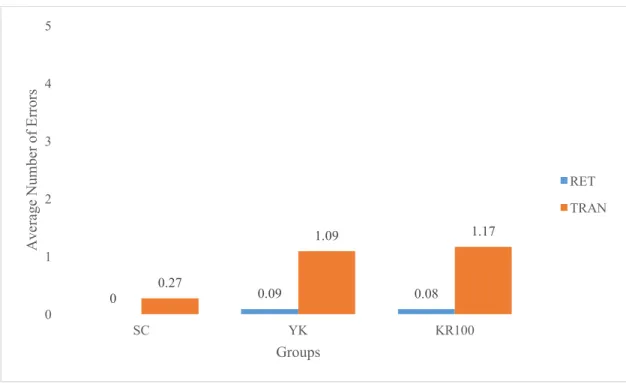
Separate negative binomial regression analyses were run for retention and transfer to examine if group error rates differed significantly among groups. Figure 9 shows the mean number of errors committed for the SC, YK, and KR100 groups during retention and transfer. There was no significant main effect for group during retention, x2 (2) = 1.58; p = .453 or during
transfer, x2 (2) = 4.92; p = .086.
Needs Satisfaction Measures
Basic Psychological Needs Satisfaction Survey (BPNS)
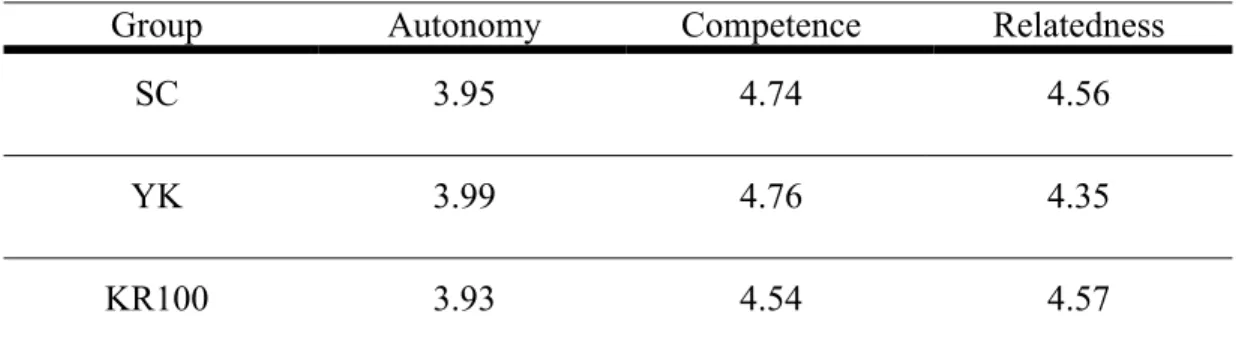
Separate one-way univariate ANOVAs were run for each BPNS sub-category in order to examine any group differences. BPNS sub-categories include Autonomy, Competence, and Relatedness. Table 1 shows the mean scores for each of the BPNS sub-categories. There was no significant main effect for group for Autonomy, F (2, 43) = .02; p = .984, Competence, F (2, 43)
Figure 9. Mean number of errors for self-control (SC), yoked (YK), and 100% feedback (KR100)
groups during retention and transfer.
0 0.09 0.08 0.27 1.09 1.17 0 1 2 3 4 5 SC YK KR100 A ve ra ge N um be r of E rr or s Groups RET TRAN