IEEE TRANSACTIONS ON MOBILE COMPUTING, VOL. XX, NO. XX, NOVEMBER 201X 1
Evidence-aware Mobile Computational
Offloading
Huber Flores, Pan Hui, Petteri Nurmi, Eemil Lagerspetz, Sasu Tarkoma, Jukka Manner,
Vassilis Kostakos, Yong Li, and Xiang Su
Abstract—Computational offloading can improve user experience of mobile apps through improved responsiveness and reduced energy footprint. A fundamental challenge in offloading is to distinguish situations where offloading is beneficial from those where it is counterproductive. Currently, offloading decisions are predominantly based on profiling performed onindividual devices. While significant gains have been shown in benchmarks, these gains rarely translate to real-world use due to the complexity of contexts and parameters that affect offloading. We contribute by proposingcrowdsensed evidence tracesas a novel mechanism for improving the performance of offloading systems. Instead of limiting to profiling individual devices, crowdsensing enables characterising execution contexts across a community of users, providing better generalisation and coverage of contexts. We demonstrate the feasibility of using crowdsensing to characterize offloading contexts through an analysis of two crowdsensing datasets. Motivated by our results, we present the design and development of EMCO toolkit and platform as a novel solution for computational offloading. Experiments carried out on a testbed deployment in Amazon EC2 Ireland demonstrate that EMCO can consistently accelerate app execution while at the same time reduce energy footprint. We also demonstrate that EMCO provides better scalability than current cloud platforms, being able to serve a larger number of clients without variations in performance. Our framework, use cases, and tools are available as open source from GitHub.
Index Terms—Mobile Cloud Computing, Computational Offloading, Big Data, Crowdsensing.
F
1
I
NTRODUCTIONC
Omputational offloading is a powerful mechanism forimproving responsiveness and battery efficiency, two critical factors in the acceptability and usability of mobile applications [1]. By outsourcing (parts of) computation-ally intensive tasks to dedicated computing infrastructure, devices can reduce burden on their own resources while benefiting from resources provided by the dedicated infras-tructure. Several platforms for providing offloading support have been proposed in the literature with the main differ-ence being the level at which offloading is enabled. Exam-ples of proposed mechanisms include annotation [2], [3], thread-migration [4], thread-migration through data shared memory (DSM) [5], and various others [6], [7], [8].
A key challenge in computational offloading is to dis-tinguish situations where offloading is beneficial from those where it is counterproductive. For example, offloading net-work intensive computing tasks is only beneficial when the network link is sufficiently fast and stable whereas of-floading parts of applications that require interactivity (e.g.,
• H. Flores is with the Department of Computer Science, University of Helsinki, Finland.
E-mail: see http://huberflores.com
• P. Hui is with the Hong Kong University of Science and Technology, China, and Deutsche Telekom Laboratories, Germany.
• P. Nurmi, E. Lagerspetz and S. Tarkoma are with the University of Helsinki, Finland.
• V. Kostakos is with the University of Melbourne, Australia. • J. Manner is with Aalto University, Finland.
• Y. Li is with Tsinghua University, China. • X. Su is is with the University of Oulu, Finland.
Manuscript received November xx, 201x; revised Month xx, 201x.
augmented reality) is often counterproductive as energy gains are offset by decreased responsiveness resulting from increased latency [9]. Making optimal decisions, however, is far from straightforward as a wide range of factors can influence the effectiveness of offloading. For example, the extent of energy savings from reduced CPU usage depend on temperature and the number of applications running on a device [10]. Similarly, network type, device model, and the capacity and current load of the cloud surrogate have a major impact on offloading performance [11], [12].
Quanti-fying and characterizing the effect of these factors on asingle
device is clearly infeasible due to the inherent complexity and diversity of these factors. Indeed, in our experiments we demonstrate that quantifying individual factors, such as characterizing whether a particular mobile application requires heavy processing or characterizing the effect of network type, requires a large amount of samples (data
from over100 different apps or over 6,000 RTT samples).
While individual devices cannot capture such amounts
easily, harnessing acommunity of devices would make the
process feasible. A population of100devices, which is easily
obtainable within a university or even a company, would be capable of collecting the required measurements within
a week or less, and a community of 1000 devices, which
is increasingly possible through app store deployment [13], could collect the required measurements in less than a day.
We contribute by developing evidence-aware mobile
computational offloading (EMCO) as a novel mechanism for
optimizing the performance of computational offloading frameworks. The key novelty in EMCO is the use of
crowdsensed evidence traces to characterize the influence
offloading decisions [14]. Contrary to existing solutions, which either rely on static code profiling performed on individual devices [2], [3], [4], [5], [6], [11], [15], [16], [17] or on parametrized models that consider a handful of parameters such as network latency, remaining energy, and CPU speed [9], [18], the use of crowdsensing enables EMCO to quantify and characterize the effect of a wide range of parameters and how they vary over execution contexts. EMCO models the context where offloading decisions are made is through simple dimensions that are easy to scale, and determines optimal dimensions using an analytic process that characterizes the performance of offloading based on contexts captured by the community. EMCO also supports identifying reusable and profitable code invocations that can be cached locally to further accelerate performance. We evaluate EMCO through extensive benchmarks conducted on an Amazon EC2 testbed deployment. Our results demonstrate that EMCO significantly accelerates mobile app performance, resulting in over five-fold improvements in response time and over
30% reductions in energy. When pre-caching on the client
is used, the magnitude of savings is even higher with up to
30-fold improvements in response rate being possible.
The contributions of the paper are summarized as follows:
• We propose crowdsensed evidence traces as a novel
mechanism for optimizing offloading performance. By aggregating samples from a larger community of devices, it is possible to learn optimal execution contexts where to offload. We analyze two crowd-sensing datasets, Carat [19] and NetRadar [20], to demonstrate that it is possible to use crowdsensing to accurately quantify the effect of different factors on offloading performance. We also demonstrate that carrying out the profiling on a single device is not feasible due to the number of samples required.
• We present the design and development of the
Evidence-Aware Mobile Computational Offloading (EMCO) platform and toolkit. We demonstrate that EMCO enables apps to accelerate their re-sponse time up to five-fold, and up to thirty-fold with pre-caching. We also demonstrate that EMCO can achieve further reductions in energy footprint through optimal selection of the cloud surrogate.
• We develop LAPSI1as a novel cloud-based runtime
environment that supports characterization of sur-rogate performance. LAPSI is based on the Dalvik virtual machine which we have directly integrated with a cloud server. This creates a lightweight com-piler for executing code and provides good scaling performance over a large community of clients.
• We develop and deploy a real testbed in Amazon
EC2 and show that simply by dynamically adapting the resource allocation of the surrogate, EMCO in-creases gains in energy from offloading by 30%. In addition, we show that EMCO considerably reduces the energy required in the communication with cloud through the use of pre-caching.
1. Finnish for child, motivated by our runtime environment’s parent-child structure.
2
R
ELATEDW
ORKThe origins of computational offloading are in cyberfor-aging, which aimed at distributing computations from a resource constrained (mobile) device to nearby infrastruc-ture [21]. Since then, most of the work has focused on linking the device with remote infrastructure or a hybrid that combines remote and local connectivity. An example of the latter are Cloudlets [15] in which constrained devices act as thin clients that connect to remote infrastructure through a nearby gateway service (the cloudlet).
In most of the early works, offloading took place at application level, i.e., the execution of the entire app was shifted to another device. Current state-of-the-art solutions provide finer-grained control over the offloading process by instrumenting the apps at code level. For example, MAUI [2] proposes a strategy where the software developer annotates the code and during runtime methods are offloaded when suitable conditions are detected by the MAUI profiler. Simi-larly, CloneCloud [4] exploits a dynamic approach, where a code profiler extrapolates pieces of bytecode at thread level to a server. CloneCloud uses static analysis to par-tition code. However, this is inadequate to verify runtime properties of code, which usually cause unnecessary code offloading. COMET [5] is another framework for code of-floading that offloads at thread level, but introduces a DSM mechanism that allows the device to offload unmodified multi-threads. ThinkAir [3] addresses scalability by creating virtual machines (VMs) of a complete smartphone system in the cloud. However, since the development of mobile application uses annotations, the developer must follow a brute-force approach to adapt his/her application to a spe-cific device. Moreover, the scalability claimed by ThinkAir does not support multi-tenancy, but the system creates multiple virtual machines based on Android-x86 within the same server for parallelization. Other frameworks for computational offloading include [16], [22], [23], [24], [25]. COSMOS [6] provides offloading as a service at method level using Android-x86. The framework introduces an extra layer in an existing offloading architecture to solve the mismatch between how individual mobile devices demand computing resources and how cloud providers offer them. However, COSMOS relies on the user to manually solve this problem, which is inefficient. Moreover, end users seldom are familiar with different cloud options and their costs.
Studies of computational offloading in the wild have
mostly shown that offloading increases computational
ef-fort rather than reduces it [26]. This is due to the large amount of mobile usage contexts, and the poor under-standing of the conditions and configurations in which a device offloads to the cloud. Some recent work attempts to overcome this problem by dynamically alleviating the issues of inferring the right matching between mobile and cloud considering multiple levels of granularity [11], [27]. Similarly, CDroid [26] attempts to improve offloading in real scenarios. However, the framework focuses more on data offloading rather than computational offloading.
IEEE TRANSACTIONS ON MOBILE COMPUTING, VOL. XX, NO. XX, NOVEMBER 201X 3
Dataset Carat NetRadar
Data source App store deployment(Multiple locations) Finland (MetropolitanHelsinki area) Number
of samples
2.9∗109
(from 328,000 apps) 135,000 Start time 01/08/2013 01/01/2015
Duration 1 year 1 year
TABLE 1: Summary statistics of application usage and net-work connectivity datasets.
reduces the effort and time of learning when to offload. This also improves the detection of offloading opportunities as it captures a large spectrum of possibilities from the community. Lastly, unlike other work that just uses the cloud as computational infrastructure to offload, EMCO takes advantage of the capabilities of cloud infrastructure to optimize the diagnosis of offloading contexts.
3
F
EASIBILITY OFC
ROWDSENSING FORQ
UANTI-FYING
O
FFLOADINGC
ONTEXTSThe focus of our work is on improving the effectiveness of offloading through the use of crowdsensing. Before detailing our approach, we investigate two fundamental questions in the use of crowdsensing. First, we examine the accuracy and generality of crowdsensed evidence traces and demonstrate that measurements provided by a community of devices can indeed be used to characterize offloading contexts. Sec-ond, we determine the amount of measurements required to characterize execution contexts. Specifically, we demon-strate that collecting a sufficient amount of measurements is infeasible on individual devices, but can be captured even from a (reasonably) small community of devices. We carry out our analysis using two large-scale datasets of mobile crowdsensing: Carat [19] and NetRadar [20]; see Table 1 for a summary of the datasets. The former captures the process-ing requirements and energy use of applications, whereas the latter captures network performance related parameters across different devices. Additionally, we carry out a crowd-sensing simulation to characterize cloud resource allocation performance. In summary, we show that characterization via crowdsensing captures richer context information about smartphone usage (mobile context), network (communica-tion context) and task accelera(communica-tion (execu(communica-tion context).
3.1 Smartphone Application Usage
We first consider the feasibility of using crowdsourcing to quantify the computational performance on applications, a critical factor in deciding when to offload. We perform the analysis by considering a large-scale data set contain-ing energy footprints of mobile apps collected through the Carat application [19]. While many offloading frameworks operate on finer level of code granularity, i.e., on a method or class level, collecting such data is infeasible as it requires a large-scale deployment of apps which have been instru-mented with the appropriate mechanism. Nevertheless, we demonstrate that even when considering application level granularity, it is possible to identify the conditions in which mobile applications require intensive processing. The
ana-lyzed data contains data from approximately328,000apps,
collected over a period of one year. For each app, the data contains the expected % of energy drain which is calculated over the entire community of devices; see [19] for details of the Carat methodology.
We first consider the minimum number of apps that are needed for identifying conditions for resource intensiveness. We analyze the distribution of expected energy drain, as given by the Carat application, and identify convergence of the resulting energy distribution. The results of our analysis are shown in Figure 1a. From the results we can observe that
measurements from around120different apps are required.
The average energy drain of apps within the community
is < 0.004, which depicts battery consumption in % per
second. In our experiments we consider this value as a lower bound for the detection of resource-intensive behavior.
To further illustrate the practical value of our approach, we assess the fraction of apps that could benefit from offloading through two representative examples of ap-plication categories that are generally believed to bene-fit from offloading: photo face manipulation and games. We also separately consider puzzle and chess games, two subcategories of games with heavy computational require-ments, to demonstrate that our methodology applies to smaller sets of applications. For each category, we extract all unique apps. Overall there are about 550 photo face manipulation apps, about 7,805 game apps, about 717 puz-zle apps, and about 166 chess apps, i.e., each category meets the minimum requirement for estimating resource intensiveness. Each group is compared with the average energy drain of the subset, which excludes its own energy drain. From the results in Figure 1 we can observe that around (1b) 43.84%, (1c) 44.56%, (1d) 42.75% and (1e) 33% of apps implement computational operations that require higher energy drain than normal, which is a significant number of apps. This result suggests that computational offloading could be beneficial for a large fraction of apps.
As the final step of our analysis, we consider the amount of samples required from the community to accurately characterize high energy drain. According to Figure 1f, we find that about 10,000 samples are gathered to estimate high
energy drain within interval of 0.0040±0.000035. As Carat
collects samples each time the battery of a device changes,
we get on average 50−100 samples per device in a day.
Collecting the required10,000 samples on a single device
would thus clearly be infeasible, but a community of 100
devices could achieve this in a day or two.
A limitation of our analysis is that we considered app level offloading instead of method, class or thread level migration. Intuitively, we would expect finer-granularity to further improve decision making. However, this requires instrumenting the offloading mechanisms with the ability to monitor its own local and remote execution. To enable this kind of analytics, our implementation of EMCO integrates required mechanisms to capture both local and remote execution performance; see Section 4 for details.
3.2 Network Connectivity
0.002 0.004
10 1000 50000
Battery consumption [%/s]
Number of apps
0.0035 0.004 0.0045
50000 75000 100000
(a)
0 5 10 15 20 25 30
(0,0.001] (0.001,0.002](0.002,0.003](0.003,0.004](0.004,0.005](0.005,0.006](0.006,0.007](0.007,0.008](0.008,0.009](0.009,0.01](0.01,+]
% of face manipulation apps
Battery drain [%] Normal energy drain
4.0 16.09
10.72
25.36 Higher energy drain
15.27
8.0 5.18 4.75
2.271.27 7.09
(b)
0 5 10 15 20 25 30
(0,0.001] (0.001,0.002](0.002,0.003](0.003,0.004](0.004,0.005](0.005,0.006](0.006,0.007](0.007,0.008](0.008,0.009](0.009,0.01](0.01,+]
% of game apps
Battery drain [%] Normal energy drain
3.29 6.14
19.60 26.36
Higher energy drain
16.09
8.52 4.39 3.68
2.19 1.78 7.91
(c)
0 5 10 15 20 25 30
(0,0.001] (0.001,0.002](0.002,0.003](0.003,0.004](0.004,0.005](0.005,0.006](0.006,0.007](0.007,0.008](0.008,0.009](0.009,0.01](0.01,+]
% of puzzle apps
Battery drain [%] Normal energy drain
5.99 10.18
21.51 19.57
Higher energy drain
16.0
7.39 3.76
2.26 0.83 0.97
11.54
(d)
0 5 10 15 20 25 30
(0,0.001] (0.001,0.002](0.002,0.003](0.003,0.004](0.004,0.005](0.005,0.006](0.006,0.007](0.007,0.008](0.008,0.009](0.009,0.01](0.01,+]
% of chess apps
Battery drain [%] Normal energy drain
6.02 9.03
27.10
24.09 Higher energy drain
9.63 6.62
5.42 2.40
1.20 0.60 7.83
(e)
0.001 0.004 0.01
10 1000 10000
Battery consumption [%/s]
Number of samples
0.0035 0.004 0.0045
1000 2500 5000 10000
[image:4.612.51.558.43.313.2](f)
Fig. 1: Characterization of smartphone app usage via crowdsensing. (a) Number of applications for community charac-terization. (b, c, d, e) Smartphone apps that depict higher energy drain at different community granularity. (f) Number of samples for energy characterization.
communication interfaces, e.g., WiFi, 3G, LTE. Characteriz-ing networkCharacteriz-ing performance, however, can easily become energy-intensive, especially in suboptimal network condi-tions as more samples and and a longer duration of monitor-ing are required. In this section we examine the potential of replacing the network profiler with crowdsensing. The main question we investigate is how many samples are required to characterize latency accurately at a particular time or lo-cation. We answer this question by analyzing the NetRadar
dataset2[20] and characterizing the performance of 3G and
LTE communications. Since latency in the cellular network also depends on the provider, we consider three different mobile operators, which are the main network providers in Finland. For anonymity, we refer to the operators using pseudonyms Operator-1, Operator-2 and Operator-3.
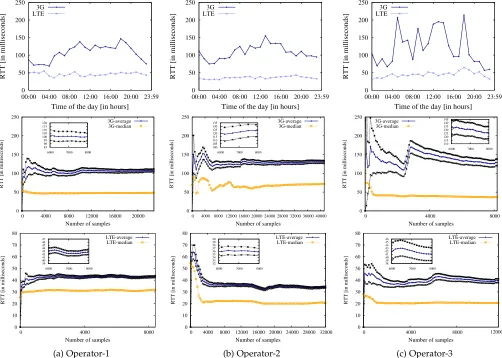
The topmost row of Figure 2 shows the average latency of the communication (RTT) for each provider. From the re-sults, we can observe that the average RTT varies across the
operators: 107ms (SD≈283) for Operator-1, 130ms (SD≈387)
for Operator-2, and 129ms (SD≈403) for Operator-3. For
LTE, the averages are 43ms (SD≈35) for Operator-1, 33ms
(SD≈65) for Operator-2, and 39ms for (SD≈90)
Operator-3. While there is a notable difference between 3G and LTE in terms of speed, we can observe higher stability in the communication link of LTE. In terms of quality of service, in the case of 3G, Operator-1 provides the most stable commu-nication and Operator-3 the most unstable one. In the case of LTE, Operator-2 provides the most stable communication and Operator-1 the most unstable one, i.e., both the operator and the communication technology should be taken into
2. https://www.netradar.org/en
account when making offloading decisions.
Regarding the amount of data needed for characteri-zation, we calculate the number of samples required to estimate latency. The average and median latency as a function of the number of samples for 3G and LTE are shown on the two bottommost rows of Figure 2. We can observe that the amount of data required to characterize the latency of communication depends on the stability of the communication link. For instance, for 3G, to characterize the most stable communication (Operator-1) with an interval of
100 ±7.24 at least6,300 samples are needed. In contrast,
if the same amount of samples is used to characterize the most unstable channel (Operator-3), then an interval of 132
±10.06is achieved. Thus, to improve accuracy and reduce
error at comparable rates as Operator-1, an addition of 3,700 samples is required (10,000 in total). By generalizing the characterization time as a function of samples required,
we have T = S/(St∗ n), where T is the time that takes
to complete the characterization, S is the total number of
samples required for the characterization,Stis the number
of samples collected in time t, and n is the number of
devices available to collect samples. In terms of sampling complexity, assume we want to characterize latency of 3G
for Operator-3 and that we receive5samples per day from
IEEE TRANSACTIONS ON MOBILE COMPUTING, VOL. XX, NO. XX, NOVEMBER 201X 5
application data requests, significantly larger communities of devices could be reached, making it possible to complete the characterization in a matter of hours.
3.3 Augmented Resource Allocation
Computational provisioning takes place at infrastructure level through instances, which are physical or virtualized servers associated to a specific type of resource [27]. An instance follows a utility computing model, whereby con-sumers pay on the basis of their usage and type preferences. The cost of the instance is proportional to its type, which in turn determines the level of acceleration at which a task is executed and energy required in the communication [28]. Moreover, the type of the instance also defines its capacity to handle multiple offloading requests at once. Speeding up code execution certainly depends on how code is written. However, higher types of instances can process a task faster than lower ones as higher types can rely on larger memory span and higher parallelization in multiple processors [29].
To thoroughly characterize cloud resources, we conduct a simulation study where a large number of clients create a dynamic workload which is sent to the cloud [30]. Our simulator operates in two different operational modes: (i) concurrent and (ii) inter-arrival rate. In the former, the
simulator creates n concurrent threads that offload a
ran-dom computational task loaded from a pool of common algorithms found in apps, e.g., quicksort, bubblesort. Each thread represents a mobile device outsourcing a task to a remote server. This mode is utilized to benchmark the in-stances of the cloud. In inter-arrival rate mode, the simulator takes as parameters the number of devices (workload), the inter-arrival time between offloading requests and the time that the workload is active. This mode is utilized to produce synthetic workloads. We note that while throughput could be analyzed through server logs, such logs are (to our best knowledge) not freely available and we are not aware of any studies that would have done so. Thus, we focus instead on performing the characterization on the clients with the help of a community of devices.
To simulate crowdsensing in the wild, we configure our simulator in concurrent mode to stress the instances with a heavy workload of requests. In this experiment, each request that is created by the simulator is taken randomly from the pool. The processing required for each task is also determined randomly. The random nature of the experiment is important to verify all possible cases that can influence the processing of a task by a server. We conduct a 3-hour experiment per server to ensure coverage. We also check this characterization by relying on static load. We evaluate the influence of increasing users’ load by configuring the workload from 1 to 100 in intervals of 10 users; per each server loads 1,10,20,30,40,50,60,70,80,90 and 100. Concurrent load is generated with an inter-arrival rate of 1 minute. This means that the maximum load (load=100) used for
characterizing a server is≈ 18000 (3*60*100) requests and
the minimum load (load=1) is≈180requests. The purpose
of the 1 minute inter-arrival is to give enough cool down time to the server before stressing it again.
Figure 3 shows the results of the experiments. We can observe how the response time of the requests is distributed
through the interpercentile range of the processed load. The slope of the mean response time becomes less steep as we use more powerful instances. This suggests that the re-sponse time of a request is defined by the type of the server. Based on this property, we characterize each server into an acceleration group. We find that servers can be classified to 3 acceleration groups. This is important as servers with different costs provide the same level of acceleration when server utilization is low. However, there is also a correlation between server acceleration and utilization, the response time of an offloading request degrades based on the resource capabilities of the server as utilization increases.
Lastly, we used a minimax algorithm with a static input as workload to confirm our results. We can observe the differences between acceleration levels. A task is executed
≈1.25 times faster by a server of level 2 when compared with
one of level 1. Similarly, a task is accelerated≈1.73 times by
a server of level 3 compared with level 1. The difference
between levels 3 and 2 is also significant (≈1.36 times
accel-eration). Our results thus demonstrate that crowdsensing is capable of characterizing both cloud throughput and acceleration across a wide range of contexts.
4
EMCO T
OOLKIT ANDA
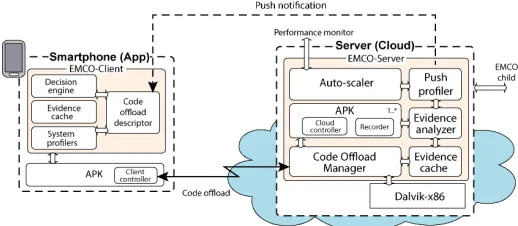
RCHITECTUREIn this section we describe the EMCO development toolkit and platform, which integrate novel mechanisms for har-nessing crowdsensed evidence traces in offloading decision making. EMCO handles two types of mobile communica-tion with the cloud: synchronous code offloading and asyn-chronous injection of data analytics via push notifications. The overall architecture of EMCO is shown in Figure 4. EMCO follows a model where the source code of an app resides both on the mobile and at the server, but it releases the mobile from a fixed cloud counterpart as implemented
by other frameworks. EMCO encourages a scalable
provi-sioning as a serviceapproach where EMCO is deployed on
multiple interconnected servers and responds on-demand to computational requests from any available server. EMCO also provides a toolkit that facilitates the integration of the mobile and cloud mechanisms in the development life-cycle. In the following we describe the different mechanisms and components of EMCO in detail.
4.1 Development Toolkit
To integrate offloading support into applications, EMCO provides a toolkit that consists of a GUI conversion tool that prepares the apps for client/server deployment. Our conversion tool receives as input an Android project and produces as output two projects, one for the mobile, and another for the cloud. Each project is defined with
Maven-Android3 so that for each project an Android Application
Package (APK) file is built automatically. The tool also provides means for automatic deployment of the APK to the cloud. Our conversion tool has been designed to operate with existing frameworks and hence does not introduce any additional complexity, such as learning a new API.
The conversion tool transforms all methods that fulfill offloading requirements by wrapping each task (or method)
0 50 100 150 200 250
00:00 04:00 08:00 12:00 16:00 20:00 23:59
RTT [in milliseconds]
Time of the day [in hours]
3G LTE 0 50 100 150 200 250
00:00 04:00 08:00 12:00 16:00 20:00 23:59
RTT [in milliseconds]
Time of the day [in hours]
3G LTE 0 50 100 150 200 250
00:00 04:00 08:00 12:00 16:00 20:00 23:59
RTT [in milliseconds]
Time of the day [in hours]
3G LTE 0 50 100 150 200 250
0 4000 8000 12000 16000 20000
RTT [in milliseconds]
Number of samples 3G-average 3G-median 85 90 95 100 105 110 115 120
6000 7000 8000
0 50 100 150 200 250
0 4000 8000 12000 16000 20000 24000 28000 32000 36000 40000
RTT [in milliseconds]
Number of samples 3G-average 3G-median 100 105 110 115 120 125 130 135
6000 7000 8000
0 50 100 150 200 250
0 4000 8000
RTT [in milliseconds]
Number of samples 3G-average 3G-median 110 115 120 125 130 135 140 145
6000 7000 8000
0 10 20 30 40 50 60 70 80
0 4000 8000
RTT [in milliseconds]
Number of samples LTE-average LTE-median 39 40 41 42 43 44 45 46 47
6000 7000 8000
(a) Operator-1 0 10 20 30 40 50 60 70 80
0 4000 8000 12000 16000 20000 24000 28000 32000
RTT [in milliseconds]
Number of samples LTE-average LTE-median 32 33 34 35 36 37 38 39 40
6000 7000 8000
(b) Operator-2 0 10 20 30 40 50 60 70 80
0 4000 8000
RTT [in milliseconds]
Number of samples
12000 LTE-average LTE-median 38 39 40 41 42 43 44 45 46
6000 7000 8000
[image:6.612.53.555.49.407.2](c) Operator-3
Fig. 2: Network characterization: (top and middle-top) Number of samples collected at different times of day; (middle-bottom) latency for 3G and LTE technologies (Operators 1-3); ((middle-bottom) amount of samples required to characterize latency.
into a container, which retrieves its execution details from a
descriptorduring runtime (see Sec. 4.3) [4]. The container is
named with the name of the task, while the original task is renamed by adding the prefix "local". Similar instrumenta-tion is followed in [3], [6], [8] with the main difference in our approach being the inclusion of a descriptor that governs the execution of tasks based on the community analysis. Besides equipping the app with offloading mechanisms, the conversion tool integrates the device with crowdsensing mechanisms, i.e., mechanisms for collecting context infor-mation and sharing it with the wider community. As has been shown in previous works [19], such monitoring has minimal impact on the battery lifetime of the mobile client.
4.2 EMCO Server
TheEMCO Serverprovides computational resources for
of-floading and analyzes crowdsensed measurements to iden-tify contexts where offloading is beneficial. We next detail the server’s subcomponents and their key functionalities.
Evidence Analyzer
The Evidence Analyzer analyzes evidence traces collected through crowdsensing and identifies conditions that are
beneficial for offloading. Our implementation of the Evi-dence Analyzer is based on a dual layer analysis pipeline. The first layer, dimension discovery, identifies factors that
are most relevant for creating a code offload descriptor for
a particular app. The second layer, classification, uses the evidence obtained by the first layer to build a classifier which integrates the decision logic used to construct the offload descriptor. The constructed classifier can then be deployed on the client to make offloading decisions directly without interfacing with the cloud.
The first layer, dimension discovery, operates on traces collected from the community. A trace consists of a list of parameters or features such as device model, app identifier, the name of the executed method, input of the method, local execution time, RTT, type of server, and remote ex-ecution time. Additionally, when the code is offloaded, each trace includes a binary variable that indicates whether the remote invocation succeeded. The invocation can fail, e.g., if the surrogate in unable to invoke the code (e.g., missing dependencies) or communicate back the result of that invocation (e.g., malformed serialization). To analyze
evidence, we transform the evidence into rate distributions
which model variations of a specific featuref over time. For
IEEE TRANSACTIONS ON MOBILE COMPUTING, VOL. XX, NO. XX, NOVEMBER 201X 7
10 100 1000
1 10 20 30 40 50 60 70 80 90 100
Response time [in milliseconds]
Number of concurrent users Acceleration level 1: t2.nano
(a)
10 100 1000
1 10 20 30 40 50 60 70 80 90 100
Response time [in milliseconds]
Number of concurrent users Acceleration level 2: t2.medium
(b)
10 100 1000
1 10 20 30 40 50 60 70 80 90 100
Response time [in milliseconds]
Number of concurrent users Acceleration level 3: m4.10xlarge
[image:7.612.52.557.41.180.2](c)
Fig. 3: Cloud-based characterization via crowdsensing gives different acceleration levels to servers based on performance degradation as more users are added.
Fig. 4: Evidence-aware mobile code offloading architecture.
local and remote execution and compare them to identify when offloading is beneficial. Rate distributions are created for all obtainable parameters with the only requirement being that the feature and its value can be estimated during the execution of local and remote computations.
Formally, we construct rate distributions by converting
evidence traces into a set of samples. Let st = (c, p,fˆ)
denote a sample taken at time t of code execution with
identifierc(e.g., app id or method name) which is processed
at p (local or remote) and which is characterized by the
set of features fˆ. In our implementation we consider the
features to be represented as key-value pairs, e.g., "response-time=2s", "energy-consumed=180J". We sort the samples based on time and split them into two groups, one for local execution and one for remote. For each group, successive
measurements(st1, f s)and (st2, f s), are converted into a
rate distributionu=(f s2−f s1)
(t2−t1) , which later is associated with
the rest of features to create a pairR= (u,fˆ). This
associa-tion is important in order to keep track about the values of
the other features withf s. Once the rate distributions are
calculated for a given feature, pairsRlocal andRremote are
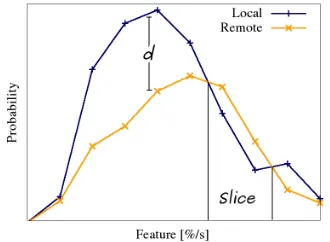
compared as shown in Figure 5. The comparison consists of
finding an overlap, or aslice, between the two distributions.
Typically, Rremote values that are higher than Rlocal ones
suggest that remote execution is counterproductive for the device in the context specified by the slice.
When slices that are counterproductive for offloading are encountered, we remove the corresponding samples from analysis and recalculate the rate distributions. We
then analyze the next featuref si over the remaining set of
samples, i.e., we gradually refine the samples and features to identify conditions that are favorable for offloading. Once
the refinement process completes, we construct acode offload
descriptor which incorporates the most important
dimen-sions. To create the descriptor, we compare the distanced
between the local and remote distributions as this deter-mines the level of improvement; see Figure 5. We aggregate
the distancesdinto bins, and select the bin with the highest
count for the descriptor. Note that the process thus identifies the most frequent conditions for obtaining benefits instead of selecting the ones with the highest performance increase. This is essential for avoiding overfitting to highly specific conditions which are encountered infrequently. EMCO also extracts various alternatives for surrogates based on the
levels of frequency of d. Additionally, the set of rules is
created at the end of the descriptor following a simple heuristic method presented in [31]. Since processing in the cloud is not constrained to service response time, we choose the heuristic solution. Naturally, any other method can be implemented and the modularity of EMCO provides an easy way to extend the functionality of the components.
Once the first layer has finished refining the evidence, the remaining samples are passed on the second layer, classification, to train a classifier which can be deployed on the mobile device as a decision engine. As classifiers we currently use C4.5 decision trees as they can be learned efficiently in the cloud from crowdsourced data and as the decisions made by the classifier can be easily explained [32]. An additional benefit from the use of decision trees is that it provides a mechanism for app developers to scrutinize which parts of their app have been offloaded and why.
The overall EMCO analysis is described in Algorithm 1
and consists of≈1500 LOC written in Scala. To avoid
over-loading the surrogate with extra processing, the analysis is outsourced to a separate monitoring server, which also collects performance metrics about EMCO execution.
Evidence Cache
[image:7.612.47.306.232.345.2]Fig. 5: Comparison of local and remote distributions.
Algorithm 1Evidence analysis
Require: : path to thetraces
1: foreachappintracesdo
2: Create samples.
3: Specify features to compare<f s>
4: foreachfeatureinf sdo
5: Compute rate distribution using samples.
6: <Rlocal,Rremote>
7: CompareRlocalwithRremote
8: Remove slices whereRremoteis higher
9: Update samples
10: end for
11: Calculatedusing filtered samples.
12: Createcode offload descriptor
13: EMCO policy creates the descriptor based on
higher frequency ofd
14: Push descriptor to subscribed smartphone app
15: end for
calculate a digest key from the output of the serialization (SHA-1 checksum). We then index the resulting invocation results with the checksums. Whenever a new request is received, the server compares the checksum of the new request against the previously seen requests and returns the results from the cache whenever a match is found.
Code Offload Manager
TheCode Offload Manager is responsible for handling code
offload requests arriving at the server. The component
ex-tracts from each incoming request an object package which
contains details about the app and details of invocation (method, type of parameters, value of parameters, and so forth). As outlined above, we first calculate a checksum of the request and compare it against the evidence cache. When a match is found, we return the result associated with the match. Otherwise the offload manager identifies the app and its associated (Dalvik) process in the server.
The connection is forwarded to the process so that theCloud
Controllerassociated with the APK file instance can invoke
the method via Java reflection. The result obtained is packed and sent back to the mobile device. In parallel, a trace is created by recording the execution of the method, e.g., execution time, type of server, CPU load, etc., and stored along with the data of the request and its result. Finally, the
trace is passed to theEvidence Analyzerfor analysis.
Push Profiler
ThePush Profileris the messaging component of the cloud
server. Our implementation is based on GCM (Google
Cloud Messaging) service4 which is a notification service
provided by Google to send messages to Android devices. We rely on an existing technique as messaging mechanisms are widely used by cloud vendors to trigger events on the mobiles to synchronize data with their cloud counterparts, e.g., Gmail. These mechanisms are well integrated with current handsets and they have been carefully optimized to have low energy consumption [33].
The EMCO server is registered to GCM service using a key obtained from the Google API. Multiple servers associ-ated with one deployment of EMCO can use the same key. A mobile app subscribes to EMCO to receive notifications, obtaining a sender ID as a result. The ID is valid until the app unsubscribes (or GCM service is refreshed). EMCO then sends a message to the smartphone client which consists of a push request to the GCM service. The request consists of
theAPI key, thesender IDand the message payload. Requests
are queued for delivery (with maximum of five attempts) or stored if the mobile is offline. Once the message reaches the
device, the Android system executes a broadcast intent for
passing the raw data to thecode offload descriptor.
EMCO relies on push requests to construct code offload descriptors for smartphone apps. As each message sent through GCM is limited to 1024 bytes, multiple messages are needed to form a descriptor. Messages are sent to the mobile based on different events, for instance, dynamic cloud allocation, periodic trace analysis, location detection of the mobile, etc. Since GCM is a popular service, it does not guarantee the delivery of a message and is unreliable to be used in real-time applications. To counter this problem, EMCO provides a generic interface, which can be used to in-tegrate easily other push technologies, e.g., MQTT (Message Queue Telemetry Transport). We have also developed our
own push server5based on XMPP, which can overcome the
issues of proprietary push technologies and performance reliability of the notifications.
Auto Scaler
The Auto Scaler enables EMCO to support multi-tenancy.
It uses the AMI EC2 tools wrapped into Java, to manage
[image:8.612.51.301.203.417.2]dynamic resource allocation of servers. The mechanism allows the framework to scale dynamically in a public or private cloud infrastructure. Note that while public cloud vendors provide mechanisms for scaling, e.g., Amazon Au-toscale and Amazon Lambda, these mechanisms are de-signed for scaling SOA applications on demand. Resource requirements in computational offloading are driven by users’ perception of app performance, which is governed by throughput of the cloud infrastructure. This differs from tra-ditional SOA applications that focus on energy savings and reduced computational time without concern for through-put variations. EMCO addresses this gap by utilizing a hierarchical control and supervision scheme as shown in Figure 6. In our scheme, EMCO server acts as a parent, and a separate monitor server collects performance metrics from
4. developer.android.com/google/gcm/
IEEE TRANSACTIONS ON MOBILE COMPUTING, VOL. XX, NO. XX, NOVEMBER 201X 9
Fig. 6: Multi-tenancy and horizontal scaling in EMCO.
the available EMCO servers (based on collectD6). When the
parent reaches its service utilization limits, it creates another child. In this case, the list of subscribed devices is split between the parent and child, and a push notification mes-sage is sent to each device to update the information of its assigned surrogate. In this manner, code offloading requests are balanced among the servers. Respectively, a child can become a second level parent when its service utilization limits are reached. When a child is destroyed, e.g., when it has served all requests and there are no incoming requests, the subscribed mobile devices are passed to the parent.
Surrogate Runtime Environment
EMCO Server is deployed on top of Lightweight App Per-formance Surrogate Image (LAPSI), a customized
Dalvik-x867virtual machine for Android. LAPSI has been built by
downloading and compiling the source code of Android Open Source Project (AOSP) over the instance to target a x86 server architecture, and removing the Applications and Application Framework layers from the Android software architecture. Contrary to other frameworks [3], [4], EMCO does not rely on the virtualization of the entire mobile plat-form to execute the code remotely (such as with Android-x86). Full virtualization has been shown to consume sub-stantial CPU resources and to slow down performance of code execution [34]. Moreover, full virtualization limits the number of active users offloading to a single server. In our case we also found that maintaining a complete execution environment requires substantial storage on the server (>100 GB) to install the software which includes AOSP code and Android SDK, among others. Moreover, once the OS is running in the server, all default features are activated (e.g., Zygote and GUI Manager) which are unnecessary for operating as surrogate and which result in higher CPU utilization of the surrogate. To avoid these overheads, LAPSI uses a Dalvik compiler extracted from the mobile platform which is deployed directly onto the underlying physical resources. This reduces the storage size of our surrogate to 60 GB. Moreover, our surrogate does not activate any default processes from the OS. Besides reducing overall system load, a major advantage of our approach
6. http://collectd.org/
7. Released as public in Ireland region of Amazon EC2 as ami-b2487bd4
is that offload requests getting stuck or lost can be killed individually without restarting the entire offloading system.
4.3 EMCO Smartphone Client
TheEMCO Clientmanages the offloading process on mobile
devices. We next detail the subcomponents of the EMCO client and their key functionalities.
Context Profilers
Profilers are local monitors that gather information about parameters that can potentially influence the outcome of the offloading process. Examples of profilers include system profilers (e.g., network and CPU monitors usage), device monitors (e.g., battery state), and sensor data profilers (e.g., location or remaining battery). We rely on built-in Android APIs to get the status of each resource. In addition, EMCO also includes a code profiler that quantifies the execution of a task (i.e., a method or a process). A task is quantified in terms of response time and energy. The latter is estimated using PowerTutor [35], which has been shown to have low estimation error [19]. We also collect details about the task, e.g., cast type and parameters which allows more fine-grained analytics of offloading performance.
Code Offload Descriptor
The code offload descriptor controls the management (cre-ation, updating, and deletion) of the data analytics injected from the cloud for a particular app running on the device. The descriptor consists of a characterization of the compu-tational offloading process in JSON format which is stored as part of the app space; see Snippet 1 for an example. The descriptor effectively characterizes the logic that is used to determine which parts of the app are suitable of offloading, which acceleration levels are suitable for executing these parts, and which contexts are beneficial for offloading.
Formally, let D represent the dimensions contained in
the descriptor, D = {di ∈ D : 1 ≤ i ≤ N}. Each
di ∈ D consists of sets S of attributes sdi, where Sdi =
{sdi
j ∈Sdi : 0≤j ≤N}, and their valuesadi, whereAdi
={adi
k ∈ A : 1 ≤ k ≤ N}. Our current implementation
assumes attributes are represented as key-value pairs to ensure their storage and processing is lightweight. The descriptor can also contain other types of parameters, such as an indicator of whether the results of a specific method request are reusable and thus a candidate for caching, or parameters that describe user preferences regarding which surrogate to use.
Decision Engine
Snippet 1Computational offloading descriptor in JSON {
"mobileApplication": "Chess",
"deviceID": "i9300",
"what-to-offload": [ {
"candidates-methods": "miniMax, betaPruning", %META-DATA }
],
"when-to-offload": [ {
"bandwidth-threshold": "50", %META-DATA
"interface": "LTE", %META-DATA }
],
"where-to-offload": [ {
"option1-surrogates": "{(miniMax, m1.large), (betaPrunning, m2.4xlarge)}", %META-DATA
"option2-surrogates" : "{(miniMax, m1.micro)}", %META-DATA }
],
"location": [ {
"GPS-coordinates": "60.20453, 24.96185", %META-DATA
"Preferable SSID" : "HUPnet", %META-DATA }
] }
the decision making mechanism is lightweight to run on the client, and the decision paths can be easily scrutinized and communicated to developers whenever needed [32].
Evidence Cache
Similarly to the server, the EMCO client utilizes a cache to maintain results of methods that are executed in the cloud. We store the results of method invocations into a hash table as key-value pairs, where the key is the name of the app appended with the name of the method, and the value contains the object sent from the cloud, the type in which the object should be cast during runtime and a time to live (TTL) value. The TTL value prevents to store permanently a result in the mobile. Thus, the result is assigned with a temporal lifespan. In this context, if the result is not used during that lifespan, then it is automatically removed from the hash table. The TTL value is updated every time the cache result is utilized in order to increase its lifespan.
4.4 Worked Examples
To illustrate EMCO in action, we consider two example scenarios, one related to a chess app that allows playing against an AI agent and the other related to a backtracking-based 3D model loading app; see Sec. 5.1 for description of the apps. We consider context descriptors associated with these apps shown in Snippets 2 and 3, respectively. The values of the context variables in the examples correspond to the average values of the parameters in the crowdsensing experiments described in Section 3 and are representative of the real-world circumstances where offloading takes place.
For the context associated with the chess app (Snippet 2), WiFi and LTE have similar latencies. Hence, EMCO’s de-cision of whether to offload (and if so, where to offload) largely depends on the computational capability of the surrogate and the mobile device. In Snippet 3, on the other hand, WiFi has high latency (147ms) which would result in LTE being used as the communication technology (latency 39ms). In both scenarios the surrogate used for offloading
Snippet 2Chess experimental context.
l a b e l=Ctx1, d e v i c e=i 9 3 0 0, CPU=20% LTE=40ms, 3G=139ms, WiFi=27ms
method=Minimax, parameters=" chessboard−15 ", energy=533J,
s u r r o g a t e s=["m1 . s m a l l " (response time (load= 1 ) ) , "m1 . medium" (load= 1 ) , "m1 . l a r g e " (load= 1 ) , "m3 . medium" (load= 3 ) , "m3 . l a r g e " (load= 2 ) , "m3 . x l a r g e " (load= 6 ) , "m3. 2 x l a r g e " (load= 1 0 ) , "m2. 4 x l a r g e " (load=8)
]
Snippet 3Backtracking experimental context.
l a b e l=Ctx0, d e v i c e=i 9 2 5 0, CPU=43% LTE=39ms, 3G=138ms, WiFi=147ms
method=ObjLoader, parameters=" model . 3 ds ", energy=212J,
s u r r o g a t e s=["m1 . s m a l l " (load= 1 ) ,
"m1 . medium" (load= 1 ) , "m1 . l a r g e " (load= 1 1 ) , "m3 . medium" (load= 3 0 ) , "m3 . l a r g e " (load= 1 0 ) , "m3 . x l a r g e " (load= 2 2 ) , "m3. 2 x l a r g e " (load= 7 0 ) , "m2. 4 x l a r g e " (load=50)
]
can be chosen based on estimated response time to minimize latency. Note that since both scenarios represent computa-tionally intensive tasks, the effect of network bandwidth is not apparent. For data-intensive, real-time tasks, such as face manipulation on a live camera stream, the combined effect of bandwidth, latency, energy, and remote surrogate response time need to be taken into account. We have included the type of the device and its current CPU usage as part of the examples as both the savings from offloading and the energy footprint of the method depend on device characteristics and CPU load.
Snippet 4Two alternative Chess contexts.
l a b e l=Ctx2, d e v i c e=i 9 3 0 0, CPU=80% LTE=73ms, 3G=365ms, WiFi=80ms
method=Minimax, parameters=" chessboard−30 ", energy=97J
l a b e l=Ctx3, d e v i c e=i 9 3 0 0, CPU=40% LTE=65ms, 3G=411ms, WiFi=287ms
method=Minimax, parameters=" chessboard−19 ", energy=528J
Another benefit of EMCO is that it can react to dynamic changes in the offloading context. For example, the offload-ing decision can be adapted based on the location where the app is being used. To illustrate this, we consider two additional contexts shown in Snippet 4. The latencies in these contexts correspond to average latencies within two distinct cities (Ctx2 and Ctx3) and have been derived from of our study in Section 3.2. We also consider different stages
of the game, chessboard-19 and chessboard-30, where 19
and 30 correspond to the number of moves made. The
IEEE TRANSACTIONS ON MOBILE COMPUTING, VOL. XX, NO. XX, NOVEMBER 201X 11
[image:11.612.58.295.43.180.2](a) chessboard-15 (b) chessboard-19 (c) chessboard-30
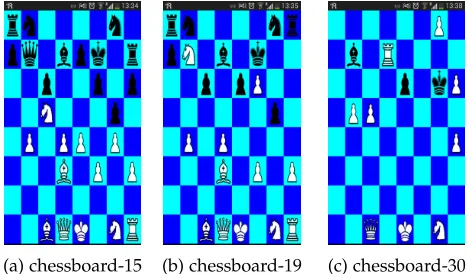
Fig. 7: Three execution states for the chess app: (a, b) intermediate stage (15th and 19th moves) that are compu-tationally intensive, and (c) a later stage of the game (30th move) which is computationally lightweight to solve.
analyze how EMCO behaves when the configuration of the chess application changes from Ctx1, to Ctx2 and Ctx3.
Assume first that the context of the chess application changes to Ctx2. This triggers an automated update of the values of the network interfaces using information from the community of devices running EMCO. We assume that the status of the cloud infrastructure remains the same. In Ctx2, LTE performs better than WiFi whereas in Ctx1 WiFi performed better. Consequently, EMCO would trigger a change of network interface to LTE. The example in Ctx2 corresponds to a later stage of the game (See Figure 7b) and thus the computational requirements are likely to be lower than in Ctx1. While in theory the request could be served on the local device, the high CPU load on the client in the example context would trigger EMCO to offload the request. As the computational requirements are likely to be low, any available surrogate can be chosen without signifi-cant influence on performance. Alternatively, the diagnosis generated by EMCO can be useful for optimizing resource allocation [36] to select the server with the cheapest cost that provides the same quality of service. Consider next a change from Ctx2 to Ctx3, the second in Snippet 4. The con-text corresponds to an intermediate state of the game and hence computing requirements are higher than in Ctx2. This would result in EMCO optimizing surrogate selection, e.g., to use a m2.4xlarge surrogate to optimize response time. In summary, these examples highlight EMCO’s capability to make fine-grained adjustments depending on the currently prevailing offloading context and determine not only when to offload, but to which surrogate to offload.
5
E
VALUATIONEMCO has been designed to improve the user experience of mobile apps through better offload decision making. This results in reduced energy footprint and improved respon-siveness. This section evaluates EMCO, demonstrating that it achieves its design goals and improves on current state-of-the-art solutions. Our main experiments have been carried out through a a real-world testbed deployment of EMCO. We also consider simulation-based experiments carried out using crowdsensing and offline profiling of applications.
5.1 Experimental Setup and Testbed
Our main experiment considers a typical scenario where a mobile app is associated with cloud infrastructure to improve energy and performance on the users’ devices. We consider two simple examples of such apps: a backtracking-based 3D model loader app and a chess app with an AI agent. These apps were designed to incorporate common computational operations that are used in apps with heavy computational requirements and battery footprint. Our im-plementations are freely available for research purposes.
Backtracking8 overlays a 3D model on the surface of the
mobile camera. A user can interact with a model once is displayed, e.g., moving and turning. Our implementation is equipped with ten models (in 3ds format) with the
size of each model being between 500KB and 2000KB.
Loading and displaying the mesh of each model requires a significant amount of processing and hence each model is loaded individually as required by the user. The heavy processing requirements of model loading make the app a good candidate for offloading. Loading the model in the cloud enables splitting it into parts so that the only parts the user interacts with are sent to the mobile de-vice. Examples of similar apps include Augment http:// www.augment.com/augmented-reality-apps/ and Glovius 3D CAD viewer https://www.glovius.com/.
Chess9 allows user to play (chess) against an AI agent
on multiple levels of difficulty. The agent uses a minimax algorithm to determine the best move to make. The portion of code that corresponds to the minimax logic is the most intensive task in the application and hence a good candidate for offloading. Note, that the processing requirements of the minimax vary considerably depending on the state of the chess board with early and late moves typically being less intensive than intermediate ones; see Figure 7.
To conduct our experiments, we have deployed EMCO in Amazon (Ireland region / eu-west-1) using latest
gen-eral purpose instances10 (m3.medium, m3.large, m3.xlarge,
m3.2xlarge) and a memory-optimized instance (m2.4xlarge). As client devices we consider two smartphone models: i9300 (Samsung Galaxy S3) and i9250 (Google Nexus). We follow the principle that an offloading request should both improve (or at least preserve) app responsiveness while reducing en-ergy consumption of the client [29]. The appropriate level of responsiveness depends on the type of application. For ex-ample, real-time games or video applications would expect to have a speed of 30-60 frames per second, while interactive non-realtime applications can have response times up to one second. The energy footprint of the client is measured using
a Monsoon Power Monitor11.
5.2 Characterizing Offloading Context
As the first step of our evaluation we consider a benchmark where we collect evidence for characterizing the execution
8. https://github.com/huberflores/MeshOffloading 9. https://github.com/huberflores/CodeOffloadingChess
10. We have also considered general purpose instances of previous generation: m1.small, m1.medium, and m1.large. These instances con-sistently resulted in worse performance than local execution on the mobile client and hence we have excluded then from our discussion.
0 10 20 30 40 50 60 70 80
5 10 15 20 25 30 35
Response time [in seconds]
Task execution
High processing Low processing
Local (i9300) Local (i9250) m3.medium m3.large m3.xlarge m3.2xlarge m2.4xlarge
(a)
1 5 10 15 20 25 30 35
i9300 i9250-(Nexus)m3.mediumm3.large m3.xlargem3.2xlargem2.4xlargePre-cached
Execution time [in seconds]
Processing-time Communication-latency
(b)
0.1 1 10 100 1000 10000
Local(i9300)Local(i9250)m3.mediumm3.large m3.2xlargem2.4xlargepre-cached
Energy [in Joules]
(c)
0 10 20 30 40 50 60 70 80
1 2 3 4 5 6 7 8 9 10
Response time [in seconds]
Task execution Local (i9300) Local (i9250) m3.medium m3.large m3.xlarge m3.2xlarge m2.4xlarge
(d)
1 5 10 15 20 25 30 35 40 45
i9300 i9250-(Nexus)m3.mediumm3.large m3.xlargem3.2xlargem2.4xlargePre-cached
Execution time [in seconds]
Processing-time Communication-latency
(e)
0.1 1 10 100 1000 10000
Local(i9300)Local(i9250)m3.mediumm3.large m3.2xlargem2.4xlargepre-cached
Energy [in Joules]
[image:12.612.54.546.46.312.2](f)
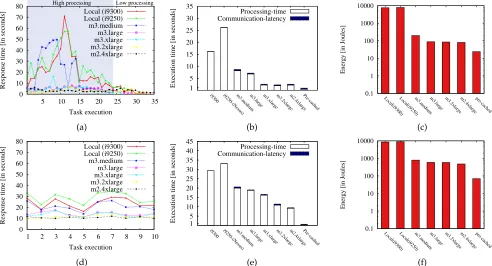
Fig. 8: App performance: (a), (b), and (c) from the chess application and (d), (e), and (f) from the backtracking app. The first column of each row corresponds to response time with a specific execution environment (surrogate or local) and app state (the number of moves since game start for chess and the index of the model being loaded for backtracking). The second column is the average execution time of the task, and the third column show the energy consumption of the client.
of our test apps. We execute both apps 48 times on each
of the five surrogates (i.e., 240 remote execution trials) and
100 times on each mobile device (i.e., 200 local execution
trials). For the chess app, the number of offloading requests depends on the length of the chess match. In total we
observed 7200 requests, i.e., approximately 30 moves per
game. For the backtracking app we loaded all 10 models
during each trial, resulting in 2400offloading requests (48
trials×5surrogates×10models). The surrogate used for
offloading requests was selected in a round-robin fashion from the instances which were available.
The results of our benchmarks are shown in Figure 8. For both apps we observe that offloading generally improves both response time and energy footprint. However, we can also observe that the magnitude of the benefits depends on the execution context. This is particularly true for the chess app where we can see a large variation in response time depending on the complexity of the game state (Figure 7). For later stages of the game the benefits of offloading start to be marginal compared to local execution - unless the request is found in the pre-cache which results in latency becoming the dominant factor for offloading decisions.
5.3 Response Time and Energy Footprint
We next evaluate the gains in response time and energy obtained by using EMCO. As part of the experiment we also assess the performance gains provided by caching results of offloading requests and reusing them. We perform the evaluation by executing the apps locally on the device and offloading them into all available surrogates and measuring the associated response time and energy consumption.
Figure 8c and Figure 8f show the energy consumed in each offloading case for each application, respectively. From the results we can observe that the effort to offload is different depending on the time of active communication. From the figure we can also observe caching to further reduce energy consumption and response time.
Existing offloading methods bind mobile devices to any available server in the deployment and it remains static server during application usage. In contrast, EMCO imple-ments a mechanism that allows requests to be treated in-dependently, which means that can be handled by multiple servers based on its processing requirements. To compare EMCO against current state-of-the-art, we have developed a generic code offloading framework which (i) makes of-floading decisions based on network latency and estimated energy, but (ii) has no support for diagnosing cloud perfor-mance and allocates requests to a random server instead (in the experiments these correspond to m3.medium for the chess app and m3.2xlarge for the backtracking app). Our baseline does not directly follow any single system, but incorporates mechanisms commonly found in current
offloading frameworks12[2], [3], [6], [8].
The response times of EMCO and the baseline are shown in Figure 9a. For the chess app (top figure), we can observe that EMCO is capable of adjusting the offloading environ-ment according to characteristics of the computing task and current context, which results in a stable and fast response time throughout. The performance of the baseline suffers during complex intermediate states as the system cannot
IEEE TRANSACTIONS ON MOBILE COMPUTING, VOL. XX, NO. XX, NOVEMBER 201X 13
0 10 20 30 40
[image:13.612.54.543.47.179.2]0 5 10 15 20 25 30 35
[in seconds]
Request execution
Chess app
No-diagnosis Diagnosis
0 10 20 30
1 2 3 4 5 6 7 8 9 10
[in seconds]
Request execution
Backtracking app
No-diagnosis Diagnosis
(a)
0 10000 20000 30000
No-diagnosis Diagnosis
Energy [in Joules]
Chess Backtracking
(b)
0 0.1 0.2 0.3
m1.small m1.mediumm1.large m3.mediumm3.large m3.xlarge m3.2xlarge m2.4xlarge
Time [in seconds]
(c)
Fig. 9: (a): Request response time of both scenarios with and without diagnosis, (b): energy spent by the client, and (c): response time of pre-cached results in different instances types.
adapt to the changing computational requirements. Further-more, the baseline is incapable of adjusting its performance to different load conditions on the surrogate which fur-ther causes fluctuations in performance. In particular, the performance of the lower-end general purpose instances, m3.medium and m3.xlarge, degrades in heavy workload conditions (Figure 10a) and thus ideally the app must of-fload to m3.large, m3.2xlarge or m2.4xlarge. Since our goal is to minimize response time and energy, EMCO offloads in these situations to m2.4xlarge. By using the diagnosed configuration, the chess app accelerates its responsiveness five-fold compared to local execution. Moreover, dynamic surrogate selection reduces 30% and 10% of the energy required in the communication with the cloud when com-pared with random surrogate selection in the chess and backtracking app scenarios, respectively.
For the backtracking app (bottom of Figure 9a) offload-ing should ideally use as surrogate m3.medium, m3.large, m3.xlarge, m3.2xlarge or m2.4xlarge. However, under heavy workload conditions, the app should be offloaded to m3.large as it is the lowest general purpose instance which is capable of providing major gains in throughput in such circumstances. Since the generic framework is allocated with a powerful machine randomly, it can provide similar performance especially when the number of surrogates to choose from is small. However, the likelihood of achieving that same level of performance every time depends on the available cloud resources. Moreover, despite the fact that both frameworks provide similar response times rates to users, only EMCO is able to achieve further acceleration through the identification of reusable offloading results from its crowdsensing process. Thus, by using pre-cached functionality, EMCO accelerates about 30 times the response time of applications installed in devices such as i9250.
Figure 9b compares the energy consumption of the client under EMCO and the baseline system. We observe accumu-lative gains in energy obtained by EMCO in a continuous offloading environment. This also can be seen as the dif-ference between plain instrumentation and instrumentation with data analytic support (EMCO). Based on these results, we can conclude that EMCO is more effective as it saves more energy in comparison with existing offloading frame-works. EMCO’s decision engine also appears to be lighter in comparison to the mechanisms used by MAUI and related
frameworks. Specifically, when we compare the MAUI lin-ear programming (LP) mechanism with our decision engine using the same amount of parameters, the results show that
EMCO consumes ≈12% less energy. The processing steps
required to take a decision using LP depends on the number of parameters introduced in the engine.
The utilization of a powerful server is naturally associ-ated with a cost. To mitigate the cost of running increas-ingly powerful servers, after pre-cache results are stored, they can be shared with lower capability servers, which can then respond to duplicated offloading requests. For instance, pre-cached results processed in m3.2xlarge can be transferred to m1.small, such that m1.small can then serve the result without any processing, yielding rates compa-rable to a m3.2xlarge. We conduct multiple experiments to determine the response time of a reusable result using different instances types. Figure 9c shows the results. We can observe that the response time of a reusable result is stable on different instances types on Amazon, average
≈0.253, standard deviation (SD)≈0.016. We also notice that
a cached result served from any surrogate outperforms a fresh result computed by the most powerful surrogates shown in Figures 8b and 8e.
5.4 Generalizability
We next demonstrate that the benefits of EMCO translate to a wider range of apps and that EMCO is capable of optimizing their performance in a wide set of execution
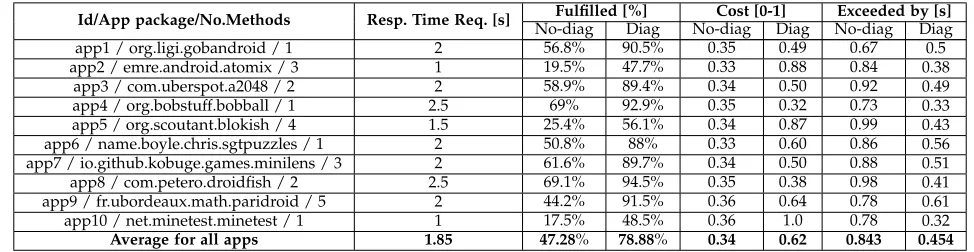
contexts. We accomplish this through an evaluation of 10
apps in simulated offloading contexts. In our evaluation, each app creates virtual offloading requests whose context parameters are determined using the crowdsensed datasets considered in our work. By simulating the context we can ensure the parameters are representative of real world situa-tions encountered by users. Simulation also helps to provide reproducibility for our analysis.
For the evaluation, we chose10open source apps from
the F-droid13 repository; see Table 2. We chose the most
popular applications from the repository that had compu-tationally intensive parts that benefit from offloading. We used a combination of community analysis and static pro-filing to determine which apps contained computationally