__________________________________________________________________________ INDEX DE ENFERMERÍA 2019, 28(1-2): e12078e
Index de Enfermería, 2019; 28(1-2): e12078e http://www.index-f.com/p/ie/e12078e ISSN: 1132-1296 © Fundación Index, 2019
A
CADEMY
Recibido: 16.06.2018 Aceptado: 15.01.2019Stressors perceived by nursing students during clinical practices.
Differences between educational programs
María Cristina
Enríquez Reyna
,
1Karla Margarita
Chavarría Sauceda
21Universidad Autónoma de Nuevo León, Facultad de Organización Deportiva. Nuevo León, México. 2Universidad de
Monterrey, Escuela de Enfermería Christus-Muguerza. Nuevo León, México Correspondence: [email protected] (María Cristina Enríquez Reyna)
Abstract
Main objective: Evaluate differences between nursing educational programs regarding the stressors that affect students during their clinical practices. Methodology: Descriptive-comparative design with a sample of 266 participants of two educational programs: Bachelor and Associate Degree in Nursing. The KEZKAK questionnaire was applied and the differences between educational programs were analyzed. Main results: Perceived stressors during clinical practices of nursing students differ between educational programs; having differences regarding the subscale "the patient seeks an intimate relationship". The main stressors were "doing my job wrong and hurting the patient", "that my responsibility in a patient´s care is important" and "having to be with a terminal patient". Main conclusions: Undergraduate students presented higher stress values than those in a bachelor’s degree. This justifies the need to include, in a curricular level, specific strategies for stress management.
Keywords: Psychological stress. Nursing. Diploma programs. Students. Education.
Introduction
Stress has been recognized as a predominant symptom with an impact on the labor world and society.1 In health pro-fessions such as nursing, consequences of stress are especially serious and visible; Patient relationship is a difficult task that requires competencies, skills and attitudes by sanitary person-nel´s part, since the professional must know how to establish necessary therapeutic distance without losing empathy and commitment.2
In the work sector, stress usually starts during formative period, joined to the development stages of health area stu-dents. Each student in the health area, entering to clinical practice, faces stressors during its interaction withthe clinical fieldenvironment. However, clinical practice is required for the holistic training of the student.3,4 It is considered that prac-tices function as a bridge or path between school and work, helping to understand similarities and differences between academic and labor fields; they can even reduce stress and anxiety caused by confronting a new world.5 Stress during clinical practices in nursing profession students, its personal, professional level repercussions regarding patient's care is of interest in research. While, some authors have studied stu-dents’ stress in face of their first clinical practices,6-8 there are reports that analyze the influence of socio-demographic fac-tors and stressors persistence over time.9-15
No publications analyzing differences according to the kind of academic training were found. The shortage of nursing
personnel in Latin America supposes obstacles to ensure access and health covering for every individual. Predominant causes of this nursing personnel shortage include premature school dropout, small access to quality education, inadequate curriculum organization, as well as poor political and adminis-trative infrastructure of schools.16 Nursing educational pro-grams have been diversified and updated to meet social tasks involving training of technical personnel with baccalaureate degree studies, but also, training of professionals with a ba-chelor's degree and greater possibilities of practical specializa-tion. Curricular design of both educational programs presents specific updating needs that must be addressed to guarantee their general efficiency.
Therefore, the objective of the study was to determine dif-ferences between educational nursing programs regarding stressors that affect students during their clinical practic-es.Two educational programs were considered: one of bacca-laureate and another of undergraduate degree. Analysis of differences will be useful to justify pertinence and inclusion of related contents in educational programs; as well as for the development of a pertinent academic redesign.
Methodology
A quantitative study with a descriptive-comparative and transversal design took place in a private nursing school in a northeastern city in Mexico. In the Baccalaureate program in Nursing (N = 441) students attend upper secondary education
along with university subjects,to get the bivalent baccalaureate with nursing degree in three years. In the Undergraduate's Nursing program (N = 128),students have completed upper
secondary education, have university subjects to complete their training and graduate with a bachelor's degree in four years. Baccalaureate program students are usually younger than those who attend the undergraduate program. Students carry out clinical practices in public and private sector units, in an indistinct way to the educational program.
Sample size was calculated for a universe of 569 candi-dates, with an error margin of 5% and a confidence level of 95%; proportional sampling by conglomerates based on atten-dance lists. It included enrolled students, with presence in clinical practices and voluntary participation. Those who men-tioned consuming anxiolytiques, antidepressant or stress drugs were excluded.
Gender, age, educational program, family situation (whom does live with?) and if it has a partner or boyfriend/girlfriend were questioned. KEZKAK bilingual questionnaire was ap-plied, which aims to measure stressors of nursing students in clinical practices.17This questionnaire has shown high internal consistency (Cronbach's α = ,95) and good research
reliabili-ty.10,13It consists of 41 items and is divided into nine subs-cales: I. Lack of competence (15, 16, 13, 14, 4, 2, 6, 26, 1, 3, 17, and 5); II. Contact with suffering (27, 39, 18, 10, 9, 31, 32, 29, 14 and 34); III. Relationship with tutors and partners (12, 28, 19, 25, 11 and 10); IV. Impotence and uncertainty (23, 38, 14, 41, 36, 6, 32, 3, 17, 2 and 20);V. Not controlling the rela-tionship with patient (5, 33, 7, 30, 29, 39, 17 and 20); VI. Emotional involvement (21, 8, 22 and 31); VII. Self damage in relation with the patient (11, 24, 26, 15 and 14); VIII. Pa-tient seeks an intimate relationship (40 and 37) and IX. Over-load (35, 36, 34, 30 and 31). Likert-type response options range from anything, almost nothing, something, almost eve-rything 3). From the score on each subscale an index (0-100) was estimated. Overall indexes for the analysis were also calculated.
Data collection procedure took place as follows: Research-er presented himself in the classroom, explained project’s generals and reviewed the selection criteria among candidates. Those who confirmed their desire to participate received a booklet with the informed consent, personal data card and the KEZKAK questionnaire. Filling time was 10 to 15 minutes. To respect legal guidelines of anonymity, format of informed consent and questionnaires with information of interest were separately collected. Students, who did not met selection
crite-ria or did not agree to participate, remained in the classroom doing other personal activities. By the end of questionnaires’ filling, the group was thanked for their time and culminated their participation in the study.
For statistical processing, the SPSS program version 21.0 was used. Validity and reliability of the questionnaire was verified through the sample adequacy measure of Kaiser-Meyer-Olkin and the Cronbach's Alpha coefficient. Descrip-tive statistics wereuseful to know participants' socio-demographic characteristics and questionnaire analysis. Subs-cale indexes distribution were determined by the goodness of fit test (Kolmogorov Smirnov with Lilliefors correction). Critical values of 0,5 were considered.
This research complies with General Health Law Regula-tions on Health Research Subject. Authorization was obtained from Educational Institution where data was collected and the written consent of participants.
Results
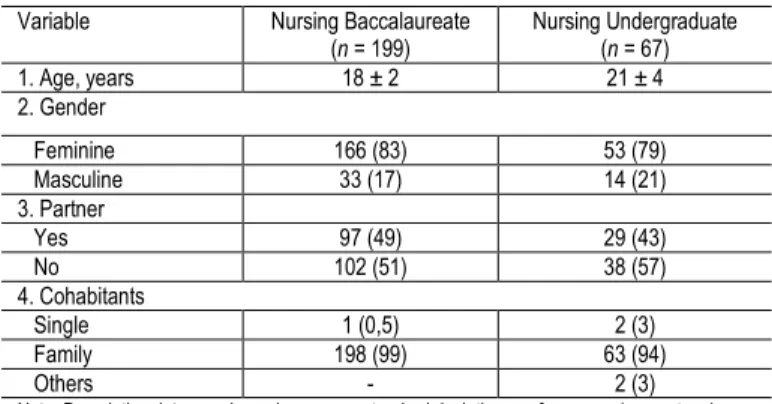
Eighty-two percent of the sample was formed by women (18%, men); 53% of participants reported having a partner; and 98% living with their family. Average age of participants was 19 years old (SD = 3, range = 15-48). Two hundred and
sixty-six participants’ data are presented (Table 1).
Table 1. Participants’ description by educational program
Variable Nursing Baccalaureate (n = 199) Nursing Undergraduate (n = 67) 1. Age, years 18 ± 2 21 ± 4 2. Gender Feminine 166 (83) 53 (79) Masculine 33 (17) 14 (21) 3. Partner Yes 97 (49) 29 (43) No 102 (51) 38 (57) 4. Cohabitants Single 1 (0,5) 2 (3) Family 198 (99) 63 (94) Others - 2 (3)
Note: Descriptive data are shown by mean ± standard deviation; or, frequency (percentage).
Sample adequacy measure of Kaiser-Meyer-Olkin (,915) and Bartlett's sphericity test (r= ,820, p<,01) confirm
ques-tionnaire's and its subscales validity. Regarding emotional implication subscale (r= ,690, p< ,01) Cronbach's reliability
value remained at the acceptable limit (a = ,69). Permanence
Table 2. Descriptive KEZKAK questionnaire data by educational program
Nursing Baccalaureate (n = 199) Nursing Undergraduate (n = 67) Scale or Subscale M DE Mdn M DE Mdn KEZKAK 50,46 18,54 49,59 51,90 16,93 53,66 I. Lack of competence 58,93 22,00 23,86 64,26 19,46 66,67 II.Contact with Suffering 46,52 23,86 46,67 45,52 21,83 43,33 III. Tutors and partners relationship 37,10 21,51 33,33 33,25 33,33 20,80 IV. Impotence and Uncertainty 57,16 20,13 60,60 62,32 18,89 66,67 V. Not controlling the relationship with patient 52,93 21,05 54,17 54,10 19,86 54,17 VI. Emotional involvement 39,07 24,03 41,67 43,16 41,67 23,70 VII. Self damage in relation with the patient 57,49 24,56 60,00 56,91 21,47 53,33 VIII. Patient seeks for an intimate relationship 67,67 32,11 66,67 62,69 30,16 66,67
IX. Overload 49,61 23,90 46,67 49,95 22,51 46,67
__________________________________________________________________________ in this situation was confirmed by the items debugging
tech-nique without reliability increase. With that subscale excep-tion, reliability values are considered good (a with values
between ,875 and ,733). Table 2 shows descriptive results of complete questionnaire and its subscales.
Overall stress score between educational programs was similar (p< ,05). In the whole sample, there was a tendency
towards significance of differences in the subscales I. Lack of competence and the IV. Impotence and uncertainty (p =,06)
which are associated with stressors related to personal perfor-mance. The most outstanding stressors of clinical practice were: "doing my job wrong and hurting the patient", "mess up", "doing physical damage to the patient", "feeling that I cannot help the patient" and” the relationship with health professionals"(p<,01).
Based in data distribution of (p< ,05), the type of
inferen-tial analysis to be followed was assigned (non-parametric statistics). Mann-Whitney U test analysis was run with to compare the differences between programs. Starting from the items with a high response average (options from quite to a lot), the following stood out: "Doing my job wrong and hurt-ing the patient" (U = 5494.5, p =,02); "That my responsibility
in patient care be important" (U = 5512.5, p =,02); and
"Hav-ing to be with a terminal patient" (U = 7725.5, p =,04). There
were no differences between programs for the rest of the items.
In total score of the instrument, women presented higher levels of stress than men (U = 3935, p =, 011); with statistical
significance differences for subscales II. Contact with suffer-ing, V. Not controlling the relationship with patient, VII. Self damage in relationship with patient and VIII. Patient seeks an intimate relationship (p< ,05). Having a partner did not raise
differences regarding the levels of stress. To determine the association between age, total stress score and instrument subscales, a Spearman correlation matrix was run (Table 3). Discussion
Undergraduate students reported higher levels of stress in seven subscales compared to their peers in the baccalaureate program. Confrontation of theory with practice with a more critical approach could be causing higher levels of stress in undergraduate students. In this sample, baccalaureate school students stress levels were only higher regarding the contact with suffering and the relationship with tutors and partners. Higher stress levels in women, with greater age and /or higher
academic training advance have been previously reported in the literature.13It could be that the concern to overcome the fear of the unknown, control-responsibility perception and for late adolescence and youth social acceptance search promote this difference. Pulido et al. (2015) in a related study ex-plained that students who pay more attention to their emotions are more susceptible to suffer due to stress sources.
In contrast to other reports,15, 18 in this sample highlighted the subscale "the patient seeks an intimate relationship" be-cause it promoted differences between educational programs. In the complete sample, was found that this stressor decreases with increasing age (p <,01). Outstanding stress level
asso-ciated with this subscale may be attributed to cultural issues of the sample itself. It is possible that maturity that comes with increasing age allows the development of coping strategies for the healthy management of empathic behaviors towards pa-tients and, therefore, the control of this kind of stressor. It must be considered that a moderate to high level of stress in hospital environment can affect disposition and time possibili-ties to provide care and perform multiple administrative tasks implied in health care.19,20
Female gender preponderance in the sample is a constant with studies of nursing students.6-15,21 In the same way, the "lack of competence" and the "impotence and uncertainty" feeling have been highlighted in studies carried out in Spain10,14,15,18,21 Colombia13 and Uruguay.11 The lowest levels of stress were found in the relationship with health profession-als; this data is consistent with the findings of Garcia et al.12 "Impotence and uncertainty" subscale has been a constant with greater affectation in related studies;8,20 this subscale was as-sociated with total stress score, the "lack of competence" and "contact with suffering" (p<,01).
In line with studies conducted in Mexico,7, 22 and Colom-bia13 the level of perceived stress in relation to the following stressors is highlighted: "lack of competence", "impotence and uncertainty" and "the patient seeks an intimate relationship". Persistent association of stress with personal performance justifies the need for students in the health area to confront clinical practices during the student stage.3-5 This suggests inclusion need in educational programs of teaching techniques for the effective confrontation of stress such as emotions ex-ternalization, rest, self-reflection, coping strategies, eliminate unnecessary tasks and self-activation to mention some exam-ples.2 In stressful situations such as patients volume, workload in the service and insufficient number of staff affecting both public and private institutions.20 Training to strengthen
emo-Table 3. Spearman correlation matrix of nursing students during their clinical practice
1 2 3 4 5 6 7 8 9 10
1. Age, years -
2. KEZKAK ,019 -
3. Lack of competence ,021 ,837** -
4. Contact with suffering -,019 ,872** ,599** -
5. Relationship with tutors or partners ,039 ,749** ,507** ,657** -
6. Impotence and uncertainty ,059 ,895** ,868** ,699** ,533** -
7. Not controlling the relationship with patient ,020 ,893** ,754** ,795** ,579** ,845** -
8. Emotional involvement ,024 ,822** ,581** ,805** ,672** ,676** ,682** -
9. Self damage in relationship with patient -,049 ,835** ,756** ,702** ,696** ,698** ,654** ,607** -
10. Patient seeks for an intimate relationship -,166** ,590** ,465** ,446** ,343** ,501** ,465** ,373** ,559** -
11. Overload -,018 ,755** ,453** ,699** ,550** ,632** ,716** ,645** ,562** ,473** Source: KEZKAK questionnaire. * p<,05, ** p<,01. n = 266.
tional intelligence of nursing should be considered not only for students in training but also for nursing care assistance personnel.15,23 Students see as experts and models of behavior to follow to the professional nursing staff, therefore,23 their experience may serve as a guide for students facing the diver-sity of complex situations in healthcare environment.
Practices aid with certainty to know and face the main stressors during the professional practice of hospital care. The feeling of not having technical-practical ability to solve certain issues in the clinical practice of nursing diminishes student's ability to perform at a professional level.2 Clinical knowledge is a theoretical-practical skills mixture, these skills acquisition, takes part of a professional training process between teacher-student relationships. Then, experience generates knowledge and encourages skills development. Therefore, the lack of competence feeling requires attention throughout academic training.2,18 Despite strategies that can be achieved in the class-room, it is clinical practice that determines the way in which the student will perform in hospital environment, community and personal scope.23 It is useful to participate in practical workshops, laboratories with simulators and teaching tech-niques such as role play. Training in emotional intelligence to prepare future nurses could prepare them to deal appropriately with occupational stressors, typical of their work.15
First semester participants were not included because, at collection date, they still did not attend to practices. This represents a limitation of the study; however, it must be consi-dered that the purpose of this analysis is more aimed at diffe-rentiating the stressors according to the kind of educational
program. It is not possible to determine the influence of edu-cational program advance on research findings; future longi-tudinal or experimental studies could increase the exploration level by analyzing stressors over time or with the progress of the educational program. A qualitative or mixed approach could help to clarify in more detail the specific scenario by educational program and the determination of differences according to different kinds of clinical fields (public and pri-vate). Analysis of stressors related to clinical practice should also be studied in other professions of the multidisciplinary health team.
Conclusions
From the findings it is possible to identify that: age, "lack of competence", "impotence and uncertainty" and the "seek for an intimate relationship on the part of the patient", stand out as sources of stress in nursing students. In this sample, at an older age, participants seem to have greater control of stressors related to personal performance perception; Empha-sizing then, the social stressors regarding their relationship with others. This suggests a greater awareness of the responsi-bility with respect to the patient. Due to literature persistence of this type of findings, it is considered necessary to introduce at the curricular level, strategies teaching of specific action to increase control and management of stress in nursing students. Providing timely attention to the stressors perception in stu-dents could impact the dropout career rates of health and indi-vidual quality life.
References
1. Organización Panamericana de la Salud/Organización Mundial de la Salud. Estrés laboral es una carga para los individuos, los trabajadores y las sociedades. 2016. Disponible en http://www.paho.org/hq/index.php?option=com_con tent&view=article&id=11973%3Aworkplace-stress-takes-a-toll-on-individuals-employers-and-societies& Itemid=135&lang=es [acceso: 19/01/2019].
2. García-Moran MC, Gil-Lacruz M. El estrés en el ámbito de los profesionales de la salud. Persona 2016;(19):11-30. Disponible en https://www.reda lyc.org/articulo.oa?id=147149810001 [acceso: 19/ 01/2019].
3. American Holistic Nurses Association. Stress Management for Nursing Students. 2016. Disponible en http://www.ahna.org/Resources/Stress-Mana gement/For-Nursing-Students [acceso: 12/05/2018].
4. Mancilla-García ME, Zepeda-Arias FM. Importancia de las guías de práctica clínica en enfermería. Revista de Enfermería del Instituto Mexicano del Seguro Social 2012; 20(1):1-3.
5. Baraz S, Memarian R, Vanaki Z. Learning Challenges of nursing students in clinical environments: A qualitative study in Iran. Journal of Education and Health Promotion 2015; 4(52). doi: 10.4103 / 2277-9531.162345.
6. Cobo-Cuenca AI, Rodríguez Aguilera C, Sánchez Donaire A, Vivo Ortega I, Gómez De Zamora RC, Castellanos Rainero RM. Estresores y ansiedad de los estudiantes de enfermería en sus primeras prácticas clínicas. Ansiedad y Estrés 2012; 18(2/3):91-101.
7. López-Cruz V, Hernández-Castañón MA, Mendoza-Zamora A, Villareal-Ríos E, Gasca-Ramírez MA. Apoyo a estudiantes de enfermería en su primera prácti-ca clíniprácti-ca ante situaciones de estrés. Revista de Enfermería del Instituto Mexiprácti-cano del Seguro Social 2016; 24(3):165-170.
8. Mamani OA. Factores estresantes en las primeras experiencias prácticas hospitalarias. Universidad Nacional de Córdoba 2013, 1-28. Disponible en http://www.enfermeria.fcm.unc.edu.ar/biblioteca/tes is/mamani_omar.pdf [acceso: 12/05/2018].
9. Yera Fachal MC, Gómez Besteiro MI. Factores desencadenantes de estrés en los estudiantes de Enfermería durante sus prácticas clínicas en la Escuela Universi-taria de Enfermería A Coruña. Metas Enferm 2014; 17(9): 27-31.
10. López VF, López MJ. Situaciones generadoras de estrés en los estudiantes de enfermería en la práctica clínica. Ciencia y Enfermería 2011; 17(2):47-54. doi: http://dx.doi.org/10.4067/S0717-95532011000200006
11. Tessa Giménez R, Silvera S. Percepción de los estudiantes de enfermería sobre las dificultades en su inserción a la práctica clínica de paciente crítico. Enfer-mería Cuidados Humanizados 2014; 3(2):34-40. DOI: https://doi.org/10.22235/ech.v3i2.592.
12. García Rodríguez JJ, Labajos Manzanares MT, Fernández Luque F. Revista Rol de Enfermería 2014; 37(7-8):488-494.
13. Arias Mosquera, LY, Montoya Gallo, LI, Villegas Henao, AF, Rodríguez Gázquez MA. Estresores en las prácticas clínicas de los estudiantes de enfermería de una universidad pública en Colombia. Investigación en Enfermería: Imagen y Desarrollo 2018; 20(1):1-11.
14. De Dios Duarte MJ, Varela Montero I, Braschi Diaferia L, Sánchez Muñoz E. Estrés en estudiantes de enfermería. Educación Médica Superior 2017; 31(3):110-123.
__________________________________________________________________________
15. Pulido-Martos M, Augusto-Landa JM, López-Zafra E. Estudiantes de Enfermería en prácticas clínicas: El rol de la inteligencia emocional en los estresores ocupacionales y bienestar psicológico. Index de Enfermería 2016; 25(3):215-219.
16. Organización Panamericana de la Salud/Organización Mundial de la Salud. La OPS/OMS destaca la necesidad de formas más personal de enfermería en américa latina y el caribe. 2015. Disponible en http://www.paho.org/hq/ index.php?option=com_content&view=article&id= 10947:2015-pahowho-highlights-need-train-more-nursing-personnel&Itemid=1926&lang=es [acceso: 10/12/2018].
17. Zupiria-Gorostidi X, Uranga-Iturrioz MJ, Alberdi-Erice MJ, Barandiaran Lasa M. KEZKAK: cuestionario bilingüe de estresores de los estudiantes de enfer-mería en las prácticas clínicas. Gaceta Sanitaria 2003; 17(1):37-51.
18. Zupiria-Gorostidi X, Uranga-Iturrioz MJ, Alberdi-Erice MJ, Barandiaran Lasa MT, Huitzi-Egileor X, Sanz-Cascante X. Fuentes de estrés en la práctica clínica de los estudiantes de enfermería. Evolución a lo largo de la diplomatura. Enferm Clin 2006; 16(5): 231-7.
19. Enríquez CB, Colunga C, Preciado ML, Ángel M, Domínguez R. Factores psicosociales y estrés en el trabajo hospitalario de enfermería en Guadalajara, México. Revista Colombiana de Salud Ocupacional 2011; 1(1):23-26.
20. Hernández-Cruz R, Moreno-Monsivais MG, Cheverría Rivera S, Landeros López M, Interial Guzmán MG. Cuidado de enfermería perdido en pacientes hospi-talizados en una institución pública y privada. Index de Enfermería 2017; 26(3):142-146.
21. Moya Nicolás M, Larrosa-Sánchez S, López-Marín C, López-Rodríguez I, Morales-Ruiz L, Simón-Gómez A. Percepción de estrés en los estudiantes de En-fermería ante sus prácticas clínicas. EnEn-fermería Global 2013; 31:232-243. Disponible en: http://scielo.isciii.es/scielo.php?script=sci_arttext &pid=S1695-61412013000300014&lng=es [acceso: 20/01/2019].
22. Vanegas-Pérez C, Andrade-Cepeda RMG, Miranda Herrera MM, Jara-Alba NO. Estresores de los estudiantes de la licenciatura de enfermería en la práctica clínica. Revista Académica de Investigación 2017; 25(1):12-20.