STONE: A Stream-based DDoS Defense Framework
Mar Callau-Zori
Universidad Politécnica de Madrid, Spain[email protected]
Vincenzo Gulisano
Universidad Politécnica de Madrid, Spain[email protected]
Zhang Fu
Chalmers University of Technology, Gothenburg, Sweden[email protected]
Ricardo Jiménez-Peris
Universidad Politécnica de Madrid, Spain[email protected]
Marina Papatriantafilou
Chalmers University of Technology, Gothenburg, Sweden[email protected]
Marta Patiño-Martínez
Universidad Politécnica de Madrid, Spain[email protected]
ABSTRACT
An effective Distributed Denial of Service (DDoS) defense mechanism must guarantee legitimate users access to an In-ternet service masking the effects of possible attacks. That is, it must be able to detect threats and discard malicious packets in a online fashion. Given that emerging data streaming technology can enable such mitigation in an ef-fective manner, in this paper we presentSTONE, a stream-based DDoS defense framework, which integrates anomaly-based DDoS detection and mitigation with scalable data streaming technology.
WithSTONE, the traffic of potential targets is analyzed via continuous data streaming queries maintaining informa-tion used for both attack detecinforma-tion and mitigainforma-tion. STONE provides minimal degradation of legitimate users traffic dur-ing DDoS attacks and it also faces effectively flash crowds. Our preliminary evaluation based on an implemented proto-type and conducted with real legitimate and malicious traffic traces shows thatSTONE is able to provide fast detection and precise mitigation of DDoS attacks leveraging scalable data streaming technology.
Categories and Subject Descriptors
H.2 [Information Systems]: Database Management
General Terms
Algorithms, Experimentation, Performance, Security
Keywords
DDoS Detection and Mitigation, Data Streaming
Permission to make digital or hard copies of all or part of this work for personal or classroom use is granted without fee provided that copies are not made or distributed for profit or commercial advantage and that copies bear this notice and the full citation on the first page. To copy otherwise, to republish, to post on servers or to redistribute to lists, requires prior specific permission and/or a fee.
SAC’13March 18-22, 2013, Coimbra, Portugal.
Copyright 2013 ACM 978-1-4503-1656-9/13/03 ...$15.00.
1.
INTRODUCTION
ADistributed Denial of Service(DDoS) attack in commu-nication networks attempts to exhaust the computational resources of a server making its service unavailable to legit-imate users. A typical attacking method is packet flooding, conducted sending thousands of packets per second to a tar-get host to congest its network links. The high volume of illegitimate traffic is usually generated by controlling a col-lection of compromised machines connected to the Internet (botnets). DDoS detection and mitigation techniques are challenging due to the vast and evolving range of big scale attacks. A successful defense mechanism must filter out ma-licious traffic effectively, minimizing legitimate users service degradation. Furthermore, the filtering mechanism should stand constantly to react immediately to threats and should incur in a negligible latency overhead (especially when there are no attacks being perpetrated). We foresee that data streaming is the right paradigm to address the requirements of mitigation of DDoS attacks, especially, due to the recent advances in the field that have yielded elastic and scalable data streaming engines [6]. In this paper we leverage such elastic and scalable data streaming technology that enables the creation of continuous queries that constantly process incoming data and produce results in a real-time fashion, scaling as needed to deal with DDoS attacks.
Prior work.
In recent years the need for effective solutions against DDoS attacks has made it an active and important research topic. Two main types of approaches exist for network intru-sion detection [9]: 1) signature-based and 2) anomaly-based solutions. Signature-based solutions [13] check each incom-ing packet to verify its signature and decide whether to for-ward or discard it. They have several limitations: not all the protocols can be signed and, for each new type of attack, a new type of signature may be necessary [11]. Contrary to signature-based ones, anomaly-based solutions, adopted in the context of threats where every malicious packet may seem legitimate if analyzed individually, attempt to cover a wider spectrum of attacks by spotting deviations between current and reference traffic behavior [9]. Plenty of anomaly-based solutions provide detection or mitigation of multiple types of attacks relying on complex analysis of the traffic features [3, 11, 15]. The challenge lies in defining a traffic
analysis that is amenable for on-line processing (solutions based on mining tools as [11] are best suited to study rather than detect threats) but accurate enough to properly miti-gate attacks (solutions that simply look at the overall traffic volume [1, 10, 14] provide no insights about what to discard during an attack).
Our contribution.
We presentSTONE, a stream-based DDoS defense frame-work implemented on top of StreamCloud [5, 6], an elastic parallel-distributed Stream Processing Engine (SPE). With STONE, network traffic features are analyzed to both detect and mitigate threats. One of the novel features ofSTONE is its smooth shaping of a host’s traffic volume even in the presence of legitimate abrupt changes (i.e., during a flash crowd,STONE avoids the saturation of the protected host while prioritizing sources communicating frequently with it). Filtering decisions are taken for groups rather than individ-ual machines applying prefix level traffic aggregation. Thus, all the machines that belong to a small network whose traffic is legitimate will have equal chances of communicating with the protected host in the presence of attacks. We provide an evaluation ofSTONEconducted using data traces based on the network traffic data from CAIDA [7] and SUNET [16, 12]. The results achieved bySTONE prototype show quick detection and effective mitigation capabilities, thus making STONE a promising solution for mitigating DDoS attacks. Our contributions can be summarized as follows:
1. STONE: an anomaly-based defense solution that pro-vides both detection and mitigation of DDoS attacks. 2. A novel traffic analysis approach based on data stream-ing and implemented on top of StreamCloud, an elastic parallel-distributed SPE.
3. An evaluation based on a real prototype and conducted using real legitimate and malicious traffic traces. The rest of the paper is organized as follows: the system model is introduced in Section 2. In Section 3, we discuss the architecture ofSTONE. The evaluation is presented in Section 4. Finally, conclusions are presented in Section 5.
2.
SYSTEM MODEL
In this section, we introduce the network and stream model, we define the adversary model and state the problemSTONE aims to solve.
Network and Stream model. The network comprises four kinds of entities: (1)protected entities, network hosts that can be attacked; (2) legitimate hosts, end-hosts who consume protected entities services; (3)STONE machines, used to runSTONE; and (4)bots, network hosts controlled by the attacker. The protected entities, legitimate hosts and the bots are connected via network links and routers, while STONE machines form a separated private network that cannot be reached by the attacker. Note thatSTONE can be used for protection of both single host and multiple hosts. It can also be extended for deployment in the framework for traffic control and isolation against DDoS problem and pro-tecting network resources [4]. Due to the space constraint, we do not address such issue in this paper. In the following, we study howSTONE behaves considering only the traffic being sent to a specific protected entity.
STONE defines two input data streams: network stream
S andaggregated network stream Sa. S represents the flow
of packets sent to a protected entity; each packet can be seen as a tuplehsrcIP, bytesi. AttributessrcIP andbytes repre-sent the source IP address and the size of the packet, respec-tively. Satuples contain aggregated information ofSpackets
on a per-srcIP basis over periods of time and are composed by attributeshsrcIP, tsA, tsB, packets, bytesi(e.g., given
pe-riod 8:00:00-8:00:30, tuplehA,8:00:12,8:00:25,5,250istates that A sent 5 packets -250 bytes- starting from 8:00:12 to 8:00:25). Stream Sa can be created from S using
moni-toring applications such as Cisco Netflow, which is widely supported by network devices or ISPs.
In data streaming, incoming data (tuples) is processed on-the-fly bycontinuous queries, defined as directed acyclic graphs of operators. Results are computed over the most recent window of tuples (e.g., tuples received in the last 5 minutes). Windows cover overlapping periods ofsizetime,
advancetime units far from each other. For instance, a win-dow of size and advance of 30 and 10 minutes, respectively, will cover periods [8:00:00-8:30:00), [8:10:00-8:40:00) and so on.
Adversary model. STONE aims at defending against packet-flooding based DDoS attacks, e.g., SYN flood and UDP flood attacks. The adversary can use different types of packets in the attacks, such as TCP packets, UDP packets, ICMP packets, etc. However, we assume that the adver-sary has no knowledge about the characteristics of the traf-fic to the victim, such as distribution of source addresses, the number of flows and the rates of flows. In other words, the adversary can hardly launch an attack without dispro-portional changes of the victim’s traffic features. With re-spect to the reference information maintained by STONE, we assume that the attacker cannot modify nor pollute it. We stress that preventing the pollution of the reference in-formation is orthogonal to the task of using it in order to detect attacks.
Problem formulation.Given a protected entity and its maximum loadL, the goal ofSTONE is to monitor its traf-fic to (a) detect possible threats and (b) to shape its volume when it exceeds a threshold load αL. Whenever filtering is applied,STONE must maximize the percentage of legiti-mate traffic forwarded to the protected entity. As discussed in the introduction,STONE can be used to protect the host from real threats as well as legitimate peak loads (e.g., flash-crowds). For this reason, we use the term legitimate traffic in a global way to refer to sources that are either frequently communicating with the victim host or that were communi-cating with it before the attack or peak load started. That is, during a peak load, the legitimate traffic is the one gener-ated by the usual clients of the host. The defense mechanism must ensure that the malicious IPs that reach the protected entity before detecting the attack have no way to exceed its maximum load. The challenge lies in which criteria to use to discard packets inSguaranteeing that the overall traffic vol-ume does not exceedLwhile forwarding as much legitimate traffic as possible.
The reason whySTONE filters traffic only if it exceeds
αLis two-fold: on one hand, our solution is not intended to analyze the cause of the anomaly and does not distinguish between legitimate or illegitimate traffic spikes; on the other hand, forwarding potentially malicious traffic whenαLis not
exceeded makes harder for the attacker to adapt the attack depending on how the system is reacting to it.
3.
STONE ARCHITECTURE
In this section we present the components in charge of analyzing the protected host traffic in order to the detect possible threats and in charge of shaping its traffic volume when it exceedsαL.
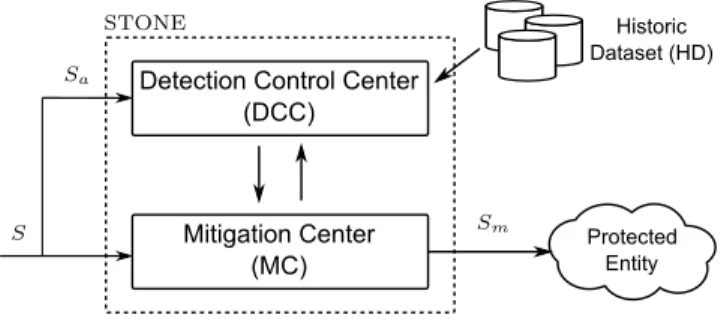
Figure 1 showsSTONE architecture. TheDetection Con-trol Center (DCC) is the subsystem in charge of detecting at-tacks. It consumesSaand compares its current features with
the reference features maintained at the Historic Dataset (HD). TheMitigation Center (MC) is placed between the in-coming stream S and the protected entity and takes care of filtering the traffic if it exceeds αL. Its output stream
Sm is equal toS whenever the incoming load is lower than αLor a subset ofS when filtering is applied. The filtering criterion is determined by theDCC. Whenever the traffic of the protected entity is belowαL, the MC is not active and simply forwardsSpackets, resulting therefore in a negligible overhead for the protected entity.
Sa
S Sm
STONE
Figure 1: STONE architecture
STONEcomputes traffic features aggregating together in-formation of multiple IPs. More precisely, inin-formation is maintained for groups of source IPs, referred assource clus-ters (srcCL), sharing the same prefix of b bits of the IP addresses. The reason why features are not maintained on a per-srcIPbasis is threefold: (a) the huge number of IPs con-necting to an entity might render the protocol impractical, (b) the traffic exchanged by individual IPs might be negli-gible with respect to the overall traffic, making thus com-parison between current and reference features not reliable and (c) decisions taken for source clusters (i.e., physically close machines for small source clusters) allow for smoother mitigation (e.g., forwarding traffic from all the nodes of a legitimate network rather than only a subset of them).
3.1
Detection Control Center (DCC)
The DCC is fed with the tuples of stream Sa. The
fea-tures of sources belonging to the same source cluster are aggregated together so that each source clusteri(srcCLi)
is represented by featuresfi= (φi, ωi, τi) , whereφi
repre-sents the average number of packets per flow,ωi represents
the average amount of bytes per flow andτi represents the
average elapsed time per flow. We remark that, being based on temporal windows, this information refers to the most recent fraction of data. For instance,φicould represent the
average number of packets per flow sent to the protected entity fromsrcCLiduring the last hour.
STONE analyzes how source clusters behave by parti-tioning them into groups and studying how the frequency of each group evolves over time. Concretely,STONE splits the space into eight different groups{G0, . . . , G7}and
main-tains the number of source clusters belonging to each group. Source clusters are partitioned into groups comparing their features with the reference point O = (Oφ, Oω, Oτ)
(Fig-ure 2). The reference point cannot be fixed as an absolute value but must be instead computed depending on the traf-fic features of the entity being protected. For this reason, the reference pointOis computed over past features (main-tained at theHD) as the 0.95-quantile value of each feature. The 0.95 value is motivated by previous studies [8] stating that more than 90% of the traffic flows aremice flows with small number of packets. In our approach, source clusters sending miceflows to the protected entity belong to group
G0 (low number of packets and bytes sent during short
pe-riods of time), which includes most of the source clusters (95%×95%×95%≈85% of them if the three features are independent). ≤Oφ > Oφ G0 ≤Oτ > Oτ G1 G2 ≤Oτ > Oτ G3 G4 ≤Oτ > Oτ G5 G6 ≤Oτ > Oτ G7 ≤Oω > Oω ≤Oω > Oω fi= (φi, ωi, τi) For example: f= (φ, ω, τ)∈G3 ↔ φ≤Oφ,ω > Oωandτ > Oτ
Figure 2: Group description
STONE detects an anomaly if the difference between the reference frequency of each group and the current one is higher than a threshold parameter. The number of source clusters belonging to each group in the current traffic are re-ferred as{nb0, . . . ,bn7}while the reference number of source
clusters are referred as {n0, . . . , n7}. STONE uses these
counters to compute the current ratio per group b
ri =bni/Pjbnj and the reference ratio ri =ni/Pjnj. A
traffic anomaly is detected if the distance between reference and current values exceeds a thresholdtol, i.e., maxi|ri−
b
ri| ≥tol.
The information maintained at the HD is used to com-pute the reference pointOand the reference ratiosr0, . . . , r7.
These values are based on the traffic features observed over
Dintervals (e.g., Wednesday, 10:00:00-11:00:00) in the past. The reference ratio ri is computed as Pdn
(d) i / P j,dn (d) j ,
where n(id) is the counter of group iat intervald. The ref-erence point O is computed as the weighted 0.95-quantile of each feature of the source clusters communicating with the protected entity during the previousDintervals. Source clusters contribution to O is proportional to the number of times they appear during the reference period. For this purpose, we weight the contribution of each srcCLi in O
definingwi as the number of intervals in which it appears
features of srcCLi, referred as fi = (φi, ωi, τi), are
com-puted as the average of the features observed over the last
Dintervals. For allsrcCLiwith weightwiand average
fea-tures fi, the weighted 0.95-quantile of feature φ (resp. ω
andτ) is computed by ordering all the source clusters aver-age feature{φi}i (resp. {ωi}i and{τi}i) and selecting the
one with weighted position 0.95P
iwi. While monitoring
the traffic of a protected entity, an anomaly is detected each time the distribution of the source clusters to groups changes abruptly; for instance, when a flooding-packet attack intro-duces a large number of new source clusters.
3.2
Mitigation Center (MC)
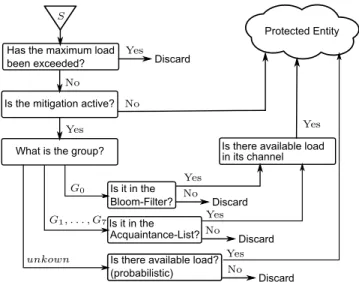
MCis responsible for mitigating an attack to the protected entity filtering malicious traffic while minimizing the degra-dation of the legitimate one. Figure 3 shows the sequence of steps taken to decide which packets to forward to the pro-tected entity and which to discard. If the maximum load of the protected entity has not been exceeded and mitiga-tion is not activated, packets are forwarded. If the traffic is being mitigated, theMC must ensure the maximum load
L is not exceeded while prioritizing legitimate traffic. Fil-tering of traffic belonging to groupG0 (i.e., mice flows)
pri-oritizes source clusters that were communicating with the protected entity just before detecting the threat. Due to the large number of source clusters that might belong to
G0, its filtering relies on a Bloom Filter [2]. On the other
hand, filtering of traffic belonging to groupsG1, . . . , G7(i.e.,
elephant flows) prioritizes source clusters that communicate frequently with the protected entity. In this case, filtering is applied on a per-source cluster basis, depending on the infor-mation maintained in the Acquaintance-List (AL). Besides, packets forwarding decisions are taken partitioning the load into channels (one for each group), so that the proportion of load consumed by each group resembles the one observed processing only legitimate traffic. Packets that refer to un-known source clusters (i.e., traffic that could be either from the attack or a flash crowd) are forwarded using a proba-bilistic function that depends on the available capacity.
G0 G1, . . . , G7 No Yes S Yes Yes Yes No Yes unkown Yes No No No
Figure 3: Mitigation Center
The Bloom-Filter (BF), used to filter packets sent by sources cluster belonging to group G0, is a space-efficient
probabilistic data structure used to check the membership of elements in a set [2]. While BFs allow for new elements to be added to the set, removal of elements is not trivial. In STONE we improve the base BF defining atime-based BF where elements belonging to the set are associated to timestamps that specify when they have been added ( time-based BF have the same time and space complexity of the base one [2]). Doing this, STONE is able to maintain the source clusters belonging to groupG0 over periods of time
(over the last 5 minutes in our mitigation mechanism). The Acquaintance-List AL is used to maintain the source clusters that belong to groupsG1, . . . , G7. Each source
clus-ter is paired with a probability that specifies the proportion of the packets coming from each source cluster should be forwarded while mitigating an attack. Packets belonging to source clusters appearing to be frequently communicat-ing with the protected entity will have a higher probability to be forwarded than the ones sent by source clusters that connect sporadically.
It should be noticed that, either using the BF or the AL, we are still not guaranteeing that a single source cluster (or a group of them) whose traffic is being forwarded to the protected entity is unable to exceed its maximum load L. Although the attacker has no knowledge about the traffic of the protected entity, if a set of the source addresses overlaps with the ones maintained by the BF and the AL, we need a mechanism to ensure that the traffic of these sources will not saturate the capacity of the protected entity. For this reason, we assign to each group a fraction of the maximum load proportional with the one that each group usually injects.
3.3
Parallel Data Stream Computation
In this section, we present howSTONE has been imple-mented by means of a data streamingcontinuous queryand how its execution is parallelized by the StreamCloud SPE.
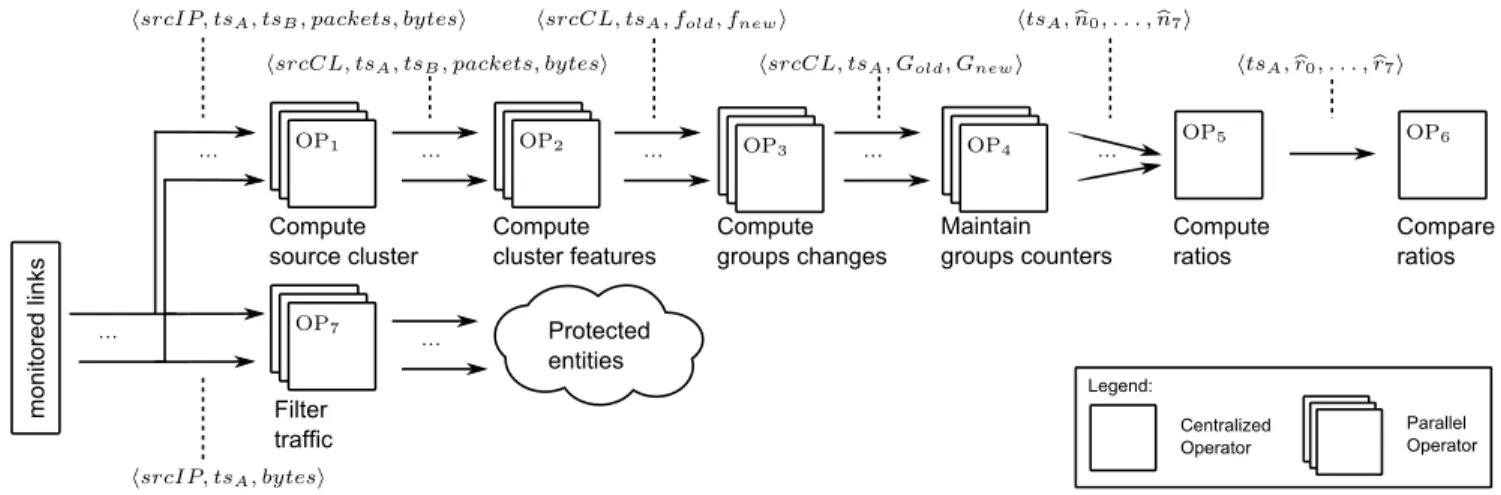
As shown in Figure 4, STONE’s query is defined by 7 operators: OP1, . . . , OP6 compose the DCC while OP7
composes the MC. For each operator input stream, Figure 4 shows its tuples schema. In the following, we provide a short description of each operator. Operator OP1is used to
compute the source cluster to which each tuple ofSarefers
to. For each tuplet forwarded by OP1, OP2 outputs a
tu-ple containing the features of the source cluster maintained by OP2 before processingt(fold) and after updating them
(fnew). Group Gold, representing the group to which the
source cluster belongs based onfold, and groupGnew,
rep-resenting the one to which the source cluster belongs based onfnew, are computed by OP3 and, ifGold6=Gnew, a tuple
is sent to OP4 to update groups counters nold and nnew.
If Gold = NULL (i.e., the source cluster appears in Gnew),
only counter nnew is updated. Similarly, If Gnew = NULL
(i.e., the source cluster disappears fromGold), only counter noldis updated. Group counters are forwarded from OP4 to
OP5in order to compute observed ratios{br0, . . . ,br7}, which are subsequently forwarded to OP6in order to be compared
with the reference ones. Mitigation is invoked by OP6each
time maxi|ri−rbi|>tol. When activated, OP7 is used to shape the protected entity traffic maximizing the forwarding of legitimate packets.
We discuss now how the query execution is parallelized by StreamCloud, where each operator can be executed at an arbitrary number ofSTONE machines. On one hand, stateful operator OP2 (maintaining awindow of tuples) is
hsrcCL, tsA, tsB, packets, bytesi hsrcCL, tsA, Gold, Gnewi
hsrcCL, tsA, fold, fnewi
hsrcIP, tsA, tsB, packets, bytesi htsA,bn0, . . . ,bn7i
htsA,br0, . . . ,br7i ... OP3 OP5 OP2 OP1 ... ... ... OP4 ... OP7 ... hsrcIP, tsA, bytesi OP6 ...
Figure 4: Implementation as a continuous query
parallelized using semantic-aware routing (i.e., tuples refer-ring to the same source cluster are forwarded to the same machine). On the other hand, stateless operators OP1, OP3,
OP4and OP7that do not maintain windows are parallelized
using round-robin routing. In order to compute the current ratios, all the information maintained by OP4 nodes must
be processed together; for this reason, operator OP5, and
subsequently OP6, are centralized.
4.
EVALUATION
In this section we provide an evaluation ofSTONE detec-tion and mitigadetec-tion capabilities. As aforemendetec-tioned, an ef-fective DDoS defense mechanism must detect attacks quickly and mitigate them minimizing the filtering impact on the le-gitimate users. For this reason, we evaluate three metrics, namely, (1) detection time, the time elapsed between the at-tack start and the atat-tack detection, (2) mitigation precision, the quantification of the degradation of the legitimate user traffic and (3) traffic volume shaping, the quantification of how much traffic is discarded during the attack.
Evaluation setup. The legitimate traffic is derived from real anonymized data traces from an OC-192 (10Gbits/s) backbone link of OptoSUNET [16]. The data traces are ex-cerpts of the traffic happening on Thursdays (during 9 weeks in 2010) during the period 11:00-12:00. Tuples belonging to
Saare generated for intervals of 5 minutes. Among the
des-tination hosts that appeared in the data traces, we selected the one with higher traffic as the protected entity. TheHD is populated using the features of the traffic in the first 8 days, while the last day trace is used aslegitimate data trace. The attack data trace is taken from CAIDA [7] and contains ap-proximately one hour of anonymized packets from a DDoS attack. Theattack data trace has been mixed with the le-gitimate data trace simulating an attack starting after 20 minutes (1200 sec). In our evaluation we use a set of nodes equipped with a quad-core Xeon [email protected], 8GB of RAM and 1Gbit Ethernet.
Detection time. A fast detection of an incoming DDoS attack is crucial for the mitigation effectiveness. Figure 5 shows the maximum difference between the reference and current ratio (maxi|ri−bri|) for any groupiduring the pe-riod of time when the attack is taking place. This difference
increases rapidly when the attack starts. An anomaly is de-tected if this maximum exceeds the tolerance. For instance, given a tolerance tol = 0.05, STONE detects the attack after 18 seconds. 11700 1180 1190 1200 1210 1220 1230 1240 1250 0.1 0.2 0.3 0.4 attack start tolerance Time (sec)
Norm of the ratio difference
18 sec
Figure 5: Detection time
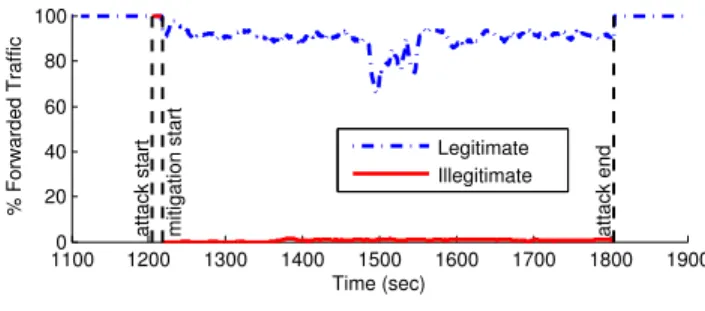
Mitigation precision. This experiment studies how ef-fective the BF and the AL are in preventing the forward-ing of illegitimate traffic to the protected entity. In order to do this, upon detection of the injected attack (happen-ing at second 1218 in the experiment), the system discards all the packets that do not belong to the BF or the AL. We first measure the precision with which the MC compo-nent forwards legitimate traffic and discards illegitimate one. Figure 6 presents the percentage of legitimate traffic with respect to the overall legitimate traffic and the percentage of illegitimate traffic with respect to the overall illegitimate traffic forwarded to the protected entity. It can be noticed that, during the attack, the percentage of legitimate traffic that is forwarded is around 90%. The illegitimate traffic is forwarded entirely to the protected entity before the attack detection, but once the mitigation is activated more than 99% is discarded.
Traffic volume shaping. Together with the mitiga-tion precision evaluamitiga-tion, we now evaluate how effective the BF and the AL are when shaping the victim traffic volume (Figure 7). The load is expressed in KBit/second using a logarithmic scale for the y axis. The solid line represents the overall traffic load injected during the attack while the dashed line represents the output traffic forwarded by the
11000 1200 1300 1400 1500 1600 1700 1800 1900 20 40 60 80 100
attack start mitigation start attack end
Time (sec)
% Forwarded Traffic
Legitimate Illegitimate
Figure 6: Mitigation precision
MCto the protected entity. While the mitigation is not ac-tive, all the input traffic is forwarded to the protected entity. Once the attack is detected, most of the traffic (≈97%) is discarded by the BF and the AL. That is, the BF and the AL together are able to reduce drastically the amount of suspicious traffic, leading to an effective mitigation in the presence of legitimate load peaks (e.g., flash crowds).
1100 1150 1200 1250 1300 1350 1400 1450 1500 100 101 102 103 104 105 attack start mitigation start Time (sec)
Load (KBit/s) Input Load
Fowarded Load
Figure 7: Forwarded traffic load
5.
CONCLUSIONS
In this paper we have proposedSTONE, an anomaly de-tection DDoS defense framework that leverages data stream-ing to attain the real-time requirements of this kind of ap-plication. STONEdetects packet-flooding attacks by main-taining traffic features extracted by means of continuous data streaming queries that are also used to mitigate the attack masking it to the legitimate users. Our mitigation mechanism is also beneficial in the presence of flash crowds as it can be used to prioritize usual clients while trying to distribute the remaining capacity among all the clients. The system has been implemented on top of StreamCloud, an elastic parallel-distributed SPE. Our evaluation shows STONE’s effectiveness both in terms of detection and miti-gation.
6.
REFERENCES
[1] P. Barford, J. Kline, D. Plonka, and A. Ron. A signal analysis of network traffic anomalies. InACM IMW’02, pages 71–82, 2002.
[2] A. Z. Broder and M. Mitzenmacher. Network applications of bloom filters: A survey.Internet Mathematics, 1(4):485–509, 2003.
[3] V. Chandola, A. Banerjee, and V. Kumar. Anomaly detection: A survey.CSUR, 41(3), 2009.
[4] Z. Fu, M. Papatriantafilou, and P. Tsigas. Club: a cluster based framework for mitigating distributed denial of service attacks. InACM SAC’11, pages 520–527, 2011.
[5] V. Gulisano, R. Jim´enez-Peris, M. Pati˜no-Mart´ınez, C. Soriente, and P. Valduriez. Streamcloud: An elastic and scalable data streaming system.IEEE TPDS’12, 2012.
[6] V. Gulisano, R. Jim´enez-Peris, M. Pati˜no-Mart´ınez, and P. Valduriez. Streamcloud: A large scale data streaming system. InIEEE ICDCS ’10, pages 126–137, 2010.
[7] P. Hick, E. Aben, and K. Claffy. The CAIDA ”DDoS Attack 2007” Dataset.http://www.caida.org, 2012. [8] M.-S. Kim, Y. J. Won, and J. W. Hong. Characteristic
analysis of internet traffic from the perspective of flows.Comp. Comm., 29(10):1639–1652, 2006. [9] R. R. Kompella, S. Singh, and G. Varghese. On
scalable attack detection in the network.IEEE/ACM Trans. Netw., 15(1):14–25, 2007.
[10] B. Krishnamurthy, S. Sen, Y. Zhang, and Y. Chen. Sketch-based change detection: methods, evaluation, and applications. InACM IMC’03, pages 234–247, 2003.
[11] A. Lakhina, M. Crovella, and C. Diot. Mining anomalies using traffic feature distributions. InACM SIGCOMM’05, pages 217–228, 2005.
[12] F. Moradi, M. Almgren, W. John, T. Olovsson, and T. Philippas. On collection of large-scale
multi-purpose datasets on internet backbone links. In BADGERS ’11, pages 62–69, 2011.
[13] M. Roesch. Snort,http://www.snort.org/, 2012. [14] M. Roughan, T. Griffin, Z. M. Mao, A. G. Greenberg,
and B. Freeman. Combining routing and traffic data for detection of IP forwarding anomalies. InACM SIGMETRICS ’04, pages 416–417, 2004.
[15] F. Silveira, C. Diot, N. Taft, and R. Govindan. Astute: detecting a different class of traffic anomalies. InACM SIGCOMM’10, pages 267–278, 2010.
[16] The Swedish University Computer Network OptoSUNET. SUNET.
http://basun.sunet.se/engelska.html, 2012.
7.
ACKNOWLEDGEMENTS
This research has been partially funded by the Madrid Regional Council (CAM), FSE and FEDER under project CLOUDS (S2009TIC-1692), the Spanish Research Agency MICINN under project CloudStorm (TIN2010-19077), the European Commission under project MASSIF (FP7-257475), Swedish Civil Contingencies Agency (MSB) and European Union Seventh Framework Programme (FP7/2007-2013) un-der grant agreement No.257007 SysSec. Ricardo Jim´ enez-Peris and Marta Pati˜no-Mart´ınez filed a patent at USPTO with number US13/112,628 related to this paper. We thank Farnaz Moradi and Wolfgang John for their support with the data traces collection.