Improving Query Performance Using Materialized XML
Views: A Learning-Based Approach
Ashish Shah and Rada Chirkova Department of Computer Science
North Carolina State University Campus Box 7535, Raleigh NC 27695-7535
{anshah,rychirko}@ncsu.edu
Abstract. We consider the problem of improving the efficiency of query processing on an XML interface of a relational database, for predefined query workloads. The main contribution of this paper is to show that selective materialization of data as XML views reduces query-execution costs in relatively static databases. Our learning-based approach precomputes and stores (materializes) parts of the answers to the workload queries as clustered XML views. In addition, the data in the materialized XML clusters are periodically incrementally refreshed and rearranged, to respond to the changes in the query workload. Our experiments show that the approach can significantly reduce processing costs for frequent and important queries on relational databases with XML interfaces.
1 Introduction
The extended markup language (XML) [18] is a simple and flexible format that is playing an increasingly important role in publishing and querying data in the World Wide Web. As XML has become a de facto standard for business data exchange, it is imperative for businesses to make their existing data available in XML for their partners. At the same time, most business data are still stored in relational databases. A general way to publish XML data in relational databases is to provide XML interfaces over the stored relations and to enable querying the interfaces using XML query languages. In response to the demand for such frameworks, database systems with XML interfaces over non-XML data are increasingly available, notably relational systems from Oracle, IBM, and Microsoft.
In this paper we consider the problem of improving the efficiency of evaluating XML queries on relational databases with XML interfaces. When querying a data source using its XML interface, an application issues a query in an XML query language and expects an answer in XML. If the data source is a relational database, this way of interacting with the database adds new dimensions to the old problem of efficiently evaluating queries on relational data. In the standard scheme for evaluating queries on an XML interface of a relational database, the relational query-processing engine computes a relation that is an answer to the query on the stored relational data; see [9] for an overview. On top of this process, the query-processing engine has to (1) translate the query from an XML query language into SQL (the resulting query is then posed on the relational data), and (2) translate the answer into XML. To efficiently process a query on an XML interface of a relational database, the query-processing engine has to efficiently perform all three tasks.
We propose an approach to reducing the amount of time the query-processing engine spends on answering queries on XML interfaces of relational databases. The idea of our approach is to circumvent the standard query-answering scheme described above, by precomputing and storing, or materializing, some of the relational data as XML views. If
the DBMS has chosen the “right” data to materialize, it can use these XML views to answer some or most of the frequent and important queries on the data source without accessing the relational data. We show that our approach can significantly reduce the time to process frequent and important queries on relational databases with XML interfaces.
Our approach is not the first view-based approach to the problem of efficiently computing XML data on relational databases. To clarify how our approach differs from previous work, we use the terms (1) view definitions, which are data specifications given in terms of stored data (or possibly in terms of other views), and (2) view answers, which are the data that satisfy the definition of a view on the database. In past work, researchers have looked into the problem of efficiently evaluating XML queries over XML view definitions of relational data (e.g., SilkRoute [8] or XPERANTO [16]). We build on the past work by adding a new component to this framework: We incrementally materialize XML view
answers to frequent and important XML queries on a relational database, using a learning
approach. To the best of our knowledge, we are the first to propose this approach. The following are the contributions of this paper:
• We develop a learning-based approach to materializing relational data in XML.
• We propose a system architecture that takes advantage of the materialized XML to reduce the total query-execution times for incoming query workloads.
• We show how to transform a purely relational database system to accommodate materialized XML and our system architecture.
Using our approach may result in significant efficiency gains on relatively static databases. Moreover, it is possible to combine our solution with the orthogonal approaches described in [8,16], thus achieving the combined advantages of the two solutions.
The remainder of the paper is organized as follows. Section 1.1 discusses related work. In Section 2 we formalize the problem and outline our approach. In Sections 3 and 4, we describe the system architecture and the learning algorithm. Section 5 describes experimental results. We discuss the approach in Section 6, and conclude with Section 7.
1.1 Related Work
The problem of XML query answering has recently received a lot of attention. [11, 13] propose a logical foundation for the XML data model. [3] describes a system for data-model management, with tools to map schemas between XML and relations. [6] looks into developing XML documents in a normal form that guarantees some desirable properties of the document format. [7] proposes an approach to efficiently representing and querying semistructured Web data. [10] proposes an XML data model and a formal process, to map Web information sources into commonly perceived logical models; the approach provides for easy and efficient information extraction from the World-Wide Web.
[14] describes an approach to XML data integration, based on an object-oriented data model. [15] proposes an XML data-management system that integrates relational DBMS, Java and XSLT. [20] reports on a system that manages XML data based on a flexible mapping strategy; given XML data, the system stores data in relations, for efficient querying and manipulation. XCache [2] describes a web-based XML-querying system that supports semantic caching; ACE-XQ [4] is a caching system for queries in XQuery; the system uses sophisticated cache-management mechanisms in the XML context.
SilkRoute [8] is a framework for publishing relational data using XML view definitions. The approach incorporates an algorithm for translating queries from XQuery into SQL and an optimization algorithm for selecting an efficient evaluation plan for the SQL queries. XPERANTO [16] is an XML-centric middleware layer that lets users query and structure the contents of a relational database as XML data and thus allows them to ignore the
underlying relations. Using the XPERANTO query facility and the default XML view definition of the underlying database, it is possible to specify custom XML view definitions that better suit the needs of the applications.
The motivation for using views in query processing comes from information-integration applications; one approach, called data warehousing [17], uses materialized views. [1,5,19,21] propose a unified approach to the problem of view maintenance in data warehouses. In our work, we use a learning method called concept, or rule, learning [12].
2 Problem Specification and Outline of the Proposed Approach
In this section we specify the problem of improving the efficiency of answering queries on XML interfaces of relational databases, and outline our solution. An XML-relational data
source (“data source”) comprises a relational database system and an XML interface. For a
query in an XML query language, to evaluate the query on a data source means to obtain an XML answer to the query via the XML interface of the source. Suppose there is a finite set of important queries, with associated relative weights, that users or applications frequently pose on the data source. We call these queries a query workload. In our cost model, the cost of evaluating a query on a data source is the total time elapsed between posing the query on the source and obtaining an answer to the query in XML. The total
cost of evaluating a query workload on a data source is the weighted sum of the costs of
evaluating all workload queries, using their relative weights. We consider the problem of
improving the efficiency of evaluating a query workload on a data source; the goal here is
to reduce the total cost of evaluating a given query workload on a given data source. To improve the efficiency of evaluating a query workload on a data source, we propose an approach based on incrementally materializing XML views of workload-relevant data. To materialize a view is to compute and store the answer to the view on the database. We materialize views in XML rather than in relations, to reduce or eliminate the time required to translate (1) the workload queries from an XML query language into SQL, and (2) the relational answers to the queries into XML. In the proposed system architecture, when answering a query, the query-processing engine first searches the materialized XML views, rather than the relational tables; if the query can be answered using the views, there is no need to access the underlying relations. Using this approach may result in significant efficiency gains when the underlying relational data do not change very often.
In our approach, we need to decide which data to materialize in XML. We use a learning-based approach to materialize only the data that is needed to answer the workload queries on the data source. In database systems, it is common to maintain statistics on the stored data, for the purposes of query optimization [9]. We maintain similar statistics on access rates to the data in the stored relations, and materialize the most frequently accessed tuples in XML. We use learning techniques combined with the access-rate statistics to decide when and how to change, incrementally, the set of records materialized in XML.
We manage the materialized data using the concept of clustering. In our approach, clustering means combining related XML records into a single materialized XML structure. These XML structures are stored in a special relation and can be queried using the data source’s XML query language. (In the remainder of the paper we assume that XQuery is the language of choice.) Storing the most frequently accessed tuples in materialized XML clusters increases the probability that future workload queries will be satisfied by the clusters. To answer those queries that are not satisfied by the XML clusters, we use the relational query-processing engine.
3 The System Architecture
We now discuss the architecture of the system. We describe the query-processing subsystem, the required changes to the schema of the originally relational data source, and the process of generating workload-related XML data from the stored relations.
3.1 The Query-Processing Subsystem
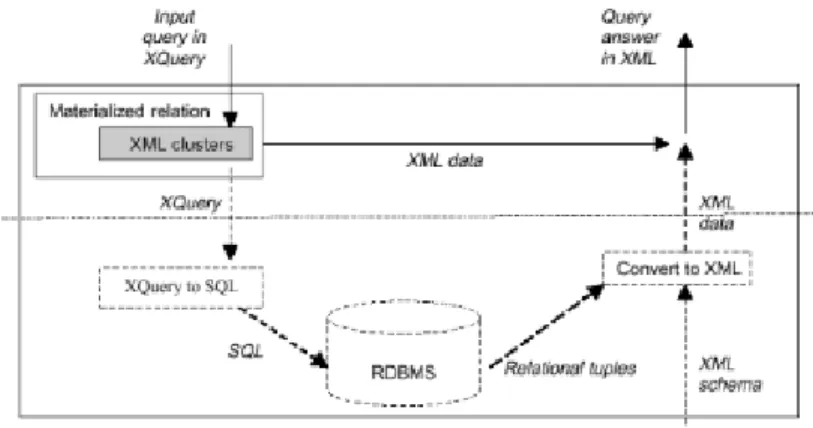
In this section we describe a typical query path taken by an input query; see Fig. 1.
Fig. 1. The Query-Processing subsystem
The solid lines in Fig. 1 show the primary query path, which is taken for all queries on the data. If a workload query can be answered by the materialized XML clusters, then only the primary path is taken. Otherwise, the query next follows the secondary query path, shown in dotted lines in Fig. 1; here, the input query is pushed down to the relational level and is answered using the stored relations, rather than the materialized XML.
The XML clusters are stored as values of an attribute in a special relation. The system queries the relation in SQL to find the most relevant cluster, and then poses the XQuery query on the cluster. The schema for the clusters is specified by the database administrator.
3.2 Setting up Materialized XML Clusters
In this section we describe how to set up materialized XML clusters, by transforming the relational-database schema to accommodate XML. For simplicity, we use a schema with just two relations, R(A1,…, An) and S(B1,…, Bm). A1is the primary key of the relation R.
3.2.1 Modifying the given relational schemas
In our approach, for tuples of certain relations we keep track of how many times each tuple is accessed in answering the workload queries. To enable these access counts, we change the schema of the relational data source, by adding an extra attribute to the schema of one or more of the stored relations. The most likely candidates for this schema change are the
relations of interest, which are relations that have high access rates, primarily large
relations that are involved in expensive joins. For instance, suppose we have a query that involves a join of the relations R and S. If the relation R is large, the query would be
expensive to evaluate, hence we consider R as a suitable candidate for the schema change. (Alternatively, the database administrator can make the choice of the schema to modify.)
Suppose we decide to add an attribute A(n+1)to the schema of the relation R; we will store access counts for the tuples in relation R as values of this attribute. R(A1,…,An, A(n+1)) is the schema of the modified relation. Initially, the value of A(n+1)is NULL in all tuples.
3.2.2 Creating the relations for the materialized XML clusters
We now define the schema of the relation T that will store the materialized XML clusters, as T(A1, C). Recall that A1is the primary key of the relation R; using this attribute in the relation T helps us index the materialized XML clusters in the same way as the relation R. The attribute C is used to store the materialized XML clusters in text format.
To summarize, we set up materialized XML clusters by doing the following: 1. Select a relation of interest (R in the example) to modify.
2. Add an access-count attribute to the schema of the selected relation.
3. Create a new relation (T in the example), to hold the materialized XML version of the data in the selected relation of interest (R in the example).
4 The Learning Algorithm
In this section we describe a learning algorithm that populates and incrementally maintains the XML clusters. We first describe how to select relational tuples for materialization, and then explain our clustering strategy for building an XML tree of “interesting records.”
Our general approach is as follows. When answering queries, we first pose each query on the materialized XML clusters in the relation T that we have added to the original stored relations. Whenever a query cannot be answered using the materialized XML clusters (or at system startup, see next paragraph), the query is translated into SQL and pushed down to the stored relations. Each time this process is activated, the system increments access counts for all tuples that contribute to the answer to the SQL query.
At system startup, the relation T that holds the materialized XML is empty. As a result, all incoming queries have to be translated into SQL and pushed to the relational query-processing engine. The materialization phase starts when the access counts in the relations of interest exceed an empirically determined threshold value, see Section 4.3; all tuples whose access counts are greater than the threshold value are materialized into XML. The schema for the materialized XML is specified by the input XQuery workload. (Alternatively, it can be specified by the database administrator.) As the learning algorithm executes over an extended time period, the most frequently accessed tuples in the relations of interest are materialized into XML and stored in the relation T.
4.1 Learning I: Discovering Access Patterns in the Relations of Interest
To incrementally materialize and maintain XML clusters of workload-relevant data, the system periodically runs a learning process that translates frequently accessed relational tuples into XML and reorders the resulting records in a hierarchy of clusters. We now describe the first stage of the learning process, where the system discovers access patterns in the relations of interest by using the access-count attribute. Once the access pattern is established, the system translates the most frequently accessed tuples into XML. To obtain the current access pattern, the system needs to execute the following steps.
1. (This step is executed during the system startup.) Input an expected query stream and set up the desired output XML schema.
2. Pose the incoming workload queries on the stored relations; in answering the queries, increment the access counts for those tuples in the relations of interest that contribute to the answers to the queries.
During the system startup we use an expected, rather than real, query stream to determine access patterns in the relations of interest. For example, if each workload query may use one of the given 250K keywords with given frequencies, then for our expected query stream we select the 1000 most-frequent keywords.
4.2 Learning II: Materializing XML and Forming Clusters
Once the first stage of the learning process has discovered the access patterns in the relations of interest, the system performs, in several iterations, the following steps:
1. To generate the materialized XML records, retrieve from the relations of interest all tuples whose access counts are greater than the predefined threshold value. 2. Translate the data into XML and store in the materialized XML relation. 3. Form clusters (also see section 4.3):
a. Find all relational tuples that are related to the materialized XML, w.r.t. the workload queries.
b. Select those of the tuples whose access counts exceed the threshold value, and translate them into XML.
c. Cluster the tuples and materialized XML into a single XML tree.
4.3 The Clustering Phase
In our selective materialization, we use clustering to increase the scope of materialized XML beyond the relations of interest, by incrementally adding to the XML records “interesting records” from other relations. The criterion for adding these interesting records is the same as the criterion for materializing relational tuples in XML. More precisely, the relations with the most frequently accessed records are selected in the descending order of access frequency. For example, if there are three relations R1, R2, R3, in descending order of tuple-access frequencies, then we can form clusters, starting with R1 and R2, then R2and R3, and so on.
The relation T now contains a single XML structure, which holds related records with high access rates. In each cluster, the records are sorted in the order of their access counts. In the current implementation, the schema for the cluster is provided as an external input (see Fig. 1). Choosing cluster schemas automatically is a direction of future work.
We now explain on an example how to form hierarchies of clusters. Consider a database with four relations, R1-R4, in the descending order of tuple-access frequency. We first modify the relation R1, to store the XML clusters generated from the tuples retrieved from a join of R1and R2on some attribute. Similarly, we modify R2to store a join of R2and R3, and so on. With every join of Rnand Rn+1, we form the most-frequently accessed clusters; the clusters form a hierarchy w.r.t. their access rates: For example, the cluster formed from
R1and R2will have higher access rates than the cluster for R2and R3. In our experiments, we have explored the first level of clustering for simple queries; see Section 5. We are working on implementing multiple levels of clustering for more complex queries.
In our approach we determine the threshold value empirically: At system startup time, we repeat the learning process several times to arrive at a suitable value. The choice of the
threshold value is a tradeoff between larger materialized views and better query-execution times: A lower threshold value means more tuples will be materialized as XML; thus more queries will get satisfied in the XML views. A higher threshold value prevents most of the relational data from being selected for materialization, which limits the number of queries that can be answered using the views. The key is to strike a balance between the point at which the system materializes tuples and the proportion of records to be materialized. In our future work, we intend to make the choice of this threshold value dynamic.
5 Experimental Setup and Results
5.1 The Setup
The CDDB collection [22] is a database that stores information about CDs and CD tracks. The CDDB schema comprises two relations, Disc(cd_id,cd_title,genre,num_of_tracks) and
Tracks(cd_id,track_title). (For simplicity, we omit other attributes of the relations in
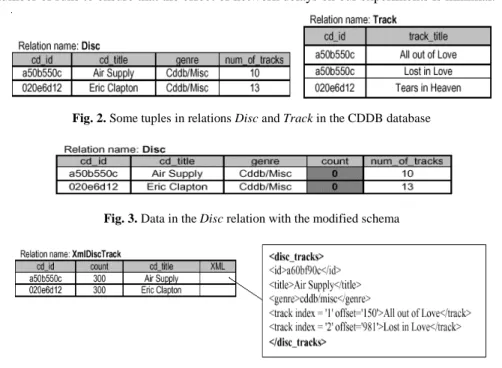
CDDB.) The Disc relation has 250K tuples. Each CD has an average of 10 tracks, stored in the Tracks relation. Fig. 2 shows some tuples in the two relations in CDDB.
In our experiments, we used Oracle 9.2 on a Dell Server P4600 with Intel Xeon CPU at 2GHz and 2GB of memory running on Microsoft Windows 2000. We implemented the middleware interface in Java using Sun JDK 1.4, and ran it on an Intel Pentium II 333MHz machine with 128MB of memory on Red Hat Linux 7.3. We conducted a significant number of runs to ensure that the effect of network delays on our experiments is minimal.
Fig. 2. Some tuples in relations Disc and Track in the CDDB database
Fig. 3. Data in the Disc relation with the modified schema
Fig. 4. Schema for the relation that holds the materialized XML and an example of a simple cluster To determine access patterns for the Disc relation, we added a new attribute, count, to the schema; this attribute holds an access count for each CD record. The rest of the
database schema is unchanged. (Section 3.2.1 explains how to choose relations for the schema change.) Fig. 3 shows the tuples in the Disc relation with the modified schema.
Fig. 4 shows the table XmlDiscTrack. This new relation holds materialized XML as text data in record format. The process of defining this materialized table is explained in Section 3.2.2. In the XmlDiscTrack relation that we create in the CDDB database, attributes cd_id and count are the same as in the Disc relation. The value of the count attribute in XmlDiscTrack equals the value of count in the corresponding tuple in the Disc relation, at the point in time where that tuple was materialized as XML. The XML attribute in XMLDiscTrack holds the materialized XML. For example, the value of the XML attribute, in the tuple for the ‘Air Supply’ CD in XMLDiscTrack, is shown in Fig. 4.
Workload queries: The workload queries in our experiments use CD titles as keywords.
In our architecture, the query-processing engine first tries to answer each workload query by searching the XML clusters in the relation XMLDiscTrack; if it fails to find an answer there, the engine then searches the Disc table using SQL. The two query paths are shown in Fig. 1 in Section 3. In learning stage I, whenever the system answers an input query using the original stored relations in the CDDB database, it increments the access count for each answer tuple in the Disc table. For learning stage II to be invoked, the access counts have to reach the threshold value; see Section 4.2. In the second stage of learning, we materialize in XML all the tuples in the Disc relation whose access counts exceed the threshold value. The generation of materialized XML is explained in Section 4. Fig. 4 shows the materialized XML for the CD “Air Supply” generated from Disc and Track.
Cluster formation: This phase is invoked for every tuple in the relation XMLDiscTrack
that holds materialized XML. The XML shown in Fig. 4 is only suitable to answer those queries that ask for tracks in that CD; this restriction limits the scope of the approach. Hence, we form clusters. Clusters are formed by identifying related records. The algorithm for selecting these related records is explained formally in Section 4. The tuples in the Disc relation that match ‘Air Supply’ and that have their access counts above the threshold value are chosen to form the clusters. These tuples are converted to XML and merged into the original structure. An example for the merged structure is shown in Fig. 5. Once the clustering phase is completed, the XML shown in Fig. 6 replaces the XML in Fig. 4.
Fig. 5. An example of materialized clustered XML
5.2 Experimental Results
In this section we show the results of our experiments on the feasibility of our learning-based materialization approach.
ÿ Comparing the efficiency of querying materialized XML to the efficiency of getting answers to SQL queries on the stored relational data.
The objective of this experiment was to analyze whether XQuery-based querying is effective on materialized XML views, as compared to using SQL on the stored relations.
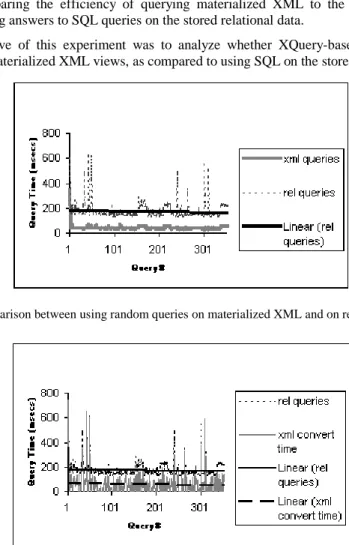
Fig. 6. Comparison between using random queries on materialized XML and on relational data
Fig. 7. Average query times for a random set of 1000 repeated queries on relational data and an analysis of the time required to convert this relational data to XML
Fig. 7 shows query-execution times for 5000 XML records, for the query SELECT *
FROM Disc, Track WHERE Disc.cd_id = Track.cd_id AND Disc.cd_title = ‘%Eddie Murphy%’. Interesting tuples in the join of Disc and Track are stored in XML. The
relational tables hold 2.5 million tuples (250K CDs times 10 tracks). The cluster records are similar to the XML shown in Fig. 5. The graph is a plot of query-execution times for XQuery queries based on the attribute cd_title of the Disc relation. The experiment shows that processing a query on an XML view is faster than using SQL on the relations and then converting the answer to XML. Fig. 6 shows that executing SQL queries is more time-consuming than executing their XQuery counterparts on materialized XML.
In pushing XQuery queries to the relational data, converting the answers into XML is a major overhead. We analyze the overhead in Fig. 7, which shows that the process of converting answer tuples into XML is the most expensive part of answering queries. Hence, it would be beneficial if such data were to be materialized.
ÿ Analyzing the maximum time spent in converting query answers to XML.
The objective of this experiment was to analyze the time spent on translating relational query answers into XML. The graph in Fig. 7 is a plot of query-execution times for SQL queries based on the attribute cd_title of the Disc relation. The graph shows, as a solid line, the mean execution times for relational queries plus the times to convert the answers into XML. We see that of the total time of around 190 ms, converting relational data into XML takes around 60ms (the dotted line). While the relational query takes 190 ms – 60 ms = 130 ms to execute, there is an overhead of 60 ms in converting the relational data to XML. These results are the motivation for using materialization techniques.
ÿ Simulation runs to show the decrease in total query-execution times when querying the materialized XML alongside the stored relational data.
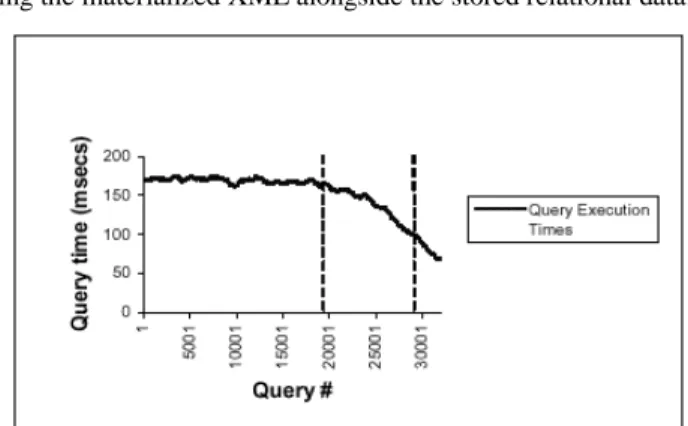
Fig. 8. Average query-execution times for a randomized set of 1000 repeated queries on a combination of relational and materialized data
Fig. 8 shows 30 simulation runs for a query workload of 1000 randomly selected CD titles. The X-axis shows the query ID, while the Y-axis shows the query-execution times. The vertical dotted lines show the points at which XML materialization took place. (Recall that the system periodically runs the learning algorithm.) It can be seen in Fig.8 that after every learning stage, the slope of the curve falls. Intuitively, after new learning has taken place, the XML clusters can satisfy a higher number of queries, with higher efficiency.
6 Discussion
The proposed approach is to store materialized XML views in a relational database using learning. One extreme of the approach is to materialize the entire relational database as XML and then use a native XML engine to answer queries. This way, we would be able to avoid the overhead of translating all possible queries on the data source into SQL, and of translating the relational answers to the queries into XML. However, query performance might degrade considerably, as XML query-answering techniques are slower than their relational counterparts. In addition, the system would have to incur a significant overhead of keeping the XML consistent with the underlying relations.
In Section 4 we described the process of grouping together related records in XML clusters. This approach allows a database system to incrementally find an optimal proportion of XML records that can be accessed faster than the relational tables. This optimal proportion can be arrived at by varying the size of the clustered XML and the
threshold value. Additional improvements can be made when user applications maintain local caches: It may be beneficial to prefetch the XML data in the application’s cache, so that future queries from the application have a higher chance of being satisfied locally.
In our approach, the added counters and flags in the relations have to be updated frequently and thus create an overhead. In our future work, we plan to reduce the overhead by updating tuple-access counts offline or during periods of lower query-loads.
We materialize only frequently-accessed tuples; thus, only a fraction of the database is materialized as XML at any given time. (The clusters are recomputed from scratch every time the learning phase is invoked.) The advantage of the learning approach is to balance the proportion of data in relations and XML, by materializing the tuples that are in the answers to multiple queries.
As the materialized XML is generated based on the access count of relational tuples, there may be queries that need to access both materialized XML and relational database. We plan to explore how to handle such queries in our future work.
7 Conclusions and Future Work
We have described a view- and learning-based solution to the problem of reducing total query-execution times in relational data sources with XML interfaces. Our approach combines learning techniques with selective materialization; our experiments show that it can prove beneficial in improving query-execution speeds in relatively static databases.
This paper describes an implementation that is external to the database engine. We are currently working on incorporating our approach inside a relational database-management system. We are looking into automating schema definition for materialized XML clusters, by using the information about past query workloads and the relations accessed by these workloads. We are working on developing a learning approach to selecting “interesting records” for XML clusters. We plan to implement a dynamic approach to selecting the threshold value in XML materialization. We plan to devise better strategies for (1) prioritizing XML records within clusters, and (2) automatically dematerializing obsolete XML data. Finally, we plan to automate the choice of the relations of interest, given a query workload.
References
1. J. Chen, S. Chen, and E.A. Rundensteiner. A transactional model for data warehouse maintenance. In Proc. of the 21st Int’l Conference on Conceptual Modeling (ER), 2002.
2. L. Chen, E.A. Rundensteiner, and S. Wang. XCache: A semantic caching system for XML queries. In Proc. 2002 ACM SIGMOD International Conference on Management of Data, 2002. 3. K.T. Claypool, E.A. Rundensteiner, X. Zhang, H. Su, H.A. Kuno, W.C. Lee, and G. Mitchell.
Gangam — a solution to support multiple data models, their mappings and maintenance. In Proc. 2001 ACM SIGMOD International Conference on Management of Data, 2001.
4. L. Chen, S. Wang, E. Cash, B. Ryder, I. Hobbs, and E.A. Rundensteiner. A fine-grained replacement strategy for XML query cache. In Proc. Fourth ACM CIKM International Workshop on Web Information and Data Management (WIDM 2002), pages 76–83, 2002.
5. J. Chen, X. Zhang, S. Chen, A. Koeller, and E.A. Rundensteiner. DyDa: Data warehouse maintenance in fully concurrent environments. In Proc. ACM SIGMOD, 2001.
6. D.W. Embley and W.Y. Mok. Developing XML Documents with Guaranteed “Good” Properties. In Proc. 20thInternational Conference on Conceptual Modeling (ER), pages (426-441), 2001.
7. I.M.R.E. Filha, A.S. da Silva, A.H.F. Laender, and D.W. Embley. Using nested tables for representing and querying semistructured web data. In Proceedings of the Advanced Information Systems Engineering, 14th International Conference (CAiSE 2002), 2002.
8. M. Fernandez, Y. Kadiyska, D. Suciu, A. Morishima, and W.C. Tan. SilkRoute: A framework for publishing relational data in XML. ACM Trans. Database Systems, 27(4):438–493, 2002. 9. Yannis E. Ioannidis. Query optimization. In Allen B. Tucker, editor, The Computer Science and
Engineering Handbook, pages 1038–1057. CRC Press, 1997.
10.Z. Liu, F. Li, and W.K. Ng. Wiccap data model: Mapping physical websites to logical views. In Proc. 21st International Conference on Conceptual Modeling (ER), 2002.
11.Liu Mengchi. A logical foundation for XML. In Proc. Advanced Information Systems Engineering, 14th International Conference (CAiSE 2002), pages 568–583, 2002.
12. Tom M. Mitchell. Generalization as search. Artificial Intelligence, 18:203–226, 1982.
13. Liu Mengchi and Tok Wang Ling. Towards declarative XML querying. In Proc. 3rd International Conference on Web Information Systems Engineering (WISE 2002), pages 127–138, 2002. 14. K. Passi, L. Lane, S.K.Madria, B.C. Sakamuri, M.K. Mohania, and S.S. Bhowmick. A model for
XML schema integration. In Proc. 3rd Int’l Conf. E-Commerce and Web Technologies, 2002. 15.Giuseppe Psaila. ERX: An experience in integrating entity-relationship models, relational
databases, and XML technologies. In Proc. XML-Based Data Management and Multimedia Engineering EDBT workshop, 2002.
16. J. Shanmugasundaram, J. Kiernan, E. J. Shekita, C. Fan, and J. Funderburk. Querying XML views of relational data. In Proc. 27th Int’l Conference on Very Large Data Bases, 2001. 17. Jennifer Widom. Research problems in data warehousing. In Proc. Fourth International
Conference on Information and Knowledge Management, pages 25–30, 1995. 18. Extensible Markup Language (XML) http://www.w3.org/XML.
19. X. Zhang, L. Ding, and E.A. Rundensteiner. Parallel multi-source view maintenance. VLDB Journal: Very Large DataBases, 2003. (To appear).
20. X. Zhang, M. Mulchandani, S. Christ, B. Murphy, and E.A. Rundensteiner. Rainbow: mapping-driven XQuery processing system. In Proc. ACM SIGMOD, 2002.
21. Xin Zhang and Elke A. Rundensteiner. Integrating the maintenance and synchronization of data warehouses using a cooperative framework. Information Systems, 27:219–243, 2002.