http://researchcommons.waikato.ac.nz/
Research Commons at the University of Waikato
Copyright Statement:
The digital copy of this thesis is protected by the Copyright Act 1994 (New Zealand). The thesis may be consulted by you, provided you comply with the provisions of the Act and the following conditions of use:
Any use you make of these documents or images must be for research or private study purposes only, and you may not make them available to any other person. Authors control the copyright of their thesis. You will recognise the author’s right
to be identified as the author of the thesis, and due acknowledgement will be made to the author where appropriate.
You will obtain the author’s permission before publishing any material from the thesis.
Verification-friendly Programming
Language
A thesis
submitted in fulfilment
of the requirements for the Degree of
Doctor of Philosophy in Computer Science at
The University of Waikato by
Min-Hsien Weng
Abstract
This thesis develops a compiler to convert a program written in the verification-friendly programming language Whiley into an efficient implementation in C. Our compiler uses a mixture of static analysis, run-time monitoring and a code generator to find faster integer types, eliminate unnecessary array copies and de-allocate unused memory without garbage collection, so that Whiley programs can be translated into C code to run fast and for long periods on general operating systems as well as limited-resource embedded devices. We also present manual and automatic proofs to verify memory safety of our im-plementations, and benchmark on a variety of test cases for practical use. Our benchmark results show that, in our test suite, our compiler effectively re-duces the time complexity to the lowest possible level and stops all memory leaks without causing double-freeing problems. The performance of implemen-tations can be further improved by choosing proper integer types within the ranges and exploiting parallelism in the programs.
This work can not be done without the team of my wonderful supervisors. It is fantastic to have the opportunity to work with them in such a good department.
I would like to thank my supervisors: Dr. Robi Malik, Dr. Mark Utting and Dr. Bernhard Pfahringer for contributing to most of the thoughts and insightful feedback in this project. They consistently give me lots of support on thesis writing and under their guidance, we explore two difficult research fields — compiler optimisation and program verification — and overcome lots of problems and have several publications about our findings.
My sincere thanks also goes to Oracle Labs, Australia for providing travel funding to attend SAPLING14 and SAPLING16 meetings.
With a special gratitude to Dr David J. Pearce and the people involved in the development of Whiley compiler at the School of Engineering and Com-puter Science, Victoria University of Wellington.
Contents
1 Introduction 1
2 Background Knowledge 7
2.1 Verifying Compiler . . . 7
2.2 Whiley Language . . . 8
2.3 Whiley Intermediate Language . . . 10
2.3.1 Example . . . 11
2.3.2 WyIL Code Types . . . 17
2.3.3 Benefits of WyIL Code . . . 20
2.4 WyIL To C . . . 20 2.4.1 Bounded Integer . . . 21 2.4.2 Memory Reduction . . . 21 2.4.3 System Architecture . . . 21 3 Related Work 23 3.1 Static Analysis . . . 23
3.2 Static Bound Analysis . . . 25
3.3 Memory Management . . . 27 3.3.1 Reference Counting . . . 29 3.3.2 Garbage Collection . . . 30 3.4 Copy Elimination . . . 31 3.5 Verifying Compiler . . . 33 3.6 Rust Comparison . . . 35
4 Live Variables and Bound Analysis 36 4.1 Bound Consistency Check . . . 37
4.1.1 CFG Construction . . . 37
4.1.2 Live Variable Analysis . . . 39
4.1.3 Bound Inference . . . 44
4.1.4 Widening Operator . . . 52
4.2 Pattern Matching and Transform . . . 63
4.2.2 Pattern Transformation . . . 67
5 Copy Elimination Analysis 71 5.1 Function Analyses . . . 71
5.1.1 Read-Write Analyser . . . 72
5.1.2 Return Analysis . . . 73
5.1.3 Live Variable Analysis . . . 74
5.2 Copy Elimination Analysis . . . 74
5.3 Reverse Example . . . 76
6 Memory Deallocation Analysis 79 6.1 Deallocation Invariant . . . 80 6.2 Deallocation Macros . . . 81 6.2.1 Pre-Deallocation Macro . . . 81 6.2.2 Post-Deallocation Macros . . . 81 6.3 Informal Proofs . . . 86 6.3.1 Pre-Deallocation Macro . . . 88 6.3.2 Array Generator . . . 92 6.3.3 Assignment . . . 96
6.3.3.1 ADD DEALLOC Macro . . . 96
6.3.3.2 TRANSFER DEALLOC Macro . . . 102
6.3.4 Function Call . . . 107
6.3.4.1 RETAIN DEALLOC macro . . . 107
6.3.4.2 RESET DEALLOC macro . . . 109
6.3.4.3 CALLER DEALLOC macro . . . 117
6.3.4.4 CALLEE DEALLOC macro . . . 128
6.4 Automatic Proofs by Boogie . . . 134
6.4.1 Declaration . . . 135
6.4.2 Macro Construction . . . 136
6.4.3 Proof Results . . . 138
7 Code Generator 141 7.1 Naive Code Generator . . . 142
7.1.1 Function Signature . . . 142
7.1.2 Variable Declaration . . . 143
7.1.3 Function Body . . . 144
7.2 Code Optimisation and Integer Type Choice . . . 152
7.2.1 Copy Elimination . . . 152
7.2.2 Deallocation Macro . . . 154
7.2.3 Code Optimisation and Generation . . . 156
vi
8 Benchmarks for Sequential Programs 179
8.1 Micro-Benchmarks . . . 180
8.2 Case Study: Cash Till . . . 185
8.3 Case Study: Coin Game . . . 188
8.4 Case Study: LZ77 Algorithm . . . 193
8.4.1 LZ77 Compression . . . 194
8.4.1.1 LZ77 Compression using Append Array . . . 194
8.4.1.2 LZ77 Compression using Pre-allocate Array . 196 8.4.1.3 Benchmark Results . . . 198
8.4.2 LZ77 Decompression . . . 201
8.4.2.1 LZ77 Decompression using Append Array . . 201
8.4.2.2 LZ77 Decompression using Array List . . . . 203
8.4.2.3 Benchmark Results . . . 203
8.4.3 Handwritten Code and Performance . . . 206
8.4.3.1 Handwritten LZ77 compression . . . 206
8.4.3.2 Handwritten LZ77 Decompression . . . 207
8.4.4 Conclusions . . . 208
8.5 Case Study: Sobel Edge Detection . . . 209
8.5.1 Algorithm . . . 210
8.5.2 Benchmark Results . . . 213
8.5.3 Handwritten Code and Performance . . . 215
8.5.4 Conclusions . . . 220
9 Benchmarks for Parallel Programs 221 9.1 OpenMP Data/Task Parallelism . . . 222
9.2 Polly Compiler Data Parallelism . . . 225
9.2.1 Polly Compiler . . . 226
9.2.1.1 Static Control Parts (SCoPs) . . . 227
9.2.1.2 Polly OpenMP Parallelism . . . 230
9.2.2 Performance Evaluation . . . 231
9.2.2.1 Micro-benchmark on standalone machine . . . 232
9.2.2.2 MatrixMult benchmarks on virtual machine . 233 9.3 Cilk Plus Task Parallelism . . . 236
9.3.1 Performance Evaluation . . . 238
9.4 Case Study: Coin Game . . . 243
9.4.1 OpenMP Parallel For . . . 245
9.4.2 Cilk Plus For . . . 246
9.4.3 Benchmark Results . . . 247 9.4.3.1 Performance Evaluation on Standalone Machine 247 9.4.3.2 Performance Evaluation on Virtual Machine . 250
9.5 Case Study: LZ77 Compression . . . 253
9.5.1 Polly Parallelism . . . 253
9.5.2 OpenMP Map/Reduce Code . . . 254
9.5.3 Cilk Plus Reducer . . . 258
9.5.4 Benchmarks . . . 262
9.5.4.1 Performance Evaluation on Standalone Machine 263 9.5.4.2 Performance Evaluation on Virtual Machine . 263 9.6 Summary . . . 265
10 Conclusions and Future Work 267 Appendices 280 A Boogie Program 281 B Benchmark Programs 286 B.1 Benchmark Whiley Program . . . 286
B.2 LZ77 benchmark results . . . 312
B.3 Sobel Edge Benchmark Results . . . 318
C Development Logs 320 C.1 Development Logs for Parallel Benchmarks . . . 320
C.1.1 OpenMP Map/Reduce . . . 320
C.1.2 Profiling Results . . . 324
C.1.3 Understanding LLVM Code . . . 325
List of Figures
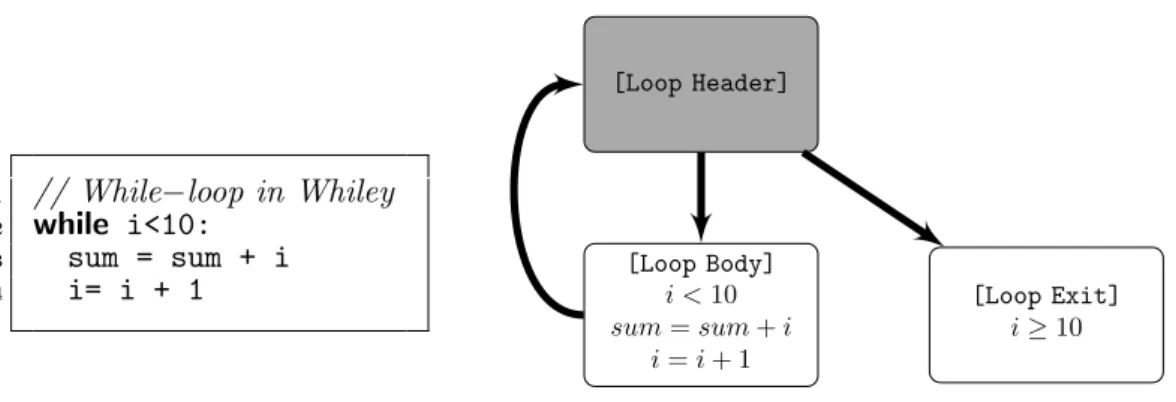
2.1 System architecture (dashed boxes: our project) . . . 22 4.1 While-loop structure . . . 38 4.2 Control flow graph of While-loop nest program (edge: live
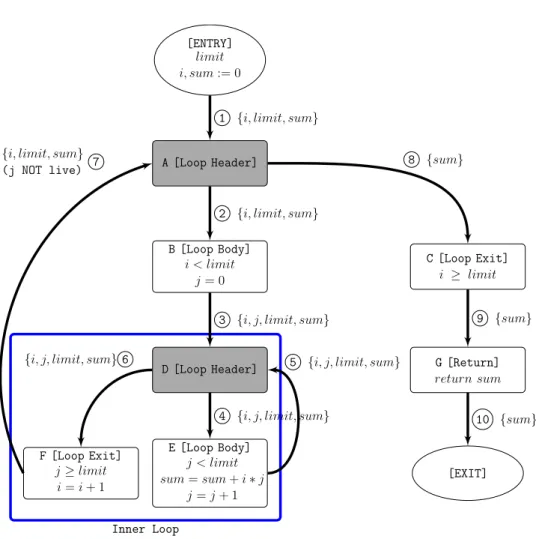
variable set) . . . 43 4.3 Bound inference and reachability check of If-Else program
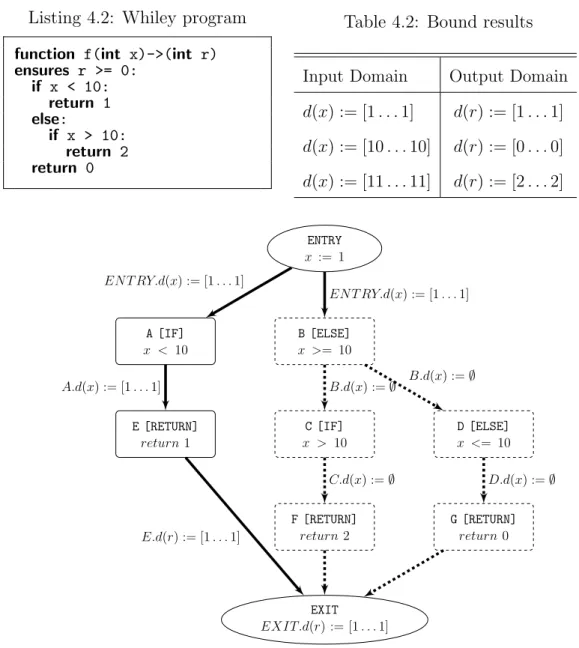
with x :=1 (solid: reachable, dashed: unreachable) . . . 50 4.4 Control flow graph of While-loop program using naive widen
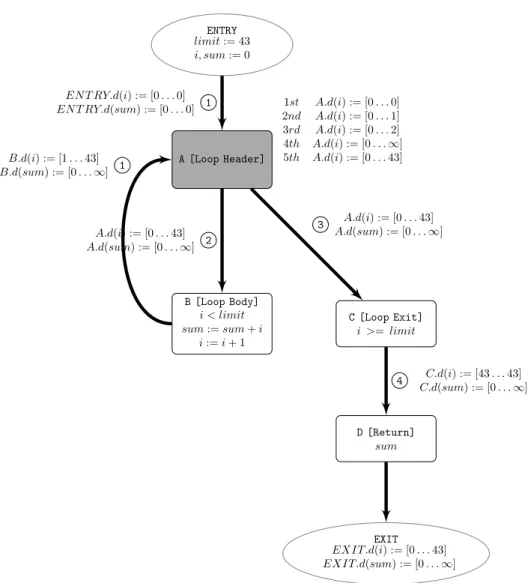
operator in breath-first order . . . 56 4.5 Control flow graph ofWhile-loopprogram using gradual widen
operator in breath-first traversal . . . 58 4.6 Control flow graph of While-loop with break program using
naive widening Operator in breath-first traversal . . . 59 4.7 Control flow graph of While-loop with break program using
naive widening operator in depth-first traversal . . . 60 4.8 Control flow graph of While-loop nest program using naive
widening operator in breath-first traversal . . . 61 4.9 Control flow graph of While-loop nest program using naive
widen operator in depth-first traversal . . . 62 5.1 Average execution time graph of naive and copy eliminated
Reverse program . . . 78 7.1 Flow chart of code generation and optimisation (dashed box) . 141 8.1 Execution time graph of cash till test case . . . 187
8.2 A line of coin array Cn . . . 188
8.3 Execution time graph of coin game . . . 192
8.4 Execution time graph of LZ77 compression on medium sizes . 199 8.5 Execution time graph of LZ77 compression using pre-allocate array on large sizes . . . 200
8.6 Execution time graph of lZ77 decompression on medium prob-lem sizes . . . 205
8.7 Execution time graph of LZ77 decompression using array list on large problem sizes . . . 205
8.8 Execution time graph of written LZ77 compression code . . . 207
8.9 Execution time graph of generated and written LZ77 decom-pression code . . . 208
8.10 Sample images before and after Sobel edge detection . . . 209
8.11 Pixel point and its neighbouring points . . . 210
8.12 Sobel edge detection with varying threshold values . . . 211
8.13 Execution time graph of Sobel edge on small problem sizes . . 214
8.14 Execution time graph of Sobel edge on large problem sizes . . 215
8.15 Execution time graph of written Sobel edge code atO2 optimi-sation . . . 216
8.16 Execution time graph of written Sobel edge code atO3 optimi-sation . . . 217
9.1 OpenMP work-sharing parallel programming model . . . 223
9.2 Polly architecture . . . 226
9.3 Automatic parallelisation and code generation by Polly compiler 230 9.4 Relative speed-ups of Polly OpenMP micro-benchmark programs on standalone machine . . . 233
9.5 Relative speedups of Polly OpenMP MatrixMult program . . . 236
9.6 Cilk Plus work-stealing task parallelism . . . 238
9.7 Average execution time of Cilk Plusmergesort program on stan-dalone machine . . . 239
x
9.8 Relative speed-ups of Cilk Plus mergesort program on stan-dalone machine (problem size: 300,000,000) . . . 240 9.9 Relative speed-up ofmergesort Cilk Plus program on 8-core (up
to 16 threads) AWS EC2 machine (Problem Size: 300 million) 242 9.10 Relative speed-up of mergesort Cilk Plus program on 8-core
(up to 16 threads) Google Cloud machine (problem size: 300 million) . . . 242 9.11 Iteration space of the loop in coin game program . . . 244 9.12 Relative speedup of parallel coin game programs on 4-core
ma-chine (Intel(R) Core(TM) i7-4770 CPU @ 3.40GHz, 4 cores) . 249 9.13 Relative speed-up of coin game on 8 cores (16 hyper-threads)
Google Cloud Machine (Intel(R) Xeon(R) [email protected] and 16 GB) . . . 251 9.14 Directed Acyclic Graph (DAG) of offset loop iterations (N = 8)
with 2 threads in LZ77 compression . . . 260 9.15 Relative Speedup of parallel LZ77 compression program on
4-core (up to 8 threads) standalone machine (Intel(R) Core(TM) i7-4770 CPU @ 3.40GHz and 16 GB memory) . . . 263 9.16 Relative speedup (vs. 1 Thread) of parallel LZ77 programs on
8-core (up to 16 threads) Google Compute Engine machine (In-tel(R) Core(TM) i7-4770 CPU @ 3.40GHz and 16 GB memory) 264
2.1 Partially supported WyIL code types . . . 17
2.2 Non-supported WyIL code types . . . 18
2.3 Fully supported WyIL code types . . . 19
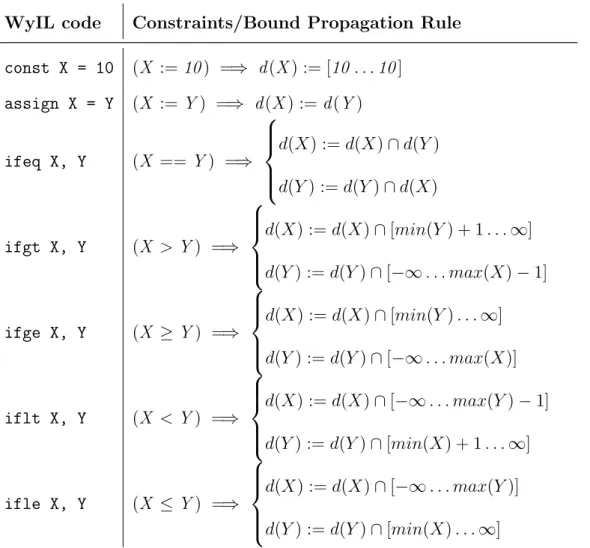
4.1 Bound constraints and bound propagation rule . . . 44
4.2 Bound results . . . 50
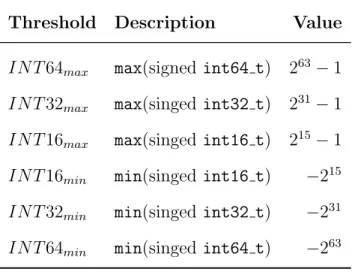
4.3 Threshold values of fixed-width integer type . . . 54
4.4 Bound results using naive widening operator in breath-first or-der (limit:=43, l: lower bound, u: upper bound) . . . 57
4.5 Bound results using naive widening operator in depth-first order (limit:=43, l: lower bound, u: upper bound) . . . 57
5.1 Copy elimination rule . . . 75
5.2 Live variable analysis result . . . 77
6.1 Post-deallocation macro for function call . . . 83
6.2 Counter Example from Boogie Verifier . . . 139
7.1 Supported fixed-width integer type and value range . . . 171
7.2 Final Domains of Functionfunc . . . 175
7.3 Final bounds of copy eliminated methodmain . . . 176
8.1 Memory leaks (bytes) of micro-benchmarks . . . 181
8.2 Average execution time (seconds) of micro-benchmarks . . . . 184
xii
8.4 Average execution time (seconds) of cash till (OOM: out-of-memory) . . . 187 8.5 Memory leaks (bytes) of coin game . . . 191 8.6 Average execution time (seconds) of coin game test case . . . 191 8.7 Offset-length pairs encoded in LZ77 compression of sample string193 8.8 Memory leaks (bytes) of LZ77 compression . . . 198 8.9 Memory leaks (bytes) of LZ77 decompression . . . 204 8.10 Memory leaks (bytes) of Sobel edge detection . . . 213 9.1 Average execution time (seconds) of micro-benchmarks
opti-mised by GCC and Polly compilers on standalone machine . . 231 9.2 Absolute speed-ups of Polly optimised micro-benchmark
pro-grams (vs. GCC compiler) on standalone machine . . . 232 9.3 Average execution time (sec.) ofMatrixMult case on standalone 234 9.4 Average execution time (sec) of MatrixMult case on AWS EC2 234 9.5 Average execution time (sec) of MatrixMult case on Microsoft
Azure . . . 234 9.6 Average execution time (seconds) of Cilk Plus mergesort
pro-gram on standalone machine . . . 239 9.7 Average execution time (seconds) of Cilk Plus mergesort
pro-gram on 8-core (up to 16-threads) AWS EC2 machine (Intel(R) Xeon(R) CPU E5-2666 v3 @ 2.90GHz, 30 GB memory) . . . . 241 9.8 Average execution time (seconds) of mergesort Cilk Plus
pro-gram on 8-core (up to 16 threads) Google Cloud machine (In-tel(R) Xeon(R) CPU @ 2.20GHz and 16 GB memory) . . . 241 9.9 Results of MOVES arrays in coin game program . . . 244 9.10 Average execution Time (seconds) of parallel coin game
pro-grams on 4-core (up-to 8 threads) standalone machine (Intel(R) Core(TM) i7-4770 CPU @ 3.40GHz and 16 GB memory) . . . 247
9.11 Average execution time (seconds) of parallel coin game pro-grams on 4-core standalone machine (Intel(R) Core(TM) i7-4770 CPU @ 3.40GHz and 16 GB memory) . . . 248 9.12 Average execution time (seconds) of parallel coin game code
on 8-core (up to 16 threads) Google Virtual Machine (Intel(R) Xeon(R) CPU @ 2.20GHz and 16 GB memory) . . . 250 9.13 Average execution time (seconds) of Polly LZ77 compression
program on 4-core standalone machine (Intel(R) Core(TM) i7-4770 CPU @ 3.40GHz, 16 GB memory) . . . 253 9.14 Best match of string AACAACABCABAAAC . . . 255 9.15 Sample outputs of LZ77 OpenMP map/reduce program at
po-sition 3 using 3 threads . . . 257 9.16 Sample outputs of Cilk Plus LZ77 compression at position 8
using 2 threads . . . 260 9.17 Grain size varying on large256x (147.2 MB) file . . . 262 B.1 Average execution time (seconds) of LZ77 compression on medium
sizes (OOM: out-of-memory, OOT: out-of-time ≥ 10 minutes) 312 B.2 Average execution time (seconds) of LZ77 compression on medium
sizes (OOM: out-of-memory, OOT: out-of-time ≥ 10 minutes) 313 B.3 Average execution time (seconds) of LZ77 compression on large
sizes . . . 314 B.4 Average execution time (seconds) of LZ77 decompression . . . 315 B.5 Average execution time (seconds) of LZ77 decompression using
array list on large sizes . . . 316 B.6 Average execution time (seconds) of handwritten and generated
LZ77 compression programs . . . 316 B.7 Average execution time (seconds) of handwritten and generated
LZ77 decompression programs . . . 317 B.8 Average execution time (seconds) of Sobel Edge on small sizes 318 B.9 Average execution time (seconds) of Sobel Edge on large sizes 318
xiv
B.10 Average execution time (seconds) of written Sobel edge at O3 optimisation . . . 319 C.1 Complete list of Length-Offset Pairs computed by using OpenMP
map/reduce program with 2 threads . . . 320 C.1 Complete list of Length-Offset Pairs computed by using OpenMP
map/reduce program with 2 threads . . . 321 C.1 Complete list of Length-Offset Pairs computed by using OpenMP
map/reduce program with 2 threads . . . 322 C.1 Complete list of Length-Offset Pairs computed by using OpenMP
map/reduce program with 2 threads . . . 323 C.2 Top 5 functions of OpenMP map/reduce program . . . 324 C.3 Average execution time (seconds) of parallel LZ77 compression
programs on 4-core (up to 8 threads) standalone machine (In-tel(R) Core(TM) i7-4770 CPU @ 3.40GHz and 16 GB memory) 328 C.4 Average execution time (sec) of parallel LZ77 compression
pro-grams on 8-core (upto 16 threads) Google Cloud machine(Intel(R) Xeon(R) [email protected] and 16 GB memory) . . . 329
Introduction
Software in modern life is used anywhere and anytime, so bugs occur conse-quently. A single software failure can lead to severe and costly losses as it requires a long correction time, extra efforts for debugging and software patch, and most importantly can cause damage to people’s productive life.
The software bug problem becomes worse as the increasing software com-plexity rapidly raises the difficulty of debugging, and also the bugs from poor coding expose potential risks to security vulnerability and cause crashes in systems.
Tools for improving software quality are needed and can be developed in different ways. Testing-based methodsuse a set of test cases to check if software meets its requirements and find possible software defects. Software verifica-tion (Huth and Ryan, 2004) applies formal proof techniques to show a program works correctly and verify the software is fit for use. The formal and rigor-ous proofs also help programmers come up with precise and reliable program design, and guarantees the correct performance within proper use so that po-tential life-threatening errors in safety-critical systems can be eliminated.
However, it is a grand challenge to build a verifying compiler (Hoare, 2003) using automated mathematical and logical reasoning to find as many bugs as possible at early compilation. Much research has attempted to enable the verification and reduce design flaws for existing programming languages,
2
e.g. Extended Static Check for Java programs (Flanagan et al., 2002) and Spec# (Mike Barnett, 2005) for C# programs.
Whiley (Pearce and Groves, 2015a) is a new programming language and is designed with an extended verifying compiler to make it easy to write up formal specifications in the program and verify the software at compile-time such that the program can run correctly without run-time errors. The Whiley compiler can also convert the program into Java or JavaScript to be executed across heterogeneous platforms.
This thesis focuses on building a compiler to translate high-level Whiley into low-level C code and improve the efficiency of generated C code, and formalises and proves the memory safety of the generated code using formal verification. However, as value semantics is used in Whiley to guarantee pro-gram correctness, the naive and line-by-line translated implementation has potential inefficiency problems as follows.
• Arbitrary-sized integers leads to poor performance.
• Too much extra and unneeded array copying increases memory overhead and lowers the efficiency.
• Manual deallocation is required to avoid memory leaks and to ensure memory safety.
Since Whiley is intended to be used for programming embedded devices as well as general programming, an inefficient implementation like this is not acceptable, as it would mean Whiley programs running on small embedded processors could run out of memory, or the program might run too slowly for its intended purpose. For general acceptance of Whiley, it is important that reasonably efficient implementations of Whiley are available.
This leads to the main research questions of this thesis:
Can the overheads caused by the design of Whiley be reduced using a compiler whilst preserving the correctness?
Contributions The main contribution of this thesis is as follows.
• Building the optimising compiler for Whiley and preserving the safety.
• Inventing algorithms for copy eliminations and improving the efficiency.
• Inventing new algorithm for de-allocation analysis: – Combines static and dynamic analysis,
– Guarantees exactly one memory de-allocation (no leaks nor double freeing problems occur in the generated C code),
– Has less overhead than reference counting.
• Proving the memory safety of our macros using formal verification. The below describes our compiler back-end in more detail.
• Abstract interpretation-based bound inference with extended symbolic analysis is developed to estimate the intervals of integer variables and speed up the convergence of approximating the ranges within finite steps. It also finds the matching patterns and make any necessary program transformation for high efficiency of the resulting code. A shorter version of bound analysis also appears in the paper (Weng et al., 2016).
• The value semantics in Whiley makes copies at each assignment and func-tion call, so wastes time and memory copying large arrays. A copy elim-ination analyser is developed to detect and remove unnecessary copies wherever possible. By reducing expensive overheads of array copying, the generated code gains speed-ups and has more memory space to run on large-scaled problems. A shorter version of copy elimination analysis is presented as the conference paper (Weng et al., 2017).
• Memory deallocation without garbage collection is complex particularly for aliased and shared memory. A deallocation analyser extended with dynamic run-time monitoring is developed in this thesis. It inter-operates
4
with the copy analyser to find unneeded memory when no longer used, and inserts deallocation macros in the generated code to avoid memory leakages and ensure each memory space is freed only once. A shorter ver-sion of memory deallocation analysis also appears in the same conference paper as copy elimination analysis (Weng et al., 2017).
• Semi-formal proofs are constructed to show our deallocation eliminates double deallocation problems and avoids memory leaks in the generated code whilst preserving memory safety. The proofs involve assumptions, invariants and the program reasoning about pre-and post-conditions, and are converted into Boogie program and are validated using the automatic SMT theorem prover Z3 (version 4.6.1).
• A code generator is developed to automatically translate the source Whiley program at byte-code level into the C programming language. The code generator can use our copy or deallocation analysis separately, or combine the results of both copy and deallocation analyses to improve the generated code, such that the resulting C code runs efficiently.
• Our code analysis and code generator have been applied to five micro-benchmark programs and four large case studies. The results show our code optimisation can remove most of unnecessary array copies in com-plex programs and give high efficiency. Furthermore, our optimised code can absolutely prevent memory leaks and avoid use-after-free memory vulnerability without garbage collection.
• Parallel computing utilises multiple processors in modern computers to run the program simultaneously and reduce long waiting time caused by the sequential execution. We convert our generated C code into parallel code by-hand and experiment with three kinds of parallel techniques: Polly compiler (Polyhedral optimisations for LLVM), Cilk Plus task par-allelism and OpenMP map-reduce program styles. We provide several case studies of the effectiveness of each technique.
Project Scope Our project aims to reduce the overheads caused by the language design. Our compiler takes a Whiley program as input, analyses and optimises the program at Whiley intermediate representation level (WyIL) to produce a safe and efficient C implementation for running correctly, faster and for longer.
Our project implements a subset of the Whiley programming language with static code analysis tools along with an automatic code generator, and our project limitations are as follows.
• The program can be run with one dimensional array of primitive types (integer, byte and Boolean) without cyclic references. For multi-dimensional arrays, recursive data type or nested data structures, whose sizes and memory space dynamically change at run-time, a re-design of memory deallocation is required.
• The program does not have recursion because our analyser has not yet defined static analysis behaviours of recursive function calls, which can be implemented by extending our analyser as a part of the future work.
• The program invariant and verification conditions are all stripped off when translating into C code, as they are not relevant to the computation part of the program and this kind of code erasing technique is also used in F* to C code (Protzenko et al., 2017a). These formal specifications can provide crucial and useful information to our compiler, e.g. loop invariant contains the estimated array sizes and the bounded values, and can be encoded as constraints to improve the precision of our static analysis and make a better decision for code translation.
• The program executes in sequential, and does not utilise any concurrency. We are aware that the support of parallelisation is an important future work to gain further performance and better throughput from multi-core machines as well as high performance computing cloud.
6
Thesis Outline Chapter 2 gives background knowledge. Chapter 3 con-tains related work that our project uses. Chapter 4 describes our bound anal-yser. Chapter 5 details our copy elimination analyser, and Chapter 6 describes the memory deallocation approach and provides semi-formal proof of memory safety in our macro design. Chapter 7 presents the procedure of code gener-ation and optimisgener-ation. Chapter 8 shows performance evalugener-ation of our code optimisation with micro benchmarks as well four real case studies. Chapter 9 investigates parallelism and gives experimental results on our parallel C code. Chapter 10 gives conclusion and future work.
Background Knowledge
This chapter provides basic preliminaries for our project.
2.1
Verifying Compiler
Prof. Sir Tony Hoare (the ACM Turing Award Winner, FRS) (Hoare, 2003) once said that it is a grand challenge for computing research to create a veri-fying compiler, with automated mathematical and logical reasoning, to detect the software errors at the compile time. By catching more bugs at compile-time, we can avoid unexpected software failure while running the program. Also, via the verification process we can check whether the implementation meets user specification, and thus improve the quality of software.
Many researchers have been trying to build up automatic compile-time verifying tools to transform a program into constraints, and verify their validity to prove the correctness of program and identify defects. However, these new tools are extended from object-oriented programming languages (Java and C#) to include verification feature and there are limitations on the usage of a verifying compiler.
8
2.2
Whiley Language
Whiley (Pearce and Groves, 2015b) is a new verification-friendly functional programming language and its compiler aims to solve the verification issues that arise from object-oriented programming languages. The language uses hybrid functional core and imperative paradigms. The functional core ensures the output of each Whiley function depends only on input values and does not cause any side effect, e.g. sin(x) function always produces the same output value for the samex each time. The imperative layer allows Whiley program-mers to describe a program with sequence of statements. Whiley supports:
Pure Function Java or C# language allows functions to have different states, e.g. passing call-by-reference parameter to called function. Because callee may change the value of passed parameter, it would produce different results at each function call.
Side effects are not easily observed by verifying compiler because side-effecting function would modify a variable outside its scope and cause an un-expected error. Whiley (Pearce and Groves, 2015b) explicitly defines functions that are side effect-free and pure, whilst method are impure. Consider the be-low example.
1 function func(int[] a) -> int[]: // Pure function 2 a[0] = 10
3 return a
4 // Impure method
5 method main(System.Console sys): 6 int[] a = [0, 0, 0] // a[0] = 0
7 int[] b = func(a) // Does not update array ’a’ 8 assert a[0] == 0
9 assert b[0] == 10
Functionfunc uses call-by-value semantics and thus does not change the value of input array a, because a is first copied and then passed to called function. The output array b however has updated value. A pure Whiley function has below properties:
• Given the same input, Whiley function always produces the same output.
Separating pure functions from methods allows specifying what can be under-taken in a function, and simplifies the reasoning and verification of Whiley programs.
Value Semantics Java arrays or objects are passed by reference to the called function, and because both callee and caller can change its value, these objects are no longer immutable. The presence of mutable collections makes it difficult to verify the program as anticipated.
Whiley (Pearce and Groves, 2015b) uses value semantics on compound data types, e.g. arrays, so the verification in Whiley can focus on the values, rather than objects themselves. For example, an array assignment in Whiley copies the value of an existing array, and then assigns to the new variable, so that any change to new array will not affect or update the existing array.
Consider the following Whiley program: 1 function func(int[] a) -> int[]: // a[0] = 0 2 int[] b = a // b = COPY(a)
3 b[0] = 1 // b[0] = 1 4 assert a[0] == 0
5 assert b[0] == 1
6 return a // The value of ’a’ remains unchanged.
Variable a and b are both integer arrays. The assignment in line 2 copies the value of array a to b, so variable b does not share the same array as a but points to a new and separate array. Any change to array b will not update array a or return value. As such, value semantics makes function func pure because it passes parameters by value and does not cause any change to the actual parameters outside function scope.
Value semantics and pure functions enable Whiley language to have hy-brid characteristics of imperative and functional languages. That means, we can write Whiley programs in imperative statements and still ensure program safety using side effect free function.
Unbound Arithmetic The unbounded integers in Whiley (Pearce and Groves, 2015b) can ease the difficulty of reasoning about soundness of arithmetic
op-10
erations using an automatic theorem prover. For example, adding two 32-bit integers may exceed the maximal value which a 32-bit integer can hold, and thus such an arithmetic will have integer overflow problems and lead to an unpredictable system behaviour.
Whiley verifying compiler can detect bugs at compile-time and convert the program into bug-less Java or C code. However, translating high-level Whiley programs into efficient implementations has some challenges, for ex-ample, array copies and unbounded integers causes substantial slowdown on the performance of Whiley implementations.
2.3
Whiley Intermediate Language
Our code analysis first uses Whiley compiler to compile a source Whiley pro-gram into WyIL (Whiley Intermediate Language) code and then performs code analysis on WyIL code and translates WyIL to optimised C code.
WyIL byte-code language (Pearce, 2015b) is a register-based and three-address like code, similar to LLVM (Low Level Virtual Machine), with semi-structure control-flows. The three-address form consists of an instruction and three registers. Each register is denoted with a prefix % and an integer number, and the set of register numbers is unlimited to accommodate all operands. A WyIL code has below features:
• A WyIL code statically assigns a register to hold a parameter on entry, constant, local variable or a temporary operand which is used to store computed results. Register number starts from input parameters to all operands in the context order of WyIL code, e.g. register %0 represents the first parameter, and %1 maps to the second parameter, etc. And different registers never share the same number.
• Register allocation at WyIL level generates a temporary operand to store the value of computed result. For example, add %6 = %2, %5 adds the values of register %2 and %5, and then assigns the result to target
register %6, which differs from any other existing ones. By having a unique target register, we can avoid potential variable aliasing at an assignment and a function call.
• Each WyIL code has at most one register on the left-hand side but may contain two or more registers on the right side. For example, a loop byte-code loop (%3, %4, ...) lists what registers can be changed within the loop.
WyIL acts as an intermediate language and aims to be translated and op-timised into different kinds of implementations and run efficiently across plat-forms. The WyIL code keeps all type information and preserves all invariant at source code to ensure program behaviour, e.g. we can place a loop invariant to ensure our loop counter does not exceed the maximal loop bound and avoids potential out-of-range error. Also, the WyIL code reduces the number of code types to represent statements and expression in Whiley source code, so that the complexity of our code generation and optimisation can be reduced.
There are a number of WyIL code types. We will choose some code types necessary to our project and illustrate each code type with an example.
2.3.1
Example
1 // input: input array, output: output array
2 function func(int[] input) -> (int[] output): 3 int n = |input| // Get the size of ’input’ array
4 output = [0;n]// Create output array of size ’n’ filled with 0 5 int i = 0
6 while i < n where i <= n:
7 output[i] = input[i] * 2// Array update
8 i = i + 1
9 return output 10
11 // Main entry point
12 method main(System.Console sys):
13 int[] a = [1;20]// Create an input array of size 20 filled with 1 14 int[] b = func(a)// Call ’func’ function
15 assert a[0] == 1 // Check ’a[0]’ 16 assert b[0] == 2 // Check ’b[0]’
17 sys.out.println(b[0])// Print out ’b[0]’
12
Example 2.1 Function func takes an array as input, and creates output array with the length of passed input array, and populates the output array by using a while-loop. Main method creates the input array and makes a call to function func. Then it checks the input and output arrays with two assertions, and prints out the array value.
1 private function func(int[]) -> (int[]): // %0: input, %1: output
2 body: // Function body
3 lengthof %4 = %0 : int[] // %4 =|input|
4 assign %2 = %4 : int // %2 = n = %4
5 const %5 = 0 : int
6 arraygen %6 = [%5; %2] : int[] // %6 = [0;n]
7 assign %1 = %6 : int[] // %1 = output = %6
8 const %7 = 0 : int
9 assign %3 = %7 : int // i = 0
10 loop (%1, %3, %8, %9, %10, %11, %12) // Start of loop 11 invariant // Start of loop invariant
12 ifle %3, %2 goto label0 : int // ’i<=n’
13 fail
14 .label0
15 return// End of loop invariant
16 ifge %3, %2 goto label1 : int // loop condition ’i>=n’ 17 indexof %8 = %0, %3 : int[] // %8 = input[i]
18 const %9 = 2 : int
19 mul %10 = %8, %9 : int // %10 = input[i] ∗ 2
20 update %1[%3] = %10 : int[] -> int[] // output[i] = %10
21 const %11 = 1 : int
22 add %12 = %3, %11 : int // %12 = i + 1
23 assign %3 = %12 : int // i = %12
24 // End of loop
25 .label1 // Loop exit
26 return %1 // return output
Listing 2.2: Functionfunc at WyIL Level
Function func Consist of function declaration, function body and pre- and post-conditions. Each WyIL code contains the code itself and includes type information of all relevant operands and results. Because outputting all con-tents is quite lengthy and hard to interpret, Listing 2.2 displays each WyIL code in a simplified format with selected type information.
Our code generation skips the translation of pre and post conditions be-cause these have been verified during the compilation at Whiley source level, and focus on function declaration and body.
Function Declaration Include function signature and variable declara-tion. The signature consists of function name, return type and a list of param-eter types. In our example, private function func(int[]) -> (int[]) means the input and output of function func are integer arrays.
All variables and operations in a function are statically stored with a set of registers, and register order is consistent with the context of WyIL code. In our example, register %0 denotes the parameter input, and %1 represents array output, which both appear in the function signature.
A register could be associated with a present variable at Whiley source code if it stores the value, e.g. register %2 maps to variable n.
Function Body Contains a block of WyIL code to represent each state-ment in Whiley program. The code types used in Listing 2.2 are discussed as follows. The lengthof code loads array parameterinput from register %0 and writes its array size to temporary %4. The assign code copies array size to target %2 or local variablen. Theconst code loads constant value 0 to register %5. And the arraygen code loads size from %2 and the value at register %5, and then creates an array of the given size and fills each array item with the value, and assigns to a temporary register %6. Then by usingassign code, we can copy array at register %6 to %1 or return variable output. Similarly, we use const and assign code to write 0 to register %3 or variable i.
1 loop (%1, %3, %8, %9, %10, %11, %12)// A list of modified registers 2 invariant// Start of loop invariant ’where i <= n’
3 ifle %3, %2 goto label0 : int // i <= n 4 fail
5 .label0
6 return// End of loop invariant
7 ifge %3, %2 goto label1 : int // Loop condition ’i>=n’ 8 indexof %8 = %0, %3 : int[] // %8 = input[i]
9 const %9 = 2 : int //%9 = 2
10 mul %10 = %8, %9 : int // %10 = input[i]∗ 2
11 update %1[%3] = %10 : int[] -> int[] // output[i] = %10 12 const %11 = 1 : int
13 add %12 = %3, %11 : int // %12 = i + 1 14 assign %3 = %12 : int // i = %12
15 // End of loop
16 .label1// Loop exit
14
The loop code (see Listing 2.3) contains a loop block and includes a set of registers to indicate those registers may be changed by the loop body.
The loopinvariant code in where clause (e.g. where i≤n) is represented as a separate invariant block and placed before the loop condition at line 9. The invariant is translated as conditional and fail code to throw out a run-time error when the condition does not hold. Theconditional code is prefixed with if and a comparing operator to compare the values of two registers and decide whether to go forward to next code or jump to a further label code which indicates a position within WyIL code. In our example, ifge %3, %2 goto label1 checks that %3 ≥ %2. If so, then jump to label1. Otherwise, move on to next step. WyIL conditional code isforward-only branch because the control flow does not allow call back and backward branches.
After loop condition, we use indexof code to access array at a given in-dex and return the value to target register, e.g. indexof %8 = %0, %3 is equivalent to%8 = input[i]. Then we usebinOp code to perform arithmetic operation on two registers and writes the result to target register, e.g. mul %10 = %8, %9is %10 = %8×%9. We useupdate code to update the array at a spe-cific index with given result, e.g. update %1[%3] = %10 is %1[%3] = %10. And the loop counter i is incremented by one using a combination of const, add and assign code.
Outside the loop, we place label code to indicate the loop exit label when the loop iterations stop. And finally, we use return code to return the value of target register and stop the function.
Method are impure and different from side effect free functions.
• A method can call another method and allow side-effecting standard input and output stream, such as print, but a function can not call a method nor display messages on console.
• A method may or may not have a return, but a function always returns values.
1 method main(System.Console sys):// Main entry point
2 int[] a = [1;20]// Create an input array of size 20 filled with 1 3 int[] b = func(a)// Call ’func’ function
4 assert a[0] == 1 // Check ’a[0]’ 5 assert b[0] == 2 // Check ’b[0]’
6 sys.out.println(b[0])// Print out ’b[0]’
Listing 2.4: Main Method in Example Whiley Program
Example 2.2 Consider our example 2.4 again. In main method we make a call to function func with an input array, and add assertions to check the function input/return and print out an array value.
1 private method main(whiley/lang/System:Console):// %0 = sys 2 body:
3 const %3 = 1 : int 4 const %4 = 20 : int
5 arraygen %5 = [%3; %4] : int[] // %5 = [1;20] 6 assign %1 = %5 : int[] // %1 = a = %5
7 invoke (%6) = (%1) example:func : function(int[])->(int[])// %6 =
func(a)
8 assign %2 = %6 : int[] // %2 = b = %6 9 assert // Start of ’assert a[0] == 1’
10 const %7 = 0 : int
11 indexof %8 = %1, %7 : int[]
12 const %9 = 1 : int
13 ifeq %8, %9 goto label2 : int 14 fail
15 .label2 // End of assertion
16 assert // Start of ’assert b[0] == 2’
17 const %10 = 0 : int
18 indexof %11 = %2, %10 : int[]
19 const %12 = 2 : int
20 ifeq %11, %12 goto label3 : int 21 fail
22 .label3 // End of assertion
23 fieldload %13 = %0 out : {int[][] args,{method(any)->() print,
method(int[])->() print_s,method(any)->() println,method(int
[])->() println_s} out} // %13 = sys.out
24 fieldload %14 = %13 println : {method(any)->() print,method(int [])->() print_s,method(any)->() println,method(int[])->() println_s} // %14 = sys.out.println
25 const %15 = 0 : int
26 indexof %16 = %1, %15 : int[] // %16 = b[0]
27 indirectinvoke () = %14 (%16) : method(any)->()// sys.out.println
(%16)
28 return
16
Method Declaration Contain all used registers and their associated types. Because register allocation starts from method arguments, register %0 in our example is assigned to system console object and ready to display any message.
Method Body Can contain everything in function body (See Listing 2.5). In our example, we have invoke code at line 7 to call function func with the parameter from register %1, and then return the result to target %6. Invoke code uses the colon to split the contents of code, and example:funcindicates the called function and function(int[])->(int[]) shows the input and re-turn types of called function. Furthermore, invoke code can be used to call the functions in Whiley run-time library, such asMath.max orFile.Reader.
We then use assert code to handle an assertion at WyIL level by using conditional and fail code to ensure a run-time exception is thrown out when the assertion condition is not met (see line 9 to 22 in Listing 2.5).
1 public type PrintWriter is { // Nested type inside System.Console 2 method print(any), // out.print
3 method println(any), // out.println
4 method print_s(ASCII.string), // out.print s 5 method println_s(ASCII.string) // out.println s 6 }
7 // System.Console type
8 public type Console is {
9 PrintWriter out, // Output stream method interfaces 10 ASCII.string[] args // command line arguments 11 }
Listing 2.6: System.Console Package
After two assert code, we use two lines of fieldload code to access method out.printlnfrom register %0 to target %14 because the method is nested and associated toSystem.Console object. As shown in Listing 2.6, the console has one field out and another field args. The out field is declared as PrintWriter type and contains a list of printing method interfaces whilst the args field is an array of ASCII code (numerical presentation of characters).
In our example, the fieldload code at line 23 loads out field from register %0 to %13 and the contents after colon lists all field types ofSystem.Console type, which is surrounded by curly braces, and each field is split by comma.
Similarly, thefieldload code at line 24 loadsprintln field from %13 to %14 and displays field types after the colon.
In line 27, we use indirectinvoke code to indirectly call ’println’ method as the called method/function is determined by a register. In our example indirectinvoke () = %14 (%16)loads sys.out.println method from reg-ister %14 and invokes the method to print out passed parameter %16. The method after colon indicates the types of called method (sys.out.println).
A function call in WyIL code can be direct or indirect. The invoke code directly runs a static function or method declared in the same source file or method in Whiley runtime library (e.g. Math.abs) whereas the indirectinvoke code executes a function or method indirectly determined by a given operand.
2.3.2
WyIL Code Types
We categorise and list the WyIL code types with the support level of our project: full, partial and none. The symbols in the table are described as follows. l1 is target register on the left-hand side. r1 and r2 are the operand
registers on the right-handed side. constant number is the constant value. Andlabel identifier indicates a labelled position at WyIL code,typedenotes a given type and field presents a field name of a structure. And func is the name of called function.
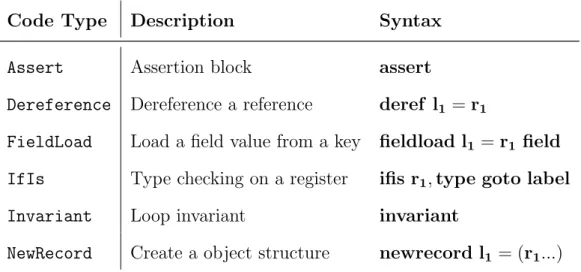
Table 2.1: Partially supported WyIL code types
Code Type Description Syntax
Assert Assertion block assert
Dereference Dereference a reference deref l1=r1
FieldLoad Load a field value from a key fieldload l1=r1 field
IfIs Type checking on a register ifis r1,type goto label
Invariant Loop invariant invariant
18
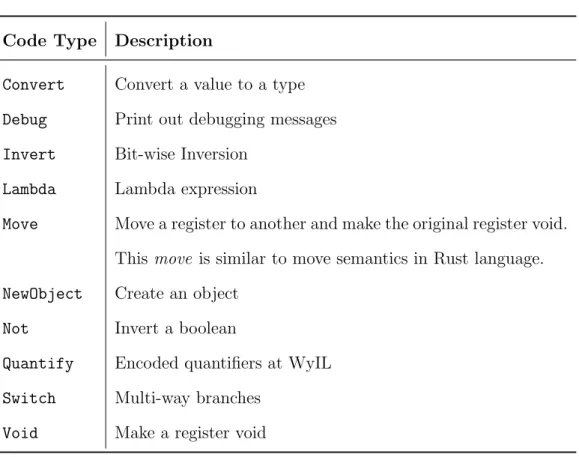
Table 2.2: Non-supported WyIL code types
Code Type Description
Convert Convert a value to a type Debug Print out debugging messages Invert Bit-wise Inversion
Lambda Lambda expression
Move Move a register to another and make the original register void. This move is similar to move semantics in Rust language. NewObject Create an object
Not Invert a boolean
Quantify Encoded quantifiers at WyIL Switch Multi-way branches
Void Make a register void
Table 2.1 shows a list of partially supported WyIL code types. Our project does not translate assert and invariant code into C code as a default action, but provides ea compiler option to enable its code generation. For structure related code (dereference, fieldload and newrecord), our project supports the code generation of single-array like structure, which contains only one integer array with a few extra integer fields, but our deallocation analysis does not guarantee the memory leaks and safety of structure types. Ourifis code checks if a register is null type and can not perform the check on other types. Table 2.2 lists the code types that our project has not supported yet, and the below table shows the code types of fully supported Whiley intermediate level (WyIL) and gives a short explanation of code syntax.
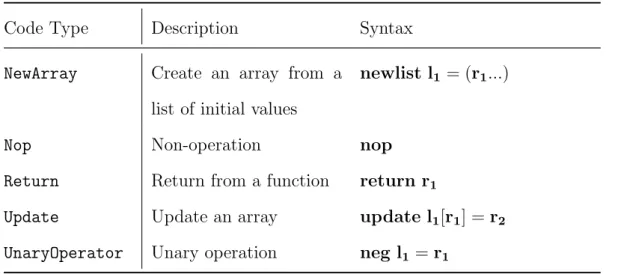
Table 2.3: Fully supported WyIL code types
Code Type Description Syntax
ArrayGenerator Generate an array arraygen l1 = [r1;r2]
Assign Assignment assign l1 =r1
BinOp Arithmetic operations
add l1 =r1, r2 sub l1 =r1, r2 mul l1 =r1, r2 div l1 =r1, r2 rem l1 =r1, r2
Const Load a constant const l1 =constant
Fail Throw an exception fail
Goto Jump to a label position goto label
If Conditional branch
ifeq r1, r2 goto label
ifneq r1, r2 goto label
iflt r1, r2 goto label
iflteq r1, r2 goto label
ifgt r1, r2 goto label
ifgteq r1, r2 goto label
IndexOf Access array item indexof l1 =r1, r2
IndirectInvoke Indirect function call indirectinvoke (l1) = r1(r2...)
Invoke Function Call invoke (l1) = (r1...) :func
Label Label position .label
LengthOf Array size lengthof l1 =r1
Loop Loop block loop (r1...)
20
Table 2.3 Fully Supported WyIL Code Types (Continued) Code Type Description Syntax
NewArray Create an array from a list of initial values
newlist l1 = (r1...)
Nop Non-operation nop
Return Return from a function return r1
Update Update an array update l1[r1] =r2
UnaryOperator Unary operation neg l1 =r1
2.3.3
Benefits of WyIL Code
Our code analysers and optimiser operate at Whiley intermediate language level because WyIL code provides several advantages over source code. Firstly, WyIL reduces the number of operation code (opcode) types and replaces nested control-flows with uniform branching, so that we can use the same approach as conditional to handle with nested control-flowbreakorcontinue. As a result, the implementation complexity of code analysis can be reduced. Secondly, WyIL breaks down a long calculation into a sequence of binary operations and provides greater flexibility for our back-end to apply code optimisation. Finally, we can take the same WyIL code without needing re-compilation from source code to experiment with different code optimisations and to compare the performance improvement.
2.4
WyIL To C
Our project translates WyIL code into efficient C code of lower memory usage and faster execution, compared to the naive C code that our compiler produces without any optimisation. Two additional things are required to undertake during code generation, as follows.
2.4.1
Bounded Integer
Arbitrary-precision integer requires more memory and computing than a fixed-size integer. For example,BigInteger in Java has variable-length size and must run on slow software layer whereas fixed-size integers, such asint16 t(signed 16-bit integer), uses exact size and can directly run on fast hardware layer.
In our project we use static bound analysis to find the ranges of integer variables and substitute arbitrary-precision integers with a variety of fixed-size types whenever possible.
2.4.2
Memory Reduction
Unnecessary array copying causes program inefficiency and memory leaks lead to program in-scalability. In our naive implementation of WyIL to C code, we include value semantics to have an array copy at each assignment or function call. But excessive array copies which are not always needed waste execution time and resources. In addition, the amount of memory leaks from heap-allocated arrays is accumulated to cause thrashing and a failure to scale up the program to a larger problem size.
In our project, we design a macro system to detect unnecessary array copies and minimise the memory usage whilst maintaining the memory safety.
2.4.3
System Architecture
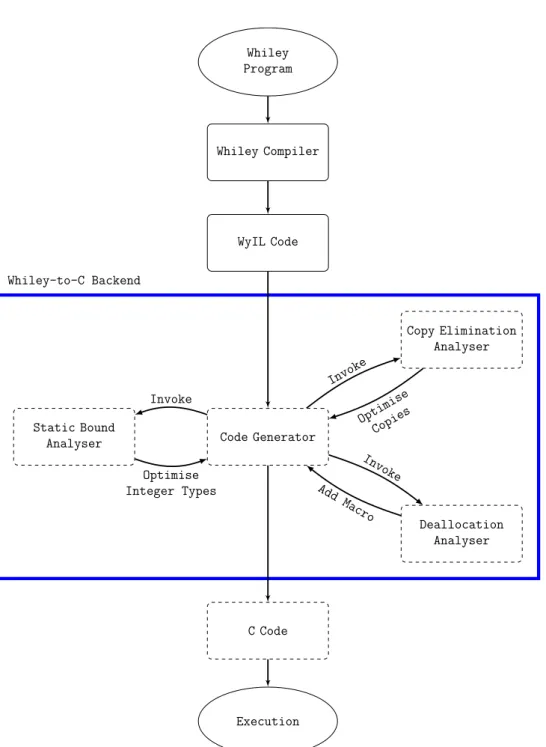
Our WyIL-to-C backend includes code generation and three static analysers (integer bound, copy elimination and deallocation analysers). Our backend operates at Whiley intermediate language (WyIL) generated from high-level Whiley source code to generate and optimise C Code.
22 Whiley Program Whiley Compiler WyIL Code Code Generator Static Bound Analyser Copy Elimination Analyser Deallocation Analyser C Code Execution Whiley-to-C Backend Invoke Optimise Integer Types Invoke Optimise Copies Invoke Add Macro
Figure 2.1: System architecture (dashed boxes: our project)
As shown in Figure 2.1, the code generator converts the WyIL code into efficient C code while interacting with bound analyser to make use of the fixed-size integer types, and with copy elimination and deallocation analyser to minimise the memory usage in the generated C code by reducing the num-ber of array copies and de-allocating on the unused arrays. Our project goal is to implement a large subset of Whiley in C with parallelism where possi-ble/useful.
Related Work
In this chapter we first go through some static (bound) analysis to find a proper tool to estimate integer intervals and choose bounded integer types, and then examine some related work about memory management and design principles to reduce the memory usage. Lastly, we reviewed some important work about static and dynamic analysis to eliminate the unused array copies and improve program efficiency.
3.1
Static Analysis
Static analysis validates the consistency between software specifications and program behaviours using mathematical methodologies. For example, the bound consistency technique is widely used to solve the finite constraint do-main problem (Marriott and Stuckey, 1998).
However, the problems of object-oriented program languages, such as side-effects and non-deterministic results, make it a grand challenge (Hoare, 2003) to create a compiler, with automated mathematical and logical reasoning, that can statically verify the specifications and detect the errors at compile-time.
Some automatic static analysers use different approaches to find software defects at early compilation stage to improve program correctness and produce high-quality software. Extended static checker for Java (ESC/Java)(Flanagan et al., 2002) uses an automatic theorem prover to analyse the program and find
24
common Java run-time errors, (e.g. array out-of-bound or null dereference, etc). Also, ESC checker can be used to analyse concurrent Java programs and issue warnings for potential run-time race conditions and dead locks. As ESC requires to annotate specifications in programs, the annotation burden and excessive warning messages could cause inconvenience for programmers.
Boogie, which was originally developed in Microsoft Spec# (Mike Barnett, 2005) system to verify a C# program, acts as an intermediate verification lan-guage (Leino, 2008) to transform a Boogie program into verification conditions. By using an automatic theorem prover (e.g. Z3 satisfiability modulo theories solver (de Moura and Bjørner, 2008)) it can statically prove the correctness of a program against pre- and post-conditions, and Boogie can point out possible error cause in the program if verification fails. Using Boogie can avoid expen-sive run-time check and improve the efficiency of program execution as Boogie has statically verified those conditions at compile time and thus can remove them from run-time. Furthermore, Boogie verification resembles writing a pro-gram, e.g. we can write frame conditions as modifies and ensures clauses in Boogie to restrict which variables a function can change and to write complex formulas in pre- and post-conditions. Apart from Spec#, Boogie supports a variety of programming languages, including Java byte-code with BML (Mallo, 2007), Dafny (Leino, 2010), Eiffel (Tschannen et al., 2011) and C (Vanegue and Lahiri, 2013). Furthermore, Whiley also supports Boogie as a verification back-end (Utting et al., 2017).
The static analysis using abstract interpretation can approximate the ab-stract semantics of a program without execution and allows the compiler to detect errors and find applicable optimisation. For example, Microsoft Re-search Clousot (Manuel Fahndrich, 2010) can statically check the absence of run-time errors and infer facts to discharge assertions. In our project, the number of WyIL code is much larger than its high-level and human-readable Whiley source code as every complicated operation in Whiley is broken down into a series of three-address forms in WyIL to preserve the semantics. We use
abstract interpretation-based static analysis to analyse such a large amount of WyIL code because it can operate at lower execution time and still produce high precision.
3.2
Static Bound Analysis
Static bound analysis is a compiler optimisation technique, which estimates the upper and lower bounds of a variable and detects potential run-time arithmetic overflows at compile time.
The static bound analysis inLLVM (Low Level Virtual Machine) becomes popular as the LLVM code can be optimised and converted to machine-depend assembly code by the compiler without changes to original source program. For example, an industrial-quality range analysis (Campos et al., 2012) has been implemented in LLVM compiler and adapts revised polynomial interval analysis (Gawlitza et al., 2009) to observe the decrease or increase in cycles and then saturate the cycles by using the widening operator. However, LLVM bound analyser tends to have overflow problems as the signedness information has been lost at LLVM level, but could be solved by using a signedness-agnostic bound analyser (Navas et al., 2012).
Static loop bound analysis approximates the number of loop iterations and proves the termination of loop. And the estimated loop bounds can also be used to unroll the loop and to increase program speed. The commonly used techniques includepattern-matching andcounter increment. Pattern-matching CodeStatistics (Fulara and Jakubczyk, 2010) can prove the loop termination by finding all for loop patterns in Java programs, and inserting termination conditions as annotation into existing code. Their results show that their method can efficiently prove 80% of for loops and detect error-prone loops in large-scaled applications, including Google App Engine, Apache Hadoop, TomCat and Oracle Berkeley DB. A counter-incremented approach (Shkar-avska et al., 2010) is presented to obtain the linear and non-linear loop-bound
26
function (LBF), that binds the numeric loop condition to the number of loop iterations. Shkaravska’s approach can handle very complicated loops to in-fer polynomial LBFs but also ensure the correctness of derived LBFs using an external verifying tool. Due to inefficiency on simple loops, it is usually considered as a complementary approach to other existing ones.
Pattern-matching and counter-increment approaches do not handle multi-path loops of different effects or non-trivial patterns well. Acontrol-flow refine-ment technique (Gulwani et al., 2009) is used to transform a multi-path loop into one or more explicit interleaving loops to simplify the analysis, and then use progress invariant technique to compute precise symbolic loop bounds. The experimental results show that their approach can find 90% of loop bounds in a large Microsoft product.
The static bound analysis usually has a trade-off between precision and effi-ciency. When dealing with undecidable problems, the analyser usually accepts imprecise results to avoid long running time and non-termination problems. An interval analysis without widening or narrowing operator (Su and Wag-ner, 2004) is proposed to solve integer range constraints, and shows that their approach produces precise bounds in polynomial time whilst the termination is guaranteed. Our project uses abstract interpretation iteration strategy to compute the integer bounds in an abstract domain and accelerate the conver-gence of bound inference by using widening operator with thresholds (Blanchet et al., 2003) which goes through a number of threshold values and effectively approximates the loop bound to fix-points within finite time.
A forward-propagated integer analysis (Pearce, 2015a) is presented in Whiley compiler to exploit type and loop invariant to restrict the ranges of integer vari-ables with explicit integer type declaration. In our project, we use abstract interpretation-based static bound analysis to estimate the ranges of integer variables, and base on the resulting bounds to use precise integer types in the generated code. Our approach targets at abstract typed integers and infers their bounds with abstract interpretation-based widening operator. We may
obtain the estimated bound results but ensure there is no integer over-flows occurring with our bound results and also guarantee the termination of our bound analysis.
3.3
Memory Management
There are two kinds of memory space: stack and heap, and both stack and heap are stored in the same random-access memory (RAM). Our project represents a Whiley array with heap-allocated array in C and needs to undertake below work to produce efficient C code:
• Extra dynamic memory deallocation is needed to free the arrays on heap.
• Extra analysis for array-typed arguments is required to avoid memory leaks during a function call.
• Extra care must be taken to ensure the aliased array is only freed once and no double freeing memory problem occurs in our program.
We give a brief comparison between stack and heap arrays, and discuss the region-based memory management.
Stack Store small and local arrays faster, because stack memory can be freed automatically without extra deallocation efforts when the function returns.
There are some restriction on stack memory. i) The array on stack can be passed to called function, but can not be returned because all stack data will be deleted at function return. ii) Stack size is set to be small (8MB) to avoid over-writing heap space. A too large stack requires moving heap space and may invalidate all heap-allocated pointer addresses and break the program. Also, if maximal stack size is reached we have astack overflowand cause segmentation fault. iii) Arrays on stack must be declared and specified statically at source code and do not allow re-allocation to grow and shrink back the array size at run-time.
28
Heap Use dynamic memory allocation to provide more flexibility to store large and variable-length data of longer life-time.
Heap-allocated memory has several advantages over stack one. i) Heap arrays can be used outside the function as a parameter or return. ii) Heap size is limited to the size of virtual address space (thanks to the operating system’s swap mechanism), so is able to accommodate most problem sizes in 64-bit operation system. iii) Heap provides several built-in functions for programmers to dynamically change the heap-allocated array size at run-time by using malloc, realloc, calloc and free functions.
However, heap space has less efficient allocation than stack and may cause memory leaks and double freeing issues. Region-based memory allocation is another way of memory management.
Region Region-based memory management (Hicks et al., 2004) allocates and assigns each array to a region, and has hybrid advantages of heap and stack memory.
1 int* bar(int* a){
2 return a; // Return input array ’a’ 3 }
4
5 int* foo(){
6 Region *r1 = createRegion();// Create region memory
7 // Allocate array ’a’ to region ’r1’
8 int* a = allocateFromRegion(r1, sizeof(int)*10); 9 int* b = bar(a); // Array ’a’ and ’b’ are aliased.
10 destroyRegion(r1); // Free aliased array ’a’ and ’b’, so ’b’ becomes null. 11 return b; // Array ’b’ is dangling pointer
12 }
Listing 3.1: Dangling pointers in region-based memory
Region memory, similar to stack, has low overheads of allocation and deal-location because all the objects in one region are allocated to a block of con-tiguous memory space, and when the region is destroyed, all objects are de-allocated at once in a constant time without needing to empty each object separately. Moreover, region-allocated objects have longer lifetime and larger space access than stack-allocated ones. As such, the region memory is more suitable to store complex data structures, such as linked list, and make it easy
to reason about the required memory space.
However, region memory needs manual de-allocation, like heap, and still has memory leaks and dangle pointers. Consider the example in Listing 3.1. Arrays a and b are aliased at function call (line 9) but they are freed when region r1 is destroyed (line 10). As such, function foo returns a dangling pointer that refers to invalid address.
Solving this problem requiresregion inference to statically find the scope of variables and limit the use of deallocation, e.g. unique pointers are integrated to safe C dialect Cyclone (Hicks et al., 2004) programming language to ensure only one valid reference points to an object, and to avoid any attempt to de-reference any dangling pointer.
Reference counting and garbage collection are common approaches, which are used to deal with the deallocation of unused memory automatically.
3.3.1
Reference Counting
Reference counting algorithm can reclaim an unused memory as soon as it is no longer in use. The basic reference counting firstly creates an extra counter for each referenced item to track the number of its references during execu-tion. Secondly, it increments the counter when a new reference is created and referenced, and decrements the counter when the reference is out-of-scope or over-written. Lastly, the item can be deleted when its counter reaches to zero. Reference counting gives prompt response to clear out all unused memory and reduce memory usage to improve performance in limited resource systems, particularly embedded system.
However, frequent updates on the reference count consume too much com-putation and slow down the execution. Also, reference counting can not handle reference cycles, where an object refers to itself and forms a cyclic chain of ob-jects. We could solve this cyclic reference issues by implementing additional approaches to reference counting but increase its complexity. In our project, we focus on only arrays of primitives (no pointers of pointers are allowed) so
30
there will be no cycles used in the program and thus reference counting can be used to solve our memory deallocation problem. We use a run-time boolean flag, rather than counting reference number, to keep track of reference changes from one variable to another.
3.3.2
Garbage Collection
Garbage collection automatically detects and frees unused memory without manual instruction so garbage collector can avoid some memory leaks and safety bugs, such as dangling pointers and double freeing problem, which frees the memory space that has been de-allocated before.
Tracing garbage collection algorithm identifies in-used and unused objects, which are no longer referenced, and then reclaim unused memory. Unlike reference counting, the garbage collector can effectively free the memory of cyclic reference objects. The basic mark-and-sweep algorithm assigns each object with a flag to indicate whether the object is reachable and build up a set ofroots to preform two-phased operation to detect all unreachable objects (mark phase) and clean the memory space for all unreachable objects (sweep phase).
However, mark-and-sweep phase needs to suspend the program during garbage collection and may cause long pause as the algorithm must exam-ine and check the entire memory space. Also, make-and-sweep may consume and exhaust the memory space if it has been triggered constantly. Additional and well-defined methods are required to solve these performance issues. In our project, the target programs do not have cyclic references and therefore there are no needs for automatic garbage collection to clean up memory.
Rust is the most relevant to our project. Rust programming language (Blandy, 2015) provides the control over memory, like C and C++, and also ensures the memory safety and data-race-free concurrency with single ownership, move semantics, borrow reference, etc. So Rust compiler can estimate the lifetime
of every variable and drop every value whenever not having ownership, so that dangling pointers can never be used. Our project bases on Rust design prin-ciples to determine the responsible deallocation at run-time and avoid double freeing problem.
Smart pointers (Alexandrescu, 2001) are implemented in C++ with built-in memory management to reduce the misused pobuilt-inters and avoid memory leaks. Our project uses similar pointers, particularlyshared pointers. Multiple pointers are allowed to access the shared memory. But the de-allocation occurs only once as the flag has been transferred to the last (used) variable during assignments.
3.4
Copy Elimination
Copying is an expensive operation and creating redundant copies leads to in-efficient problems in most programming languages that uses the copy/value semantics. Some reference type programming languages, including C, C++, Java and Rust (Blandy, 2015), allow programmers to mark the immutable vari-ables as mutable and update the values without copying. However, in a copy-semantics programming language, such as MATLAB, Whiley or TCL (Ouster-hout et al., 2010), copies are always made to avoid side effects of updating existing variables, so compiler optimisations have been developed to find un-necessary copies in a program.
Static analysis can be used to detect unneeded copy operation in functional programming languages. Static abstract interpretation reference counting (Hu-dak and Bloss, 1985) was proposed to approximate the number of references with the termination of inference guaranteed, so that the compiler can apply in-place updates onto the variables which are used only once. However, the copy avoidance on divide and conquer programs, such as quicksort, requires a further inter-procedural analysis (Gopinath and Hennessy, 1989). Their ap-proach uses fix-point iterations to compute the aliasing of function argument