SEARCHING FOR ENTITIES:
WHEN RETRIEVAL MEETS EXTRACTION
by
Qi Li
B. S., Peking University, 2000
M. S., Peking University, 2006
Submitted to the Graduate Faculty of
the School of Information Sciences in partial fulfillment
of the requirements for the degree of
Doctor of Philosophy
University of Pittsburgh
2011
UNIVERSITY OF PITTSBURGH
SCHOOL OF INFORMATION SCIENCES
This dissertation was presented
by
Qi Li
It was defended on
October 7th 2011
and approved by
Daqing He, PhD, Associate Professor
Michael Spring, PhD, Associate Professor
Paul Munro, PhD, Associate Professor
Jung Sun Oh, PhD, Assistant Professor
Fu-Chiang (Rich) Tsui, PhD, Assistant Professor
SEARCHING FOR ENTITIES:
WHEN RETRIEVAL MEETS EXTRACTION
Qi Li, PhD
University of Pittsburgh, 2011
Retrieving entities from inside of documents, instead of searching for documents or web pages themselves, has become an active topic in both commercial search systems and aca-demic information retrieval research area. Taking into account information needs about entities represented as descriptions with targeted answer entity types, entity search tasks are to return ranked lists of answer entities from unstructured texts, such as news or web pages. Although it works in the same environment as document retrieval, entity retrieval tasks re-quire finer-grained answers—entities—which need more syntactic and semantic analyses on germane documents than document retrieval. This work proposes a two-layer probability model for addressing this task, which integrates germane document identification and an-swer entity extraction. Germane document identification retrieves highly related germane documents containing answer entities, while answer entity extraction finds answer entities by utilizing syntactic or linguistic information from those documents. This work theoretically demonstrates the integration of germane document identification and answer entity extrac-tion for the entity retrieval task with the probability model. Moreover, this probability approach helps to reduce the overall retrieval complexity while maintaining high accuracy in locating answer entities.
Serial studies are conducted in this dissertation on both germane document identification and answer entity extraction. The learning to rank method is investigated for germane document identification. This method first constructs a model on the training data set using query features, document features, similarity features and rank features. Then the model
estimates the probability of the germane documents on testing data sets with the learned model. The experiment indicates that the learning to rank method is significantly better than the baseline systems, which treat germane document identification as a conventional document retrieval problem.
The answer entity extraction method aims to correctly extract the answer entities from the germane documents. The methods of answer entity extraction without contexts (such as named entity recognition tools for extraction and knowledge base for extraction) and answer entity extraction with contexts (such as tables/lists as contexts and subject-verb-object structures as contexts) are investigated. These methods individually, however, can extract only parts of answer entities. The method of treating the answer entity extraction problem as a classification problem with the features from the above extraction methods runs significantly better than any of the individual extraction methods.
TABLE OF CONTENTS
1.0 INTRODUCTION TO ENTITY RETRIEVAL . . . 1
1.1 PROBLEM STATEMENT . . . 2
1.2 RESEARCH GOALS . . . 5
1.3 TERM DEFINITIONS. . . 6
1.4 ENTITY RETRIEVALS OUTSIDE UNSTRUCTURED TEXTS . . . 8
1.5 LIMITATIONS AND DELIMITATIONS . . . 11
1.6 CONTRIBUTIONS . . . 13
1.7 OUTLINE . . . 14
2.0 RELATED WORK. . . 16
2.1 DOCUMENT RETRIEVAL . . . 16
2.1.1 Vector Space Model . . . 16
2.1.2 Language Model . . . 18
2.1.3 Link Analyses . . . 20
2.1.4 Topic Detection and Query Construction . . . 21
2.2 ENTITY EXTRACTION . . . 22
2.2.1 Named Entity Recognition Tools . . . 23
2.2.2 Rule-based Methods . . . 25
2.2.3 Supervised Learning . . . 26
2.2.4 Semi-supervised Learning . . . 27
2.2.5 Unsupervised Learning . . . 28
3.0 A TWO-LAYER RETRIEVAL AND EXTRACTION PROBABILITY
MODEL . . . 31
3.1 OVERALL ARCHITECTURE . . . 31
3.2 A MODEL COMBINING DOCUMENT RETRIEVAL AND ENTITY EX-TRACTION . . . 33
3.3 GERMANE DOCUMENT IDENTIFICATION IN TREPM . . . 35
3.4 ANSWER ENTITY EXTRACTION IN TREPM . . . 38
3.5 SUMMARY . . . 41
4.0 EXPERIMENTAL METHODOLOGY . . . 42
4.1 EXPERIMENTAL QUESTIONS AND EVALUATION FRAMEWORK . . 42
4.2 TEST COLLECTIONS . . . 44
4.2.1 INEX Entity Ranking Track 2007/2008 . . . 44
4.2.2 TREC Entity Track 2009/2010 . . . 46
4.2.3 RAP Collection . . . 49
4.3 EVALUATION METRICS . . . 50
4.4 INFORMATION RETRIEVAL TOOLS . . . 51
4.5 ENGLISH-LANGUAGE NLP TOOLS . . . 52
5.0 GERMANE DOCUMENT IDENTIFICATION. . . 54
5.1 GERMANE DOCUMENT IDENTIFICATION AS CONVENTIONAL DOC-UMENT RETRIEVAL . . . 54
5.2 ENTITY TYPE LANGUAGE MODEL . . . 57
5.2.1 Category Similarity Strategies . . . 59
5.2.2 Document Similarity Strategies. . . 60
5.2.3 Experiments . . . 61
5.2.4 Summary . . . 64
5.3 LEARNING TO RANK . . . 64
5.3.1 Germane Document Identification with a Learning to Rank Approach 65 5.3.2 Variety of Features . . . 68
5.3.2.1 Query features . . . 68
5.3.2.3 Rank features . . . 70
5.3.2.4 Similarity features . . . 70
5.3.3 Evaluation . . . 73
5.4 SUMMARY . . . 80
6.0 ANSWER ENTITY EXTRACTION . . . 83
6.1 ANSWER ENTITY EXTRACTION WITHOUT CONTEXTS . . . 87
6.1.1 Answer Entity Extraction with Named Entity Recognition Tools . . . 88
6.1.2 Knowledge Base Entity Type Filtering. . . 92
6.1.3 Discussion . . . 94
6.2 SYMBOLIC CONTEXTS: TABLE/LIST EXTRACTION . . . 95
6.2.1 Answer Entity Extraction from Tables/Lists . . . 96
6.2.2 Experiment on Table/List Extractions from the Web Pages . . . 97
6.2.3 Table/List Extractions from Knowledge Base . . . 99
6.2.4 Discussion . . . 102
6.3 SYNTACTIC CONTEXTS: BOOTSTRAPPING . . . 103
6.3.1 Bootstrapping Algorithm . . . 104
6.3.1.1 Pattern Generation and Pattern Weighting . . . 105
6.3.1.2 Pattern Matching Strategy . . . 108
6.3.2 Experiments on Company-Product and Company-Location . . . 109
6.3.3 Experiments on Twenty Topics of TREC 2009 data set . . . 112
6.3.4 Discussion . . . 115
6.4 ANSWER ENTITY EXTRACTION AS A CLASSIFICATION PROBLEM 116 6.4.1 Answer Entity Extraction: a Binary Classification Problem . . . 118
6.4.2 Evaluation and Results . . . 120
6.4.3 Discussion . . . 123
6.5 EXPERIMENTS ON TREPM MODEL . . . 124
6.5.1 Evaluation on TREC 2009 Task . . . 124
6.5.2 Evaluation on TREC 2010 Task . . . 126
6.5.3 Topic Analysis on TREC entity retrieval . . . 128
7.0 CONCLUSION AND FUTURE WORK . . . 132
7.1 TREPM MODEL REPRESENTATION . . . 132
7.2 GERMANE DOCUMENT IDENTIFICATION . . . 133
7.3 ANSWER ENTITY EXTRACTION . . . 134
7.4 THE FUTURE OF ENTITY RETRIEVAL AND ITS APPLICATION . . . 135
7.4.1 Future Work . . . 136
7.4.2 Applications on Medical Entity Retrieval . . . 138
8.0 ACKNOWLEDGMENTS . . . 141
BIBLIOGRAPHY . . . 142
APPENDIX A. HOMPAGE DETECTION FOR THE TREC TASK . . . . 151
APPENDIX B. ENTITIES OF PRODUCTS EXTRACTED FROM WIKIPEDIA INFOBOX . . . 155
APPENDIX C. A SAMPLE DOCUMENT OF INEX 2007:“NEXT” . . . . 157
APPENDIX D. A SAMPLE DOCUMENT OF INEX 2009:“NEXT” . . . . 159
LIST OF TABLES
1 The comparison of different retrieval systems . . . 9
2 Methods of germane document identification in TREC and INEX . . . 17
3 Methods of answer entity extraction in TREC . . . 24
4 The testing sets . . . 45
5 The annotation summary of 20 topics in the TREC 2009 data sets . . . 48
6 Results of germane document identification as conventional document retrieval 56 7 Results of document similarity estimations in the entity type language model 63 8 Results of the entity type estimation in the entity type language model. . . . 64
9 Results of the learning to rank method for germane document identification . 76 10 The features with their weights in the logistic regression model . . . 79
11 The answer entity context structures for 20 Topics in TREC 2009. . . 85
12 Context structures for 20 topics in TREC 2009 . . . 87
13 Results of named entity recognition tools for answer entity extraction . . . . 90
14 Results of Wikipedia entity type filtering for answer entity extraction. . . 93
15 Results of table/list detections for answer entity extraction . . . 99
16 Patterns for extracting the company-product pair. . . 114
17 Results of the bootstrapping method for answer entity extraction . . . 115
18 Results of the learning based method for answer entity extraction . . . 122
19 The features with their weights in the learning-based extraction . . . 123
20 Results of entity retrieval with TREPM model . . . 125
21 Results of homepage detection . . . 153
LIST OF FIGURES
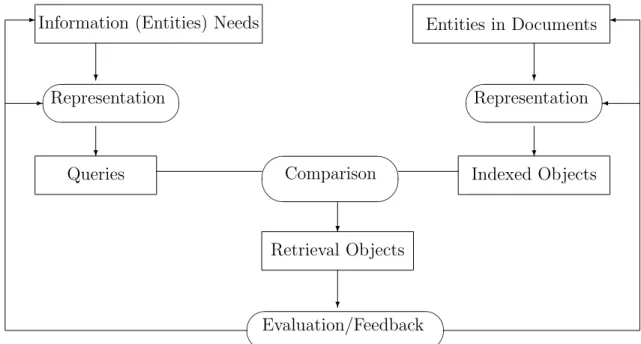
1 Entity retrieval model . . . 4
2 Information retrieval tasks . . . 8
3 The Two-Layer Retrieval and Extraction Probability Model (TREPM) . . . . 32
4 The evaluation framework for TREMP Model . . . 43
5 A sample topic of INEX entity retrieval task . . . 46
6 A sample topic of TREC entity retrieval task . . . 47
7 The learning to rank framework . . . 66
8 The algorithm extracting answer entities from tables/lists . . . 97
9 A sample of Infobox . . . 100
10 The algorithm extracting entities from knowledge bases . . . 101
11 Bootstrap framework of topic-answer entity pair extraction . . . 106
12 Bootstrap results of company-location extraction with One-Entity matching . 110 13 Bootstrap results of company-product extraction . . . 111
1.0 INTRODUCTION TO ENTITY RETRIEVAL
In answering questions such as “What are Microsoft’s products” and “Who are Microsoft’s competitors,” related information is scattered over different web places, such as companies’ homepages, encyclopedia pages, and news articles which needs to be collected. In order to obtain an answer, users need to identify the names of key entities (e.g., Microsoft), analyze how they are related to each other (e.g., products or competitors), and then piece the assorted bits of information together to formulate an answer. Manually repeating the search process for additional candidates is both tedious and prone to error. In contrast to the Gutenberg Age, when people spent hours in the library gathering information on a certain topic, we now have achieved great improvements in locating information in documents with machine-indexing techniques. However, we now expect to find answers at a finer-grained level (such as passage, entity, or snippet) from various sources (such as news and Web pages) and in several formats (such as books, web pages, emails, blogs, or simply computer files).
Traditional search engines, returning results in a sequentially ranked list of documents or aggregating the results in clusters based on documents or web pages at the smallest unit, may not directly provide answers to users’ information needs in a finer unit. Even though search engines analyze hyper-links and anchor texts, they cannot solve this problem. The deficiency is caused partly by the limitation of the basic assumption in document retrieval that keywords in documents are unordered or a “bag of words.” The co-occurrence of terms at document level make it hard to estimate the answers at the entity level. The deficiency also comes from relevance judgments. If any piece of the document is relevant regardless of how small that piece is in relation to the rest of the document, the current retrieval systems will mark it as relevant to some degree. In this case, a page is retrieved only if it matches the words in the user’s query. This kind of search engine will eschew analyses involving entities
among topics and answers since the identification of entities has not yet occurred. Entity retrieval, on the other hand, assumes the answer entities have some sort of relationship with the topic entities, and is evaluated using a different unit of entities, which will be a useful alternative for document retrieval on large and diverse Web environments.
1.1 PROBLEM STATEMENT
This study focuses on entity retrieval—the search for “objects” of “entities”— on unstruc-tured noisy documents, like HTML pages, in response to users’ information needs which are expressed in the natural languages. Here are some key characteristics for entity retrieval, which makes it different from other retrieval tasks:
Querying about entities , instead of querying on relevant documents, is one of the big differences between document retrieval and entity retrieval. Entity retrieval returns the answer of entities existing in documents as finer units.
Retrieving from un-structured noisy documents is another important factor for the retrieval task. Compared to semantic web retrieval which retrieves on the semantic web, entity retrieval in this study is based on noisy web documents.
Descriptions of users’ information needs with special entity types in entity retrieval differ from the one in document retrieval, which do not specify the entity types. In order to describe users’ information needs, topics will be described narratively, such as the “narrative” field in the TREC entity retrieval task. In most cases, the description of the “narrative” field can be viewed as a topic entity with phrases describing the relations between the topic entity and the query entities. For example, “organizations that award Nobel Prizes” describes a user’s information need, which can be viewed as the topic en-tity (i.e., Nobel Prizes), the target enen-tity type (i.e., organizations), and the relation (i.e., award) between the topic entity and the target entity.
There are many definitions of entities in the literature. An entity can be a thing that is recognized to have an “independent existence” and can be “uniquely identified”
[Beynon-Davies, 2004]. An entity can be an instance of the pre-definite types/fields in the database or knowledge base. An entity can be an atomic element with categories such as the names of persons, organizations, locations, expressions of times, and quantities in un-structured texts [Tjong Kim Sang, 2002]. In this dissertation, an entity et is defined as an named object with a term surface e and an associated type t. For example, “Washington” in the document can be an entity with the type of location or person depending on different contexts. In the sentence of “Washington chopped down a cherry tree”, “Washington” is the entity with the surface of “Washington” and the type of person, while “Washington” in “Washington State” is the entity with the surface of “Washington” and the type of location. This study only experiments on four types of entities—persons, locations, organizations, and products for the purpose of evaluations. Moreover, in this research, entity types, entity classes, and entity categories are treated as equivalent.
The description of topic entities and answer entities is viewed as the relations be-tween two entities, when users describe their information needs in the entity retrieval task [Nardi and Brachman, 2003]. Therefore, for one entity a with the type A and the other en-titybwith the typeB, the relationr with the type ofR is defined asrR⊆aA×bB. Note that two entities with the same types might have different relations. For example, the relation between “Mary” with the type of persons and “Pittsburgh” with the type of locations can be the relation of “was born in” for the type of born-in or the relation of “was studies in” for the type of study-in.
A basic entity retrieval problem is set up as follows: we assume that there exists an entity set E = {Et1, ...., Eti, ..., Etm}, where Eti = {e1ti, e2ti, ..., elti} is a group of entity instances
with the type ofti. In the retrieval environment, there is a corpusC ={D1, ..., DJ, ..., DN}, whereDJ is a document. The corpusC contains an entity setE, which includes the different types of entities, such as locations, companies, persons, et al. Entity retrieval is defined as the matching of some stated user queries about an entity against a set of entities existing in free-form texts. The information needs are represented as descriptions and target types. The matching process identifies the correct entities, not only their surfaces but also their types. The relevancy evaluation is the same as most document retrieval studies, which can be binary relevance (i.e., relevant and non-relevant) or three levels (i.e., non-relevant, relevant,
and highly relevant). The evaluated answer entities may be sent back to the system for either re-constructing the queries or re-building document representations to improve the entity extraction task. Some tasks, such as TREC or INEX, require the URIs/URLs of entities as answers. Because these tasks assume the same entity can be represented in the different names, the URIs/URLs of entities can help to refer the different names of entities to the same entity objects. In this study, however, we focus on the entity retrieval itself, so we treat answer entities, instead of the URIs/URLs of entities, as results. The model of entity retrieval follows the conventional information retrieval process [Manning et al., 2008], as shown in Figure 1.
A typical entity retrieval task in my research, for example, is to find the answers for “products of MedImmune, Inc,” where the query is asking for the entity of “products of MedImmune, Inc” (target entity/answer entity) with the type of products. The answer enti-ties are terms such as “Synagis”, “FluMist”, and “Ethyol”, where their types are products.
Evaluation/Feedback Retrieval Objects ? Queries Comparison ? Indexed Objects - Representation Representation ? ? ? ?
Information (Entities) Needs Entities in Documents
-
1.2 RESEARCH GOALS
Entity retrieval in this study is driven by several research goals. The most critical one is to find entities in an effective and efficient manner. Entity retrieval, as one type of information retrieval task, shares the same questions raised in information retrieval—performance and efficiency. On the one hand, a retrieval system needs to come up with answers within seconds. Text collections, growing faster than hardware performance, become a challenge for indexing and sorting algorithms. We have to consider the system’s efficiency in the query execution time. On the other hand, the performance of entity retrieval system, including precision and recall, is also important. Given a query, all identified entities should be ranked in a manner where highly relevant entities are ranked above less relevant or non-relevant ones. Although precision has become more important than recall in the Web environment, recall in the entity retrieval task is still important because people will not only consider how many answers are correct but also how the system can answer questions.
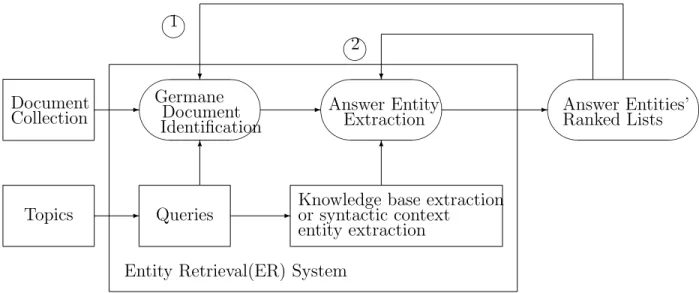
In order to find the correct entity answers effectively and efficiently, this study proposes a combined probability model integrating document retrieval and entity extraction. Document retrieval aims to quickly and efficiently find the germane documents containing the answer entities; whereas, entity extraction is in charge of correctly and effectively extracting the answer entities. Modeling entity retrieval problems as a combination of document retrieval and entity extraction helps to reduce the complexity of entity retrieval into two separated sub-tasks. The hypothesis is that the global optimal problem of entity retrieval can be simplified into two local optimization problems. The advantages of this localized optimization are that it not only lowers the computational complexity, but also adapts more state-of-the-art techniques from both document retrieval and entity extraction disciplines into entity retrieval tasks.
By decomposing the entity retrieval problem, this research evaluates whether this prob-ability model can achieve the retrieval goals effectively and efficiently; whether document retrieval can effectively find the germane documents containing the answer entities; whether entity extraction can easily and correctly identify the entities existing in one document or scattered among several documents. Document retrieval explores the methods to improve
germane document identification, such as query generations, entity type searches, and learn-ing to rank. Entity extraction explores methods, such as named entity recognition tools, knowledge base (e.g., Wikipedia) entity extractions, table/list extractions, syntax extraction, or treating named entities identification as a classification task. This research, therefore, will evaluate whether the combination of germane document identification and answer entity ex-traction can work together effectively to detect answer entities. The results of entity retrieval are entity ranked lists, and are evaluated by the system performance, such as precision and recall.
1.3 TERM DEFINITIONS
Formal definitions of entity retrieval, entities, entity sets, entity types, topic entities, target entities, topics, queries as well as germane documents in this study are listed here.
Entity retrieval is the search task that finds the entity objects in unstructured noisy documents like HTML pages with regards to users’ information needs. For example, for the query asking for the product entities of MedImmune, Inc (target entity/answer entity), the answer entities are terms such as Synagis, FluMist, and Ethyol, where their types are products.
Entity (denoted as Et) is a thing recognized as capable of an independent existence, which can be uniquely identified with a certain type of t. Usually it uses the entity type t to distinguish the different entities. For example, the location entity means the entity with the type of location.
Entity instance (denoted as eti) is every individual entity with the type t. The entity instances of organization, for example, include Department of Information Sciences, School of Information Sciences, and University of Pittsburgh.
Each entity is assigned a entity type t (or, equivalently, category or class). The entity instance of School of Information Sciences, for example, belongs to the type of organization. This work treats the relation between an entity type and its entity instance as the relation of a class and its instance.
Topic entity (or query entity), in this thesis, refers to the central entities in the topics describing users’ information needs. For example, the topic entity for products of MedImmune, Inc is MedImmune, Inc, which is the central entity in the topic. In TREC entity retrieval task, the topic entities are specially marked up in a separate field with the tag of <entity name>.
An answer entity or a target entity refers to the retrieved answers for the entity retrieval system in this study. The answer entities for the query of products of MedImmune, Inc., for example, are the target entities of Synagis, FluMist, and Ethyol.
For our research purpose, relations, in this study, refer to the relation (e.g., product of) between the topic entity (e.g., MedImmune Inc.) and the answer entities (e.g., Synagis, FluMist, and Ethyol).
A topicrepresents a user’s information needs. This study uses the natural language de-scription to depict users’ requirements (e.g., product of MedImmune Inc.), the topic entities to define the subject of information need (e.g., MedImmune Inc.), and the (answer) entity type (e.g., product) to limit the type of the retrieved answers.
A query is the texts containing the data or string to be passed to the search system. This study focuses on the Web search, so the queries could be a natural language text string. We should specifically note that with the same information needs and the same search envi-ronment, the search queries can vary according to the different criteria or assumptions. For example, the topic of products of MedImmune, Inc. in the Web search environment, the query can be “products of MedImmune Inc”, or it can be “MedImmune LLC produces”, as-suming that MedImmune LLC is a formal name of MedImmune Inc. and the verb “produces” is another way to represent the relation.
A germane document is the document which contains the answer entities for answer-ing users’ information needs. For example, http://www.medimmune.com/about us prod-ucts.aspx is the germane document for the topic of product of MedImmune Inc because it contains the answer entities of Synagis, Flumist, and Ethyol.
1.4 ENTITY RETRIEVALS OUTSIDE UNSTRUCTURED TEXTS
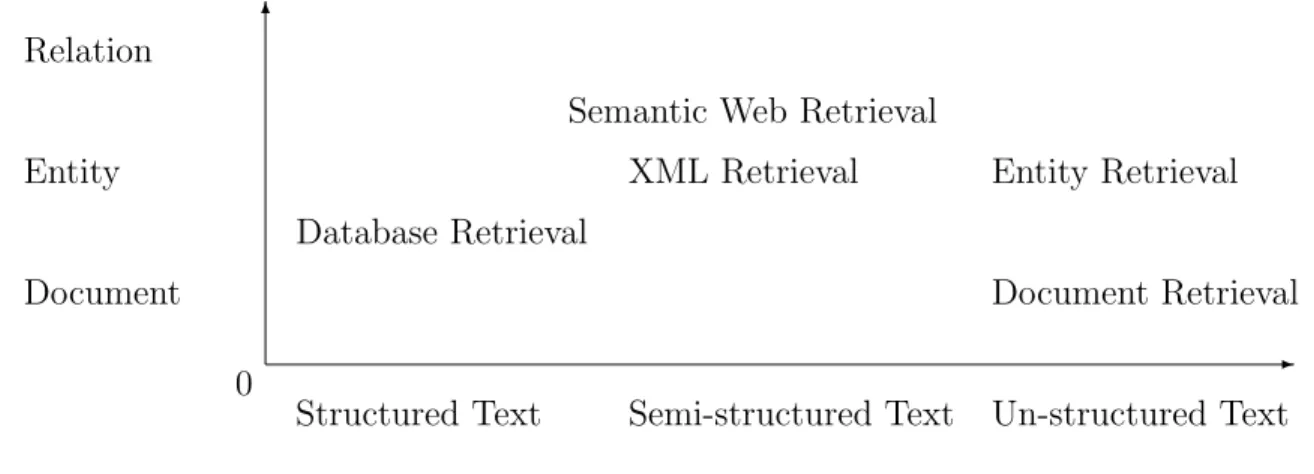
On the one hand, entity retrieval not only exists in Web search, but also it exists in database and semantic web search. On the other hand, entity search retrieves from the same plain texts as document retrieval, but they also differ in their returned units. Figure 2 shows these retrieval tasks in two dimensions. The horizontal dimension is the structure of retrieval contents. The left part consists of more structured data and the right part contains more un-structured data. The vertical dimension is the returned unit. The higher the vertical dimension, the finer unit the search produces. The closer to the origin the easier the retrieval problem is. Entity retrieval studied in this dissertation is on the upper right part, which means it is among the hardest retrieval tasks.
-6
0
Structured Text Semi-structured Text Un-structured Text
Document Entity Relation
Database Retrieval
Semantic Web Retrieval XML Retrieval
Document Retrieval Entity Retrieval
Figure 2: Information retrieval tasks
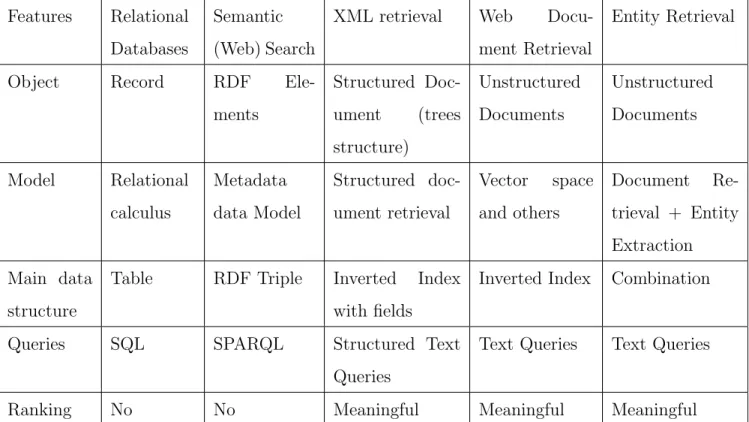
Table1summarizes the differences among the above retrieval systems in terms of retrieval models, data structures, and query languages.
Database searches are designed to find structured data: sets of records that have val-ues for predefined attributes such as product numbers and product prices. For example, some highly structured search problems are best solved with a relational database because the product table contains an attribute for short textual descriptions about each product. The search results from a database are a set of entries without any ranking, which means database search is one kind of boolean search (exist or does not). Another difference between database retrieval and entity retrieval is that database systems build on top of structured
Table 1: The comparison of different retrieval systems
Features Relational
Databases
Semantic (Web) Search
XML retrieval Web
Docu-ment Retrieval
Entity Retrieval
Object Record RDF
Ele-ments Structured Doc-ument (trees structure) Unstructured Documents Unstructured Documents Model Relational calculus Metadata data Model Structured doc-ument retrieval Vector space and others Document Re-trieval + Entity Extraction Main data structure
Table RDF Triple Inverted Index
with fields
Inverted Index Combination
Queries SQL SPARQL Structured Text
Queries
Text Queries Text Queries
Ranking No No Meaningful Meaningful Meaningful
information—records—and store all records in the tables. They can use relational calculus not only for retrievals but also inferences and deductions. In contrast to relational databases, however, entity retrieval systems obtain information from unstructured text, which makes retrieval answers more difficult to locate and harder to do inferences in the results.
Semantic search improves search accuracy by adding the understanding of searcher in-tents, as well as the contextual meanings of terms in the searchable data spaces, on the Web or within a closed system, in order to generate more relevant results [Guha et al., 2003]. Both semantic web retrieval and entity retrieval involve entities associated with their types as well as relations between these entities. Semantic web retrieval, however, includes not only entity search but also other retrievals, such as relation search. In some run-time systems, semantic search relies on the semantic web, which is built on top of RDF documents rep-resenting a well-defined ontology or schema with concepts and relations [Guha et al., 2003]. For example, SHOE [Luke and Rager, 1996], Freebase [Bollacker et al., 2008] and DBpedia
[Auer et al., 2007] are some of these semantic systems. Although some systems are based on unstructured document retrieval, they still match the entities to knowledge bases for en-tity extractions. For example, Balog matches the candidate entities to Freebase for enen-tity retrieval [Balog et al., 2010b]. Entity retrieval in this research differs from these systems in that it is based on searching plain texts, which are the documents without any pre-defined semantic information.
XML Retrieval is the content-based retrieval of documents structured with XML (eX-tensible Markup Language). So-called markup languages such as SGML or XML are widely used to annotate text structures in a machine-readable form. XML retrievals are used to search for information in structured documents. The development of structured retrieval has been driven by the INEX evaluation initiative. Because these special structures are assigned to the document, a full-fledged XML retrieval system provides more flexibility and complete-ness with respect to the formulation and execution of structural queries. Therefore, these searches also benefit from structural indexing and retrieval procedures. Earlier studies on structured retrievals by Navarro [Navarro and Baeza-Yates, 1995] have already considered most of the functionalities that can be expected from current systems working with XML data. Freely composing queries with contents and structure conditions are allowed in XML retrieval. Special query languages are designed to express structural requests on XML like XQuery Full-Text [Amer-Yahia et al., 2007] or NEXI [Trotman, 2004]. Moreover, XML re-trieval does not require the users to specify fields of interests at indexing time, but allows them to query the content of any tagged fragment of the collection. These features ask for different index designs. Entity retrieval in this research assumes that all the documents are plain texts, which makes it difficult to index fragments found within collections.
Document retrieval, as always, is important in the history of retrieval. It regards each document as an atomic unit of interests, and does not distinguish whether some parts of a document are relevant to information needs while other parts are not. The user of a document retrieval system will find a sentence snippet if it is considered relevant to his/her query. Also the relevance estimation is based on the content of the entire document. If one sentence in the document is highly relevant but the other parts are not, the final relevance estimation of the entire document is considered lower than those of shorter documents with the same
keywords in the document but is exclusively about the topic of interests. From an indexing perspective, document retrieval allows the construction of efficient inverted document index structures.
1.5 LIMITATIONS AND DELIMITATIONS
While many researchers are working actively in entity retrieval, a developed entity retrieval system is still a long way from completion, especially within the World Wide Web. This study proposes a probability model to decompose the entity retrieval task into two subtasks— germane document identification and answer entity extraction. By doing this, the global optimal problem is turned into two local optimization problems. However, there are some limitations.
First of all, the decomposition cannot guarantee that the whole system always achieves the best results. Although the goal of the two-layer probability model is to effectively and efficiently find the answers according to users’ information needs, it is a heuristic rule and does not guarantee the best results. In the most extreme cases, for example, when answers are evenly distributed over documents and within a variety of contexts, the performance of the combination probability model will drop, like “Who have their own websites?” There are a huge number of documents that contain the answer entities and there are also a large number of possible patterns for the answer entities, which makes it harder for the model to achieve the best answers with this localized optimum. However, the advantages of this model, as mentioned, are that it can effectively and efficiently find the possible answers.
The second limitation to this combined model is that germane document identification, with the assumption of bag-of-words searching, can fail at detecting the best documents for further entity extraction. This assumption limits document retrieval models to only consider the co-occurrences of the words but without considering the semantic meanings between the words. With the non-proper queries generated for topics and the ranking strategies, it will cause the retrieval inaccuracy. For example, for the query of “organizations that award Nobel prizes”, after stemming and removing stop words, the retrieval task is turned into
finding documents with co-occurrences of the tokens “organization”, “award”, “nobel”, and “prize”, which are equal to the query of “organizations awarded Nobel prizes.” Although some methods such as query reconstructions might fix these problems partially, it cannot be solved completely. For example, if the query “Nobel prizes” instead of “organizations that award Nobel prizes” is used for the retrievals, more semantic analyses work will be applied in the answer entity extraction to further extract the answers. Even so, the query re-writing or entity extraction can only partially compensate for some of the drawbacks from the model assumptions of document retrieval.
The open Web environment is heterogeneous and distributed and entities in this envi-ronment are also various and multi-typed. These require significant new progresses in the development of entity retrieval in order to identify the correct entities on the scale of the Web. Some open issues remain.
First of all, entities are quite subjective and flexible concepts and used to describe the existences of things in the world by different people who usually have different viewpoints with various aims. For example, for the same term “apple”, people with different viewpoints can mark it as a “fruit” or a “company”. Moreover, with the same viewpoints and the same aims, different users might use different notation systems to represent them. For example, the type of “company” can be represented as a flat structure or as a hierarchical structure such as “/Business/Company”. Therefore, consistently representing these concepts will be a big challenge to entity extraction systems. This study will not further discuss the possible different representations of the entities.
Secondly, entity identification is a laborious and tedious process. Although many meth-ods can be applied to different domains to extract different entity types, the study will continue to focus on four types of entities—persons, locations, organizations and products.
Finally, although entity retrieval can be the retrievals in various media or data formats, this work focuses only on searches in unstructured texts, especially the noisy HTML web pages, instead of searching in structured data (e.g., databases) or semi-structured data (e.g., semantic web).
1.6 CONTRIBUTIONS
This thesis has studied the problem of entity retrieval represented in a combined probability model. It makes the following four contributions.
First, the probability model proposed in this study decomposes the “black box” of entity retrieval into germane document identification and answer entity extraction. This decompo-sition, at the same time, separates the word-independence factors from word-dependence fac-tors. In this dissertation, word independence means, in the language model, we assume that in a document all the words are independent to each other, i.e., p(d) = p(w1)p(w2)...p(wn). In fact, this is a unigram model. The word-dependence means we assume that in a docu-ment the words are related each other. Therefore, we need to analyze the semantic meaning between the words, instead of simply treating them as a unigram model. Information needs for entity retrieval task usually require semantic analyses of topics. Therefore, germane document identification efficiently narrows down document pool into a smaller set based on word-independence factors. Answer entity extraction deeply analyze the sentence structures or document formats of the small set of germane documents in order to extract the answer entities based on word-dependence factors. Because the deep sentence analysis or document format analysis is time-consuming work, narrowing down the pool of documents to be parsed can significantly decrease the time needed for entity retrieval, while increasing the accuracy of entity detections.
Second, this study demonstrates the decomposition process in a theoretical way. Al-though many groups actively in the entity retrieval competition follow the same ideas of the decomposition the entity retrieval task into the retrieval step and the extraction step, it is the first time to demonstrate it from a theoretical way using a probability model. Chapter
3 proposes a probability model and proves that the entity retrieval problem can be decom-posed into germane document identification and answer entity extraction. Moreover, this dissertation proves the calculation time of this model can be significantly decreased using the big-o notation.
Third, with the decomposition, the system performance can be evaluated in two parts, which in turn improves the overall system. Compared to the previous method, especially the
entity retrieval competition task such as TREC or INEX, of treating entity retrieval as one “black box” and evaluating the “black box” as a whole, the decomposition can clearly identify two steps and evaluate them individually in order to detect the sources of the improvements. Additionally, this decomposition can help to find the limitations of sub-steps in the system, which can further improve the entity retrieval.
Lastly, many state-of-the-art methods can be introduced to the system as well as each individual layer, e.g., topic detection. Especially, this thesis introduces the learning to rank method for improving germane document identification, which is the first time using learning-based methods in germane document identification. The answer entity extraction task is treated as the query-dependent extraction method, which is more precise than the previous method of treating this task as query-independent extraction. Based on the query-dependent extraction, the context is introduced for the answer entity extraction. The methods of ta-ble/list extraction and sentence syntax extraction are used to improve the entity extractions in the documents.
1.7 OUTLINE
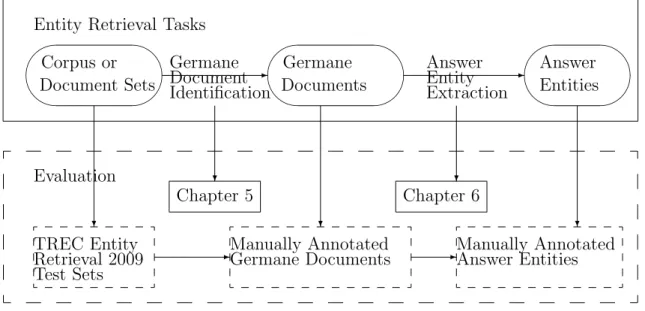
The remaining chapters are organized as follows. Chapter 2 reviews the development of entity retrieval and its related disciplines, such as document retrieval and entity extraction. In Chapter 3, a two-layer probability model combining information retrieval and entity ex-traction (TREPM) is proposed as a generalized representation for an entity retrieval system. This chapter describes entity retrieval from a theoretical view and explains how two layers— germane document identification and answer entity extraction—work together and how they symbiotically contribute each other for the benefit of the whole task. Chapter4summarizes the research hypotheses and resources used in the experiments including evaluation frame-work, collections for evaluation, evaluation metrics, and tools for corpus preprocessing and document retrieval as well as entity extraction. Germane document identification, the first layer of TREPM, is investigated in Chapter 5. It explores the methods of treating germane document identification as a conventional document retrieval problem, the entity type
lan-guage model, and the learning to rank method. Chapter 6 focuses on the second layer of TREPM. The methods of answer entity extraction, such as named entity recognition tools, knowledge bases, table/list extractions, the bootstrapping method, as well as the learning based answer entity extraction, are investigated. Chapter7summarizes the whole thesis and discusses my future work.
2.0 RELATED WORK
This chapter reviews the state-of-the-art work on entity retrieval (ER) and some related disciplines. Entity retrieval in this study, to some degree, is regarded as a process combining germane document identification and answer entity extraction. Rather than exhaustively surveying prior work, this chapter reviews the evolution of germane document identification and answer entity extraction in order to analyze alternative or combination approaches that identify entities in the linguistic and semantic levels. At the end of this chapter, we review the entity retrieval task in two famous competitions: TREC and INEX.
2.1 DOCUMENT RETRIEVAL
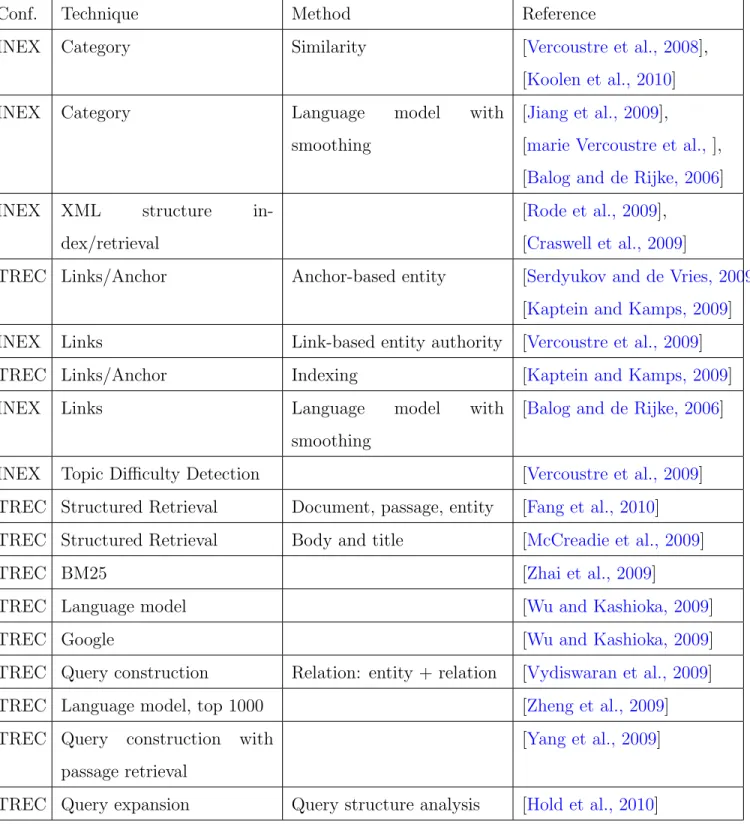
Document retrieval, sometimes referred to as (or as a branch of) text retrieval, allows users to locate the relevant documents with regards to their information needs. It treats docu-ments as the atomic units of users’ interests regardless whether the whole document or just part of the document is relevant to their information needs. The methods for germane doc-ument identification are adapted from docdoc-ument retrieval approaches, such as vector space model, language model, link analysis, and query constructions. The germane document identification methods used in TREC and INEX are summarized in Table 2.
2.1.1 Vector Space Model
The vector space model is an algebraic model that represents text documents as term vec-tors. For example, a document, d, in the corpus is represented as a term vector (i.e.
Table 2: Methods of germane document identification in TREC and INEX
Conf. Technique Method Reference
INEX Category Similarity [Vercoustre et al., 2008],
[Koolen et al., 2010]
INEX Category Language model with
smoothing
[Jiang et al., 2009],
[marie Vercoustre et al.,], [Balog and de Rijke, 2006]
INEX XML structure
in-dex/retrieval
[Rode et al., 2009], [Craswell et al., 2009]
TREC Links/Anchor Anchor-based entity [Serdyukov and de Vries, 2009],
[Kaptein and Kamps, 2009]
INEX Links Link-based entity authority [Vercoustre et al., 2009]
TREC Links/Anchor Indexing [Kaptein and Kamps, 2009]
INEX Links Language model with
smoothing
[Balog and de Rijke, 2006]
INEX Topic Difficulty Detection [Vercoustre et al., 2009]
TREC Structured Retrieval Document, passage, entity [Fang et al., 2010]
TREC Structured Retrieval Body and title [McCreadie et al., 2009]
TREC BM25 [Zhai et al., 2009]
TREC Language model [Wu and Kashioka, 2009]
TREC Google [Wu and Kashioka, 2009]
TREC Query construction Relation: entity + relation [Vydiswaran et al., 2009]
TREC Language model, top 1000 [Zheng et al., 2009]
TREC Query construction with
passage retrieval
[Yang et al., 2009]
d = (w1, w2, ..., wm)), and a query, q, is also represented as a term vector (i.e. q = (w1q, w2q, ...wtq)). The relevance between the document d and the query q, therefore, is measured by the cosine similarity between these two vectors (i.e.,sim(d, q) = cosθ= |dd|×|×qq|). In the classic vector space model proposed by [Salton et al., 1975], the specific weights of terms in the document vector, wt,d, are the products of term frequency (TF) and inverse document frequency (IDF). That is, wt,d=tft,d×log |{d∈DN|dt∈d}|, where tft,d is the frequency
of a term t in a document d, and log Nd
|{d∈D|t∈d}| is the inverse document frequency with
Nd for the total number of documents in the whole document set and |{d ∈ D|t ∈ d}| for the number of documents containing the term t. Therefore, the final similarity func-tion is sim(d, q) = cosθ = |dd|×|×qq| =
P
iwi,d×wi,q
√ P
iwi,d2×Piwi,q2
. More advanced weighting algorithms were created to improve the document-query similarity calculations, such as Okapi BM25. The BM25 method scores the similarity between a document and a query as sim(d, q) =
P ilog N−|{d∈D|t∈d}|+0.5 |{d∈D|t∈d}|+0.5 × tft,d×(k1+1) tft,d+k1(1−b+bavgNd(d))
proposed by [Robertson et al., 1996], where N, the total number of documents in corpus, and b are constant parameters, and avg(d) is the average document length in the corpus. Zhai used the BM25 method to identify the germane documents in his work [Zhai et al., 2009].
The advantages of this method are its simplicity and effectiveness, which is capable of computing a continuous degree of the similarity between queries and documents as well as ranking documents according to their relevance scores. But this method has the following limitations. First, long documents will require high-dimensional vector manipulations, which makes similarity measurements expensive to complete. Second, documents with similar contents but different vocabularies may come out with poor inner-product results. These are the limitations of keyword-driven IR systems in general since such systems cannot easily process semantic contents. The research in this study demonstrate that the deficiency of semantic analysis in the document search can be over come by answer entity extraction.
2.1.2 Language Model
Language model approaches to information retrieval are attractive and promising. The language model usually assumes that all terms t1, t2, ..., tn are independent in a documentd.
That is,p(d) =p(t1t2...tn) = p(t1)p(t2)...p(tn). This is a unigram language model. There are many other language models, such as the bigram language model or the trigram language model.
A basic language modeling approach for information retrieval, proposed by Ponte and Croft [Ponte and Croft, 1998], assumes the query is a sample of words drawn from a docu-ment according to a language model, i.e. the likelihood of p(q|d). The maximum likelihood estimation is one of the solutions, i.e., p(q|d) =Q
tpmle(t|d) =
Q
t tft,d
Nd , where t is a term in
the query q, and tft,d is the occurrence of a term t in a document d, and Nd is the total number of terms in the document d. Thus, it is easy to estimate the terms appearing in the documents using the maximum likelihood. In order to estimate the probability of terms that do not appear in the document, called a smoothing problem, many approaches are discussed [Zhai and Lafferty, 2004]. One approach is Jelinek-Mercer smoothing, which is a linear inter-polation method combining the maximum likelihood model and the collection model with a coefficientλ to control the influence of each term, i.e.,p(w|d) = (1−λ)pmle(w|d) +λp(w|C). Another method is Bayesian smoothing, which uses Dirichlet priors as a prior for each word for smoothing, i.e., pµ(w|d) =
tft,d+µp(w|C)
Nd [MacKay and Peto, 1994].
Many approaches in entity retrieval use the language modeling for germane document identification. For example, the language modeling approach on structured documents (such as XML files) is applied to improve the search results. Two well-known examples of re-trieving the structured texts or text elements are XML retrieval [G¨overt and Kazai, 2002] and question answering [Prager et al., 2000]. Both retrieval tasks are based on the hierar-chical structures of documents, but the only difference is that XML structures are intro-duced by authors while structures of question answering are introintro-duced by annotators. Zhao [Zhao and Callan, 2008] summarized the structured retrieval as a generative retrieval model by expanding the basic keyword language model into a structure with hidden variables. Zhao and Callan introduced the fields (which are the snippets in a document) into their model, and emphasized that the major difference between document retrieval and field retrieval was that the surrounding context of a query term shrinks from a document to a field. Later, in the work of McCreadie, they applied the structured retrieval on HTML title and body parts [McCreadie et al., 2009]. The greater weight of the HTML title part than the HTML
body part indicated that they preferred title matches to body matches in germane docu-ment identification. Fang proposed a hierarchical relevance language model on three levels: document, passage, and entity [Fang et al., 2010]. The final document ranking score was a linear combination of the relevance scores from these three levels.
Language model approaches are applied not only in the structured document retrieval but also in category/type information for parameter smoothing or model enrichment, especially in INEX. This study does not distinguish categories and types either in entity types or in document categories but treats them equally as the classes for documents or entities. Jiang applied category information from queries into the query model and considers the similarity between queried category and the candidate entity category [Jiang et al., 2009]. They considered the probability of an entityeto be the target typeq cat, that is,p(q cat|e) = p(cat q|cat e) = Q
cat j∈CAT qp(cat j|CAT q). The probability of the category similarity can also be viewed as Jelinek-Mercer smoothing for complementing the corpus smoothing. Similar approaches also appeared in [Vercoustre et al., 2009] and [Balog et al., 2010a]. This study will expand the language model and apply it on the document types and entity types to improve germane document identification.
2.1.3 Link Analyses
Link analyses apply in information retrieval for finding relevant documents by considering the authority pages and hub pages (such as the HITS algorithm) or measuring the relative importance of a page within a set (such as the PageRank algorithm). The HITS algorithm, developed by Jon Kleinberg, is an iterative algorithm based on two basic steps—the au-thority update and the hub update [Kleinberg, 1999]. The authority update gives a node its authority score by summing up the hub scores of each node pointing to it; and the hub update gives a node its hub score by summing up the authority scores of each node that it points to. The PageRank algorithm is also an iterative algorithm by adjusting approximate PageRank values to more closely reflect a page’s theoretical true value [Brin and Page, 1998]. Both the HITS algorithm and the PageRank algorithm use a coarse-grained model of the Web, which assumes each page is a node in a graph with a few scores associated with it.
The disadvantage of HITS is that it is sensitive to local topology. Moreover, both algorithms need to handle huge matrix manipulations. Vercoustre et al adapted the similar idea of the document’s PageRank into a LinkRank module, which calculated a weight for a page based on the number of links to the entities on this page [Vercoustre et al., 2009]. The assumption is that a good entity page is the one that is referred to form contexts with many occurrences of the entity examples.
Although link analyses are successful in the document retrieval, they are more useful in mining the entities from the linked pages. Therefore, the link information in this thesis would be applied to extract the answer entities from the germane documents.
2.1.4 Topic Detection and Query Construction
With users’ information needs, different methods are explored to express the topics as proper queries, such as topic difficulty predictions and query constructions.
The topic difficulty prediction in the research field of the XML entity ranking was studied in [Vercoustre et al., 2009]. Their work generated a topic classifier based on how well the runs submitted by participating systems could answer the topics. Each topic calculated the topic difficulty using the Average Average Precision (AAP) measure: the higher the AAP, the easier the topic. According to the AAP scores, the topics were grouped into two classes (Easy and Difficult). The features for classification were extracted from the topics and run-time results. They detected 32 features. Because some features were correlated, they removed the correlated features and kept nine features for the real-time classification task. These features included the number of sentences in the narrative, the ratio between the number of words in the title and the narrative, the ratio between the intersection and union of words in the title and the narrative, the ratio between the intersection and union of words in the description and the narrative, the ratio between the intersection of words in the title and description part and union of words in the title, description and the narrative part, the ratio between the intersection of words in the description and narrative part and union of words in the title, description and the narrative part, the number of pages in each target categories, the number of intersections of entity categories, and the ratio of the intersection
of entity categories and the union of the entity categories. Their system applies different parameters on the retrieval model according to the topic difficulties. Their results were among the top four best performing in INEX 2008.
Query construction is also applied in germane document identification. Vydiswaran mod-eled the information need of entity retrieval as a structured query [Vydiswaran et al., 2009]. They identified three parts of the queries: the relation (represented as descriptions of the topic entity and the answer entity), the entity of focus (the topic entity), and the entity of interest (the answer entity). For example, the query of all team-mates of Michael Schu-macher could be addressed by two related relation queries: “[Michael SchuSchu-macher][drives for] [ORG-1]” and “[PER] [drives for] [ORG-1]”. Finding related entities through ORG-1 (the team), which is as yet unknown, would hopefully get filled in it by the term of “Fer-rari” during execution. Once the relation predicates were identified, they augmented them with their synonyms from WordNet as well as similar words from a large text corpus on distributional similarity. The final query formulation with the primary entity, the relation word with its synonyms, optional noun phrases from the narrative, and the type of the de-sired entity, enforces retrieval system to match the primary entity and one of the relation words in all retrieved documents. Hold also preprocessed the queries using part-of-speech techniques to identify the source entity, target entity, and the relations between them. Then he used synonym dictionaries (exploiting Freebase sources) to find the alternative names for the source entities, and expand the queries [Hold et al., 2010]. The annotations for ger-mane documents in the entity retrieval task also confirmed that different topics had different preferences in germane document identification. This study, therefore, investigates a better way to represent the users’ information needs with proper queries for germane document identification.
2.2 ENTITY EXTRACTION
Answer entity extraction in entity retrieval systems identifies answer entities from germane documents. It is usually simplified as entity extraction, which extracts targeted entities
without considering whether these entities answer the query. Entity extraction involves two subtasks: the identification of proper names in texts and the classification of these names into a set of predefined categories of interests. The entity extraction task was from the Sixth Message Understanding Conference (MUC-6) [Grishman and Sundheim, 1996]. The typi-cal entity extraction task, for example, takes an un-annotated block of text, such as “Jim bought 300 shares of Acme Corp. in 2006,” to produce an annotated block of text, such as <ENAMEX TYPE=“PERSON”>Jim</ENAMEX>bought<NUMEX TYPE=“QUANTITY”>
300</NUMEX>shares of<ENAMEX TYPE=“ORGANIZATION”>Acme Corp.</ENAMEX>
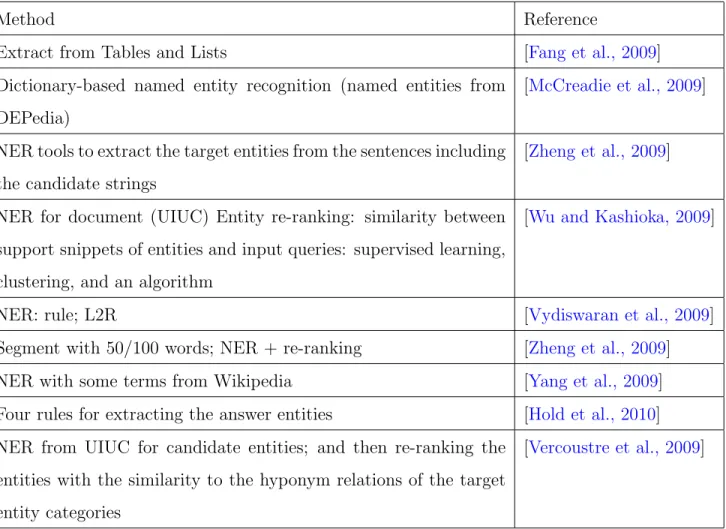
in<TIMEX TYPE=“DATE”>2006</TIMEX>. With 15 years of research (from 1996), many approaches for entity extractions are investigated, which can be categorized into four classes: rule-based methods, supervised learning methods, semi-supervised learning meth-ods, and unsupervised learning methods. Although the studies of named entity extraction have been going on for more than 15 years, the techniques used in the TREC entity retrieval are mainly limited in rules-based methods, which are summarized as in Table3. This section reviews the methods used not only in the TREC answer entity extraction but also in the general domain of entity extraction.
2.2.1 Named Entity Recognition Tools
The tools of named entity recognition (NER) or entity identification or entity extraction lo-cate and classify atomic elements in texts into predefined lo-categories, such as the names of per-sons, locations and times. There are many commercial and free NER tools, such as Stanford NER [Finkel et al., 2005], UIUC NER [Ratinov and Roth, 2009], OpenNLP (community), GATE [Cunningham et al., 2002], LingPipe [Alias-i, 2008], OpenCalise [OpenCalaise, 2010], and Inxight [SAP, 2010]. The first three are the free tools, and the last two are the commer-cial products.
Zhai applied the Stanford NER tool on documents as well as topic descriptions to ex-tract the candidate entities [Zhai et al., 2009]. The final answer entities were decided by filtering out the entities which did not belong to the targeted types and ranking them with a probabilistic model.
Table 3: Methods of answer entity extraction in TREC
Method Reference
Extract from Tables and Lists [Fang et al., 2009]
Dictionary-based named entity recognition (named entities from DEPedia)
[McCreadie et al., 2009]
NER tools to extract the target entities from the sentences including the candidate strings
[Zheng et al., 2009]
NER for document (UIUC) Entity re-ranking: similarity between support snippets of entities and input queries: supervised learning, clustering, and an algorithm
[Wu and Kashioka, 2009]
NER: rule; L2R [Vydiswaran et al., 2009]
Segment with 50/100 words; NER + re-ranking [Zheng et al., 2009]
NER with some terms from Wikipedia [Yang et al., 2009]
Four rules for extracting the answer entities [Hold et al., 2010]
NER from UIUC for candidate entities; and then re-ranking the entities with the similarity to the hyponym relations of the target entity categories
[Vercoustre et al., 2009]
Although Wu also used the NER tool from the Cognitive Computation Group at UIUC [Ratinov and Roth, 2009] to tag persons, organizations, and miscellaneous (as candidates for products), they applied a more complicated algorithm for entity filtering and ranking [Wu and Kashioka, 2009]. First, they gave every entity a score by considering the link be-tween the entity and the query. If there is a hyperlink-to and a hyperlink-from bebe-tween the entity and the query, the score for the entity is 2; if there is a to or a hyperlink-from between the entity and the query, the score for the entity is 1; if there is a hyperlink-to or a hyperlink-from between the entity and the terms in the query, the score for the entity is 0.5; otherwise, the entity score is 0. Then they chose the top 100 entities (with the descend-ing order of the scores) with their original topics to find the support snippets in the search
engine. The final ranking of the entities was based on the similarities between the input query and support snippets of related entities. Vechtomova applied the NER tools for can-didate entity recognitions, then used the similarity of the grammatical dependency between candidate entities and seed entities for re-ranking the candidate entities [Vechtomova, 2010]. Utilizing NER tools to extract target entities as answer entities is simple and straight-forward. But it is limited by the entity recognition tool. If the entity type can not be identified by the tool, the system will fail at extraction them. The quality of the entity answers is limited by the tool. What is more important is that the extracted entities can not be guaranteed to answer the questions.
2.2.2 Rule-based Methods
One of the first research papers in the entity extraction field described a system relying on heuristics and handcrafted rules to extract and recognize company names [Rau, 1991]. Collins and Singer added language factors into entity extraction, that is, parsing a complete corpus in search of candidate named entity patterns for the entities of companies, persons, and locations [Collins and Singer, 1999]. The following sample rules are used: rule 1: if the spelling is “New York”, then it is a Location; rule 2: if the spelling contains “Mr.”, then it is a Person; rule 3: if the spelling is all capitalized, then it is an organization.
Fang extracted the entities not only from NERs, but also from the structured data embedded in natural language texts, such as tables, lists or other forms [Fang et al., 2009]. They extracted the attributes from the tables or lists using the rules: if the majority of the elements with the same attribute were the same type or identified as target entities, they treated all these elements as the target entities.
Instead of relying on rules to extract tables and lists, Hold set up four types of rules to identify the source, the target, the context, and the candidate respectively [Hold et al., 2010]. In that way, they identified the sentences with the same structures as queries in order to extract the candidate entities.
The dictionary-based entity extraction approach is a special case of rule-based methods. McCreadie specially used DBpedia as dictionaries [McCreadie et al., 2009] for extractions.
They built a large dictionary of entity names from DBpedia, a structured representation of Wikipedia. This dictionary also comprised all known aliases for each unique entity in DB-pedia. For example, “Barack Obama” was represented by the dictionary entries of “Barack Obama” and “44th President of the United States”. They also assigned the entity types with the categories of DBpedia using some heuristics rules. For example, the occurrence of the clue word “company” was likely to be identified as organizations. Entries about people from DBpedia and common proper names derived from US Census data (Census) were used to produce the entities of persons.
Vydiswaran used both knowledge bases, such as gazetteers (derived from Wikipedia), and rules, such as regular expression patterns, to extract the location and product names respectively [Vydiswaran et al., 2009]. For example, in order to extract the product name, the rule of “finding capitalized phrases containing some numbers with length greater than two” was applied on the text of “the Nokia 6600 was one of the oldest models” for tagging “the Nokia 6600” as a potential product name. When multiple regular expression patterns defined to capture the entities of products were trigged in the extractions, the pattern generating the longer phrase was chosen to extract the entities.
The rule-based method is sometimes better than the NER detection approach because each entity type has its own vocabulary for the extraction task. But it still suffers from the following problems. It is limited by the knowledge from the knowledge base. If the knowledge base fails to store some entities, the whole system will not identify these entities in further extractions. Moreover, in order to extract a complete answer entity set, all the possible rules or patterns are required for extractions, but, in fact, it is hard to achieve this level of completeness.
2.2.3 Supervised Learning
Supervised learning is a machine learning technique predicating the output of testing data based on a function deducing from the training data. A small fixed text set is chosen and manually marked up in order to train the function. The trained function produces similar annotations on unseen texts. Therefore, it turns an extraction problem into a learning
problem and extracts the phrases with each argument and the types of entities.
Supervised named entity extraction is a decision on whether a given term in the document is a target entity. Either binary or multi-class classifications can be used. In a binary classification system, the positive samples are labeled as one class and the negative samples are labeled as the other classes. Final classification is performed by passing each instance to be labeled for all of the classifiers and then choosing the label from the classifier with the most confidence. There are many supervised learning based named entity extraction methods, for example, Hidden Markov Models (HMM)[Bikel et al., 1997], Decision Trees [Sekine, 1998], Maximum Entropy Models (ME) [Borthwick et al., 1998], Support Vector Machines (SVM) [Asahara and Matsumoto, 2003], and Conditional Random Fields (CRF) [McCallum and Li, 2003] and [Krishnan and Manning, 2006].
The advantage of supervised learning is its accuracy, but it requires an annotated training data set to learn the function for the entity extraction tasks, which is hard to obtain. For example, the task of extracting the named entity of products is difficult, not only because the innumerable data available on the Web that needs to be annotated, but also because the entity class itself is heterogeneous and, sometimes, mixes multiple classes (such as products).
2.2.4 Semi-supervised Learning
Semi-supervised learning, also called as lightly supervised approaches, or partially supervised learning, includes learning from Labeled and Unlabeled examples (LU learning) and learn-ing from Positive and Unlabeled example learnlearn-ing (PU learnlearn-ing) [Liu, 2006]. Co-training is one of the PU learning methods. Avrim Blum and Tom Mitchell in 1998 introduced for co-training method as assuming each example was described with two different but com-plementary feature sets. [Blum and Mitchell, 1998]. Ideally, two feature sets, as two views, are conditionally independent; that is, two feature sets for each instance are conditionally independent given the class. Although each of the feature sets is sufficient for learning the target classification function, the co-training method tries to improve the classification by combining them together. The original training paper described experiments using co-training to classify whether web pages were “academic course home pages”. The classifier
could be built either on the text appearing on the page itself or on the anchor text attached to hyperlinks pointing to the page from other pages on the Web. Their experiment showed that the classifier categorized 95% of 788 web pages with only 12 labeled web pages as ex-amples. The key part for this method is that it requires two different but complementary feature sets for the extraction.
Another important semi-supervised learning method is called bootstrapping. It either starts from a set of seeds and then generates the patterns for entity extraction, or starts from some patterns and then generates seeds to extract the entities. The idea of bootstrapping is that, with a small degree of supervision, the system starts the learning process, searches for sentences containing entities, and identifies contextual clues common to the samples. Then, the system finds other instances of the entities according to the contextual clues. With the learning process repeating these steps, more entities and more contexts will eventually be gathered. Brin did the pioneer work in 1998 to start with just a handful of seed tuples for the relation of interests, and automatically discovered extraction patterns for the relation extraction task [Brin, 1999]. These patterns, in turn, helped to discover new tuples for the relation, which could be used as new tuple for the next iteration of process. He also discussed the duality between patterns and seeds. Pasca investigated the same techniques inspired by mutual bootstrapping for the entity extraction task, but he innovated more general pattern generation by considering words as members of the same semantic class [Pasca et al., 2006]. Semi-supervised learning has been successfully applied in many extraction tasks. The advantage of this method is that it requires fewer training sets than supervised learning. This research investigates this semi-supervised learning method in answer entity extraction and evaluates whether it can improve entity retrieval task.
2.2.5 Unsupervised Learning
Rule-based entity extraction can be viewed as one type of unsupervised learning. For ex-ample, Hearst used rules (e.g., “city such as Paris”) to extract the entities (e.g., the city of Paris) [Hearst, 1992]. Clustering is another kind of important unsupervised learning meth-ods. For example, one can try to gather named entities from clustered groups based on the
similarity of contexts.
The KNOWITALL system used an unsupervised method to extract named entities from the Web [Etzioni et al., 2005]. Inspired by Hearst’s work, the KNOWITALL system utilized eight domain-independent extraction patterns to generate candidate entities. A generic pat-tern “NP1 such as NPList2”, for example, indicates that the head of each simple noun phrase (NP) in the list NPList2 is a member of the class named in NP1. By instantiating the pattern for the class city, KNOWITALL extracted three candidate cities—Paris, Lon-don, and Berlin—from the sentence, “We provide tours to cities such as Paris, LonLon-don, and Berlin.” Next, KNOWITALL automatically tested the plausibility of the candidate entities it extracted using point-wise mutual information (PMI) statistics computed by treating the Web as a massive corpus of texts. PMI-IR, developed by Turney, measures the dependence between two expressions using web queries [Turney, 2001]. A high PMI-IR means that ex-pressions tend to co-occur. KNOWITALL leverages existing Web search engines to compute these statistics efficiently. In the initial run, they found that KNOWITALL was capable of autonomously extracting high quality information from the Web, so that they used three methods to improve systems’ recall. The first was pattern learning, which learned domain-specific patterns that served both as extraction rules and as validation patterns to assess the accuracy of instances extracted by the rules. The second was subclass extraction, which automatically identified subclasses in order to facilitate extraction. For example, in order to identify more scientists, it might be helpful to determine subclasses of scientists (e.g., physicists, geologists, etc.) and look for instances of these subclasses. The third method was list extraction, which located lists of class instances, learned a “wrapper” for each list, and used the wrapper to extract list elements. Each method dispensed with hand-labeled train-ing examples by bootstrapptrain-ing from the information extracted by KNOWITALL’s domain-independent patterns. The experiment indicated these three methods greatly improved the recall of the baseline KNOWITALL system, while keeping the high precision, which in turn improved the overall extraction rate.
The unsupervised learning approach has succeeded in the generic entity extraction pro-cess, but still needs to be further evaluated for the answer entity extraction task, since answer entity extraction is not only to find the specific entities with target types but also to find