Supplementary Appendix
This appendix has been provided by the authors to give readers additional information about their work.
Supplement to: Skjerven HO, Hunderi JOG, Brügmann-Pieper SK, et al. Racemic adrenaline and inhalation strat-egies in acute bronchiolitis. N Engl J Med 2013;368:2286-93. DOI: 10.1056/NEJMoa1301839
Supplementary
Appendix
Racemic Adrenaline and Inhalation Strategies in Acute Bronchiolitis
(Bronchiolitis All-study SE Norway, ClincialTrials.gov number, NCT00817466. EudraCT number, 2009-012667-34)
A study performed within the ORAACLE, Oslo, Norway
Håvard Ove Skjerven1,2; Jon Olav Gjengstø Hunderi3,2, Sabine Kristin Brügmann-Pieper 4, Anne
Charlotte Brun 5, Hanne Engen 6, Leif Eskedal 7, Marius Haavaldsen3, Bente Kvenshagen3, Jon
Lunde 3, Leif Bjarte Rolfsjord 8, Christian Siva 5, Truls Vikin 9, Petter Mowinckel 2, Kai-Håkon
Carlsen 1,2, Karin C. Lødrup Carlsen 2,1
1. Institute of Clinical Medicine, University of Oslo, Oslo, Norway 2. Dept of Paediatrics, Oslo University Hospital, Oslo, Norway
3. Dept of Paediatrics, Østfold Hospital Trust, Fredrikstad, Østfold, Norway 4. Dept of Paediatrics, Vestre Viken Hospital Trust, Drammen, Buskerud, Norway 5. Dept of Paediatrics, Vestfold Hospital Trust, Tønsberg, Vestfold, Norway 6. Dept of Paediatrics, Telemark Hospital Trust, Skien, Telemark, Norway
7. Dept of Paediatrics, Sørlandet Hospital Trust, Kristiansand, Vest-Agder, Norway 8. Dept of Paediatrics, Innlandet Hospital Trust, Elverum, Hedmark, Norway 9. Dept of Paediatrics, Innlandet Hospital Trust, Lillehammer, Oppland, Norway
The study was performed within ORAACLE (the Oslo Research Group of Asthma and Allergy
in Childhood; the Lung and Environment), a member of GA2LEN (Global Asthma and Allergy
European Network) and MeDALL (Mechanisms of the Development of ALLergy) a collaborative
project conducted within the European Union under the Health Cooperation Work Programme of
Corresponding author: Håvard Ove Skjerven
Address:
Oslo University Hospital Dept of Pediatrics, Ullevål Postboks 4956 Nydalen 0424 Oslo
Email: [email protected]
Table of Contents
Page 3 Introduction
Page 3 Methods
Clinical scoring
Clinical registrations and management
Page 5 Results
Influence of Age
Page 5 Discussion
Pages 6-10 Table S1, S2, S3, S4 and S5
Page 11 References and Figure Legends
Pages 12-15 Figure S1 and Figures S2a and S2b
Introduction
Length of stay in bronchiolitis is mostly influenced by supportive treatment 1 such as nasogastric
feeding and oxygen supplementation and less commonly by ventilatory support2,3
Methods
Clinical
scoring
Acute bronchiolitis was defined by Court as following:
“Illness mainly affecting infants, especially in the first 6 months of life. Rapid respiration,
dyspnea, wheezing, chest recession, cough, rhonchi and rales are very frequent. Visible distension
of the chest and increased pulmonary translucency on the chest radiograph are frequent and of
high diagnostic significance. Upper respiratory features, especially nasal discharge and a red
pharynx are frequent. Fever is very frequent, but high fever is uncommon.”
Very frequent is noted as at least 50% of the children, while frequent refers to 25-50%.
Clinical
registrations
and
management
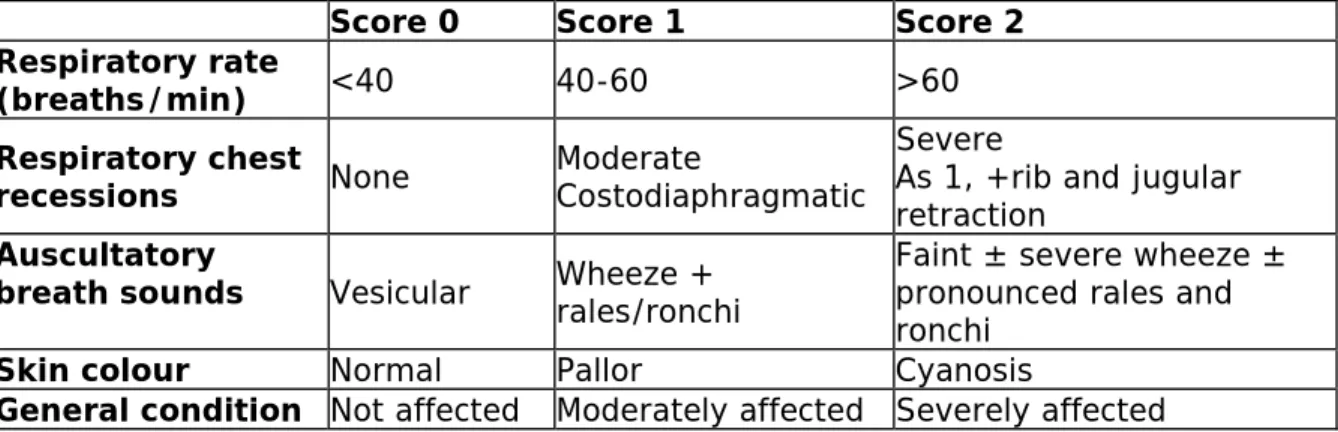
The clinical score (Table S1) was recorded by a physician prior to and 30 minutes after an
inhalation every morning. Parents and the attending nurse each completed a visual analogue scale
(VAS) and the nurse noted oxygen saturation, respiratory rates and heart rates prior to and 30
minutes after the first inhalation and subsequently once every morning and evening. Saliva was
sampled upon inclusion and in the first morning, and nasopharyngeal aspirates and urinary
samples were collected as soon as possible after inclusion. All stored biological samples were
frozen within 24 hours for further analysis. Biological samples, nurse and parental VAS scale as
well as clinical scoring by physician throughout the hospital stay will not be further discussed in
Registration of the use of nasogastric tube feeding and ventilatory support and time for each
inhalation were recorded daily.
Results
Influence
of
age
In children younger than three months only, inhalations given OD compared to RI was associated
with a relative risk of 0.37 (0.15-0.90) of patients receiving treatment with ventilatory support
(p=0.021). (Table S3)
Discussion
The clinical scoring (Table S1) used in the present study had previously been used in a
Scandinavian study4, but was, in line with other scoring systems of acute bronchiolitis, not
validated5. The commonly used Respiratory Distress Assessment Instrument 6 was considered to
be too specific.
In contrast to most other studies, this study allowed inclusion of patients with one previous
episode of wheeze. Subgroup analyses of patients with no previous wheeze (n=264) showed
Table S1: Clinical score
Score 0 Score 1 Score 2
Respiratory rate
(breaths/min) <40 40-60 >60 Respiratory chest
recessions None Moderate Costodiaphragmatic
Severe
As 1, +rib and jugular retraction
Auscultatory
breath sounds
Vesicular Wheeze + rales/ronchi Faint ± severe wheeze ± pronounced rales and ronchi
Skin colour Normal Pallor Cyanosis
General condition Not affected Moderately affected Severely affected
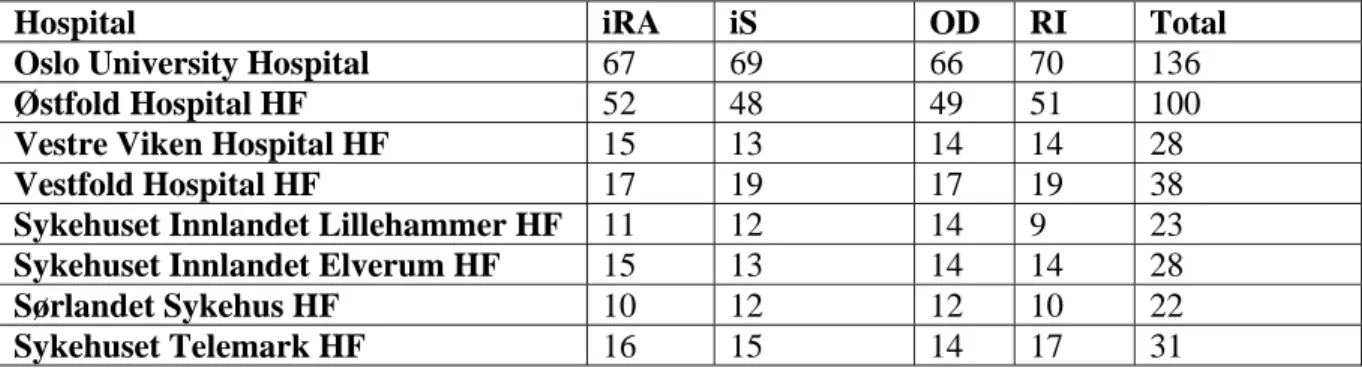
Table S2: Randomization by hospital
Hospital iRA iS OD RI Total
Oslo University Hospital 67 69 66 70 136
Østfold Hospital HF 52 48 49 51 100
Vestre Viken Hospital HF 15 13 14 14 28
Vestfold Hospital HF 17 19 17 19 38
Sykehuset Innlandet Lillehammer HF 11 12 14 9 23
Sykehuset Innlandet Elverum HF 15 13 14 14 28
Sørlandet Sykehus HF 10 12 12 10 22
Sykehuset Telemark HF 16 15 14 17 31
Table S3: Length of Stay in subgroup analysis
1 previous wheeze Adrenaline Saline On demand Fixed schedule
N 47 51 44 54
Mean LOS, hours 78.1 88.6 85.0 82.4
Estimated mean LOS*, hours (95% CI) 74.2 72.0 60.8 66.4
Mean difference in estimated mean LOS* (95% confidence interval)
-2.2 (-26.8,22.3) p=0.86 5.6 (-18.8,30.0) p=0.65
No previous wheeze
N 132 132 134 130
Mean LOS, hours 81.7 81.2 72.9 90.3
Estimated mean LOS*, hours (95% CI) 56.3 64.5 47.6 62.5
Mean difference in estimated mean LOS* (95% confidence interval)
8.3 (-4.8,21.3) p=0.22 14.9 (1.81,28.0) p=0.03
Age <3 months
N 92 85 86 91
Mean LOS, hours 100.9 91.4 83.5 108.5
Estimated mean LOS*, hours (95% CI) 93.1 89.2 41.3 71.6
Mean difference in estimated mean LOS* (95% confidence interval)
-3.8 (-24.7,17.0) p=0.72 30.3 (10.3,50.3) p=0.003
Age > 3 months
N 111 116 114 113
Mean LOS, hours 60.2 74.8 66.7 68.7
Estimated mean LOS*, hours (95% CI) 50.7 55.9 52.8 56.6
Mean difference in estimated mean LOS* (95% confidence interval)
5.2 (-6.7,17.0) p=0.39 3.8 (-8.0,15.6) p=0.53
Table S4: Results by all randomization groups
Adrenaline/ On demand (N=102) Adrenaline / Fixed Schedule (N=101) Saline/ On Demand (N=98) Saline/ Fixed Schedule (N=103)Mean Length of Stay in hours (95% confidence intervals)
71.6 (58.9-84.2) 85.9 (72.0-99.7) 76.3 (62.9-89.8) 87.0 (74.5-99.6) Change in clinical score by 1. Inhalations
(95% confidence intervals) -1.22 (-1.45 to -0.98) -1.31 (-1.37 to 0.93) -1.15 (-1.37 to -0.93) 1.01 (1.22 to -0.80)
Use for supportive therapy no/total no. (%)
Oxygen 37/96 (38.5) 46/96 (47.9) 35/92 (38.0) 48/97 (49.5)
Nasogastric Tube Feeding 28/101 (27.7) 29/100 (29.0) 24/97 (24.7) 35/102 (34.3)
Ventilatory Support 2/102 (2.0) 13/101 (12.9) 6/98 (6.1) 9/103 (8.7)
Discontinued treatment 17/102 (16.7) 19/101 (18.8) 20/98
(20.4)
Table S5: Mean Length of Stay (LOS) for children not discontinued (n=321).
Adrenaline/ On demand (N=85) Adrenaline/ Fixed Schedule (N=82) Saline/ On Demand (N=78) Saline/ Fixed Schedule (N=76)ITT: Mean LOS (hr) 57.5 (46.8-68.3) 69.4 (57.6-81.3) 59.5 (49.5-70.0) 76.4 (65.5-87.3)
PP: Mean LOS 54.7 (44.4-65.0) 64.0 (53.3-74.7) 54.8 (45.1-64.5) 72.8 (62.0-86.6) Adrenaline (N=167) Saline (N=154) On Demand (N=163) Fixed Schedule (N=158)
Mean LOS actual discharge, hours (95% CI)
63.4 (55.3-71.4) 67.9 (60.3-75.4) 58.5 (51.1-65.9) 72.8 (64.7-80.9)
Mean LOS, deemed ready for discharge, hours (95% CI)
59.3 (51.8-66.7) 63.7 (56.3-71.0) 54.7 (47.6-61.8) 68.2 (60.6-75.8)
Estimated mean LOS*, actual discharge, hours (95% CI)
47.4 (31.4-63.4) 55.0 (39.9-70.1) 37.1 (21.1-53.0) 51.5 (35.3-67.7)
Mean difference in estimated mean LOS*, actual discharge
7.60 (-2.64 to 17.8), p=0.15 14.4 (4.3 to 24.6), p=0.01
Estimated mean LOS*, deemed ready for discharge, hours (95% CI)
47.1 (31.6-62.6) 52.7 (45.4-58.9) 33.6 (18.2-49.1) 48.3 (39.3-57.3)
Mean difference in estimated mean LOS*, deemed ready for discharge
5.6 (-4.4 to 15.5), p=0.27 14.7 (4.9 to 24.5), p=0.004
Mean number of inhalations (95% CI) 15.1 (13.0-17.2) 17.2 (14.8-19.6) 12.8 (10.9-14.6) 19.5 (17.0-22.0)
Pearsons correlation coefficient between actual time of discharge and deemed ready for discharge was calculated to 0.99. *Length of Stay (LOS) estimated by robust linear regression analyses.
Figure
legends:
Figure S1: Discharge from hospital in number per hour of the day in children treated with
bronchiolitis by randomization groups A (adrenaline/on demand), B (adrenaline/fixed schedule), C
(saline/on demand) and D (saline/fixed schedule).
Figure S2: Length of Stay given by age for treatment medication with inhaled racemic adrenaline
versus inhaled saline (A) and treatment strategy on demand versus fixed schedule (B) in infants
with acute bronchiolitis. Regression lines are calculated by local regression smoothing, with 95%
confidence interval shaded in gray for each of the smoothing lines.
References
1. Cunningham S, McMurray A. Observational study of two oxygen saturation targets for discharge in bronchiolitis. Archives of disease in childhood 2012;97:361-3.
2. Donlan M, Fontela PS, Puligandla PS. Use of continuous positive airway pressure (CPAP) in acute viral bronchiolitis: a systematic review. PediatrPulmonol 2011;46:736-46.
3. Wang EE, Law BJ, Stephens D. Pediatric Investigators Collaborative Network on Infections in Canada (PICNIC) prospective study of risk factors and outcomes in patients hospitalized with respiratory syncytial viral lower respiratory tract infection. The Journal of pediatrics 1995;126:212-9.
4. Kristjansson S, Lodrup Carlsen KC, Wennergren G, Strannegard IL, Carlsen KH. Nebulised racemic adrenaline in the treatment of acute bronchiolitis in infants and toddlers. ArchDisChild 1993;69:650-4.
5. McCallum GB, Morris PS, Wilson CC, et al. Severity scoring systems: Are they internally valid, reliable and predictive of oxygen use in children with acute bronchiolitis? Pediatric
pulmonology 2012.
6. Lowell DI, Lister G, Von Koss H, McCarthy P. Wheezing in infants: the response to epinephrine. Pediatrics 1987;79:939-45.