c
SOCIAL NETWORKING: SECURITY, PRIVACY, AND APPLICATIONS
BY SONIA JAHID
DISSERTATION
Submitted in partial fulfillment of the requirements for the degree of Doctor of Philosophy in Computer Science
in the Graduate College of the
University of Illinois at Urbana-Champaign, 2013
Urbana, Illinois Doctoral Committee:
Associate Professor Nikita Borisov, Chair Professor Carl A. Gunter, Co-chair Associate Professor Indranil Gupta
ABSTRACT
Online social networks have become ubiquitous and changed the way that users interact online. There has been an enormous growth in the usage of online social networking in the past few years as users share a variety of information including personal profiles, pictures, and messages to socialize with their friends in the Internet. Besides, several special purpose social networks have emerged to serve their users with useful functionalities. This vast amount of user data is valuable, and therefore, introduce several security and privacy risks and challenges.
In this thesis we propose several techniques to enhance the security and privacy features of online social networks. Our goal is to shift the control over user data from a centralized social network provider to the end users. We realize this concept by decentralization of the social networking architecture. First, we construct and implement a cryptographic access control mecha-nism that ensures data confidentiality and integrity, and efficiently supports the fine-grained access policies expected by social network users. Next, we present a detailed design of a decentralized online social network that fo-cuses on security and privacy. Finally, we propose and implement auditable anonymity, a cryptographic scheme, which allows a social networking user to keep track of who accesses her data even when her data is encrypted and decentralized, without revealing this information to the storage provider.
ACKNOWLEDGMENTS
This dissertation would not have been possible without the help of my advisor Nikita Borisov. Nikita supported me when I needed it the most. I would like to thank Nikita for guiding me through this challenging journey.
Thanks to my fellow students and colleagues at University of Illinois at Urbana-Champaign who helped me with discussions, constructive sugges-tions, and advice every now and then. Also, thanks to my co-authors for the hard work and involvement in the projects that we did together.
Finally, thanks to my family and friends for their love and support. Thanks Imranul Hoque – my husband, peer, and friend for the love and support you have given me. Thanks to my son Shopnil Aydin whose birth changed my perspective about life and taught me how to accomplish what I want even though priorities of life change. Finally, thanks to my parents Rahima Nabi and Md. Eunus Jahid for everything that you have done and have been doing for me.
TABLE OF CONTENTS
LIST OF TABLES . . . vii
LIST OF FIGURES . . . viii
1 INTRODUCTION . . . 1
1.1 Thesis Statement . . . 4
1.2 Challenges . . . 4
1.3 Requirements and Properties . . . 5
1.4 Proposed Approaches . . . 7
1.5 Summary of Contribution . . . 9
1.6 Organization . . . 10
2 LITERATURE REVIEW . . . 11
2.1 Summary . . . 11
2.2 Centralized Social Networking Architecture . . . 12
2.3 Decentralized Social Networking Architecture . . . 15
3 EASIER . . . 18
3.1 Background . . . 19
3.2 Architecture . . . 23
3.3 Cryptographic Construction . . . 25
3.4 Security Analysis . . . 35
3.5 Implementation and Evaluation . . . 38
3.6 Related Work . . . 47
3.7 Conclusion . . . 49
4 DECENT . . . 51
4.1 Functional Model . . . 52
4.2 Architecture . . . 53
4.3 Implementation and Evaluation . . . 62
4.4 Leveraging Social Links to Improve Performance . . . 67
4.5 Conclusion . . . 68
5 ANONYMOUS AUDIT . . . 69
5.1 Background . . . 71
5.2 Architecture . . . 74
5.4 Implementation and Evaluation . . . 82 5.5 Related Work . . . 83 5.6 Conclusion . . . 84 6 A SECURE AND PRIVATE ONLINE SOCIAL NETWORK . . . . 85 7 CONCLUSION . . . 87 REFERENCES . . . 89
LIST OF TABLES
3.1 Component Size and Communication Overhead in EASiER . . 46 4.1 Key Size for Cryptographic Schemes used in DECENT . . . . 64
LIST OF FIGURES
3.1 EASiER Architecture . . . 24 3.2 Performance Analysis: Comparison of EASiER with
BSW-CPABE. Number of the revoked users is set to 500. (a) Secret key generation depends on the number of attributes in the key. (b) Encryption depends on the number of leaf nodes in the policy. (c) Decryption depends on the type of policy used to encrypt and the number of leaf nodes in the
policy. . . 40 3.3 Performance Analysis: Time Required for Revocation/Rekeying
the Proxy and Ciphertext Conversion. (a) Generating proxy key depends on the number of revoked users. (b) Par-tial pre-calculation of ciphertext conversion depends on the number of users revoked (c) Ciphertext conversion depends on the number of leaf nodes in policy and is hardly affected
by the number of users revoked. . . 42 3.4 Performance Analysis: Time Required for Key Delegation
and Decryption with Delegated Key. The number of re-voked users is set to 500. (a) Key delegation depends on the number of delegated attributes. (b) Decryption with delegated key depends on the type of policy used to encrypt
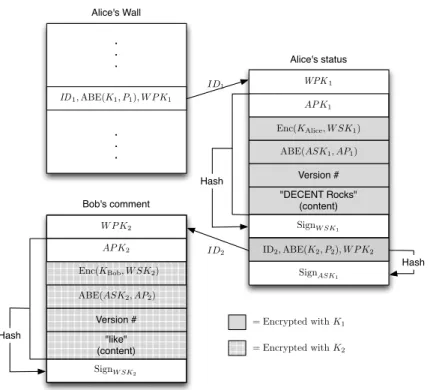
and the number of leaf nodes in the policy. . . 44 4.1 Example objects in DECENT. Alice’s wall is represented as
an object. Alice creates a status, stores it in the DHT and posts a reference to the status on her wall. To comment on this status, Bob creates a comment object, stores it in the DHT, and posts a signed reference to this comment on
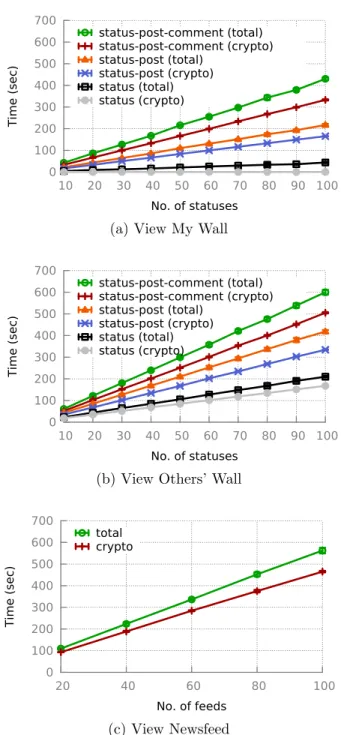
Alice’s status object. . . 60 4.2 Simulation Results for 10,000 nodes: The average time to
view another user’s wall with 10 and 20 status/post/comments is about 60 s and 120 s respectively. The average time to
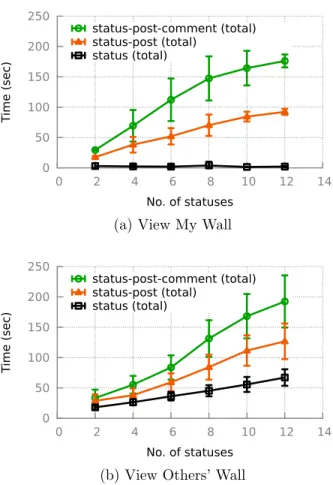
view a newsfeed with 20 peers is 109 s. . . 63 4.3 PlanetLab Results: The average time to view another user’s
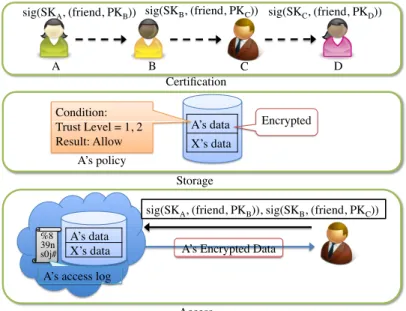
5.1 Certification, Access Control, and Private Audit in
1
INTRODUCTION
Over the past few years, Online Social Networks (OSNs) such as Facebook, Google+, Twitter, etc. have become ubiquitous and have changed the way users interact on the Internet. They provide a platform where users con-nect and share personal information with their social contacts, also known as friends. In addition to socialization, OSNs such as PatientsLikeMe, LinkedIn, Academia.edu serve their users with useful functionalities, for example, sug-gestions on a medical condition, jobs, and connection with research commu-nities. A significant growth has occurred in the usage of OSNs in recent years. Started in 2004, Facebook in 2013 has over a billion active users [1]; Google+ has 359 million active users [2]; there are more than 500 million users on Twitter [3], and more than 225 million users on LinkedIn [4].
Along with services, either socialization or other functionalities, OSNs in-troduce new challenges and risks. Study shows that Facebook users share more than 30 billion pieces of data each month, whereas Twitter users send over 400 million tweets each day [1, 5]. This large amount of data is valu-able [6], and introduces security and privacy risks, and turns the provider into an attractive attack target. While information such as a status post on Facebook may not be considered sensitive, social networks contain other information that are considered sensitive, and if revealed to inappropriate parties, can cause harm to the users. For example, recently, users have started using the location services to share their geographic information on the OSN. An ambiguous privacy setting may reveal this information to
un-wanted parties. Besides, a collection or this kind of information can be used to infer user’s location [7, 8].
If not protected properly, social networking data can be used to infer sensi-tive information. For example, study has shown that social networking data has been used to derive social security number [9, 10]. OSNs may not store social security numbers directly, but they store enough data that can be used to derive such information. Users store their date of birth and email address that associate the users to their schools or specific communities. Hence, if revealed to inappropriate parties, this information may be used against the user to perform identity theft and other harmful activities.
Experimental and real phishing attacks have been performed on Face-book [11, 12]. Insiders can also intentionally or accidentally release private information [10, 13]. Several privacy compromises by the OSN provider ei-ther intentionally or accidentally also have thrown these issues into sharp focus [14, 15]. In addition to the OSN provider and the users in the OSN, third party applications introduce new security and privacy risks by reveal-ing personal user information such as list of users’ social contacts and profile information [16, 17] .
The primary reason of these issues is the complete control of a central-ized social network provider, for example Facebook or Google+, on a large collection of user data. Users trust the provider with their data. However, the provider can use the user data any way it wants. Therefore, researchers have proposed several designs to shift the access enforcement point from the OSN provider to the end users. Unfortunately, not all these proposed schemes provide adequate level of privacy. Several designs [18–21] focus on cryptography-based access control while keeping the centralized architecture of the OSN provider. Centralized OSN providers are interested in user data
since they can sell it with advertisers who can send targeted advertisements based on this data.
On the other hand, users interested in using the OSN functionalities must trust the provider hoping that it will not misuse their data. However, con-cerned users share limited information or in some cases restrict themselves from participating in any OSN. Hence, a decentralized architecture is more desirable for enhancing security and privacy in OSNs. Researchers have worked on designs [22–26] that primarily focus on decentralization of the OSN rather than security and privacy. A recent work [27] combines both cryptography and distributed storage service, but falls short supporting ac-cess revocation, which is a required feature to support the type of policy expected by social network users. None of these proposed works allow users to get an idea about who accesses their data while providing adequate level of security and privacy.
Apart from socialization, social networking is being used to support pa-tients who have similar symptoms and want to get real world experience 1.
It provides a platform where patients share different types of medical infor-mation, and this information is shared with third parties [28]. Medical data is always considered sensitive, and hence, this kind of OSN should be secure and private. In future, when this type of social networking will be popular and widely used to support broader functionality, such as health information exchange, patients will need more control on their data rather than trusting the social network provider.
Decentralization will enable patient-centric medical social networking where patients are in control of their data. They can share their data with whoever they want to get service without revealing this information to the social
work provider. A secure health information exchange system will be possible so that users get better service from the healthcare providers. We envision a social networking system with enhanced security and privacy features that will be used not only for better socialization but also improved healthcare system.
1.1
Thesis Statement
In this thesis we investigate, analyze, and propose techniques to enhance security and privacy in OSN. We focus on decentralization of the social net-working architecture and cryptographic techniques. We believe that provid-ing security and privacy in OSNs is challengprovid-ing. We also understand that it may not be achievable completely by hiding every piece of information since that may interfere with the services provided by the OSN. Our work can be summarized through the following research statement.
Security and privacy of online social networks can be enhanced by shifting the control over user data from the centralized provider to the end users through a decentralized architecture and advanced cryptographic mechanisms.
1.2
Challenges
Decentralization of the social networking architecture shifts the control over data to the end user and hence enhances security and privacy. However, designing a secure and private decentralized social network is challenging.
• Distributing data requires careful consideration. In order to provide confidentiality and integrity, researchers have proposed to encrypt data.
However, as research shows, existing cryptographic techniques are not adequate to support the flexible policy expected by social network users [27].
• Encryption only may not be enough to provide privacy. Appropriate measures should be taken to avoid any kind of information leak, for example, inferring social relationships.
• Since there is no single platform to store and serve user data, ensuring data availability gets challenging.
• Social networking data is of different types and may have multiple ownership – for example, a comment on a status post belongs to both the status poster and the commenter. Therefore, designing a data structure that supports the complex security and privacy expectation on social networking data is challenging.
• Finally, deployment of a decentralized OSN is the most challenging task since it has to provide better security and privacy than existing OSNs while allowing efficient service. However, our focus in this thesis is on enhancing the security and privacy aspects, and we leave wide scale deployment as a future work.
1.3
Requirements and Properties
1.3.1
Security and Privacy Requirements
We can outline a number of security and privacy requirements of a decen-tralized social network:
Confidentiality: Preserving the confidentiality of user content is a key requirement for a decentralized OSN. Content should be accessible to only those who are explicitly authorized by the content owner. Furthermore, nodes hosting such data may themselves not be authorized to read the data.
Integrity: We must also ensure the integrity of the data so that OSN users can be certain that the content posted by their friends is authentic. This property is important in a peer-to-peer network since storage nodes are untrusted and may try to perform unauthorized updates to the stored data. Availability: User content should remain available until it is explicitly deleted by its owner, even if the owner is offline, and despite potential mali-cious attempts to destroy the data. Readers should also be able to retrieve the most recent version of a content object rather than past ones.
Explicit Owner-specified Access Control: Policies controlling who may view, modify, or comment on content are defined by its owner and cannot be changed without the owner’s authorization. However, when a content has multiple owners, the more restrictive policy should be enforced. Relationship Privacy: User’s social graph is considered sensitive [29]. Relationships between users should remain hidden from third parties that may have no relationship with the data owner and are therefore untrusted, such as storage nodes.
Auditing: Users should be be able to get information about when and by whom their data is used for better knowledge about privacy. Stealing or sharing a digital data does not leave any trace. Informative auditing should be enabled at every access of and action on information at each level, which can be used in future to detect potential misuse of data.
Authentication: Information accessors should authenticate themselves at each access of data. Identity of the accessors is a crucial part in tracing
back misuse of data. However, authentication should not reveal any infor-mation to inappropriate parties.
1.3.2
Threat Model
We assume that the participants in the decentralized OSN may be malicious (or compromised) and therefore should not be trusted with the confidentiality and integrity of data and relationship information. Moreover, the malicious entities are considered to be Byzantine, and can launch both active and passive attacks. Distributed systems are vulnerable to the problem of Sybil attacks, where a single entity can obtain multiple identities in the system and violate security properties. We assume the existence of mechanisms to defend against the Sybil attack [30, 31]. We consider that up to 25% of the nodes in the system can be malicious, since, beyond that, existing mechanisms [30] are not able to securely route in distributed hash tables, which is a necessary prerequisite to provide both integrity and availability guarantees.
In peer-to-peer networks, malicious nodes may attempt to launch denial of service (DoS) attacks against honest peers, by overwhelming their network, computational, or storage resources. We assume existence of defenses against such DoS attacks [32, 33]. In this thesis we focus on architecture design and cryptographic mechanisms to protect the security of stored data, rather than on routing-based attacks or DoS attacks, which can be addressed by existing mechanisms, and which we will therefore not discuss here.
1.4
Proposed Approaches
We propose three methods to enhance security and privacy in OSNs. These methods should not be considered mutually exclusive, but combined together
they build up a secure and privacy-aware social network.
Our first approach named EASiER [34,35] is a cryptographic access control scheme for social networking. Researchers have proposed Attribute-based Encryption (ABE) to ensure data confidentiality in social networking because of its expressiveness [27]. Unlike traditional cryptography, in ABE, data is encrypted with a plaintext policy defined over a set of attributes, for example ‘(friend and family) or coworker’. Secret keys that satisfy this policy will be able to decrypt this data. However, ABE schemes can be expensive to provide perfect forward secrecy when the system requires frequent revocation as they are burdened with redistributing individual secret keys. For example, in social networking systems, users may encrypt data for their close friends, but cease the relationship with a specific friend at a later time. In absence of an efficient revocation scheme, they will have to re-key every remainingclose friend to protect data, which is an expensive task if the list is large. We present an efficient revocation scheme in ABE by introducing a minimally trusted proxy. Though we present it in the context of a social network, it can be adopted by any system that uses ABE to protect its data.
We propose DECENT [36, 37], a decentralized design and architecture for OSN with an emphasis on confidentiality, integrity, and availability. We dis-tribute user data and get rid of the centralized OSN provider. The underlying storage system is a distributed hash table (DHT) that structurally stores and retrieves private user data. We borrow the concept of object oriented design to represent different types of social networking data such as user profiles, wall posts, pictures, and messages. The data owner creates an object with the data as an object element, and stores the object in the DHT. This operation gives the user a reference to the object in the DHT. Since data is distributed, each object along with its reference is encrypted to provide confidentiality.
The objects and their references as well are encrypted using EASiER. This architecture shifts the access control point from the provider to the users by combining advanced cryptographic mechanisms and decentralization.
For sensitive data, for example, interactions in the social network, it is im-portant to avoid revealing undue information to the storage provider. Despite encryption, certain information, such as access patterns, are still available to the storage provider and it can tell, for example, who accessed our data, or who we interact with socially. Cryptographic access control makes it difficult to implement important security protections, such as maintaining an audit log of accesses. In the third approach, we allow a data owner to receive a log of data accesses, while hiding this information from the storage provider. We call this approach auditable anonymity. To address the auditability is-sue, we extend anonymous credentials with revocable anonymity [38] that allows users to prove in zero knowledge that they are authorized to access a service or a piece of data without revealing the contents of the credential, and, importantly, their identity through a chain of trust, a concept similar to anonymous webs of trust [39]. Each access, however, generates an encrypted record that can be used by a special anonymity revocation service to learn who was behind such an access. In our architecture, this service is run by the data owner, who is able to decrypt the audit log records and get an access log.
1.5
Summary of Contribution
Our contribution can be summarized as follows:
• We construct and implement a cryptographic scheme that supports efficient revocation in attribute-based encryption. The code is available
at https://bitbucket.org/hatswitch/easier.
• We construct and implement a cryptographic scheme that allows anony-mous access on outsourced user data while creating a private access log for the data owner hidden from the storage provider.
• We also design and implement a decentralized social networking archi-tecture that focuses on data confidentiality, integrity, and availability. We adopt and use the cryptographic schemes in the context of enhancing security and privacy of online social networking. However, these approaches are generalized and hence, any outsourced storage will be able to adopt these techniques to provide security, privacy, and anonymity to protect their data.
1.6
Organization
In the rest of this thesis, we give a literature review in Chapter 2. We describe the three approaches that we propose to enhance security and pri-vacy in OSNs in Chapters 3, 4, and 5 respectively, and briefly summarize in Chapter 6 how these approaches are combined for a secure and privacy-aware social network. Finally, we conclude in Chapter 7.
2
LITERATURE REVIEW
In this chapter we describe several existing works that try to address the security and privacy issues of OSNs. At first we present a summary of the existing works and why they fall short, and next we describe them in detail.
2.1
Summary
Researcher have been working on different approaches to address the secu-rity and privacy problems of online social networking. These works broadly can be categorized based on the architecture of the social network provider (centralized or decentralized) and the type of mechanism used to provide se-curity and privacy of stored data (cryptography, information flow, or trust). Most of these works focus on one aspect rather than the overall design with emphasis on security and privacy.
Some designs require users to trust the centralized provider with their data, but focus on how information is shared with third party applications [40]. Some focus on auditing without emphasis on security and privacy [41]. Sev-eral works use different types of cryptographic techniques as their protection mechanism [18–20, 42–45]. In these approaches, the social network provider may not have enough incentive to store encrypted data as it does not have direct access to user data, or may infer a user’s social graph as it performs key management or mediates access to users’ data.
users as it removes the concept of trusting a centralized provider [22–27, 46]. In decentralized designs, data is stored with trusted or untrusted storage nodes, which can be third party storage servers or other users in the social network. In some designs users trust their social contacts to enforce their privacy policies, some rely on a few supernodes for availability and access control, and some trust the storage nodes with their data. A few designs use cryptographic techniques for data protection.
However, several problems still exist. Existing designs do not take into con-sideration the different types of data in OSNs, they do not consider complex data ownership and flexible policies, and do not have option to track data ac-cess while protecting data. Besides, when encryption is used to protect user data, existing schemes fall short to cryptographically represent privacy poli-cies expected by OSN users. We for the first time, present a comprehensive design for a decentralized OSN, and construct novel cryptographic schemes to support appropriate access control in social networking and anonymous auditing on protected user data.
2.2
Centralized Social Networking Architecture
Singh et al. propose the xBook framework for building privacy preserving so-cial network applications [40]. xBook uses information flow models to control what untrusted applications can do with the information they receive. Their design retains the functionality offered by existing online social networks. xBook provides enforcement for both user-user access control for informa-tion flow within a single applicainforma-tion, as well as for informainforma-tion sharing with entities outside xBook. Social network applications are re-designed to have access to all the data that they require, but this data is not allowed to be
passed on to an external entity unless approved by the user. However, xBook does not perform encryption for data confidentiality and hence the security and privacy risks persist.
Cristofaro et al. propose Hummingbird, a privacy enhanced version of Twitter type social network [42]. In this architecture, users encrypt their tweets and can follow hash-tags without revealing this information to unau-thorized parties. Hummingbird is a centralized social networking design and the provider does not have access to the tweet contents because of encryption, which may not motivate it to store user data.
Lucas and Borisov propose flyByNight, a Facebook application designed to mitigate privacy risks in social networks [19]. flyByNight users encrypt sensitive messages using javascript on the client side and send the ciphertext to some intended party, i.e., Facebook friends, who can then decrypt the data. The architecture ensures that transferred sensitive data cannot be viewed by the Facebook servers in an unencrypted form. However, the utility of flyByNight is limited to preserving the privacy of messages intended for social network friends, i.e., email type communication, and thus, it does not provide complete privacy. For example, the application server knows a user’s friendlist on facebook. flyByNight is also vulnerable to active attacks by the OSN provider, since the OSN interface is used for key management.
Guha et al. propose to improve user privacy while still preserving the func-tionality of existing online social network providers [18]. Their architecture is called none of your business (NOYB), in which encryption is used to hide the data from the untrusted social network provider. The key feature of their architecture is a general cipher and encoding scheme that preserves the se-mantic properties of data such that it can be processed by the social network provider oblivious to encryption. A users private information is partitioned
into atoms, and NOYB encrypts a users atom by substituting it with the atom of another user. Thus the OSN can operate on ciphered data, but only the authorized users can decrypt the result.
Frikken describes a key allocation scheme for OSNs [20]. In this work, relationship between two users depends on their distance. A social contact at a distance less than d can access any information encrypted by the user for her contacts at distance d. Each user defines the maximum depth L
of her social relationships, generates keys for each distance, encrypts data for her contacts at the desired distances, and makes the keys available to the appropriate parties. However, to establish different relationships such as friend, family, etc. a user defines L+ 1 keys for each relationship, making it infeasible.
Luo et al. propose FaceCloak where users store random and fake data on Facebook and the actual data in encrypted form on FaceCloak server [43]. Fake data from Facebook is used as an index to retrieve actual data from FaceCloak on the client side. This design introduces redundant data storage at two different servers. Beato et al. propose Scramble, which uses symmetric key encryption to provide data confidentiality and integrity [44]. However, Scramble also creates an access control list of users who are actually allowed to see a piece of data by encrypting the symmetric key to each of them separately. Hence, the approach is not expressive.
Anderson et al. propose a client-server architecture for providing social network privacy [21]. In their design, the server is a very simple untrusted social network provider which serves as a data container, while a complex client side architecture performs the access control. The server only provides availability and client is responsible for data confidentiality and integrity. Besides content data, the architecture is also able to protect the social graph
information.
Feldman et al. propose a framework called Frientegrity that primarily fo-cuses on avoiding equivocation by the untrusted centralized social network provider [45]. Users store their encrypted data with the provider, and ver-ify the data integrity through a history of operations on the data and col-laboration with other users. Although Frientegrity provides several desired features of a security and privacy-aware social network, the provider is still centralized, and therefore, may not have enough incentive to store user data. Besides, access revocation is logarithmic with the number of friends a user has. Also, provider can deduce an anonymous graph of relations between users.
2.3
Decentralized Social Networking Architecture
Shakimov et al. consider a decentralized OSN as a privacy preserving alter-native to the current centralized architectures [22]. The basic idea of their decentralized OSN is that users store their data in a Virtual Independent Server (VIS) owned by themselves. These VISs form an overlay network per OSN. The authors consider different types of decentralized OSNs, depending on where the VISs reside: a) cloud based b) desktop based c) hybrid, and compare their privacy, costs and availability.
PeerSon, LotusNet, and Safebook [23–25], three decentralized designs for social networking benefit from DHTs in their architecture. PeerSon and Safebook suggest access control through encryption, but they fall short to provide fine-grained policies compared to ABE-based access control. Safebook is based on a peer-to-peer overlay network named Matryoshka. The end-to-end privacy in Matryoshka is provided by leveraging existing hop-by-hop
trust. In all of these schemes overhead of key revocation affects performance. LotusNet [23] is a decentralized OSN based on a DHT called Likir [47], which in turn is based on the base DHT Kademlia [48]. To provide access control, Likir uses signed grants to specify permissions. Though it is based on a DHT with untrusted nodes, it does not support any kind of encryption.
Diaspora is a decentralized client-server architecture for OSNs where each user is considered to own a seed [26]. A seed is a web server, contains user information, and can reside anywhere including the user’s machine and the diaspora server. Diaspora defines three types of security level including high, low, and no security at all. However, Diaspora is not based on a DHT and uses symmetric key encryption for high security data. The access policies are not fine-grained or expressive, and revocation is still a problem in Diaspora. SCOPE is a distributed data management system for specialized P2P social networks [46]. Clients connect to and store data on a group of super-nodes with higher computation and storage capacity. However, clients do not par-ticipate in the DHT; only the super-nodes run the DHT code. Clients connect to super-nodes and rely on them for sharing and access control on their data. Persona is a privacy-aware OSN architecture based on ABE [27]. Persona uses a decentralized persistent storage medium, and puts policy decisions in the hands of users by allowing them to choose with whom they store their information. Users are empowered to create groups and are also able to me-diate admission control in a group. Access to personal data is controlled by encrypting to groups. Restricting data to specific groups allows users to have fine-grained control over access policy. Users define relationships with their social contacts by assigning attributes to them. For example, Alice might assign the attributes friend and co-worker to Bob. Data is encrypted under a policy defined over a set of attributes using potentially complex logical
formulas. Users can only decrypt the data if they have enough attributes to satisfy the policy. Though Persona introduces a desired property for OSN by performing ABE, it does not scalably support dynamic groups. The major problem is key revocation. Whenever someone leaves a group, Alice needs to issue the remaining members new keys, and the entire data set may need re-encryption. This creates high overhead if group membership changes fre-quently.
3
EASIER
Encryption allows users to directly control access to their data by distributing keys to the intended parties. Fine-grained access control is a key challenge in this space; for example, Facebook and Livejournal have rolled out mech-anisms to specify access control policies for each post, as the data items are usually destined for a subset of friends, or groups. Persona [27] is a state-of-the-art design that proposes the use of Attribute-based Encryption (ABE) [49] to enable fine-grained access control. A user can create groups by assigning different attributes and keys to her social contacts, and then en-crypt data such that only particular users having the desired set of attributes can decrypt it.
However, user attributes may change over time and access revocation be-comes necessary. This could be because of change in location, work envi-ronment, or the nature or strength of the relationship with a contact [50]. Recent studies have shown that the user interaction graph is much less dense than friendship graph, indicating that users interact most frequently with a small group of friends, further validating the need for fine grained access control [51]. Moreover, the churn rate for the interaction graph has been shown to be quite high, motivating the need for access control mechanisms to support dynamic groups. Persona and similar designs introduce signifi-cant overhead for group membership changes, especially when a contact is removed from a group: all other members of the group must receive a new key; additionally, all existing data items destined for that group must be
re-encrypted. This does not scale when group sizes are large and group churn rate is high.
Our first approach EASiER is a cryptographic scheme that enables users to set fine-grained access control policies even for dynamic groups. To handle group churn, we leverage ideas from the field of efficient revocation in group communications systems [52] and apply them to the ABE setting. Our de-sign makes use of a minimally trusted proxy that handles revoked users and attributes. A user who revokes a contact or an attribute need not issue new keys to the rest of the group, nor re-encrypt data. We believe this feature is key for access control in OSNs, and would also be useful in any other context where ABE is used together with highly dynamic group membership.
The proxy cannot decrypt by itself, and even if it were compromised, it cannot allow previously revoked users to decrypt either (unless the compro-mise crosses a proxy re-key operation). Therefore, a centralized OSN provider can act as a proxy without introducing significant privacy risks. The only assumption we hold is that the proxy is updated with a new key each time a revocation takes place and that it discards the old one. We provide a proof of the security of our construction, and present performance analysis that demonstrate the efficiency of the scheme.
3.1
Background
3.1.1
Attribute-based Encryption
With standard public-key cryptography, it is necessary to explicitly enumer-ate all of the users who may decrypt each data item. While it is possible to issue group keys, this creates complex key management issues and several
problems still remain. Attribute-based encryption (ABE) [49,53,54] provides a better solution for defining fine-grained access control to groups of people. It provides an alternative approach to data protection, where the ability to decrypt data items is controlled by a policy specified in terms of attributes. For example, in Ciphertext-Policy ABE (CP-ABE) [49] (one variant of ABE), the encryptor uses a policy described over attributes to encrypt a piece of data; different secret keys are issued for different sets of attributes, and a key that has enough attributes to satisfy the policy decrypts the ciphertext.
For example, Alice encrypts a file with the policy “Professor OR (Teaching Assistant AND Security)”, which means either a Professor, or a Teaching Assistant in Security can decrypt this file. An example key with attributes “Teaching Assistant, Security” that Alice issues can decrypt this file since it satisfies the policy, but a key with just the “Teaching Assistant” attribute cannot. This variant is calledciphertext-policy ABE;key-policy ABE reverses the process, with attributes assigned to data items and policies to keys.
ABE explicitly prevents collusion between users: if Bob is a teaching assis-tant in databases, and Carol is a research assisassis-tant in security, they cannot combine their attributes together to satisfy the above policy if neither of them satisfies it individually. Finally, ABE provides public-key functional-ity, allowing, for example, Bob to encrypt a message with Alice’s public key to be decrypted by the set of secret keys issued by Alice.
Various applications can benefit from the flexibility and expressiveness of ABE, but require support for frequent revocation. ABE falls short in such areas and when immediate revocation of access is required. Researchers have proposed revocation by attaching an expiry date to the keys [49, 54], which requires re-keying non-revoked users and re-encrypting old ciphertexts. They also introduce delay in revocation.
We can formally define a CP-ABE scheme with revocation by six algo-rithms:
- Setup. This algorithm takes security parameters and generates a public key PK and master secret key MK.
- Encrypt(PK, M, P). This algorithm takes the public keyPK, a message
M, and a policy P and generates a ciphertext CT encrypted withP. - Keygen(MK, S). This algorithm uses the master secret key MK to generate a secret attribute key SK using the attributes in the setS.
- ProxyRekey(PK,MK, U). This algorithm uses the public keyPK and master secret keyMK to generate a proxy keyP XK using the revoked users in the set U.
- Convert(PXK,CT, u). This algorithm, run by the proxy, converts the ciphertext components in the set CT into a decryptable form CT0 for the user u using the proxy key PXK.
- Decrypt(CT0,SK). This algorithm decrypts a converted ciphertextCT0 to plaintext M as long as the set of attributes S inSK satisfies the policyP
that was used to generate CT fromM. (The policy is implicitly encoded in CT.)
- Delegate(SK,S˜). The delegate algorithm in single authority setting takes as input a secret keySK for some set of attributesS and a set ˜S⊆S. It outputs a secret key SK˜ for the set of attributes ˜S. The algorithm re-randomizes the secret key and allows further delegation.
- DelegatedDecrypt(CT0,SK˜ ). This algorithm decrypts a converted ciphertext CT to plaintext M, as long as the set of attributes ˜S in SK˜ satisfies the policy P that was used to generateCT from M.
We also consider a multi-authority delegation scenario. In this case, Alice runs a key authority that issues a secret key to Bob, who himself runs a
separate key authority that can delegate the key to Carol. Alice and Bob each run separate proxies and Carol may decrypt only if Alice has not revoked Bob and Bob has not revoked Carol.
- MA–Delegate(SK,S,˜ MK˜ ). This allows Bob to delegate his secret key SK, issued by Alice for the set of attributes S, using his own master secret key MK˜ , producing a delegated key ˜SK, with attributes ˜S ⊂S
- MA–DelegatedDecrypt(CT00,SK˜ ). This allows the owner of a dele-gated key to decrypt a ciphertext CT00 that was obtained by first running
Convert using Alice’s proxy with key PXK, and then converting it again
using Bob’s proxy and key PXK˜ . The decryption succeeds if ˜S satisfies the policy P used to encrypt the original ciphertext.
3.1.2
Revocation Scheme
To support practical revocation in EASiER, we adopt a scheme developed by Naor and Pinkas [52] that allows efficient revocation of users. The scheme uses Shamir secret sharing [55] to create shares of a secret key, where t+ 1 shares are necessary for reconstruction, and gives one to each user. During normal operation, the sender broadcaststrandom shares, which lets any user to reconstruct the secret key by combining the shares with his or her own. To revoke up totusers, the sender broadcasts their shares instead of random ones. Any non-revoked user still hast+ 1 distinct shares and can reconstruct the private key, whereas the revoked users do not have enough information even if they all collude.
3.1.3
Cryptography Basics
Bilinear Pairing:
LetG1, G2, andGT be multiplicative cyclic groups of prime orderp, andea
map (G1×G2 →GT). Letg1 andg2 be generators ofG1 andG2 respectively
(Gi = hgii). If ∀u ∈ G1, v ∈ G2 and a, b ∈ Zp, e(ua, vb) = e(u, v)ab and
e(g1, g2) 6= 1, then e is called a bilinear pairing. If G1 = G2, it is called a
symmetric pairing, otherwise the pairing is asymmetric. Secret Sharing:
In Shamir’s secret sharing scheme [55], a secret s in some field F is shared amongn parties by creating a random polynomial P ∈F[x] of degree tsuch thatP(0) =s. Thei-th party gets the share (i, P(i)). Given anyt+ 1 shares
P(x0), . . . , P(xt), it is possible to recoverP(0) using Lagrange interpolation:
P(0) = t X i=0 λiP(xi), where λi = Y j6=i xj (xj−xi)
3.2
Architecture
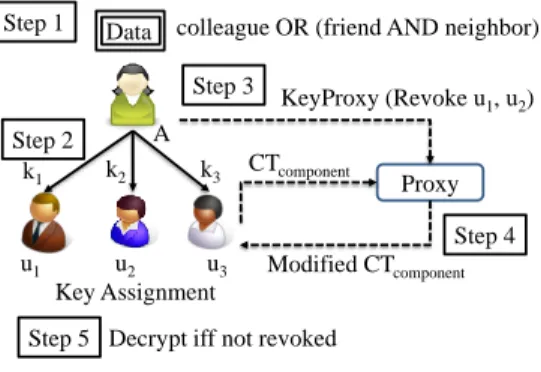
Unlike traditional OSNs, social relationships in EASiER are of various types. Users define relationships by assigning arbitrary set of attributes to their con-tacts, act as their own key authorities, generate different secret keys for the assigned attributes, and encrypt pieces of data such as profile information, wall posts, etc. with attribute policies. An encrypted item can be decrypted only by the contacts with keys that have enough attributes to satisfy the pol-icy attached to the data. For instance, in Figure 3.1, user Alice defines the attributes (friend, colleague, neighbor), generates the keys k1 (‘colleague’), k2 (‘friend, neighbor’), and k3 (‘colleague, neighbor’) for u1, u2, and u3
re-spectively. Therefore, u1 and u3 are in the colleague group, u2 and u3 are in
the ‘neighbor’ group, and u2 is in the ‘friend’ group of Alice. She encrypts
her data with the policy ‘colleague or (friend and neighbor)’.
Data
k1 k2 k3
Key Assignment u1 u2 u3
colleague OR (friend AND neighbor)
Step 2 Step 1
Step 3 KeyProxy (Revoke u 1, u2)
Proxy
Modified CTcomponent
Step 5 Decrypt iff not revoked CTcomponent
Step 4 A
Figure 3.1: EASiER Architecture
Revocation is a key functionality for OSNs, as relationships can and do change over time: Alice may want to cease her relationship with u1 and u2,
and revoke the corresponding keys, which should prevent them from viewing her data encrypted with any policy that their keys satisfy. Besides, she may want to revoke the attribute ‘neighbor’ from k3 assigned to u3 and effect a
corresponding change in access control. EASiER makes use of a proxy that is involved in every decryption. In summary, decryption keys in EASiER are blinded in a way specific to each user’s identity; to decrypt a data item, a user with the appropriate key must contact the proxy to transform the ciphertext partially so that it is compatible with the blinded key. When Alice wishes to revoke an attribute, she updates the proxy key in such a way that this transformation is impossible for the revoked users.
The proxy itself is minimally trusted and cannot decrypt the data; it also cannot restore access for a previously revoked user even if it is compromised, and so it may be implemented by a centralized service with minimal risk. Upon each revocation, Alice rekeys her proxy with the latest revocation
in-formation. A new proxy key, created each time a revocation takes place, prevents revoked users from colluding with the proxy or with each other to get the data. We argue that this is a desirable property: currently trusted contacts are not likely to crawl the entire set of social network data and store it for later use, but former friends or colleagues might try to abuse their former status by accessing past data. Figure 3.1 summarizes the whole architecture.
3.3
Cryptographic Construction
3.3.1
Key Revocation
Intuition:
The master key MK contains a polynomial P of degree t. Each user u gets a random share P(u) of P(0) in her key. The proxy key consists of t such random shares and is used to convert a part of the ciphertext for decryption. Whenever an access is revoked from a keySK, its share becomes a part of the proxy key, and hence the converted ciphertext. Therefore, the revoked user does not have (t+ 1) distinct points to unblind her key and the ciphertext. However, non-revoked users always have (t + 1) distinct points and hence decrypt successfully.
When no one is revoked, the proxy key consists of t random P(x) points. Since the revocation is based on polynomial secret sharing with a polynomial of degree t, the scheme is limited to a maximum of t key revocations. The total number of users in the system, however, is not limited.
- Setup: The setup algorithm randomly generates a polynomial P of degreet overZp, wherep=|G1|, sets the secretP(0), and randomly chooses
α, β ∈ Zp. The public key PK and master secret key MK are generated as
follows. This is directly adapted from BSW CP-ABE, modifying it to use asymmetric pairings and adding the polynomial component to the secret key.
P K =G1,G2, g1, g2, h=g
β
1, e(g1, g2)α
, M K = (β, gα2,P)
- Encrypt(PK, M, τ): A policy is represented as an access tree structureτ
with the attributes at leaves and thresholdk-of-ngates at intermediate nodes. Each node x is associated with a polynomial qx of degreedx (dx =k−1 for
that node). The random secret s (s∈Zp) to blind the data M is associated
with the polynomial at the root R of the tree; i.e., qR(0) =s. For all other
nodes, qx(0) =qparent(x)(index(x)). index(x) returns a number between 1 and
the number of children of parent(x). Y is the set of leaf nodes in τ.
Other than the asymmetric groups, the encryption algorithm works exactly the same as in BSW CP-ABE.H :{0,1}∗ →
G2 is a hash function (modeled
as random oracle) that maps string attributes to random elements ofG2, and hy = logg2H(att(y)), used for notational convenience only, as it is assumed
infeasible to compute. CT = (τ,C˜ =M e(g1, g2)αs, C =hs =gβs1 , ∀y∈Y :Cy =g qy(0) 1 , C 0 y =H(att(y)) qy(0) =ghyqy(0) 2 )
- KeyGen(M K, S): The key generation algorithm outputs the secret key corresponding to the set of attributes S for the user uk, blinded by P(0).
uk and D00j are the extra components generated by this algorithm compared
informationuk(a point onP). ukdoes not need to be secret sinceP is secret. SK = (D,∀j ∈S :hDj, Dj0,D 00 ji, uk), D=g(2α+r)/β, Dj =g2rH(j) rjP(0), D0 j =g rj 1 ,D 00 j = (D 0 j) P(uk) =grjP(uk) 1
- ProxyRekey(P K, M K,{u1, . . . , ur}): This algorithm takes a list
(pos-sibly empty) of revoked users, with 0 ≤r ≤tand evaluates the corresponding
P(ui) using MK. In case of fewer than t revocations, it generates random
points x (other than the actual user identities) and calculates P(x). The secret proxy key PXK is set as follows:
P XK ={ui, P(ui)},1≤i≤r
{xi, P(xi)}, r < i≤t, for random xi
- Convert(PXK, CT): This algorithm, run by the proxy, takes as input the proxy key PXK, the ciphertext CT, and the decryptor’s identity uk to
calculate Cy00 as follows: ∀i, j ∈ {1, . . . , t}, k /∈ {1, . . . , t}, λi = uk uk−ui ·Y j6=i uj (uj −ui) , ∀y∈Y :Cy00= (Cy0)Pti=1λiP(ui)=ghyqy(0) Pt i=1λiP(ui) 2
Since SK is blinded by P(0), the user needs Cy00in addition to Cy and Cy0 for
decryption. The algorithm also calculatesλk for the decryptoruk, so CT0 =
{CT,{∀y∈ Y : Cy}, λk}. Note that in practice, only the Cy0 components of
the ciphertext need to be passed to the proxy.
- Decrypt(CT0,SK): The decryption steps involve one extra pairing than BSW CP-ABE at each leaf node of the policy. For each leaf node x where
i=att(x) and Cx00 ∈C00, if i∈ S, (S is the set of attributes for which SK is issued) then, DecryptNode(CT,SK, x) = e(Cx, Di) e(Di00, C0 x)λke(D 0 i, Cx00) = e(g1, g2) rqx(0)+hiriP(0)qx(0) e(g1, g2)rihiqx(0)λkP(uk)e(g1, g2)rihiqx(0) Pt j=1λjP(uj) = e(g1, g2) rqx(0)+hiriP(0)qx(0) e(g1, g2)rihiqx(0)( Pt j=1λjP(uj)+λkP(uk)) = e(g1, g2) rqx(0)+hiriP(0)qx(0) e(g1, g2)rihiqx(0)P(0) , k 6∈ {1,2, . . . , t} =e(g1, g2)rqx(0)
Otherwise DecryptNode returns ⊥. The rest of the decryption proceeds as BSW CP-ABE.
Explanation of Asymmetric Group:
We use different groups forCi0andD0i. The user getsCi0converted toCi00 =Ci0a
(a = Pt
j=1λjP(uj), explained in the Convert algorithm) by the proxy.
However, if both Ci0 and D0i belong to the same group, and the user gives the proxy Di0 instead of Ci0, she will get (Di0)a = gari. She will also get λ
k,
which she can use to get Di00λk = gλkP(uk)ri. Multiplying these two, she gets gri(a+λkP(uk))=griP(0). She can use this last value to decrypt any ciphertext
without using the proxy, so the revocation is no longer effective. Therefore, we use asymmetric pairing, where Ci0 and Di0 are in different groups and mapping of Di0 into the Ci0 group is not possible, also known as External Diffie Hellman Assumption (XDH).
3.3.2
Delegation of Access
We design delegation of attributes in EASiER in two settings depending on whether the secret keys are issued by a) single key authority, or b) multiple key authorities.
- Delegate(SK,S˜). The delegation algorithm takes in a secret key SK
issued for a set of attributes S to user uk, and generates a delegated key ˜SK
for the subset of attributes ˜S ⊆S. As long asukis not revoked, the delegated
key can be used for decryption. An extra public parameter f = g21/β is introduced in the public keyP K. Some components inSKare re-randomized and a new component Dj000 is introduced. Let random ˜r ∈ Zp, and random
∀j ∈S,˜ r˜j ∈Zp. SK˜ is set as follows. ˜ SK = ( ˜D,∀j ∈S˜:hD˜j, Dj0, D 00 j, D 000 j i), ˜ D= (D)fr˜=g2(α+r+˜r)/β,D˜j = (Dj)g2r˜H(j) ˜ rj, D000 j =g ˜ rj 1
each leaf node x and Cx00∈C00: DecryptNode(CT,SK˜ , x) = e(Cx,D˜i) e(D00λk i ·D 000 i , Cx0)e(D 0 i, Cx00) = e(g1, g2) qx(0)(r+˜r+hiriP(0)+hi˜ri) e(g1, g2)(riλkP(uk)+ ˜ri)hiqx(0) · 1 e(g1, g2)rihiqx(0) Pt j=1λjP(uj) = e(g1, g2) (r+˜r)qx(0)+hiriP(0)qx(0)+hi˜riqx(0) e(g1, g2)rihiqx(0)λkP(uk)+hir˜iqx(0) · 1 e(g1, g2)rihiqx(0) Pt j=1λjP(uj) = e(g1, g2) (r+˜r)qx(0)+hiriP(0)qx(0)+hi˜riqx(0) e(g1, g2)rihiqx(0)( Pt j=1λjP(uj)+λkP(uk))+hir˜iqx(0) = e(g1, g2) (r+˜r)qx(0)+hiriP(0)qx(0)+hi˜riqx(0) e(g1, g2)rihiqx(0)P(0)+hir˜iqx(0) , k 6∈ {1,2, . . . , t} =e(g1, g2)(r+˜r)qx(0)
Let A=e(g1, g2)(r+˜r)qR(0) =e(g1, g2)(r+˜r)s for the root node. The rest of the
decryption proceeds as follows, ˜ C e(C,D˜) A =M e(g1, g2)αs e(g1, g2)(r+˜r)s e(g1, g2)αs+rs+˜rs =M
- MA-Delegate(SK,S,˜ MK˜ ). Recall that in this case, Bob is in posses-sion of a secret key SK issued by Alice, and is simultaneously in charge of a separate key authority with master key MK˜ . In this case, Bob creates a new identity u0 for another user Carol and re-randomizes the delegated key:
˜ S ⊆S. ˜ SK = (D,∀j∈S˜:hDj, Dj0,D˜ 00 j,D˜ 000 j i, u, u 0 ),where ˜ Dj00= (Dj00)1/P˜(0),D˜j000 = (D00j)P˜(u0)/P˜(0)
- MA-Decrypt(CT00,SK˜ ). To decrypt a ciphertextCT using a delegated key, first Alice’s proxy convertsCT producing{Cy00 =C0XA
y }, λA. Then Bob’s
proxy converts it further, based on identity u0, to obtain {Cy000 =C0XB
y }, λB.
Bob’s identity is conveyed to Carol as a part of the communication for ˜
SK, or some other way. Carol does a modified bilinear pairing in the
DecryptN ode, and finally decrypts the data.
DecryptNode(CT,SK, x˜ ) = e(Cx, Di) e( ˜Di00, Ci000)λBe( ˜D000 i , Cx0)λBλCe(D0i, Ci00) = e(Cx, Di) e(g0, g1)rihxqx(0)XBλBPA(B)/PB(0) · 1 e(g0, g1)rihxqx(0)PA(B)PB(C)/PB(0)λBλCe(D0i, C 00 xA) = e(g0, g1) rqx(0)+rihxqx(0)PA(0) e(g0, g1)rihxqx(0)λBPA(B)e(g0, g1)rihxqx(0)XA = e(g0, g1) rqx(0)+rihxqx(0)PA(0) e(g0, g1)rihxqx(0)PA(0) =e(g0, g1)rqx(0)
The rest of the decryption proceeds as before. If Alice revokes Bob, or Bob revokes Carol, the decryption will not succeed since both Alice and Bob’s proxies participate in the decryption, and the delegated secret key ˜SK
contains information about all Alice, Bob, and Carol.
3.3.3
Attribute Revocation
In this section, we describe attribute revocation from a given secret key in a limited universe. This is useful since often the key authority may want to merely revoke a few attributes from her contacts instead of the whole key. For instance, in a social network, user A might want to remove colleague
attribute from B, but B still stays a friend. Intuition:
The master secret key contains one polynomial Pi of degree ti for each
possi-ble attribute i that the key authority defines in her universe. Any attribute can be introduced later by generating a new polynomial and storing it in
M K. Pi(0) is used to blind the corresponding attribute in the secret keys.
Each user u also gets a random share Pi(u) of Pi(0) in her key. The proxy
key consists of ti such shares for each attribute in the policy used in the
ciphertext. Whenever some attribute is revoked from some user, that share becomes a part of the proxy key, and hence the converted ciphertext. There-fore, the revoked user does not have enough points, i.e. (ti+ 1) points for
that specific attribute to unblind her key and the ciphertext, and thus fails to decrypt it. Non-revoked users always have (ti + 1) distinct shares for
attribute i, and so decrypt successfully. When no attribute is revoked, the proxy key consists of ti random points for each attribute i.
- Setup: The setup algorithm randomly generates a polynomial Py of
degree ty over Zp for each attribute y ∈ Y where Y is the set of attributes
in the system, sets the secret Py(0), and randomly chooses α, β ∈ Zp. The
public key P K and master secret key M K are generated as follows:
P K = (G1,G2, g1, g2, h=g1β, e(g1, g2)α), M K = (β, g2α,∀y∈Y :Py)
- KeyGen(MK, S, {Px}): The algorithm KeyGen takes M K and a list
of polynomials {Px} (possibly empty) for new attributes not in M K, and
outputs the secret key corresponding to the set of attributesSfor the useruk.
key component is specific to the attribute represented by that component. SK = (D,∀j ∈S :hDj, Dj0, D 00 ji), whereD=g (α+r)/β 2 , Dj =g2r·H(j) rjPj(0) =gr+hjrjPj(0) 2 , D 0 j =g rj 1 , D 00 j = (D 0 j) Pj(uk) =grjPj(uk) 1
- Encrypt(PK, M, τ): The encryption algorithm works as in key revo-cation.
- ProxyRekey(PK, MK, ∀y ∈Y :RLy): This algorithm takes a list of
revoked usersRLy ={ui},1≤i≤ty for each attributey ∈Y, and generates
the proxy key P XK. In case of fewer than ty revocations, random values
hx, Py(x)iare generated to makeRLy of size ty. The set of users from whom
different attributes are revoked, may or may not overlap. Without loss of generality, we assume that the sets of revoked users don’t overlap.
P XK =∀y∈Y,∀ui ∈RLy :hui, Py(ui)i
- Convert(PXK, ∀y ∈ Y : Cy): This algorithm is run by the proxy to
convert the ciphertext components Cy0 to Cy00 for the user uk. ∀y ∈ Y, the
algorithm also calculates λyk for uk.
λyi = uk uk−ui ·Y j6=i uj (uj −ui) ,∀ui, uj ∈RLy, uk ∈/ RLy, RLy ∈P XK ∀y∈Y :Cy00 = (Cy0)Ptyi=1λ y iPy(ui) =ghyqy(0) Pty i=1λ y iPy(ui) 2
- Decrypt(CT, SK): For each leaf node xwhere i=attr(x), i∈S (S is the set of attributes for which SK is issued), i is not revoked from uk, and
follows: DecryptN ode(CT, SK, x) = e(Cx, Di) e(D00 i, Cx0)λ i ke(D0 i, Cx00) = e(g1, g2) rqx(0)+hiriPi(0)qx(0) e(g1, g2)rihiqx(0)(λ i kPi(uk)+ Pti j=1λijPi(uj)) = e(g1, g2) rqx(0)+hiriPi(0)qx(0) e(g1, g2)rihiqx(0)Pi(0) , k 6∈ {1,2, . . . , ti} =e(g1, g2)rqx(0)
Otherwise DecryptN ode returns ⊥. The rest of the decryption proceeds as before. In summary, if an attribute i is revoked from user u, he can not do pairing on Cx00 and Di0. He can continue to use components related to his other unrevoked attributes. Therefore, some of his attributes are revoked whereas some continue to be active.
3.3.4
Distribution of the Proxy
In our design, the proxy is semi-trusted. We assume that the proxy is updated with a new proxy key with each revocation, and it forgets the old keys. In order to enhance proxy security, we propose an alternate design to a centralized proxy. An alternate design to a centralized proxy is a threshold-based distributed proxy.
Threshold secret sharing can be used to split the proxy functionality among several parties. This model, where we can assume that majority of the parties are not actively malicious, will ensure the security of the proxy. With (t, n) threshold proxies, i.e., proxy functionality is distributed to n parties with t as the threshold value, (t < n), t+ 1 out of n proxies need to be malicious, i.e., colluding with the decryptor, to allow a revoked user to decrypt data.
3.4
Security Analysis
First, we need to define the requisite security properties for CP-ABE with Proxy Revocation. We present the definition for identity-based revocation; the definition for attribute-based revocation is analogous. We base our def-inition on the security model defined by Bethencourt et al. [49], with the addition of revocation and proxy operations. In this game, all encryptions remain secure even when the adversary compromises the proxy and obtains its key material, as long as this happens after the most recent revocation. Setup. The challenger runs the Setup algorithm and gives the public
parameters, P K, to the adversary. The challenger also runs the Prox-yRekey(P K, M K,∅) algorithm to generate a proxy key P XK.
Phase 1. The adversary makes repeated queries to Keygento obtain keys
for users u1, . . . , uq1 with sets of attributes S1, . . . , Sq1. The adversary also
interacts with the proxy by callingConvertwith the input ({C10, . . . Cr0}, uk)
for Ci0 ∈ G1 and uk ∈ Zp, at which point the challenger runs the Convert
algorithm with the stored proxy key P XK. Finally, the adversary may call ProxyRekey by supplying a revocation list RL. This will cause the
challenger to update the proxy key P XK.
Challenge. The adversary submits two equal length messages M0 and M1
and an access structure A∗. The adversary also supplies a new revocation list RL∗. RL∗ and A∗ satisfy the constraint that, for each user uk, either
uk ∈RL∗ or Sk does not satisfy A∗.
The challenger flips a coin to obtain a random bit b and returns Mb
en-crypted with the access structure A∗. Additionally, it runs ProxyRekey
(P K, M K, RL) and returns the resulting key P XK to the adversary. Phase 2. The adversary makes repeated queries to Keygento obtain keys
for usersuq1+1, . . . , uq2 with attribute setsSq1+1, . . . , Sq2. The new keys have
to satisfy that if uk∈/ RL∗, then Sk does not satisfy A∗.
Guess. The adversary outputs a guess b0 of b.
The advantage of an adversary is defined as P r[b0 =b]− 1 2.
Definition 1 A ciphertext-policy attribute-based encryption with proxy re-vocation scheme is secure if all polynomial time adversaries have at most negligible advantage in the above game.
3.4.1
Proof Sketch
We can prove the security of our scheme using a variant of a generic bilinear group model. Note that since the security of the original CP-ABE scheme relies on the generic bilinear group model, the assumption we make is only slightly stronger than the original. In particular, we must work within an asymmetric bilinear group, with a pairing of e : G1×G2 → GT, such that
there is no efficiently computable isomorphism fromG1toG2. (In a
symmet-ric bilinear group, a user could submit D0j to Convert and recover grjP(0)
0 ,
obviating the need to use the proxy in further decryptions.) This is believed to hold true for MNT curves [56].
The generic asymmetric bilinear group model. Consider three random encodings of the additive groupFp represented by injective mapsψ1, ψ2, ψT :
Fp → {0,1}m, where m >3 logp. We will define G1,G2,GT as the range of
the respective map. We are given access to a group action oracle for each group and an oracle for a non-degenerate bilinear map e : G1 ×G2 → GT
(we will refer to the ranges of ψ1, ψ2, ψT asG1,G2,GT, respectively). We are
also given oracle access to the isomorphism φ:G2 →G1 and a hash function H :{0,1}∗ →
Theorem 1 The construction presented in Section 5.3 is secure under the generic asymmetric bilinear group model.
We sketch the main argument here; most of the rest of the details are similar to the proof presented by Bethencourt et al. [49].
First of all, we can assume that no “unexpected collisions” happen be-tween the maps, meaning that if we keep track of the algebraic expressions passed toψ1, ψ2, ψT,andφ, two values are equal if and only if the expressions
are symbolically equivalent. This assumption is true except for a negligible probability.
For simplicity of presentation, we will assume that A∗ contains a single attribute Aj for somej. Then after phase 2, the adversary has the following
elements available: G1 :g1, gβ1, C =g βs 1 , Cj =g1s(=g qj(0) 1 ), C 0 jg hjs 1 ,
where s is the random secret used to encrypt the challenge message and hj
is implicitly defined such that H(j) =ghj 2 . G2 :g2, D =g (α+ruk)/β 2 , Dj =g ru+hjruk,jP(0) 2 , Dj =g ruk,j 2 , D 00 j =g ruk,jP(uk) 2
for each queried user uk where Aj ∈Sk. Note that we can ignore all Dj0 for j0 6=j because, as with CP-ABE, they will not help with decryption.
GT :e(g1, g2)α, M ·e(g1, g2)αs
In addition, the adversary knows uk, P(uk) for all the revoked users in
RL∗. Note that we can ignore any other elements of G1 obtained through
is because in order to guess correctly with a non-negligible probability, the adversary needs to compute e(g1, g2)αs. Since there are no occurrences of s
in G2, each pairing must involve gsk1 for some k, and hence be derived from C, Cj, or Cj0.
The adversary can compute e(C, D(u)) =e(g
1, g2)αs+rus, hence computing e(g1, g2)αs is equivalent to computing e(g1, g2)rus for some user u. Note also
that the secret keys obtained for other users are not helpful here, for the same reason as in original CP-ABE. Algebraically, the adversary must solve the following equation:
e(g1, g2)rus =e
g1x,D(ju)
y
e(g1, g2)z
where x, y, and z are derived from the available elements other than D(ju). Note that x, y 6= 0, since otherwise there is no way to introduce ru into the
right-hand side. However, the rest of the values are independent of P(0), since the only values of the polynomial available to the adversary outside of
D(ju) are P(uk) foruk ∈RL∗, and thus are not sufficient to determine P(0).
3.5
Implementation and Evaluation
We implemented the constructions in EASiER, as described in Section 5.3. We took the BSW CP-ABE toolkit [57] as base, and implemented the re-vocation scheme. The current implementation supports key revocation and access delegation for the multiple authorities setting. Similar techniques can be applied to perform attribute revocation.
The implementation uses MNT curves [58] with 159-bit base field. The experiments were performed on an emulab 1 d710 machine with 2.40 GHz
64-bit Quad Core Xeon processor running Ubuntu 10.04. We also imple-mented a Facebook application to provide the functionality on a social net-work. The code for EASiER and the Facebook application are available
at https://bitbucket.org/hatswitch/easier and https://bitbucket.
org/hatswitch/easier-fb respectively.
3.5.1
Performance Analysis
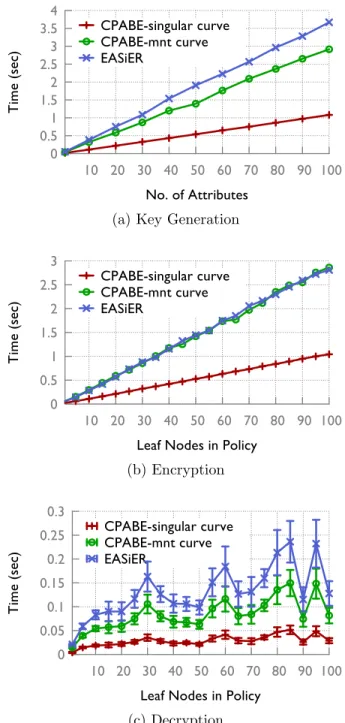
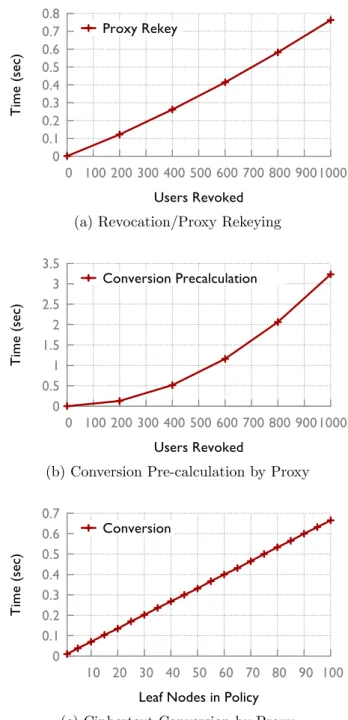
We provide some information on the performance evaluation of EASiER, and compare it with BSW CP-ABE. Though CP-ABE implementation uses sym-metric pairing, we use asymsym-metric pairing for both EASiER and CP-ABE in our implementation. This provides security by preventing key and cipher-text components exchange. The comparison results are shown in Figure 3.2, revocation/proxy re-keying time and the time to convert ciphertext by the proxy in EASiER are shown in Figure 3.3, and finally, the time to delegate keys and decrypt with a delegated key are shown in Figure 3.4.
Key Generation: Key generation time is linear with number of attributes both in BSW CP-ABE and EASiER. EASiER does extra exponentiation, and generates an extra component for each attribute. BSW CP-ABE with supersingular curve requires the least time as expected.
Encryption: To test encryption and decryption, we generated 10 different policies with a random combination ofands andors, and attributes randomly chosen from{attr1, attr2, . . . , attr100}for each of the desired number of leaves
(1,5,10, . . .100). An example policy is “attr1 and (attr2 or attr3 or (attr4
and attr5))”. Encryption is also linear with respect to the number of leaf
nodes in the policy. Since encryption is same in both the schemes, BSW CP-ABE with MNT and EASiER have the same performance.
0 0.5 1 1.5 2 2.5 3 3.5 4 10 20 30 40 50 60 70 80 90 100 T im e (s ec ) No. of Attributes CPABE-singular curve CPABE-mnt curve EASiER
(a) Key Generation
0 0.5 1 1.5 2 2.5 3 10 20 30 40 50 60 70 80 90 100 T im e (s ec )
Leaf Nodes in Policy CPABE-singular curve CPABE-mnt curve EASiER (b) Encryption 0 0.05 0.1 0.15 0.2 0.25 0.3 10 20 30 40 50 60 70 80 90 100 T im e (s ec )
Leaf Nodes in Policy CPABE-singular curve CPABE-mnt curve EASiER
(c) Decryption
Figure 3.2: Performance Analysis: Comparison of EASiER with
BSW-CPABE. Number of the revoked users is set to 500. (a) Secret key generation depends on the number of attributes in the key. (b) Encryption depends on the number of leaf nodes in the policy. (c) Decryption depends on the type of policy used to encrypt and the number of leaf nodes in the policy.
Decryption: Decryption depends on the policy used in encryption, and the attributes involved. We generated a decryption key with 100 attributes, i.e., the superset of all the attributes used to generate the policies, and so it satisfies each of the policies used in encryption. The decryption results are shown with a 95% confidence interval. All the lines show the performance when an optimization was used to ensure the usage of the minimum number of leaves in the algorithm DecryptNode.
Proxy Rekey and Conversion: EASiER involves two extra costs before decryption: re-keying the proxy and converting the ciphertext components specific to the leaves in the policy. The re-keying results (Figure 3.3a) show that for even 1 000 revoked users, the time required is around 0.8 second. This should be compared with the time required to rekey the rest of the group, i.e., generate a new key for everyone, when even one person in the group is revoked. The latter number depends on group size and number of attributes in the key. For example, to rekey a group of size 100 each with a key size of 20 attributes in CP-ABE-singular curve setting (Figure 3.2a), the time will be 22 seconds (100×0.22).
Conversion primarily involves one exponentiation for each of the leaf spe-cific ciphertext components. It also calculates λk for the requester uk, and
completes theλisfor each of the revoked users. We perform an optimization
by allowing the proxy to pre-calculate a portion of the λi’s in theConvert
algorithm. With the optimization, the proxy needs to do 1 multiplication per revoked user to calculateλi. LetRLbe the list of revoked user. It works
as follows: λ0i = Y ui,uj∈RL,i6=j uj (uj−ui) , and l0i =λ0iP(ui)
0 0.1 0.2 0.3 0.4 0.5 0.6 0.7 0.8 0 100 200 300 400 500 600 700 800 900 1000 T im e (s ec ) Users Revoked Proxy Rekey
(a) Revocation/Proxy Rekeying
0 0.5 1 1.5 2 2.5 3 3.5 0 100 200 300 400 500 600 700 800 900 1000 T im e (s ec ) Users Revoked Conversion Precalculation
(b) Conversion Pre-calculation by Proxy
0 0.1 0.2 0.3 0.4 0.5 0.6 0.7 10 20 30 40 50 60 70 80 90 100 T im e (s ec )
Leaf Nodes in Policy Conversion
(c) Ciphertext Conversion by Proxy
Figure 3.3: Performance Analysis: Time Required for Revocation/Rekeying the Proxy and Ciphertext Conversion. (a) Generating proxy key depends on the number of revoked users. (b) Partial pre-calculation of ciphertext conversion depends on the number of users revoked (c) Ciphertext conversion depends on the number of leaf nodes in policy and is hardly affected by the number of users revoked.