HAL Id: hal-02282084
https://hal.archives-ouvertes.fr/hal-02282084
Submitted on 9 Sep 2019
HAL is a multi-disciplinary open access archive for the deposit and dissemination of sci-entific research documents, whether they are pub-lished or not. The documents may come from teaching and research institutions in France or abroad, or from public or private research centers.
L’archive ouverte pluridisciplinaire HAL, est destinée au dépôt et à la diffusion de documents scientifiques de niveau recherche, publiés ou non, émanant des établissements d’enseignement et de recherche français ou étrangers, des laboratoires publics ou privés.
Multi-class SVM for relation extraction from clinical
reports
Anne-Lyse Minard, Anne-Laure Ligozat, Brigitte Grau
To cite this version:
Anne-Lyse Minard, Anne-Laure Ligozat, Brigitte Grau. Multi-class SVM for relation extraction from clinical reports. Recent Advances in Natural Language Processing, Jan 2011, Hissar, Bulgaria. �hal-02282084�
Multi-class SVM for relation extraction from clinical reports
Anne-Lyse Minard1, 2, Anne-Laure Ligozat1, 3, Brigitte Grau1, 3(1) LIMSI-CNRS, BP 133, 91403 Orsay Cedex, France (2) Universit´e Paris-Sud, 91400 Orsay, France (3) ENSIIE, 1 square de la r´esistance, 91000 ´Evry, France
Abstract
Information extraction in specialized texts raises different problems related to the kind of searched information. In this pa-per, we are interested in relation identifi-cation between some concepts in medical reports, task that was evaluated in the i2b2 2010 challenge. As relations are expressed in natural language with a great variety of forms, we proceeded to sentence analysis by extracting features that enable all to-gether to identify a relation and we mod-eled this task as a multi-class classification based on an SVM, each type of relation representing a class. We will present the selection of the features used by our sys-tem and an error analysis. This approach allowed us to obtain a F-measure of 0.70, classifying the system among the best sys-tems.
1 Introduction
Medical information systems have improved past years and are used for the storage of the infor-mation, to facilitate the access to data, to help to search medical information about the patient or to provide decision support to improve the quality of care. The information processed concerns mainly medical literature and medical records of patients, such as the clinical reports and the consultation reports, which contain a lot of information about the medical follow-up. A large part of this infor-mation is under a textual form, so an issue is to be able to automatically extract information from texts. The need to convert all this information to some structured form is currently an important is-sue as it is the starting point for the development of interrogation tools and automatic processing of this information.
Extraction of medical information raises dif-ferent problems related to the kind of
informa-tion sought in texts: the recogniinforma-tion of medi-cal terms, related concepts and relations between them. A terminologic analysis of the documents can allow to build semantic indexes used to search information (Jonquet et al., 2010). Identifying relations between concepts gives a more struc-tured representation. That is useful for precise information retrieval, for example for Question-Answering systems (Tjongkimsang et al., 2005), (Embarek and Ferret, 2010).
In this paper, we present our work1on the iden-tification of relations in clinical reports, task of the i2b2 2010 challenge 2. One of the goals of the challenge was to identify several kinds of relations between concepts (treatment, test and problem). These relations are expressed in the reports by a wide range of wordings. The incompleteness of semantic knowledge bases combined with the dif-ficulty of relating wordings with conceptual rep-resentations is an obstacle to the realization of a deep analysis of sentences which would highlight the relations between concepts.
Thus, we considered that several sentence char-acteristics such as the words used, their syntactic category help to detect the presence of a relation. We realized shallow analysis to extract the useful features for the detection of a relation. And we considered relation identification as a multi-class classification task, with each category of relation is considered as a class.
2 Related work
The first approach for relation extraction is based on handmade patterns. In the medical domain, the SemRep system (Rindflesch et al., 2000) was developed to identify branching of anatomical re-lations from reports. It was also applied to de-tect relations between medical problems and their
1
This work has been partially supported by OSEO under the Quaero program.
treatments (Srinivasan and Rindflesch, 2002). The MedLEE system extracts relations from radio-graphic reports, biomolecular interactions (Fried-man et al., 2001) and gene-phenotype relations (Chen and Friedman, 2004).
These approaches are not very robust and are mainly efficient in precision. So, other ap-proaches are based on supervised machine learn-ing. (Uzuner et al., 2010) use SVM (Support Vec-tor Machines) to class relations between medical problems, tests and treatments in clinical reports. They use surface features (ordering of the con-cepts, distance, etc.), lexical features (lexical tri-grams, tokens-in-concepts, etc.), and shallow syn-tactic features (verbs, synsyn-tactic bigrams, syntac-tic link path, etc.). They obtain an F-measure from 0.60 to 0.85, but for under-represented re-lations the classification did not work. (Roberts et al., 2008) also use a SVM to extract relations in the corpus of the Clinical E-Science Framework (CLEF) project that hold between entities (e.g. condition, drug, result) and modifiers (e.g. nega-tion) in clinical records of cancer patients. There are seven classes of relations and each entity pair can be linked by only one relation (except between an investigation and a condition). So the classifi-cation task is considered as a binary classificlassifi-cation (i.e. the detection of relation) between a type of relation and the non-relation class. They also use lexical, morpho-syntactic and semantic features.
In the general domain, (Zhou et al., 2005) use SVM to identify relations between people, organi-zations and places, etc. on the ACE corpus.
Our system also uses SVM to classify fine-grained relations. We use classical features as well as features specific to the domain, as the seman-tic types of the UMLS3and medical abbreviation lists, and features specific to the writing style of texts, for handling concept coordination.
3 Corpus
The corpus used contains reports from several medical centers in the USA. It was provided by i2b2 organizers. The texts were manually anonymized and annotated to build the reference. A first corpus was given before the evaluation phase, it consists of 350 documents. We divided this corpus in two parts: training corpus (4515 in-stances of relations) and test (749 inin-stances of
re-3Unified Medical Language System (http
://www.nlm.nih.gov/research/umls/)
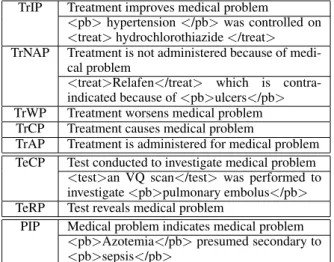
TrIP Treatment improves medical problem
<pb>hypertension</pb>was controlled on
<treat>hydrochlorothiazide</treat>
TrNAP Treatment is not administered because of medi-cal problem
<treat>Relafen</treat> which is contra-indicated because of<pb>ulcers</pb>
TrWP Treatment worsens medical problem TrCP Treatment causes medical problem
TrAP Treatment is administered for medical problem TeCP Test conducted to investigate medical problem
<test>an VQ scan</test>was performed to investigate<pb>pulmonary embolus</pb>
TeRP Test reveals medical problem
PIP Medical problem indicates medical problem
<pb>Azotemia</pb>presumed secondary to
<pb>sepsis</pb>
Table 1: The eight relations to identify
lations). For the final evaluation, i2b2 organizers gave participants a corpus of 477 documents.
Three types of concepts were manually anno-tated in the corpora:
• Medical problems defined as the observations made by patients or clinicians about what are thought to be abnormal or caused by a disease.
• Treatments defined as the procedures, interven-tions, substances and drugs given to the patient to treat a medical problem.
• Tests defined as the procedures and examina-tions that are done to a patient or body fluid to control or rule out a medical problem.
Between these three kinds of concepts, eight re-lations can exist. The rere-lations are described in table 1.
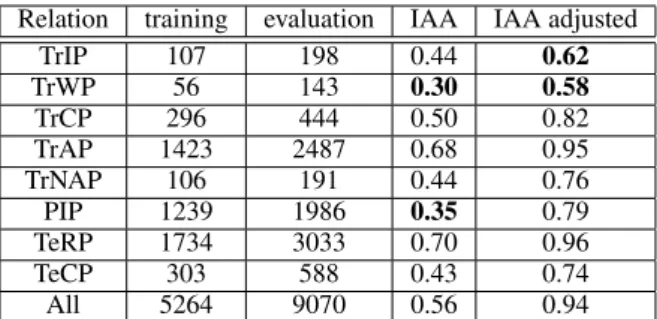
The number of instances of each relation in the corpus is presented table 2. We also mention of the inter-annotator agreement (IAA) calculated by the i2b2 organizers. The adjusted IAA was ob-tained after discussion on problematic cases. We can observe that the IAA is low for TrWP and TrIP relations.
The corpus is made of short sentences (on aver-age 17 words per sentence in the training corpus). Clinical reports are often hold with fragments of sentence (1) and enumerations (2).
(1) <pb> C5-6 disc herniation</pb> with <pb>cord compression</pb>and<pb>myelopathy</pb>.
(2) Revealed <pb>icteric sclerae</pb>, <pb>the oropharynx with extensive thrush</pb>, and<pb>an ulcer under his tongue</pb>.
Relation training evaluation IAA IAA adjusted TrIP 107 198 0.44 0.62 TrWP 56 143 0.30 0.58 TrCP 296 444 0.50 0.82 TrAP 1423 2487 0.68 0.95 TrNAP 106 191 0.44 0.76 PIP 1239 1986 0.35 0.79 TeRP 1734 3033 0.70 0.96 TeCP 303 588 0.43 0.74 All 5264 9070 0.56 0.94
Table 2: Number of each instances of relations and inter-annotator agreement (IAA)
4 Method
4.1 Preprocessing of the corpus
Texts were preprocessed and normalized before the classification process. First, abbreviations were replaced with their meanings, thanks to a list. This list was built for the i2b2 20094 chal-lenge by (Del´eger et al., 2010) from the biomed-ical abbreviation list of Berman 5 and examples found in the i2b2 2009 corpus. For example,h.o. is converted inhistory ofandp.r.n.intoas needed. Then we substituted the anonymized data with the markupsNAME,DATEandAGE, and numer-ical values (mainly proportions) are replaced with the markupNUM. Finally texts are part-of-speech (POS) tagged by the TreeTagger (Schmid, 1994) in order to have lemmas and POS categories.
4.2 Classification
Our classification task was based on SVM imple-mentation of LIBSVM tool (Chang and Lin, 2001) parametrized for a multi-class classification ( one-versus-onevoting). We used a RBF kernel, which gave better results than a linear kernel. The pa-rameters are chosen by the scriptgrid.pyprovided with LIBSVM. Thecparameter was set to 16 and thegammaparameter to 0.03125. We also tested a classification by pair of concepts by training a classifier for relations between a test and a medi-cal problem, then between a treatment and a med-ical problem, and between two medmed-ical problems. But results were lower than when we learned with all the relations. The features used for the classi-fication captures surface information, such as the position of the two candidate concepts, lexical in-formation, for example the words which refer to the concepts, syntactic information as POS tags,
4
https://www.i2b2.org/NLP/Medication/
5http://www.julesberman.info/abbtwo.htm
and semantic information. The features are au-tomatically computed, if necessary by using tools and external resources. Each feature has an unique identifier, which is set to one if it appears else zero.
4.2.1 Surface features
Ordering of the candidate concepts:the
expres-sion of the relation depends on the position of the test or treatment compared with the problem. In example (3) the test is expressed before the re-vealed problem, and in example (4) the problem is before the test.
(3) She had<test>a workup</test>by her neurologist and <test>an MRI</test> revealed <pb>a C5-6 disc herniation</pb>[...]
(4) The patient was<pb>thrombocytopenic</pb>with
<test>a platelet count</test> of <NUM> on the
<NUM>.
Distance(i.e. number of words6) between the
candidate concepts: in the training corpus there is never more than 65 words between two related concepts. However two concepts which are not in relation can be separated by a maximum of 205 words. The value of this feature is a number.
Presence of other concepts between the
can-didate concepts: for 80% of the concept pairs in relation in the training corpus there are no other concepts between them.
4.2.2 Lexical features
The words and stems 7 which constitute the
concepts and the headword 8 of each concept.
The stems are used to group inflectional and derivational variations together. The words of con-cepts can trigger relations. For example in (5) the adjective recurrentis the trigger of a TrWP rela-tion (a treatment worsens a problem).
(5) He has had <NUM> week courses of
<treat>antibiotics</treat> with <pb>recurrent
bacteremia</pb>.
The stems of the three words in the left and
right context of candidate concepts. After several experiments we chose a window of three words; with bigger or smaller windows, the precision lightly increases but the recall decreases.
6
The words include also the punctuation signs.
7
We use the PERL module lingua::stem to obtain the stem of the word.
8The headword is the word which precedes a preposition
Relation base +dist +conc +dir +verb +prep +intra +types TrIP 0.333 0.333 0.333 0.333 0.235 0.235 0.235 0.235 TrWP 0.000 0.000 0.000 0.000 0.000 0.000 0.000 0.000 TrCP 0.366 0.370 0.405 0.411 0.424 0.441 0.526 0.517 TrAP 0.620 0.638 0.708 0.721 0.708 0.706 0.737 0.726 TrNAP 0.620 0.620 0.620 0.620 0.666 0.666 0.666 0.620 PIP 0.611 0.613 0.664 0.664 0.654 0.671 0.618 0.659 TeRP 0.790 0.792 0.833 0.843 0.850 0.848 0.866 0.866 TeCP 0.253 0.253 0.373 0.351 0.373 0.351 0.333 0.285 All 0.647 0.652 0.704 0.712 0.711 0.713 0.724 0.727
Table 3: Variation of the F-measure according to the features (test corpus)
The stems of the words between candidate
concepts; the most important information for the classification is located here.
The stems of the verbsin the three words at the
left and right of candidate concepts and between them. The verb is often the trigger of the relation: for example in (6) the TeRP relation (a test reveals a problem) is expressed byreveal.
(6) <test>CT scan</test>was obtained and thisrevealed
<pb>free air</pb>and<pb>massive ascites</pb>.
The prepositions between candidate concepts.
In (7) the prepositionforindicates a TrAP relation (a treatment is administered for a problem).
(7) She was treated with <treat>IVF</treat> for
<pb>her ARF</pb>.
4.2.3 Morpho-syntactic features
The morpho-syntactic tagsof the three words at
the left and right of candidate concepts: the tags come from the TreeTagger.
The presence of a prepositionbetween
candi-date concepts, regardless of the preposition.
The presence of a punctuation sign between
candidate concepts, if it is the only “word”. This feature is useful for considering lists.
4.2.4 Semantic features
The semantic type (from the UMLS)of the three
words at left and right of candidate concepts. In the example (3)neurologisthas the semantic type professional or occupational group.
The types of candidate concepts (problem,
test or treatment): it is the most important feature, because the relations are expressed differently be-tween a test and a problem, a treatment and a prob-lem, and between two problems.
The VerbNet’s classes 9 (an expansion of
Levin’s classes) of the verbs in the three words at the left and right of candidate concepts and be-tween them. For example reveal is member of the class indicate-78-1-1which contains also the verbs show, prove, demonstrate, etc. In exam-ples (6) and (8)revealandshoware triggers of the same relation.
(8) <test>Recent chest x-ray</test> shows
<pb>resolving right lower lobe pneumonia</pb>.
4.2.5 Coordination
Two concepts in relation can be separated by other concepts which do not carry information about the relation. So, we processed sentences before the feature extraction. We deleted other concepts in coordination with candidate concepts, and we added three features: the number of deleted con-cepts, the coordination words that are the trig-gers of the deletion (or, and, a comma), and a feature which indicates that the sentence was re-duced. Coordinations are often a sign of the lack of relation, while they add information that are not useful to type it and even create some noise. In the training corpus, for 23% of the pairs of concepts (3819 pairs on 16437) the sentences have been re-duced. In the example (6) for the pairCT scanand massive ascites, after reduction the sentence seg-ment is: CT scan was obtained and this revealed massive ascites.
4.2.6 Feature relevance
We evaluated the usefulness of each feature with the same method as (Roberts et al., 2008). We ob-served the performances of the system on the test corpus by adding features class by class. Results are shown in table 3.
The features are grouped in categories accord-ing to the information they describe. The cate-gory base contains the stems of the words, the morpho-syntactic tags of the three words at the left and right of the concepts, and the stems of the words between the concepts. Then we added the categorydist(distance between the concepts), conc(the other concepts),dir(the ordering of the concepts), verb (the stems of the verbs and the VerbNet classes), prep (the prepositions between the concepts),intra(the constituent words and the headword of the concepts) and types (semantic types). The results of the last column in the table is the results of the system with all the features, this system corresponded to the system used for the evaluation. In this system we did not use the fea-tures about the coordination of the concepts. We separately evaluated these features, which increase the F-measure of the final system of 0.002. 5 Evaluation
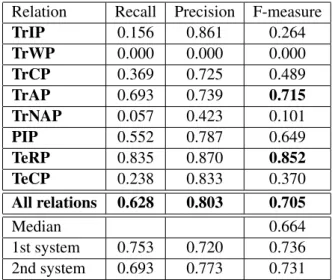
Table 4 shows the results obtained. We achieved better results over well-represented relations (such as TeRP relation for which the system scored an F-measure of 0.852) than over smaller classes of relations (such as TrCP relation with an F-measure of 0.489).
For the i2b2 challenge, we used this system (without the control of the coordination) and we combined it with some patterns to identify the four under-represented relations (patterns have priori-ties on the classifier). Our system obtained an F-measure of 0.709, and ranked 3rd out of 16 par-ticipants. In table 4 we show the results of the 1st and 2nd best systems and the median.
For classification of non-relations, our system obtained a recall of 0.93, a precision of 0.84 and an F-measure of 0.89.
6 Error analysis
For relations occurring between a treatment and a medical problem, we observed that the misclassi-fied relations are mainly classimisclassi-fied in the TrAP cat-egory (treatment is administered for medical prob-lem) or as a non-relation. For example 54% of TrIP relations (treatment improves medical prob-lem) are classified as a non-relation and 31% as TrAP relation. It is sometimes difficult to differ-entiate a TrIP or TrAP relation, because the TrIP relation is a specific relation of TrAP. Indeed if a treatment improves a medical problem so the
treat-Relation Recall Precision F-measure
TrIP 0.156 0.861 0.264 TrWP 0.000 0.000 0.000 TrCP 0.369 0.725 0.489 TrAP 0.693 0.739 0.715 TrNAP 0.057 0.423 0.101 PIP 0.552 0.787 0.649 TeRP 0.835 0.870 0.852 TeCP 0.238 0.833 0.370 All relations 0.628 0.803 0.705 Median 0.664 1st system 0.753 0.720 0.736 2nd system 0.693 0.773 0.731
Table 4: Recall, precision and F-measure obtained on the evaluation corpus
ment is administered because of a medical prob-lem. It is the same for TrWP relation which in-cludes cases where the treatment is administered for a medical problem but worsens it: this relation is a specific case of TrAP relation.
For relations between two medical problems, we observed that 50% of PIP relations (medical problem indicates medical problem) were not de-tected. In the training corpus there are enough ex-amples, but the description of the relation might not be precise enough (see IAA in table 2). In ex-ample (9) a PIP relation was annotated between symptomsandanxiety, but not in the example (10) betweensymptomsanddry cough.
(9) She was hooked up with support services in Collot Ln, Dugo, Indiana <NUM> for
<treat>further counselling</treat> and given
<treat>Xanax</treat> for <pb>symptoms</pb>
of<pb>anxiety</pb>.
(10) Pt was o/w in his USOH until <NUM> weeks ago when he developed <pb>a URI</pb> with
<pb>symptoms</pb> of <pb>dry cough;</pb>
no<pb>fever</pb>[...]
We have found three types of errors:
• The relation is expressed by a verb or an expres-sion, but this construction is not represented in the training corpus. In (11), the system classi-fied the relation betweenpulmonary nodules in his RMLandfu imagingas TeRP. Indeedreveal is a trigger of a TeRP relation, and the trigger of the TeCP relation iswhich need, but this last verb occurs only once in the training corpus.
(11) <test>CTS chest</test>was negative for<pb>PE
</pb>, however it did reveal <pb>pulmonary nodules in his RML</pb> which need <test>fu imaging</test>in<NUM>months.
• The relation cannot be classified without using external resources or more training corpus. In (12) the system wrongfully detected a relation, as it would need to know that there is no rela-tion possible between incisions and obesity to correctly classify the relation.
(12) <pb>obese</pb> with <pb>multiple well healed surgical incisions</pb>, positive bowel sounds.
• The annotation of the relation is debatable. In (9) a relation betweensymptomsandanxietyhas been annotated, but this two terms make refer-ence to the same concept.
To improve the extraction of under-represented relations such as TrWP or TrIP, a bigger corpus is necessary, as the problem is the lowest number of occurrences of these relations in the corpus. How-ever there is no such annotated available corpus. 7 Conclusion
Relation extraction between concepts in clinical reports is a task that helps improve access to in-formation in medical documentation. This task is based on the recognition of the several wordings that the relation can take in the sentences. This variability is very important as for the vocabulary variability as syntactic structures. So, we have taken into account these variabilities by defining different features, which can describe such kinds of sentences. We used features specific to the do-main, the type of concepts for instance, features specific to the kind of texts and general domain features. We obtained very good results thanks to the selection of the features and the combina-tion we made. The selected features are general enough that they can be used on corpus in other fields, with an adaptation of the domain dependent features (such as semantic types).
The results are low for not well-represented re-lations in the corpus. To have more instances of these relations, we could operate a reduction of the syntactic variability and a simplification of sen-tences before the learning stage.
References
Chih-Chung Chang and Chih-Jen Lin, 2001. LIBSVM: a library for support
vector machines. Software available at http://www.csie.ntu.edu.tw/ cjlin/libsvm.
Lifeng Chen and Carol Friedman. 2004. Extracting phenotypic information from the literature via nat-ural language processing. In Medinfo 2004: Pro-ceedings Of THe 11th World Congress On Medical Informatics.
Louise Del´eger, Cyril Grouin, and Pierre Zweigen-baum. 2010. Extracting medical information from narrative patient records: the case of medication-related information.JAMIA, 17(5):555–558. Mehdi Embarek and Olivier Ferret. 2010. Can
escu-lape cure the complex of œdipe in the medical do-main? InAdaptivity, Personalization and Fusion of Heterogeneous Information, RIAO ’10.
Carol Friedman, Pauline Kra, Hong Yu, Michael Krauthammer, and Andrey Rzhetsky. 2001. Ge-nies: a natural-language processing system for the extraction of molecular pathways from journal arti-cles. Bioinformatics, 17.
Clement Jonquet, Paea LePendu, Sean M. Falconer, Adrien Coulet, Natalya F. Noy, Mark A. Musen, and Nigam H. Shah. 2010. Ncbo resource index: Ontology-based search and mining of biomedical re-sources. In Semantic Web Challenge, 9th Interna-tional Semantic Web Conference, ISWC’10. Thomas C. Rindflesch, Carol A. Bean, and Charles A.
Sneiderman. 2000. Argument identification for arterial branching predications asserted in cardiac catheterization reports. InAMIA Annu Symp Proc. Angus Roberts, Robert Gaizauskas, and Mark
Hep-ple. 2008. Extracting clinical relationships from pa-tient narratives. InBioNLP2008: Current Trends in Biomedical Natural Language Processing.
Helmut Schmid. 1994. Probabilistic part-of-speech tagging using decision trees. InProceedings of the International Conference on New Methods in Lan-guage Processing, pages 44–49.
Padmini Srinivasan and Thomas Rindflesch. 2002. Ex-ploring text mining from medline. In Proc AMIA Symp, pages 722–726.
Erik Tjongkimsang, Gosse Bouma, and Maarten de Ri-jke. 2005. Developing Offline Strategies for An-swering Medical Questions. InProceedings of the AAAI-05 Workshop on Question Answering in Re-stricted Domains, Pittsburgh, PA, USA.
Ozlem Uzuner, Jonathan Mailoa, Russell Ryan, and Tawanda Sibanda. 2010. Semantic relations for problem-oriented medical records. Artificial Intel-ligence in Medicine, 50:63–73.
GuoDong Zhou, Jian Su, Jie Zhang, and Min Zhang. 2005. Exploring various knowledge in relation ex-traction. InProceedings of the 43rd Annual Meeting of the ACL, pages 427–434.