Florida International University
FIU Digital Commons
FIU Electronic Theses and Dissertations University Graduate School
6-5-2014
Integrity-Based Kernel Malware Detection
Feng Zhu
Follow this and additional works at:http://digitalcommons.fiu.edu/etd
Part of theComputer Security Commons
This work is brought to you for free and open access by the University Graduate School at FIU Digital Commons. It has been accepted for inclusion in FIU Electronic Theses and Dissertations by an authorized administrator of FIU Digital Commons. For more information, please [email protected]. Recommended Citation
Zhu, Feng, "Integrity-Based Kernel Malware Detection" (2014).FIU Electronic Theses and Dissertations.Paper 1572. http://digitalcommons.fiu.edu/etd/1572
FLORIDA INTERNATIONAL UNIVERSITY Miami, Florida
INTEGRITY-BASED KERNEL MALWARE DETECTION
A dissertation submitted in partial fulfillment of the requirements for the degree of
DOCTOR OF PHILOSOPHY in COMPUTER SCIENCE by Feng Zhu 2014
ii To: Dean Amir Mirmiran
College of Engineering and Computing
This dissertation, written by Feng Zhu, and entitled Integrity-Based Kernel Malware Detection, having been approved in respect to style and intellectual content, is referred to you for judgment.
We have read this dissertation and recommend that it be approved.
_______________________________________ Bogdan Carbunar _______________________________________ Xudong He _______________________________________ Gang Quan _______________________________________ Geoffrey Smith _______________________________________ Jinpeng Wei, Major Professor
Date of Defense: June 5, 2014
The dissertation of Feng Zhu is approved.
_______________________________________
Dean Amir Mirmiran
College of Engineering and Computing
_______________________________________ Dean Lakshmi N. Reddi University Graduate School
iii
© Copyright 2014 by Feng Zhu All rights reserved.
iv
DEDICATION
v
ACKNOWLEDGMENTS Thanks, everyone!
vi
ABSTRACT OF THE DISSERTATION
INTEGRITY-BASED KERNEL MALWARE DETECTION by
Feng Zhu
Florida International University, 2014 Miami, Florida
Professor Jinpeng Wei, Major Professor
Kernel-level malware is one of the most dangerous threats to the security of users on the Internet, so there is an urgent need for its detection. The most popular detection approach is misuse-based detection. However, it cannot catch up with today's advanced malware that increasingly apply polymorphism and obfuscation. In this thesis, we present our integrity-based detection for kernel-level malware, which does not rely on the specific features of malware.
We have developed an integrity analysis system that can derive and monitor integrity properties for commodity operating systems kernels. In our system, we focus on two classes of integrity properties: data invariants and integrity of Kernel Queue (KQ) requests. We adopt static analysis for data invariant detection and overcome several technical challenges: field-sensitivity, array-sensitivity, and pointer analysis. We identify data invariants that are critical to system runtime integrity from Linux kernel 2.4.32 and Windows Research Kernel (WRK) with very low false positive rate and very low false negative rate. We then develop an Invariant Monitor to guard these data invariants against real-world malware. In our experiment, we are able to use Invariant Monitor to detect ten
vii
real-world Linux rootkits and nine real-world Windows malware and one synthetic Windows malware.
We leverage static and dynamic analysis of kernel and device drivers to learn the legitimate KQ requests. Based on the learned KQ requests, we build KQguard to protect KQs. At runtime, KQguard rejects all the unknown KQ requests that cannot be validated. We apply KQguard on WRK and Linux kernel, and extensive experimental evaluation shows that KQguard is efficient (up to 5.6% overhead) and effective (capable of achieving zero false positives against representative benign workloads after appropriate training and very low false negatives against 125 real-world malware and nine synthetic attacks).
In our system, Invariant Monitor and KQguard cooperate together to protect data invariants and KQs in the target kernel. By monitoring these integrity properties, we can detect malware by its violation of these integrity properties during execution.
viii TABLE OF CONTENTS CHAPTER PAGE 1. INTRODUCTION ... 1 1.1. Motivation ... 1 1.2. Contribution ... 2 1.3. Research Goals ... 4 1.4. Outline ... 4 1.5. Publications ... 5 2. BACKGROUND ... 6
2.1. Background on Integrity Measurement and Security Assumptions ... 6
2.2. Data Invariant ... 7
2.2.1. Data Invariants and Their Relevance in Integrity Protection ... 7
2.2.2. Existing Solutions ... 8
2.3. Kernel Queue ... 9
3. Invariant Analysis System ... 11
3.1. Automated inference of global invariants through static analysis... 13
3.1.1. Overview ... 13
3.1.2. Design Goals ... 14
3.1.3. Major Design Points of the Assignment Recognition ... 16
3.1.3.1. Field Sensitivity ... 17
3.1.3.2. Array Sensitivity ... 17
3.1.3.3. Pointer Analysis ... 17
3.1.3.4. Union Support ... 18
3.1.3.5. Heuristics-base Assignment Recognition ... 18
3.1.4. Constant Invariant Recognition ... 19
3.1.5. Recognition of Other Kinds of Invariant ... 21
3.1.6. Implementation ... 23
3.2. Evaluation ... 23
3.2.1. Metrics, Methodology, and Test Cases ... 23
3.2.1.1. Comparing with a Dynamic Invariant Detector ... 24
3.2.1.2. Constant Invariants ... 25
3.2.1.3. Other Kinds of Invariants ... 32
3.2.1.4. Summary of Statically Detected Invariants ... 33
3.2.2. Experimental Evaluation ... 34
3.2.2.1. Implementation of the Invariant Monitor ... 34
3.2.2.2. Evaluation of False Positives ... 36
3.2.2.3. Evaluation of False Negatives ... 37
3.2.2.4. Performance Overhead ... 38
3.3. Limitations of Our Approach ... 40
3.4. Related Work ... 41
ix
4. Kernel Queue Analysis System ... 46
4.1. Problem Analysis: KQ Injection ... 47
4.1.1. Importance of KQ Injection Attacks ... 47
4.1.2. KQ Injection Attack Model ... 49
4.1.3. Design Requirements of KQ Defense ... 50
4.2. Design of KQguard ... 51
4.2.1. Architecture Overview and Assumptions ... 51
4.2.2. Building the EH-Signature Collection ... 54
4.2.2.1. Instrumentation of the Kernel to Log EH-Signatures ... 54
4.2.2.2. Dynamic Profiling to Collect EH-Signatures ... 55
4.2.3. Validation Using EH-Signature Collection ... 55
4.2.4. Specification of the Callback-Signatures ... 56
4.2.5. Generation of Callback-Signatures from KQ Requests ... 60
4.2.5.1. Motivation for Delinking ... 60
4.2.5.2. Details of Delinking ... 61
4.2.6. Automated Detection of KQs... 64
4.3. Implementations of KQguard ... 66
4.3.1. KQguard Implementation on WRK ... 66
4.3.2. KQguard Implementation in Linux kernel ... 68
4.3.3. KQguard Protection ... 69
4.4. Evaluation of KQguard ... 70
4.4.1. Real-World KQ Injection Attacks ... 70
4.4.2. Protection of All KQs ... 72 4.4.3. Protection of KQguard ... 72 4.4.4. False Alarms ... 73 4.4.5. Performance Overhead ... 75 4.5. Related Work ... 76 4.6. Summary ... 78
5. CONCLUSION AND FUTURE WORK ... 79
5.1. Conclusion ... 79
5.2. Future Work ... 82
REFERENCES ... 85
x
LIST OF TABLES
TABLE PAGE
Table 3.1 Overall result of the constant invariant detection ... 25
Table 3.2 Comparison of the static and dynamic analysis results for the .data segment (FN: false negative; FP: false positive) ... 26
Table 3.3 Examples of non-constants ... 30
Table 3.4 Size Distribution of Membership Invariants ... 33
Table 3.5 Summary of Statically Detected Invariants ... 33
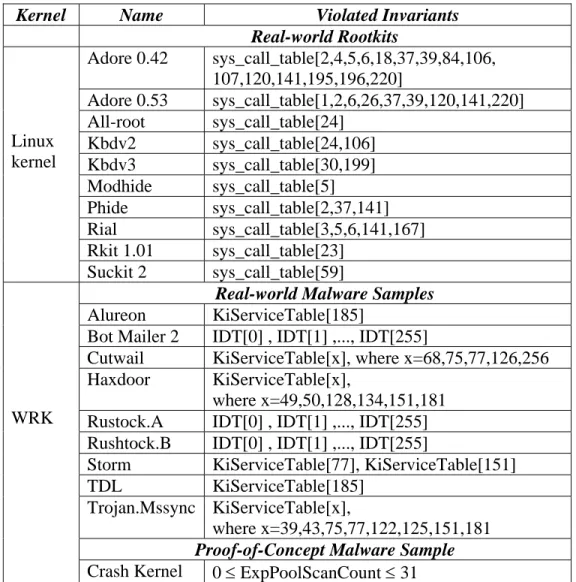
Table 3.6 Rootkit Detection Results ... 38
Table 4.1 Representative Automatically Detected KQs ... 68
Table 4.2 Known KQ Injection Attacks in Representative Malware ... 71
xi
LIST OF FIGURES
FIGURE PAGE
Figure 1.1 The architecture of our system ... 4
Figure 3.1 Invariant analysis architecture ... 13
Figure 3.2 Snippet of the analysis report that shows why ctrl_map[2] can be indirectly modified through the pointer key_map ... 28
Figure 3.3 Relevant Code Path For the False Negatives in WRK ... 31
Figure 3.4 One example of automatically generated code for checking invariants at runtime ... 35
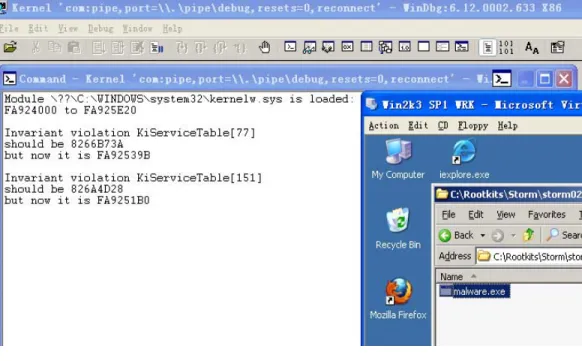
Figure 3.5 Detection of the invariant violation by Storm ... 39
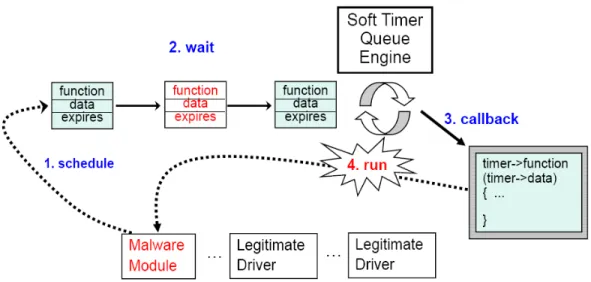
Figure 4.1 Life cycle of a timer request in Linux ... 48
Figure 4.2 Overall Architecture of KQguard ... 53
Figure 4.3 Illustration of a False Negative Caused by a Callback-Signature that Only Includes the Shaded Fields. The two KQ requests have different executions (i.e., bar_one vs bar_two), but their Callback-Signatures are the same. Here bar_two is a malicious function. ... 57
Figure 4.4 Illustration of Different Allocation Types of Pointers: (a) Heap Variable, (b) Global Variable, (c) Local Variable ... 62
Figure 4.5 Example Heap Allocation Call Stack ... 63
Figure 4.6 Details of the Power Management Notification Queue on Linux Kernel 2.4.32 ... 65
1
1. INTRODUCTION
1.1. Motivation
In today's world, the Internet has become an essential part of our daily life. People enjoy various services offered on the Internet such as eBay [1], which is an example of online commercial services provided on the Internet, or Fackbook [2], a representative of online social networking services. However, with more and more users on the Internet, their security becomes a serious problem. Especially, their security is significantly threatened by malware, which is software used or programmed by attackers to execute malicious logic that can damage computer system, disable computer services, steal sensitive information or get control of computer system. For instance, malware can be created and used by criminals to steal credit card information online for money purpose.
One of the most dangerous threats to systems security today is kernel-level malware such as rootkits. Because kernel-level malware is one type of malware that runs at the same privilege level as the operating systems kernel, it can affect the OS behavior for its malicious purpose. For example, a common attack of kernel-level malware is to alter the existing code and/or data of an OS for the purpose of hiding the runtime state of the system in terms of running processes, network connections, and files. Besides, kernel-level malware can add new functionalities to the OS to carry out malicious activities such as key logging and sensitive information collection. The detection of kernel-level malware is a difficult task because kernel-level malware may be able to subvert the software (normally running in user space) that is intended to find it.
To defend against kernel-level malware, it is necessary to detect its existence and then stop the execution of its malicious logic. One popular approach is to study behaviors of
2
malware by running it in a virtual machine or isolated sandbox. Such dynamic approach can never reason about all potential behaviors. If the malware performs differently while being analyzed, or can detect the analysis itself, then the malware has a high probability to escape detection. On the other hand, static approach, which performs code analysis to infer behaviors of malware without running it, also has difficulties: (1) the source code of malware samples is not readily available and analyzing binaries brings along intricate challenges. (2) a technique called code packing, which is a transformation of a complied program, is adopted by malware authors to obfuscate the intent of the malware and raise the difficulty of code analysis.
1.2. Contribution
Motivated by the above challenges, we propose our integrity-based detection for kernel-level malware in this thesis: we harden the system kernel so that malware can be detected due to the violation of integrity properties triggered by its execution. Integrity properties are attributes of the target system. For example, kernel code integrity is an important integrity property of a system and many rootkits try to subvert kernel code integrity to achieve their malicious goals such as concealing malicious running processes. Protection of kernel code integrity means preventing attackers from modifying existing code in a kernel or from executing injected code with kernel privilege, over the lifetime of the system.
Specifically, this thesis focus on two classes of integrity properties: (1) data
invariants. These invariants include properties of global data structures and serve as specifications of data structure integrity [4]. For example, they can represent critical system integrity properties such as the immutability of the Interrupt Descriptor Table
3
(IDT) and the system call table. Therefore, they have been checked by state-of-the-art integrity monitors [4][5]. (2) integrity of kernel callback queue (KQ) requests. In modern kernels, KQs are the mechanism of choice for handling events. However, KQs can also be abused by kernel-level malware to achieve their malicious goals by submitting their KQ requests. For example, the Pushdo/Cutwail spam bot has misused one KQ called Registry Operation Notification Queue in the Windows kernel to monitor, block, or modify legitimate registry operations [6]. Hence, the integrity of KQ requests is important to system security. In this thesis, we discuss how we derive specifications of legitimate KQ requests and use them to validate all KQ request.
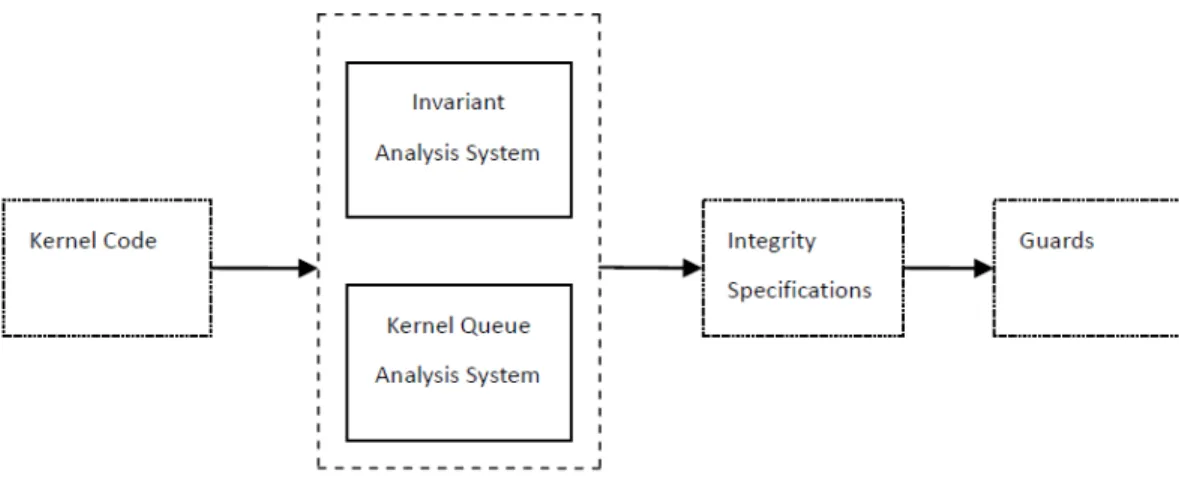
We have developed a system to derive and monitor these two classes of integrity properties (data invariants and integrity of KQ requests) for commodity operating systems kernels, which in turn can be used to detect or mitigate kernel-level malware. The architecture of our system is demonstrated in Figure 1.1.
Generally, in order to derive the specifications for these two integrity properties, we apply static analysis on the source code of the target kernel or perform dynamic analysis of the binary code of the target system. The specifications are then fed into the code generator to generate code that can guard the integrity properties of the target kernel as its extension. Due to the difference of these two kinds of integrity properties, we separate our system into two subsystems in real implementation: one for invariants and the other one for KQs. The invariant analysis subsystem generates the source code of Invariant Monitor, and KQ analysis subsystem produces EH-Signature (properties of legitimate KQ event handlers, which is discussed in Chapter 4) collection which is used by KQguard for validating KQ
4
requests. Invariant Monitor and KQguard work together to protect the target kernel. Details of the two subsystems are described in Chapter 3 and 4.
Figure 1.1 The architecture of our system 1.3. Research Goals
The main research problems we address in this thesis are:
(1) Deriving the two classes of integrity properties---data invariants and integrity of KQ requests from a commodity operating systems kernel.
(2) Monitoring the derived integrity properties and detecting kernel-level malware that violates the monitored integrity properties.
1.4. Outline
The rest of this document is organized as follows. Chapter 2 reviews the modeling of data invariants and KQs as important classes of integrity properties. Chapter 3 discusses our invariant analysis for Linux kernel and WRK, and malware detection based on our Invariant Monitor. Chapter 4 describes our kernel queue analysis for Linux kernel and
5
WRK, and the evaluation of our KQ guard against malware. Finally, Chapter 5 summarizes the conclusions and suggests future research directions.
1.5. Publications
Most of the material presented in this thesis has appeared previously in the following publications:
Feng Zhu and Jinpeng Wei (2014). "Static Analysis Based Invariant Detection for Commodity Operating Systems." Computer & Security, 43 (2014):49-63.
Jinpeng Wei, Feng Zhu, and Yasushi Shinjo. (2011) "Static Analysis Based Invariant Detection for Commodity Operating Systems". 7th International Conference on Collaborative Computing (CollaborateCom 2011), Orlando, FL, October 15-18, 2011. Jinpeng Wei, Feng Zhu, and Calton Pu (2013). "KQguard: Binary-Centric Defense against Kernel Queue Injection Attacks." Computer Security–ESORICS 2013. Springer Berlin Heidelberg, 2013. 755-774.
Specifically, the first two papers are about our invariant analysis work and are the base of Chapter 3. The last paper is for our KQ analysis work and presented in Chapter 4.
6
2. BACKGROUND
In this chapter, we first review the basics of integrity measurement and our assumptions; then we informally define invariants in the context of integrity protection against malware attacks. Finally we introduce the concept of kernel queue(KQ) and KQ injection attack.
2.1. Background on Integrity Measurement and Security Assumptions
An integrity measurement system typically consists of three components: the target system, the measurement agent, and the decision maker [7]. Our first assumption is that the measurement agent is isolated from and independent of the target system, therefore it has a true view of the internal states (including code and data) of the target system. This is a realistic assumption due to the popularity of virtual machine monitors [8] and machine emulators such as QEMU [9], and it has also been shown that the measurement agent can run on dedicated hardware such as a PCI card [10]. Our second assumption is that measurement results are securely stored and transferred to the decision maker. This can be supported by hardware such as a Trusted Platform Module (TPM) [11]. The third assumption is that the target system’s states (e.g., code and data) may be compromised by a powerful adversary who can make arbitrary modifications; therefore the decision maker can rely on very few assumptions about the trustworthiness of the target system.
Based on these assumptions, the decision maker is given a true view of the target system, and its task is to estimate the “healthiness” of the target system. The healthiness include functional correctness (e.g., a function that is supposed to reduce the priority level of a task is not modified to actually increase the priority level), and non-functional
7
correctness (e.g., the priority level can be modified by a privileged user instead of a normal user). In the following subsections, we model the healthiness as integrity properties.
Moreover, the healthiness of the target system may change over time, because it may be under constant attacks. Therefore, the integrity of the target system may need to be periodically reevaluated.
2.2. Data Invariant
In this section, we first define invariants in this thesis and then discuss existing solutions for invariant analysis.
2.2.1. Data Invariants and Their Relevance in Integrity Protection
An invariant is a property that holds at a certain point or points in a program. In this thesis, we are interested in invariant properties that are true over all program executions. More specifically, we focus on four kinds of invariants: constant (var const), membership (var {a, b, c}), bounds (var ≥ const) (var const), and non-zero (var ≠ 0) in
this thesis. The reason of this design is that other invariant analysis tools (e.g., Gibraltar [4], ReDAS [5], etc) also focus on these kinds of invariants.
Data invariants are one important class of integrity properties that concerns the expected values of program variables (other integrity properties include control flow integrity and information flow integrity). Since the behavior of a program can largely depend on its variables, manipulation of data has been an important malware attack technique. For example, many rootkits (such as Adore, Haxdoor, and SucKIT) have attacked immutable kernel data (such as system call table, System Service Descriptor Table, and SYSENTER handler function), which can be characterized as violations of
8
constant invariants. As another example, malware can manipulate a variable used as the index into a global array, such that its value exceeds the length of the array; this out-of-bound access can trigger a kernel crash and is categorized as a violation of the bounds invariant.
On the defensive side, data invariants are the basis of many rootkit detection systems such as ReDAS [5], Copilot [10], Livewire [13], and several commercial tools (e.g., [14][15][16], and [17]). For example, the fact that a variable var satisfies a constant invariant (var == c) makes it easy to check its integrity: many rootkit detectors use a clean copy or hash value of a constant (e.g., c) as the baseline to tell whether the variable has been tampered with by a rootkit.
2.2.2. Existing Solutions
Several kinds of approaches have been taken to analyze a target system for invariants. Manual analysis is applicable to well-known properties such as the immutability of the Interrupt Descriptor Table (IDT) and has been used in early integrity protection systems. In response however, rootkits have moved their targets to less-known places such as device driver jump tables to evade detection, and the general trend of such attacks is towards more sophistication and stealth [18]. Eventually, manual analysis will reach a point where a human expert has difficulty understanding the logic of a system, which calls for automated tools to assist a human expert. Dynamic analysis tools such as Gibraltar [4] and ReDAS [5] can infer likely invariants of a system based on the runtime states of the target system and hypothesizing relationship among the variables at runtime. But as mentioned in Chapter 1, it is impossible for a dynamic analysis tool to cover all possible execution paths for the target system. As a result, dynamic analysis may generate false invariants. Typical solution
9
to overcome such shortcomings is to use a large set of test cases. For example, ReDAS [5] created 70 training scenarios and 13,000 training sessions for the ghttpd server. However, how to systematically generate a large number of test cases that can trigger all execution paths in a program is a challenging and open research problem by itself.
2.3. Kernel Queue
One of the most time-critical functions of an operating system (OS) kernel is interrupt/event handling, e.g., timer interrupts. In support of asynchronous event handling, multi-threads kernels store the information necessary for handling an event as an element in a KQ, specialized for that event type. To avoid interpretation overhead, each element of a KQ contains a callback function pointer to an event handler specialized for that specific event, plus its associated execution context and input parameters. When an event happens, a kernel thread invokes the specified callback function as a subroutine to handle the event. As concrete examples, we found 20 KQs in the Windows Research Kernel (WRK) [19] and 22 in Linux kernel 2.4.32. In addition to being popular with kernel programmers, KQs also have become a very useful tool for kernel-level malware such as rootkits [6][20]. For instance, as we mentioned in Chapter 1, the Pushdo/Cutwail spam bot abuses the Registry Operation Notification Queue in the Windows kernel. This thesis includes 125 examples of real-world malware misusing KQs demonstrating these serious current exploits, and nine additional synthetic potential misuses for illustration of future dangers.
The above-mentioned kernel-level malware misuses the KQs to execute malicious logic, by inserting their own requests into the KQs. This kind of manipulation is called KQ Injection or simply KQI. Although KQI appears similar to Direct Kernel Object Manipulation (DKOM) [3] or Kernel Object Hooking (KOH) [21], it is more expressive
10
thus powerful than the other two. While DKOM attacks only tamper with non-control data and KOH attacks only tamper with control data, KQI attacks are capable of doing both because the attacker can supply both control data (i.e., the callback function) and/or non-control data (i.e., the parameters). Moreover, KQI is stealthier than DKOM or KOH in terms of invasiveness: DKOM or KOH attacks modify legitimate kernel objects so they are invasive, while KQI attacks just insert new elements into KQs and do not have to modify any legitimate kernel objects.
Several seminal defenses have been proposed for DKOM and KOH attacks [3][4][22][23]. Unfortunately, they are not directly applicable to KQI attacks either because of their own limitations or the uniqueness of KQIs. For example, CFI [22] is a classic defense against control data attacks, but it cannot address non-control data attacks launched via KQ injection (Section 4.1.2 provides a concrete example in WRK). Gibraltar [4] infers and enforces invariant properties of kernel data structures, so it seems able to cover KQs as one type of kernel data structure. Unfortunately, Gibraltar relies on periodic snapshots of the kernel memory, which makes it possible for a transient malicious KQ request to evade detection. Petroni [24] advocates detecting DKOM by checking the integrity of kernel data structures against specifications, however, the specifications are elaborate and need to be manually written by domain experts. Finally, KQI attacks inject malicious kernel data, which makes HookSafe [23] an inadequate solution because the latter can only protect the integrity of legitimate kernel data. Therefore, new solutions are needed to defend against KQI attacks.
11
3. Invariant Analysis System
Remote attestation is a security mechanism that a party in a distributed environment can employ to determine whether a target computer has the appropriate hardware/software stack and configuration, so it can be trusted (i.e., it has integrity). The idea of remote attestation has been widely adopted. For example, the trusted platform modules [11] chip has become a standard component in modern computers.
Remote attestation has evolved from static attestation to runtime attestation. Traditional remote attestation techniques only ensure that a computer is bootstrapped from trusted hardware and software (e.g., operating systems and libraries), but there has been a consensus in recent years that such static attestations are inadequate [5][7]. This is because runtime attacks such as buffer overflow can invalidate the result of static attestation during the execution of the target system, so a remote challenger cannot gain high confidence in a target system even if it is statically attested [5]. In order to regain high confidence, the challenger must enhance traditional remote attestation with runtime attestation, or runtime integrity checking.
One of the determining factors of the effectiveness of runtime attestation is the attestation criteria, i.e., the expected integrity properties of the target system. Other than a few static program states (e.g., code segments and constant data), most of the runtime state of a system (normal variables, stack, and heap) cannot be trivially characterized. This uncertainty about the criteria results in two classic attestation errors: false positives and false negatives. False positives happen when the remote challenger endorses an overly stringent criterion that even an uncompromised system fails to meet; and false negatives happen when the challenger endorses an overly loose criterion that a compromised system
12
can also meet (i.e., the remote challenger ends up trusting a corrupted computer). Obviously, both kinds of errors are undesirable for remote attestation.
The root cause for the above attestation errors is the lack of precise specifications of expected integrity properties. While under-specification can reduce the rate of false positives by lowering the bar for a target system, it allows a compromised system to obtain trust. On the other hand, over-specification errs on the side of safety to ensure that no compromised system can pass the integrity check, but it may raise too many false alarms.
In this chapter, we focus on one class of integrity properties---data invariants. As we discussed in Section 2.2.2, the existing solutions for data invariants detection are dynamic analysis and have various shortcomings. In contrast, we explore the applicability of static analysis for finding data invariants. The basic idea is to use compiler technology to analyze the behavior of a program to derive its data invariants, without actually running the program. Static analysis can overcome the limitations of dynamic analysis by exploring all execution paths. For example, if v=v+2 is found in the true or false branch of a conditional statement in the target program, then the property that “variable v always has a constant value at runtime” is likely false. However, a dynamic analysis tool cannot observe this assignment if the test cases do not satisfy the condition for the assignment; as a result, a dynamic analysis tool may conclude that the variable v is a constant. Since static analysis has the source code of the program, it has the advantage to reveal all conditions for assignments to a variable, so it can be more precise.
The rest of this chapter is organized as follows. Section 3.1 presents an automated invariants detection tool based on static analysis of source code. Section 3.2 discusses a thorough evaluation of our invariant detection tool by applying it to the Linux kernel and
13
the Windows Research Kernel. Section 3.3 discusses the limitations of our approach. Section 3.4 explores related work. Section 3.5 summaries this chapter.
3.1. Automated inference of global invariants through static analysis
3.1.1. Overview
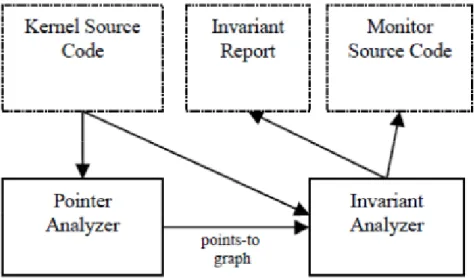
We have developed a static analysis-based system to detect invariants for commodity operating systems kernels. Figure 3.1 shows the overall architecture. We apply compiler technology to automatically analyze the control and data flows of a target kernel, e.g., assignments, function calls, and conditional statements, to support or reject hypothesis about likely invariants. For example, if a variable is assigned multiple times with different values, it is unlikely a constant.
Figure 3.1 Invariant analysis architecture
Our system recognizes two kinds of assignments: direct assignment and indirect assignment. Direct assignment recognition is straightforward. Indirect assignment is mainly made through pointers in a modern kernel implemented in the C language. To
14
recognize indirect assignment through pointers, our system has a pointer analyzer, as shown in Figure 3.1.
Our system accepts the merged kernel source code as input, which is fed into the Pointer Analyzer and the Invariant Analyzer. The Pointer Analyzer processes the kernel code and generates the points-to graph, which records the points-to set (i.e., a set of variables) of any pointer variable. The Invariant Analyzer scans the kernel source code including variable declarations, kernel functions, conditional statements, and assignment statements. When it scans an indirect assignment statement such as *p=v, it queries the points-to graph generated by the Pointer Analyzer and gets the set of kernel variables that can be pointed to by p, and notes that all such variables are potentially assigned once by this statement. Internally, the Invariant Analyzer has several supporting components: assignment recognition (Section 3.1.3), constant invariant recognition (Section 3.1.4), and other kinds of invariant recognition (Section 3.1.5).
The output of our system is a report of likely invariants over all global variables in the input kernel, as well as supporting evidence for manual validation (e.g., for variables that are not considered constant, our system reports the relevant assignment statement(s) that modify those variables). We have made a sample of such a report available on our web site [25]. Another output of our system is the source code for an Invariant Monitor that can be installed in the analyzed system as a kernel module to monitor the invariants detected. More details of the Invariant Monitor are presented in Section 3.2.2.1.
3.1.2. Design Goals
The major goal for our invariant analysis is high precision, i.e., to minimize false positive rate and false negative rate. As we discuss in the beginning of Chapter 3, both
15
kinds of errors are undesirable for remote attestation. Below we discuss the technical challenges in both cases and our solutions when analyzing programs written in C like languages, using static detection of constant invariants (var const) as an illustration.
The major reasons for false negatives are a lack of fine-granularity and imprecise pointer analysis. If the static analyzer is field-insensitive, i.e., it cannot differentiate individual fields in a C structure, it will regard an assignment to any field of a structure as an assignment to the entire structure; thus the entire structure may become a non-constant. This means that even if some fields of that structure are constant and hold critical data such as function pointers, they cannot be protected. This lack of precision obviously causes false negatives. Similarly, lack of support for array sensitivity, i.e., being unable to differentiate individual elements in an array, is another cause for false negatives. From our experience, in a modern kernel such as the Linux kernel, the majority of global data is within some structure or array, which means that a static analyzer that is field and array-insensitive is almost useless. Therefore, our invariant analyzer must be field and array-sensitive (Sections 3.1.3.1 and 3.1.3.2). Another cause of false negatives is the conservativeness of pointer analysis algorithms. If the pointer analysis algorithm is too conservative, e.g., a pointer can point to all global variables, the invariant analyzer would recognize many bogus (or impossible) assignments and thus consider a constant variable as a non-constant. Therefore, we need to develop a precise pointer analysis algorithm. We employ a precise points-to algorithm in our design (Section 3.1.3.3).
The major reason for false positives (i.e., incorrect constant invariants) is a failure to recognize legitimate assignments. This can be caused by two reasons: implicit assignments and incomplete points-to analysis. One kind of implicit assignment is
16
assignment by assembly code: since our static analyzer does not understand assembly code, it cannot capture such assignments. Another example of implicit assignment is structure-level assignment: if variables foo and bar are defined as struct{int a;int b}foo,bar; then the assignment foo = bar implicitly modifies both foo.a and foo.b. Another cause of missing assignment recognition is related to the precision of points-to analysis: if it returns an incomplete points-to set for a pointer, the analyzer may miss legal but indirect updates to some variables through that pointer; as a result, the analyzer may mistakenly classify those variables as constants. In order to capture implicit assignments, we apply heuristics in our analyzer (Sections 3.1.3.1, 3.1.3.4, and 3.1.3.5). In order to avoid incomplete pointer analysis, we employ a precise points-to analysis algorithm (Section 3.1.3.3).
3.1.3. Major Design Points of the Assignment Recognition
One component of our invariant analyzer identifies assignments to variables, which is critical to the detection of constant invariants and membership invariants. For programs written in C, modifications to a variable can occur in two forms: direct assignment and indirect assignment. In the former case, the said variable is the left hand side of an assignment statement (e.g., v in v=k+3). In the latter, the said variable is assigned indirectly through a pointer that references it (e.g., p=&v,...,*p=k+3). In order to capture the second case, the detector needs to first find out the points-to set of the pointer (via a points-to analysis [26]), and then note that each target in the points-to set is assigned indirectly.
In the rest of this section, we discuss how our design satisfies the goals outlined in Section 3.1.2.
17
3.1.3.1. Field Sensitivity
To achieve the desired field sensitivity, our analyzer uses lexical names to disambiguate structure field references (e.g., p->a is considered a different memory location from p->b), in a way similar to [27]. This enables our analyzer to capture explicit assignments to structure fields. Moreover, our analyzer treats structure level assignments as implicit assignments to the individual fields. For example, if variables foo and bar are defined as struct{int a;int b}foo, bar; then the assignment foo = bar; is translated into foo.a
= bar.a; foo.b = bar.b.
3.1.3.2. Array Sensitivity
Array sensitivity is another method for our analyzer to achieve fine-granularity. The basic idea is to treat each element of an array as an independent variable. For example, the array int d[3] is treated as three variables d[0], d[1], and d[2]. Our analyzer can handle arrays of arbitrary dimension. Finally, our analyzer can recognize pointers into arrays. For example, if the analyzer sees int *p = d; it can interpret *(p + 1) as the same as d[1].
3.1.3.3. Pointer Analysis
Our invariant analyzer performs points-to analysis in order to recognize indirect assignments through pointers. Based on the analysis in Section 3.1.2, we know that the accuracy of the points-to analysis algorithm is the key for reducing false positives and false negatives. Therefore, our pointer analyzer is based on the generalized one level flow (GOLF) algorithm [28], which is among the most precise pointer analysis algorithms, achieving precision close to Anderson’s algorithm [26]. Our pointer analyzer is built on top of the field-sensitivity (Section 3.1.3.1) and array-sensitivity (Section 3.1.3.2) capabilities to return fine-grained points-to targets. For example, it would return individual structure
18
field foo.b instead of the entire structure foo. Finally, it can also contribute to field-sensitivity and array-sensitivity. For example, in struct{int a;int b}bar, *p, if p’s points-to set includes bar, then an assignment to p->a is considered an indirect assignment to bar.a.
3.1.3.4. Union Support
Our analyzer also supports unions: each field of a union is treated as an alias of other fields in the same union. This means that an explicit assignment to one field of a union is an implicit assignment to all the other fields. Therefore, if one field of a union is not a constant, other fields of the union are not constant, either.
For example, in union uarg{int a; int b}c, c.a and c.b are treated as the same variables; if c.a is not a constant, c.b is not a constant, either.
3.1.3.5. Heuristics-base Assignment Recognition
The use of assembly code in the kernel poses difficulties to our static analysis. Because our analyzer only recognizes C code, variable reads or writes by assembly code are not visible to it. One prominent example is get_current(), which returns a pointer to the task structure of the current process. Because this function uses assembly code, several chains of pointer dependency are broken, and our static analysis suffers inaccuracy as a result. To overcome these inaccuracies caused by assembly code, we apply a function
prototype-based heuristic. The basic idea is to summarize the effect (in terms of
assignments to the input parameters) of assembly code inside a function body to bridge the “analysis gap”. For example, the function memcpy() copies a block of memory to another block of memory, so it can change the target memory and thus should be treated as a kind of implicit assignment. We identify this kind of functions (the functions that use assembly
19
code) in two steps: first, our static analysis reports all functions that contain assembly code in their bodies; second, we manually analyze the reported functions to see if any assignment is performed in the assembly code. For function get_current() mentioned above, we assume it can return a pointer to the global variable init_task_union.task. In total, we apply this heuristic to 11 functions in the Linux kernel and one function in the Windows kernel.
Another difficulty to our static analysis, especially for the Windows kernel, is the use of external functions for which we do not have source code. For example, the external function InterlockedIncrement increments (increases by one) the value of the specified 32-bit variable as an atomic operation. To overcome this problem, we first identity this kind of functions by their extern tag; second, we figure out the effect of these external functions from Microsoft MSDN [29]. Then we can also apply the function
prototype-based heuristic based on the effect of these functions. We identify eight such functions.
3.1.4. Constant Invariant Recognition
A second component of our invariant analyzer recognizes constant invariants, defined as having a constant value during normal execution of the system (i.e., after system initialization). Determination of constant invariants is based on the assignments to each variable, i.e., if a variable is assigned only once in its lifetime, it is a constant.
Because the definition of constant invariants only concerns the variables’ value after system initialization, we treat assignments during system initialization differently than those during normal execution of the system. Specifically, a constant variable can be assigned multiple possible values during initialization, as long as it is not assigned during
20
normal execution. On the other hand, assignments at normal execution time typically indicate that a variable is not a constant. Being assigned differently during system initialization is quite possible for some constant variables whose known-good values depend on hardware configuration; they can get several different values depending on the hardware features detected during system initialization.
In our design, each global variable is associated with a flag that indicates whether it is a constant and a legal value list that contains its possible values. Initially, all global variables are marked as constant and all legal value lists are empty.
Our invariant analyzer first scans global variable declarations and initialization functions (e.g., those with “__init” directives). If a global variable, which is marked as a constant invariant, is assigned a constant value, the analyzer adds this value into the variable’s legal value list. On the other hand, if a global variable is assigned a non-constant value, the analyzer marks it as a non-constant.
After this scan, if a global variable's legal value list is still empty, the analyzer adds a default value into the list, based on the type of the variable (e.g., 0 for an integer variable).
Next, the constant invariant analyzer scans the remaining kernel functions. If a global variable, which is marked as a constant invariant, is assigned a non-constant value, or a constant value but the value is not in its legal value list, or a constant value in its legal value list but the length of it legal value list is greater than 1, the analyzer marks it as a non-constant (in the third case, we treat this variable as a membership invariant candidate). Note that assignments to global variables here include those indirect assignments made through pointers, i.e., when an indirect assignment is encountered, our constant invariant analyzer regards all global variables in the points-to set as being assigned.
21
At the end of the kernel code scanning, our analyzer generates a report about the constant invariant status of all global variables, based on their flags. For those non-constants, the report also includes the reason, e.g., the related assignment statement(s) in the kernel source code, for in-depth investigation by a human expert.
3.1.5. Recognition of Other Kinds of Invariant
In addition to constant invariants, our invariant analyzer can recognize several other kinds of invariants: membership invariants, bounds invariants, and non-zero invariants.
The inference of membership invariants is similar to that of constant invariants discussed in Section 3.1.4, in the sense that each variable is associated with a flag and a legal value list. The difference is that the collection of legal values happens throughout the program, not only inside the initialization functions, and the flag means whether a membership invariant can be safely reported for that variable. Specifically, when a global variable is assigned a constant value, directly or indirectly, the value is added to that variable’s legal value list; however, if a non-constant value is used in the assignment, the variable is marked as unsafe for membership invariants. At the end of the analysis, membership invariants for variables still marked as safe are reported, and constants in the legal value list of each such variable are used to generate the specification of the membership invariants.
To infer bounds invariants, we apply two heuristics during the code scan: (1) if a global variable is used as an index of an array, its value should fall within the range [0, Len-1], where Len is the length of the array; (2) if a global variable is compared with a constant in a conditional statement, and one of the branches leads to a kernel crash (such as by calling panic or do_exit), then we have a constraint for this variable that its legal value
22
should not satisfy the condition for the kernel crash. At the end of the code scan, we solve the inferred constraints for each global variable and derive the upper bound and lower bound. For example, if we have one constraint g≥2 and another constraint g10, the analyzer will decide a bounds invariant 2g10 for g.
We recognize non-zero invariants based on a heuristic similar to the second heuristic for the bounds invariants (about a branch that causes kernel crash), where the global variable is compared against zero.
For the inferred invariants, the analysis report also includes relevant information, e.g., the conditional statement(s) in the kernel source code, which provides convenience for human validation.
We should note that the heuristics mentioned in this section are conservative in order to avoid detecting incorrect invariants, so our invariant analyzer may miss some invariants. For example, we give up the membership invariant for a variable var that is assigned a non-constant value (e.g., another variable w) because it may be very difficult to statically determine what values the other variable (e.g., w) may have. For another example, when a variable is compared against a non-constant in a conditional statement, we do not infer a non-zero invariant because we do not know whether the non-constant variable always contains zero or not. In this case, we may miss a non-zero invariant if the non-constant variable is always equal to zero. We can combine the result of constant invariants analysis and our existing heuristics to improve the situation. Finally, our invariant detection architecture can be extended with new heuristics once they are identified. We leave these improvements as future work.
23 3.1.6. Implementation
We implement a prototype of our static invariant detector based on the C Intermediate Language (CIL) [30]. Our pointer analyzer is implemented in 5,000 lines of Ocaml code, and our invariant analyzer is implemented in 4,300 lines of Ocaml code.
3.2. Evaluation
In this section, we report a large-scale evaluation of our invariant detection tool, using Linux kernel 2.4.32 and Windows Research Kernel (version Windows Server 2003) as the input kernels. Our evaluation focuses on the precision of the detected invariants and the performance of the detection tool.
3.2.1. Metrics, Methodology, and Test Cases
We choose two common metrics to evaluate the precision of the detected data invariants for the input kernels:
False positives happen when variables whose values do not satisfy a certain invariant are mistakenly recognized as such. A monitor can generate false alarms when such variable’s runtime values violate the “fake” invariants (e.g., when a variable that can legally change its value is recognized as being constant).
False negatives happen when a true invariant is not recognized as such. As a result of false negatives, a monitor may fail to detect rootkits that tamper with global variables so as to violate the true invariants. For example, if a critical variable that should be constant is not monitored, a rootkit can modify it and at the same time evade detection.
We evaluate the false positive and false negative rates of the static invariant detection in two ways: (1) comparing with the result of a dynamic invariant detector, and (2) running against real software (benign or malicious). In the evaluation on the Linux kernel, the set of
24
benign test programs includes Mozilla Firefox, the Linux Test Project [31], Iperf [32], Andrew benchmark [33], and Kernel compilation; and the malicious test programs are ten real-world rootkits such as Adore 0.42. Similarly, we evaluate WRK with a set of benign test programs: Mozilla Firefox, Internet Explorer, Notepad, WinSCP, Super PI [34], Iozone [35], 7zip [36] and Windows Driver Kit [37]. And we use nine real-world malware samples as the malicious test programs.
3.2.1.1. Comparing with a Dynamic Invariant Detector
We develop a dynamic invariant detector (as a loadable kernel module in Linux or as a Windows Device Driver in Windows) that periodically reads the values of the global variables of the kernel during a training phase and hypothesizes likely invariants satisfied by the global variables based on their observed values. For comparison purposes, this dynamic invariant detector detects the same kinds of invariants as our static invariant analyzer: constant invariants, membership invariants, bounds invariants, and non-zero invariants. To be fair in the comparison, we aim to trigger as many modifications to the global variables as possible. Therefore, we choose benign test programs (mentioned in Section 3.2.1) that represent comprehensive workloads. For example, the Linux Test Project (version 20050107) is an open source test suites that validate the reliability, robustness, and stability of Linux kernel, and it includes more than 700 test cases that test the Linux kernel in many aspects (such as system calls and file system functionality) and more than 60 test cases that exercise the basic functionalities of the network.
In the rest of this subsection, we mainly focus on the constant invariant (Section 3.2.1.2), and we briefly report the comparison on other kinds of invariants in Section 3.2.1.3.
25
3.2.1.2. Constant Invariants
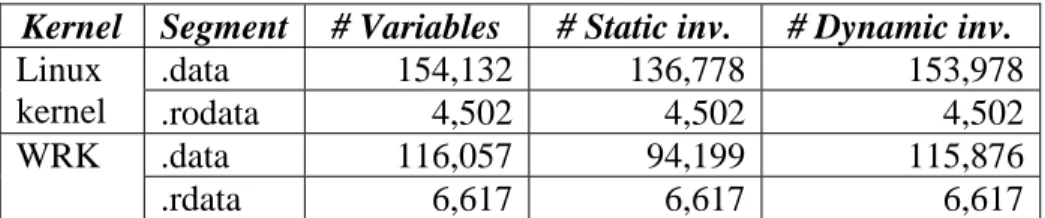
Table 3.1 summarizes the constant invariant analysis results for the .data and the
.rodata segments of Linux kernel 2.4.32, as well as the .data and the .rdata segments of WRK. The third column is the total number of global variables (with field and array-sensitivity). The fourth column shows the number of statically-detected constant invariants out of all the variables, and the fifth column shows the number of dynamically-detected constant invariants out of all the variables.
Kernel Segment # Variables # Static inv. # Dynamic inv.
Linux kernel .data 154,132 136,778 153,978 .rodata 4,502 4,502 4,502 WRK .data 116,057 94,199 115,876 .rdata 6,617 6,617 6,617
Table 3.1 Overall result of the constant invariant detection
From Table 3.1 we can see that both static and dynamic constant invariant detection achieve 100% accuracy on the .rodata segment and the .rdata segment, which is expected because variables in the .rodata segment and the .rdata segment are supposed to be constant.
The dynamic constant invariant detector reports that more than 99% of the variables in the .data segment of either Linux kernel or WRK are constants. Comparatively, static analysis reports 88.7% of the variables in the .data segment of Linux kernel and 81.2% of the variables in the .data segment of WRK as constants. This difference implies that despite our effort to use comprehensive test cases, they still may not be able to trigger every possible modification to global variables, so there may still exist some false constant invariants in the dynamically-detected set.
26
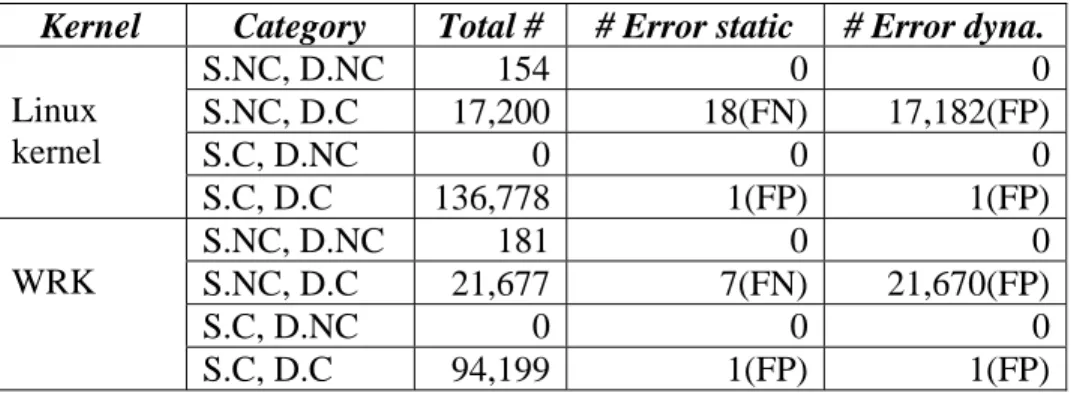
Table 3.2 gives a more in-depth comparison of the results of the static and dynamic analyzers for the .data segment. Since each variable can be considered constant or non-constant by each of the analyzer, there are four combinations. For example, the category “S.NC, D.C” includes all variables that are considered non-constant by the static analyzer but constant by the dynamic analyzer.
We can see that there are in total 154 variables in Linux kernel and 181 variables in WRK that both analyzers agree to be non-constant. We are confident about the correctness of the results because the dynamic analyzer classifies a variable as non-constant only if it observes that the value of the variable does change at runtime. Therefore, the non-constants reported by the dynamic analyzer must be truly non-constants.
Kernel Category Total # # Error static # Error dyna.
Linux kernel S.NC, D.NC 154 0 0 S.NC, D.C 17,200 18(FN) 17,182(FP) S.C, D.NC 0 0 0 S.C, D.C 136,778 1(FP) 1(FP) WRK S.NC, D.NC 181 0 0 S.NC, D.C 21,677 7(FN) 21,670(FP) S.C, D.NC 0 0 0 S.C, D.C 94,199 1(FP) 1(FP)
Table 3.2 Comparison of the static and dynamic analysis results for the .data segment (FN: false negative; FP: false positive)
Next, we see from Table 3.2 that a large number (e.g., 17,200 in Linux kernel) of variables in the "S.NC, D.C" category are classified as non-constants by the static analyzer but constants by the dynamic analyzer. Here we cannot trust the dynamic analyzer because it may not observe legal but conditional assignments due to the incompleteness of the test coverage, and we cannot trust the static analyzer either, because its points-to analysis is conservative.
27
To find the ground truth about these variables, we manually verify whether they are indeed non-constants. This verification task seems daunting, but it is actually made much easier by the following facts about our static analyzer: (1) if a variable is directly modified, the assignment statement logged in the analysis report is straightforward evidence that the variable is a non-constant; (2) if a variable is only indirectly modified through a pointer, our analyzer outputs the relevant statements from the source code that support the points-to relationship, which is relatively straightforward to verify by a human (e.g., Figure 3.2 is a portion of our analysis report that shows why ctrl_map[2] can be indirectly modified through the pointer variable key_map); (3) because our analysis is array sensitive, we can generalize from one confirmed non-constant array element to all other elements in the same array. E.g., given an array arr of size 1024, if we confirm that arr[0] is a non-constant due to an assignment to arr[i], then we can conclude that arr[1] through arr[1023] are all non-constants. In other words, we can confirm non-constants in batches, which significantly speed up the verification. Because of the above reasons, it took one graduate student about 20 hours to finish the verification of the 17,200 variables in the "S.NC, D.C" category of Linux kernel. As a result, we are able to confirm that 17,182 of such variables are non-constants, i.e., they can be modified by assignments at runtime. Similarly, we confirm that 21,670 out of 21,677 variables in the "S.NC, D.C" category of WRK are non-constants, which took one graduate student around 24 hours. Below we give some examples of these non-constant variables:
The array ctrl_map in Linux kernel holds the values of the Control Key combinations. Figure 3.2 shows how an element of this array (e.g., ctrl_map[2] ) can be indirectly modified through a pointer in function do_kdsk_ioctl. However, since our dynamic analysis
28
test cases do not trigger function do_kdsk_ioctl, the dynamic invariant analyzer wrongly classifies all elements of the array ctrl_map as constants.
KeBootTime in WRK stores the absolute time when the system was booted. One of its fields, KeBootTime.QuadPart, can be changed by KeBootTime.QuadPart +=
TimeDelta.QuadPart in function KeSetSystemTime. However, the dynamic invariant
analyzer reports KeBootTime.QuadPart as a constant because KeSetSystemTime is invoked only during system boot but our test cases do not reboot the kernel.
<Name>ctrl_map[2]</Name> <Invariant>No</Invariant> <Reason1>
*(key_map + 0) = (unsigned short )(((2 << 8) | 126) ^ 61440); vt.c:224, Indirectly modified through key_map.
Path from ctrl_map[2] to key_map: <Label>ctrl_map[2]</Label> <STMT>ctrl_map=&ctrl_map[2] defkeymap.c:65</STMT> <Label>l_473154</Label> <STMT>key_maps[4]=ctrl_map defkeymap.c:141</STMT> <Label>l_479876</Label> <STMT>key_map = key_maps[tmp.kb_table];vt.c:174 </STMT>
Figure 3.2 Snippet of the analysis report that shows why ctrl_map[2] can be indirectly modified through the pointer key_map
The array PspLoadImageNotifyRoutine in WRK is used to hold driver-supplied callback functions that are subsequently invoked whenever an image is loaded (or mapped into memory). Specifically, it is written into by tmp = ExCompareExchangeCallBack(&
PspLoadImageNotifyRoutine[i], CallBack, (PEX_CALLBACK_ROUTINE_BLOCK )((void *)0)) in function PsSetLoadImageNotifyRoutine. Therefore, this array is obviously not constant. However, since our dynamic analysis test cases do not trigger any new driver-supplied callback registration, the dynamic invariant analyzer cannot see any
29
changes to PspLoadImageNotifyRoutine; so it mistakenly concludes that the entire array
PspLoadImageNotifyRoutine is constant.
We study the distribution of evidence (direct assignment and/or indirect assignment) applicable to the 17,336 confirmed non-constants in Linux kernel (including the 154 non-constants in the “S.NC, D.NC” category and the 17,182 non-constants in the “S.NC, D.C” category). We see that 13,191 non-constants (or 76% of 17,336) can be modified only indirectly through a pointer, 2,615 non-constants can be modified only directly, and the rest (1,530 non-constants) can be modified in both ways. Note that we have merged the non-constants recognized via heuristics (Section 3.1.5) into the direct or indirect group depending on whether the address of the target variable is taken. A similar study of the 21,851 confirmed non-constants in WRK (181 non-constants in the “S.NC, D.NC” category plus 21,670 non-constants in the “S.NC, D.C” category) shows that 4,321 non-constants can be modified only directly, 489 non-constants can be modified both directly and indirectly, and 17,041 non-constants (or 78% of 21,851) can be modified only indirectly through a pointer. Our observation confirms the wide-scale use of pointers in both the Linux kernel and WRK to manipulate memory and also means that for any static invariant detector of them, the points-to analysis part is critical for the overall precision.
We further look at the type and meaning of the confirmed non-constants in the “S.NC, D.C” group to see whether the classification makes sense. We coarsely divide them into several categories, such as list heads, locks, accounting information (e.g., counters), resource management information (e.g., page tables and memory zone lists), and configuration data. Table 3.3 shows example variables for each category. From this analysis, we feel that the static analysis results make sense. For example, list heads, locks,
30
and performance counters should be dynamic, so they should not be constants. Unfortunately, our dynamic analyzer classifies this large group of non-constants in the wrong way, due to the incompleteness of test cases in our experiment. We believe that the large number of non-constants highlight the relative advantage of static analysis over dynamic analysis.
Category Example variables
Linux kernel WRK
List heads acpi_bus_drivers.next arp_tbl.gc_timer.list.next AcquireOpsEvent.Header.WaitL istHead CmpDelayedLRUListHead Locks context_task_wq.lock.lock dev_base_lock.lock AcquireOpsEvent.Header.Lock CmpHiveListHeadLock Auditing information kernel_module.archdata_end kernel_module.archdata_start ExPoolCodeEnd ExPoolCodeStart Accounting information console_sem.count.counter con_buf_sem.count.counter CcFastReadResourceMiss CcLostDelayedWrites Resource mgmt data contig_page_data.node_zonelists[0]. zones[0] contig_page_data.node_zones[0].fre e_area[0].map ExPoolTagTables[0] ExpNonPagedPoolDescriptor[0] Configurati on data FDC2, FLOPPY_DMA, FLOPPY_IRQ, can_use_virtual_dma, fifo_depth KeMaximumIncrement KeMinimumIncrement Table 3.3 Examples of non-constants
The 18 false negatives in the “S.NC, D.C” group of Linux kernel are the fields of a global structure called i810_fops (e.g., i810_fops.ioctl, i810_fops.read, i810_fops.write, etc). Our static analyzer reports that they can be assigned indirectly through a pointer to
i810_fops. However, our manual verification indicates that such a points-to relationship is wrong, most likely due to imprecision introduced by the unification step of the GOLF algorithm [28] that our pointer analyzer uses.
The seven false negatives in the “S.NC, D.C” group of WRK are the fields of a global
31
KiInitialProcess.AddressCreationLock.Gate.Header.Absolute,
KiInitialProcess.AddressCreationLock.Gate.Header.Type, etc). For them, our manual
analysis indicates that they should be constants, which is due to the limitation of our analyzer. The source code relevant to these false negatives is shown in Figure 3.3. First, based on the heuristics about KeGetCurrentThread (Section 3.1.3.5), the variable Thread is
assigned a pointer to KiInitialThread; then our pointer analyzer indicates that
Thread->ThreadsProcess is a pointer to KiInitialProcess. Next, sinceVdmRundownDpcs is an external function for which we do not have source code, we have to apply the function
prototype-based heuristics (Section 3.1.3.5) for this function, which conservatively assumes that every field of the structure pointed to by the input parameter (i.e.,
KiInitialProcess) can be modified to reduce false alarms as many as possible. As a result, we have the seven false negatives.
In function PspExitThread: Thread = KeGetCurrentThread(); Process = Thread->ThreadsProcess; ...
VdmRundownDpcs(Process);
Figure 3.3 Relevant Code Path For the False Negatives in WRK
These false negatives illustrate the limitation of our pointer analyzer, which employs a conservative points-to algorithm. However, given the total number of real constant invariants, our static analyzer still has very low false negative rate: in Linux kernel we have 141,297 real constant invariants (we have 136,778 + 4,502 = 141,280 statically detected constant invariants, 18 false negatives, and one false positive, so the total number is 141,280 + 18 - 1 = 141,297) with a false negative rate of 0.013% (18 out of 141,297); in WRK we have 100,822 real constant invariants (94,199 + 6,617 = 100,816 statically
32
detected constant invariants, seven false negatives, and one false positive, so the total number is 100,816 + 7 - 1 = 100,822) with a false negative rate of 0.007% (7 out of 100,822).
Continue on Table 3.2, we see that no variable is classified as "S.C, D.NC", which means that no variable is classified as constants by the static analyzer but non-constants by the dynamic analyzer. Such variables, if they exist, would be false positives for the static analyzer.
Finally, for the variables in "S.C, D.C" group, both analyzers believe they should be constants. Since our static analyzer does not provide evidence for constants, we cannot verify the correctness statically. Similarly, the dynamic analyzer does not provide evidence to prove constants, either. Therefore, we decide to experimentally verify the results (Section 3.2.2).
3.2.1.3. Other Kinds of Invariants
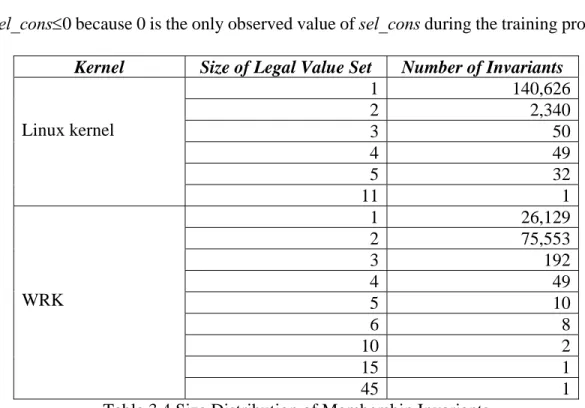
In addition to constant invariants, our static analyzer detects 143,098 membership invariants, 41 bounds invariants and 35 non-zero invariants without false positives in Linux kernel. Our static analyzer also works well on WRK: it detects 101,897 membership invariants, 265 bounds invariants and 8 non-zero invariants from WRK with no false alarms. The size distribution of the membership invariants is shown in Table 3.4.
We can see that the detected membership invariants can have up to 45 legal values, but the majority of membership invariants have no more than two legal values. Comparatively, the dynamic analyzer can only detect less precise invariants. More specifically, the dynamic bounds detector only reports sub-ranges of statically detected bounds invariants. For example, sel_cons in Linux is used as an index for array vc_cons
33
with a length of 64 and it can be modified by the assignment sel_cons=fg_console in function set_selection; therefore, our static detector recognizes a bounds invariant 0sel_cons63. However, the dynamic analyzer recognizes a tighter bounds invariant 0sel_cons0 because 0 is the only observed value of sel_cons during the training process.
Kernel Size of Legal Value Set Number of Invariants
Linux kernel 1 140,626 2 2,340 3 50 4 49 5 32 11 1 WRK 1 26,129 2 75,553 3 192 4 49 5 10 6 8 10 2 15 1 45 1
Table 3.4 Size Distribution of Membership Invariants
3.2.1.4. Summary of Statically Detected Invariants
In total, our static analyzer detects 284,471 invariants in Linux kernel and 202,992 invariants in WRK. The details are shown in Table 3.5.
Linux kernel WRK Constant Invariant 141,297 100,822 Membership Invariant 143,098 101,897 Bound Invariant 41 265 Non-zero Invariant 35 8 Total 284,471 202,992
34 3.2.2. Experimental Evaluation
3.2.2.1. Implementation of the Invariant Monitor
We implement an Invariant Monitor that periodically (every 30 seconds) checks the statically detected invariants in the memory of a Linux kernel 2.4.32 (the kernel that our static tool analyzed). To simply the implementation, our proof-of-concept Invariant Monitor is implemented in the form of a loadable kernel module. Other techniques such as virtual machine monitor (VMM) or dedicated hardware can also be leveraged in the implementation (e.g., Livewire [13] uses a VMM and Copilot [10] runs on a PCI card).
The monitor loops over each invariant and verifies if it is satisfied by the runtime values of the global variables. The monitor emits a warning message if any invariant is not satisfied. The list of invariants as well as their specifications is derived by the static invariant analyzer presented in Section 3.1. We also implement an Invariant Monitor for WRK as part of the kernel in a similar way.
One practical difficulty that our Invariant Monitor overcomes is the semantic gap between the monitor and the rest of the kernel – not all global variables are exposed to the monitor as symbols. For example, msg_ctlmax is an unresolved symbol when we try to load the monitor in Linux. For this reason and for better portability (e.g., running the monitor from a hypervisor in the future), our monitor refers to global variables by their runtime addresses rather than symbolic names. However, our static invariant analyzer reports invariants using symbolic names of global variables. Therefore, we need to bridge the gap between names and runtime addresses. To solve this problem, in Linux kernel we use the information contained in the System.map file, a standard file generated during the
35
kernel compilation process, which contains a mapping from kernel variable names to their runtime addresses. In WRK, we use wrkx86.map file instead of System.map file.
A related difficulty brought by the semantic gap is the lack of offset information when our monitor makes fine-grain memory accesses to individual fields of structure variables or array elements, because System.map and wrkx86.map only provide the starting address of a structure or array variable but our monitor needs to look inside it. As a scalable approach, we leverage the power of static analysis to automatically generate code for the monitor. Specifically, the static analyzer generates code that declares pointer variables of the appropriate type, uses pointer dereferencing expressions to represent fine-grain memory accesses, and lets the compiler find out the correct offset information. For example, the static analyzer generates the code snippet in Figure 3.4 for the constant invariant
timedia_data[3].num == 8 where timedia_data is an array whose elements are of type
struct timedia_struct that has a field named num. Here 0xc0272420 is the runtime address of the timedia_data array. Note that the known-good value 8 that is compared in the if statement is automatically supplied during the code generation because it is available to the static invariant analyzer by the time of code generation (i.e., in the legal value list). If the length of legal value list of a constant invariant is greater than 1 and its runtime value in the first time check is also in its legal value list, this value will be treated as the only legal value of the constant invariant in the following checks.
p=(struct timedia_struct*)0xc0272420; if (((struct timedia_struct*)p)[3].num!=8) {printk(KERN_WARNING "Bad invariant timedia_data[3].num \n");};
![Figure 3.2 Snippet of the analysis report that shows why ctrl_map[2] can be indirectly modified through the pointer key_map](https://thumb-us.123doks.com/thumbv2/123dok_us/1990388.2795677/40.918.291.683.396.670/figure-snippet-analysis-report-shows-indirectly-modified-pointer.webp)