Facility Location Planning Under Disruption
Badr Afify
A Thesis in
The Concordia Institute for
Information Systems Engineering
Presented in Partial Fulfillment of the Requirements For the Degree of
Doctor of Philosophy (Information and Systems Engineering) at Concordia University
Montréal, Québec, Canada
January 2020
C
ONCORDIA
U
NIVERSITY
School of Graduate Studies
This is to certify that the thesis prepared
By: Badr Afify
Entitled: Facility Location Planning Under Disruption
and submitted in partial fulfillment of the requirements for the degree of
Doctor of Philosophy (Information and Systems Engineering)
complies with the regulations of this University and meets the accepted standards with re-spect to originality and quality.
Signed by the final examining committee:
Dr. Luis Amador-Jimenez
Chair
Dr. Amin Chaaban
External Examiner
Dr. Akshay Kumar Rathore
External to Program Dr. Mourad Debabbi Examiner Dr. Chun Wang Examiner Dr. Anjali Awasthi Thesis Supervisor Approved by
Dr. Dr. Mohammad Mannan, Graduate Program Director
March 24, 2020
Dr. Amir Asif, Dean
Abstract
Facility Location Planning Under Disruption
Badr Afify, Ph.D.
Concordia University, 2020
Facility Location Problems (FLPs) such as the Uncapacitated Facility Location (UFL) and the Capacitated Facility Location (CFL) along with thek-Shortest Path Problem (k-SPP) are important research problems in managing supply chain networks (SCNs) and related oper-ations. In UFL, there is no limit on the facility serving capacity while in CFL such limit is imposed. FLPs aim to find the best facility locations to meet the customer demands within the available capacity with minimized facility establishment and transportation costs. The objective of the (k-SPP) is to find thek minimal length and partial overlapping paths be-tween two nodes in a transport network graph. In the literature, many approaches are proposed to solve these problems. However, most of these approaches assume totally reli-able facilities and do not consider the failure probability of the facilities, which can lead to notably higher cost.
In this thesis, we investigate the reliable uncapacitated facility location (RUFL)and the reliable capacitated facility location (RCFL) problems, and thek-SPP where potential facilities are exposed to disruption then propose corresponding solution approaches to ef-ficiently handle these problems. An evolutionary learning technique is elaborated to solve RUFL. Then, a non-linear integer programming model is introduced for the RCFL along with a solution approach involving the linearization of the model and its use as part of an iterative procedure leveraging CPLEX for facility establishment and customer assignment along with a knapsack implementation aiming at deriving the best facility fortification. In
RUFL and RCFL, we assume heterogeneous disruption with respect to the facilities, each customer is assigned to primary and backup facilities and a fixed fortification budget allows to make a subset of the facilities totally reliable. Finally, we propose a hybrid approach based on graph partitioning and modified Dijkstra algorithm to find k partial overlapping shortest paths between two nodes on a transport network that is exposed to heterogeneous connected node failures. The approaches are illustrated via individual case studies along with corresponding key insights. The performance of each approach is assessed using benchmark results. For the k-SPP, the effect of preferred establishment locations is ana-lyzed with respect to disruption scenarios, failure probability, computation time, transport costs, network size and partitioning parameters.
Acknowledgments
I am so grateful to the people who have touched my life, granted me the highest level of support and contributed towards reaching this goal. Through the tough days of my Ph.D program, keeping the motivation was one of the challenges and with the subtle guidelines from those we trust, I was able to find my own path. I will try to mention those who helped me maintain the goal on sight in one way or another, but memory sometimes can play games with our minds.
In particular, I would like to express my sincere gratitude to my advisor Prof. Anjali Awasthi for the continuous support of my Ph.D study and related research, for her patience, motivation, and immense knowledge. Her kind words, scientific curiosity, knowledge, and vast experience have transformed these years into a true learning and life-changing journey. Her guidelines were essential and her guidance helped me in all the time of research and writing of this thesis. I could not have imagined having a better advisor and mentor for my Ph.D study.
Besides my advisor, I would like to thank the rest of my thesis committee: Prof. Mourad Debbabi, Prof. Chun Wang, and Dr. Akshay Kumar Rathore, not only for their insightful comments and encouragement, but also for the hard question which enticed me to widen my research from various perspectives. I am also grateful to all my friends who helped and supported me during my Ph.D study. Thank you Dr. Andrei Soeanu and thank you Dr. Sujoy Ray for your generosity and support.
Ahlam Fouda, who deserved my constant gratitude at every step I took as I was standing on their shoulders to reach higher and higher. In times like these, written words are the only means available to show appreciation. I am especially grateful to my parents, Safia Abdulhakim and Mahmoud Selim. Although they both passed away on May 17, 1999 and July 31, 2019 respectively, I still feel their souls have always been there to support me. Through own life example, they have been the inspiration behind my dreams and set my ethical guidelines. Their teachings go beyond any academic program and their endless demonstrations of affection are certainly one of my main motivations in life.
I also wish to thank my brothers and sisters for their support. And finally, to all the people that I have not mentioned by name but who have shown interest in this work and motivated me to get to this point: thank you!
Contents
List of Figures x
List of Tables xii
1 Introduction 1 1.1 Context . . . 1 1.2 Motivation . . . 2 1.3 Problems Overview . . . 4 1.4 Objectives . . . 5 1.5 Research Methodology . . . 6 1.6 Document Organization . . . 8 2 State-of-the-Art 12 2.1 Introduction . . . 12
2.2 Uncapacitated Facility Location Problem (UFL) . . . 13
2.3 Capacitated Facility Location Problem (CFL) . . . 17
2.4 Shortest Path Problem . . . 24
2.5 Gap Analysis . . . 27
3 Uncapacitated Facility Location Planning Under Disruption 30 3.1 Introduction . . . 30
3.2 Model Assumptions . . . 31
3.3 Model Formulation . . . 31
3.3.1 Reliablep-Median Problem (RPMP) . . . 31
3.3.2 Reliable Uncapacitated Facility Location (RUFL) . . . 34
3.4 Evolutionary Boosting Technique . . . 35
3.4.1 Assumptions . . . 36
3.4.2 Evolutionary Learning and Solution Pool Handling . . . 36
3.4.3 Error Mitigation . . . 40
3.4.4 Weight Bias Determination . . . 42
3.4.5 Algorithm Design . . . 45
3.4.6 Case Study . . . 50
3.4.7 Experimental Results . . . 56
3.4.8 Sensitivity Analysis . . . 63
3.4.8.1 Demand Priority & Fortification Cost . . . 63
3.4.8.2 Euclidean vs. Geographic Distance . . . 65
3.4.9 Conclusion . . . 67
4 Capacitated Facility Location Planning Under Disruption 69 4.1 Introduction . . . 69
4.2 Model Assumptions . . . 70
4.3 Model Formulation . . . 70
4.4 Separation-Linearization Solution Approach . . . 73
4.4.1 Establishment-Allocation . . . 73
4.4.1.1 Model Linearization . . . 74
4.4.2 Fortification . . . 75
4.4.3 Solution Approach Summary . . . 76
4.4.5 Case Study . . . 80
4.4.6 Experimental Results . . . 84
4.5 Conclusion . . . 92
5 k-Shortest Path Problem Under Disruption 93 5.1 Introduction . . . 93
5.2 Problem Assumptions . . . 93
5.3 Problem Description . . . 94
5.3.1 Graph Partitioning Problem (GPP) . . . 94
5.3.2 Shortest Path Problem (SPP) . . . 95
5.4 Clustering Based Shortest Path Technique . . . 95
5.4.1 Algorithm Design . . . 96
5.4.2 Graph partitioning algorithm . . . 99
5.4.3 k-Shortest Path Generator . . . 99
5.4.4 Case Study . . . 103
5.4.4.1 Partial Disruption . . . 108
5.4.4.2 Node Complete Disruption . . . 111
5.4.5 Experimental Results . . . 114
5.4.5.1 Node Partial Disruption . . . 121
5.4.5.2 Node Complete Disruption . . . 124
5.5 Conclusion . . . 127
6 Conclusion and future work 128
Bibliography 133
List of Figures
1 Near-optimal solution finding for a RUFL instance . . . 44
2 Overview of the Solution Technique . . . 45
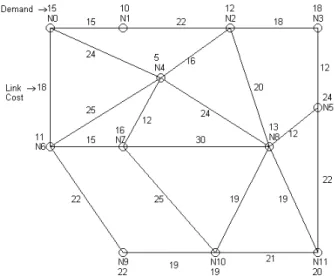
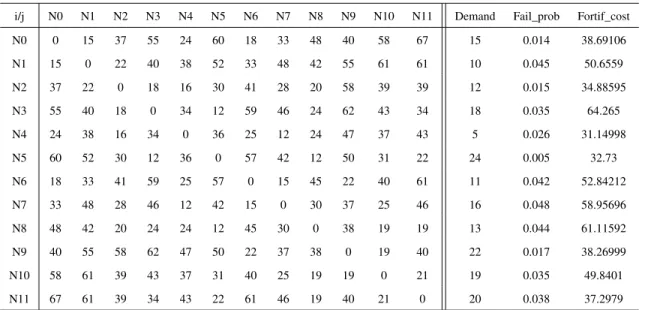
3 Case Study: A 12 node examplep-Median problem . . . 50
4 Solution search trace for Case Study . . . 53
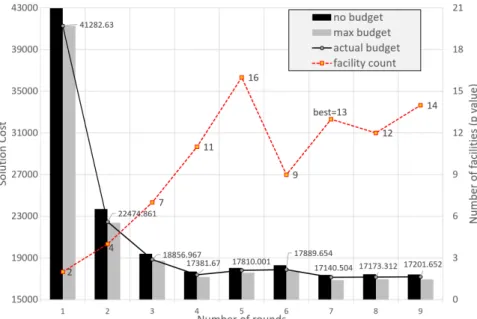
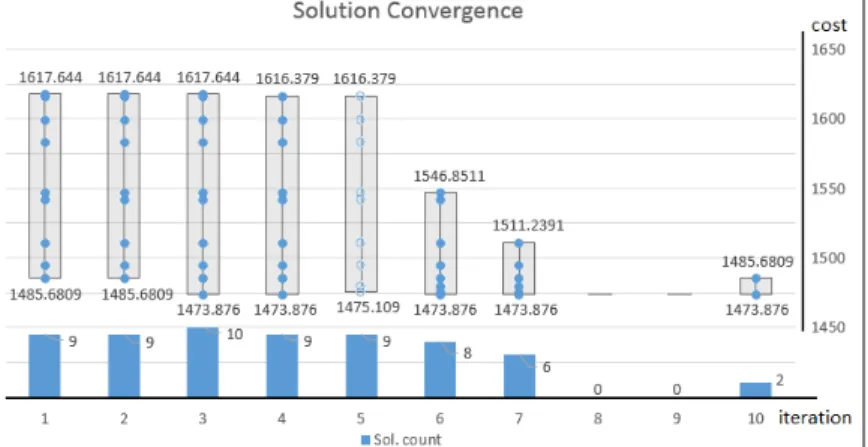
5 Near-optimal solution finding via evolutionary learning . . . 55
6 Solution profile for 100-node problem instance (P = 5) . . . 60
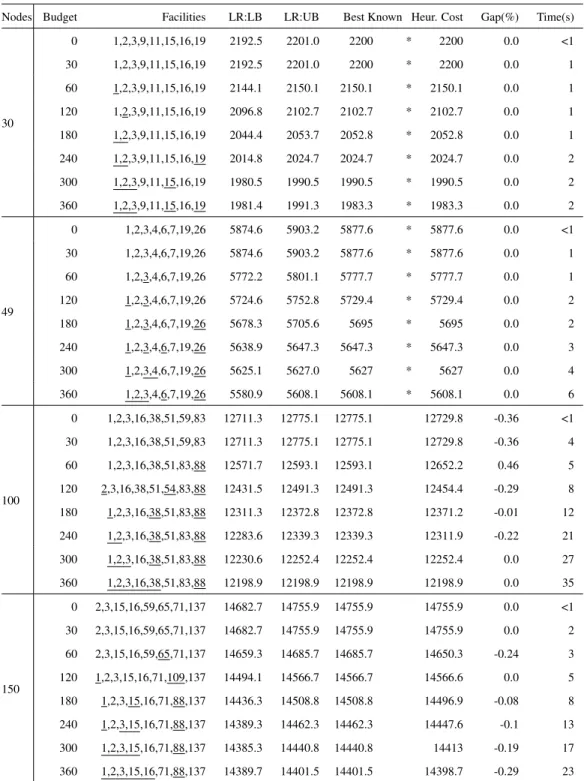
7 Heuristic Performance for 30, 49, 100 and 150 node problem instances (P = 5) . . . 62
8 Cost comparison for 100-node RPMP with fortification budget=240 . . . . 64
9 Solutions for 100-node RPMP with budget=240 and demand priority for 20% nodes . . . 65
10 Solution comparison for 100-node RPMP instance (p= 8andbudget= 240) 66 11 Solution comparison for 100-node RUFL problem with fortification bud-get=180 . . . 67
12 Overview of the Solution Technique . . . 78
13 Disruption and Fortification Effect . . . 83
14 Disruption Effect vs. Solution Cost . . . 84
15 Disruption & Fortification (30 to 70 nodes) vs. Solution Cost & Computa-tion Time . . . 90
16 Disruption & Fortification (90 to 120 nodes) vs. Solution Cost &
Compu-tation Time . . . 91
17 Overview of the Solution Technique . . . 96
18 Case Study: A 24 node example Clustering problem . . . 103
19 Clustering problem details . . . 104
20 k-Shortest path generation details . . . 109
21 Normal vs. Partial Disruption Paths . . . 110
22 A Disrupted 22 Nodes Case Study . . . 111
23 Normal vs. Complete Disrupted Paths . . . 113
24 Shortest paths comparison . . . 115
25 Cluster Search Space Reduction . . . 119
26 Solution finding via search space reduction . . . 120
27 Search Space Reduction and Graph Density . . . 121
28 Partial Disruption Shortest Paths Comparison . . . 123
List of Tables
1 Abbreviations . . . 9
2 Survey of previous effort on uncertainty over Uncapacitated FLP . . . 16
3 Survey of previous effort on uncertainty over Capacitated FLP . . . 22
4 Survey of previous effort on SPP andk-SPP . . . 29
5 Case Study: A 12 node examplep-Median problem . . . 51
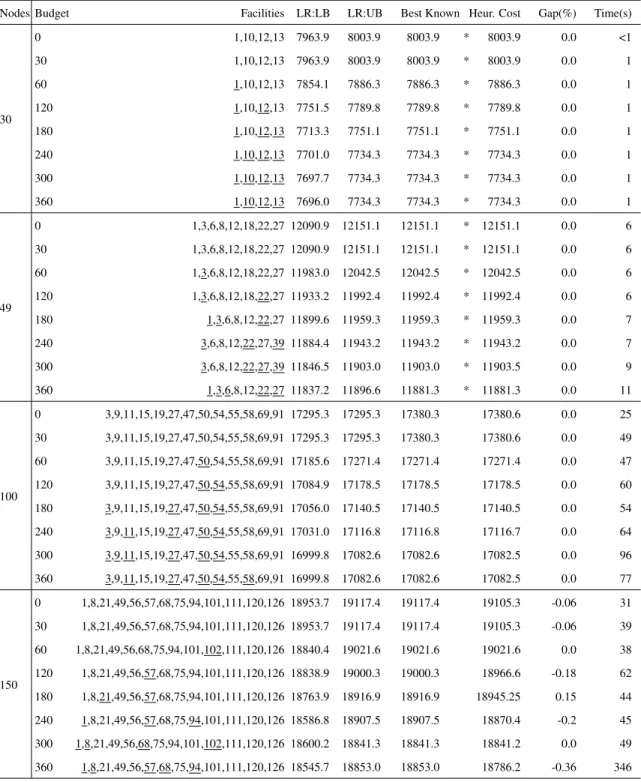
6 Benchmark details on RPMP problem instances for P=5 . . . 57
7 Benchmark details on RPMP problem instances for P=8 . . . 58
8 Benchmark details on RUFL problem instances . . . 61
9 15 Nodes Instance Details . . . 80
10 Customer Allocation Cost . . . 81
11 Solution Details of 15 Nodes RCFL Instance in Normal Scenario . . . 81
12 Customers Allocation of 15 Nodes RCFL Instance in Disruption Scenario . 82 13 Final Solution Details of 15 Nodes RCFL Instance . . . 82
14 Solution Details of RCFL Problem Instances in Normal Scenario . . . 85
15 Solution Details of RCFL Problem Instances in disruption Scenario . . . . 86
16 Solution Details vs. Disruption/Fortification Effect . . . 88
17 Network Partitioning Details . . . 103
18 Critical Nodes & Links . . . 104
19 Cluster Adjacency Matrix . . . 104
21 Shortest Paths Details . . . 106
22 k-Shortest Path Solution Generation . . . 107
23 Node Partial Disruption SP Details . . . 110
24 Network Repartitioning Details . . . 112
25 Node Complete Disruption SP Details . . . 112
26 Datasets Details and Partitioning Parameters & Output . . . 114
27 Datasets and Partial Overlapping Paths Details . . . 114
29 Heuristics and Clusters Search Space Reduction . . . 117
30 Clustering and Search Space Reduction . . . 117
28 Shortest paths solution details . . . 118
31 Dataset Partial Disruption details . . . 122
32 Partial Disruption Shortest Paths details . . . 122
33 Datasets Repartitioning Results . . . 124
34 Complete Disruption Shortest Paths details . . . 125
35 Gap Comparison . . . 126
A.1 Detailed Solution of 30-nodes RCFL Problem Dataset . . . 142
A.2 Detailed Solution of 45 Nodes RCFL Problem Dataset Instances . . . 143
A.3 Detailed Solution of 60 Nodes RCFL Problem Dataset . . . 144
A.4 Detailed Solution of 60 Nodes RCFL Problem Dataset (Cont..) . . . 145
A.5 Detailed Solution of 70 Nodes RCFL Problem Dataset Instances . . . 146
A.6 Detailed Solution of 70 Nodes RCFL Problem Dataset Instances(Cont..) . . 147
A.7 Detailed Solution of 90 Nodes RCFL Problem Dataset . . . 148
A.8 Detailed Solution of 90 Nodes RCFL Problem Dataset(Cont..) . . . 149
A.9 Detailed Solution of 105 Nodes RCFL Problem Dataset . . . 150
A.10 Detailed Solution of 105 Nodes RCFL Problem Dataset(Cont..) . . . 151
A.12 Detailed Solution of 120 Nodes RCFL Problem Dataset . . . 153 A.13 Detailed Solution of 120 Nodes RCFL Problem Dataset (Cont..) . . . 154 A.14 Detailed Solution of 120 Nodes RCFL Problem Dataset (Cont..) . . . 155
Chapter 1
Introduction
1.1
Context
As stated in [53], “supply chain network (SCN) is defined as a system of facilities, people, activities, information and resources involved in moving a product or service from sup-plier to customer”. From strategic perspective, a SCN should be designed to minimize the cost where most of the cost is determined by the location of facilities and the transport of products. SCN design is also referred to as network modelling due to the fact that a mathematical model can be created to optimize the SCN design [91]. From operation per-spective, a SCN should be designed to ensure the efficient flow of products from suppliers to customers.
Facility disruptions can have negative impact on the SCN flow and consequently lead to economic and market-share loss due to customers dissatisfaction as a result of the delay or termination of the deliveries. In the past, at the planning stage, SCN planners assume continuous availability and unlimited capacities of established facilities to guarantee con-tinuous and sustainable flow of the materials over the SCN with no expected delay or termination of the delivery services. However, in reality the SCN infrastructure are often affected by various internal and external disruption factors which may render such network
completely or partially disrupted. The aim of this thesis is to explore how such plans can be formed to develop reliable SCN that work efficiently in the normal conditions and minimize the impact of the disruption.
1.2
Motivation
Supply facilities may fail due to internal factors (e.g. poor inventory management, technical issues, work accidents, etc.) as well as external factors (e.g. power outage, road blockages, natural disasters, etc.). Thus, unexpected disruptions can have significant negative impact on the network reliability including its economic activities and lead to higher transportation costs, order delays, inventory shortages and loss of market share.
In [24], the authors investigate a network involving 2610 U.S. domestic airports and 64,204 flight connections. The study mentions that because of a complete disruption of Ted Stevens Anchorage international airport, the average span of flights has changed from 3.192 to 3.566 over the U.S. domestic airport network which is corresponding to an overall 12% extra stops over all flight traversals. In [100], the authors document that the collapse of I-35W bridge over the Mississippi river interrupted the usual routes of about 140,000 daily vehicle trips and caused an additional overall daily loss of $400,000 for travellers and commercial vehicles due to re-routing. In [18], the authors study the impact of Nisqually earthquake in 2001 on SeaTac international airport. The authors mention that the airport operated at reduced capacity for three months during repairs and the major cargo airport in the region suffered from a damage in the runway that led to a significant impact for both the passengers and the cargo delivery.
In [60], the authors state that the Hanshin-Awaji Earthquake caused a direct repair cost of $5.5 billion for the port of Kobe along with an estimated indirect economic loss of $6 billion. In [63], the authors state that the disruption of a flu vaccine manufacturer in Bris-tol, UK in 2004 resulted in disastrous consequences since the U.K. government stopped
production when U.S. regulators inspected a manufacturing plant and found evidence of bacterial contamination problems. This event reduced the U.S.’s supply of the vaccine by nearly 50% during the 2004-2005 flu season. In [49], the authors document that Hurri-canes Katrina and Rita in 2005 on the U.S. Gulf Coast destroyed facilities at almost all levels of the supply chain causing a reduction of the production facilities capacity to the minimum level. In [48], the author studies the economic effects of Japan’s 2011 Earthquake and Tsunami. The event crippled Japan’s nuclear industry since 11 of Japan’s 50 nuclear reactors were immediately closed after the disaster and as a result reducing the country’s electricity generation by 40%.
According to the aforementioned events, unpredictable and unhandeled disruptions might have serious and negative impact on SCN activities. In this dissertation we focus on eliminating the impact of such disruption on SCN by investigating the following prob-lems:
• Uncapacitated Facility Location (UFL) problem, in which we consider that the SCN facilities are subject to failure. This includes allocating one layer of backup facilities for each customer while fortifying subset of the established facilities within a limited budget. The fortification ensures continuous availability of facilities that are exposed to disruption. The objective of the model is to minimize the total facility establish-ment and transportation costs for customers to their primary and backup facilities.
• Capacitated Facility Location (CFL) problem, in which we consider that the SCN facilities are subject to failure. Also, we assign each customer to one primary facility and another totally reliable backup facility. Finally, a limited budget is be used to fortify a subset of the established facilities to ensure that the facilities will maintain its capacity in case of disruption. The objective of the model is to minimize the total facility establishment and transportation costs for the customers to their primary and backup facilities.
• k-Shortest Path Problem (k-SPP), in which we consider partial and complete disrup-tion in facilities over a large size transport network. This includes partidisrup-tioning the network intoppartitions, investigate the effect of facility disruption and findkpartial overlapping paths from a source node to a destination node such that the generated paths length are minimum.
1.3
Problems Overview
In this thesis, we address the FLP which is considered a strategic decision problem and the
kwhich is considered an operational decision problem. More precisely, we investigate the designing of SCN that are exposed to the risk of complete or partial disruption in facilities. We also investigate the k-SPP where a subset of nodes (and consequently their connected links) are exposed to the risk of complete or partial disruption. UFL, CFL as well ask-SPP are designed over a graph of interconnected nodes. In both UFL and CFL, we consider a subset of nodes to represent the available locations to establish facilities and another subset of nodes to represent customers of known demands that will be assigned to the established facilities. Finally, the set of edges are representing transportation links of known costs.
In UFL, by definition it is assumed that there is no capacity limit on the serving facilities while in CFL the serving facilities have capacity limitations. The objective of UFL and CFL is to establish a number of facilities to serve the customer demands such that the optimal solution minimizes the facility establishment and the transportation costs.
The objective of the shortest path problem is to find a path with minimal length from source to a destination nodes while in thek-shortest path problem the objective is to find
k partial overlapping paths when a subset of the established facilities on the network are disrupted completely or partially.
1.4
Objectives
The aim of this thesis is to design models for the UFL, RCFL and thek-SPP by taking into consideration the existence of complete or partial disruption on the established facilities. We introduce a non-linear integer programming formulation for UFL and CFL and propose solution approaches for both problems. We also propose hybrid approach based on graph partitioning and modified Dijkstra algorithm for the k-shortest path problem. Thus, the objectives of this dissertation are as follows:
• Modeling the Uncapacitated Facility Location Problem Under Disruption: Our first objective is to model the uncapacitated facility location problem under disruption, understand problem requirements, complexity, and propose a solution approach.
• Modeling the Capacitated Facility Location Problem Under Disruption: Our sec-ond objective is to model the capacitated facility location problem under disruption, understand problem requirements, complexity, and propose a solution approach.
• Modeling Partitioning Based partial Overlapping k-Shortest Path Problem Under Disruption: Our third objective is to model the shortest path problem under disrup-tion, understand the problem requirements, assumptions, complexity and propose a solution approach.
• Designing efficient algorithms for the above three mentioned problems: We develop various techniques and algorithms to solve the problems.
• Algorithms performance illustration: We illustrate the proposed approaches using case studies to show the performance of such approaches.
• Verification and validation of algorithms: We compare the proposed approaches with respect to existing similar approaches in the literature via experimental results.
1.5
Research Methodology
UFL and CFL are considered as strategic decision problems, in other words they are long-term focused decision problems for SCN. As such, for both of these problems, it is quite important to design models that are taking into account the potential disruption and its impact on the resulting cost.
k-SPP is considered an operational decision for SCN, in other words it is a short-term focused decision problem (day to day activities), and is affected by the SCN design since in some situation it is important to reach a specific site location from different routes in a cost effective manner (time or distance).
In Chapter 3, we address the UFL problem where we consider that the SCN facilities may experience complete disruption, leading the customers to travel to backup facilities. This is reflected as a transportation cost increase since each customer is assigned to pri-mary and backup facilities. We propose a fast evolutionary learning heuristic solution technique to generate near-optimal solutions for reliable p-median problem (RPMP) and RUFL instances. More specifically, we address the uncapacitated facility location problem by combining learning with evolutionary boosting technique. RPMP and RUFL have been addressed before using Lagrangian relaxation (LR) approach in [54]. The difference be-tween our approach and the LR approach is our case, we obtain in a comparatively short time complete solutions in terms of facility establishment, fortification budget allocation and customer assignments while the LR approach takes longer time and provides upper and lower solution cost bounds.
In Chapter 4, we address the CFL where we consider that the SCN facilities are subject to partial disruption which renders such facilities lose portion of its capacity and in this case the customers fulfil their demands from a backup facilities and this will add extra transportation costs to the customers that go to such facilities. We propose a separation-linearization algorithm to generate optimal solutions for the RCFL instances. We address
the capacitated facility location problem by separating the initial model into two separate sub-models (location allocation and fortification sub-models). More specifically, we use CPLEX solver for the location allocation sub-model while ue develop an implementation for the knapsack problem to generate the optimal facility fortification strategy. Finally, the approach is flexible enough to hedge against different disruption situations using different fortification budget amount and the ranking (importance) of facilities. In other words, the approach allows partial fortification.
In RPMP, RUFL and RCFL models, the facility fortification budget is defined as a cost that is used to improve the reliability of the established facilities.
Finally, in Chapter 5, we address the k-SPP where we consider partial and complete disruption in the connected nodes over a large size transport network (TN). In case of partial disruption, a subset of the connected nodes fail partially and consequently extra cost will be added to their connected links. As a result, all the generated paths will be of higher costs comparing to the normal scenario. In the case of complete disruption, a subset of the connected nodes fail completely and consequently they became unavailable and their connected links as well. Consequently this would lead to the generation of paths with higher costs compared to the normal (undisrupted) situation. To solve the k-SPP under disruption, we propose hybrid approach based on graph partitioning and modified Dijkstra algorithm. The approach enable partitioning the TN sub-networks and allows faster solution generation via reducing the query time when computing the shortest path between two nodes for a very large TN. The approach can generate a maximum predefined number of shortest paths between any pairs of nodes on a transportation network unless the destination cluster is isolated.
1.6
Document Organization
The thesis is organized as follows. Chapter 2 discusses the literature related to our prob-lems, namely UFL, CFL and k-SPP and details the gap analysis. Chapter 3 presents the uncapacitated facility location problem under disruption (RPMP and RUFL), details the solution approach, and provides a case study and benchmarks. Chapter 4 presents the capacitated facility location problem under disruption (RCFL) along with the separation-linearization solution generation. It also provides a case study and benchmarks. Chapter 5 details thek-shortest path problem under disruption and presents the solution approach along with a case study and benchmarks. Finally, Chapter 6 concludes the thesis.
Table 1: Abbreviations
Term Abbreviation
Facility Location Problem FLP P-Median Problem PMP Uncapacitated Facility Location UFL Capacitated Facility Location CFL Reliable Uncapacitated Facility Location RUFL Reliable P-Median Problem RPMP Reliable Capacitated Facility Location RCFL
k-Shortext Path Problem k-SPP Lagrangian Relaxation LR Branch and Bound B & B
Tabu Search TS
Genetic Algorithm GA Continuum Approximation CA Supply Chain Network SCN Public Service Facility Network PSFN Reliable Facility Location-Network Design Problem RFLNDP Reliable Uncapacitated Facility Location with Service Levels RUFL-SL Integer Programming IP Integer Linear Programming ILP Mixed Integer Non-Linear Programming MINLP Mixed Integer Programming MIP Transportation Network TN Facility Failure FF Non-Linear Integer Programming NIP Demand Failure DF Link Failure LF Iterative Metaheuristic IM Variable Neighbourhood Search VN Capacitated Arc Routing Problems CARP
Capacitated Warehouse Location Model with Risk Pooling CLMRP Benders Decomposition BD
-constraint technique ECT Capacitated Location-Routing Problem CLRP Green CLRP G-CLRP Planar Location-Allocation Problem PLAP Neighbourhood Search NS Multi-Period Capacitated Flow Refuelling Location Problem MCFRLP Electric vehicles EVs Cross Decomposition CD Distribution Centers DCs Capacitated Facility Location and Network Design CFLNDML Problem with Multi-type of Links
Fix-And-Optimize FAO Stochastic Energy-Efficient Facility Location Allocation SEEFLA Stochastic Simulation STS Scatter Search SCS Single Source Multiple Target SSMT Reliable Shortest Path Problem RSPP Constrained Shortest Path Tour Problem CSPTP Dijkstra algorithm DA Transit Node Routing TNR Density-based Clustering for Shortest Path Deliveries DenCluSPD k reliable shortest paths KRSP Road Network RN Markov Decision Process MDP Approximate Dynamic Programming ADP Analytical Hierarchical Processing AHP Ant Colony Optimization ACO Single Source Shortest Path Problem SSSPP Single Source Single Destination SSSD Shortest Path Routing Problem SPRP
Wireless Sensor Network WSN Shortest Path Routing SPR Dynamic Navigation Algorithm DNA Spatially Dependent Reliable Shortest Path Problem SD-RSPP Simulation Based Genetic Algorithm SBGA k Shortest Path With Diversity KSPD Replacement Paths Algorithm RPA Realtime Shortest Path RSP Realtime Shortest Path Plus R-SP+ Recursive Enumeration Algorithm REA Dijkstra-Ant Colony DACO Particle Swarm Optimization PSO Simulation Based Genetic Algorithm SBGA R-Interdiction Median Problem with Fortification S-RIMF Fortification fortif.
Chapter 2
State-of-the-Art
2.1
Introduction
Supply chain management and logistics planning involving facility location and short-est path are important problems extensively studied across the scientific communities all around the world. The computation complexity and practical relevance of commodity de-livery problems have attracted the researchers for more than half a century. The planning of logistics activities is a particular type of operational plan that ensures the supply of re-sources in a timely manner at the right locations. In the chapter, we address two types of FLP including UFL, CFL problems as well ask-shortest path problem. Often time, UFL and CFL problems are formulated as non-linear integer programming and we find several approaches that are proposed in the literature to solve such problems. However, the ma-jority of the proposed solution approaches assume that the established facilities are totally reliable.
2.2
Uncapacitated Facility Location Problem (UFL)
A majority of the FLP employ a graph to represent the underlying network in order to model the problem. The objective function of a typical FLP is to minimize total cost of facility establishment and transport from the serving facilities to the demand (customer) nodes. The objective functions of these models aim to improve path coverage as described by [39], minimize establishment and transportation costs as discussed by [32], reduce failure probability as introduced by [56], etc. [31] documented a detailed classification of these location problems. A brief taxonomy of the facility location models including the median and plant location models, and the center and covering models can be found in [72]. [50] provide a critical survey of the SCN design problem under uncertainty and the related proposed optimization models. Moreover, [83] provide a survey of supply chain disruptions models.
The Uncapacitated Facility Location Problem is a subcategory of FLP which imposes no limitation on the serving facility capacity. In the literature, the Uncapacitated FLP in classified in two different categories, namely thep-median problem and the uncapacitated Facility Location(UFL), based on the cost and the number of established facilities. Inp -median problem there is no cost of establishing facilities but a maximum bound (p) is placed on the number of established facilities. Thus, the objective of the problem is to reduce overall transportation cost only. However, in UFL problem there is a cost of es-tablishing facilities and there is no maximum bound placed on the number of established facilities so each facility has an associated establishment cost. Thus, the objective of the problem is to reduce overall establishment cost and the overall transportation cost. The UFL problems are handled using greedy algorithms, branch and bound schemes, dual de-scent heuristic, and other programming techniques as discussed by [45]. [3] present a genetic algorithm (GA) and a scatter search (SCS) approaches to solve p-median problem where some facilities may not be operative during certain periods.
Various approximation algorithms for solving such problems have been surveyed by [32] and [81]. The common solution generation techniques forp-median problems include greedy methods, branch and bound heuristic, primal-dual heuristic, node partitioning and substitution, meta-heuristic techniques, etc. as detailed by [90]. [28] introduce the con-cept of facility disruptions based on two mathematical models. The first model captures a variant of thep-median problem with known facility failure probability. The second model captures a (p;q)-center problem in whichpfacilities must be located to minimize the max-imum cost when at most q facilities fail. He used heuristic algorithm for the solution of both problems. More recent articles show growing academic interest on the reliability-oriented optimization in distribution networks as well as characterizing different sources of disruptions.
[25] study the RUFL problem and presented a model that optimally determines the fa-cility locations as well as the customer assignments in order to minimize initial setup costs and expected transportation costs in both normal and failure scenarios. They solved mid-sized instances using Lagrangian relaxation (LR) algorithm and for large-scale problems they used continuum approximation (CA). Under independent and location specific facil-ity failure probabilities, [59] analyze an uncapacitated fixed-charge facilfacil-ity location model with two types of facilities: unreliable and reliable. In this formulation, each customer will be assigned to one primary facility and one totally reliable backup facility. The objective of this model is to optimally determine the number and location of both types of facili-ties and the customer assignment. They developed a Lagrangian relaxation-based solution algorithm to solve the model. [7] formulate a non-linear integer programming model to investigate SCN design problem where some facilities are exposed to random disruptions and as a result may fail to serve the customers. They develop a genetic-algorithm-based solution approach to solve the model.
network that is robust to the worst instances of long-term facility loss. They presented a decomposition algorithm to solve the bilevel program optimally. [57] present the Stochastic R-Interdiction Median Problem with Fortification(S-RIMF). In S-RIMF model, the authors aim to minimize the impact of disruption by allocating defensive resources among facilities. They used heuristic reduction rules to solve the model. [45] study the supply chain network design problem that is exposed to the risk of partial and complete facility disruption by considering different disruption scenarios. They develop two solution methods based on Lagrangian relaxation (LR) and genetic algorithm (GA) to solve the model. [82] develop a reliable facility location-network design problem (RFLNDP) which is suitable to hedge against the impact of facility disruptions by hardening selected facilities while taking into account facility location, link construction, and transportation costs. They linearize the model then solve it using CPLEX.
To handle the sources of uncertainty associated with demand and service, [95] model the congested situations in the system within a queuing framework and propose a reliable location-allocation model where the facilities are subject to the risk of disruptions. The au-thors enhance a Benders decomposition algorithm using two efficient accelerating methods including valid inequalities and knapsack inequalities to obtain exact solution of the pro-posed model. [76] compare two mathematical formulations for the reliable uncapacitated facility location problem (RUFL)in which correlated facility disruptions is modelled. The study compared two variant of RUFL models. The first model reduces unsatisfied service by allowing the decision maker to price unsatisfied demand using a penalty cost. The sec-ond model with service levels (RUFL-SL) in which a minimum level of satisfied demand for each scenario is guaranteed. The authors use LINGO 17.0 to solve RUFL and RUFL-SL models to optimality.
With the increasing attention given to environmentalism, [99] develop a 0-1 mixed inte-ger bi-objective programming mode for a green closed-loop supply chain network design.
To generate lower bounds efficiently, the authors implement an improved reformulation-linearization technique based on decomposed piecewise McCormick envelopes.
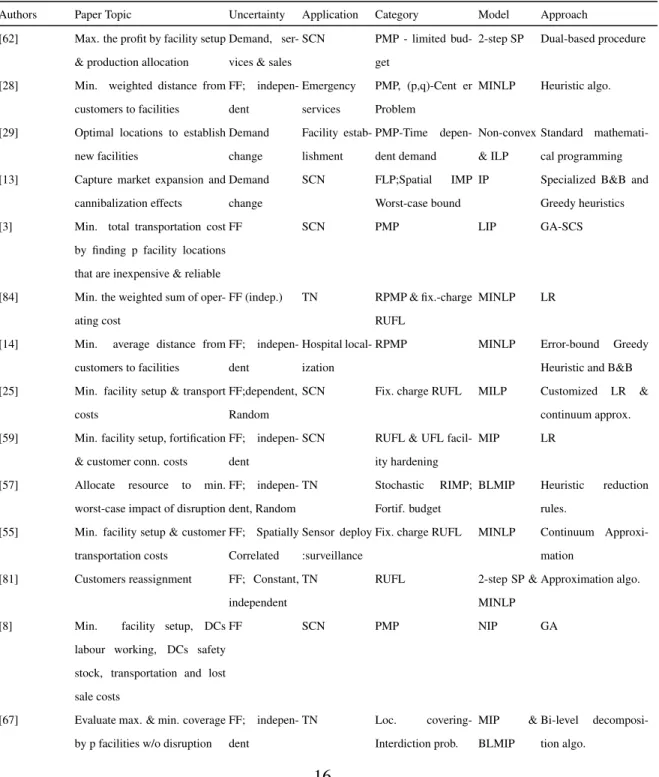
Table 2 covers a number of relevant existing efforts to handle uncertainty over the Un-capacitated FLP.
Table 2: Survey of previous effort on uncertainty over Uncapacitated FLP
Authors Paper Topic Uncertainty Application Category Model Approach
[62] Max. the profit by facility setup & production allocation
Demand, ser-vices & sales
SCN PMP - limited bud-get
2-step SP Dual-based procedure
[28] Min. weighted distance from customers to facilities FF; indepen-dent Emergency services PMP, (p,q)-Cent er Problem
MINLP Heuristic algo.
[29] Optimal locations to establish new facilities Demand change Facility estab-lishment PMP-Time depen-dent demand Non-convex & ILP Standard mathemati-cal programming [13] Capture market expansion and
cannibalization effects
Demand change
SCN FLP;Spatial IMP
Worst-case bound
IP Specialized B&B and Greedy heuristics [3] Min. total transportation cost
by finding p facility locations that are inexpensive & reliable
FF SCN PMP LIP GA-SCS
[84] Min. the weighted sum of oper-ating cost
FF (indep.) TN RPMP & fix.-charge RUFL
MINLP LR
[14] Min. average distance from customers to facilities
FF; indepen-dent
Hospital local-ization
RPMP MINLP Error-bound Greedy
Heuristic and B&B [25] Min. facility setup & transport
costs
FF;dependent, Random
SCN Fix. charge RUFL MILP Customized LR & continuum approx. [59] Min. facility setup, fortification
& customer conn. costs
FF; indepen-dent
SCN RUFL & UFL facil-ity hardening
MIP LR
[57] Allocate resource to min. worst-case impact of disruption
FF; indepen-dent, Random
TN Stochastic RIMP;
Fortif. budget
BLMIP Heuristic reduction rules.
[55] Min. facility setup & customer transportation costs
FF; Spatially Correlated
Sensor deploy :surveillance
Fix. charge RUFL MINLP Continuum Approxi-mation
[81] Customers reassignment FF; Constant, independent
TN RUFL 2-step SP &
MINLP
Approximation algo.
[8] Min. facility setup, DCs
labour working, DCs safety stock, transportation and lost sale costs
FF SCN PMP NIP GA
decomposi-[23] Min. facility setup, inventory holding and delivery costs
FF; Scenario Plan & trans-port structure
RUFL MINLP Custom LR &
Poly.-time algo.
[56] Maximize flow & path coverage Sensor failure Sensor Deploy RUFL ILP Custom Greedy & LR [85] Min. the weighted distance
from customers to facilities
DF & LF TN UFLP - limited bud-get
IP Decomposition algo.
[45] Optimal facility location & cus-tomers assignments FF; indepen-dent, Scenario SCN Integrated SC de-sign models MINLP LR & GA
[49] Generate extreme events & characterize impact
FF & LF; in-dep., Scenario
SCN Risk model with
multi-hazard
3-phase hazards
Monte-Carlo simula-tion
[82] Opt. facility location, customer assignment & facility harden-ing costs FF; indepen-dent Integrated facility & SC design
RUFL (facility & link)
MINLP Linearization
[54] Min. facility setup, fortification & customer connection costs
FF; indepen-dent
TN RPMP & RUFL
-fortif. budget
MINLP LR
[51] Max. the expected net revenues Sales & trans-port costs
SCN
(1-Echelon)
SMLTP Binary IP LR, C&W savings, TS & heur.
[8] Min. facility setup, inventory, transportation & lost sales costs
FF SCN Stochastic FLP NIP GA
[95] Min. the fixed setup, trans-portation, serving & penalty costs
FF SCN design RUFL MIP BD
[76] Min. the sum of fixed and trans-portation costs
FF (Corre-lated)
SCN RUFL & RUFL-SL NLIP LINGO 17.0
[99] Min. the total costs and CO2 emissions Demand and CO2 emission rate SCN RUFL 0-1 MI bi-objective program-ming Reformulation-Linearization tech-nique
2.3
Capacitated Facility Location Problem (CFL)
Facility Location Problem (FLP) usually employs a graph to represent the underlying trans-port network in order to model the problem where the objective is to minimize total cost of facility establishment and transport from facilities to demand nodes. Based on the capacity
of the serving facilities, FLPs are classified in the literature into capacitated and uncapac-itated. In contrast with the uncapacitated FLP, the capacitated FLP impose a limitation on the capacity of the serving facilities. Since capacitated FLPs have more realistic assump-tions compared to the uncapacitated FLPs, there is a growing academic interest on consid-ering the capacitated version of FLP under different sources of disruptions. [35] developed a mathematical model for the discrete capacitated FLP where the established facilities are unreliable (unavailable) as a result of disruptions and use the sample average approxima-tion algorithm to solve it. [58] develop a mathematical model for the capacitated FLP with limited budget to fortify a subset of the established facilities. The goal of the model is to optimally protect the network against correlated facility disruptions as well as to optimize protection plans to hedge against large area disruptions. The authors employ adapted tree search (ATS) algorithm to find out which facilities to be protected. [11] propose a model to design supply chain network (SCN) consisting of capacitated production facilities, dis-tribution centers and retailers. The authors assume that the supply chain network is under uncertainties from demand-side and supply-side.
[4] propose a set of two-stage robust optimization models to design reliablep-median facility location networks under the risk of disruption and also include practical cases: fa-cility capacities and demand losses due to disruptions. [69] study the logistics network design problems (LNDP) with facility disruptions and propose a mixed-integer program-ming model to minimize the nominal cost and reduce the disruption risk using p-robustness criterion. To solve the model, they develop a hybrid metaheuristic algorithm based on ge-netic algorithm (GA), local improvement (LI) and the shortest augmenting path (SAP) method to solve the model. [86] propose an approach for designing and planning multi-echelon, multi-commodity production distribution networks under deterministic demands. They consider that the decisions related to facilities, supplier and the production flows are dynamic. They also consider that a facility is functioning only between a minimum and
maximum rate of utilization of its installed capacity. To solve the model they use Xpress-MP (MILP solver) based on the branch-and-bound (B&B) approach. A detailed review of FLP including the capacitated version and an overview of the major location problems that have been introduced in the literature can be found in [88].
[44] investigate the single source location problem with the presence of several possible capacities in which the opening fixed cost facility depend on the used capacity and the area where the facility is located. The authors formulate two mathematical models for both the discrete and the continuous cases using the rectilinear and Euclidean distances. To solve the models, they propose two methods, namely an iterative metaheuristic (IM) approach and variable neighbourhood search (VNS) based metaheuristic technique. [92] study the waste collection problem in Denmark which motivated them to develop a fast heuristic solution approach for the large-scale capacitated arc routing problems (CARP) with or without duration constraints. [68] study the capacitated warehouse location model with risk pooling (CLMRP) in which a single plant ships one type of product to a set of retailers, each with an uncertain demand. They formulate the problem as a non-linear integer program and propose a Lagrangian relaxation (LR) solution algorithm to solve it with reasonable computational requirements.
To ensure the desired level of reliability and availability for supply chain facilities, [65] investigate a supply chain problem design that is subject to random failures and consider a stochastic SCN design model that handles facility location and facility unavailability man-agement simultaneously. To solve the model, they use GA based optimization approach to define the optimal supply chain structure and perform two simulation strategies to manage the facilities failure, one by replacing each unavailable facility by the closest facility and the other is to execute reallocation process using GA. [71] propose a mathematical formu-lation for the capacitated facility location problem under uncertainty and they assume that
the uncertainty appears in the demands and costs. They develop an efficient heuristic solu-tion algorithm based on the VNS to solve the problem. [80] introduce a mixed non-linear integer programming model for the distance-constrained mobile hierarchical facility loca-tion problem in order to minimize the total system costs. The authors develop a GA based heuristic approach to solve the model.
[34] propose a computational study for the capacitated FLP to address the usefulness of the Benders Decomposition (BD) approach. The study focuses on the particular case where the application of BD yields a single subproblem of the same size as the original problem. To minimize the fuel consumption, they propose a mixed integer linear bi-objective model for the Capacitated Location-Routing Problem (CLRP), named Green CLRP (G-CLRP). The authors solve the proposed mathematical model using the classical Pareto optimisation
-constraint technique (ECT).
[77] present a linear mixed integer formulation for the generalized version of the re-liable capacitated facility location problem (RCFLP) under correlated facility disruptions with uncertain joint distribution. The model guarantees a minimum level of service in terms of satisfied demands. They optimally solve the model for several penalty cost values using LINGO 17.0. A survey about deterministic FLP, dynamic FLP, stochastic FLP, and robust FLP can be found in [15]. To handle the sources of uncertainty associated with demand and service, [95] model the congested situations in the system within a queuing frame-work and propose a reliable location-allocation model where the facilities are subject to the risk of disruptions. The model is solved using an enhanced BD algorithm employing two accelerating methods including valid inequalities and knapsack inequalities.
[76] compare two mathematical formulations for the reliable uncapacitated facility lo-cation (RUFL) problem where a correlated facility disruption is modelled. The first model reduces unsatisfied service by allowing the decision makers to price unsatisfied demand us-ing a penalty cost. The second model employs service levels (RUFL-SL) where a minimum
level of satisfied demand for each scenario is guaranteed. The authors use LINGO 17.0 to optimality solve RUFL and RUFL-SL models. [73] introduce a mixed integer non-linear programming model for the RCFLP in which certain facilities are exposed to disruption. The authors develop two heuristic procedures to solve the problem. [6] propose a model for reliable distribution centers (DCs) in case of unexpected disruption including the site-dependent failure and random link disruptions. The authors use three solution approaches to solve the proposed model, including LR, cross decomposition (CD) and a firefly algo-rithm.
To hedge against random disruptions and capacity limitation of the distribution centers (DCs), [5] use the concept of reliable & unreliable facility and propose a two-stage integer programming model for the Reliable Facility Location Distribution Network (RFLDN) in which the authors consider the location decisions for opening DCs in the first stage while assigning customers to either a reliable or an unreliable facility in the second stage. The authors develop LR approach to solve the model.
To solve the proposed model, the authors develop a fix-and-optimize (FAO) heuristic based on the firefly algorithm. [46] present a new stochastic energy-efficient facility loca-tion allocaloca-tion (SEEFLA) model subject to carbon emission, economical, capacitated, and regional constraints. To solve the model, the authors employ an algorithm that integrates stochastic simulation (STS) and scatter search (SCS). [16] present a mathematical model to support location decisions oriented for the Public Service Facility Network (PSFN). The model aims to minimize the total cost needed to provide remaining facilities with addi-tional service capacities to satisfy demand resulting from the reallocation of users previ-ously assigned to service points that have been closed. [99] develop a 0-1 mixed integer bi-objective programming mode for a green closed-loop supply chain network design. To generate lower bounds efficiently, the authors implement a linearization technique.
of the system whose fortification reduces the impact of the worst possible disruption while our work hedges against disruption by assigning each customer to a primary and a backup facility. The works of [35], [71] and [73] introduce penalty costs for the unmet demands from the disrupted facilities while in our work the customers obtain the portion of unmet demand from the backup facility when the primary facility partially fails. The work intro-duced in [5] has similar assumptions like our work but this work hedge against disruption by adding an emergency cost for supplying from the reliable facilities in the case of dis-ruption. Thus, the customers obtain emergency services from the backup facility when the primary facility fails while in our work we hedge against disruption in the sense that the customers obtain the portion of unmet demand from the backup facility when the primary facility partially fails. The work of [77] use an effectiveness metric to guarantee a minimum level of satisfied demand to avoid the penalty cost for unmet demand in order to ensure an acceptable service level under disruption while in our work we use a limited budget to for-tify a subset of the established facility so that they become available and each customer is assigned to a primary and a backup facility.
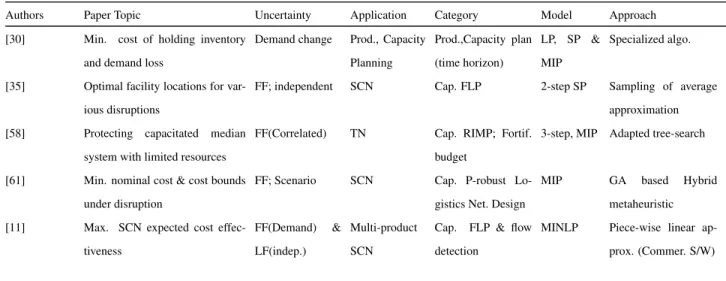
Table 3 covers a number of relevant existing efforts to handle uncertainty over the Ca-pacitated FLP.
Table 3: Survey of previous effort on uncertainty over Capacitated FLP
Authors Paper Topic Uncertainty Application Category Model Approach
[30] Min. cost of holding inventory and demand loss
Demand change Prod., Capacity Planning Prod.,Capacity plan (time horizon) LP, SP & MIP Specialized algo.
[35] Optimal facility locations for var-ious disruptions
FF; independent SCN Cap. FLP 2-step SP Sampling of average approximation [58] Protecting capacitated median
system with limited resources
FF(Correlated) TN Cap. RIMP; Fortif. budget
3-step, MIP Adapted tree-search
[61] Min. nominal cost & cost bounds under disruption
FF; Scenario SCN Cap. P-robust
Lo-gistics Net. Design
MIP GA based Hybrid
metaheuristic [11] Max. SCN expected cost
effec-tiveness
FF(Demand) & LF(indep.)
Multi-product SCN
Cap. FLP & flow detection
MINLP Piece-wise linear ap-prox. (Commer. S/W)
[4] Min. weighted distance from cus-tomers to facilities FF; Simult., Sce-nario DN Cap. RPMP & RUFL
MINLP Benders decomposi-tion; col.-constraints [92] Min. the overall cost including
fixed cost of using the depots & vehicles, the dead-heading travel and the total penalty costs
Time RN CARP ILP Branch & Cut,
Clus-tering based heuristic
[68] Min. the sum of facility setup, transportation, and inventory car-rying costs
Demand SCN Cap. FLP NIP LR
[65] Min. the sum of the follow-ing costs: facility setup, shipment plus transportation, the total in-ventory and the DC holding safety stock costs.
FF SCN Cap. FLP NIP GA
[71] Opt. location for p number of Cap.facilities in such a way that minimizes the total expected costs of transportation, construc-tion, and penalty of uncovered de-mands
Demand & Cost SCN Cap. PMP MINLP NS
[80] Find the optimal number and lo-cations of launch and recharge stations to minimizing the total establishment, drone procurement and drone usage costs
Demand Telecomm. Cap. PMP MINLP GA
[77] Min. total facility setup & trans-portation costs
FF (Correlated) SCN Cap. RUFL MILP LINGO 17.0
[73] Min. total investment and opera-tional costs
FF SCN Cap. RUFL MINLP Relax & Fix and Relax
& Round Heuristics [6] Min. Total Facility setup,
trans-portation and improvising costs
FF (Dep.)-LF SCN Cap. RUFL MILP LR, Cross
Decompo-sition & Firefly [5] Min. the facility setup, the
de-terministic service cost for cus-tomers, the expected service cost for customers, and the holding costs. FF-site-dependent DN RFLDN Two-Stage IP LR - CPLEX solver
[95] Min. the fixed setup cost as well as expected transportation, serv-ing & penalty costs
[76] Min. the sum of fixed and trans-portation costs
FF (Correlated) SCN RUFL & RUFL-SL NLIP LINGO 17.0
[46] Min. the total transportation en-ergy consumption of customers
FF Energy-eficient
FLA
Cap. FLP NLIP Stochastic Simulation
& Scatter Search [16] Min. the total cost needed to
pro-vide remaining facilities with ad-ditional service capacities
Facility Capacity Public Services Network
Cap. PSFN ILP CPLEX solver
[99] Min. the total costs and CO2 emissions.
Demand and CO2 emission rate SCN RUFL 0-1 MI bi-objective program-ming Reformulation-Linearization tech-nique
2.4
Shortest Path Problem
The classical shortest path problem is one of the fundamental problems in graph theory in which the objective is to find a path that minimize the length from a source node to a destination node. In the last few decades, a variety of approach have been introduced to solve such problem. In [27], the author develops a single source multiple target (SSMT) algorithm for the shortest path problem. The authors in [94] propose a pre-computation based approach for both single pair alternative shortest path and all pairs shortest paths processing in spatial network. To handle the variability of travel time, [97] present an algorithm to solve the mean-standard deviation reliable shortest path problem (RSPP) in which they take into account the correlations between the link travel time. [33] propose a mathematical model for the constrained shortest path tour problem (CSPTP) in which the path must cross by a sequence of node in a given order must. The author introduces a Branch & Bound method to solve the model.
[41] formulates a non-linear objective functions for the stochastic shortest path problem using the mean and standard deviation values of the resulting probability distribution and general cost functions. To solve the model, the author applies Lagrangian relaxation (LR) to
find the feasible solution. Considering the travel time uncertainty, [21] extend the classical
k-loopless shortest path problem to the stochastic transportation network and introduce the
k reliable shortest paths (KRSP). To solve the problem in large-scale networks exactly, the authors propose a deviation path algorithm and to further improve the KRSP finding performance they introduce theA?technique.
The authors in [22] study the travel time uncertainties in a road network(RN)where the goal is to find the most reliable path that maximizes the probability of on-time arrival. They propose a two-stage solution algorithm that exactly solve the problem. The authors in [79] use the historical information and the real-time information of a transportation network and present the dynamic shortest path problem with stochastic disruptions as a discrete time fi-nite horizon Markov decision process (MDP). They develop a hybrid approach based on approximate dynamic programming (ADP) and clustering using deterministic lookahead policy and value function approximation. In [2], the author provides an experimental anal-ysis on how traversal algorithms behave on social networks. Dijkstra algorithm has been used in [89] to generate single source single destination (SSSD) shortest path in large sparse graphs where the goal is to reduce the response time for online queries. [1] present ASAP system that can extremely quickly generate the shortest path for all pair of nodes on large scale networks.
The dynamic single source shortest path problem (SSSPP) has been addressed in [37] via dynamizing Dijkstra algorithm and generate the solution of that problem with com-plexity O(nlg m) for the update time. To reach an emergency area in a minimum time, [64] develop a dynamic emergency routing approach based on Dijkstra algorithm and analytical hierarchical processing (AHP). For safe evacuation in a short time from an emergency area, [75] model the evacuation route then they generate the directed graph based on the distance between nodes and coordinate of nodes. To generate the shortest and safest path, they use Dijkstra algorithm and Dijkstra-ACO.
[9] optimize Dijkstra algorithm using a faster queue design based on binary (or d-ary) heap implementation to accelerate the computation of the shortest paths. [43] introduce a new time-dependent shortest path algorithm for SSSD in multimodal transportation net-work.
Considering the stochastic disruption in a network, the authors in [47] present an emer-gency evacuation model for the SSP and they propose a real-time dynamic navigation algo-rithm (DNA) to solve it. [42] study a network that is stochastic on-time arrival and propose a modification for the reliable routing algorithm. The authors modify the shortest path algorithm to decrease its computation time by choosing particular subset of graph nodes and links. Taking into account the travellers concern on travel time reliability in congested RN, [20] formulate the spatially dependent reliable shortest path problem (SD-RSPP) on a RN of correlated link travel times. The authors propose a link-based multi-criteria A* algorithm (ERSPA* algorithm) to solve the model. To find the optimal path in an uncertain transportation network, [19] formulate three model for the shortest path problem typically name expected value, dependent-chance and chance constrained models. The authors de-velop a simulation based genetic algorithm (SBGA) to solve the former models.
[36] derives the uncertainty distribution of the shortest path length in an uncertain net-work and investigates solutions to theα-shortest path. The author indicates that there is an equivalence relation between theα-shortest path in an uncertain network and the shortest path in a corresponding deterministic network and as so proposes an approach to find the
α-shortest path and the equivalence deterministic shortest path. An approach based on GA for the SPRP has been presented in [12]. The authors in [70] indicate that most of the exist-ing approaches that handle the shortest path problem have two main drawbacks: generatexist-ing the path before movement and re-processing when node and/or link fails. To handle these shortcomings, they propose two novel algorithms typically name Realtime Shortest Path (RSP) and Realtime Shortest Path Plus (R-SP+).
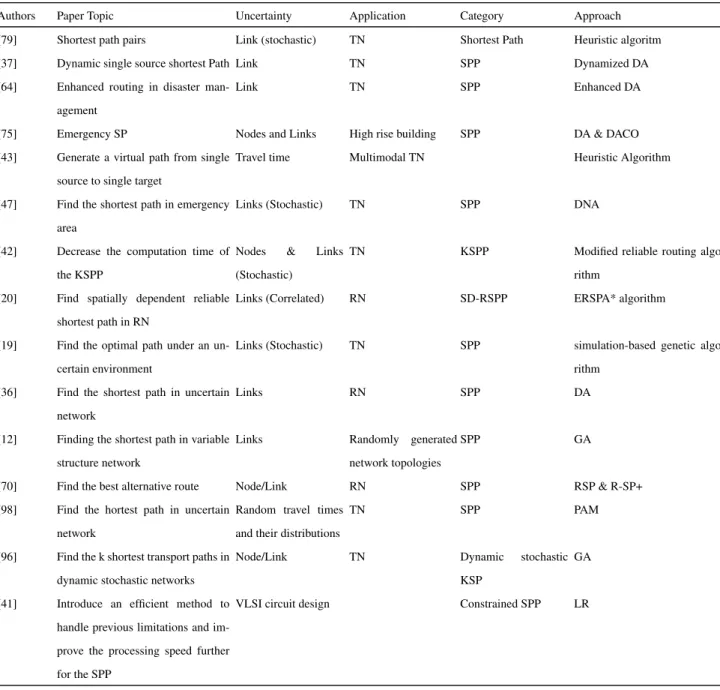
The authors in [98] present a robust shortest path model to hedge against the risk of un-certainty in travel times. To solve the model, they propose an efficient primal approximation method that has to solve the deterministic shortest path problem and the mean-standard de-viation shortest path problem. [96] analyze the dynamic stochastic characteristics and the relationships between the links and nodes of the transportation network. The authors de-fine the probabilistic shortest path concept, propose a mathematical model for the dynamic stochastic KSP and develop a GA to solve the model. A survey on variations of the short-est path problem of different objective functions and existing solution approaches can be found in [87]. Table 4 covers a number of relevant existing efforts to handle the shortest path problem and k-shortest path problem.
2.5
Gap Analysis
In the previous Sections 2.2,2.3 and 2.4, we summarize a number of relevant existing ef-forts to handle the uncapacitated FLP, capacitated FLP, and shortest path problem under disruption (uncertainty) over SCN. Section 2.2 and Section 2.3 cover a number of relevant existing efforts to handle the uncapacitated FLP and capacitated FLP. The majority of these works consider only complete disruption of facilities with equal probability, which is not a very realistic assumption. Also, they ignore partial facility disruptions in the case where facilities fail partially, which is a more realistic assumption. Moreover, a minority of these works consider partial fortification depending on a ranking of the facilities. Furthermore, most of them do not address correlated facility failure probabilities (site dependence and spatial correlation) since it can trigger the failure of other facilities. Finally, most of the works do not consider the impact of SCN disruption on economic conditions and popula-tion especially when the SCN facilites are located on a site of a populapopula-tion that is highly correlated to the SC activities.
Section 2.4 covers a number of relevant existing efforts to handle the shortest path prob-lem andk-shortest path problem. The majority of these works do not take into account the failure probabilities in the connected nodes partially or completely and their consequences on the connected links. Also, the majority of them do not handle the partial overlapping
k-SPP. Moreover, most of these works do not consider the case when the correlated failures of the connected nodes. Furthermore, a minority of these models handle k-shortest path problem in multi-modal or global networks.
In the next three chapters of this thesis and based on the foregoing explanation, we are addressing the following gaps:
• Partial and Complete disruption in SCN facilities, where they are subject to hetero-geneous failure probabilities,
• Partial and Complete disruption in TN connected nodes, where they are subject to heterogeneous failure probabilities
• Partial fortification of SCN facilities, depending on a ranking of the facilities, and
• Partial overlappingk-SPP.
we are going to address the foregoing gaps as follows:
• Presenting a non-linear integer programming model for RPMP, RUFL problems as well as developing an evolutionary learning heuristic as solution generation approach.
• Capturing the RCFL problem using a non-linear integer programming model and developing a separation-linearization-based solution approach for MILP solver based solution generation.
• Modelling the partial overlappingk-SPP under partial and complete disruption in the TN connected nodes as well as developing a clustering-based solution approach.
Table 4: Survey of previous effort on SPP andk-SPP
Authors Paper Topic Uncertainty Application Category Approach
[79] Shortest path pairs Link (stochastic) TN Shortest Path Heuristic algoritm
[37] Dynamic single source shortest Path Link TN SPP Dynamized DA
[64] Enhanced routing in disaster man-agement
Link TN SPP Enhanced DA
[75] Emergency SP Nodes and Links High rise building SPP DA & DACO
[43] Generate a virtual path from single source to single target
Travel time Multimodal TN Heuristic Algorithm
[47] Find the shortest path in emergency area
Links (Stochastic) TN SPP DNA
[42] Decrease the computation time of the KSPP
Nodes & Links (Stochastic)
TN KSPP Modified reliable routing
algo-rithm [20] Find spatially dependent reliable
shortest path in RN
Links (Correlated) RN SD-RSPP ERSPA* algorithm
[19] Find the optimal path under an un-certain environment
Links (Stochastic) TN SPP simulation-based genetic
algo-rithm [36] Find the shortest path in uncertain
network
Links RN SPP DA
[12] Finding the shortest path in variable structure network
Links Randomly generated
network topologies
SPP GA
[70] Find the best alternative route Node/Link RN SPP RSP & R-SP+
[98] Find the hortest path in uncertain network
Random travel times and their distributions
TN SPP PAM
[96] Find the k shortest transport paths in dynamic stochastic networks
Node/Link TN Dynamic stochastic
KSP
GA
[41] Introduce an efficient method to handle previous limitations and im-prove the processing speed further for the SPP
Chapter 3
Uncapacitated Facility Location
Planning Under Disruption
3.1
Introduction
The p-median problem (pmp) represents a subclass of facility location problem where a fixed p number of facilities are required to be established and the objective function in-volves minimizing total transportation cost. In UFL, each node has an associated facility establishment cost and the decision makers are required to establish an optimal number of facilities to minimize overall sum of establishment cost and transportation cost. Thus, in general, facility location problems assume guaranteed availability of facilities to serve customer demands. Conversely, reliablep-median problem (RPMP) and reliable uncapaci-tated facility location problem (RUFL) consider a predefined probability of failure for each node. Therefore, in this context, every customer is required to be associated with multi-ple facilities (typically a primary and a backup) to ensure availability of facilities under disruptions.
3.2
Model Assumptions
The following assumptions are typically considered to define RPMP and RUFL:
• Facilities have unlimited capacity (as in [59], [54], [25] and [4]).
• If a facility fails, it becomes totally unavailable.
• Facility failures are independent (as in [59], [54], [25] and [4]).
• Each customer is assigned to a primary facility and a backup facility (as in [54]) unless the primary facility is fortified (i.e. totally reliable) in which case it also serves as a backup for the same customer.
• Probability of a simultaneous failure of primary and backup facilities is negligible for each customer.
• The fortification budget is fixed (an input to the problem).
3.3
Model Formulation
We present next the specific details and formulation of each of these two problems.
3.3.1
Reliable
p
-Median Problem (RPMP)
In RPMP, each member node of a network of interconnected nodes is exposed to a prede-fined failure probability. The problem aims to selectplocations to serve the customers such that the total transportation cost to satisfy customer demands, by assigning each customer to one primary and one backup facilities, is minimal. Additionally, the problem assumes a fixed budget available to fortify few selected facilities to increase network reliability. RPMP model is considered as detailed by [54].
The formulation considers a set of customers I, a set of potential facility locationsJ, and a predefined numberpof facilities to be established. The set of potential facilities is a subset all customers, J ⊆ I. However, they can also represent a different set. Each customeri∈I has a specific demandhi. Letdij >0be the transportation cost of one unit
of demand from facility locationj ∈ J to customeri ∈ I. For each facilityj there exists a failure probabilityqj where0 ≤ qj ≤ 1 and a fortification costf cj which consists of a
setup costsj and a reliability costqj ×rcj. rcj denotes the cost related to unit reduction in the failure probability. Total fortification budget isB.
The decision variables used in the formulation are as follows:
xj =
1, If a facility is established at locationj
0, otherwise. zj =
1, If the facility at locationj is fortified
0, otherwise. yij0 =
1, If customeriis served by primary facilityj
0, otherwise. yij1 =
1, If customeriis served by backup facilityj
0, otherwise.
The objective function for optimization is described as follows:
M inX i∈I
X
j∈J "
hidijyij0(1−qj(1−zj)) +hidijyij1
X
r∈J,r6=j
qryir0(1−zr)
#
Subject to: X j∈J yij0 = 1 ∀i∈I (2) X j∈J yij1 = 1 ∀i∈I (3) yij0+yij1 ≤xj∀i∈I, j ∈J (4) X j∈J xj =p (5) zj ≤xj (6) X j∈J (sj+qj×rcj)zj ≤B (7) zj, xj ∈ {0,1}∀j ∈J (8) yij0, yij1 ∈ {0,1}∀i∈I, j ∈J (9) The objective function (1) of RPMP model is to minimize the total transportation cost for satisfying all customer demands. The termX
j∈J "
hidijyij0(1−qj(1−zj)) #
is the
ex-pected transportation cost between customeriand its primary facility, where(1−qj(1−zj))
is the probability that the primary facility is available. The termX
j∈J " hidijyij1 X r∈J,r6=j qryir0(1− zr) #
is the expected transportation cost between customeriand its backup facility, where
the term X
r∈J,r6=j