c
AUTOMATIC VERIFICATION OF SECURITY POLICY IMPLEMENTATIONS
BY
SANKALP SINGH
DISSERTATION
Submitted in partial fulfillment of the requirements for the degree of Doctor of Philosophy in Computer Science
in the Graduate College of the
University of Illinois at Urbana-Champaign, 2012
Urbana, Illinois Doctoral Committee:
Professor William H. Sanders, Chair and Director of Research Professor Roy H. Campbell
Associate Professor Darko Marinov Professor David M. Nicol
ABSTRACT
Networked systems are ubiquitous in our modern society. They are found in settings that vary from mundane enterprise IT systems to critical infrastructure systems. The security of networked systems is important given their widespread use. In particular, the emerging scenarios and the likely trends for the future of critical networked systems make the security of those systems a paramount concern, especially in the area of controlling access to the critical elements of the system over communication networks; successful cyber-attacks on such systems, in a worst-case scenario, could result in loss of life, or in massive financial losses through loss of data, actual physical destruction, misuse, or theft.
Access control is a cornerstone of network security. In a modern networked system, access control is implemented through a variety of devices and mechanisms that include, but are not lim-ited to, router-based dedicated firewalls; host-based firewalls, which could be based in software or hardware; operating-system-based mechanisms, such as the mandatory access control in the Na-tional Security Agency’s (NSA’s) SELinux; and middleware-based mechanisms, such as the Java Security Manager. Such devices and mechanisms collectively implement a networked system’s global policy (which is usually implicit), which specifies the overall system-level objectives with respect to resource access. However, it has been shown in empirical studies that misconfiguration of access control enforcement points is common. The problem of identifying those misconfig-urations is compounded when several such mechanisms are present, as the complex interactions among those distributed and layered mechanisms can mask problems and lead to subtle errors.
In this dissertation, we propose a framework for performing comprehensive security analysis of an automatically obtained snapshot of an access control policy implementation (e.g., firewall rule-sets) to check for compliance against a (potentially partial) specification of the global access policy. We identify and classify possible errors that can be found in global policy implementations,
including both policy violations and internal inconsistencies. We provide detailed formalisms that can be used to efficiently model the topology of the networked system being analyzed and the rule-sets from multiple types and makes of firewalls that may be present on the network. The formalisms are XML-based, with sound mathematical underpinnings. We present an XML-based global policy specification language, with algorithms that ensure internal consistency of specifica-tions written in that language and resolve any conflicts. We show that our specification language is at least as expressive as linear temporal logic.
We describe an efficient algorithm for exhaustive analysis to identify all the inconsistencies and policy violations. The analysis algorithm utilizes specialized data structures, that we call multi-layered rule-graphs, to dramatically improve performance. We provide additional mechanisms for identifying the root causes of any problems discovered. We further enhance the scalability of our analysis by presenting an algorithm for statistical analysis of the networked system; the algorithm uses importance sampling, and produces a sample set of violations and a quantitative estimate of the remainder.
To facilitate the analysis, our framework includes techniques that automatically infer the net-work topology for the system being analyzed based simply on the firewall rule-sets implemented. The framework has been implemented with a sophisticated graphical front-end as the Network Access Policy Tool (NetAPT). We demonstrate the efficiency, scalability, and extensibility of our techniques through analytic evaluation and empirical evidence based on real-world testing. We also present an algorithm for automatically generating a benchmark suite for testing NetAPT; the algorithm learns the defining characteristics of our real-world data sets and generates random net-works and firewall rule-sets that are representative of the real-world ones.
ACKNOWLEDGMENTS
The road I have taken in my journey through graduate school has been long and winding. There were times when the end did not seem to be in sight, but ultimately, I am glad I persevered and find myself tremendously richer for the experience. I could not have completed this journey without the support and encouragement of many people, and I would like to thank them.
First, I would like to thank my advisor, Professor William H. Sanders, for his technical, financial, and, when needed, emotional guidance and support throughout my graduate career. I am grateful for the opportunity to learn the fundamentals of good and high-impact research from him. I will always be thankful for his unwavering support when extraneous factors introduced delays in my thesis research. I would like to thank Professor David M. Nicol for serving as my unofficial co-advisor, and for serving on my thesis committee. His technical insights and guidance have helped me mold and sharpen into focus a lot of the research presented in this dissertation. I would like to thank both Professor Sanders and Professor Nicol for allowing me the opportunity and freedom to tackle relevant and meaningful problems.
I would like to thank Mouna Bamba for helping me to bring my research out from the ethereal into the corporeal. It has been an incredibly pleasant and instructional experience collaborating with her on the NetAPT tool, and I am grateful for all the support and encouragement she has provided.
I would like to thank Edmond Rogers for sharing his technical insights and wisdom that can only come through experience. His help and feedback have been invaluable in refining the research presented in this dissertation.
I am thankful to Jenny Applequist for the education in grammar she has given me, and the many long hours of work she has graciously spent helping me with my writing.
during graduate school. I am thankful for the nourishing and intellectually simulating environment the PERFORM group has provided, and I am not surprised that I have formed some of my closest friendships within the group. I am grateful to Eric Rozier and Ryan Lefever for their friendship; their support and mentorship have been invaluable. I would like to thank the following members for their support and friendship: Adnan Agbaria, Sobir Bazarbayev, Robin Berthier, Shuyi Chen, Tod Courtney, Michel Cukier, David Daly, Nathan Dautenhahn, Salem Derisavi, Doug Eskins, Ahmed Fawaz, Michael Ford, Shravan Gaonkar, Mark Griffith, Vishu Gupta, Michael Ihde, Kaustubh Joshi, Ken Keefe, Vinh Lam, Elizabeth LeMay, James Lyons, Michael McQuinn, Hari Ramasamy, Fabrice Stevens, and Saman Aliari Zonouz.
I thank Professors Roy H. Campbell and Darko Marinov for serving on my committee and offering me their support, guidance, and suggestions. Their feedback during my preliminary ex-amination was critical to my thesis, and their support throughout this process helped me to shape my research into a successful dissertation.
I would also like to thank the various agencies1 that funded my research. This material is based in part upon work supported by the U.S. Department of Homeland Security under Grant Award Number 2006-CS-001-000001; by the Institute for Information Infrastructure Protection (I3P) under grant 2003-TK-TX-0003 from the Office of Domestic Preparedness and the Office of Science and Technology of the U.S. Department of Homeland Security; by the Department of Energy under Award Number DE-OE0000097; by the National Science Foundation under Grant No. CNS-0524695; by DARPA under contract number F30602-02-C-0134; by Motorola, Inc.; and by the Boeing Company. Any opinions, findings, points of view, and conclusions or recommenda-tions expressed in this document are those of the author and do not necessarily reflect the official position or views, either expressed or implied, of the National Science Foundation, the U.S. De-partment of Homeland Security, the Office of Domestic Preparedness, the Office of Science and Technology, or the other supporting agencies.
I would like to thank my family for all of their love, support, and encouragement. I really
1This report was prepared as an account of work sponsored by an agency of the United States Government. Neither the United States Govern-ment nor any agency thereof, nor any of their employees, makes any warranty, express or implied, or assumes any legal liability or responsibility for the accuracy, completeness, or usefulness of any information, apparatus, product, or process disclosed, or represents that its use would not infringe privately owned rights. Reference herein to any specific commercial product, process, or service by trade name, trademark, manufacturer, or otherwise does not necessarily constitute or imply its endorsement, recommendation, or favoring by the United States Government or any agency thereof. The views and opinions of authors expressed herein do not necessarily state or reflect those of the United States Government or any agency thereof.
appreciate their encouragement and patient support as I made my circuitous way through graduate school. I thank my parents for their support of my academic pursuits throughout my life and nurturing of my interests. I thank my brother Tanmay for sharing so much of my life and being a great friend in addition to being a great brother.
TABLE OF CONTENTS
LIST OF TABLES . . . xi
LIST OF FIGURES . . . xii
LIST OF ABBREVIATIONS . . . xiii
CHAPTER 1 INTRODUCTION . . . 1
1.1 Thesis Statement . . . 2
1.2 Contributions . . . 3
1.3 Organization . . . 4
CHAPTER 2 ACCESS CONTROL IN NETWORKS . . . 7
2.1 Policy Violations . . . 10 2.2 Rule-Set Inconsistencies . . . 11 2.2.1 Intra-Firewall Inconsistencies . . . 11 2.2.2 Inter-Firewall Inconsistencies . . . 13 2.2.3 Cross-Path Inconsistencies . . . 13 2.3 Rule-Set Redundancy . . . 14
CHAPTER 3 RELATED WORK . . . 16
3.1 Analyzing Rule-Sets for Consistency . . . 16
3.1.1 Single Firewall Consistency . . . 16
3.1.2 Inter-Firewall Consistency Analysis . . . 16
3.2 Top-Down Management . . . 17
3.3 Attack Graphs . . . 17
3.3.1 Without Statistical Analysis . . . 18
3.3.2 With Statistical Analysis . . . 18
3.4 Policy Specification and Composition . . . 19
3.4.1 Authorization Policy Specification Languages . . . 19
3.4.2 Logics . . . 19
CHAPTER 4 ANALYSIS FRAMEWORK . . . 21
4.1 Analysis Framework: Formalisms . . . 21
4.1.1 Formalisms for Global Access Policy . . . 21
4.1.2 Formalisms for Access Control Elements . . . 25
4.2 Analysis Framework: Data Structures . . . 32
4.2.1 Multidimensional Interval Tree . . . 32
4.2.2 Multilayered Rule-Graph . . . 34
4.3 Policy Specification Formalism: Comparison with LTL . . . 38
4.3.1 Brief Background on LTL . . . 38
4.3.2 Why LTL? . . . 40
4.3.3 Expressing LTL Formulas in Our Formalism . . . 42
CHAPTER 5 EXHAUSTIVE ANALYSIS . . . 46
5.1 Identifying Inconsistencies . . . 46
5.2 Identifying Policy Violations . . . 49
5.3 Analytic Evaluation . . . 52
CHAPTER 6 STATISTICAL ANALYSIS . . . 57
6.1 Estimation of Security Compliance Metric . . . 58
6.1.1 Metric Definition . . . 58
6.1.2 Review of Importance Sampling . . . 60
6.1.3 Application to Security Compliance MetricG(Ψ) . . . 61
6.2 Estimation with No Exceptions Identified . . . 64
CHAPTER 7 TOPOLOGY INFERENCE . . . 66
7.1 Overall Topology Inference Framework . . . 66
CHAPTER 8 FRAMEWORK IMPLEMENTATION: NETWORK ACCESS POLICY TOOL . . . 70
8.1 NetAPT Architecture . . . 70
8.2 NetAPT Analysis Engine . . . 73
8.3 NetAPT Features . . . 74
CHAPTER 9 EXPERIMENTAL RESULTS . . . 79
9.1 Experimental Evaluation Using Test Cases . . . 79
9.1.1 Evaluation of Exhaustive Analysis . . . 79
9.1.2 Evaluation of Statistical Analysis . . . 82
9.1.3 Field Testing at a Multi-Site PCS . . . 83
9.2 Automatic Generation of Representative Networks . . . 85
9.2.1 Related Work and Background . . . 86
9.2.2 Overall Approach . . . 92
9.2.3 Learning Characteristics . . . 93
9.2.4 Generation Algorithm . . . 97
CHAPTER 10 CONCLUSIONS . . . 102
10.1 Contribution Review . . . 102
10.2 Future Avenues . . . 104
10.2.1 Fast Incremental Change Analysis . . . 104
10.2.2 Statistical Analysis . . . 104
APPENDIX A TOPOLOGY INFERENCE DETAILS . . . 106
A.1 Goal . . . 106
A.2 Top-Level Approach . . . 106
A.3 Overall Topology Inference Framework . . . 107
A.3.1 Topology Database and Management Scripts . . . 108
A.3.2 Input Scripts . . . 112
A.3.3 Output Scripts . . . 123
LIST OF TABLES
2.1 Inconsistent Single Access Control List (ACL) . . . 12 2.2 Single ACL with Redundant Rules . . . 14 A.1 Lists and Strings Created During Input Parsing . . . 118
LIST OF FIGURES
2.1 Representative Network . . . 8
4.1 Global Access Policy Document Type Definition (DTD) . . . 22
4.2 Algorithm for Resolving Policy Constraints . . . 26
4.3 Network Topology DTD . . . 27
4.4 Access Control Elements DTD: Part 1 . . . 28
4.5 Access Control Elements DTD: Part 2 . . . 29
4.6 An Example Process Control Network . . . 30
4.7 Constructing Rule Graphs . . . 34
4.8 A Sample Rulegraph . . . 38
7.1 Topology Inference as Part of Overall Framework . . . 67
8.1 NetAPT Architecture . . . 71
8.2 Operational Overview of the Analysis Engine . . . 73
9.1 A Representative Process Control Testbed . . . 80
9.2 A Network Topology Inferred by NetAPT (Anonymized) . . . 84
9.3 Evaluating NetAPT Using Randomly Generated Networks . . . 92
9.4 A Example (Partial) Classification of Network Types . . . 94
9.5 Information Stored in a Cluster Node . . . 95
LIST OF ABBREVIATIONS
AAA Authentication, Authorization, and Accounting ACL Access Control List
ASA Adaptive Security Appliance CTL Computation Tree Logic
DMZ DeMilitarized Zone
DTD Document Type Definition LTL Linear Temporal Logic NetAPT Network Access Policy Tool NAT Network Address Translation NSA National Security Agency PCS Process Control System PIX Private Internet eXchange
SCADA Supervisory Control And Data Acquisition SAML Security Assertion Markup Language SELinux Security-Enhanced Linux
XACML eXtensible Access Control Markup Language XML eXtensible Markup Language
CHAPTER 1
INTRODUCTION
Networked systems are used in a large number of settings, including many critical infrastructure systems, such as chemical plants, electric power generation and distribution facilities, water distri-bution networks, and waste water treatment facilities. The emerging scenarios and the likely trends for the future of critical networked systems demand that the problem of securing these systems re-ceive immediate attention, especially in the area of controlling access to the critical elements of the system over communication networks. Given the mission-critical nature of a significant number of large networked information systems, it is extremely important to ensure their protection against cyber-attacks, which, in a worst-case scenario, could result in loss of life, or in massive financial losses through loss of data, actual physical destruction, misuse, or theft.
A modern networked system includes a variety of devices and mechanisms for controlling ac-cess to its resources. These acac-cess control mechanisms include, but are not limited to, router-based dedicated firewalls; host-router-based firewalls, which could be router-based in software or hardware; operating-system-based mechanisms, such as the mandatory access control in the National Secu-rity Agency’s (NSA’s) SELinux; and middleware-based mechanisms, such as the Java SecuSecu-rity Manager, that provide for specification and enforcement of fine-granularity access control policies for Java programs.
The importance of correctly implementing access control for effective intrusion prevention can-not be overestimated. A survey of the SANS Institute’s top 20 vulnerabilities [1] shows that a significant number of them are defended against by appropriate configurations of access control policy. To defend systems against the most critical known threats, one has to be able to validate se-curity policy implementation. However, distributed and layered mechanisms, such as those listed above, can interact in complex ways that can lead to subtle errors and mask problems. It can be difficult to discern the global picture that emerges from the local configurations of these myriad
ac-cess control elements. As a result, it is not surprising that misconfigurations of these mechanisms are a major source of security vulnerabilities. In fact, a study in 2004 suggested that most firewalls (the most popular access control mechanism) suffer from misconfigurations [2]. It is important for the administrators of computer networks to have ways to make sure that high-level specifications of such system access constraints are reflected in the actual configurations of the access control mechanisms spread throughout the system. Furthermore, if the implementation of policy (device configurations) is not in compliance with the specification, a diagnosis to locate the root causes of the problem is critical.
This dissertation describes a framework and a set of constituent techniques to address the needs described above. Our techniques allow for the analysis of the security policyimplementationfor conformance with the global security policy specification. They integrate policy rules (i.e., con-figuration information) from a large variety of sources typically found in a modern network and provide for a detailed offline analysis, as well as dynamic online analysis of incremental config-uration changes that allows for detection of policy implementation holes during operation. They ensure scalability with increasing network size and complexity via a statistical analysis mode. We have implemented the framework in the form of a tool, the Network Access Policy Tool (NetAPT), which includes a graphical front-end for usability and ease of information management.
1.1
Thesis Statement
It is difficult to meet best-practices recommendations and compliance requirement rigorously by hand without significant person-hour investment. There exists a need for methods that can express best practices and compliance requirements for large networked systems as global access policy in a machine-checkable form. Furthermore, we need techniques that can automatically detect and identify violations of the global access policy by its implementation (in the form of configuration of firewalls and other access policy enforcement devices).
It is our thesis that:
• Access control policyimplementationin networked systems can be verified for compliance against a (potentially partial)specificationof the global access policy.
• Mechanisms for such verification can be demonstrably efficient, scalable and extensible, and require minimal user guidance.
• Those mechanisms can be of use to real system administrators and auditors by helping them identify security problems that would otherwise be difficult to detect without a considerable time investment.
1.2
Contributions
The main contributions of this dissertation are as follows:
• A classification of the possible errors that can be found in global policy implementations. This includes errors leading to policy violations and/or internal rule-set inconsistencies. • An XML-based global policy specification language with mechanisms for direct
transcrip-tion as well as translatranscrip-tion from other formalisms, such as Linear Temporal Logic (LTL) and GUI-based specifications. We provide algorithms for ensuring internal consistency of the specification and resolution of any conflicts. We prove that our specification language is at least as expressive as LTL.
• A unified XML-based schema for representing rule-sets from multiple types and makes of firewalls. We currently support nearly full feature-sets of the devices from the four most popular commercial firewall manufacturers.
• A multi-layered rule-graph data structure for efficient modeling of network topology and the accompanying access policy implementation. We use multidimensional interval trees (continuous elements) and hash-tables (discrete elements) to represent rule-graphs, policy constraints, and traffic attribute sets.
• An efficient algorithm for exhaustive analysis that produces a complete list of inconsistencies and policy violations. We provide additional mechanisms for identifying the root causes of the reported violations.
• An algorithm for statistical analysis of the networked system, which produces a sample set of violations and a quantitative estimate of the remainder.
• A method for automatically inferring the network topology from the configuration of the layer 3 devices (firewalls, routers, and switches).
• An implementation of the proposed framework in the form of the Network Access Policy Tool (NetAPT). The tool provides a high-functionality GUI as well as a powerful command-line interface. It incorporates implemented policy rules from a wide variety of sources, and, through extensive automation, minimizes the need for user guidance. It has been used successfully at several real-world sites.
• A method for learning the defining characteristics of a set of network topologies and the rule-sets of the firewalls therein, and use them to generate random networks and firewall rule-sets that are similar. The generated networks can be varied along dimensions such as numbers of sub-networks, access control devices, hosts, applications deployed, and rule-set size and complexity. We use the randomly generated networks to provide comprehensive experimental results demonstrating the efficacy and scalability of our analysis and topology-inference algorithms. The experimental results supplement the analytic evaluation of those algorithms.
1.3
Organization
The remainder of this dissertation is organized as follows.
Chapter 2 begins with some background information on how access control is implemented in modern networked systems. We then provide a detailed and comprehensive classification of possi-ble errors that can be found when implementing access control through firewalls. We include both errors due to internal inconsistencies in the firewalls’ rule-sets and errors resulting from violations of the user-specified global policy.
Chapter 3 presents the state of the art of the research in related areas, particularly policy spec-ification and identspec-ification of misconfigurations in firewalls. We look at academic research and
several commercial products. We critically examine the prior art and identify the key challenges that still need to be addressed in order to satisfy our thesis statement.
Chapter 4 introduces the formalisms and data structures that we use to develop efficient analysis algorithms. We provide formalisms for global access policy specification, access control elements, and network topology. We describe the multilayered rule-graph data structure that we use to model the network topology and access control elements (firewall rule-sets). We detail mechanisms for efficient traversal of the rule-graph data structure using multidimensional interval trees. We con-clude the chapter with a comparison of our policy specification language and LTL, proving that our specification language is at least as expressive as LTL.
Chapter 5 details our algorithms for efficient, exhaustive analysis of a given network system (topology and rule-sets) for compliance with a user-specified global access policy. We formally describe an algorithm for identifying all the internal inconsistencies in the rule-sets, an algorithm for identifying all the paths through the network that violate some tenets of the global access policy, and, finally, algorithms for identifying the root causes that result in all the violating paths. We conclude with an analytic evaluation (complexity analysis) of the algorithms described in the chapter.
Chapter 6 details importance sampling-based algorithms for statistical analysis for checking compliance. We provide descriptions of the required metrics and mathematical formulation to support the use of importance sampling. We also outline an algorithm for determining the likeli-hood of there being no violations if none are found when some stopping criterion is reached.
Chapter 7 describes the techniques we use for inferring the network topology from the config-uration files of the firewalls and layer 3 devices (such as routers and switches). We highlight the ways in which we have made major extensions to an existing inference framework to implement our techniques. We describe the inference algorithms in detail in Appendix A.
Chapter 8 details the implementation of our framework in the form of the Network Access Policy Tool (NetAPT). We describe the tool architecture and highlight some of the tool’s essential features.
Chapter 9 details experimental evaluation of our algorithms. We evaluate NetAPT on test cases drawn from various industry collaborations, and demonstrate that our algorithms are efficient and provide results that can easily be used by system administrators to identify and correct any
prob-lems with the configurations of their firewalls. We also detail a mechanism for generating a bench-mark suite of automatically generated network topologies and firewall rule-sets that share essential characteristics with the data set obtained through industry collaboration.
Finally, Chapter 10 concludes with a summary of our contributions and brief discussion of future avenues for research.
CHAPTER 2
ACCESS CONTROL IN NETWORKS
Access control has long been the linchpin of system security; modern systems have multiple access control methodologies, different security models, and separate configurations for each methodol-ogy and each device. Together these all form the access control implementation. However, only very limited technology exists to answer crucial questions about precisely what security posture is produced, how the different access control policies interact, and whether the implementation is in compliance with an overall statement of global access control policy, among others.
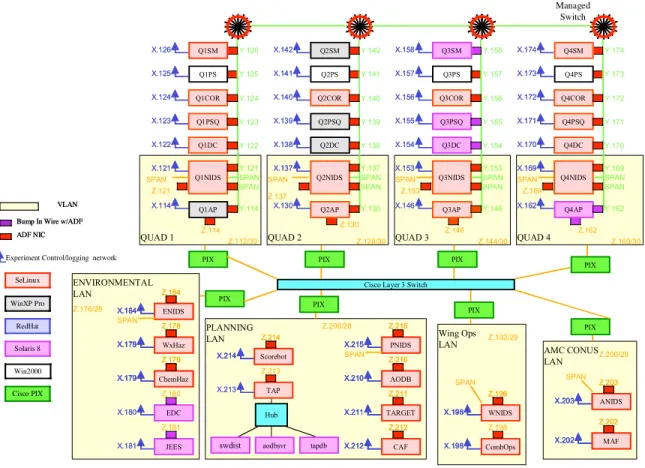
To better appreciate the issue, let’s examine some of the access control components of a dis-tributed system. Firewalls are critical assets in the protection of a network. A firewall is configured through its rules (collectively referred to as a rule-set), which it can use to shape the traffic that crosses it. A firewall matches the incident network traffic against its rules, using traffic character-istics such as the source of origin, intended destination, and communication protocol, and either forbids or allows the traffic to pass through depending on the action indicated by the matching rule. A typical setting usually contains a distributed firewall implementation, wherein traffic may need to pass through more than one firewall to transit the network. Firewalls can be used to divide the network into secure zones that limit user and application access between zones. For exam-ple, Figure 2.1 shows a real-life network we have studied, developed as part of a large Defense Advanced Research Projects Agency (DARPA) project, which is composed of multiple network zones (in boxes) isolated by devices that enforce access control policy. Of particular interest is the fact that there are eight separate zones and over 50 different policy enforcement devices (including SELinux on some of the hosts).
Most companies configure firewalls with a “deny all, permit none” setting with a few exceptions. However, in reality, there are no generic rules that fit all situations, and the specific architecture of the system (e.g., the use of demilitarized zones (DMZ)) dictates how the rules should be configured
SeLinux SeLinux WinXP Pro WinXP Pro Solaris 8 Solaris 8 RedHat RedHat ADF NIC ADF NIC
Experiment Control/logging network
Win2000 Win2000
Bump In Wire w/ADF Bump In Wire w/ADF
Cisco Layer 3 Switch Y.126 Y.125 Y.124 Y.123 Y.122 Y.121 Y.114 SPAN SPAN X.126 X.126 Q1SM Q1PS Q1COR Q1PSQ Q1DC Q1NIDS Q1AP X.125 X.125 X.124 X.124 X.123 X.123 X.122 X.122 X.121 X.121 X.114 X.114 X.174 X.174 Y.174 Y.173 Y.172 Y.171 Y.170 Y.169 Y.162 SPAN SPAN Q4SM Q4PS Q4COR Q4PSQ Q4DC Q4NIDS Q4AP X.173 X.173 X.172 X.172 X.171 X.171 X.170 X.170 X.169 X.169 X.162 X.162 X.158 X.158 Y.158 Y.157 Y.156 Y.155 Y.154 Y.153 Y.146 SPAN SPAN Q3SM Q3PS Q3COR Q3PSQ Q3DC Q3NIDS Q3AP X.157 X.157 X.156 X.156 X.155 X.155 X.154 X.154 X.153 X.153 X.146 X.146 X.142 X.142 Y.142 Y.141 Y.140 Y.139 Y.138 Y.137 Y.130 SPAN SPAN Q2SM Q2PS Q2COR Q2PSQ Q2DC Q2NIDS Q2AP X.141 X.141 X.140 X.140 X.139 X.139 X.138 X.138 X.137 X.137 X.130 X.130 Z.169 SPAN Z.153 SPAN Z.146 Z.162 Z.130 SPAN Z.137 Z.114 Z.121 SPAN AMC CONUS LAN Wing Ops LAN PLANNING LAN ENVIRONMENTAL LAN MAF X.202 Z.202 MAF X.202 MAF X.202 X.202 Z.202 CombOps X.198 CombOps X.198 X.198 Z.198 AODB X.210 Z.210 AODB X.210 AODB X.210 X.210 Z.210 TARGET X.211 Z.211 TARGET X.211 TARGET X.211 X.211 Z.211 CAF X.212 Z.212 CAF X.212 CAF X.212 X.212 Z.212 TAP X.213 X.213 Z.213
swdist aodbsvr tapdb Hub ChemHaz X.179 Z.179 ChemHaz X.179 ChemHaz X.179 X.179 Z.179 EDC X.180 X.180 Z.180 JEES X.181 X.181 Z.181 WxHaz X.178 Z.178 WxHaz X.178 WxHaz X.178 X.178 Z.178 Z.200/29 Z.192/29 Z.208/28 Z.176/28
QUAD 1 Z.112/30 QUAD 2 Z.128/30 QUAD 3 Z.144/30 QUAD 4 Z.160/30
Managed Switch VLAN VLAN ANIDS X.203 Z.203 ANIDS X.203 ANIDS X.203 X.203 Z.203 ENIDS X.184 Z.184 ENIDS X.184 ENIDS X.184 X.184 Z.184 WNIDS X.196 Z.196 WNIDS X.196 WNIDS X.196 X.196 Z.196 PNIDS X.215 Z.215 PNIDS X.215 PNIDS X.215 X.215 Z.215 Scorebot X.214 Z.214 Scorebot X.214 Scorebot X.214 X.214 Z.214 PIX PIX PIX PIX PIX PIX PIX PIX Cisco PIX Cisco PIX SPAN SPAN SPAN SPAN
Figure 2.1: Representative Network
for effective security at a particular site. Firewalls may further support “stateful” rules that keep track of roles in a TCP/IP session and only allow traffic that is consistent with the past history of the session indicated in the network packet. In addition, firewalls may provide network address translation (NAT), which creates a mapping between the IP addresses and port numbers used in the interior of the network and a (common) IP address and port number offered to the outside network. A system can also have host-based firewalls, implemented in either software or hardware. Software-based firewalls, such as iptables [3] in Linux and several commercial ones available for Windows, are implemented in the host operating system. Hardware-based firewalls, such as 3Com’s Embedded Firewall (EFW) PCI card [4], are implemented on the network interface card (NIC) itself, and as a result, those firewalls are tamper-resistant to cyber-attackers who were able to gain control of the operating system on a host.
There are published guidelines (e.g., the National Infrastructure Security Coordination Center (NISCC) guide to good practices in firewall deployment [5]) to facilitate the development of unique
rule-sets for the different firewalls at an operating site, but they are fairly generic and have to be customized by network system administrators to the specific needs of their sites.
However, access control is more complex than just firewall rules. A finer-grained access control is provided by mechanisms available on the operating system and middleware levels. They might include discretionary in-built mechanisms for managing permissions for local objects (such as files) and privileges of the processes that are present in the default installations of popular operating systems like Linux and Windows. However, in security-conscious settings, especially for networks managing critical infrastructure, hardened versions of the traditional operating systems have been increasingly adopted. These include SELinux [6] (developed by the NSA), which is a secure version of the Linux operating system. It can be configured using a (large) number of policy files that can be compiled into the Linux kernel. It makes it possible to restrict the processes on a machine so that they run withindomains that are isolated from each other, with explicit rules in the policy files governing transition between domains (i.e., change in privilege). It can control the ability of applications and user classes/roles to access not just file objects, but also network sockets and other applications. Policies are typically specified using type enforcement and role-based access control mechanisms. Similar functionality for Windows operating systems can be provided through third-party software, such as the Cisco Security Agent [7].
An increasing number of handheld and embedded devices that liaison with networked systems are based on, or at least support, Java. The Java Security Manager provides fine-grained access control similar to SELinux for the Java Virtual Machine, and adds another avenue for access policy implementation.
However, access control is more complex than just firewall rules. In security-conscious settings, hardened versions of traditional operating systems have been adopted. These include SELinux [6] (developed by the NSA), which is a secure version of the Linux operating system. Similar func-tionality for Windows operating systems can be provided through third-party software, such as the Cisco Security Agent [7]. Such software can provide mandatory mechanisms such as role-based access control, type checking, and multi-level security models. Such tightly controlled access con-trol is likewise at the heart of the emerging “trusted network” architectures [8], for which a device must prove to the system that it meets a specification for joining the network. Once admitted, a device’s access control profile is often driven by role-based access control [9].
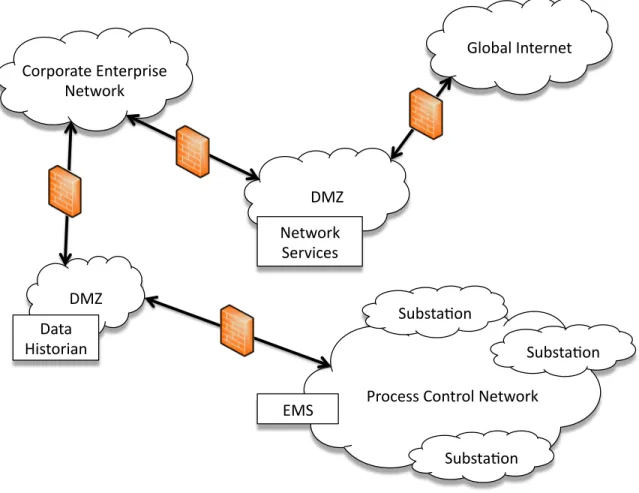
One can use a global policy to specify at a system level the overall objectives with respect to access control. It specifies both what connectivity between roles and devices is inadmissible, and what connectivity must be supported. The rules are stated in terms of sets of roles and devices, rather than individual ones. For example, a rule might read, “An account manager in the sales network zone must be able to use sftp to forward any file in the Monthly Sales directory to his or her Reports directory, on the sales server found in the management network zone.” Another rule could be “Aside from the Library Historian, which may receive SQL updates from the mirrored Historian within the process control zone, no actor on any host in the DMZ may connect to any host in the process control zone.” Clearly, multiple access control policies are at play here; it is also clear that the rules can be stated in a form that allows a program that is analyzing access control configurations to determine whether the rule is satisfied.
The critical problem this work addresses is that networked systems check only fine-grained local access policy rules at single devices, not global policy. Global access policy implementations may or may not comply with global policy requirements. Without a way to check that compliance, serious security vulnerabilities can and do exist in real implementations of critical systems, causing them to fail in potentially harmful ways when attacked.
More formally, we now discuss a classification of the problems resulting from misconfigurations of access control mechanisms, in particular firewalls.
2.1
Policy Violations
Administrators often have high-level policies describing what access to the network should be pro-hibited (blacklists) or ensured (whitelist). It is crucial that firewall configurations exactly reflect the security policy. Any nonconforming configurations may result in undesired blocking, unau-thorized access, or even the potential for an unauunau-thorized person to alter security configurations. Therefore, a firewall must be verified against the policy.
Although policy definition is specific to individual institutions, the network security community has some well-understood guidelines on firewall configurations. From an external auditor’s point of view, Wool [2] studied 37 configurations of the Check Point’s FireWall-1 product and noticed
12 common firewall configuration errors. For example, 90% if the configurations allowed “any” destination on outbound rules, and “any” service on inbound rules. Allowing of NetBIOS and Portmapper/Remote Procedure Call service was another common class of errors that expose the network to very insecure services. A large number of firewalls were not configured correctly to provide proper protection. Approximately 46% of the firewalls are not configured with stealth rules to hide themselves, and over 70% of them were open to insecure management protocols or external management machines. All such “errors” affect the security of the entire network and must be carefully checked.
Another source of input for the blacklist is the bogon list [10], which describes IP blocks or port numbers not currently allocated by the Internet Assigned Numbers Authority (IANA) and Regional Internet Registries (RIRs) plus those reserved for private or special use. Attackers often use these IP blocks or ports for DoS attacks, spamming, or hacking activities. Most firewall administrators would want to ensure that traffic to and from these IP blocks and port numbers is neither explicitly nor implicitly allowed to reach their networks.
2.2
Rule-Set Inconsistencies
Firewall configurations represent the administrators intention, which should be consistent. There-fore, inconsistencies are often good indicators of misconfigurations. Checking for inconsistencies is solely based on the configuration files and does not need external input. Inconsistencies happen at three levels: intra-firewall, inter-firewall, and cross-path.
2.2.1
Intra-Firewall Inconsistencies
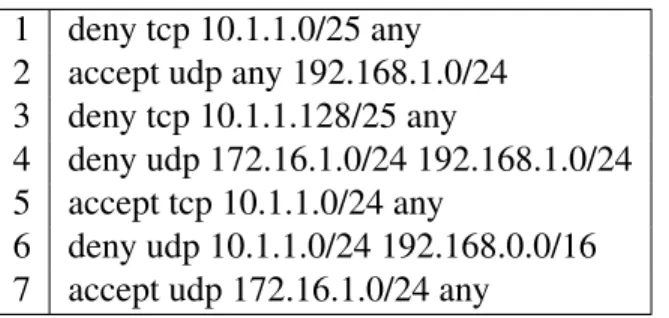
1. Shadowingrefers to the case whereallthe packets that one rule intends to deny (or accept) have been accepted (or denied) by preceding rules. This often reveals a misconfiguration and is considered an “error.” A rule can be shadowed by one preceding rule that matches a superset of the packets. In Table 2.1, rule 4 is shadowed by rule 2, because every UDP packet from 172.16.1.0/24 to 192.168.1.0/24 is accepted by rule 2, which matches any UDP packets destined for 192.168.1.0/24. Alternatively, a rule may also be shadowed by a set of
1 deny tcp 10.1.1.0/25 any 2 accept udp any 192.168.1.0/24 3 deny tcp 10.1.1.128/25 any
4 deny udp 172.16.1.0/24 192.168.1.0/24 5 accept tcp 10.1.1.0/24 any
6 deny udp 10.1.1.0/24 192.168.0.0/16 7 accept udp 172.16.1.0/24 any
Table 2.1: Inconsistent Single Access Control List (ACL)
rulescollectively. For example, rule 5 is shadowed by thecombinationof rules 1 and 3. Rule 1 denies TCP packets from 10.1.1.0/25, and rule 3 denies TCP packets from 10.1.1.128/25. Collectively, they deny all TCP packets from 10.1.1.0/24, which are what rule 5 intends to accept.
2. Generalizationrefers to the case where a subset of the packets matched to this rule has been excluded by preceding rules. It is the reverse of shadowing and happens when a preceding rule matches a subset of this rule but takes a different action. In Table 2.1, rule 7 is a generalization of rule 4 because UDP packets from 172.16.1.0/24 and to 192.168.1.0/24 form a subset of UDP packets from 172.16.1.0/24 (rule 7), yet the decision for the former is different from the latter.
3. Correlation refers to the case where the current rule intersects with preceding rules but specifies a different action. The predicates of these correlated rules intersect, but are not related by the superset or subset relations. The decision for packets in the intersection will rely on the order of the rules. Rules 2 and 6 are correlated with each other. The intersection of them is “udp 10.1.1.0/24 192.168.1.0/24,” and the preceding rule determines the fate of these packets.
Generalization and correlation are not necessarily errors, as they are commonly used techniques for excluding part of a larger set from a certain action. Proper use of these techniques could result in fewer rules. However, the techniques should be used very consciously. Access control lists (ACLs) with generalizations or correlations can be ambiguous and difficult to maintain. If a preceding rule is deleted, the action for some packets in the intersection will change. For a large and evolving list of rules, it may be difficult to remain aware of all the related generalizations and correlations when
working manually. Without a priori knowledge about the administrator’s intention, we cannot be certain of whether they represent misconfigurations. Therefore, we classify them as “warnings.”
2.2.2
Inter-Firewall Inconsistencies
Inconsistencies among different firewalls might not be errors. When a few firewalls are chained together, a packet has to survive the local filtering actions of all the firewalls on its path to its destination. Therefore, a downstream firewall can often rely on an upstream firewall to achieve policy conformance and can be configured more loosely. On the other hand, a downstream firewall at the inner perimeter often needs a tighter security policy. Without input from the administrator, the only inter-firewall inconsistency that can be classified as an “error” is shadowed accept rules. By explicitly allowing certain predicates, we infer that the administrator intends to receive the relevant packets.
2.2.3
Cross-Path Inconsistencies
As discussed earlier, multiple data paths could exit from the Internet to the same protected net-work. Cross-path inconsistency refers to the case where some packets denied on one path are accepted through another path. Depending on the underlying routing table, these anomalies may be exploitable. However, attacks that affect routing protocols do exist and an attacker only needs to succeed once. Cross-path inconsistencies may also be indicated by intermittently disrupted ser-vices. Routing changes may necessitate that the packets originally reaching a network switch over to another path, but the firewall rules on the new path may deny such packets. Furthermore, the second path may not always be available since the actual path is determined by the underlying routing protocol. However, routing is designed to be adaptive to link failures and heavy load. In addition, it is relatively easy to inject false routing messages [11]. A safe firewall configuration should not rely on dynamic routing constraints, and should assume that all paths are topologically possible.
Checking cross-path inconsistencies through active testing is very difficult. It may disrupt the production network since routing tables must be altered to test different scenarios. Manual auditing
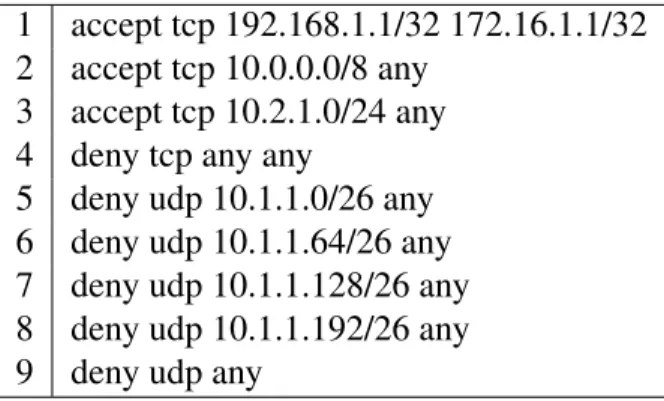
1 accept tcp 192.168.1.1/32 172.16.1.1/32 2 accept tcp 10.0.0.0/8 any
3 accept tcp 10.2.1.0/24 any 4 deny tcp any any
5 deny udp 10.1.1.0/26 any 6 deny udp 10.1.1.64/26 any 7 deny udp 10.1.1.128/26 any 8 deny udp 10.1.1.192/26 any 9 deny udp any
Table 2.2: Single ACL with Redundant Rules
of such anomalies is also difficult. Even for a network of moderate size, the number of possible paths between two nodes can be large.
2.3
Rule-Set Redundancy
A firewall needs to inspect a huge number of packets. Therefore, it is difficult not to be concerned with firewall efficiency. A lot of work has been dedicated to improving firewall speed through better hardware and software designs and implementations. To administrators, the most practical way to improve firewall efficiency is through better configuration of the firewall. An efficient firewall configuration should require the minimum possible number of rules, use the least possible amount of memory, and incur the least possible amount of computational load while achieving the filtering goals. Although inefficiency does not directly expose a vulnerability, a faster and more efficient firewall will encourage firewall deployment and therefore make the network safer. In addition, the efficiency of a firewall can determine a network’s responsiveness to Denial-of-Service (DoS) attacks.
Redundancyrefers to the case where if a rule is removed, the firewall does not change its action on any packets. Reducing redundancy can reduce the total number of rules, and consequently reduce memory consumption and packet classification time [12].
A rule can be considered redundant if the preceding rules have matched a superset of it and specified the same action. For example, in Table 2.2, rule 3 is redundant because rule 2 has already specified the same action for all packets that match rule 3. A rule can also be made redundant by
the subsequent rules. Rules 5, 6, 7 and 8 are all redundant because if we remove them, the packets they would have denied are still going to be denied by rule 9. In fact, for firewalls with a “deny all” policy implicitly appended to the end of each ACL, we do not need rules 4 through 9 at all.
Redundant accept or deny rules are “errors” within the same firewall. However, that is not the case for distributed firewalls. A packet must be accepted on all the firewalls on its path to reach its destination. Redundant accept rules on different firewalls are usually necessary. Redundant deny rules on different firewalls are unnecessary, but are often considered good practice to en-hance security, as this redundancy provides an additional line of defense if the outer perimeter is compromised.
CHAPTER 3
RELATED WORK
The complexity of implementing an access control policy through configuration of a large number of distributed devices and the risk of conflicts among these devices have spawned a significant amount of work. We can divide the prior art into several categories.
3.1
Analyzing Rule-Sets for Consistency
These efforts focused on analyzing an existing configuration of one or more access control devices for internal consistency.
3.1.1
Single Firewall Consistency
The majority of work in this area has focused on internal consistency among the rules of a single firewall [13, 14, 15, 16, 17, 18]. Most of this work used variations of rectangular set operations for fast analysis. However, as noted, these approaches are limited to the rule-sets of a single firewall, have no formal error model for the issues that can exist in rule-sets, and do not attempt to check for conformance with any sort of global policy specification.
3.1.2
Inter-Firewall Consistency Analysis
A conflict detection tool for distributed firewall systems has been described in [19], but it only checks for certain kinds of syntactic errors, such as overlapping rules, and not for semantic errors with respect to a specification of the intent. The Fireman tool, proposed in [20], uses binary deci-sion diagrams (BDDs) to check for misconfigurations and inconsistencies in one or more firewalls.
The tool is query-based, being able to indicate only whether a path about which the user has specif-ically inquired is allowed by the rule-sets. It is unable to provide a complete list of violations of a user-specified global policy. Xie et al. [21, 22, 23, 24] have outlined a limited fault model for fire-wall rule-set inconsistencies and described ways to automatically suggest corrections when errors are found. Again, they do not identify violations of a user-specified global policy. Furthermore, none of the work takes into account the collective fine-grained access control provided by the network-based mechanisms (e.g., firewalls) and host-based mechanisms (e.g., SELinux policies). Also, none of the above work has been applied to and optimized for specific classes of networks.
Those efforts did not answer the need for ways to model and analyze distributed networks of firewalls, checking for both internal consistency and compliance with policy specification.
3.2
Top-Down Management
Another vector of research effort has focused on automatic generation of consistent policy imple-mentation (at devices) from formal descriptions of global policy [25, 26]. Cisco provides Cis-coWorks [27], a suite of products that enable top-down firewall policy management that includes configuration management, a policy manager that generates policies from high-level specifica-tions, and log/audit analysis. Those are appropriate for new, vendor-homogeneous systems, but do not address existing implementations or heterogeneous systems. Furthermore, they require specification of detailed and exhaustive global security policy. For most current network system administrators, the ability to check existing configurations against policy specifications that indi-cate intended high-level behavior would likely be more useful.
Those efforts did not fill the need for mechanisms that support modeling and analysis of a wide variety of sources for access control rule-sets.
3.3
Attack Graphs
The problem of checking implementation against specification is also known as “model check-ing” [28]. This line of research has a rich history in the context of proving the correctness of both
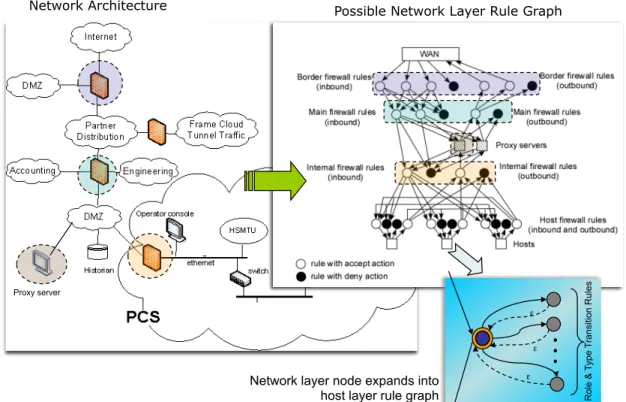
hardware and software. The key abstraction is a finite-state machine, and the key problem is that the size of the state space explodes with the complexity of the system. As we consider integration of higher layers of access control mechanisms, the finite state machine view may be appropriate for them. However, while it is possible to mapnetworkaccess control into a classical model-checking framework, we aren’t convinced of the value of doing so. Much of the attention in model-checking is paid to compact representation of the state space; we already have a representation of the prob-lem (i.e., the rule-graph, to be described), which is a graph whose number of nodes is linear in the number of rules. Furthermore, our analysis takes advantage of the problem domain rather than a general state space, with an approach that lends itself naturally to optimizations for scalability.
3.3.1
Without Statistical Analysis
The research on “attack graphs” is of some relevance to the scalability issue, particularly those research efforts are compared to the statistical analysis that we have developed. Those research efforts have largely been an application of model-checking. Ritchey and Ammann [29] use model checking to identify asingleviolating path in an attack graph. Sheyner et al. [30] provide a more comprehensive analysis, but it suffers from the state-space explosion problem, since the entire attack graph needs to be analyzed to provide the relevant metrics, thereby severely limiting the scalability.
3.3.2
With Statistical Analysis
Ou et al. [31, 32] have used a prolog-based approach, rather than the traditional model-checking, for attack graph generation and analysis; however, their solution does not seem to be able to scale to large networks that are also deep (i.e., graphs with potentially long paths), or to calculate generic metrics that are functions of paths rather than edges in the graph. Our approach includes a statistical analysis component for improved scalability when analyzing large networks, which builds and expands on the mathematical techniques we first developed for model-based penetration testing [33].
3.4
Policy Specification and Composition
As we have indicated, a comprehensive mechanism for analyzing access control policy imple-mentations would include checking for compliance against a user-specified high-level policy that describes the intended behavior. Hence, there’s a need to choose or develop a means for writing the said global policy specification.
3.4.1
Authorization Policy Specification Languages
There is considerable academic and industrial interest in XACML (eXtensible Access Control Markup Language) [34], a core XML schema for representing authorization and entitlement poli-cies, which is an open standard developed and promoted by the Oasis XACML Technical Com-mittee. Other researchers are exploring problems such as mapping into XACML of simple and intuitive global policy languages for which policies have been verified, combining XACML and SAML (Security Assertion Markup Language) to support distributed authorization [35], and anal-ysis of the impact on the global policy stance of (even small) changes in an XACML policy.
RCL2000 [36] is a specification language for role-based authorization constraints. It can be used to express prohibition and obligation constraints. Ponder [37] is a language for specifying management and security policies for distributed systems.
All of the above specification languages are similar in expressive power and largely inter-convertible. They have the added benefit of being human-readable. However, the descriptions involved can be highly verbose, and any formal reasoning on the specifications can be difficult and inefficient.
3.4.2
Logics
These include first-order predicate logic, and the temporal logics: Linear Temporal Logic (LTL) [38] and Computation Tree Logic (CTL) [39]. They are widely used as the specification languages for various model-checking tools. The specifications in these logics can be compact, lend them-selves to efficient evaluation, and facilitate analytical reasoning. However, they can be difficult
for non-experts to write and comprehend. Furthermore, while first-order predicate logic may be insufficient, full temporal logics may be an overkill for most access control policies.
The above literature on specification formalisms did not fill the need for a formalism that can be used to write human-readable specifications but still provide a clear mapping to a formal math-ematical system.
3.5
Other Commercial Tools
Vendor-neutral tools have recently appeared that consider access control in a distributed system. They include the Skybox firewall compliance auditor [40] and Red Seal SRM [41]. Both tools use network topology and routing information to determine potential network flows. Red Seal SRM uses vulnerability databases and specification of software running on hosts to compute risk measures, while Skybox determines when firewall rules allow violation of a more abstractly stated global policy. In comparison, our approach incorporates sophisticated statistical analysis for highly improved scalability and also naturally admits integration of higher-level layers of access control policy (e.g., SELinux policies, and/or role-based access in trusted networks).
Among other related commercial products are Netflow and Peakflow [42] (from Arbor Net-works), which are tools for network management and run-time anomaly detection, and focus on alert aggregation, correlation, and traffic visualization. They are event-driven and do not detect problems with the security configuration itself. That is, they perform failure detection as opposed to fault detection as they are able to detect vulnerabilities resulting from misconfigurations only when those vulnerabilities result in actual exploits.
CHAPTER 4
ANALYSIS FRAMEWORK
4.1
Analysis Framework: Formalisms
In this section, we introduce a formal framework for reasoning about and evaluating the confor-mance of access control implementation with a specification of the policy in networked systems.
4.1.1
Formalisms for Global Access Policy
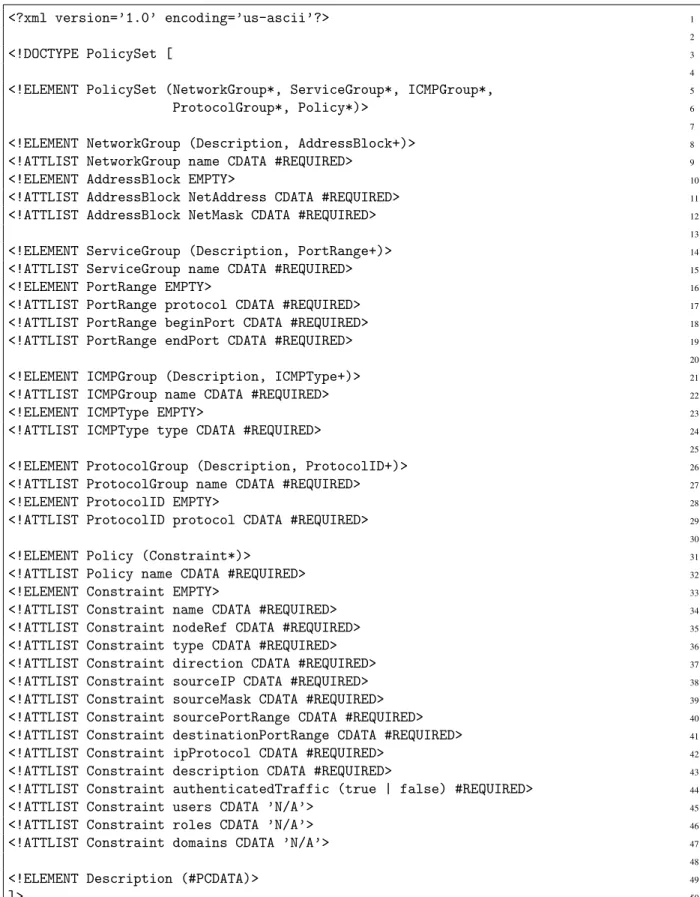
Our formalism for specifying the global access policy is an XML-based specification language inspired by XACML. The XML schema for the language is shown in Figure 4.1. We will describe formalisms as applied to network layer access control.
Definition 1. A network traffic terminus is a tuple(A,P,S).
• A is a set of disjoint IP addresses{a1,a2,· · ·,an}.
• P is a (layer 3) network protocol.
• S is a set of port numbers or other protocol-specific identifiers (e.g., ICMP message type if P=ICMP),{s1,s2,· · ·,sn}.
V is the set of all possible network traffic terminuses.
Definition 2. A constraint is used to indicate how a particular traffic flow is to be treated. It is defined as the tupleψ = (Vs,Vd,λ,ω).
• The first two parameters (Vs,Vd∈V) are the source and destination terminuses respectively.
<?xml version=’1.0’ encoding=’us-ascii’?> 1 2
<!DOCTYPE PolicySet [ 3
4
<!ELEMENT PolicySet (NetworkGroup*, ServiceGroup*, ICMPGroup*, 5
ProtocolGroup*, Policy*)> 6
7
<!ELEMENT NetworkGroup (Description, AddressBlock+)> 8
<!ATTLIST NetworkGroup name CDATA #REQUIRED> 9
<!ELEMENT AddressBlock EMPTY> 10
<!ATTLIST AddressBlock NetAddress CDATA #REQUIRED> 11
<!ATTLIST AddressBlock NetMask CDATA #REQUIRED> 12
13
<!ELEMENT ServiceGroup (Description, PortRange+)> 14
<!ATTLIST ServiceGroup name CDATA #REQUIRED> 15
<!ELEMENT PortRange EMPTY> 16
<!ATTLIST PortRange protocol CDATA #REQUIRED> 17
<!ATTLIST PortRange beginPort CDATA #REQUIRED> 18
<!ATTLIST PortRange endPort CDATA #REQUIRED> 19
20
<!ELEMENT ICMPGroup (Description, ICMPType+)> 21
<!ATTLIST ICMPGroup name CDATA #REQUIRED> 22
<!ELEMENT ICMPType EMPTY> 23
<!ATTLIST ICMPType type CDATA #REQUIRED> 24
25
<!ELEMENT ProtocolGroup (Description, ProtocolID+)> 26
<!ATTLIST ProtocolGroup name CDATA #REQUIRED> 27
<!ELEMENT ProtocolID EMPTY> 28
<!ATTLIST ProtocolID protocol CDATA #REQUIRED> 29
30
<!ELEMENT Policy (Constraint*)> 31
<!ATTLIST Policy name CDATA #REQUIRED> 32
<!ELEMENT Constraint EMPTY> 33
<!ATTLIST Constraint name CDATA #REQUIRED> 34
<!ATTLIST Constraint nodeRef CDATA #REQUIRED> 35
<!ATTLIST Constraint type CDATA #REQUIRED> 36
<!ATTLIST Constraint direction CDATA #REQUIRED> 37
<!ATTLIST Constraint sourceIP CDATA #REQUIRED> 38
<!ATTLIST Constraint sourceMask CDATA #REQUIRED> 39
<!ATTLIST Constraint sourcePortRange CDATA #REQUIRED> 40
<!ATTLIST Constraint destinationPortRange CDATA #REQUIRED> 41
<!ATTLIST Constraint ipProtocol CDATA #REQUIRED> 42
<!ATTLIST Constraint description CDATA #REQUIRED> 43
<!ATTLIST Constraint authenticatedTraffic (true | false) #REQUIRED> 44
<!ATTLIST Constraint users CDATA ’N/A’> 45
<!ATTLIST Constraint roles CDATA ’N/A’> 46
<!ATTLIST Constraint domains CDATA ’N/A’> 47
48
<!ELEMENT Description (#PCDATA)> 49
]> 50
• ωis the type or action of the constraint. It can take a value from the set{allowexact, allowmin,
deny}.
– allowexact indicates that a pathmustexist between the two terminuses.
– allowmin indicates that a pathcanexist between the two terminuses. This type of con-straint is used to refine broader deny concon-straints, to facilitate compactness of specifi-cation. This would become clearer as we describe theimplicit deny constraintand the
principle of greatest specificitybelow.
– deny indicates that a pathmust notexist between the two terminuses.
Ψexplicit ={ψ1,ψ2,· · ·,ψn}is the set of all explicitly defined constraints.
Definition 3. An implicit deny constraint exists for each policy, and is defined to be ψimplicit.
ψimplicit = (Vsallow,Vdallow,any,deny).
• Vsallow =S
(Vs,Vd,λ,ω)∈Ψ
explicit,s.t.ω∈{allowexact,allowmin}V
s. We define the union of the
termi-nuses as the terminus formed by the union of the corresponding elements (sets themselves) in their tuples.
• Vsdeny=S
(Vs,Vd,λ,ω)∈Ψ
explicit,s.t.ω∈{allowexact,allowmin}V
d. We define the union of the terminuses
as the terminus formed by the union of the corresponding elements (sets themselves) in their tuples.
The constraintψimplicit indicates that unlessrefinedby other constraints in the policy, all traffic
between any two terminuses mentioned in the otherallow-type constraints is denied. This allows us to define compact policy specifications using just a collection of (mostly)allowmin constraints to describe accepted (but not necessary) behavior, denying everything else.
Definition 4. A conditionally composed constraint,ψ =ψ1|ψ2is composed of the constraintsψ1
andψ2. It indicates that the constraintψ1is applicable only if the constraintψ2is true for a traffic
flow. The constraint is considered to be met ifψ2is not true.
Conditionally composed constraints are useful for modeling stateful firewalls, flows with multi-ple sessions and encapsulated traffic.
Definition 5. A global access policy specification,Π, is an ordered pair(Σ,Ψ).
• Σis a set of variable definitions for various network and traffic elements, including IP
ad-dress blocks, network protocols, and services (ports).
• Ψ(={ψ1,ψ2,· · ·,ψn,ψimplicit}) is a set of policy constraints defined on the elements ofΣ.
It is possible for a flow to have multiple rules apply to it, and have conflicts in the rule outcomes. Coupled with a good conflict resolution mechanism, that is actually quite a useful tool for compact specification of desired policy. For example, imagine that an installation wants to follow the best-practice recommendation that has traffic from the control network and from the corporate network terminate in the DMZ, except for one specific application for which a host namedcontrol-database
in the control network must be able to upload data to a host named corporate-database in the corporate network. That goal would be accomplished through the creation of two constraints. The first would implement the recommendation as we have already described; this is a “deny” rule. The second would be a “permit” rule that names control-database and the specific port used as the source set, namescorporate-database and the specific port used as the destination set, binds the constraint to control-database, makes the direction “outgoing,” and names the protocol (e.g., TCP) used to carry the connection. The union of these two rules does what we want, so long as the conflict resolution mechanisms applies the second rule to the specific flow of interest, and applies the first rule to all other flows coming out of the control network.
We resolve rule conflicts using theprinciple of greatest specificity. This principle, well-known to system administrators who manage routers, is that if there are multiple forwarding rules that apply to the destination of an incoming packet, the rule with the largest number of significant prefix bits (“longest prefix”) is the one chosen. Applied to our context, a rule that in all ways is more narrowly applicable to sources, destinations, and protocols than another ought to take precedence over it, because it is more specific in all of its descriptive details. Clearly that is exactly the case in the example described in the previous paragraph.
Definition 6. Let V = (A,P,S) and V0= (A0,P0,S0)be two network traffic terminuses, such that V,V0∈V. We say,
• V ⊂V0if at least one of the above inclusions is strict.
The principle of greatest specificity is stated as follows.
Definition 7. Let ψ1= (Vs,Vd,λ,ω)andψ2= (Vs0,Vd0,λ0,ω0)be two global policy constraints,
where Vs,Vd,Vs0,Vd0∈V,λ,λ0∈Λ, andω,ω0∈Ω. ψ2is more specific thanψ1if Vs⊂Vs0, Vd⊂Vd0
andλ =λ0. In such a case, for any traffic flow to which bothψ1andψ2apply, actionω0is taken.
The principle of greatest specificity implies that if there is a flow for which multiple constraints apply, and among these constraints there is one (say ψ) that is more specific in all particulars
than every other constraint in that policy set, then the conflicts are resolved and constraint ψ is
applied. The principle of greatest specificity will not resolve all conflicts; if a global policy has unresolved conflicts then the user needs to know what those conflicts are and the characteristics of the traffic flows that are governed by conflicting constraints. The algorithm in Figure 4.2 performs that consistency check, allowing one to define a consistent set of constraints prior to performing an analysis that checks the implementation against the policy.
4.1.2
Formalisms for Access Control Elements
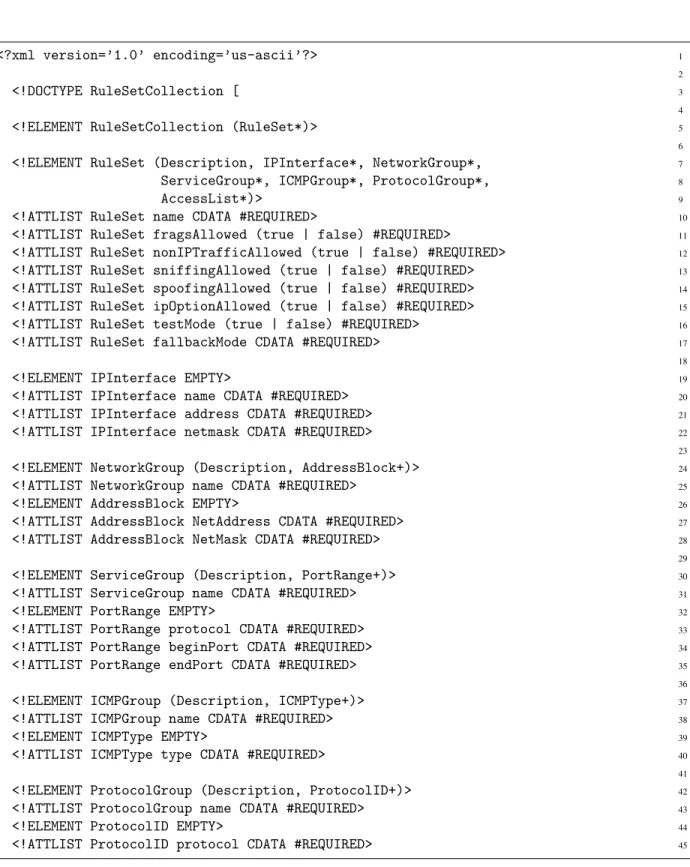
Our goal is to analyze complex networked systems with multiple networks, each containing one or more hosts, connected via various network layer 3 devices (routers/switches), where the access is controlled through firewalls (or similar devices). We also take into consideration any virtual overlays that may be present, such as Virtual Private Networks (VPNs). Our model of the network topology that can be analyzed is represented by the XML schema shown in Figure 4.3. To briefly summarize the representation, all the hosts, networks, access control devices (firewalls), layer 3 routing devices (switches), and overlays (tunnels) are enumerated. Each host stores references to the network(s) to which it belongs; each firewall or switch stores references to the networks it bridges (and information on how it bridges them); and each tunnel stores references to its end points. Some other, more specific, details are stored as well, as shown in the figure.
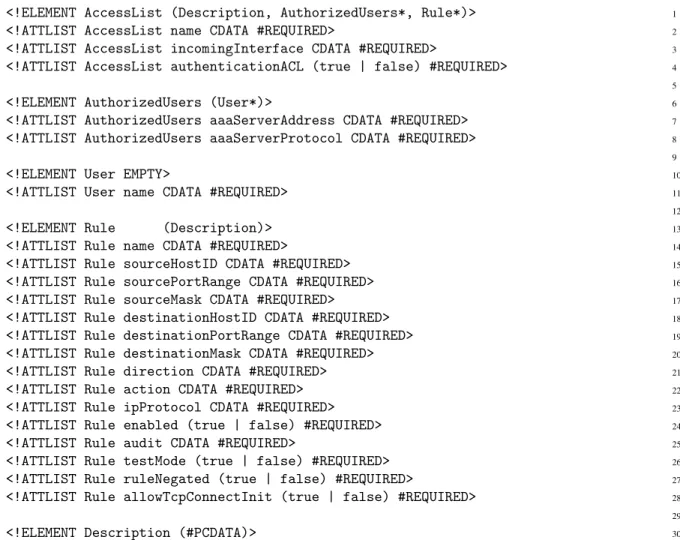
Firewalls from different vendors may vary significantly in terms of configuration languages, rule organizations, and interaction between lists or chains. However, a firewall generally consists of a few interfaces and can be configured with several access control lists (ACLs). Both the ingress
procedure resolve-constraint-conflict
Ψ← {ψ1,· · ·,ψn} #set of constraints in the policy
C← /0 #set of conflicting constraints
for allψi∈ {ψ1,· · ·,ψn−1}do for allψj∈ {ψi+1,· · ·,ψn}do
(Vsi,Vdi,λi,ωi)←ψi; (Vsj,Vdj,λj,ωj)←ψj
ifVsi∩Vsj6= /0 andVdi∩Vdj6= /0 andωi6=ωjthen
resolution1←subset(Vsi,Vsj)+subset(Vdi,Vdj)
#subset(x,y)returns1if x⊂y,2if x=y, and0otherwise resolution2←0
ifresolution1≤1 orresolution1≥4then
resolution2←subset(Vsi,Vsj)+subset(Vdi,Vdj)
ifresolution1≤1 orresolution1≥4then
C←C∪(ψi,ψj) end if end if end if end for end for ifC6= /0then return C end if end procedure
Figure 4.2: Algorithm for Resolving Policy Constraints
and egress of an interface can be associated with ACLs. If an ACL is associated with the ingress, filtering is performed when packets arrive at the interface. Similarly, if an ACL is associated with the egress, filtering will be performed before packets leave the interface. Each ACL consists of a list of rules. Individual rules can be interpreted in the form<P,action>, wherePis a predicate describes what packets are matched by this rule and actiondescribing the corresponding action performed on the matched packets. Packets not matched by the current rule will be forwarded to the next rule until a match is found or the end of the ACL is reached. At the end of an ACL, the default action will be applied. This is similar to an “if-elsif-else” construct in most programming languages. Implicit rules vary on different firewall products. On the Cisco PIX firewall and routers, the implicit rule at the end of an ACL denies everything. On Linux Netfilter, the implicit rule is defined by the policy of the chain.
<?xml version="1.0" encoding="ISO-8859-1"?> 1
<!DOCTYPE Topology [ 2
<!ELEMENT Topology (Network*, Host*, Switch*, Firewall*, Tunnel*)> 3
<!ATTLIST Topology isEncrypted (true|false) #REQUIRED> 4
5
<!ELEMENT Network (Description)> 6
<!ATTLIST Network name CDATA #REQUIRED> 7
<!ATTLIST Network isCompletelyConnected (true|false) #REQUIRED> 8
<!ATTLIST Network netAddress CDATA #REQUIRED> 9
<!ATTLIST Network netMask CDATA #REQUIRED> 10
11
<!ELEMENT Host (Description, IPAddress+, NodeRef*)> 12
<!ATTLIST Host name CDATA #REQUIRED> 13
<!ATTLIST Host accessParameters CDATA #REQUIRED> 14
15
<!ELEMENT Switch (Description, IPAddress, NodeRef*)> 16
<!ATTLIST Switch name CDATA #REQUIRED> 17
18
<!ELEMENT Firewall (Description, IPAddress+, NodeRef*)> 19
<!ATTLIST Firewall name CDATA #REQUIRED> 20
<!ATTLIST Firewall accessParameters CDATA #REQUIRED> 21
<!ATTLIST Firewall NAT CDATA #REQUIRED> 22
23
<!ELEMENT NodeRef EMPTY> 24
<!ATTLIST NodeRef name CDATA #REQUIRED> 25
26
<!ELEMENT IPAddress EMPTY> 27
<!ATTLIST IPAddress ipAddress CDATA #REQUIRED> 28
29
<!ELEMENT Tunnel (Description, IPAddress+, NodeRef+)> 30
<!ATTLIST Tunnel encryption CDATA #IMPLIED> 31
32
<!ELEMENT Description (#PCDATA)> 33
]> 34
<?xml version=’1.0’ encoding=’us-ascii’?> 1 2
<!DOCTYPE RuleSetCollection [ 3
4
<!ELEMENT RuleSetCollection (RuleSet*)> 5
6
<!ELEMENT RuleSet (Description, IPInterface*, NetworkGroup*, 7
ServiceGroup*, ICMPGroup*, ProtocolGroup*, 8
AccessList*)> 9
<!ATTLIST RuleSet name CDATA #REQUIRED> 10
<!ATTLIST RuleSet fragsAllowed (true | false) #REQUIRED> 11
<!ATTLIST RuleSet nonIPTrafficAllowed (true | false) #REQUIRED> 12
<!ATTLIST RuleSet sniffingAllowed (true | false) #REQUIRED> 13
<!ATTLIST RuleSet spoofingAllowed (true | false) #REQUIRED> 14
<!ATTLIST RuleSet ipOptionAllowed (true | false) #REQUIRED> 15
<!ATTLIST RuleSet testMode (true | false) #REQUIRED> 16
<!ATTLIST RuleSet fallbackMode CDATA #REQUIRED> 17
18
<!ELEMENT IPInterface EMPTY> 19
<!ATTLIST IPInterface name CDATA #REQUIRED> 20
<!ATTLIST IPInterface address CDATA #REQUIRED> 21
<!ATTLIST IPInterface netmask CDATA #REQUIRED> 22
23
<!ELEMENT NetworkGroup (Description, AddressBlock+)> 24
<!ATTLIST NetworkGroup name CDATA #REQUIRED> 25
<!ELEMENT AddressBlock EMPTY> 26
<!ATTLIST AddressBlock NetAddress CDATA #REQUIRED> 27
<!ATTLIST AddressBlock NetMask CDATA #REQUIRED> 28
29
<!ELEMENT ServiceGroup (Description, PortRange+)> 30
<!ATTLIST ServiceGroup name CDATA #REQUIRED> 31
<!ELEMENT PortRange EMPTY> 32
<!ATTLIST PortRange protocol CDATA #REQUIRED> 33
<!ATTLIST PortRange beginPort CDATA #REQUIRED> 34
<!ATTLIST PortRange endPort CDATA #REQUIRED> 35
36
<!ELEMENT ICMPGroup (Description, ICMPType+)> 37
<!ATTLIST ICMPGroup name CDATA #REQUIRED> 38
<!ELEMENT ICMPType EMPTY> 39
<!ATTLIST ICMPType type CDATA #REQUIRED> 40
41
<!ELEMENT ProtocolGroup (Description, ProtocolID+)> 42
<!ATTLIST ProtocolGroup name CDATA #REQUIRED> 43
<!ELEMENT ProtocolID EMPTY> 44
<!ATTLIST ProtocolID protocol CDATA #REQUIRED> 45