Eastern Michigan University
DigitalCommons@EMU
Master's Theses and Doctoral Dissertations Master's Theses, and Doctoral Dissertations, and Graduate Capstone Projects
4-10-2015
The impact of Project Lead The Way gateway to
technology foundation unit completion on
students' critical-thinking skills
Rula Odai HashemFollow this and additional works at:https://commons.emich.edu/theses Part of theScience and Technology Studies Commons
This Open Access Dissertation is brought to you for free and open access by the Master's Theses, and Doctoral Dissertations, and Graduate Capstone Projects at DigitalCommons@EMU. It has been accepted for inclusion in Master's Theses and Doctoral Dissertations by an authorized administrator of DigitalCommons@EMU. For more information, please [email protected].
Recommended Citation
Hashem, Rula Odai, "The impact of Project Lead The Way gateway to technology foundation unit completion on students' critical-thinking skills" (2015).Master's Theses and Doctoral Dissertations. 629.
The Impact of Project Lead The Way Gateway to Technology Foundation Unit Completion on Students’ Critical-Thinking Skills
By Rula Hashem
Dissertation
Submitted to the College of Technology Eastern Michigan University
In partial fulfillment of the requirements for the degree of DOCTOR OF PHILOSOPHY IN TECHNOLOGY
Area of Concentration: Technology and Education
John Dugger, Ph.D., Committee Chair Margo Dichtelmiller, PhD., Graduate Representative
Giri Jogaratnam, PhD., Committee Member Phillip Cardon, Ph.D., Committee Member
April 10, 2015 Ypsilanti, Michigan
ii
Dedication
To Almighty Allah (God), who facilitated for me all means and provided me with skills, abilities, and time to complete this dissertation
To Prophet Mohamed, peace and blessings of Allah be upon him, whose guidance and teachings always encouraged me to continue seeking knowledge and to do my best
in learning and persevering on that
To my parents, Odai Hashem and Jenan Al Adham, who were always making prayers for me and who taught me many things that helped me succeed in my life To my husband, Suleiman Ashur, who was committed to encourage and support me in
my education
To my children, Asad, Fadwa, and Noor, whose love and support encouraged me to keep going in my education
And
To all the people I love for the sake of Allah who inspired me, who contributed to my education, skills, and growth, and/or who pray for me
iii
Acknowledgment
Many people facilitated completing this dissertation. Any merit which it contains cannot be compared to their valuable time and assistance. First, I would like to show my gratitude to my advisor and the dissertation chair, Dr. John Dugger, for his support, and genuine effort to help me learn and grow in research, writing, and communicating my ideas throughout the stages of my Ph.D. education at Eastern Michigan University. Additionally, I would like to thank all my dissertation committee members, Dr. Margo Dichtelmiller, Dr. Giri Jogaratnam, and Dr. Phillip Cardon, who contributed their time and expertise to improve my dissertation and assisted in making it the best it can be.
I would like to extend my gratitude to the administration and teachers of the participating suburban middle school who volunteered to support and help me with the data collection for this dissertation. I also would like to thank the Dean, the secretary, and all the College of Technology faculty as well as the faculty of the College of Education who contributed to my education during my study at Eastern Michigan University. Finally, any shortcomings or weaknesses, which remain in this dissertation, must necessarily be attributed to the author.
iv
Abstract
Georgetown’s Public Policy Institute (2013) reported that the fastest growing occupations and the highest demand for college education and training fields will be in Science, Technology, Engineering, Mathematics (STEM), healthcare, and community services. One of the K-12 Science, Technology, Engineering, and Mathematics (STEM) programs’ purposes is to promote critical-thinking skills (Johnson, 1992). This study examined the impact of Project Lead The Way Gateway to Technology (PLTW-GTT) units, a middle school STEM program, on the critical-thinking skills of middle school students.
Quasi experimental research methods were utilized to test the impact of the completion of two PLTW-GTT foundation units on students’ critical thinking scores as measured by the
California Critical Thinking Skills Test (CCTST). Participants from the sixth- and seventh-grades of a suburban middle school in a Midwestern state formed two sets of treatment and control groups. Students enrolled in the PLTW Design and Modeling (D&M) (63 participants) and Automation and Robotics (A&R) (27 students) units along with two control groups (28 and 19 respectively) completed the CCTST at the beginning and at the end of the units.
The results of the study indicated that completion of the PLTW Design and Modeling (DM) unit had a significant positive influence on participants’ critical-thinking skills when compared to the control group. The Automation and Robotics (AR) unit had no significant impact on participants’ critical-thinking skills when compared to a corresponding control group. There appeared to be some inconsistencies in the data collection steps which may have affected the AR unit results. Therefore, future studies to test the impact of the AR unit on critical thinking are recommended. An additional finding was that both of the PLTW-GTT foundation units influenced the critical-thinking skills of male and female participants similarly.
v
Selected results may be generalized to schools that possess similar characteristics to those possessed by the sample school. Since the sample used for this study did not include a variety of ethnicities or races, it is recommended that future studies include schools with a larger
proportion of ethnic and racial diversity. Finally, there was some evidence that experiences at the sample school may be influencing students to pursue STEM careers. This phenomenon should be investigated in future studies.
vi Table of Contents Dedication ... ii Acknowledgment ... iii Abstract ... iv Table of Contents ... vi List of Tables ... ix List of Figures ... xi Chapter 1: Introduction ... 1
Statement of the Problem ... 4
Nature and Significance of the Problem ... 4
Purpose of the Study ... 7
Research Questions ... 7
Hypotheses ... 8
Limitations and Delimitations ... 9
Assumptions ... 9
Definition of Terms ... 10
Chapter 2: Literature Review ... 12
Critical Thinking ... 12
Critical-thinking instruments... 16
Teaching Critical Thinking ... 20
vii
Chapter 3: Methodology ... 31
Research Design ... 31
Population and Sample ... 34
Treatments ... 37
Instrumentation... 38
Human subjects’ approval. ... 42
Data Collection ... 42
Data Analysis ... 44
Summary ... 47
Chapter 4: Results ... 48
Description and Characteristics of Participants ... 49
Critical Thinking Test Results... 58
Hypothesis Testing ... 60
Summary ... 74
Chapter 5: Summary, Conclusions, and Recommendations ... 76
Summary of Findings ... 76
Conclusions ... 80
Recommendations ... 82
Suggestions for Future Research ... 82
viii
Appendices ... 95
Appendix A: Informed Assent PLTW Student ... 96
Appendix B: Informed Assent Non-PLTW Student ... 97
Appendix C: Informed Consent PLTW Parent ... 98
Appendix D: Informed Consent Non-PLTW Parent ... 100
Appendix E: Demographics Questionnaire ... 102
Appendix F: California Critical Thinking Test- Form M25 Description ... 104
Appendix G: Survey of Studies of PLTW Middle & High school Programs ... 106
Appendix H: Key Communications with the School ... 108
ix
List of Tables
Table 1: List of Critical-thinking skills according to Dr. Facione’s Report ... 7
Table 2: General Information California Versus Cornell ... 18
Table 3: Ethnicity: Sample School vs. Michigan... 35
Table 4: Demographics: School vs. Michigan Sixth- & Seventh- Grades ... 36
Table 5: Passing Rates: Sixth Grade MEAP ... 36
Table 6: Passing Rates: Seventh Grade MEAP ... 36
Table 7: Groups and Tests ... 42
Table 8: Research Participation ... 44
Table 9: Categorical Variables Coding ... 46
Table 10: Research Valid Participants ... 49
Table 11: Frequency Distribution: Sex ... 50
Table 12: Frequency Distribution: Age at the Time of the Posttest ... 51
Table 13: Frequency Distribution: Ethnicity ... 51
Table 14: Frequency Distribution: Socio Economic Status ... 52
Table 15: Frequency Distribution: Parent Degree - DM ... 53
Table 16: Frequency Distribution: Parent Degree - AR ... 54
Table 17: Frequency Distribution: Parents' Help in Homework for Participants ... 55
Table 18: Frequency Distribution: Usual Science Grade ... 56
Table 19: Frequency Distribution: Usual Math Grade - DM ... 57
Table 20: Frequency Distribution: Usual Math Grade - AR... 57
Table 21: Time Needed to Complete the CCTST Test: Mean & Standard ... 59
x
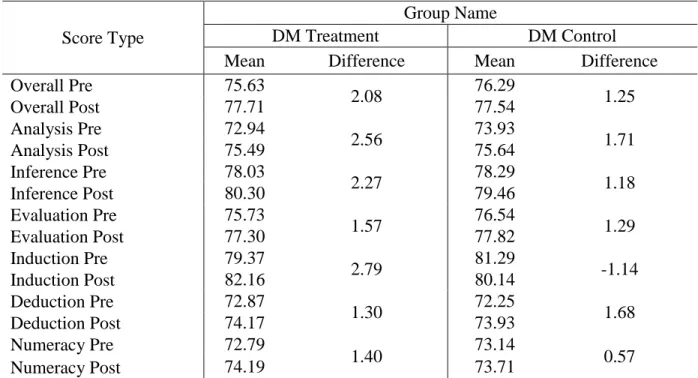
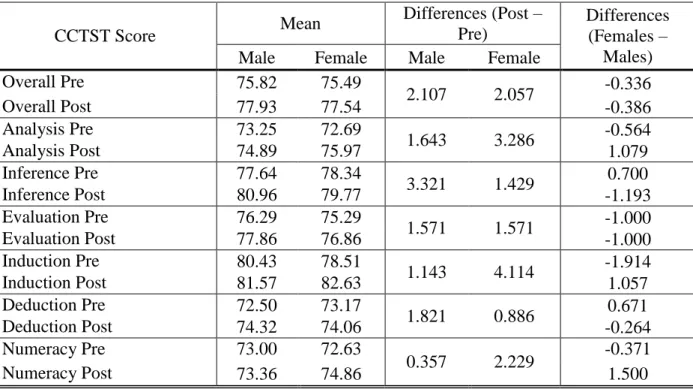
Table 23: The CCTST Scores-Mean & Mean Differences (Post-Pre) - DM ... 62
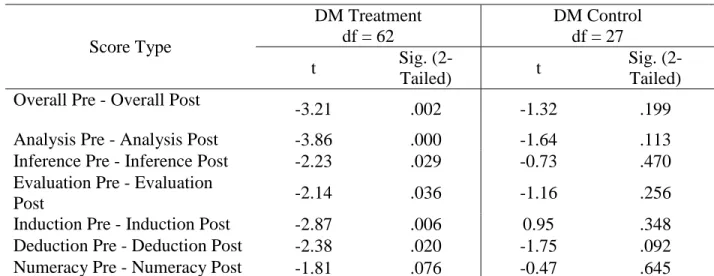
Table 24: The CCTST Scores-Paired Samples T-Test - DM ... 63
Table 25: The CCTST Scores-Means & Means’ Differences (Post-Pre) - AR ... 64
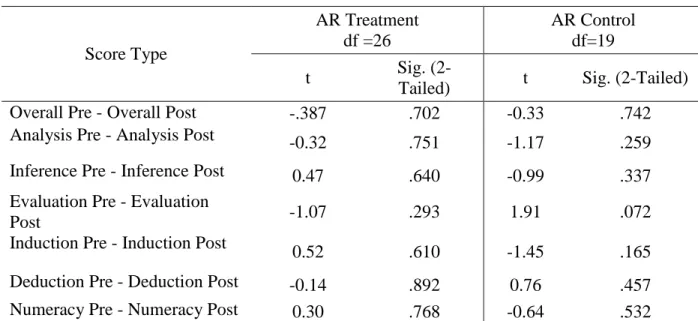
Table 26: The Paired Samples T-Test for the CCTST - AR ... 65
Table 27: The Paired Samples T-Test for the CCTST - AR ... 66
Table 28: The Paired Samples Test for the CCTST Scores – AR (New) ... 67
Table 29: The CCTST Mean Differences: Sex - DM Treatment... 68
Table 30: The CCTST Independent Samples Test: Sex - DM Treatment ... 69
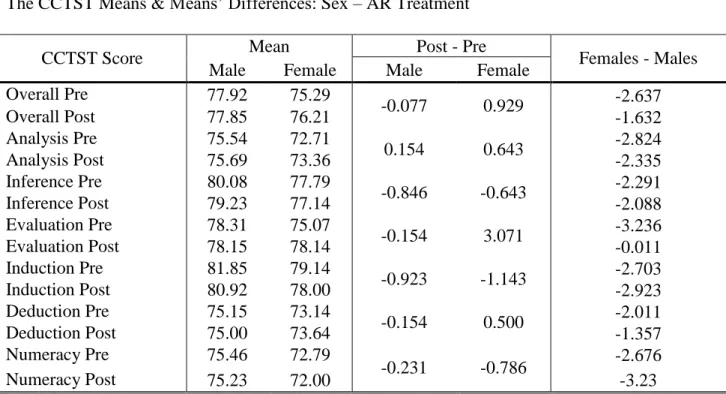
Table 31: The CCTST Means & Means’ Differences: Sex – AR Treatment ... 70
Table 32: The CCTST Independent Samples Test: Sex - AR Treatment ... 71
Table 33 The CCTST Overall Scores & Academic Performance: Correlation Table ... 72
Table 34:The CCTST Overall Scores & Parents Demo: Correlation Table ... 73
Table 35:The CCTST Overall Scores & Students Demo: Correlation Table ... 73
xi
List of Figures
Figure 1: Project Lead The Way Gateway To Technology Program ... 4 Figure 2: Project Lead The Way Program Detailed ... 26 Figure 3: Research Design ... 33
1
Chapter 1: Introduction
The synergy between rapidly changing technology and society creates the need for more educational tools especially those focused on improving critical-thinking skills. Such skills will enable humans to better cope with these changes (Geertsen, 2003). There is no doubt that critical thinking is a desired skill in all fields of education and the workplace (Facione, 2011). A report by Facione and Gittens included the following: “In the absence of critical thinking, one might simply follow the demands of authority, act without a full awareness of the situation,
thoughtlessly do what has been done before, or do nothing when action is needed” (Insight Assessment, 2015, p.14). Carnevale, Simith, and Strohl (2013) reported that the top five skills most needed in careers are “active listening, speaking, reading comprehension, critical thinking, and writing” (p. 26). Additionally, the same report confirmed that “…skills that involve
information processing and require sophisticated cost-benefit analyses such as critical thinking, complex problem-solving and decision-making…” (p. 27) are also highly valued.
The Occupational Information Network (O*NET), a job data program that is sponsored by the U.S. Department of Labor, confirmed that in many careers critical thinking is a skill that is often announced by employers as a condition for the success of their employees. Furthermore, 96 percent of all occupations rank critical thinking as either very essential or extremely essential to that occupation (cited in Carnevale, Simith, and Strohl, 2013, p. 28).
A MetLife (2011) report revealed that based on surveys administered to four groups – teachers, parents, students, and 1000 experts – at least 92 percent of them agreed that critical thinking is very important for college and career readiness and success. Thomas Friedman, the
New York Times World journalist, in “Leadership in Action Conference” August, 1, 2013,
2
communication, and collaboration” are becoming the most important characteristics that are needed for the workplace. He also added that in order for the U.S. to compete in the global economy, it is not enough for our children to just memorize information; they also need to become more critical thinkers since so much information is readily available by using the internet’s search engines (Aspen Institute, 2013). Geertsen (2003) explained that the need for critical-thinking skills comes from the continuous and tremendous changes in information flow and transfer. This change resulted in the need for everyone in society to acquire more skills in assessing and evaluating knowledge than ever before.
Critical thinking has been described as “… the corner-stone of education” (Splitter, 1990, p. 89). Two frequently cited definitions of critical thinking are: “...whatever skills are required to recognize, analyze and evaluate arguments” (Schlecht, 1989, p. 133), and “…the art of analyzing
and evaluating thinking with a view to improving it” (Paul & Elder, 2007, p. 4).
Educational, community, and career sectors have realized the need to incorporate critical-thinking skills in teaching in postsecondary institutions. Many programs and departments within higher education institutions have incorporated critical-thinking skills into some of their courses and degrees. Studies on critical thinking related courses have revealed the positive impact they have on students’ learning (Ousley, 2012; David, & Brown, 2011; Garvey, & Buckley, 2011; Mastrian, K., & McGonigle, 1999; & Mingus, & Grassl, 1997).
Fyffe (1987) indicated that based on the cognitive development skills theory, children between ages 11-15, which is during middle school, develop many of their thinking skills dramatically, and by the end of this period of human life, most thinking and problem-solving skills are acquired. Therefore, it is important for the education community to pay extra attention to this period of children’s lives and to give them all they need to reach their potential.
3
In K-12 education, critical thinking has become increasingly important especially after the adoption of the Common Core Curriculum by K-12 schools since one of the outcomes of this new curriculum is to equip students with critical-thinking skills across subject areas (Troutner, 2012). The integration of critical thinking into the K-12 schools enhances students’ potential for academic achievement (Lipman, 1988). Therefore, critical thinking should be an integral part of all subjects in K-12 education (Facione, 1990).
Many K-12 schools are attempting to incorporate critical thinking into core subjects taught during elementary, middle, and high school grades (Beyer & Backes, 1990). These efforts included incorporating STEM-related curricula during Grades 6 – 12. Some examples of such specialized curricula are: “Project Lead The Way (PLTW)”, “Engineering Projects in
Community Service” (EPICS), and the “National Center for Engineering and Technology Education” (NCETE) (Kelley, Brenner, & Pieper, 2010). Other technology programs offered similar experiences to 6-12 students after school (Tyler-Wood, Ellison, Lim, & Periathiruvadi, 2012; Alcaraz, Kreuter, Davis, Rogers, Samways, and Bryan, 2008; Wyss, Heulskamp, & Siebert, 2012).
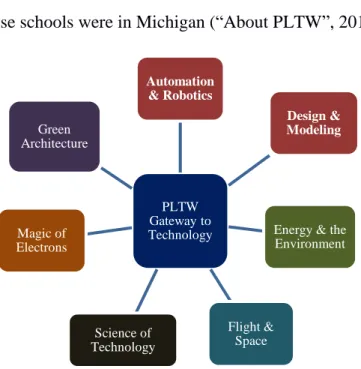
The focus of this study is on one of the widely implemented Project Lead The Way (PLTW) 6th -12th programs in the U.S. PLTW is an innovative, technology-based curriculum that focuses on teaching STEM subjects in an engineering or biomedical context. It offers alternative teaching methods to the traditional ones by implementing hands-on experiences and inquiry-based approaches that make the classes more engaging for students (“Who We Are”, 2013). The middle school program, Gateway To Technology (GTT), consists of eight units: two foundation units (Automation & Robotics and Design & Modeling) and six other units (see Figure 1 below).
4
As of November 6, 2013, the Gateway program had been implemented in 2,275 schools in the United States; 50 of these schools were in Michigan (“About PLTW”, 2014).
Figure 1: Project Lead The Way Gateway To Technology Program Units
This study will attempt to determine if a difference exists between the critical-thinking skills of middle school students who have completed a specific STEM-education curriculum and those who have not completed such a curriculum.
Statement of the Problem
There was some evidence that the PLTW Gateway to Technology program addresses critical thinking, but it is not fully understood whether these skills are enhanced or impacted by this program. At the same time, there is a lack of research regarding the PLTW Gateway program that addresses this topic.
Nature and Significance of the Problem
The increase of pre-engineering curriculum development and implementation in middle and high schools provides a strong rationale for evaluating what students gain through these engineering programs (Kelly, 2008). Kelley, Brenner, and Pieper (2010) explained that it is
PLTW Gateway to Technology Automation & Robotics Design & Modeling
Energy & the Environment Flight & Space Science of Technology Magic of Electrons Green Architecture
5
good to hear that such curricula have been developed and that many schools around the country have adopted them. But what is more important is to predict how students exposed to these classes will do in their future careers and what gains these students will make as a result of this exposure. For these reasons, educators and policy makers recognize the need for extensive research to evaluate and improve the K-12 STEM curriculum. More specifically, knowing how these programs impact students’ critical-thinking skills is essential in order to justify continuing such expensive programs in schools or school districts. According to Martin and Ritz (2012, p. 39), the second most needed research area in technology education is to uncover the “benefit of K-12 Technology and Engineering Education,” emphasizing the need for research in programs like PLTW.
One purpose of pre-engineering curricula taught in Grades 6 - 12 is to create problem solvers and good decision makers by teaching students critical- and cognitive- thinking skills (Johnson, 1992). Roberts (1994) emphasized that the main purpose of designing the teaching curriculum is not to change the world, but to help students learn to think. Therefore, researching STEM’s impact on students’ critical-thinking skills will provide a basis for evaluating the
effectiveness of a key aspect of the pre-engineering curriculum (Kelly, 2008). More specifically, investigating critical-thinking skills in the Project Lead the Way GTT foundation units will help validate its purposes and goals.
Since critical thinking is perceived to be the “corner-stone of education” (Splitter, 1990, p. 89), it is important to understand what it means. There are many definitions of critical thinking (Kinney 1980; Schlecht, 1989; Splitter, 1990; Ennis, 1987; Lipman, 1988; Paul, 1993; Sternberg, 1985; O’Neill, 1997; Facione, 2011). One of the historic definitions of critical thinking is
6
consideration of any belief or supposed form of knowledge in light of the grounds that support it, and the further conclusions to which it tends.” Another definition is “...the intellectually
disciplined process of actively and skillfully conceptualizing, applying, analyzing, synthesizing, and/or evaluating information gathered from, or generated by, observation, experience,
reflection, reasoning, or communication, as a guide to belief and action” (Paul, 1993, p. 10). One seminal study addressing critical thinking was conducted by Facione (1990). Facione used Delphi research methods to define and categorize critical-thinking skills with the support of the American Philosophical Association (APA). The APA definition that was one of the outcomes of this research is “Critical thinking is the process of purposeful, self-regulatory judgment. This process gives reasoned consideration to evidence, context, conceptualizations, methods, and criteria.” (p. 2), and “Critical thinking is using this process of purposeful, reflective judgment to decide what to believe or what to do.” (Insight Assessment, 2015, p. 14).
There were six main critical-thinking skills and sub-skills identified through this seminal work. These skills and sub-skills are summarized in Table 1 below. As a result of Dr. Facione’s seminal research, several forms of a critical-thinking skills test were created. These forms are called “The California Critical Thinking Skills Test” series for all different age groups covering elementary students to adults.
However, the critical-thinking theories that were the basis for this test were not tested in a STEM context such as PLTW-GTT. Therefore, more research efforts are needed to better identify the critical-thinking skills promoted in a STEM context. A quantitative study could support, modify, or add to the previous research effort. The results of this proposed study will help researchers and educators better understand whether the fundamental PLTW units address critical-thinking skills.
7
Table 1: List of Critical-thinking skills according to Dr. Facione’s Report
List of Critical-thinking skills according to Facione’s Report (1990)
Category Subscale Category
1. Interpretation or Categorization Decoding Significance
Clarifying Meaning 2. Analysis or Examining Ideas Identifying Arguments
Analyzing Arguments 3. Evaluation or Assessing Claims Assessing Arguments 4. Inference or Querying Evidence Conjecturing Alternatives
Drawing Conclusions 5. Explanation or Stating Results Justifying Procedures
Presenting Arguments 6. Self-Regulation or Self-Examination Self-Correction
Purpose of the Study
The purpose of this study was to determine whether students’ completion of either of the two PLTW GTT foundation units impact students’ critical-thinking skills as measured by the CCTST when compared to students who do not complete the GTT Foundation unit.
Research Questions
This study addressed the following research questions:
1. What is the impact of the successful completion of a PLTW nine-week unit of “Design and Modeling” on middle school students’ critical-thinking skillsas measured by CCTST? 2. What is the impact of the successful completion of a PLTW-GTT nine-week unit of
“Automation and Robotics” on middle school students’ critical-thinking skills as measured
8
3. Does PLTW-GTT- Design and Modeling impact CCTST scores of female students differently than male students?
4. Does PLTW-GTT- Automation and Robotics impact the CCTST scores of female students differently than male students?
5. Is there a relationship between any of the demographic variables (i.e., sex, socioeconomic status, students’ future career interest, parents’ education and jobs, parent’s help to student
in homework, the Usual Science Grade, the Usual Math Grade, MEAP [science, math, &
reading]) and the overall CCTST scores on the posttest?
Hypotheses
Null hypothesis 1: There is no significant difference between the CCTST scores of participants who have completed a GTT unit in “Design & Modeling” when compared to the scores of participants who have not completed such a GTT unit.
Null hypothesis 2: There is no significant difference between the CCTST scores of participants who have completed a GTT unit in “Automation and Robotics” when compared to the scores of participants who have not completed such a GTT unit.
Null hypothesis 3: There is no significant difference between the CCTST scores of female participants who have completed a GTT unit in “Design & Modeling” when compared to male participants who completed the same unit in the same classes.
Null hypothesis 4: There is no significant difference between the CCTST scores of female participants who have completed a GTT unit in “Automation and Robotics” when compared to male participants who completed the same unit in the same classes.
Null hypothesis 5: There is no significant correlation between any individual demographic variable (i.e., sex, socioeconomic status, students’ future career interest, parents’ education and
9
jobs, parents’ help to student in homework, the Usual Science Grade, the Usual Math Grade,
MEAP [science, math, & reading]) and the overall CCTST posttest scores.
Limitations and Delimitations The limitations included:
1. The number of participants in the study from each group, control or experimental,
depended on the number of students who agreed to participate and their parents, and what can be accessed by the middle school teachers and leaders.
2. Demographics, gender, and learning needs of students may vary between the control group and the experimental group.
The delimitations included:
The sample will be delimited to two groups of sixth- and seventh- grade students from a suburban Michigan middle school/s.
The experimental group contains students who are enrolled in PLTW-GTT foundation units and the equivalent control group contains students who are not currently enrolled in a PLTW-GTT basic unit.
Assumptions
The following list of assumptions will be used as a foundation for this study:
1) Students from both the experimental and control groups have similar demographic and background characteristics to each other.
2) Participants in this research are able to understand the test questions.
3) Participants in this research will give their opinions honestly and clearly while answering the demographic questions.
10
5) School administrators and parents are willing to allow participation in this research study. Definition of Terms
The following definitions are given to provide a foundation for communication:
Project Lead The Way (PLTW) is one of the leading provider of rigorous and innovative
Science, Technology, Engineering, and Mathematics (STEM) education curricular programs used in middle and high schools across the U.S. (“Who We Are”, 2013).
The PLTW Gateway To Technology (GTT): these basic units program features a project-based
curriculum designed to challenge and engage the natural curiosity and imagination of middle school students. This program includes seven units, of which Automation and Robotics (AR), Design and Modeling (DM), and Energy and Environment are considered the basic units in this program (Gateway To Technology | Middle School Engineering Program, 2013).
Automation and Robotics (AR): Students trace the history, development, and influence of automation and robotics. They learn about mechanical systems, energy transfer, machine automation and computer control systems. Students use a robust robotics platform to design, build and program a solution to solve an existing problem (Gateway To Technology | Middle School Engineering Program, 2103).
Design and Modeling (DM): In this unit, students begin to recognize the value of an
engineering notebook to document and capture their ideas. They are introduced to and use the design process to solve problems and understand the influence that creative and innovative design has on our lives. Students use industry standard 3D modeling software to create a virtual image of their designs and produce a portfolio to showcase their creative solutions (Gateway To Technology | Middle School Engineering Program, 2013).
11
The Occupational Information Network (O*NET) is a job data program that is sponsored by
the U.S. Department of Labor/Employment and Training Administration (USDOL/ETA) through a grant to the North Carolina Department of Commerce (O*Net Online, 2013).
12
Chapter 2: Literature Review
The purpose of this Chapter is to summarize the literature that is critical to the foundation of this study. The Chapter is organized into four sections which include: Critical Thinking, Critical-thinking instruments, Teaching Critical Thinking, and Project Lead The Way. The Critical-Thinking section presents definitions and theories related to critical thinking throughout history. The Critical-Thinking Instrument section presents comparisons between commercially available instruments of critical-thinking, appropriate for middle school age participants, including their theoretical dimensions and advantages and disadvantages of each one. The Teaching Critical Thinking section presents studies that displayed attempts and methods of teaching critical thinking during the last 50 years. Finally, the Project Lead The Way (PLTW) section included a survey of studies conducted on the PLTW middle and high school engineering programs during the last 10 years.
Critical Thinking
Facione (1990), while working under the auspices of the American Philosophical
Association (APA), used a Delphi approach involving 46 experts to reach a consensus on definitions and categories of critical thinking. The definition of critical thinking that emerged from this process is “purposeful, self-regulatory judgment which results in interpretation, analysis, evaluation, and inference, as well as explanation of the evidential, conceptual,
methodological, criteriological, or contextual considerations upon which that judgment is based.” (p. 2). The report added the characteristics of a critical thinker:
The ideal critical thinker is habitually inquisitive, well-informed, trustful of reason, open-minded, flexible, fairminded in evaluation, honest in facing personal biases, prudent in making judgments, willing to reconsider, clear about issues, orderly in complex matters,
13
diligent in seeking relevant information, reasonable in the selection of criteria, focused in inquiry, and persistent in seeking results which are as precise as the subject and the circumstances of inquiry permit. (p. 2).
Facione, Facione, and Giancarlo (1996) indicated that for anybody to be an effective learner and a successful employee, one must be ready to make educated, reasonable judgments in partially vague settings about what to accept as true and what to do in a variety of circumstances. They identified seven attributions needed for such persons, “truth seeking, open-mindedness, systematicity, inquisitiveness, analyticity, cognitive maturity, critical thinking, self-confidence” (p. 71). Systematicity deals with organization, focus, and perseverance in thinking and drawing conclusions. Analyticity deals with alertness to potential problems, or difficulties, and the awareness for the need to intervene to solve them by using proof and purpose. Cognitive maturity refers to being wise and understanding when making decisions. It is the ability to see the complexity of the problem, to be flexible, and to look at the problem from different angles. It is the ability to be sensitive to different shades of circumstances and contexts. People with low cognitive maturity usually look at things as right or wrong bluntly, may make decisions too fast or too slowly, and are unwilling to change their mind.
There have been disagreements in the literature regarding the definition and theories related to critical thinking. Many other philosophers, psychologists, and/or educators defined critical thinking. There are some connections between all other definitions and theories, on one hand, and Facione’s APA definition and theories, on the other.
People began recognizing critical thinking during the times of Socrates, Plato, and Aristotle, whose main philosophical themes were to help students understand that things that happen around them mostly are not what they appear on the exterior (Burbach, Matkin, & Fritz,
14
2004). Interpretation and inference are two skills which are part of Facione’s critical-thinking categories that have a meaning of critical thinking similar to those of Socrates, Plato, and Aristotle.
During the 20th century, critical thinking started getting more attention from educators. Dewey was one of the first people to define critical thinking during this century but his
definitions focused on reflecting on a person’s own thoughts (metacognition). He defines critical thinking as: "active, persistent, and careful consideration of any belief or supposed form of knowledge in light of the grounds that support it, and the further conclusions to which it tends." (Dewey & Skillbeck, 1970, p. 6). The APA definition included parts where the person reflects on his/her own thoughts by being fairminded in evaluation, and reasonable in the selection of
criteria.
During the 1980’s, critical thinking started to became increasingly important compared to previous eras (Dam & Volman, 2004). Sternberg (1985) defined critical thinking as "the mental processes, strategies, and representations people use to solve problems, make decisions and learn new concepts" (is cited in Splitter, 1990, p. 90). Another definition of critical thinking by Siegel (1980) is a "critical thinker is one who is appropriately moved by reasons: she has a propensity to believe and act in accordance with reasons; and she has the ability properly to assess the force of reasons in the context in which reasons play a role" (Siegel, quoted in Splitter, 1990, p 90).
These two definitions form a good connection to Facione’s definition and categories since
making decisions and assessing the force of reason are similar to making judgments by using evidence.
Paul, who serves as the Director of the Center for Critical Thinking and Chair of the National Council for Excellence in Critical Thinking, defined critical thinking as “the art of
15
analyzing and evaluating thinking with a view to improving it” (Paul & Elder, 2007, p. 4). They also added that critical thinking requires the person to be open-minded, mindful, able to solve problems, an effective communicator, and able to avoid looking at everything from the person’s own point of view or that of his social group. These definitions and characteristics are similar to Facione’s APA definition since this definition also includes analyzing and evaluating thinking skills. It also requires the person to be open-minded and trustful of reason.
Martin, D. (2011) wrote that Lipman believed that children at a young age can learn to think critically. Lipman developed and taught a course on critical thinking to middle school students. Many others were influenced by his work and tried his course successfully. His course resulted in significant improvement in middle school students’ academic performance. Dr. Lipman defines critical thinking as “skillful, responsible thinking that facilitates good judgment because it relies upon criteria, self- correcting, and is sensitive to context.” (Lipman, 1988, p.6).
Ennis (1987) defined critical thinking as “a reasonable reflective thinking that is focused on deciding what to believe and do" (p. 180). He additionally explained that this definition implies that someone characterized with critical thinking should be able to judge the credibility of sources; identify conclusions, reasons, and assumptions; judge the quality of an argument, including the acceptability of its reasons, assumptions, and evidence; develop and defend a position on an issue; and other skills (Ennis, 1987).
The two definitions by Lipman and Ennis focus on actions and judgments, which makes these definitions more operational and applicable than other definitions. At the same time, these definitions are very similar to Facione’s APA definition since they discuss good judgment, criteria, and sensitivity to context, which are the bases of Facione’s definition as well.
16
One can conclude at the end of this section that no matter what definition of critical thinking people understand and implement, what is important is that people are able to think and use their thinking to make wise judgments about things in which they are involved. It is the ability to be able to think and reflect on things happening around them and to be able to move beyond just memorization or listing of information especially in a continuously changing society. As a result, a critical thinker can succeed when dealing with people and in the workplace, and will become a good contributor to his/her society.
Critical-ihinking Instruments
Several critical-thinking instruments were described in the Mental Measurement Yearbook Database and have been summarized by Robert Ennis (1993). Almost all were designed for adults and/or high school students, which did not leave many choices for the researcher to use for the target age group for this study. Only two commercially available
critical-thinking tests have been designed for middle school students and cover all dimensions of critical thinking: The California Critical Thinking Skills Test (CCTST) and the Cornell Critical Thinking Test (CCTT).
As displayed in Table 2, there are general similarities and differences between the two tests. The general purposes of both tests are similar. However, the population which the CCTST was designed for is middle school students, whereas the CCTT was designed for a broader population from grades 4 -14, which makes the researcher wonder how one can assess all age groups with many different abilities and experiences.
The conceptualization of the CCTST was based on the American Philosophical Association (APA) Delphi research where 46 experts gave their consensus on the dimensions and the definitions of critical thinking. One major definition that came out of this research for
17
critical thinking was “a purposeful, reflective judgment to decide what to believe or what to do” (
Insight Assessment, 2015, p. 14). On the other hand, the CCTT conceptualization was based on research conducted by Robert Ennis (1987) who defined critical thinking as “a reasonable reflective thinking that is focused on deciding what to believe and do" (p. 180).
The CCTST produces six subscale scores, each of which represents one of the
dimensions of critical thinking. The CCTT, on the other hand, produces only a total score which does not show the multiple dimensions of critical thinking. When comparing the development of these two tests based on reviews in Mental Measurement Yearbook (Malcolm, 1985; &
Hughes,1985) and test manual ( Insight Assessment, 2015), one finds that the CCTST is not subject specific while the CCTT is more subject dependent. The CCTT follows a science fiction story format which displays a rescue mission to a planet and different scenarios are employed in each section of the test (Hughes, 1985). The test requires a significant amount of reading, which may indicate that the test measures reading comprehension rather than critical-thinking skills (Hughes, 1985).
18
The construct validity of the CCTST was supported by the CCTST pretest and posttest score improvement of college students who took a critical-thinking course (Lambert, 2007). On the other hand, the construct validity of the CCTT was verified by correlations with external criteria (Hughes, 1985). The external criteria that were used to validate construct validity do not provide a clear rationale about construct validity because the external criteria were based on using intelligence and reading comprehension measures which do not cover all critical-thinking skills dimensions (Hughes, 1985).
Criterion validity of CCTST was assessed by comparing CCTST scores to different measures of academic performance, such as grade point average with a correlation of 0.20,
Table 2: General Information California Versus Cornell General Information California Versus Cornell
Feature The California Critical Thinking Skills Test (CCTST)
Cornell Critical Thinking Test (CCTT)
Publisher Insight Assessment-The California Academic Press LLC
Midwest Publications, Inc.
Purpose Specifically designed to measure the skills dimension of critical thinking including analysis, inference, evaluation, induction, deduction, numeracy, and overall.
Assesses general critical thinking ability including induction,
deduction, evaluation, observation, credibility, assumption identification, and meaning.
Population Middle schools students: Grades 6 – 8 Grades 4 – 14. Level X Conceptualization Based on Delphi consensus
conceptualization of critical thinking published by the American
Philosophical Association in 1990
Based on Ennis's conceptualization of critical-thinking skills
# of Items-Format-Time limit
25 items-Multiple choices items-45 minutes or unlimited
71 items-Multiple choices items-50 minutes
Types of Scores 6: Analysis, Inference, Evaluation, Deductive Reasoning, Inductive Reasoning, Total Score
19
Graduate Record Examination (GRE) with a correlation of 0.72, and Scholastic Assessment Test
(SAT) with a correlation of 0.41 (Lambert, 2007; Martin, 2007). CCTT criterion validity was not observed because the CCTT does not correlate with any other external measure, based on the manual (Hughes, 1985).
CCTST demonstrated satisfactory internal consistency through validation studies that were conducted on this instrument, but test-retest reliability was not discussed in the manual (Lambert, 2007). On the other hand, CCTT has demonstrated low internal consistency through a brief review of studies, but test-retest reliability was also not discussed in the manual.
Taube (1997) discussed the use of different critical-thinking skills and critical-thinking disposition instruments. The study indicated that it is more accurate to use both types of
instruments, skills and disposition, to measure critical thinking than only using critical-thinking skills instruments. Frisby and Traffanstedt (2003) conducted a study on the relationship between the CCTST scores of high school and college students and the time taken to complete the test. The results showed that slower test takers obtained significantly higher scores on the CCTST.
Fawkers, O’mera, Weber, and Flage (2005) examined the content validity of the CCTST (the original adult version). Through careful investigation, they concluded that the test has a number of strengths and the clearest instructions when compared to other critical-thinking skills instruments. They also indicated that, even though most of the test questions were very well written and acceptable, a few questions had some errors and recommended that they be excluded from the test.
Research on the CCTT included research related to the characteristics of the test itself (Modjeski & Michael,1983; Frisby, 1992). Modjeski and Michael (1983) conducted a reliability and validity evaluation by a panel of psychologists of two critical-thinking tests, the CCTT and
20
Watson-Glaser Critical Thinking Appraisal. “Standards for Educational and Psychological Tests” were used in this evaluation and the results of the research indicated that both instruments ranked low according to these standards. Frisby (1992) conducted a study of construct validity and psychometric properties of the CCTT using three groups of college students which provided mixed and inconclusive results concerning the use of the CCTT as a critical-thinking skills instrument.
As a summary of both instruments, the CCTST was found to have better psychometric attributes than the CCTT. The use of many experts and from different fields in the CCTST development gives more creditability to the psychometric properties of the test than the CCTT, which was developed by one person. As explained in this section, the CCTST’s construct validity, criterion validity, and internal consistency are sound and more profound than the CCTT’s. The CCTST contains mostly question items that are not language dependent. On the other hand, the CCTT is heavily language dependent because it contains many unfamiliar words. Additionally, the CCTST was designed especially for the target age group for this study. Finally, the scoring that is provided by the CCTST is much better than the score produced by the CCTT since six dimensions of critical thinking are provided by the CCTST and only total score is provided by the CCTT.
Teaching Critical Thinking
Many attempts have been made to incorporate critical-thinking skills into K-12 schools and post-secondary formal educational experiences. Two approaches to the incorporation of critical-thinking skills include the creation of stand-alone critical-thinking courses and the modification of existing courses. Some attempts focused on incorporating critical thinking into the classroom utilizing hands-on activities, collaborative work, analyzing text, seminar
21
questioning, journal writing, scaffolding, internet, etc. The following summarizes several attempts aimed at K-12 schools and post-secondary programs. The K-12 schools efforts involved integrating critical-thinking skills into the core subjects (e.g., mathematics, language arts, science, and social studies), or by using specialized curricula or technology courses/units specifically designed to promote critical-thinking skills.
The seminar questioning approach was used as a critical-thinking teaching method and proved to affect elementary and middle school students’ critical-thinking skills and achievement scores positively. For example, Reid (2010) conducted a quasi-experimental research study to examine the impact of a critical-thinking program employing Socratic seminars, used in second grade classrooms in order to improve students’ language arts test scores. The results of this study indicated that students who were exposed to the program had significant improvement on
language arts test scores when compared to the control group.
Pogrow (2005) reported that a project called HOTS (Higher-Order Thinking Skills), supported by Title I grants, proved to be successful in promoting higher order and thinking skills of elementary students. The main purpose of this program was to promote critical-thinking skills for disadvantaged and at-risk third grade students. Socratic questioning
techniques, the promotion of new ideas, increased students’ talk time, and decreased teacher talk time were some of the main techniques used by highly trained teachers. Students were given supplemental resources such as computers to help them come up with their own ideas. More than 26,000 schools around the country used the program which influenced the academic performance of over a million disadvantaged students positively.
Using an inquiry-based approach or hands-on activities to teach critical-thinking skills was another important teaching method that educators used. For example, Flick (1998)
22
researched the use of the elements of inquiry in middle school classrooms. Teachers used a dynamic process called scaffolding by which the teacher adjusted instructions based on students’ responses. The teachers who participated in the study acted as mentors to the students. Based on interactions between teachers and students, teachers have the choice of letting students use a computer, textbook, or laboratory materials in order to give the students the resources needed for them to succeed. This method appeared to help students develop critical- and cognitive-thinking skills that enabled them to solve problems and persevere in the task given to them based on a locally developed inventory behavior.
Esswein (2010) attempted to measure the impact that an inquiry-based middle school science professional development program delivered to teachers had on their students’ critical thinking and reasoning abilities. The results of this research indicated that students whose teachers participated in the program had significantly higher reasoning abilities when comparing pretest and posttest results of science content tests, and a scientific reasoning ability measure. Additionally, a significant relationship between the teacher’s scientific reasoning abilities scores and the posttest reasoning ability scores of her students was found.
Dindial (1990) redesigned science courses for first through fourth grade gifted students in order to include challenging activities through individual, small group, or large group activities. The activities, which included real-life experiences and the use of the scientific method,
promoted critical-thinking skills. The study revealed positive results in student learning and critical-thinking skills as measured by worksheets about science content understanding and answers to higher order questions along with checklists for evaluating critical-thinking skills.
Using STEM-related curricula to promote critical thinking was another main method that educators used in K-12 schools. Duran and Sendag (2012) investigated the use of an Information
23
Technology (IT) program to develop critical-thinking skills in high school students within the STEM context. The study used a quasi-experimental design which revealed a significant
improvement in the students’ critical-thinking skills as measured by Test of Everyday Reasoning (TER). The study concluded that the IT/STEM experience that incorporates technology, inquiry, or real-life projects and collaborative work is beneficial in improving students’ critical-thinking skills.
Mojica (2010), in a quasi-experimental study using a pretest-posttest control group design, found that there was no significant difference between two groups of middle school students taking enhanced technology units versus standard technology units. It is important to note that the study did not investigate the impact of technology units on students’ critical-thinking skills, but it investigated the impact of supplemental math and science instruction on students’ critical-thinking skills as measured by Cornell Critical Thinking Test.
Lammi (2011) conducted a quasi-experimental research study of high school students who were participating in an IT/STEM program by giving pairs of students an ill-defined
engineering problem to solve. Data from administrating the “Test of Everyday Reasoning (TER) three times during a 10-month period on all participants suggested that students’ involvement in STEM courses is effective in promoting their critical-thinking skills, such as thinking
systematically, problem solving, inference, and communicating ideas.
Coleman, King, Ruth, & Stary (2001) conducted a research study that supported the use of a strategy to promote critical- and creative-thinking skills in fourth-grade classrooms. That strategy was the implementation of a teacher-made program called the “World Wide Web-Based Project” that gave students access to information and activities using the critical-thinking skills
24
of application, analysis, synthesis, and evaluation. The results of this research were positive and in support of enhancing fourth-grade students’ critical-thinking skills.
Using reflective or journal writing and communicating ideas constituted another approach that was used by educators to stimulate students’ critical-thinking skills. Vojnovich (1997) examined the use of intervention strategies to motivate and improve critical-thinking skills of high school students. These results suggested that the use of a variety of critical-thinking tasks improved students’ problem-solving skills . Simpson (2010) reported that using classroom-based research by integrating information and communication technology in a teacher-guided
collaborative online context encouraged elementary students to become critical readers as measured by students reading assessments.
It is useful, at this point, to summarize all critical-thinking teaching and learning
strategies that were the most useful in a K-12 context. The most effective K-12 critical-thinking teaching methods included: using seminar questioning techniques, project-based or active learning, journal or reflective writing, collaborative learning, web-based online tools, and STEM-related curriculum.
Post-secondary attempts to incorporate critical thinking into college students’ course work were more systematic (following the scientific method) and subject-oriented than the attempts to incorporate critical thinking into K-12 schools. These attempts included several majors or areas of study such as Nursing and Business related fields. Nursing, as a profession, requires individuals with skills of clinical judgment, inference, problem-solving, and evaluation in order to succeed in their jobs. Studies utilized several methods to promote these skills such as the use of simulation, online instructional videos, case studies, technology-centered dynamic and cooperative learning assignments (Ousley, 2012; Popil, 2011; Mastrian & McGonigle, 1999).
25
The results of these studies suggested that these interventions had a positive impact on students’ critical-thinking skills. Studies by Garvey and Buckley (2011) and David and Brown (2012) showed that the utilization of an application of prediction market technology, online material, video delivery methods, Excel and computer-based tasks showed positive impacts on the critical-thinking skills of students enrolled in business-related courses.
From all presented literature it appears that the most successful attempts to promote the teaching of critical-thinking teaching involved one or more of the following methods or
strategies: inquiry-based learning, web-based technology tools integration, questioning
techniques, writing in journals, online assignments, and most importantly teacher training. With this information in mind and attempting to connect it with the purpose of this study, Project Lead the Way (PLTW) curriculum, as defined in the introduction of this paper, includes these
strategies which could suggest that PLTW may improve critical-thinking skills. Project Lead The Way
The Project Lead The Way (PLTW) consists of five programs: Engineering, Biomedical, and Computer Sciences for high school students, Gateway to Technology for middle school students, and Launch for elementary school students (see Figure 2 for details) (“Our Programs”, 2014). PLTW- Gateway to Technology (GTT) units are designed to help prepare middle school students for PLTW high school programs. Schools implementing the PLTW-GTT program are required per PLTW registration policies to start with the foundations units, then offer other units gradually as they deem appropriate because the participation in the foundation units gives the students the basic STEM background needed to complete the future STEM courses and units (PLTW Gateway - Curriculum.", 2014).
26
Figure 2: Project Lead The Way Program Detailed
Elem = elementary, HS = high school, MS = middle school
“Project Lead The Way’s mission is to prepare students for the global economy. PLTW accomplishes this through world-class curriculum, high-quality professional development, and an engaged network” (“About PLTW”, 2014).
Currently, PLTW is offered in all 50 states, and there are more than 5,800 school implementations with about 2,400 newly registered schools within the last three years (Project Lead The Way, 2014). The significant growth of this program and the costs associated with it has led to the academic question as to whether PLTW is actually beneficial to students. For example, it is beneficial in increasing student achievement in math and science? What types of knowledge and skills are gained by students completing these courses? Are students who complete such courses better equipped with critical-thinking skills and problem-solving skills than other
PLTW Programs
Launch-Elem Gateway-MS Foundation Units Design & Modeling (DM) Automation & Robotics (AR) Six Other Units Biomedical Sciences -HS Computer Science-HS Engineering-HS Six Other Courses Foundation Courses Introduction To Engineering Design (IED) Principles Of Engineering (POE)27
students? Moreover, university program administrators are interested in knowing how effective these classes are in getting students ready for STEM field careers.
Since this study involved the PLTW Gateway to Technology (GTT) program for the middle school, it was relevant to survey the studies related to the PLTW engineering and PLTW-GTT programs over the last 10 years. The published research studies about PLTW engineering programs in middle school (Gateway to Technology (GTT)) and high school (Pathway to
Engineering (PTE)) programs related to student learning are presented in a table in Appendix G. A significant body of research has been conducted about PLTW. Approximately, 50 percent of the documents produced from these studies were dissertations and the other 50 percent were reports, research papers, or conference proceedings. Dissertations are generally more reliable than funded reports by PLTW, since dissertations are more academically focused and tend to be less biased than other types of studies. The purposes for administering these studies included: math and science achievement, STEM career interest, STEM-related fields’ college enrollment, advanced math and science course enrollment, and persistence in college and STEM careers.
Most of PLTW research studies focused on high school engineering program. One study by the University of Wisconsin-Milwaukee (2011) on PLTW courses lacked internal validity based on the formulation of the survey questions. Tran & Nathan (2010, p. 143) reported that there was no relationship between student achievement on state standardized tests and the completion of a PLTW high school Introduction to Engineering Design course. The Iowa
Department of Education longitudinal study used students who moved from eighth grade to high school. PLTW students served as the treatment group and a non-PLTW group of students
28
moderate growth in their achievement scores when compared to the control group. Additionally, the results of the study revealed that most students were white males and from the top upper-quartile. Therefore, the researchers suggested a future study that will account for the selection process for those taking PLTW courses where pre-existing abilities of students have an effect on their achievement (Schenk, Rethwisch, Chapman, Laanan, Starobin, & Zhang, 2011, p. 27).
Schenk, Rethwisch, Chapman, Laanan, Starobin, & Zhang (2011) conducted a study to test the impact of the PLTW high school engineering program on students’ performances and future college enrollment. The study indicated that students enrolled in the program had
moderate gains in mathematics standardized test scores and a smaller increase in science scores. Additionally, it was found that the students enrolled in PLTW programs had a 37 percent higher chance of enrolling in college, especially 2-year colleges.
A longitudinal study by Starobin, Schenk, Laanan, Rethwisch, and Moeller (2013), conducted on students who participated in PLTW courses during high school, indicated that PLTW students are more likely to pursue a college degree after graduating from high school. Additionally, the study showed that these students are ten percent more likely to pursue a college degree in STEM fields than non-PLTW students. These above mentioned studies and others (Paslov, 2006; Wheeler, 2009; & Martin, 2011) focused on student achievement and did not address the students’ critical-thinking skills, which will be the concentration of this study. Additionally, these studies focused primarily on high school students, whereas this study will focus on middle school students.
A recent longitudinal study by Overschelde (2013), indicated that high school students who enrolled in PLTW program performed significantly higher on the Grade 11 Texas
29
enrolled in Texas higher education institutions, and the non-college-bound PLTW students earned higher wages.
Salzman, Mann, & Ohland (2012) attempted to determine the long-term effect of PLTW course completion on students’ future perceptions and motivation to enroll in colleges of
engineering. The study revealed that PLTW students had positive long-term perceptions of engineering; at the same time, participants thought that it helped them succeed in their
engineering studies. It is important to note that most participants in the study were white males. The study suggested that further research studies are needed for the results to be generalizable (p. 8).
Several studies have been conducted in the state of Indiana about the perceptions of principals, teachers, and parents on PLTW courses (Shields, 2007; Rogers, 2006 & 2007; Werner, &, Kelly, 2008). These studies did not address middle school students’ critical-thinking skills; instead, they addressed the perceptions of other people who were involved in the students’ learning process and primarily targeted high school PLTW courses. Therefore, there is a lack of valid and reliable research regarding the impacts of PLTW experiences on middle school students’ critical-thinking skills, which this study addressed.
The impact of PLTW program on problem solving and thinking skills was only investigated in three studies which were not conducted on the PLTW middle school program (Kelley, 2008; Kelley, Brenner, & Pieper, 2010; Lammi, 2011). Kelley (2008) conducted a comparative study to investigate the cognitive process of high school students who participated in two different STEM programs [i.e., PLTW and National Center for Engineering and
30
problem definition and analysis skills more than participants of the other program. While the NCETE program participants spent more time on designing and generating solutions.
A study by Kelley, Brenner, and Pieper (2010) examined two approaches to engineering design – Project Lead The Way (PLTW) and Engineering Projects in Community Service (EPCS) – using a mix of qualitative and quantitative methods. This study used a pre-defined cognitive-skills inventory and analyzed which inventories the students used the most while solving engineering problems. The pre-defined cognitive-skills inventory was based on an earlier study by Halfin (1973) that identified 17 universal mental processes, some of which included: analyzing, computing, designing, defining problems, interpreting data, managing, predicting results, and questioning. These are consistent with critical-thinking categories identified by the Delphi research. The results of this study revealed that students in both approaches to
engineering programs (i.e., PLTW and EPCS) used ten out of 17 cognitive skills while solving an engineering problem.
Lammi (2011) administered a study involving PLTW high school program participants to investigate the students’ system thinking using specific dimensions when engaged in an
engineering design challenge. The results of this study indicated that students used higher-order thinking skills (i.e., analysis, evaluation, and synthesis) when engaged in solving an engineering design challenge. It also indicated the use of optimizations, unboundedness, and sketching while solving the given engineering challenge. As one can see from the literature, there is little work investigating the critical-thinking skills of middle school students. Therefore, this study will address the role of selected STEM programs on critical-thinking skills.
31
Chapter 3: Methodology
This chapter presents the methodology of this study, which includes the research design, the population and sample, a description of the treatments, the instrument characteristics, along with the data collection, and data analysis procedures. A quasi-experimental research design was used for this study. This type of research attempts to determine whether there is an impact on the dependent variable by the treatment. A control group was used to help ensure that the treatment was the primary impact on the dependent variable, and there is a true difference between
experimental and control groups when the independent variable is manipulated, which results in differences between dependent variables (Mertler & Charles, 2011). In this pretest-posttest control group quasi-experimental research, the researcher attempted to determine the impact of the completion of each of the PLTW-Gateway to Technology (GTT) foundation units (treatment) on students’ critical-thinking skills. Critical-thinking skills were measured using the middle school version of the California Critical Thinking Skills Test (CCTST-M25).
Research Design
A comprehensive literature review focusing on critical thinking and technology and engineering education was conducted to select a critical-thinking instrument. The California Critical Thinking Skills Test (CCTST) was chosen based on its strong psychometric properties.
An appropriate population for the study was selected based on several factors (as
discussed in the next section). Sixth grade students who were enrolled in the PLTW-GTT Design and Modeling (DM) unit constituted the treatment group; and students in the same grade who were not enrolled in that unit, with similar characteristics as the treatment group, constituted the control group. Seventh-grade students who were enrolled in the PLTW-GTT Automation and Robotics (AR) unit constituted the treatment group; and students in the same grade who were not
32
enrolled in that unit, with similar characteristics as the treatment group, constituted the control group.
Each group, including the treatment and control groups, were administered the CCTST along with the demographic questions once at the beginning of the treatment, and a second time at the end of the treatment. The data were collected, and then the responses were matched for each participant between pretest and posttest. A detailed analysis was conducted on all data including demographic variables and the CCTST scores and sub-scores, before the results and conclusions of the study were finalized. Figure 3 identifies the key steps used in conducting this research.
33 Figure 2: Research Design
34
Population and Sample
The population for this research study included sixth- and seventh-graders from a Michigan suburban middle school located in the southeastern part of the state. The school was selected for this study based on several important criteria. The first criterion was that the school/s must have implemented a PLTW-GTT foundation program for at least three years and the
teacher must have at least three years of experience in delivering the program. The second criterion was that the school did not offer any competing STEM stand-alone programs.
The researcher identified several schools that fulfilled the given criteria with help from the PLTW affiliate director in Michigan who had access to the national PLTW database which includes all PLTW schools, the number of years of implementation and the level of the PLTW teachers’ experience. Three middle schools in Michigan, two suburban and one urban, who met the mentioned criteria, were contacted by the researcher and the dissertation advisor. The school district superintendent for each school was contacted by email, and by phone. Only one of the three superintendents of the three schools agreed to participate in the research. The principal of the approved suburban middle school was contacted by email and he agreed to and supported having his school participate in the study as well. The school principal and the PLTW teachers met with the researcher and research advisor to discuss the logistics of the research.
The sample for this research study was selected from sixth- and seventh-graders. Similar to overall school characteristics, approximately 90 percent of the sample was White while three percent were African American, and three percent were Hispanic. Middle school students in the State of Michigan, on average, are 69 percent White, 18 percent African American, and 7 percent Hispanic. It is clear from this comparison that there was a difference in the ratios of the number of African-American and White students between the school selected and the state as a whole, as
35
highlighted in Table 3. Based on the PLTW implementations that existed at the time of this study, schools that more closely resembled the state ratios could not meet the criteria regarding experience with PLTW GTT Foundation modules.
Table 3: Ethnicity: Sample School vs. Michigan
Ethnicity: Sample School vs. Michigan
Race School Michigan
American Indian 0% 1%
African American 3% 17%
Asian or Pacific Islander 2% 3%
Hispanic of Any Race 3% 7%
Native Hawaiian 0% 0%
Two or More Races 2% 3%
White 90% 69%
Total Number of Students 767 230,899
Approximately 49 percent of the selected middle school students were female and 20 percent of students were from low-income families. In comparison, an average of 49 percent of Michigan middle school students were female and 49 percent of students were economically disadvantaged. It is clear that the participating school had a similar male-to-female student ratio as the state. On the other hand, the school had a much smaller percentage of economically disadvantaged students than the state, as highlighted in Table 4.
36
Table 4: Demographics: School vs. Michigan Sixth- & Seventh- Grades
Demographics: School vs. Michigan Sixth- & Seventh- Grades
Demographic School Michigan
Males 51% 51%
Females 49% 49%
Economically Disadvantaged 20% 49%
English Language Learners < 5% < 5%
Students with Disabilities 9% 13%
Total Number of Students 767 230,899
On the 2013 Michigan Educational Assessment Program (MEAP) tests, sixth graders at the participating school passed the MEAP tests at a rate that was 17 percent higher in
mathematics and 10 percent higher in reading than their Michigan peers. Please refer to Table 5 for details (State of Michigan, 2013)
Table 5: Passing Rates: Sixth Grade MEAP
Passing Rates: Sixth Grade MEAP
Subject School Michigan
Mathematics 59.10% 41.50%
Reading 81.50% 71.50%
Average 70.30% 56.50%
Similarly, seventh graders at the participating school passed the MEAP tests at a rate that was 16 percent higher on the mathematics MEAP test and 14 percent higher on the reading MEAP test than their Michigan peers. Refer to Table 6 for details (State of Michigan, 2013).
Table 6: Passing Rates: Seventh Grade MEAP
Passing Rates: Seventh Grade MEAP
Subject School Michigan
Mathematics 54.50% 39.20%
Reading 73.80% 60.40%