Learning to Teach in Space: Design Principles for Faculty Development in
Active Learning Classrooms
Tracey Birdwell
Indiana University
Suraj Uttamchandani
Indiana University We describe four design principles that guide the Mosaic Fellows Program at Indiana University, a program focused on supporting faculty pedagogy in active learning spaces. The design principles focus on exploring a variety of classrooms with faculty Fellows, engaging Fellows’ individual goals, creating shared learning experiences, and encouraging Fellows to share their insights with a larger university audience to support institutional change. We discuss each design principle in turn, explaining the rationale behind the principle, and then give specific examples of the design principle in practice. We conclude with implications for faculty development about active learning spaces at other institutions. Since 2013, Indiana University (IU) has been designingand building active learning classrooms across our seven campuses (Morrone, Ouimet, Siering, & Arthur, 2014), joining other programs that have thoughtfully reconceptualized learning spaces in higher education including Iowa State University (Rands & Gansemer-Topf, 2017), University of Minnesota (Walker & Baepler, 2017), and McGill University (Finkelstein, Ferris, Weston, & Winer, 2016). Like many of these programs, we quickly recognized that using active learning classrooms effectively necessitated intentional support for faculty for teaching in these spaces. In 2015, IU created the Mosaic Initiative to provide that support for all instructors who teach in active learning classrooms, to facilitate greater faculty input into active learning classroom design, and to encourage faculty-led research on dynamic learning spaces.
While the Mosaic Initiative works with all IU instructors who teach in active learning classrooms, in 2016 the initiative also created a core group of faculty, the Mosaic Fellows, to support the development of IU active learning classrooms and new approaches to teaching in those spaces across the system. The Mosaic Fellows, whose tenure lasts the course of one academic year, are charged with teaching in active learning classrooms, sharing their experiences, engaging in research, and working with IU’s learning spaces team to inform classroom design (see Morrone et al., 2017).
The community of Mosaic Fellows, currently numbering 104, draws faculty from all seven campuses of IU and continues to grow each year as new Fellows apply and are
chosen. The key goals of the Mosaic Faculty Fellows program are to:
• Prepare faculty members to teach in active learning classrooms by exploring a variety of instructional strategies and technologies.
• Build a community of faculty members who collaborate to advance their own teaching and to mentor other colleagues exploring and refining their pedagogical approaches.
• Promote evidence-based teaching by encouraging instructors to study the impacts of new spaces and instructional approaches on student learning.
• Create faculty leaders who work together and with other stakeholders to guide the development of new learning spaces across the university.
Meeting these goals requires bringing together perspectives on faculty development with emergent literature on active learning spaces, as we attempt to do here.
The Mosaic Fellows program plays an important role in the larger Mosaic Initiative, as it generates a person-centered infrastructure around the physical learning spaces that, in turn, supports faculty in using these spaces to their full potential. As we designed the program, we considered what overarching strategies we could use to support faculty development for teaching in active learning spaces and using active learning pedagogies. Here, we offer what we came to think of as the four distinct yet overlapping design principles for the Mosaic program. We consider these as design principles because they were overarching patterns that shaped our day-to-day choices about what to do with Fellows, where to meet with them, and what kinds of support to offer them. We believe these principles may be applicable to a broad range of faculty development programs around active learning classrooms.
Tracey Birdwell is the Program Director of the Mosaic Initiative, Indiana University.
These design principles are informed by contemporary theories about human learning and are grounded in our experiences working with faculty in and beyond active learning spaces. The Mosaic Fellows Program design principles are:
• Design Principle #1: Explore and experience a variety of classroom designs with Fellows so that they can leverage any classroom for their teaching goals.
• Design Principle #2: Intentionally and explicitly engage Fellows’ own individual goals, needs, and interests.
• Design Principle #3: Create learning experiences in which Fellows collaborate and share their experiences and insights and how they might apply them.
• Design Principle #4: Recognize that Fellows' experiences and insights have meaning for a broad array of university stakeholders and encourage sharing with those stakeholders.
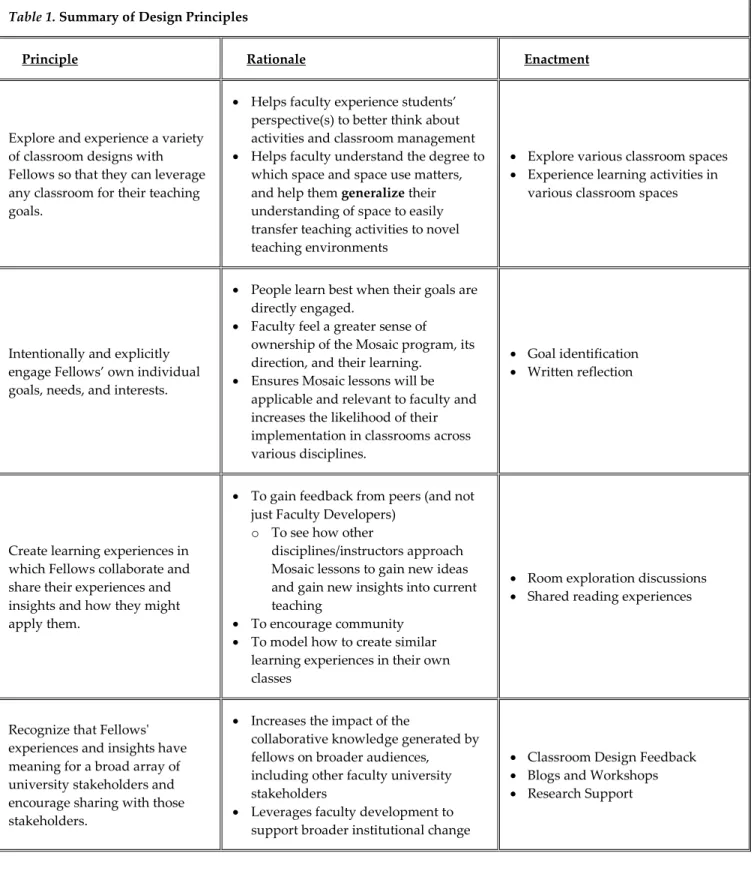
These principles are distinct concepts, but they also work together to support the broader goal of encouraging Fellows to deeply consider how classroom space can affect teaching and then how to best leverage classroom space to support active learning. Together, the principles help faculty consider how they teach in their classrooms, help university staff conceptualize what further research is needed to better understand when and how active learning spaces can be used effectively, and help encourage dialogue about how we should design new classrooms and upgrade older ones. Throughout the course of the Mosaic Fellows program, each choice we make, including where we meet, what we read, and what learning activities we do together, are informed by these design principles. The principles are summarized in Table One.
Design Principle #1: Explore and experience
a variety of classroom designs with Fellows
so that they can leverage any classroom for
their teaching goals
As other researchers have noted, classroom space matters for teaching and for student learning and therefore space should be considered a significant factor in designing student learning experiences (Brooks, 2011; Oblinger, 2006). We introduce this line of thinking about pedagogy to Fellows as we begin discussions about how to most effectively leverage classroom spaces to support student
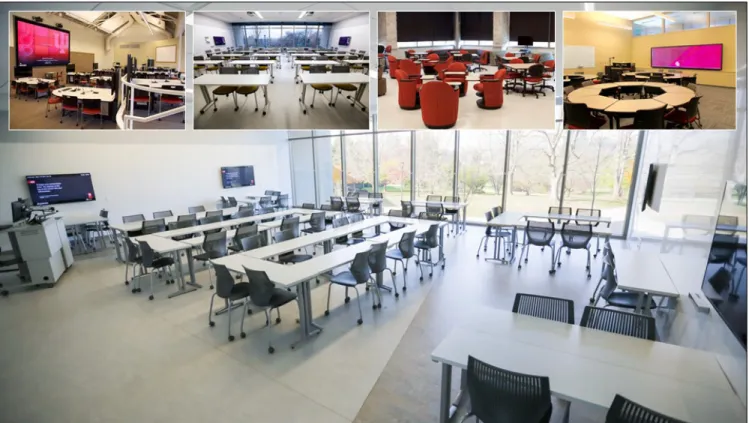
learning. Thus, we seek to help Fellows develop environmental competence (Steele, 1980), defined as the ability to effectively use the physical environment to meet desired goals, through practical, in-classroom experiences. Because there are many different types of active learning spaces at IU (see Figure 1), we encourage Fellows to explore the importance of not just the spaces they are using, but all such spaces. Rather than training faculty to teach in one specific type of room, we instead seek to develop the broader skill-set of being able to teach in any of our Mosaic classrooms. This design principle is meant to support faculty in conceptualizing the relationships between classroom space and student learning as well as to be able to leverage that relationship in a wide variety of classroom spaces (including traditional spaces) in order to teach more effectively.
In asking faculty to explore and to reflect on teaching in different spaces, we seek to support their thinking about how the affordances and constraints found in a variety of classroom spaces might influence their instructional choices and student learning, thus, as we explore each space, we support transferring ideas developed in individual classrooms to across multiple contexts. Contemporary theories of cognition demonstrate that while it is important to situate knowledge in a meaningful context of use,
over-contextualization can hinder transfer (Bransford, Brown, & Cocking, 2000). The danger in training faculty to teach in only one space is that they feel that they have to redesign their course to fit the constraints and affordances in order to teach in a specific active learning classroom. This perceived workload can cause many instructors to hesitate to teach in an active learning classroom, which is why we encourage faculty to develop skills that can transfer. We call attention to the affordancesand constraintsof each learning space for Fellow’s goals, recognizing that noticing and highlighting the affordances and constraints of a space comprises an important part of the knowledge that transfers across multiple learning environments (Greeno, 1997).
The first design principle is enacted in two overarching ways: (1) we visit and explore multiple classrooms and challenge Fellows to reflect on how they would engage students in the different classrooms we visit and (2) we create learning experiences in each of the classrooms so that they gain first-hand knowledge of how their students experience different spaces and different tools within those spaces.
Table 1. Summary of Design Principles
Principle Rationale Enactment
Explore and experience a variety of classroom designs with Fellows so that they can leverage any classroom for their teaching goals.
• Helps faculty experience students’ perspective(s) to better think about activities and classroom management
• Helps faculty understand the degree to which space and space use matters, and help them generalize their understanding of space to easily transfer teaching activities to novel teaching environments
• Explore various classroom spaces
• Experience learning activities in various classroom spaces
Intentionally and explicitly engage Fellows’ own individual goals, needs, and interests.
• People learn best when their goals are directly engaged.
• Faculty feel a greater sense of ownership of the Mosaic program, its direction, and their learning.
• Ensures Mosaic lessons will be applicable and relevant to faculty and increases the likelihood of their implementation in classrooms across various disciplines.
• Goal identification
• Written reflection
Create learning experiences in which Fellows collaborate and share their experiences and insights and how they might apply them.
• To gain feedback from peers (and not just Faculty Developers)
o To see how other
disciplines/instructors approach Mosaic lessons to gain new ideas and gain new insights into current teaching
• To encourage community
• To model how to create similar learning experiences in their own classes
• Room exploration discussions
• Shared reading experiences
Recognize that Fellows' experiences and insights have meaning for a broad array of university stakeholders and encourage sharing with those stakeholders.
• Increases the impact of the
collaborative knowledge generated by fellows on broader audiences, including other faculty university stakeholders
• Leverages faculty development to support broader institutional change
• Classroom Design Feedback
• Blogs and Workshops
Figure 1. Examples of Mosaic Classrooms at Indiana University (Attribution: Indiana University, University Information Technology Services)
Exploring Various Spaces
To begin the Mosaic Fellows program, we gather for a day-long Mosaic Institute and then meet for six subsequent sessions that are part of the two semester-long programs. For each of these sessions, Mosaic staff convene the Fellows to meet in several Mosaic classrooms that differ in key ways (e.g., in size, in available technology). As part of each session, we introduce the room by highlighting its design concepts and key affordances and constraints, thereby formulating a general awareness of the room among the Fellows. Then, we ask the Fellows to explore the room on their own, in smaller groups or individually, to think about the following questions:
• What aspects of the room might appeal in your own
courses?
• What aspects of the room would present obstacles to your teaching?
After Fellows have made their observations and reflected on how they might teach in each room, we then engage in a group discussion about the particular affordances and constraints of the classroom space. Through discussion, we explore many unique perspectives, informed by faculty’s various disciplines, on how each space we explore could be leveraged for teaching.
Experiencing Various Spaces
As we encourage faculty to think about active learning classrooms from multiple teaching perspectives, we also want to support them in thinking broadly about space from a students’ perspective. As part of visiting multiple classrooms, we create learning experiences in each of the classrooms we visit so that faculty gain first-hand knowledge of how their students experience different spaces and different tools within those spaces. We engage Fellows in brief activities, like various classroom assessment techniques (Angelo & Cross, 1993), and lengthier collaborative projects that can last a full session in order to mimic the length of a class meeting. For all spaces we also make use of the various tools specific to that space. By the end of the program, Fellows have used a variety of white board surfaces, learning technologies, and seating structures (i.e., fixed and configurable), as well as actively compared their experiences with each. In practice, these activities facilitate (a) having faculty experience the space as students, (b) calling faculty attention to the affordances and constraints of a variety of learning space tools, and (c) helping faculty think about how space influences their own approaches to teaching.
Summary
In sum, this design principle captures a core commitment: that learning in the space allows for different insight than does being told about the space. It also encourages thinking about how space influences one’s enactment of pedagogy, classroom management, and assignments. This approach is consistent with our view that experiential learning – that is, learning through experiences and participation in meaningful activity rather than through listening passively to content or observing experts’ participation in activity – results in deeper learning (Kolb, 2014). Experiencing different learning activities further helps them identify what works and what does not in their own spaces and leads to the more successful transfer of student-centered teaching practices across classroom settings.
Design Principle #2: Intentionally and
explicitly engage Fellows’ own individual
goals, needs, and interests
Mosaic Fellows come from diverse disciplines and teach in different learning spaces. They join the Fellows program eager to address a variety of problems and explore new approaches and technologies. Because Fellows have multi-faceted needs, we encourage them to identify individual goals and to pursue those goals within the broader context of the program. By tying together individual and program goals, we seek to increase the likelihood that the broader lessons of the program are both more meaningful and more likely be implemented.
The second design principle is enacted in two key ways: (1) we ask Fellows to identify an individual goal to pursue during the program and (2) we ask Fellows to write reflections during each meeting to build a portfolio of their experience.
Goal Identification
One key way we personalize the Fellows program experience is to ask each Fellow to identify a personal teaching-related goal to address in the context of the program. A few weeks before the initial day-long Institute, we speak with each Fellow informally and one-on-one to discuss the program. We share program expectations, outline program goals and experiences, and answer questions. Once we’ve framed the program via our discussion, we ask Fellows to think about a personal goal they could establish within the context of and for the duration of the program. The prompt we give them to encourage their written response is: What topics, ideas, or issues do you most hope to explore or address during your tenure
as a Mosaic Faculty Fellow? Fellows have expressed a variety of goals. Consider a few past responses from Fellows:
• “I hope to explore how to maximize the teaching space to engage students in medium-enrollment, introductory level courses for both whole-class interactive lectures as well as active learning activities, with a particular focus on lower level physical science/math courses.” (2017-2018)
• “I want to know how to better engage students in the learning process. Specifically, I want to know how to take materials from a PowerPoint type of presentation to applied/active learning opportunities for students. I also want to learn how to better use classroom space so that students aren't always sitting in the same spots and interacting with the same circle of students who also sit in the same seats each time.” (2016-2017)
• “I am interested--from a research perspective--in ways to highlight and isolate the features of the room in terms of the process and products of engaging in learning and teaching. In part it is to highlight these assets in my own analysis of my teaching for research purposes, but also to help my students--who are going to become educators themselves--can structure their own classrooms in an intentional way.” (2017-2018) As these examples show, Fellows often have diverse but related goals that we are able to take into account when planning Mosaic activities. Thus, when Fellows write their goal, they are able to make their goal explicit to themselves and to the program director, which serves three purposes. First, when Fellows make explicit goals it allows them to specify what they want to get out of the program while engaging in metacognitive reflection that meaningfully guides their engagement with the material in the program. Second, research suggests that goal setting can encourage a mastery goal orientation and support self-regulation (Ley & Young, 2001; Winne & Azevedo, 2006). It has also been shown that intentionally supporting learners’ metacognition can increase the likelihood of transfer (Bransford et al., 2000; Day & Goldstone, 2012). We support faculty in metacognitive reflection by explicitly asking Fellows to consider how to achieve those goals in different spaces. Finally, getting a sense of faculty goals allows us to best tailor program content and activities to their desires by choosing readings or activities that faculty find relevant. To support their learning and make the goal setting activity less stressful, we remind Fellows that they can come back to and change the goal later on if they wish. Taken together, this goal setting process helps connect Fellows’ personal goals with our larger programmatic goals.
Written Reflection
We also personalize the program by asking Fellows to engage in written and verbal reflections each time we meet. During each session, we ask Fellows to write, in a shared Google Doc, reflections to two prompts that connect to their session experience and to the pre-session readings. In this way, Fellows are given time to reflect and write about their own personal experiences in the program, to articulate their perspectives on the literature we read together, and to consider how they might implement changes in their future courses. These reflections are gathered in a digital portfolio and then organized and given back to them at the end of the program. The portfolio becomes a personal artifact of their own experiences, perspectives, and insights developed within the context of the broader program. This kind of critical reflection is both necessary to improving practice and ensures that faculty have the opportunity to synthesize and create meaning from programmatic activities (Ash & Clayton, 2004; Schön, 1983).
Summary
We encourage Fellows to think of the Mosaic Program as an opportunity to address their individual teaching goals even as we explore broader concepts related to classrooms space and active learning as a group. In this way we seek to ensure that all aspects of the program remain relevant to each Fellow. Goal setting, which precede our collaborative engagement, and reflection, which follows it, enhance the meaningfulness of what we do together and make more visible its implications for classroom practice. As we designed Mosaic activities, soliciting these goals and reflections allows us to target activities to the specific Fellows and to improve the program for subsequent iterations.
Design Principle #3: Create learning
experiences in which Fellows collaborate
and share their experiences and insights and
how they might apply them.
Throughout the program we lead the Fellows in personalized activities meant to inspire them to think about classroom space and active learning in their own teaching contexts. We leverage these personalized, but also shared, experiences to encourage Fellows to exchange ideas that reshape their individual understanding of space pedagogy and learning. We see discussion about shared learning experiences, such as classroom explorations and written reflection, as important avenues to expand each Fellow’s thinking about their own experiences through dialogue, collaboration, and feedback from both peers and the
program director (Palincsar, 1998). These shared learning experiences also enculturate Fellows into a learning community (e.g., Bielaczyc & Collins, 1999) and engage Fellows in collective knowledge construction (e.g., Paavola & Hakkarainen, 2005). Through these experiences, Fellows develop and use shared discourses around space and active learning and are more comfortable continuing their collaboration even after the program ends. The third design principle is enacted through discussions around common experiences such as (1) classroom explorations (2) and program readings.
Room Exploration Discussions
The shared experience of the room exploration provides fodder for a conversation rich in feedback. Consider, for example, the Fellows’ exploration of the document camera, a tool that allows for projection of artifacts, writing, calculations, drawings, and diagrams onto a large screen. When we enter a new room, we engage fellows in questions like, “What tools are you most likely to use to engage your students?” When the document camera is discussed it tends to spark a brief debate dividing the Fellows between those who use document cameras and those who do not. Several times, a lively conversation has followed about the usefulness of the tool and, specifically, in what circumstances they are useful and in what circumstances they are not. This discussion allows Fellows who do not use the tool to think about how they might use it while allowing those who do use it to consider different reasons and specific activities they might use as their own. Many leave the discussion indicating that they will try to use the tool in the future. In other cases, Fellows find that the document camera does not fit their needs and the discussion of other tools that they use instead reaffirms why they have never used a document camera.
Through these discussions at each session, Fellows gain a more nuanced understanding of the ways the doc camera, or any tool, might be used by themselves or other faculty. This type of discussion is repeated in the context of other obstacles and affordances in each room to foster peer feedback.
Shared Reading Experiences
The Fellows’ shared experiences within the program also include engaging in common readings about active learning classrooms and active learning literature throughout the program. For the readings, Fellows receive selected articles ahead of sessions. When we meet, we engage in a group discussion. The readings give Fellows a common point of reference for discussing their changing understanding of space and how to leverage it for student engagement. These
shared discussions help faculty master the situated discourses and practices (Brown, Collins, & Duguid, 1989) among active learning researchers, which in turn helps enculturate faculty into the community of instructors who use active learning approaches.
Summary
Shared experiences help Fellows shift their thinking as the result of peer feedback; the shared experiences also help faculty collectively co-construct a shared group knowledge about classroom spaces and affordances. This allows Fellows to move iteratively from their own teaching needs and possibilities to those of their colleagues. In doing so, these experiences deepen and complicate individual Fellows’ understandings of space and learning, but also build a community of thinkers around these issues whose shared views offer the potential to change cultures and discourse around active learning spaces university-wide, as discussed next.
Design Principle #4: Recognize that fellows'
experiences and insights have meaning for a
broad array of University stakeholders and
encourage sharing with those stakeholders
In addition to improving their own teaching practices, the connections that the Fellows make between their new understanding of classroom design and approaches to active learning also have the potential to meaningfully shape the work of other university stakeholders, including those directly related to the design of classroom spaces and other instructors who teach in them. By the end of the program, Fellows have spent time in multiple Mosaic classrooms, have seen images of spaces from other universities, have read literature on active learning and on active learning classrooms, and have brought these ideas to bear on their own teaching. Through these experiences, they have developed, with their peers, a nuanced understanding of classroom space and active learning. Once Fellows complete the program, we leverage their newfound insights on space and pedagogy with stakeholders across IU and, with their new role, give them the title Senior Fellows.
The fourth design principle is enacted in two overarching ways: (1) we ask the Fellows to share their insights on design and teaching with IU stakeholders, and (2) we support Fellows in faculty development experiences doing classroom-based research that can be shared with both internal (IU) and external audiences.
Classroom Design Feedback
We leverage the Fellows’ individual and collective understanding of classroom space through a key document, the Cohort Report, and through an event, the Annual Design Symposium. Cohort Reports are collaborative reports that each cohort of Fellows write at that end of the Mosaic program. The reports provide feedback from Fellows on both Mosaic and traditional classrooms on their campus. The Cohort Reports are explicitly generated to share with registrars, learning spaces teams, facilities offices, architect’s offices and other university stakeholders. The reports share what Fellows find most useful in various learning spaces, what they consider to be obstacles to teaching, and recommendations for future changes in not only specific classrooms but in all classrooms. We also leverage the current and Senior Fellows’ unique experience and insight through the Annual Mosaic Design Symposium, a day of workshops and conversation about the future designs of learning spaces at IU. Mosaic Fellows from across IU’s seven campuses were invited to design classrooms of the future. The first Design Symposium was so successful that subsequent symposiums have been expanded to invite all IU faculty members.
Blogs and Workshops
In our Mosaic blog (https://blogs.iu.edu/mosaiciu) we regularly invite Fellows to guest author posts about their experiences teaching active learning classrooms, including specific activities, suggestions about how to use different affordances in any space, and the ways in which they think about space and pedagogy in all spaces. The blogs give other instructors at IU insight into how they might teach in active learning classrooms or implement approaches to active learning, thereby spreading concepts and practices learned or developed as a result of participating in the program to a broader audience. We also invite Senior Fellows to share their teaching insights at various workshops, round tables, and other faculty development events. For example, in 2017, Brian Krohn, an Associate Professor of Tourism, Conventions, and Event Management and a Senior Fellow who is based at IU’s Indianapolis campus traveled to the IU Northwest campus to lead a workshop on active learning classrooms for faculty on that campus. The Fellows are also regularly invited to share through other groups, such as teaching centers, and with their own departments.
Research Support
We encourage Fellows to systematically study learning in their classrooms, at any scale, as part of improving their teaching. We provide all Fellows with a $1000 stipend for research support and travel related to research. In the past,
Fellows have used this money to present at teaching or disciplinary conferences. Fellows have also begun to share their research in our Mosaic faculty research webinar series that began in fall 2018. Finally, we provide faculty with access to a graduate student educational researcher to assist them with individual questions about their research.
Summary
In designing to value Fellows’ emergent expertise, we support their learning and reaffirm their value to the larger community of their peers and other university decision-makers. This design principle is part of the sustainability of the Mosaic program. By intentionally engaging Fellows even after the program ends, we serve as a central organization for faculty engaged in questions of pedagogy and learning spaces. We ensure that faculty’s experiences are not ignored or misrepresented but rather that their firsthand knowledge of effective practices create responsive dialogues directly with university administrators that lead to important changes in pedagogical spaces and issues related to the design support and scheduling of those spaces.
Conclusion
The design principles represent our approach to developing a core group of faculty to help spread ideas about learning spaces and active learning. The principles also inform broader approaches to faculty development, ranging from individual consultations in classrooms to workshops to online resources. In all aspects of faculty development, we aim to help faculty situate their approaches to active learning within the space in which they teach and to support the transfer of this skill to all learning spaces.
In anchoring their approaches to a specific classroom, we help faculty better leverage the space to support their teaching goals, working around obstacles within the classroom and making productive use of its features. Just as we seek to situate active learning approaches to a space, so do we aim to support faculty in flexibly using a variety of spaces to achieve their teaching goals. Once Fellows come to appreciate the nuanced ways the spatial arrangement matters for teaching in the context of one classroom, they begin to consider that classroom space always influences the implementation of active learning and teaching. Thus, we hope they recognize the need to and are able to re-situate, or transfer, their teaching approaches in all spaces. Our aim is then to support faculty in being able to teach effectively across a variety of learning spaces.
In thinking about how to best to use the space, we aim to help faculty think more deeply about active learning, including when and how to best design instruction and why
opportunity to think about different approaches to the same teaching goals and different ways students can experience those intended goals, all based on the type of space in which they teach (e.g., how to engage students in a collaborative activity using white boards versus in another classroom with collaborative screens). In this way, faculty sharpen and make more flexible their approaches to active learning as they learn how best to leverage active learning in any classroom space they encounter.
The Mosaic program resulted from a need to create conversations around spaces in addition to creating the spaces themselves. Although it is constantly evolving, the underlying approach of the program has been successful in supporting faculty as well as creating university-wide dialogue about learning spaces and active learning. While some aspects of our approach are unique to our institution, we believe these design principles and their associated practices can be meaningfully applied to workshops or larger programs around active learning and pedagogy at a variety of universities.
References
Angelo, T. A., & Cross, K. P. (1993). Classroom assessment techniques: A handbook for college teachers. San Francisco: Jossey-Bass.
Ash, S. L., & Clayton, P. H. (2004). The articulated learning: An approach to guided reflection and
assessment. Innovative Higher Education, 29(2), 137-154. Bielaczyc, K., & Collins, A. (1999). Learning communities in
classrooms: A reconceptualization of educational practice. In C. M. Reigeluth (Ed.), Instructional-design theories and models, a new paradigm of instructional theory
(Vol. 2, pp. 269–292) Mahwah, NJ: Lawrence Erlbaum Associates.
Bransford, J. D., Brown, A. L., & Cocking, R. R. (Eds.). (2000). Learning and transfer. In How people learn: Brain, mind, experience, and school (pp. 31–78). Washington, DC: National Academy Press.
Brooks, D. C. (2011). Space matters: The impact of formal learning environments on student learning. British Journal of Educational Technology, 42(5), 719-726. Brown, J. S., Collins, A., & Duguid, P. (1989). Situated
cognition and the culture of learning. Educational researcher, 18(1), 32-42.
Day, S. B., & Goldstone, R. L. (2012). The import of knowledge export: Connecting findings and theories of transfer of learning. Educational Psychologist, 47(3), 153-176.
Finkelstein, A., Ferris, J., Weston, C., & Winer, L. (2016). Informed principles for (re) designing teaching and learning spaces. Journal of Learning Spaces, 5(1), 26-40. Greeno, J. G. (1997). On claims that answer the wrong
questions. Educational researcher, 26(1), 5-17.
Kolb, D. A. (2014). Experiential learning: Experience as the source of learning and development. FT press.
Ley, K., & Young, D. B. (2001). Instructional principles for self-regulation. Educational Technology Research and Development, 49(2), 93-103.
Morrone, A., Flaming, A., Birdwell, T., Russell, J., Roman, T., & Jesse, M. (2017, December 4). Creating Active Learning Classrooms Is Not Enough: Lessons from Two Case Studies. Retrieved September 29, 2018, from
https://er.educause.edu/articles/2017/12/creating-active- learning-classrooms-is-not-enough-lessons-from-two-case-studies
Morrone, A. S., Ouimet, J. A., Siering, G., & Arthur, I. T., "Coffeehouse as classroom: Examination of a new style of active learning environment." New Directions for Teaching and Learning, 2014(137), 41-51
Oblinger, D. 2006. Learning spaces, London: EDUCAUSE. Paavola, S., & Hakkarainen, K. (2005). The knowledge
creation metaphor–An emergent epistemological approach to learning. Science & education, 14(6), 535-557. Palincsar, A. S. (1998). Social constructivist perspectives on
teaching and learning. Annual review of psychology, 49(1), 345-375.
Rands, M. L., & Gansemer-Topf, A. M. (2017). The room itself is active: How classroom design impacts student engagement. Journal of Learning Spaces, 6(1), 26-33. Schön, D. A. (1983). The reflective practitioner: How
professionals think in action. Routledge.
Steele, F. (1980). Defining and developing environmental competence. In C. P. Alderfer & C. L. Cooper (Eds.),
Advances in Experimental Social Processes 2 (pp. 225 - 244). New York: Wiley.
Walker, J. D., & Baepler, P. (2017). Measuring Social Relations in New Classroom Spaces: Development and Validation of the Social Context and Learning
Environments (SCALE) Survey. Journal of Learning Spaces, 6(3), 34-41.
Winne, P., & Azevedo, R. (2006). Metacognition. In R. K. Sawyer (Ed.), The Cambridge handbook of the learning sciences (pp. 63–87). New York: Cambridge University Press.