‘I play, therefore I learn?’
Measuring the Evolution of Perceived Learning and Game Experience in the Design Flow of a Serious Game
De Grove Frederik, Van Looy Jan, Cédric Courtois, De Marez Lieven Research group for Media and ICT (IBBT-MICT)
Ghent University Korte Meer 7-9-11
9000 Gent Tel: +32 9 264 84 76
Email: [email protected], [email protected], [email protected], [email protected]
Abstract
This article explores how the serious game Poverty Is Not a Game (PING) is experienced by high school students in its subsequent design stages. We first focus on the multifaceted construct of game experience and how it is related to serious games. To measure game experience we use the Game Experience Questionnaire and add a perceived learning scale to account for the specificity of serious games in a classroom. Next, the data obtained from testing PING in 22 classrooms are analyzed. Results suggest that the evolution in the different design stages of the game is not just an issue of game experience, but also of usability. Furthermore, little evidence is found indicating that the learning experience
changed positively during the different test phases. However, findings show a strong effect of the game experience on perceived learning while the game experience also varies
’I play, therefore I learn?’Measuring the Evolution of Perceived Learning and Game Experience in the Design Flow of a Serious Game
Although video games are mainly associated with entertainment, since their inception, they have also been used as tools to educate, inform and train thus positioning themselves on the intersection of fun and learning (Michael & Chen, 2006). This tendency to use video games for other purposes than mere fun has, in the past decade, seen a steep rise in interest from academics, developers and a broad range of organizations. Furthermore, the concept of game experience has become a major topic of interest when it comes to commercial video games. However, up to date, little research has been performed to explore how serious games are experienced. Therefore, the primary aim of this study is to gain insight in the relation between serious games and game experience. Moreover, as we had a video game at our disposal that was still in development, we are not only interested in exploring how serious games are experienced but also in how this experience evolves during subsequent design stages.
The first part of this article gives an overview of the most important academic literature on the topic of game experience and serious games used in a classroom context. The second part discusses the research performed to assess the evolution of game experience in the design flow of the serious game PING (Poverty Is Not A Game). This game aims to raise awareness concerning poverty and was tested in 22 Western European high school classrooms populated by students aged 14 to 16 years old, following a General or Technical education. As such we hope to contribute to the ongoing efforts in the field of gaming research to explore how video games are experienced.
Game Experience
Although game experience has become an important concept in recent academic research concerning video games (IJselsteijn, de Kort, Poels, Jurgelionis, Bellotti, 2007), attempts to clearly define it are scarce. This can probably be attributed to the complex, subjective and dynamic nature of the idea of experience (Buchenau & Suri, 2000). Ermi & Mäyrä (2005) describe game experience as “an ensemble made up of the player’s sensations, thoughts, feelings, actions and meaning-making in a gameplay setting”. This definition gives us a notion of the concept by implying a relationship between game, gamer and context. However, it also uncovers its problematic nature by referring to a variety of agent-dependent, hence subjective processes making clear that “The experience of play comes in so many forms that creating a single catalogue that takes all of them into account would be an impossible task” (Salen & Zimmerman, 2004, p.314).
It could therefore be more interesting to approach game experience from a different angle than an ontological one. By reframing the question as why the concept of game
experience has become a topic of interest for academic research, it can be narrowed down to a workable proportion. As such, game experience is directly related to the motivational aspect of gaming which is in turn connected to the question of what makes video games enjoyable (see e.g. Vorderer, Hartmann & Klimmt, 2003; Sweetser & Wyeth, 2005; Shen, Wan & Ritterfeld, 2009). In that respect, game experience can be considered as the underlying mechanism that makes video games intrinsically motivating and fun.
The Central Role of Flow
A central construct exploring what makes activities enjoyable is that of flow or optimal experience (Csíkszentmihályi, 1990). In the 1970s, Csikszentmihalyi started conducting research on why people enjoyed activities such as rock climbing or library research (Salen & Zimmerman, 2004). Since then, flow has been applied to a broad variety of activities in a
diversity of research fields ranging from pedagogy (e.g. Shernoff, Csikszentmihalyi,
Schneider & Shernoff, 2003) to marketing (e.g. Hoffman & Novak, 1996). Flow itself can be described as “an optimal, intrinsically motivating experience induced by an activity in which one is fully absorbed” (Csíkszentmihályi, 1990). As such, the motivation to perform a certain activity lies within the activity itself, namely the experience of flow. Playing video games can thus be seen as an automotivational and enjoyable activity because it is able to induce a flow state (IJsselsteijn et al., 2007). However, despite its frequent use, there is no conformity when it comes to the conceptualization and operationalisation of flow, its antecedents and
consequences. In a literature review of 16 studies using flow, Hoffman, Novak and Yung (1998) identified 12 different, often closely related concepts that have been used to explain the flow concept: arousal, challenge, control, exploratory behavior, focused attention, interactivity, optimum stimulation level, playfulness, positive affect, skill, telepresence and time distortion. They further differentiate between those concepts by dividing them into 6 categories: background variables, content characteristics, primary and secondary antecedents, flow correlates and flow consequences. Although considerable disaccord exists as to how to conceptualize flow, it becomes clear that it concerns a complex network of interdependent dimensions forming a multi-facetted construct that can be conceptualized by the relations between those dimensions. Furthermore, it is remarkable how most of these dimensions can and have been applied to video games; not in the least when researching enjoyment (e.g. Järvinen, Heliö & Mäyrä, 2002; Sherry, 2004).
A Gameflow Model
Based on Csikszentmihalyi’s conceptualization of flow, Sweetser & Wyeth (2005) constructed a Gameflow Model with eight correlating components: concentration, challenge, skills, control, clear goals, feedback, immersion and social interaction. In comparison with Csikszentmihalyi’s model, the Gameflow Model omits reference to ‘an activity’ since playing
a game is an activity in itself and it adds the social interaction component pointing out that social interaction might interfere with attaining a flow state but that it is also unmistakably a factor that adds to the enjoyment of playing video games. As enjoyment in games in strongly intertwined with aspects of usability (see e.g. Federoff, 2002), it is not unreasonable to assume that improvements in the design of a video game will have their effect on the user experience.
H1: The game experience will become significantly more positive over the three design stages of PING.
State of the Art: The FUGA Game Experience Questionnaire
Although the Gameflow model has pointed out the importance of the flow concept in relation to game experience, no actual operationalisation is proposed. This lack of
operationalising and measuring game experience while accounting for validity and reliability has been around until a validated instrument to measure game experience was constructed during the “Fun of Gaming” (FUGA) project (Poels, de Kort & IJsselsteijn, 2007). This Game Experience Questionnaire (GEQ) is a self-report measure composed of three modules: a core module, a social presence module and a post game module. The core module has seven dimensions similar, but not identical, to the Gameflow model: Competence, Annoyance, Negative Affect, Positive Affect, Flow, Immersion and Challenge. The post game module consists of Positive Experience, Negative Experience, Tiredness and Returning to Reality while the social presence module is composed of Empathy, Negative Affect and Behavioral Involvement. The GEQ was used as a basis for our research (cf. infra).
Serious Games and Experience
When exploring how serious games can be described, we discern two complementary approaches. A first one focuses on the purposes of serious games (e.g. for education) while the second one positions them in relation to other concepts such as e-learning or digital
game-based learning. We will not elaborate on these definitional issues and we describe serious games as video games that are being used with the intention to learn. Learning pertains to a variety of types of content such as educational, governmental, military, corporate, healthcare, political, religious and art.
The key question regarding serious games is how they can be integrated in the game experience construct. On the one hand our central assumption is that fun is at the core of the game experience while on the other hand the core characteristic of serious games is that their primary aim is anything but entertainment (Susi, Johannesson & Backlund 2007). At first glance, this might look contradictory. However, looking at why video games are used to educate, persuade, train or inform will make things clear.
Without fail, one of the strengths of serious games is seen in their automotivational capabilities (see e.g. Garris, Ahlers & Driskell, 2002; O’Neil, Wainess & Baker, 2005; Pereira & Roque, 2009; Squire, 2005; Michael & Chen, 2006). Video games are intrinsically motivating because they are enjoyable and it is this trait that is used as a lever to facilitate learning (Chuang & Chen, 2009). Authors like Gee (2003) and Prensky (2001) argue that the motivational nature of video games combined with educational content will make learning more effective. As a consequence, enjoyment becomes a prerequisite for success, c.q. learning. Since motivation is directly linked to the idea of flow it would not be unreasonable to assume that learning could be conceptualized as an effect of flow. This is confirmed by a review of academic literature in which learning has been linked to flow in the capacity of increased learning. This holds true for the broader academic field concerned with learning (see e.g. Webster, Trevino & Ryan, 1993) and for the field of gaming research. For example, Kiili (2005) used the flow construct as a framework to build an experiential gaming model in which positive user experiences are conceptualized as a sine qua non to enhance the impact of educational games.
As we are mainly interested in the learning experience and not in learning per se, we will be using the concept of perceived learning which refers to a self-reported learning experience. Thus two more hypotheses can be formulated.
H2: Perceived learning will rise significantly over the three design stages of PING. H3: There is a positive effect of the game experience on perceived learning. Furthermore, the context in which video games are played can influence the game experience (see e.g. Squire, 2005; Van Eck, 2006; De Castell & Jenson, 2003; Sisler, Brom & Slavik, 2008a; Sisler & Brom, 2008b; Tuzun, 2007; Ulicsak, Facer, Sandford, 2007, Michael & Chen, 2006). During our tests in different classrooms, we noticed that contextual factors strongly differed between classrooms in terms of social interaction, infrastructure and IT and educational support. Since contextual factors were not included in the original research design (cf. infra), we are limited to formulating a general hypothesis.
H4: The game experience will differ significantly across classrooms.
Measuring Perceived Learning
To measure perceived learning in video games, we will first turn to literature on
gaming. Fu, Su and Yu (2009) adapted and operationalised the Gameflow Model of Sweetser & Wyeth to the specificity of what they call e-learning games. Although useful at first sight, the concept of Knowledge Improvement introduced by Yu et al. (2009) does not cover the whole construct of learning which is typically seen as having a cognitive, an affective and a psychomotor component (cf. infra). Since PING has an important affective component, this narrow interpretation of learning makes the scale unsuitable for our purposes.
As this scale is to our knowledge the only attempt in gaming literature to operationalise the experience of learning in video games, we looked at how (perceived) learning has been operationalised in the broader academic field of education. In 2008, Rovai, Wighting, Baker
and Grooms developed and validated a scale, based on the taxonomy of Bloom, to measure perceived learning in higher education classrooms. The central assumption of Bloom’s taxonomy is that there are different domains of learning: cognitive, affective, and
psychomotor. Cognitive learning refers to the more traditional idea of learning and covers absorbing and reproducing knowledge and developing skills and intellectual capabilities (Rovai, 2002). In contrast to the cognitive domain, the affective domain addresses “interests, opinions, emotions, attitudes, and values” (Rovai et al., 2008, p.3). The psychomotor domain covers learning through physical activities to effectively perform manual tasks. It goes
without saying that the cognitive and the affective domain are of particular interest in the case of PING. However, when looking at the nine-item scale of Rovai et al. (2008), it becomes clear that it cannot be used for our purposes. The main reason is the strong emphasis on learning through a course structured system which conflicts with the nature of most video games (De Castell & Jenson, 2003).
A further review of scholarship on the topic of perceived learning resulted in similar problems. The instruments found were too specific, too global or too narrow (see Richmond, McCroskey, Kearny & Plax, 1987; Wu & Hiltz, 2003; Caspi & Blau, 2008; Glass & Sue, 2008; Russo & Benson, 2005; Alavi, 1994; McCroskey, 1994; Richardson & Swan, 2003; Frick, Chadha, Watson, Wang & Green, 2007; Kember & Leung, 2009) to suit the specificity of video games. It was therefore decided to develop our own perceived learning scale. As a starting point, we used the cognitive and affective domains discussed above. However, as we are using an untraditional medium for learning, we wanted our perceived learning scale to take this into account. Support for this decision was found in Kirkpatrick’s (1998) key work in which he proposes a model of four levels to evaluate training programs. The first level is named Reaction and pertains to how participants react affectively to a certain training
reaction will inhibit success. The second level is defined as Learning and implies the
measuring of the affective and cognitive domains (O’Neil et al., 2005). The following levels, Behavior and Results concern learning assessment outside the direct learning context on a personal and a company level. It goes without saying that the first two levels can be used as a framework for our specific needs.
To construct a perceived learning scale we kept the first two levels of Kirkpatrick in mind. Moreover, we incorporated the affective and cognitive domain of Bloom by using the operationalisation of the scale of Rovai et al. (2008) as a guideline. The constructed scale is formed by two dimensions. A first dimension (Affective Gaming) questions the attitude towards receiving education through a video game. The second dimension (Learning) pertains to the affective and cognitive domain in relation to perceived learning.
Method and Procedure Method
To measure game experience, an online survey was used. It consisted of the GEQ, the perceived learning scale and several questions inquiring about socio-demographic and gaming parameters. Both the GEQ and the perceived learning scale were presented as five-point Likert scale items: Not at all, Slightly, Moderately, Fairly and Extremely. Regarding the gaming behavior of the respondent we asked how frequent one played (6 choices ranging from never to daily). Socio-demographic parameters covered Gender, Age and Educational Level.
The Game
PING (Poverty Is Not A Game) was commissioned by the King Baudouin Foundation and is part of one of the initiatives surrounding the European Year for Combating Poverty and Social Exclusion (2010). Its primary aim is to raise consciousness in adolescents concerning poverty and social exclusion in a way that is close to their own daily lives.
The game takes place in a three dimensional environment which represents an average Western European city. Players can choose between a male or female avatar. Although the decision to play with a certain avatar has an impact on the storyline, the central message the game wishes to convey stays the same. It hopes to raise consciousness about the mechanisms underlying poverty and is specifically aimed at what is sometimes referred to as the fourth world.
Population and Sampling
As PING has been specifically developed for use in a classroom, the obvious
consequence is that it needed to be tested in the classroom as well. For the sake of uniformity it was tested in third and fourth grade classes only (age: 14-16 years). Furthermore,
participation was limited to General and Technical educational levels. Our population thus consists of all third and fourth grade students attending a General or Technical class in a school certified by the Flemish Government.
Sampling was performed on the basis of a database of schools listed on the website of the Flemish Ministry of Education (http://onderwijs.vlaanderen.be/) and on the basis of a database of schools provided by the King Baudouin Foundation. Schools were picked out at random and were sent an e-mail asking for their cooperation. Schools that did not respond were contacted by telephone.
Procedure
The general procedure was the same for all test phases and for all classes. The teacher in charge of the class was asked to give a brief introduction about the video game and about the subject matter (poverty). After this introduction, students could start playing. Due to the status of the game, during the Alpha phase, students were allowed to play for approximately 25 minutes while students were allowed to play for 50 minutes during the Beta and Release Candidate phases. After playing, students were asked to fill out an online survey.
Results Instrument Adjustment
As we used the GEQ in an atypical context (a video game in a pre-launch status in a classroom setting), we first checked, using confirmatory factor analysis, if satisfactory results emerged concerning factor structure and convergent and divergent validity. Goodness of fit indices for the core module (N=330, χ2/df = 2.86, CFI = .78, TLI = .75, RMSEA = .075, CI90
= .071, .080), the social presence module (N=330, χ2/df = 3.68, CFI = .84, TLI = .81, RMSEA = .090, CI90 = .081, .099) and the post game module (N=330, χ2/df = 4.44, CFI = .84, TLI =
.81, RMSEA = .102, CI90 = .093, .111) did not yield acceptable results. It was therefore
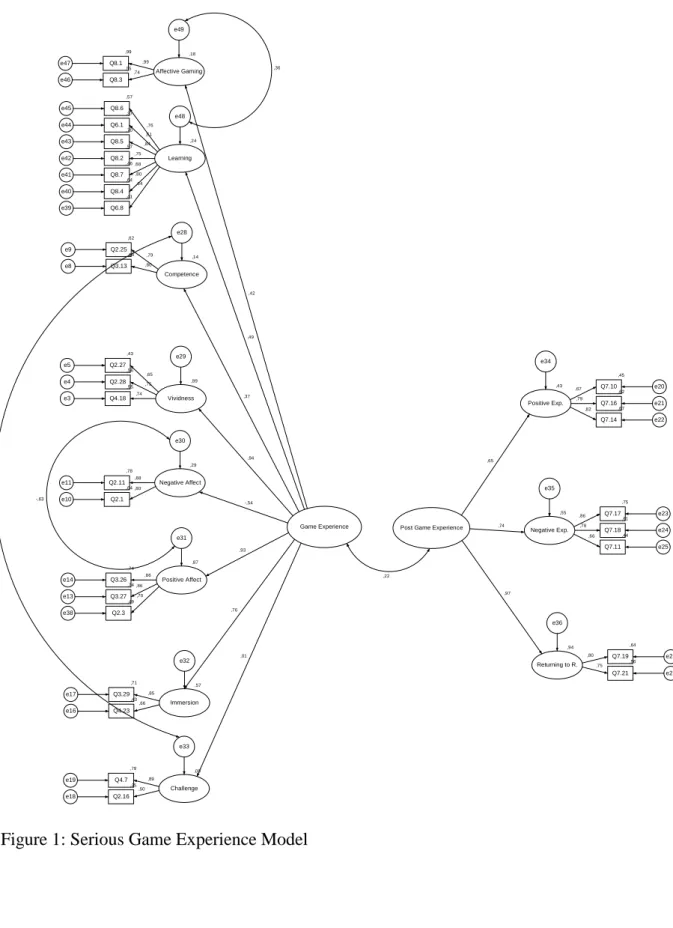
decided to adapt the GEQ and to add our own perceived learning scale. This eventually resulted in a model in which game experience is conceptualized as a second order construct with eight dimensions: Affective Gaming, (Perceived) Learning, Vividness, Competence, Immersion, Challenge, Negative Affect and Positive Affect. Due to the fact that the social presence module was not deemed fit to be used in a classroom context, it was omitted. For the post game module, we retained three dimensions: Positive Experience, Negative Experience and Returning to Reality. This Serious Game Experience model yielded an acceptable fit (N=330, χ2/df = 1.84, CFI = .93, TLI = .92, RMSEA = .050, CI90 = .045, .056) and is shown
in Figure 1. This model shows that Vividness (.94), Positive Affect (.93), and Immersion (.76) are strong predictors for Game Experience while Competence (.37) and Affective Gaming (.42) are moderate predictors. The fact that Learning has a standardized regression weight of .50 confirms our hypothesis that there is a positive effect of the game experience on perceived learning (H3). Remarkable is the fact that Game Experience has no effect
whatsoever on Challenge (.01). As for Post Game Experience, Returning to Reality (.97), Positive Effect (.65) and Negative Effect (.74) are strong predictors.
Finally, by connecting the error terms of Affective Gaming and Learning, of Competence and Challenge and of Negative Affect and Positive Affect, we wanted to examine if those constructs shared variance that was not explained by the Game Experience construct. The rationale behind this was that it could be expected, on theoretical grounds, that those constructs share other common causes for their variation. This was confirmed for Competence and Challenge (-.57), Affective Gaming and Learning (.36) and for Positive Affect and Negative Affect (-.63).
,89 Vividness ,55 Q4.18 e3 ,74 ,56 Q2.28 e4 ,75 ,43 Q2.27 e5 ,65 ,14 Competence ,64 Q3.13 e8 ,80 ,62 Q2.25 e9 ,79 ,29 Negative Affect ,64 Q2.1 e10 ,80 ,78 Q2.11 e11 ,88 ,87 Positive Affect ,74 Q3.27 e13 ,86 ,74 Q3.26 e14 ,86 ,57 Immersion ,43 Q4.23 e16 ,66 ,71 Q3.29 e17 ,85 ,00 Challenge ,25 Q2.16 e18 ,50 ,79 Q4.7 e19 ,89 Game Experience ,37 ,94 -,54 ,93 ,76 ,01
Post Game Experience
,43 Positive Exp. ,45 Q7.10 e20 ,67 ,62 Q7.16 e21 ,79 ,67 Q7.14 e22 ,82 ,55 Negative Exp. ,75 Q7.17 e23 ,86 ,61 Q7.18 e24 ,78 ,44 Q7.11 e25 ,66 ,94 Returning to R. ,64 Q7.19 e26 ,80 ,56 Q7.21 e27 ,75 ,65 ,74 ,97 e28 e29 e30 e31 e32 e33 e34 e35 e36 ,49 Q2.3 e38 ,70 ,24 Learning ,41 Q6.8 e39 ,64 ,64 Q8.4 e40 ,80 ,46 Q8.7 e41 ,68 ,57 Q8.2 e42 ,75 ,70 Q8.5 e43 ,84 ,37 Q6.1 e44 ,61 ,57 Q8.6 e45 ,76 ,18 Affective Gaming ,55 Q8.3 e46 ,74 ,99 Q8.1 e47 ,99 ,49 e48 ,42 e49 ,22 -,57 -,63 ,36
Sample Description
Testing took place from October 2009 to May 2010. In total, 50 schools were contacted of which 14 agreed to cooperate. This resulted in a total of 22 classrooms in which PING was tested. The mean age of our participants was 15 years (N = 318, S.D. = .9). As shown in Figure 2, 205 respondents were female while 122 were male. More than half (N = 202) followed General education while 138 attended Technical education (Figure 3).
205 122 0 50 100 150 200 250 female male Figure 2: Gender 202 138 0 50 100 150 200 250 General Technical
Figure 3: Level of Education
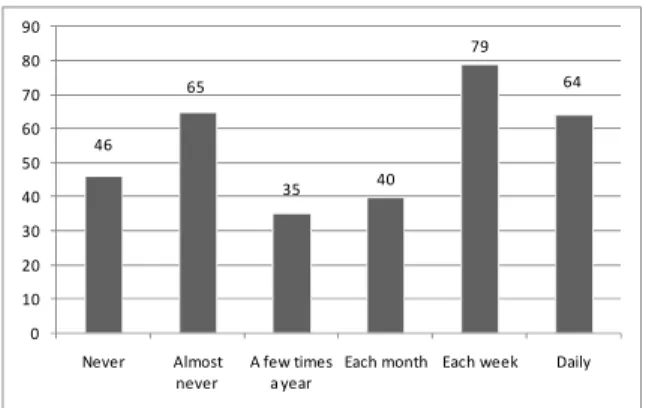
When asked about their gaming behavior, about half of the respondents (56%) indicated that they game at least once a month while 19% games on a daily basis. Less than half (44%) only seldom or never play video games.
46 65 35 40 79 64 0 10 20 30 40 50 60 70 80 90 Never Almost never A few times a year
Each month Each week Daily
Figure 4: Frequency of gaming
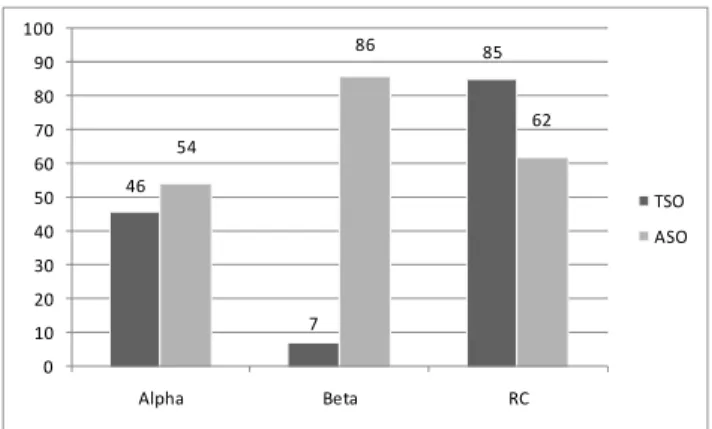
As we tested PING in its three different design stages (Alpha, Beta, Release Candidate), it is essential to have a look at how parameters such as Educational Level, Gender and
Frequency of Gaming are represented in those different stages. Figure 5 through Figure 7 show that there are some unbalanced distributions. At first sight, males are underrepresented during Alpha en Beta testing. A
χ
2 test showed that the differences in Gender were significant (p < .001). The same holds true for Educational Level (p < .000), which has a highlyunbalanced distribution in the Beta stage.
65 64 76 30 22 70 0 10 20 30 40 50 60 70 80 Alpha Beta RC female male
46 7 85 54 86 62 0 10 20 30 40 50 60 70 80 90 100 Alpha Beta RC TSO ASO
Figure 6: Comparison between design stages: educational level
To explore the differences in frequency of gaming, we used a Kruskal-Wallis test. No significant differences were found between the three design stages (p > .05).
19 21 15 24 33 33 0 5 10 15 20 25 30 35 Never Almost never A few times a year Each month
Each week Daily
Alpha Beta RC
Figure 7: Comparison between design stages: frequency of gaming
Design Stage Description
No detailed accounts exist concerning what has been changed over the different design stages of PING. An informal conversation with the game developers revealed that changes primarily pertained to the story of the game and to the navigation in the game. The Alpha stage only consisted of a rudimentary storyline while orientation in the 3D game world was a challenge as no maps were readily available. In comparison, the Release Candidate (RC) provided a fully developed story which could be finished in about 50 minutes. Navigation
was facilitated by a mini-map with GPS functionality. Similar in all design stages is the fact that PING had no sounds or music.
A major difference between the RC stage and the previous stages concerns the channel in which the game was presented. In the first two stages, the game could be played online. However, as the Beta version of the game became more dependent on the performance of IT networks, some difficulties emerged since not all schools had an adequate infrastructure. This resulted in strongly reduced playability. To cope with this problem, it was decided to use a CD-rom version of the game during the RC stage.
Global Results
Figure 8 shows the mean results regarding the game experience of PING. Overall, scores are positive. Affective Gaming (M = 4.0, SD = 1.17) has the highest mean score which implies that receiving education through a game is experienced positively. This is followed by a mean of 3.18 (S.D. = 1.00) for Positive Affect while Negative Affect only scores 1.98 (S.D. = .95). A mean of 3.03 (S.D. = 1.2) shows that most students felt competent playing the game which is confirmed by a low score for Challenge (M = 1.9, S.D. =.93). Vividness (M = 2.7, S.D. = 1.00) and Immersion (M = 2.5, S.D. = 1.10) score moderately. It is interesting to see that (Perceived) Learning has a score of 2.94 (S.D. =.81), indicating that on average, students thought this to be a positive educational experience.
In contrast to the game experience during gameplay, the post game experience
dimensions all have low scores. The reason that Returning to Reality only scores 1.45 (S.D. = .78) can probably be attributed to the fact that PING was played in a classroom context which does not support the induction of a flow state. The low score on Negative Experience (M = 1.2, S.D. =.56) is in sync with that of Negative Affect while the low score on Positive
Experience (M = 1.7, S.D. = .93) can probably be explained by the fact that the items composing this scale all referred to strong emotions.
3,03 2,66 2,54 1,90 1,89 3,18 3,99 2,94 1,72 1,23 1,45 0 1 2 3 4 5
Figure 8: Serious Game Experience of PING - means.
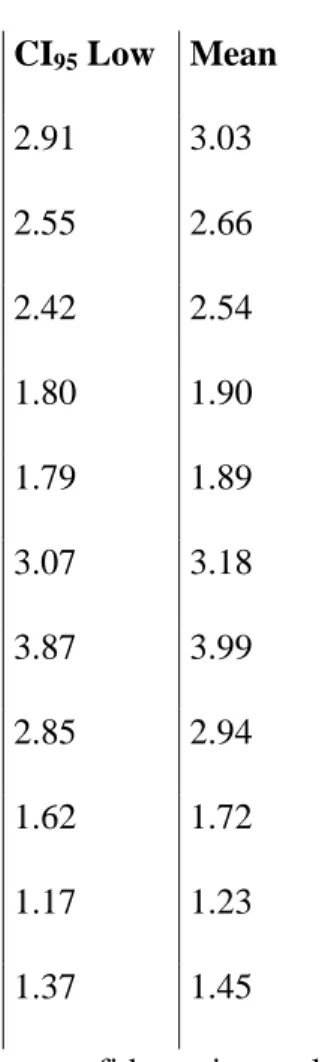
Caution is advised when judgments are to be generalized to our whole population. Figure 9 and Table 1 show all dimensions and their confidence intervals (.95). Findings discussed are to be treated with this information in mind.
0 1 2 3 4 5
CI95 Low Mean CI95 High Competence 2.91 3.03 3.16 Vividness 2.55 2.66 2.77 Immersion 2.42 2.54 2.65 Challenge 1.80 1.90 2.00 NegativeAffect 1.79 1.89 1.99 PositiveAffect 3.07 3.18 3.29 AffectiveGaming 3.87 3.99 4.12 Learning 2.85 2.94 3.02 PositiveExperience 1.62 1.72 1.82 NegativeExperience 1.17 1.23 1.29 ReturningToReality 1.37 1.45 1.54
Table 1: Mean scores - confidence intervals
Comparing the Three Design Stages
To compare how the different dimensions behaved during subsequent design stages, we analyzed the variance within groups and between groups (ANOVA). First, however, we performed a power analysis using the tool GPower3.1. Power can be described as the “probability of correctly rejecting the null hypothesis when it is false” (Hair et al., p2). In other words: the probability of finding existing differences. A power above .80 can be considered as acceptable. When using an effect size of .25 (meaning we will be able to effectively spot large and medium effects) we achieved a power of .99 which is good. Yet, with our current sample size we will not be able to spot smaller differences (effect size .10) as power is then reduced to .36.
Results indicate that, over the three design stages, only Competence (p < .005, F = 6.03, df = 335) and Challenge (p < .001, F = 5.37, df = 330) differ significantly. Post-hoc tests (Scheffe) show that these differences are to be found between the Alpha stage and the RC stage. This applies to Competence (p < .003) as well as to Challenge (p < .021). On average, Competence scores were lower during Alpha testing (M = 2.73, S.D. = .13) than during RC testing (M = 3.26, S.D. = .09) while scores for Challenge were higher for Alpha testing (M = 2.05, S.D. = .11) compared to RC testing (M = 1.72, S.D. = .07).
Learning is marginally significant (p < .065, F = 2.80, df = 329) but differences for the design stage are situated between Alpha and Beta where average Beta scores (M = 2.95, S.D. = .08) were higher than Alpha scores (M = 2.79, S.D. = .09).
Game Experience, Educational Level, Gender and Game Frequency
To explore differences in Game Experience for Educational Level, Gender and Game Frequency we took a slightly different approach than when comparing our different design stages. On theoretical grounds we decided to perform a multivariate ANOVA for Gender and Game Frequency. The rationale behind this is that game frequency and Gender are
interrelated (see e.g. Kafai, Heeter, Denner & Sun, 2008) hence interaction effects are likely to exist. The power for this test was acceptable for large and medium effect sizes (.90).
When it comes to Gender (df = 1), the game experience differs significantly for
Competence (MF = 2.78, MM = 3.43, p < .049, F = 4.50) Vividness (MF = 2.79, MM = 2.45,
p < .062, F = 3.50), Negative Affect (MF = 1.62, MM = 2.34, p < .001, F = 29.14), Positive
Affect (MF = 3.31, MM = 2.96, p < .003, F = 9.01) and Affective Gaming (MF = 4.08, MM =
3.84, p < .001, F = 7.42). Regarding the post game experience, Gender only differs
significantly for Negative Experience (MF = 1.18, MM = 1.33, p < .001, F = 5.74). As such,
Affect and Affective Gaming but lower on Competence, Negative Affect and Negative Experience.
When looking at how Game Frequency (df = 5) influences the game experience we see that Competence (p < .006, F = 3.37), Positive Affect (p < .030, F = 2.46) and Affective Gaming (p < .006, F = 3.36) differ significantly.
Finally, there is an interaction effect between Gender and Game Frequency for
Vividness (p < .011, F = 3.02, df = 5) which means that the effect of Gender on Vividness is also dependent on how frequently the respondent games. More specifically, the score on Vividness for a male gamer is not dependent on how frequently he games whereas this score is negatively influenced if the respondent is female and indicates to game ‘never’, ‘a few times a year’ or ‘each month’.
To assess the effect of Educational Level on the game experience we performed an Independent Samples t-test. Only Positive Affect (MT = 3.02, MG = 3.29, p < .021, F =
10.79, df = 252), Affective Gaming (MT = 3.80, MG = 4.11, p < .027, F = 6.39, df = 252) and
Positive Experience (MT = 1.86, MG = 1.63, p < .038, F = 6.83, df = 250) differed
significantly. Thus respondents following a General education were on average slightly more positive during gameplay and scored higher on the attitude towards learning by gaming than respondents from a Technical educational level. Remarkable is the fact that the post game Positive Experience was on average more positive for those following Technical education than for those following General education classes.
Game Experience in a Classroom Context
In total, we tested PING in 22 different classrooms. To check if our sample size was big enough to execute an ANOVA with 22 groups, we performed a power analysis. With a power of .77 our data will only be capable to reliably detect large or, to a lesser degree, medium differences.
Notwithstanding our relatively low power, Table 2 shows a considerable amount of dimensions that prove to differ significantly between classrooms (H4). Only Immersion, Positive Experience and Returning to Reality do not differ. Regrettably, we did not have enough data at our disposal to identify differences between individual classrooms.
Furthermore, classroom is a level 2 unit. By using an ANOVA we do not know whether the differences we found are related to the different compositions of the classrooms (e.g. more females in some classrooms) or if they were caused by level 2 variables (e.g. a positive group atmosphere). Dimension Sig. F df Competence*** .001 2.317 335 Vividness*** .012 1.880 330 Immersion .264 1.183 330 Challenge*** .020 1.784 330 NegativeAffect*** .000 3.428 338 PositiveAffect*** .000 2.684 335 AffectiveGaming*** .002 2.234 329 Learning*** .011 1.900 329 PositiveExperience .398 1.054 329 NegativeExperience*** .000 2.642 329 ReturningToReality .428 1.029 329 Table 2: one-way ANOVA - Classroom
Conclusion/Discussion
The testing of PING yielded some interesting results. A first remarkable outcome is the fact that there is a strong effect of the game experience on perceived learning which confirms that a positive, enjoyable game experience contributes to the experience of perceived learning (H3).
When it comes to the game experience and the different design stages, only Competence and Challenge differ significantly between the Alpha and RC stage. When we add the fact that, first of all, variation in Challenge was not explained by the game experience but shared unexplained variation with Competence (-.57, Figure 1), and secondly, that one of the two major changes during the design stages pertains to the usability of the game (navigation), some interesting assumptions can be made. On theoretical grounds, both Competence and Challenge can be connected to usability issues. Usability can be considered as a prerequisite for a good game experience but it is not equal to it. As such, it is possible that Challenge (or the way it was operationalised) is actually a measure of usability. This would explain why it failed to fit in our game experience construct. Furthermore, this could also explain some of the error variance of Competence. As such, we did not find a significant positive change in the game experience during the different design stages (H1) but we did find a significant change in the experienced usability of PING.
Although there is a positive effect of the game experience on Learning, the change is only marginally significant between the Alpha and Beta stages of the game. This significance is probably due, however, to the fact that the Beta stage had some atypical distributions. When performing a multivariate ANOVA by adding Gender or Educational Level, the difference in Learning ceases to be (marginally) significant. The fact that perceived learning does not change positively during the subsequent design stages (H2) is surprising. Especially because the storyline expanded significantly during the different design stages. Furthermore,
students were allowed to play the Beta and RC versions longer than the Alpha version which could have resulted in a better learning experience. On the other hand, this finding is not illogical if we look at our serious game experience model (Figure 1). As most of the
dimensions do not vary across different design stages, it is reasonable that learning does not vary either. More specifically, if the storyline would have changed enough, this would have been reflected in the concept of Vividness. Consequently the experience of perceived learning would have changed too. This indicates that the changes in the subsequent design stages of PING were not large enough to evoke a better learning experience.
Another interesting finding pertains to Gender. Although video games are still mostly seen as a pastime for males (which was also confirmed by our data), female students
responded more positively to PING than male respondents, despite the fact that they reported to feel less competent than their male counterparts. This can probably be explained by the fact that it concerns an educational game. During testing, male students regularly asked if they could steal a car or find some weapons. This was not observed in female students. In contrast, female students were more interested in the storyline which could in turn explain why they score significantly (marginally) higher on Vividness than male students.
Finally, it is interesting to see that there seem to exist strong differences between classrooms on most of the game experience dimensions (H4). Perhaps the most remarkable result is that, when gaming, only Immersion does not differ significantly between classrooms. A possible explanation could be that social interaction during gameplay prevents Immersion to go above a certain level while the absence of sounds or music could have been a decisive factor in stimulating social interaction. Equally intriguing is the fact that constructs such as Competence, Vividness, Challenge and Learning seem to have a collective component. With our current dataset, however, we cannot explore this further.
Several suggestions can be made regarding future research on the serious game experience in a classroom setting. Considering the pre-launch status of the game, an interesting starting point could be to use an experience measure in combination with a validated usability measure. That way, improvements in usability can be linked to game experience. Furthermore, to explain why the perceived learning experience did not differ, it could be considered to use focus groups or to use an experimental design in which the content-related variable is manipulated. Finally, as contextual factors proved to be a major point of interest, future research could benefit considerably if this were to be included. Be it in a quantitative way in a serious game experience model or in a qualitative, ethnographic way. At the very least, social interactions in the classroom should be accounted for.
References
Alavi, M. (1994). Computer-Mediated Collaborative Learning: An Empirical Evaluation. MIS Quarterly, 18(2), 159-174.
Billiet, J., Waege, H. (2005). Een Samenleving Onderzocht. Methoden van sociaal-wetenschappelijk onderzoek. Uitgeverij De Boeck nv.: Antwerpen.
Blunch, N.J. (2008). Introduction to Structural Equation Modelling using SPSS and AMOS. Sage Publications Ltd.: London.
Brockmyer, J.H., Fox, C.M., Curtiss, K.A., McBroom, E., Burkhart, K.M., Pidruzny, J.N. (2009). The Development of the Game Engagement Questionnaire: A measure of engagement in video game-playing. Journal of Experimental Social Psychology, 45, 624-634.
Buchenau, M. ,Suri, J. F. (2000). Experience prototyping. In Proceedings of the 3rd Conference on Designing interactive Systems: Processes, Practices, Methods, and Techniques. New York, USA, August 17 - 19, 2000.
Caspi, A., Blau, I. (2008). Social presence in online discussion groups: testing three
conceptions and their relations to perceived learning. Social Psychology of Education, 11, 323–346.
Choi, D.H., Kim, J., Kim, S.H. (2007). ERP Training With a Web-Based Electronic Learning System: The Flow Theory Perspective. International Journal of Human-Computer Studies, 65, 223–43.
Csíkszentmihályi, M. (1990). Flow: The psychology of optimal experience. Harper & Row: New York.
Chuang, T.Y., Chen, W.F. (2009). Effect of Computer-Based Video Games on Children: An Experimental Study. Educational Technology & Society, 12 (2), 1–10.
Federoff, M.A., (2002). Heuristics and Usability Guidelines for the Creation and Evaluation of Fun in Video Games. Master Thesis. Retrieved the 24th of April 2010 from
http://melissafederoff.com/heuristics_usability_games.html
Frick, T.W., Chadha, R., Watson, C., Wang, Y., Green, P. (2009). College student
perceptions of teaching and learning quality. Educational Technology Research and Development, 57(5), 705-720.
Fu, F-L., Su, R-C., Yu, S-C. (2009). EGameflow: A scale to measure learners’ enjoyment of e-learning games. Computers & Education, 52, 101-112.
Garris, R., Ahlers, R., Driskell, J.E. (2002). Games, motivation, and learning: A research and practice model. Simulation & Gaming, 33(4), 441-467.
Gee, J. P. (2003). What video games have to teach us about learning and literacy. New York: Palgrave Macmillian.
Glass, J., Sue, V. (2008). Student Preferences, Satisfaction, and Perceived Learning in an Online Mathematics Class. MERLOT Journal of Online Learning and Teaching,(4)3, 325-338.
Hair, J.F., Black, W.C., Babin, B.J., Anderson, R.E., Tatham, R.L. (2006). Multivariate Data Analysis (6th ed). Pearson Prentice Hall: New Jersey.
Hoffman, D. L., Novak, T.P. (1996). Marketing in Hypermedia Computer-Mediated Environments: Conceptual Foundations, Journal of Marketing, 60, 50-68.
Hoffman, D. L., Novak, T.P., Yung, Y.F. (1998), Measuring the Customer Experience in Online Environments: A Structural Modeling Approach. Working paper. Retrieved the 5th of April 2010 from
http://citeseerx.ist.psu.edu/viewdoc/download?doi=10.1.1.87.7233&rep=rep1&type=pd f
IJsselsteijn, W. A., Nap, H. H., de Kort, Y. A. W., Poels, K., Jurgelionis, A., & Bellotti, F. (2007). Characterizing and Measuring User Experiences in Digital Games. ACE Conference 2007, Salzburg, Austria.
Järvinen, A., Heliö, S., Mäyrä, F. (2002). Communication and Community in Digital
Entertainment Services. Prestudy Research Report. Retrieved the 4th of February 2010 from http://tampub.uta.fi/tup/951-44-5432-4.pdf.
Kafai, Y.B., Heeter, C., Denner, J., Sun, J.Y. (2008). Beyond Barbie and Mortal Kombat: New Perspectives on Gender and Gaming. The MIT Press.
Kember, D., Leung, D.Y.P. (2009). Development of a questionnaire for assessing students’ perceptions of the teaching and learning environment and its use in quality assurance. Learning Environments Research, 12(1), 15-29.
Kiili, K. (2005). Digital game-based learning: Towards an experiential gaming model. Internet and Higher Education, 8, 13-24.
Kirkpatrick, J.D. (1998). Evaluating Training Programs. The four levels. San Fransisco, CA: Berrett-Koehler Publishers.
Kline, R. B. (1998). Principles and Practice Of Structural Equation Modeling. New York: Guilford Press.
Koufaris, M (2002). Applying the Technology Acceptance Model and Flow Theory to Online Consumer Behavior. Information Systems Research, 13, 205–23.
McCroskey, J. C. (1994). Assessment of affect toward communication and affect toward instruction in communication. In S Morreale & M. Brooks (Eds.), SCA summer conference proceedings and prepared remarks: Assessing college student competence in speech communication. Annandale, VA: Speech Communication Association.
McCroskey, J. C., Sallinen, A., Fayer, J. M., Richmond, V. P., Barraclough, R. A. (1996). Nonverbal immediacy and cognitive learning: A cross-cultural investigation.
Communication Education, 45(3), 200-211.
Michael, D. & Chen, S. (2006). Serious games: Games that educate, train, and inform. Boston, MA.: Thomson Course Technology.
O’Neil, H.F., Wainess, R., Baker, E.L. (2005). Classification of learning outcomes: evidence from the computer games literature. The Curriculum Journal, 16(4), 455 – 474.
Pereira, L.L., Roque, L.G. (2009). Design Guidelines for Learning Games: the Living Forest Game Design Case. In Proceedings of DiGRA 2009. Breaking New Ground: Innovation in Games, Play, Practice and Theory. Brunel University, West London, United
Kingdom.
Peter, J.P. (1981). Construct Validity: A Review of Basic Issues and Marketing Practices. Journal of Marketing Research, 18(2), 133-145.
Poels, K., de Kort, Y., Ijsselsteijn, W. (2007). "It is always a lot of fun!": exploring
dimensions of digital game experience using focus group methodology. In international conference on Future Play, ACM press, pp.83-89.
Prensky, M. (2001). Digital game-based learning. New York: McGraw-Hill.
Richardson, J.C., Swan, K.S. (2003). Examining social presence in online courses in relation to students’ perceived learning and satisfaction. JALN, 7(1), 68-88.
Richmond, V.P., McCroskey, J.C., Kearny, P., & Plax, T.G. (1987). Power in the classroom VII: Linking behavior alteration techniques to cognitive learning. Communication Education, 36, 141-153.
Rovai, A.P. (2002). Sense of community, perceived cognitive learning, and persistence in asynchronous learning networks. Internet and Higher Education, 5, 319–332.
Rovai, A.P., Wighting , M.J., Baker, J.D., Grooms, L.D. (2008). Development of an instrument to measure perceived cognitive, affective, and psychomotor learning in traditional and virtual classroom higher education settings. Internet and Higher Education, 12, 7–13.
Russo, T., & Benson, S. (2005). Learning with Invisible Others: Perceptions of Online Presence and their Relationship to Cognitive and Affective Learning, Educational Technology & Society, 8 (1), 54-62.
Salen K., Zimmerman, E. (2004). Rules of Play. Game Design Fundamentals. Cambridge: MIT Press.
Shen, C., Wang, H., Ritterfield, U. (2009). Serious Games and Seriously Fun Games. In Ritterfeld, U., Cody, M. Vorderer, P. (Eds.), Serious games: Mechanisms and effects. New York: Routledge.
Shernoff, D.J., Csikszentmihalyi, M., Schneider, B., Shernoff, E.S. (2003). Student
Engagement in High School Classrooms from the Perspective of Flow Theory, School Psychology Quarterly, 18(2), 158–176.
Sisler, V., and Brom, C. (2008). Designing an Educational Game: Case Study of 'Europe 2045'. In Transactions of Edutainment I, LNCS 5080. Springer-Verlag, Berlin, 1-16. Sisler, V., Brom, C., Slavik, R. (2008). Towards a Novel Paradigm for Educational Games:
The augmented Learning Environment of ‘Europe 2045’. 12th International MindTrek Conference: Entertainment and Media in the Ubiquitous Era, Tampere, p.34-38. Susi, T., Johannesson, M., Backlund, P. (2007). Serious Games – An overview. Technical
Report HS-IKI-TR07-001. Sweden: University of Skövde.
Sweetser, P., Wyeth, P. (2005). GameFlow: a model for evaluating player enjoyment in games. Computers in Entertainment, 3(3), 1-24.
Tüzün, H. (2007). Blending video games with learning: Issues and challenges with classroom implementations in the Turkish context. British Journal of Education Technology, 38(3), 465-477.
Van Eck, R. (2006). Digital Game-Based Learning: It’s not just the digital natives who are restless. Educase Review, 41(2), 16-30.
Van Looy, J. (2010). Understanding Computer Game Culture: the Cultural Shaping of a New Medium. Lambert Academic Publishing: Saarbrücken.
Vorderer, P., Hartmann, T.,Klimmt, C. (2003). Explaining the enjoyment of playing video games: the role of competition. In: Proceedings of the 2nd IFIP International
Conference on Entertainment Computing ICEC’03. New York: ACM. Vorderer, P., Klimmt, C., Ritterfeld, U. (2004). Enjoyment: At the heart of media
entertainment. Communication Theory, 14(4), 388-408.
Wu, D., & Hiltz, S. R. (2003). Online discussions and perceived learning. Paper presented at 9th Americas Conference on Information Systems. Tampa, FL. Retrieved the 20th of April 2010 from:
http://www.alnresearch.org/Data_Files/articles/full_text/wu_Hiltz(2003).pdf
Qin, H., Rau, P.P., Salvendy, G. (2009). Measuring Player Immersion in the Computer Game Narrative. Journal of Human-Computer Interaction, 25(2), 107-133.