the Faculty of Science and Technology
43
ERIK STENMAN
Efficient Implementation of
Concurrent Programming Languages
ACTA UNIVERSITATIS UPSALIENSIS
UPPSALA 2002
the Faculty of Science and Technology
Efficient Implementation of
Concurrent Programming
Abstract
Stenman, E. 2002: Efficient Implementation of Concurrent Programming Languages, Acta Universitatis Upsaliensis.Uppsala dissertations from the Faculty of Science and
Technology 43. 150 pp. Uppsala. ISBN 91–554–5422–4.
This thesis proposes and experimentally evaluates techniques for efficient implementation of languages designed for high availability concurrent systems. This experimental evaluation has been done while developing the High Per-formance Erlang (HiPE) system, a native code compiler for SPARC and x86. The two main goals of the HiPE system are to provide efficient execution of Erlangprograms, and to provide a research vehicle for evaluating implemen-tation techniques for concurrent functional programming languages.
The focus of the thesis is the evaluation of two techniques that enable inter-process optimization through dynamic compilation. The first technique is a fast register allocator calledlinear scan, and the second is a memory architecture where processes share memory.
The main contributions of the thesis are:
• An evaluation of linear scan register allocation in a different language set-ting. In addition the performance of linear scan on the register poor x86 architecture is evaluated for the first time.
• A description of three different heap architectures (private heaps, shared heap, and a hybrid of the two), with a systematic investigation of implemen-tation aspects and an extensive discussion on the associated performance trade-offs of the heap architectures. The description is accompanied by an experimental evaluation of the private vs. the shared heap setting.
• A novel approach to optimizing a concurrent program, by merging code from a sender with code from a receiver, is presented together with other methods for reducing the overhead of context switching.
• A description of the implementation aspects of a complete and robust native codeErlangsystem, which makes it possible to test compiler optimizations on real world programs.
Erik Stenman, Department of Information Technology, Uppsala University, Box 337, SE–751 05 Uppsala, Sweden.
c
Erik Stenman 2002 ISSN 1104–2516 ISBN 91–554–5422–4
The days are all empty and the nights are Unreal.
cookie First and foremost I would like to thank my supervisor Konstantinos (Kostis) Sagonas. Without his guidance, advice, and will to help this thesis would never have been completed, or even started.
I should also note that this research has been supported in part by the ASTEC (Advanced Software Technology) competence center with matching funds by Ericsson Development.
A big compiler project like the HiPE compiler is a team effort, and I am grateful to several people for the completion of the HiPE compiler. First of all I am grateful to my original supervisor H˚akan Millroth for letting me do a Master’s thesis on compilation of Erlang, and to Thomas Lindgren for taking over the project when H˚akan left.
Much of the initial version of the HiPE system is due to my Master’s thesis partner Christer Jonsson. In the JERICO compiler he wrote the back-end and runtime system support. As we started on the HiPE compiler we switched roles and he wrote the front-end, the graph coloring register allocator, and other optimizations. Christer was a great source of inspiration, and it felt secure to have such a knowledgeable partner. Without him by my side I would probably never have undertaken such an ambitious project as the HiPE system.
Mikael Pettersson, who took over the project when Thomas Lindgren left, is also a very knowledgeable compiler hacker, and he always had an answer and could suggest a solution to any implementation problem I encountered. He is responsible for most of the runtime system support and he is the main designer of the x86 back-end.
Several others have also hacked on and around the HiPE compiler: Kostis Sagonas wrote the BEAM disassembler, and the BEAM to Icode translation. Richard Carlsson wrote help libraries such as prop-lists and
worked on the interface to the ordinary Erlang compiler. Sven-Olof Nystr¨om wrote the generalized balanced tree implementation which is the core of many data structures in the HiPE compiler.
There have also been many Master’s students and students in the Compilers-2 course hacking on the system, for example: Andreas Wallin, Thorild Sel´en, Ingemar ˚Aberg who wrote the first version of the coalesc-ing register allocator. Ulf Magnusson who worked on the x86 back-end. Christoffer Vikstr¨om, Daniel Deogun, and Jesper Bengtsson who imple-mented the SSA conversion in Icode. Per Gustafsson who impleimple-mented fast support for binaries. Tobias Lindahl who wrote the native support for floating point operations.
Last, but not least, I would like to thank Jesper Wilhelmsson who implemented most of the runtime support for the shared heap system.
We have also had much valuable help from theErlang/OTPteam
at Ericsson, and I would especially like to thank Bj¨orn Gustafsson for his patience with all my questions about the system, and for all the effort he put into making theErlang/OTPsystem support HiPE.
I have also had a lot of help in writing this thesis, and the papers it is based on, and I would again like to thank Kostis Sagonas for all the help with the writing and for helping me see what is important. I would also like to thank Sven-Olof Nystr¨om for many valuable comments on the thesis. Since much of this thesis is taken more or less straight from previously published papers some of the wordings might be those of my coauthors: Kostis Sagonas, Mikael Pettersson, Sven-Olof Nystr¨om, Jesper Wilhelmsson, and Thomas Lindgren.
I also got valuable comments on my thesis from my opponent Simon Peyton-Jones, and linguistic help from my wife Cecilia Stenman.
My friends at the department has made my time as a Ph.D student en-joyable. In the beginning Per Mildner, Christer Jonsson, Gustaf “Gaffe” Naeser, Greger Ottosson, and during the years Jakob Engblom, and Jes-per Wilhelmsson. Most valuable throughout this whole time has been my growing friendship with Richard Carlsson. He has been a great help, both as a research colleague to discuss new (and old) ideas with, and as a fun friend to reminisce about vintage home computers1 over a beer.
My time in Uppsala has been made fun by Birkarlarna, the Games-Domain gang who irregularly joined me in all night LAN-parties, and all my other friends. I am also grateful to have found my closest friend,
Fredrik Str¨om here in Uppsala. He has inspired and encouraged me since the first day of our computer science studies.
My family has always been very important to me. For always believing in me, and for buying me my first three computers, enabling me to take this path in life, I am eternally grateful to my parents.
Words are not enough to express my gratitude toward my ever loving and supporting wife who helped me through all the though times of my Ph.D. studies. Having to give up my last name was a small price to pay to get her as my wife. Thank you, Cilla!
The tools we use have a profound (and devious!) influence on our thinking habits, and, therefore, on our thinking abilities.
Edsger Dijkstra At the age of 17 I was fortunate enough to spend one year as an exchange student in the USA. This was indeed an educational year, and believe it or not, one of the most memorable experiences was related to the actual purpose of the trip: the learning of a language.
When I arrived in the States my grasp of the English language left much to desire, and my vocabulary was quite limited, but I got by. As the days went by the constant writing, reading, speaking, and listening to English finally forced me to start thinking in English. At first I was delighted, this was great, I could interact with my environment much faster when I no longer had to constantly translate every sentence into Swedish, think up a response and then translate that back to English. The joy was not long lasting though; I soon found that I had become less witted. My limited English vocabulary made it impossible to think certain thoughts; I simply lacked the words.
This taught me an important lesson about the power of language: If your language (or your grasp of it) is not up to the task, you put your intelligence and creativity at risk.
I have carried this insight with me ever since, even into the world of programming languages. Hence, I have always strived to find languages that are powerful enough to easily express the concepts at hand. To me,
Erlangwith its built in support for concurrency is such a language. In
the absence of a scientific study of the productivity in different languages I hope that my personal motivation to the importance of Erlang is
enough to rouse your interest in the efficient implementation ofErlang
and other similar languages.
This thesis is to a large extent based on the following papers.2
I. E. Johansson, S.-O. Nystr¨om. Profile-guided optimization across process boundaries. Proceedings of ACM SIGPLAN Workshop on Dynamic and Adaptive Compilation, 2000.
II. E. Johansson, M. Pettersson and K. Sagonas. A High Performance Erlang System. Proceedings of the 2nd ACM SIGPLAN Interna-tional Conference on Principles and Practice of Declarative Program-ming, 2000.
III. E. Johansson and K. Sagonas. Linear Scan Register Allocation in a High-Performance Erlang Compiler. Proceedings of the 4th International Symposium, Practical Aspects of Declarative Languages, 2002.
IV. E. Johansson, K. Sagonas, and J. Wilhelmsson. Heap Architectures for Concurrent Languages using Message Passing. Proceedings of the ACM SIGPLAN International Symposium on Memory Management, 2002.
V. M. Pettersson, K. Sagonas, and E. Johansson. The HiPE/x86 Erlang Compiler: System Description and Performance Evaluation. Sixth International Symposium on Functional and Logic Programming, 2002.
VI. E. Stenman and K. Sagonas. On Reducing Interprocess Commu-nication Overhead in Concurrent Programs. Proceedings of ACM SIGPLAN Erlang Workshop, 2002.
VII. E. Johansson, M. Pettersson, K. Sagonas, and T. Lindgren. The Devel-opment of the HiPE System: Design and Experience Report. Accepted, will appear in the Springer International Journal on Software Tools for Technology Transfer.
VIII. E. Stenman and K. Sagonas. Experimental evaluation and im-provements to linear scan register allocation. Submitted for pub-lication.
2Note that the author has changed name from Erik Johansson to Erik Stenman.
I Preface 1
1 Introduction 3
1.1 Problem statement . . . 5
1.2 Contributions of this thesis . . . 7
1.3 Thesis overview . . . 8
2 Background 11 2.1 Erlang . . . 11
2.1.1 Concurrency inErlang . . . 13
2.1.2 Memory management in Erlangand other concurrent languages . . . 14
2.1.3 Uses of Erlang . . . 16
2.2 Goals of HiPE . . . 16
2.3 A brief history of HiPE . . . 17
2.3.1 JERICO: The first prototype . . . 18
2.3.2 Compiler . . . 20
2.3.3 Calling conventions and stack frames . . . 20
2.3.4 Backpatching . . . 21
2.3.5 Performance of the JERICO compiler . . . 21
2.3.6 The HiPE system before Open Source Erlang . . . 22
2.3.7 Open source HiPE . . . 25
2.3.8 HiPE 1.0/OTP-R8 . . . 26
2.3.9 HiPE 2.0/OTP-R9 . . . 27
2.4 Some special HiPE features . . . 27
II Implementation 29 3 The compiler infrastructure 31 3.1 Phases in the compiler . . . 31
3.1.1 ToBEAMcode . . . 32 3.1.2 BEAMto Icode . . . 32 3.1.3 Icode to RTL . . . 33 3.1.4 Symbolic SPARC . . . 33 3.1.5 Symbolic IA-32 . . . 34 3.1.6 Register allocation . . . 34 3.1.7 Frame management . . . 34
3.1.8 Linearizing the code . . . 35
3.1.9 Assembling the code . . . 35
3.2 Interface issues . . . 35
3.2.1 Tailcalls . . . 36
3.2.2 Exception handling . . . 37
3.2.3 Stack descriptors . . . 38
3.2.4 Garbage collection and generational stack scanning 40 3.2.5 Mode switching . . . 40
3.2.6 Built-in functions . . . 43
3.2.7 Process switching . . . 44
3.2.8 Code loading . . . 44
3.2.9 Pattern matching implementation . . . 46
4 Register allocation 49 4.1 Global register allocation . . . 49
4.1.1 Graph coloring register allocation . . . 50
4.1.2 Iterated register coalescing . . . 50
4.1.3 Linear scan register allocation . . . 51
4.2 Implemented register allocators in HiPE . . . 53
4.2.1 Graph coloring register allocator . . . 53
4.2.2 Iterated register coalescing allocator . . . 55
4.2.3 Linear scan register allocator . . . 55
4.2.4 A na¨ıve register allocator . . . 57
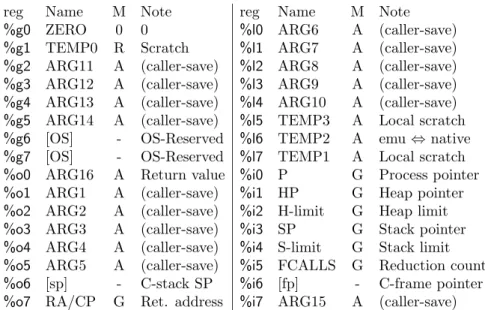
4.2.5 The SPARC back-end . . . 58
4.2.6 The x86 back-end . . . 59
4.2.7 Tweaks for linear scan on the x86 . . . 60
4.3 Related work . . . 61
4.4 Discussion . . . 62
5 Heap architectures 63 5.1 An Architecture with Private Heaps . . . 64
5.1.1 Process communication . . . 65
5.1.2 Garbage collection . . . 65
5.1.3 Pros and cons . . . 66
5.2.1 Process communication . . . 68
5.2.2 Garbage collection . . . 68
5.2.3 Pros and cons . . . 69
5.2.4 Optimizations . . . 70
5.3 Proposing A Hybrid Architecture . . . 70
5.3.1 Allocation strategy . . . 71
5.3.2 Process communication . . . 72
5.3.3 Garbage collection . . . 72
5.3.4 Pros and cons . . . 73
5.3.5 Performance of a prototype . . . 74 5.4 Related Work . . . 74 5.5 Discussion . . . 76 6 Process optimization 79 6.1 Rescheduling Send . . . 79 6.2 Direct Dispatch . . . 80 6.3 Interprocess Inlining . . . 81 6.3.1 The transformation . . . 82 6.3.2 Further considerations . . . 86 6.3.3 Return messages . . . 86
6.3.4 Experiences from a prototype . . . 87
6.4 Potential gains . . . 88
6.5 Related Work . . . 89
III Evaluation 91 7 Performance of HiPE 95 7.1 Erlang vs. other functional languages . . . 95
7.2 Comparison of Erlang implementations . . . 96
7.3 Comparison of native vs. emulated code . . . 100
7.4 Discussion . . . 101
8 Performance of register allocators 103 8.1 Benchmarks . . . 104
8.2 Compilation times . . . 106
8.3 Speed of Execution . . . 111
8.4 Spills on SPARC . . . 114
8.5 Spills on x86 . . . 116
9 A deeper look on linear scan 119 9.1 Impact of instruction ordering . . . 120
9.3 Impact of spilling heuristics . . . 123
9.4 Lifetime holes and live range splitting . . . 123
10 A comparison of heap architectures 125 10.1 The benchmarks and the setting . . . 126
10.2 A comparison of a private heap vs. a shared heap architecture . . . 127
10.2.1 Time performance . . . 127 10.2.2 Stop times . . . 130 10.2.3 Space performance . . . 131 10.2.4 Summary . . . 131 IV Conclusion 133 11 Conclusion 135 11.1 Summary of contributions . . . 135 11.2 Discussion . . . 137 11.3 Future Research . . . 137 References 141
2.1 A native stack frame in JERICO . . . 21
2.2 Backpatching when code for the functions g in the call-chainf → g→ h is reloaded. The new code callsq (not shown) instead ofh. . . 22
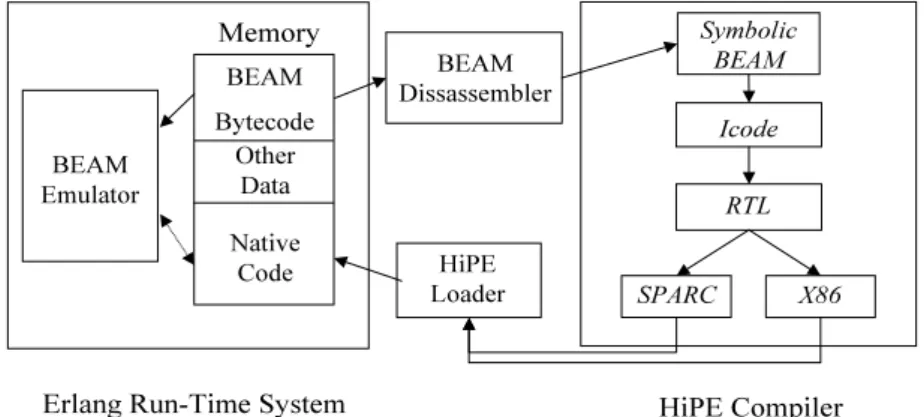
3.1 Structure of a HiPE-enabledErlang/OTP system. . . . 32
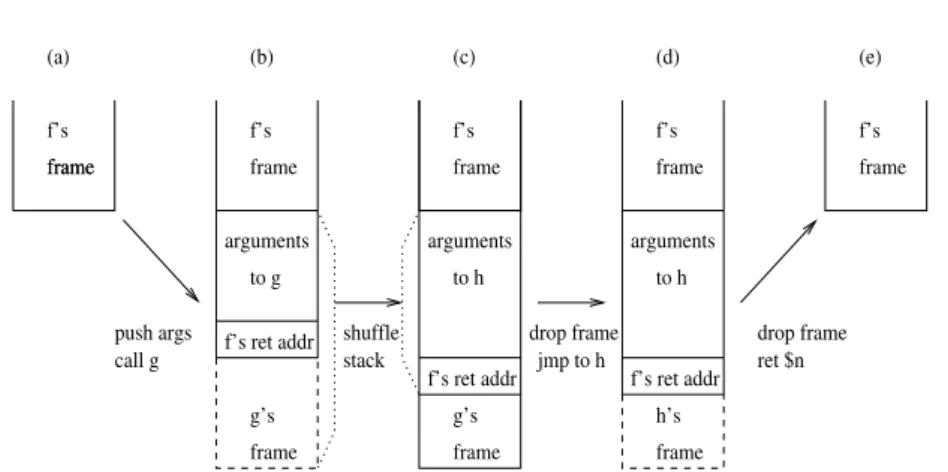
3.2 Recursive calls (f →g) and tailcalls (gtail→ h). . . 36
3.3 The Icode CFG’s for the functions g and f from Pro-gram 3.1. Note that the call tog from f is protected by an exception handler (basic block 3). . . 38
3.4 The call stack for for the functionsg/M in the call chain f /L→g/M →h/N. . . 39
3.5 A stack descriptor for a call (on SPARC) to h/0 from g/17. Note that 16 of the arguments to g/17 are passed in registers and that 1 local variable is live during the call toh/0. . . 40
3.6 Mode-switch frames created in call f →g→h. . . 42
3.7 Code backpatching done by HiPE linker. . . 45
4.1 Control-flow graph and two of its possible linearization. . 51
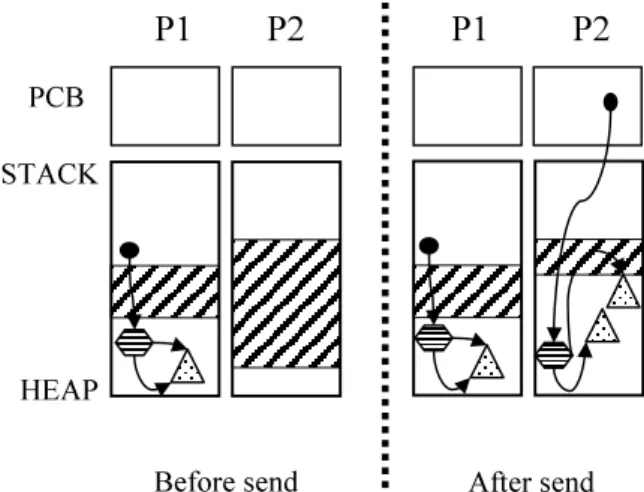
5.1 Memory architecture with private heaps. . . 64
5.2 Message passing in a private heap system. . . 65
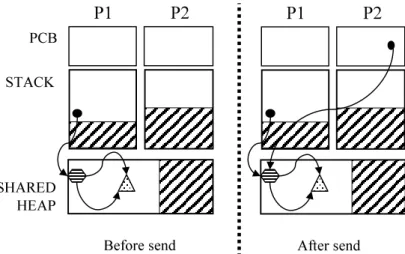
5.3 Memory architecture with shared heap. . . 68
5.4 Message passing in a shared heap system. . . 68
5.5 A hybrid memory architecture. . . 71
5.6 Message passing in a hybrid architecture. . . 72
6.1 Process merging. . . 84
8.1 Compilation times on SPARC. . . 107
8.2 Compilation times, with SSA conversion, on SPARC. . . . 108 xiii
8.3 Compilation times on x86. . . 109
8.4 Compilation times, with SSA conversion, on x86. . . 110
8.5 Execution times on SPARC. . . 112
8.6 Execution times, with SSA conversion, on SPARC. . . 112
8.7 Execution times on x86. . . 113
8.8 Execution times, with SSA conversion, on x86. . . 113
8.9 Estone ranking on SPARC and x86. . . 114
8.10 Estone ranking on SPARC and x86 with SSA conversion. 114 9.1 A simple control flow graph. . . 120
9.2 A control-flow graph and its orderings. . . 121
10.1 Normalized times for theprocs benchmark. . . 128
10.2 Normalized execution times. . . 129
4.1 Use of SPARC registers in HiPE. . . 58 4.2 Use of x86 registers in HiPE. . . 60 7.1 Performance of functional languages on three recursive
programs and one concurrent. Execution times in seconds. 96 7.2 Times (in seconds) for sequential benchmarks in different
Erlang implementations. . . 98 7.3 Speedup of different Erlang implementations compared to
JAM. . . 98 7.4 Times (in seconds) and speedup over JAM for concurrent
benchmarks in different Erlang implementations. . . 99 7.5 Times (in seconds) and speedup over JAM for larger
bench-marks in different Erlang implementations. . . 99 7.6 Speedup of HiPE-1.0 over BEAM R8. . . 101 8.1 Description of benchmark programs. . . 105 8.2 Sizes of benchmark programs. . . 106 8.3 Number of spilled temporaries and SPARC instructions
after allocation. . . 115 8.4 Number of spilled temporaries and SPARC instructions
after allocation (with SSA). . . 115 8.5 Number of spilled temporaries and x86 instructions after
allocation. . . 116 8.6 Number of spilled temporaries and x86 instructions after
allocation (with SSA). . . 117 9.1 Number of spilled temporaries using different basic block
orderings. . . 121 9.2 Number of spilled temporaries using different basic block
orderings (with SSA). . . 121 9.3 Impact of spilling heuristics . . . 123
10.1 Number of processes and messages. . . 127 10.2 Heap sizes allocated and used (in 1,000 words). . . 131
Preface
Introduction
Obviously, the median language has enormous momentum. I’m not proposing that you can fight this powerful force. What I’m propos-ing is exactly the opposite: that, like a practitioner of Aikido, you can use it against your opponents.
Paul Graham This thesis proposes and experimentally evaluates techniques for efficient implementation of languages designed for high availability concurrent systems.
A concurrent system is a system that is designed as a collection of independent processes. From the view of the designer these processes are performing their tasks simultaneously, but in reality their execu-tion might be interleaved on a single processor. We distinguish between concurrent processes, i.e., processes that conceptually are executing si-multaneously, and parallel processes, i.e., processes that in reality are executing simultaneously on, e.g., a multiprocessor machine.
Many systems lend themselves naturally to a concurrent implemen-tation, notably interactive systems in which external events dictate the execution order, and distributed systems where tasks are executed in parallel on different nodes. The concept of processes is also important as an abstraction. A process encapsulates state in a natural way; in this respect processes resemble objects in an object-oriented language. It is hence not surprising that in recent years, concurrency as a form of ab-straction has become increasingly popular, and many modern program-ming languages (such as Occam [62], CML [78], Oz [90], Erlang [10],
Java [39], and C#) come with some form of built-in support for con-current processes (or threads). Many of these languages belong to the category that we will callconcurrent functional programming languages
(CFPL). A CFPL is a functional programming language with built-in support for concurrency.
One application area, with requirements that lend themselves nat-urally to the use of a concurrent functional programming language, is
that of the tele-communications (telecom) industry. Most modern sys-tems provided by the telecom industry, such as telephone exchanges, Internet servers, and routers, have very high availability requirements. Usually, these systems require ”five nines availability”, that is 99.999% uptime. Or put another way: less than five minutes downtime per year, including all planned stops for maintenance and updates. Another char-acteristic of these systems is that it is often natural to model them as a large set of concurrent tasks or subsystems. The competitiveness of the telecom industry also demands short development times. Since large parts of these systems are implemented in software, the telecom industry has a need for software development environments that can support the fast development of highly concurrent, fault-tolerant systems. Another requirement of telecom systems is that they are supposed to run virtu-ally forever. This is far from the kind of web-applications that one writes in e.g., Java, which executes for a few minutes or hours at most. It is also far from usual user level programs such as one would build with, e.g., Microsoft Visual studio and run under Windows. Nobody expects these systems to execute continuously for 10-20 years. The lifetime of a backbone telephone exchange, on the other hand, has these kinds of requirements.
Few software development tools claim to cater for such extreme re-quirements. But the Open Telecom Platform (OTP) provided by Eric-sson is such a tool and it has proved itself in several telecom projects during the last ten years. The core technology of OTP is the concurrent functional programming languageErlang.
It is important that the runtime performance of applications devel-oped inErlangis as good as possible. Faster execution can directly be
turned into the ability to handle more users, calls, connections, requests, etc, or the ability to handle the same number of users with cheaper hard-ware. Also, if the performance of theErlang system is too low or
cer-tain language features give suboptimal performance, the developer will be tempted to use unnatural abstractions in order to achieve acceptable performance.
Therefore, we believe that it is important to find generally applicable implementation techniques for concurrent functional programming lan-guages that ensure high runtime performance. To tackle this problem we have started the HiPE (High Perfomance Erlang) project.
The main contribution of the HiPE project is the HiPE system with a native codeErlangcompiler for SPARC and x86. Our main goal with
the HiPE system is to provide the most efficient execution of Erlang
vehicle that can be used to evaluate implementation techniques for con-current functional programming languages. We have tried to make a well structured, open, and modular system which allows a programming language implementor toplug and play parts of the system, in order to evaluate different implementations of one component while keeping the rest of the system unchanged.
We believe that the nature of distributed interactive systems makes the use of static analysis sub-optimal. These systems have a huge code base and are developed in modular units making whole program static analysis problematic. As mentioned, these systems have to cater for code updates in a running system, which complicates the implementation of a static analysis and optimization scheme. And finally, these systems are very dynamic in nature, making a one-time static analysis imprecise. Instead of using static analyses we suggest that some optimization of such systems should be profile-guided and performed dynamically (done at runtime). With the HiPE system we hope to create a runtime system forErlangthat has the ability to reconfigure and re-optimize itself in a
running system without forcing the system to go offline. For example, a fast compiler, which spends little time on register allocation, can be used in just-in-time compilers and for systems with dynamic recompilation. This opens up new opportunities for optimization and can ultimately lead to faster execution compared to a system that compiles the program only once, even if this compiler produces an optimal register allocation. To achieve the most efficient execution of Erlangprograms we need
to find out which parts of theErlangsystem need to be improved and
how the execution of Erlang programs can be optimized. Then we
need to find techniques to implement these optimizations, and finally we need to tune the implementation of these techniques so that they can be applied at runtime without disturbing the execution of the application. In this thesis several techniques to achieve efficient execution of con-current functional programming languages are studied. Even though the focus of the thesis is on the applicability of these techniques toErlang,
we stress that they are applicable to other programming languages and systems as well.
1.1 PROBLEM STATEMENT
As stated previously, the goal of this thesis is to find and evaluate effi-cient implementation techniques for CFPLs through profile-guided dy-namic recompilation. Dydy-namic recompilation requires a fast compiler, so we have studied register allocation since this part of the compiler often is a compilation time bottleneck. In order to make inter-process
communication more efficient we would like to have access to shared memory, and therefore we study the impact of shared heap architectures. With a fast compiler and shared memory new process optimization tech-niques can be developed. Hence, this thesis mainly focuses on three sub-problems, 1) register allocation, 2) heap architectures supporting communication through message passing, and 3) process optimization, but it also presents some general insights on the development of pro-gramming language systems. Let us look at these three problems in a little more detail.
Register allocation The fastest memory locations in modern com-puters are the registers. Unfortunately the number of registers is limited, hence it is important to use them as efficiently as possible. The register allocator is the part of a compiler responsible for finding an effective use of registers. This is one of the hardest and most central problems to a compiler and extensive research has been conducted in this area.
We study three different register allocators and compare their per-formance to each other and against a na¨ıve allocator, which keeps all temporaries on the stack. Two of the allocators are variants of the allocation technique we suspect is the most commonly used technique in modern compilers, namely graph coloring. The third, relatively new technique, called linear scan, is designed with fast compilation times in mind, and hence is well suited for just-in-time compilation.
A somewhat surprising result of this comparison is that even though the impact on performance of register allocation compared to the na¨ıve approach is significant, when comparing the three allocators with each other their performances are similar.
We extend previous research done on linear scan register allocation by applying it to a new problem area, namely just-in-time compilation of functional programming languages. We show that linear scan performs well even though the underlying implementation requires a relatively large number of precolored registers. We also provide the first applica-tion of linear scan to a register poor architecture such as x86, and show that it performs reasonably well in that context too.
Finally, we also evaluate several variants to the algorithm to find the most efficient implementation.
Heap architectures A key issue in the design of a concurrent lan-guage implementation is the memory architecture of the runtime system. There exist many different ways of structuring the architecture of the runtime system, each having its pros and cons.
We present three memory architectures for high-level programming languages that implement concurrency through message passing.1 The
three architectures are 1) a private heap system, in which each process has its own private memory, 2) a shared heap system in which all pro-cesses share the memory in one common heap, and 3) a hybrid system with private heaps for private data and a shared heap for messages.
We systematically investigate aspects that influence the choice be-tween them, and extensively discuss the associated performance trade-offs. Moreover, in an implementation setting where the rest of the run-time system is unchanged, we present a detailed experimental compari-son between two of these architectures both on large highly concurrent programs and on synthetic benchmarks.
Process optimization The use of concurrency often hides parts of the data flow from the compiler. This makes many of the common compiler optimizations of today hard or even impossible in the case of inter-process communication, in the same way as the use of procedures limits the optimizations in compilers that does not employ inter-procedural optimizations.
As stated, the dynamic nature of the applications we are investigat-ing makes static analysis hard and imprecise. Hence, we propose the use of profiling to determine the inter-process data flow in an application. The collected information can then be used to optimize the code by for example complete or partial process merging. We present a method for partial process merging where the code sending a message is merged with the code that will receive the message.
1.2 CONTRIBUTIONS OF THIS THESIS
To summarize the contributions of this thesis by area, they are: • Register allocation
– A thorough evaluation of linear scan register allocation in a setting different from the imperative one that it has been applied to previously.
– A comparison of linear scan with three other register alloca-tors.
– The first evaluation of the performance of linear scan on the register poor x86 architecture.
1Even languages, such as Java, that implement process communications through
shared structures can use these three architectures, but the trade-offs for such a language are different than for a language that uses message passing.
– An evaluation of the effect of options to the basic algorithm. • Heap architectures
– A description of three different heap architectures (private heaps, shared heaps, and a hybrid of the two) with a system-atic investigation of implementation aspects.
– An extensive discussion on the associated performance trade-offs of each of the three heap architectures.
– An experimental evaluation of the two extreme architectures on both real world programs and artificial benchmarks, per-formed in an otherwise unchanged runtime system.
• Process optimization
– A novel approach to optimizing a concurrent program by merging code from a sender with code from the corresponding receiver.
– Methods for reducing the overhead of context switching. • System development
– A description of the implementation aspects of a complete and robust native codeErlangsystem that makes it possible
to test compiler optimizations on real world programs. – Proofs of the usefulness of this system as a research vehicle
by using the system to evaluate register allocation strategies and different heap architectures.
1.3 THESIS OVERVIEW
The thesis is divided into four parts, Preface, Implementation, Evalua-tion, and Conclusion. In the rest of this first part some background ma-terial is covered: the language Erlang, the goals of the HiPE project,
and the history of developing the HiPE compiler. The section on the history of HiPE, Section 2.3, also contains some implementation details of versions prior to the current one.
Part II begins with a chapter describing the current implementation of HiPE, Chapter 3.
This is followed by a description of register allocators in HiPE, Chap-ter 4, a presentation of different heap architectures in ChapChap-ter 5, and a presentation of process optimization strategies in Chapter 6.
In Part III, the performance of the HiPE compiler, the register allo-cators, and the heap architectures are evaluated through benchmarking.
In the final part of the thesis directions for future work are presented, some conclusions are drawn and the thesis is summarized.
The thesis covers many different areas and there is no specific chapter on related work; instead discussions of related work appear throughout the thesis as appropriate.
Background
Rem tene, verba sequentor.
Cato In this chapter we present background material needed for the under-standing of the main parts of the thesis. This chapter is divided into four sections: “Erlang” (Section 2.1), “Goals of HiPE” (Section 2.2), “A brief history of HiPE” (Section 2.3), and “Some special HiPE features” (Section 2.4).
In the first section, beside presenting aspects of the Erlang
lan-guage that influence the HiPE implementation, we also present related work on memory architectures for concurrent languages (Section 2.1.2). In the second section we present the goals of the HiPE project and the HiPE compiler, laying down the philosophy that has guided us through the implementation. Then in Section 2.3 we present the history of the HiPE project; most of this section sets the background for the current implementation. This section also presents some interesting aspects of the HiPE compiler, such as the ability to compile one function at the time (Section 2.3.2) and the use of backpatching to facilitate hot-code loading (Section 2.3.4). The last section presents some additional fea-tures in the HiPE system that makes it possible to instrument, pro-file, and measure different aspects of both the runtime system and of
Erlangapplications.
2.1 ERLANG
Erlang1 is a dynamically typed, strict, concurrent, higher-order
func-tional language. The language started out as an experimental implemen-tation, which has grown into an industrial implementation. There is no formal definition of the language, but the basic features of Erlangare
described in the so called “Erlang book” (“Concurrent programming
inErlang” [10]). Many new features have been added to the language
since that book was written, and hence the language is primarily defined by the latest implementation from Ericsson. In this section we will de-scribe the parts of the language that are needed for the understanding of the rest of the thesis. (We will try to describe the implementation independent aspects of Erlang, but since there is no formal definition
and in principle only one defining implementation, we will also describe some aspects that can be contributed as aspects of the implementation.)
Erlang’s basic data types are atoms, numbers (floats and
arbi-trary precision integers), process identifiers (or PIDs), references, and
binaries (byte arrays). These data types can be combined into the com-pound data types lists and tuples. There is no destructive assignment of variables or data, and the first occurrence of a variable is its bind-ing instance. Function rule selection is done with pattern matchbind-ing.
Erlang inherits some ideas from concurrent constraint logic
program-ming languages [83], such as the restriction to flat guards in function clauses.
For programming in-the-large,Erlangcomes with amodulesystem.
An Erlang module defines a number of functions. Only explicitly
ex-ported functions may be called from other modules. Calls to functions in different modules, calledremote calls, are done by supplying the name of the module of the called function. Tailcall optimization is a required feature of Erlang. As in other functional languages, memory
manage-ment in Erlang is the responsibility of the runtime system. Erlang
provides a catch/throw-style exception mechanism for error handling, any runtime error such as a type error or a division by zero will result in an exception that can be caught by a catch. A simple tail-recursive
Erlang program for calculating the length of a list might look like
Program 2.1.
Erlang programs execute within an Erlang node. Several
pro-cesses can execute concurrently on oneErlangnode, and several nodes
can be connected in a distributed network.
As mentioned, Erlangis used in “five nines” high-availability (i.e.,
99.999% of the time available) systems, where downtime is required to be less than five minutes per year. Such systems cannot be taken down, up-graded, and restarted when software patches and upgrades arrive, since that would not respect the availability requirement. The applications built withErlangare often intended to execute continuously for years
without exhausting resources, crashing or stopping for any other reason. To perform system upgrading while allowing continuous operation, anErlangsystem needs to cater for the ability to change the code of a
Program 2.1A program for calculating the length of a list.
-module(length). %% Defines the name of the module. -export([length/1]). %% Exports the function length. %% Returns the number of elements in the list List.
length(List) -> %% Note, variables start with a capital. length(List,0).
%% It is OK to define several functions with the same %% name as long as their arity differ.
%% The length of the empty list ([]) is 0. length([],N) -> 0;
%% The length of [_|Rest] is the length(Rest) + 1. length([_|Rest],N) ->
length(Rest,N+1).
that execute old code can continue to run, but are expected to eventually switch to the new version of the module by issuing a remote call (which will always invoke the most recent version of that module). Once the old code is no longer in use, the old module can be unloaded.
The Erlang language was purposely designed to be small, but it
comes with a large set of built-in functions (known as BIFs) and a big standard library. With the Open Telecom Platform (OTP) mid-dleware [88], Erlang is further extended with a library of standard
solutions to common requirements in telecommunication applications (distributed real-time databases, servers, state machines, process moni-tors, load balancing), standard interfaces (CORBA), and standard com-munication protocols (e.g., HTTP, FTP).
2.1.1 Concurrency in Erlang
Erlang is by some called an actor language [3], since the
concur-rency is supplied through autonomous processes that communicate asyn-chronously through message passing.
Processes inErlang are extremely light-weight, much lighter than
OS or Java threads [42]. It is not uncommon to have thousands of
Erlang processes running on each Erlang node. The memory
re-quirements of Erlangprocesses may vary dynamically during runtime. Erlang’s concurrency primitives — spawn, “!” (send), and
re-ceive — allow a process to create new processes and communicate with other processes through asynchronous message passing. That is, the send operation is non-blocking, but the receive is blocking. Note though that Erlang provides a mechanism for allowing a process to timeout
while waiting for messages. (This makes it possible to implement a non-blocking receive by supplying a timeout of zero.)
Any data value can be sent as a message and processes may be located on anyErlangnode, i.e., any machine in anErlangnetwork.
Distribution is hence almost invisible in Erlang. Each process has a
mailbox, essentially a message queue, where each message sent to the process will arrive. Message selection from the mailbox occurs through pattern matching. There is no shared memory between processes, or from a different perspective, since there are no destructive updates in
Erlangany sharing can never be observed.
One important feature of Erlangused to support robust systems, is
process linking, that is, a process can register to receive a message when another process terminates. It is not necessarily the father (the spawning process) that receives this message and processes can be mutually linked. This makes it easy to create supervising process structures that can restart crashing processes.
In the current implementation, processes are handled by the runtime systemscheduler, which selects anErlangprocess from a ready queue.
The process is assigned a number of reductions to execute, called the
time-slice of the process. Each time the process does a function call a reduction is consumed. The process is suspended when the time-slice is used up (i.e., the number of remaining reductions reaches zero), or when the process reaches a receive and there are no matching messages in its mailbox.
In the HiPE system, the scheduler is implemented in C as a function that can be called either by the BEAMemulator or directly from native compiled code. The scheduler takes as arguments the process that has been running and the number of executed reduction steps, and returns the next process to execute.
Processes inErlangare not garbage collectedErlangobjects
(al-though the process identifiers are recycled). They can keep on living even though no other process has access to them. Instead a process will live as long as it has code to execute. The runtime system keeps information about a process in a process control block or PCB. When a process dies, its PCB is deallocated.
2.1.2 Memory management in Erlang and other concurrent languages
As in other functional languages, memory management in Erlang is
a responsibility of the runtime system and happens through garbage collection.
Note that since there are no destructive updates, the heap in an
Erlang system is unidirectional, i.e., there are no circular structures
and all pointers on the heap always point toward older objects.
The soft real-time concerns ofErlangcall for bounded time garbage
collection techniques [91, 54]. Armstrong and Virding propose such a technique in [9]. This technique, based on a mark-and-sweep algorithm, takes advantage of the unidirectionality of the heap but imposes a sig-nificant overhead and was never fully implemented. In practice, in a tuned Erlang system with a generational copying garbage collector,
garbage collection latency is usually low (less than 10 milliseconds) as most processes are short-lived or small in size. Longer pauses are quite infrequent. However, a blocking collector provides no guarantees for real-time responsiveness.
In the current implementation all Erlangterms are tagged and at
each garbage collection all roots are known allowing the system to do
precise garbage collection. That means that the collector knows the type of each term and does not need to be conservative [54].
In the context of strict, concurrent functional language implementa-tions, there has been work that aims at achieving low garbage collection latency without paying the full price in performance that a guaranteed real-time garbage collector usually requires.
Notable among them is the work of Doligez and Leroy [31] who com-bine a fast, asynchronous copying collector for the thread-specific young generations with a non-disruptive concurrent mark-and-sweep collector for the old generation (which is shared among all threads). The result is a quasi-real-time collector for Concurrent Caml Light.
Also, Larose and Feeley in [35] describe the design of a near-real-time compacting collector in the context of the Gambit-C Scheme compiler. This garbage collector was intended to be used in the Erlang to Scheme (Etos) system, but to the best of our knowledge, it has not yet made it to an Etos distribution.
To achieve low garbage collection pause times, concurrent or real-time multiprocessor collectors have also been proposed; both for (con-current) variants of ML [47, 67, 24], and recently for Java [12, 46].
An issue which is to a large extent orthogonal to the choice of garbage collection technique is the memory organization of a concurrent system: Should one use an architecture which facilitates sharing, or one that requires copying of data? The issue often attracts heated debates both in
the programming language implementation community and elsewhere.2 We will investigate this issue further in Chapter 5.
Until the fall of 2001, the Ericsson Erlang implementation had
exclusively a private heap architecture, that is a memory architecture where each process allocates and manages its own memory area. We describe this architecture in Section 5.1. The main reason why this architecture was chosen is that it is believed it results in lower garbage collection latency. As we wanted to investigate the validity of this belief, we have designed and implemented a shared heap memory architecture for Erlang processes. We describe this architecture in Section 5.2; it
is already included in theErlang/OTP release.
2.1.3 Uses of Erlang
Erlangis currently used industrially both by Ericsson Telecom and by
other companies for the development of high-availability servers and networking equipment. Some examples of products built using the
Erlang/OTP system are: AXD/301, a scalable ATM switching
sys-tem [17], ANx, an ADSL delivery syssys-tem [68], a switching hardware control system, a next-generation call center, and a suite of scalable Internet servers. Since 1994, the annual Erlang User Conference is
the principal forum for reporting work done in Erlang and provides
a record of Erlang’s evolving industrial use; additional information
aboutErlangapplications can be obtained through the relevant pages
atwww.erlang.org. 2.2 GOALS OF HIPE
The main goal of the HiPE project is to find generally applicable tech-niques for efficient implementations of concurrent programming lan-guages. Another goal is to provide transfer of technology from academia to industry by providing techniques, which are the result of academic research, in an industrial language implementation. As a means to that end we are developing the HiPE compiler and runtime system.
To use this system to evaluate new ideas and techniques the system has to be complete, so that real world programs can be used in the evaluation. It also has to be efficient so that the aspects we want to evaluate are not shadowed by the rest of the implementation. Finally it
2For example, in the networking community an issue which is related to those
discussed in this thesis is whether packets will be passed up and down the stack by reference or by copying [4]. Also, during the mid-80’s the issue of whether files can be passed in shared memory was investigated by the operating systems community in the context of user-level kernel extensions, for example in the Mach Operating System [94].
has to be robust and bug free so that we know that we are measuring the correct behavior.
Even though our aim is to find techniques that are applicable to any programming language and useful for the development of any applica-tion, we are concentrating our efforts on the runtime performance of
Erlang and the type of applications primarily developed inErlang,
namely large control systems.
The typicalErlangapplication is very dynamic in nature and hence
very hard to analyze statically with good precision. We believe that such applications could benefit from profile-driven just-in-time compilation; hence it is important that the compilation times are kept low. Another characteristic of control applications is that they often consist of a huge code base out of which a large chunk is the code for operation and maintenance, which is not time critical. For this reason we feel that it is important to have both a compact code format combined with efficient, but larger, native code. We achieve this by allowing very small compilation units when compiling to native code; the user can for each function decide whether it should be emulated or in native code.
To reach these goals in a reasonable time and to ensure that the outcome is industrially relevant, we have based our implementation on theErlangsystem provided by Ericsson. This is an industrial strength
system that has been under constant development by a team of engineers at Ericsson for more than 10 years.
Our top-level goals have resulted in three somewhat contradictory requirements on the HiPE compiler: 1) The system should be open and modular in order to let us plug-and-play parts of the system to evaluate different implementation techniques. 2) The compilation times should be kept low in order to allow for dynamic compilation. 3) The system should be complete in order to allow us to use real programs.
The first requirement has led to a layered solution with several in-termediate codes in the compiler; these will be described in Chapter 3. The second requirement has led us to examine techniques such as linear scan register allocation described in Chapter 4. This requirement is also one of the motivations for allowing the compilation of single functions. By reducing the scope of compilation the compilation times can be re-duced. The third requirement has led to a rather long and thorough development of the system, as described in the next section.
2.3 A BRIEF HISTORY OF HiPE
In this section we will describe the history of HiPE, while briefly address-ing some implementation details and the rationale behind some design
decisions we took. We divide the description into five parts, correspond-ing to the five major revisions of the HiPE system:
1. A first attempt, written in C, gave some insight on how to ad-dress the problem of efficiently implementingErlangand showed
that considerable speedup could be achieved using relatively sim-ple methods.
2. A flexible and more easily extensible compiler design, mostly writ-ten inErlang, made it possible to experiment with different
op-timization techniques and measure their impact on some “real-world” applications of Erlang.
3. An Open Source Erlang distribution from Ericsson made it possible for HiPE to be publicly released, get some users and input from the outside world.
4. A strong coupling of the HiPE compiler with the Erlang/OTP
system resulted in HiPE becoming a standard component in Open Source Erlang.
5. Testing, cleanup, and “productification”; aiming at making HiPE a supported component in the commercial version ofErlang/OTP.
2.3.1 JERICO: The first prototype
The starting point of the HiPE system was a Master’s thesis project in the summer of 1996 [49]. The goal was to develop an optimizing com-piler, calledJERICO, that would substantially improve the performance of Erlangprograms.
One approach that was briefly considered was to use the Java Virtual Machine (JVM [60]) as a back-end — this was at the time when Java was just starting to become a popular language. It was soon realized that the architecture of the JVM is not well-suited for a dynamically typed language such as Erlang. The JVM provides no support for
tagged data items, so for example integers have to be wrapped, and it is awkward to get proper tail-recursion, which is a required feature of
Erlang. In addition, compiling to JVM implies losing control over the
efficiency of light-weight threads; a feature critical for the performance of typicalErlangapplications; see also [42] which compares the
perfor-mance of Erlang processes and Java threads. Consequently, the idea
to compile to JVM was quickly abandoned and instead we decided to aim for a direct compilation to native code. The chosen architecture was SPARC V8; according to Ericsson this was the most common general purpose platform forErlang applications at the time.
We decided to implement our own back-end for several reasons. First and foremost we wanted a system with support for on-the-fly compila-tion; a system able to assemble, link, and load the compiled code directly into a running system, without having to rely on any external programs. Also since we need to support backpatching (Section 2.3.4) to allow hot-code loading we needed fine grained control over the object hot-code format. A smaller but similar problem is the handling of atoms in the code. Since atom values are only known at load time the loader has to be able to in-stantiate these values. Having fine grained control would also allows us to do more advanced switching on atoms as described in Section 3.2.9.
Even if we would have liked to use some standard tool for producing dynamically linked libraries the choices were not that many. Using C as a portable assembler would have been possible. We did not want to try it though since it is very hard to get full and efficient support for tail-recursion in C. And to also make it work together with emulated code, hot-code loading, and garbage collection would be a nightmare. Another possibility would have been to use ML-RISC [37]. To support backpatch-ing, precise garbage collection, and stack maps (Section 3.2.3) we would not have been able to use it out of the box without hacking the ML-RISC implementation. A back-end solution that nowadays looks promising is C-- [56]. The intention of C--is to be a portable assembler to be used by compiler back-ends, and it is intended to supply everything needed to handle both garbage collection and concurrency [77]. Unfortunately C-- did not exist at the time when we started the project.
Since the goal was to develop a compiler that worked for the complete
Erlanglanguage and not just a toy compiler for a subset of Erlang,
we decided to base our compiler on the stable and working Erlang run-time system made by Ericsson. At that run-time there were two Erlang
systems concurrently being developed at Ericsson:
JAM The older system with a stack-based abstract machine.
BEAM A relatively new system based on a register abstract machine, influenced by the Warren Abstract Machine (WAM) [92] used in many Prolog implementations. At that time, the BEAM system had an option to compile Erlang programs to native code via
C [43]; this option was not very robust and was later removed. Both systems used the same runtime system and similar data repre-sentations [40]. The BEAM system was quite complex and not really stable. Also, at that time, BEAM had not proven itself substantially faster than JAM. The JAM system on the other hand was quite stable and significantly simpler. For example, there where much less than 256
different byte-code instructions in the JAM, while the BEAM had over 400 different instructions. We decided that this would be a good starting point for our compiler: we could translate the generatedJAMbyte-code into an internal intermediate representation and then optimize it before generating native code.
2.3.2 Compiler
In the Ericsson implementations of Erlang, the smallest unit of
compi-lation is a module, but we decided early on that the user or the system should be able to choose to selectively compile a single—presumably time-critical—function at a time to native code. This way, the com-pact representation of emulated byte-code with the efficiency of (usually larger) native code can be combined. This feature is potentially very important for large telecom applications, where typically only a small portion of the code is time-critical while the remaining code deals with error correction and maintenance.
The translation fromJAMcode to the compiler’s intermediate three-address code was done in a straightforward way and left some oppor-tunities for optimization. For example, since JAMwas a stack machine there would be a push each time a variable was referenced. This push would be translated to a register copy which would often be unneces-sary. To improve code quality, the JERICO compiler performed constant propagation, constant folding, unreachable code elimination, and dead code removal [5, 66]. A simple delay slot filler which only looked in the basic block preceding the branch for suitable instructions was also implemented. Register allocation was based on a simple graph coloring algorithm.
2.3.3 Calling conventions and stack frames
The JAM instruction set is simple and the instructions contain no in-formation about the current frame size. Instead several JAM-machine registers were used to keep track of the location of local variables, ar-guments, and the stack top. All these pointers had to be saved on the stack at function calls. The native code on the other hand passed the first five arguments in real machine registers. Apart from local variables, only the return address was saved on the stack. The format of a native stack frame is shown in Figure 2.1.
The JERICO runtime system used the same memory area for the native and theJAM stacks, stacking native frames and JAM frames on top of each other. Small “dummy” frames were placed between frames of different types to indicate a transition between emulated and native
Argument 6 M Argument N return address CallerSave 1 M CallerSave M SP
Figure 2.1: A native stack frame in JERICO
code. Most bugs we encountered originated from the emulated/native-code integration and the rather hairy stack we ended up with. This scheme was later abandoned.
2.3.4 Backpatching
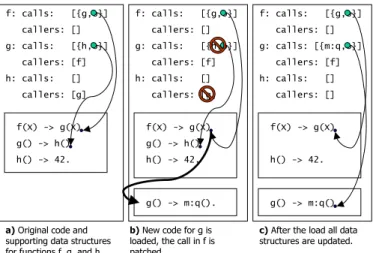
To facilitatehot-code loading and recompilation in an interactive system we implemented a scheme where call sites were patched when the target of the call was updated. For each function, we kept a list of all call sites in the function and their destinations, and another list of all the callers to the functions. In Figure 2.2a these lists are shown for three functions
f, g, andh together with the code for the functions. When a function, e.g., g is recompiled and loaded the list of callers for g is used to find and update (backpatch) all calls to the function (In Figure 2.2b the call from f → g is updated). Since the set of call destinations of the new function might be different from the old function, the calls list is used to find functions whereg is in the callers list and removed these references (e.g., callers forh in Figure 2.2b). Then all call-sites in the new version of g are inserted in the calls list (and the corresponding information added to the destinations caller lists). The resulting data structures are shown in Figure 2.2c. This scheme has worked well and has been used, with minor variations, in all versions of the HiPE compiler.
2.3.5 Performance of the JERICO compiler
The JERICO compiler performed quite well on small benchmark pro-grams. The produced code was frequently attaining a factor of 10 speedup over JAM code [49] and was slightly faster than the BEAM
g() -> m:q() f: calls: [{g,o}] callers: [] g: calls: [{h,o}] callers: [f] h: calls: [] callers: [g] f(X) -> g(X) g() -> h() h() -> 42. f: calls: [{g,o}] callers: [] g: calls: [{h,o}] callers: [f] h: calls: [] callers: [g] f(X) -> g(X) g() -> h() h() -> 42. g() -> m:q(). f: calls: [{g,o}] callers: [] g: calls: [{m:q,o}] callers: [f] h: calls: [] callers: [] f(X) -> g(X) h() -> 42.
a) Original code and supporting data structures for functions f, g, and h.
b) New code for g is loaded, the call in f is patched.
c) After the load all data structures are updated.
Figure 2.2: Backpatching when code for the functions g in the call-chain f → g → h is reloaded. The new code calls q (not shown) instead ofh.
gcc. On the other hand, JERICO had problems with scaling up to com-pile large systems (e.g., tens of thousands of lines of code) and it was difficult to develop and debug new optimizations rapidly in it.
Another point confirmed by our measurements was that, even in concurrent applications, most time is spent running sequential code (“in between process communications”). The same measurements also in-dicated that process communication would start being a bottleneck for those applications, only when the system became 2–3 times faster. We therefore decided to focus on sequential optimizations.
2.3.6 The HiPE system before Open Source Erlang
With the JERICO compiler’s performance evaluated on small programs, the natural next step was to make the system more robust, add more code optimizations to the compiler, and evaluate its performance on industrial applications instead of small benchmarks. It was soon realized that — especially in the context of an academic project with limited manpower — the optimizations we wanted to add would be much easier to develop in Erlang than in C. To get a more flexible system that
would allow us to easily add new optimizations we decided to rewrite the compiler from scratch in Erlang. At the same time, the project
(and the system) was named HiPE.
HiPE: Implementation issues Since we were starting from scratch, we acquired the then-latest Erlang system from Ericsson, version 4.5.3.
(This was still before Erlang became open source.) That Erlang
system could be configured either as a JAM- or aBEAM-based system at installation time. The BEAM implementation had matured at this point, with a better compiler than JAM,3 but it was a moving target
and had still not proven itself much faster than JAM. Furthermore, we had shown that our straightforward compilation to native code was faster than BEAM. Since basing our compiler on JAM byte-codes was easier (fewer instructions to handle), we chose to stay with theJAM. Runtime System To minimize the number of bugs in this first ver-sion of the HiPE system we decided to put some effort into making the interface between emulated and native code as simple and clean as possi-ble. Our performance measurements had shown that reducing the stack frames sizes gave a significant performance improvement so the cost of maintaining the different types of frames was justified, but on the other hand dealing with them in the same memory area was error-prone. To avoid these problems, we decided to separate the native code stack from the emulated code stack.4 This way we could have different stack frame formats for emulated and native code, but on either stack we would only have to deal with one type of stack frames. With separate stacks, special effort had to be put into maintaining tailcall optimization as required byErlang. In JERICO, the garbage collector had to keep a state
vari-able indicating the mode (emulated or native) of the stack frame being scanned, and for each frame it had to check if the frame marked a switch to the other mode. With separate stacks, the garbage collector can scan each stack quickly and easily, knowing it will find only one type of frame on each stack. One problem with this scheme was that the exception handling mechanism was implemented by a set of catch frames linked together on the stack; this meant that there were links (pointers) be-tween the two stacks. This caused a slight complication when a stack needed to be relocated (in order to expand or shrink it), since all catch frame links on the other stack must be updated.
Compiler Rewriting the HiPE compiler inErlangwas not the only
step in making it extensible. Instead of the single intermediate for-mat that the JERICO compiler used, several intermediate representa-tion levels were introduced; these are described in detail in Secrepresenta-tion 3.1.
3Although technically compilers, they still generate virtual machine code for each
system’s emulator.
4Erlang code does not run on the runtime system’s C stack, except when calling
In addition to the optimizations mentioned in Section 2.3.1, the HiPE compiler optimized constant data structures into data references and implemented spilling. The use of Erlangand several intermediate
for-mats allowed us to experiment relatively easily and incorporate many compiler optimizations.
On the other hand, while implementing some optimization algo-rithms in Erlang, we experienced performance problems in the HiPE
compiler itself. The compiler frequently updated its internal data struc-tures; however, since it was written in Erlang, these “updates” were
implemented by creating new versions of the data structures. This spurred us to implement fast declarative arrays and hash tables, which used destructive updates internally, and gave considerable performance benefits. But as we shall see, these imperative structures would later lead to some problems.
Benchmarking and performance By 1998, HiPE was slowly becoming a stable system and it was time to measure its performance and the effect of various compiler optimizations on large industrial Erlang
applica-tions. A quick survey of currentErlangprojects led us to the Ericsson
AXD/301 [17] project which was implementing a scalable ATM switch. This was a rather large project with several hundred people involved, and their software base consisted of large amounts of Erlang code
(i.e., several hundreds of thousands of lines). Furthermore, the devel-opers of AXD/301 were benchmarking conscious — mainly due to the competitiveness of the ATM switch market — and willing to provide “real” data to use as benchmarks for HiPE’s performance evaluation and spend some time explaining how to run these programs. One of the main problems with benchmarking industrial Erlang applications
is that they are often connected to a specific hardware and software platform, which is frequently proprietary—most probably the situation is similar for many embedded control software. In practice, this means that benchmarking has to be conducted on-site, with all the problems that this entails. The AXD/301 benchmark, SCCT, could however be run on a stand-alone workstation. SCCT was a mere 50,000 lines of code, a fifth of the AXD/301 software at that time, but did contain the time-critical portion of AXD/301.
Our performance measurements are summarized in [50, 51]. Ba-sically, we found that the AXD/301 system runs a huge inner loop, spanning hundreds of functions, none of which stands out in the profile. Because of this, rewritingSCCTin some lower-level language (e.g., in C) is not an attractive option for improving AXD’s performance. On the other hand, due to the size of the program, we found that in native code
there is little reuse in the I-cache, and that the system frequently stalls waiting for instructions. Our second finding was thatSCCTspends much time inside built-in functions manipulating byte arrays and the internal database. Finally, considerable time is spent in the OS kernel. For these reasons, the performance speedup from compilingSCCTto native rather than to emulated code, although noticeable, is considerably lower than that obtained for small benchmark programs, only about 30% lower exe-cution time. Still this speedup probably justifies the increased code size and compilation time.
2.3.7 Open source HiPE
In December 1998, Ericsson released their current Erlang/OTP
sys-tem asOpen Source Erlang (OSE), which opened the possibility to also distribute the HiPE system as Open Source.
Unfortunately, contacts between the differentErlangdevelopment
groups (HiPE’s and Ericsson’s) had been infrequent and often indirect, which meant that HiPE and Ericsson’s Erlang system had evolved
independently for about two years (sinceErlang4.5.3). In short, HiPE
was based on an old and obsolete system and had to be ported to OSE before we could release it.
The task of porting HiPE to OSE turned out to be significantly harder than we anticipated (or hoped). For example, Ericsson’sErlang
system had switched to a different tagging scheme, using the low bits of the word rather than the high ones. The syntactic changes to the
Erlang source code since 4.5.3 were massive; our only option was to
settle for a mostly manual, and thus extremely slow and painful, “diff & merge” process.
When porting HiPE to the second OSE release,JAM47.4.1, we were confronted with more surprises! The Ericsson system now featured a
generational garbage collector [54] which, besides needing modifications for the native code stack, was incompatible with our compiler’s use of imperative data structures. Generational collectors place objects in sep-arate memory areas depending on their age, and they concentrate their efforts to reclaiming memory among the younger objects since they tend to be short-lived. Updates can cause old objects to contain references to young objects. These references need special treatment in most genera-tional collectors: addigenera-tional data structures are needed to record them, and code must be generated to maintain the data structures [54, Chap-ter 7.5]. Our problem was that this support did not exist in the runtime system, since the baseErlang system did not need it. At the time we