INTERNATIONAL DESIGN CONFERENCE - DESIGN 2008 Dubrovnik - Croatia, May 19 - 22, 2008.
NETWORK ENABLED CAPABILITY AS A
CHALLENGE FOR DESIGN: A CHANGE
MANAGEMENT VIEW
R. Keller, S.R. Atkinson and P.J. Clarkson
Keywords: change prediction, network enabled capability
1. Introduction
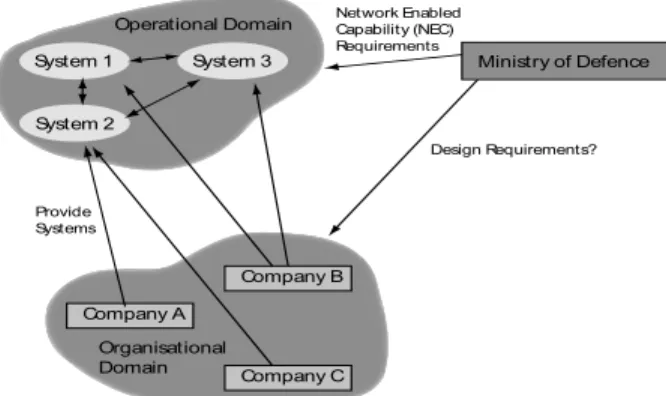
In 2002 the UK Ministry of Defence (MoD) introduced Network Enabled Capability (NEC) in the Strategic Defence Review New Chapter, as its response to US designs for Network Centric Warfare (NCW). NEC as a paradigm poses a number of requirements on systems in the battlefield and defence companies are expected to deliver systems that meet these requirements. Thus, being able to translate operational NEC requirements into design requirements (and developing systems and services accordingly) can give companies a competitive advantage when bidding for defence contracts in the UK. At the same time, the main supporting documentation for NEC which is the JSP 777 [Network Enabled Capability 2005] is mainly concerned with how NEC can be exploited in an operational environment and so gives little advice to defence organisations delivering services and products to the MoD (see Figure ). If NEC is to be successful it will need to both evolve and to create change after change to both the MoD and industry, so that it moves through its different ‘epochs’ and change, adaptation, agility, learning, self-healing and the 'knowledge society' become the norm.
Network Enabled Capability (NEC) Requirements Company A Company B Company C System 1 System 2
System 3 Ministry of Defence Operational Domain Organisational Domain Provide Systems Design Requirements?
Figure 1. Design Requirements for NEC
Some of the requirements described in NEC such as ‘agility’, ‘interoperability’, etc. can be achieved by improved change planning. Since changes happen and not only do they happen but we often want to cause change for the better. At the same time, the effects of change can be unpredictable; propagating to other systems and leading to an avalanche of change which can be impossible to control. Thus, scoping the effects of change before a change is made can be crucial for allowing an organisation to deliver products or services in time and in budget – and, most importantly, to justify and support change and necessary investment.
This paper investigates how the requirements for the operational aspects of NEC may impact industry and in particular the design offices tasked with designing network enabled products from a change
perspective. The contributions are two-fold. In Section 2, we give an introduction to NEC, which is followed by a description of some of the high-level aspects and requirements on systems in the operational domain; the focus is on three of the main NEC themes namely ‘agility’, ‘interoperability’ and ‘decision taking’. In Section 3 these themes are examined as requirements for companies designing systems for the operational domain from a change perspective and we define requirements for future research into change management and prediction.
2. Network Enabled Capability
There are a number of interpretations about ‘what NEC is’ that tend to vary depending on from where one is looking and from what perspective. The source document remains the UK MoD’s JSP 777 Edition 1, developed between 2003-4 and published in 2005. Intended as the ‘first of a series’ despite continuing NEC development, JSP 777 has yet to be superseded and so remains, from a MoD perspective, its reference document.
There is no single definition of what NEC is. A composite ‘boundary’ as abstracted from a statement made by the then Secretary of State for Defence (Geoff Hoon) in the Strategic Defence Review, New Chapter in July 2002 may best describe what NEC is, as
‘Network Enabled Capability encompasses the elements required to deliver…precise military effect rapidly and reliably. At its heart are three elements: sensors (to gather information, [and which include people]); networks (to fuse, communicate, [enable] and [jointly] exploit the information, [between many different “human centric” users]); and [capabilities] to deliver military effect. The key is the ability to collect, fuse and disseminate accurate, timely and relevant information with much greater rapidity (sometimes only a matter of minutes or even in “real time”) to help provide a common understanding among commanders and [personnel]
at all levels.’
2.1 High-Level Aspects of NEC
JSP 777 Edition 1 takes forward abstracted ideas for coherent delivery; improved decision taking and making; better enabling [operational] capabilities and the more efficient exploitation of information by introducing three NEC States or ‘epochs’:
• Initial based on current organisations, doctrine, equipment and processes characterised by minor organisation changes and equipment enhancements and the connecting up of people and equipments and systems;
• Transitional medium term supported by incremental changes leading to major organisational change and integration of technical systems to give greatly improved situation awareness; • Mature including dynamic mission groups and synchronisation.
According to JSP 777, ‘NEC offers decisive advantage through the timely provision and exploitation of information and intelligence to enable effective decision making and agile actions’. Additionally, NEC ‘will provide increased interoperability and collaboration’. The three NEC epochs (themselves a process of change) introduce a number of additional themes from those identified in the introduction including: ‘situational awareness’; synchronisation; agility, interoperability and collaboration.’ Of these themes, the quality of agility is specifically addressed and collaboration largely subsumed within concepts for interoperability. Drawing on parallel work done by the UK MoD Doctrine Concepts and Development Centre (DCDC), JSP 777 introduces the Joint HLOC (Higher Level Operational Concepts) definition of agility to be:
‘A human centric attribute, epitomised by the enduring ability of our people to think creatively, be imaginative and to adapt with versatility to the unexpected. However it also has a strong physical dimension (personnel, structures, equipment and procedures [and doctrine])’.
JSP 777 then takes these themes and capabilities to consider NEC comprising: ‘three overlapping and mutually dependent dimensions: Networks, Information and People’ (see Figure ). More recently, the MoD has gone on to consider a fourth dimension, ‘Joint Action’, which appears to comprise concepts for improved networked decision taking and making and information exploitation.
Joint
Action
Networks
Information
People
Figure 2. High-Level Aspects of NEC
2.1.1 Network
Networks tend to be taken for granted in much of the literature. For example, what are they; how are they sustained; how do the informal connect with the formal and institutional; the trusted to the ruled and the controlled to the commanded? What are the social implications of the military network and how does this relate to the communication and information systems and so to other networks, both friendly and hostile? What are the dynamics involved? JSP 777 talks of ‘networks being at the heart of NEC ‘and ‘NEC’, itself, ‘being a network of networks for distributing information; applying equally to the operational and non-operational environments.’ The emphasis within JSP 777 is on ‘using the networks to make information available to the planners and decision-makers’. It goes on to submit that: ‘it is possible to gain “Information Superiority” over one’s adversary through the effective collection and management of information: “Decision Superiority” will be enabled through the effective exploitation of that information.’ As Mario Bunge observes: ‘…cognition is personal, but knowledge is social’ [Bunge 2000]. This is probably the underlying fact behind networks which are essentially social – Networks, Information and People in JSP 777 terms – and which also differentiates’ between cognition (situational awareness in NEC) and knowledge. Taken with People and noting the JSP 777 reference to Networks and People, as one of its three dimensions, Networks may be seen as underpinning NEC.
2.1.2 Information
JSP 777 considers information in terms of ‘decision makers’ requiring ‘to identify at all levels what information is required and available to support their decisions:…the key to NEC is effective information management.’ It then links information to information management (IM), whilst recognising that ‘the NEC focus will always be directed ultimately to operational effectiveness’. This is considered in terms of ‘decision support tools’ and ‘help to assist in finding information, structure and present information in the most appropriate manner’. The focus is upon ‘commanders at all levels
[having] more information on which to base decisions…[so contributing] to the overall achievement of decision superiority’. To achieve information sharing, JSP 777 advocates the use of NEC common standards and processes – a function of interoperability – but acknowledges the need ‘to do better’. From many perspectives this is an incomplete understanding of information. For example, there are different requirements for information capture and dissemination – including data handling, intelligence, classification, knowledge management and IM – and also different types of information. Moreover, is the information being absorbed and understood by the ‘receiver’ and, if so, can it then be disseminated in a way understood by others – social interaction? All of these requirements contribute in full or in part to ‘decision superiority’ and so to Boyd’s OODA loop (Observer; Orient[ate]; Decide; Act) which underpins many NCW and NEC concepts. Whilst JSP 777 opens up the ‘information debate’ it does not necessarily do so in a way that can be readily understood and applied.
2.1.3 People
JSP 777 talks of ‘Networks, Information and People’ within the ‘Three Dimensions of NEC’. With regard to people, it focuses on the requirement to ‘educate and train all defence personnel so that they can use their knowledge and exploit it…People will need to learn how to share and find information from multiple sources and then use that information to plan and make decisions.’ One of the issues NEC is attempting to address is ‘design inclusivity’ by better including UK soldiers, sailors and air personnel in the design and decision making processes. Essentially this is getting at the requirements to provide improved agility within the UK Armed Force for which an improved understanding of the service person (at all ranks) is required in order to see how ‘NEC supports “them”; rather than “them” supporting NEC’. This suggests that a good starting point for NEC would be to understand the requirements of the individual service person and his / her capabilities and their different levels of need. For example, a key element of NEC is ‘self-synchronicity’, for which ‘independent being’ and ‘shared situational awareness’ become imperatives. Designing NEC exclusively rather than inclusive of its main constituent – people – is likely to lead to market failure. Failure in the market space for which NEC is intended is priced in lives.
2.1.4 Joint Action
The additional fourth dimension appears to have been introduced – but not yet formally documented by the MoD – in 2006/7. This might also reflect some frustration within the MoD at the perceived slow place of delivery and change. Joint Action is identified in JSP 777 in terms of the ‘benefits chain’ which it sees to comprise of: ‘better networks; better information sharing; better shared understanding; better decision; better [Joint] Actions [and so] better effects’. HLOC similarly considers joint action based upon ‘highly responsive, well integrated and flexible joint force elements…able to thrive upon tactical innovation, [and] confident [in] the actions that they take.’ Joint action may also be seen as an attempt to give NEC more of a delivery focus, by providing a framework, through the ‘NEC benefits chain’, connecting across Networks, Information and People. 2.2 Main NEC Themes
From initial analysis and assessment, three main themes emerge: Agility; Interoperability and what is termed as ‘Decision-Taking’, seen to compromise Decision-Making, Planning and Shared Situation Awareness.
2.2.1 Agility
The ‘human centric attribute’ of agility runs strongly through NEC and NCW literature:
‘Agility has virtue, not only as a core competency in operations, but as a value metric for policy and investment decisions; it is ‘of paramount importance in an uncertain world, a characteristic to be sought even at the sacrifice of seeking to perfect capabilities associated with specific missions or tasks’. ‘Agility includes responsiveness, robustness, innovativeness, flexibility, adaptability’ and ‘resiliency (formerly included as a sense of robustness, the ability to maintain performance in the face of degradation): a robustly networked force is, by virtue of its increased connectedness, more agile.’[Alberts and Hayes 2003]. ‘Uncertainty and a potentially very dynamic battlespace is driving defense in the direction of [Agile Organizations] that have the agility to cope’.
Agility is seen to be a human-centric component – combining both élan and sûreté – that requires a knowledgeable understanding of the operational environment, combined with a principled empirical approach to observation and application; cause and effect. Agility is therefore considered more of a ‘mind-set’ than a capability, per se, meaning that it is the product of an educated and experienced, thereby knowledgeable, social-network capable of making sense of personal-cognitive observations. Within agility, one also needs to consider connected terms such as ‘adaptive’ and ‘agile’ and how they may link to complexity. It is possible to suggest, for example, that NEC might consider Complex Agile Systems, as opposed to Complex Adaptive Systems, with emphasis on their human component?
2.2.2 Interoperability
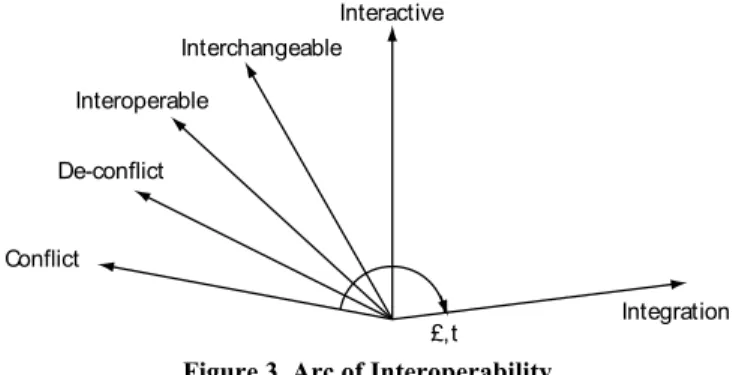
JSP 777 talks of integration in the ‘Transitional Phase’, implying Interoperability in the Initial epoch. Interoperability as seen in JSP 777 appears to cover a range of states – from the conflicted to the fully integrated, including collaboration. NATO uses the current definition for interoperability:
‘The ability of systems, units or forces to provide services to and accept services from other systems, units of forces and to use the services so exchanged to enable them to operate effectively together.’
Whereas, MITRE[Reed 2006], considers interoperability and integration together: ‘Interoperability and integration is the exchange of messages between systems.’ Whilst the MoD Interim Defence Standard 00-79 Part 1 Issue 1 Publication, Technology Insertion, Part 1 Vocabulary, dated 25 Feb 05 considers: ‘Integration: A Systems Engineering Term – the progressive assembly and verification of delivered configurations of components / subsystems.’ And work undertaken by MoD, DFD, previously considered the following definition (used in preparing Defence Strategic Guidance (DSG) 05): ‘The ability of networked systems, units or forces to provide and accept services from other systems, units or forces by uniting procedures, rules and information so that, when formed, the force operates together more effectively, capably and seamlessly as a whole’.
Integration Interactive Interchangeable Interoperable De-conflict Conflict £, t
Figure 3. Arc of Interoperability
In earlier work on Interoperability (2002 / 3), an ‘arc of Interoperability’ (see Figure ) was proposed. The arc moves from conflict, when units or forces ‘bump into each other’, to de-conflict (effectively how the allies fought the first Gulf War); to being Interoperable (a level at which the US, UK and Australian land forces fought the Iraq War); to Interchangeable (where most NATO Maritime and Air Forces are) to Interactive (at which UK, US and AUS Special Forces operate) to Integration (at which the Joint Air Operational Center manned by US and UK personnel fought the Iraq war). It was considered at the time, that there was an order of cost magnitude moving from interoperable to integrated forces, with time and cultural implications regarding training, experience and education. Not only are costs seen to be involved but interoperability may also be seen as a function of agility. As explained below, it is contended that, as one moves towards integration the more one controls or scales the network. The more scaled the network, the less agile it is likely to be (see Figure ). There therefore appear to be some pay offs in terms of the degree of interoperability, cost, time, control and so agility.
A gili ty Interoperability Interactivity Conflict
2.2.3 Decision Taking
JSP 777 makes numerous references to decision superiority, information and shared situational awareness with regard to Decision Making: ‘Decision Makers at all levels…will need to know when a decision needs to be made’. Taking better decisions, more rapidly and successfully is seen to give the UK Armed Forces its competitive and so decisive advantage. The reverse applies. In this regard decision-taking itself may be considered to include situational awareness (part of good planning), knowledge and information management and decision-making. Situational awareness is given considerable prominence within JSP 777, which introduces ‘shared situational awareness’ as also linked to decision taking: ‘NEC offers decisive advantage through the exploitation of information and intelligence to enable effective decision making and agile actions’. NEC’s ultimate success is likely to be based upon its support to the decision takers and makers, which might explain also the perceived need to introduce the fourth and linked dimension of ‘Joint Action’.
3. Need for Change Prediction in NEC
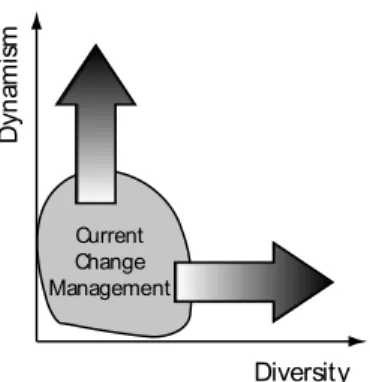
Change lies at the heart of many design processes. Especially in the light of ever decreasing lead times, increasing product complexity and longer product life-cycles, planning for change is an important activity in companies. On the one hand, systems have to be designed in a way that changes made later to the product do not cause extensive rework in other sub-systems [Fricke and Schulz 2005]. On the other hand, when changes are required, designers must be supported in making decisions about how to implement change requests. Both situations, however, rely highly on accurate predictions of the effects of change in the first place. This is also true for companies designing defence products and services. Nonetheless, change initiatives, such as NEC, provide new challenges that have to be met by the companies whilst remaining profitable – see emission legislation [Jarratt et al. 2003] as a similar initiative for the automotive industry. Two of the challenges put forward by NEC are of particular interest from a change management and prediction perspective: interoperability, which leads to a diverse system-of-system view for change management and agility, which calls for dynamic models of change (see Figure ).
Dy n am is m Diversity Current Change Management
Figure 5. Directions of change management research: towards dynamism and diversity 3.1 Existing Change Management Work: System View
Most complex products are designed by modification from previous designs. As components are changed to meet new requirements, other components can also be affected through knock-on effects. Assessing the risks of changes before they are carried out can prevent costly mistakes which would otherwise jeopardise entire projects. System level applications of change management and prediction techniques are aimed at modelling and predicting change within a system. For example, the helicopter model discussed by Clarkson et al. [Clarkson et al. 2004] would be such an application, where a helicopter and its subsystem were modelled and possible changes to the helicopter were analysed. The benefits of such a techniques is decision support in tendering, change prediction and execution and freeze planning. The advantage of this approach is that results can be obtained quickly as the method has been used frequently in a diverse range of industrial sectors such as aerospace [Jarratt 2004], automotive and defence [Clarkson et al. 2004].
Change prediction relies on underlying network models of the system that are used to predict changes. The sophistication of the model also determines the quality and possible applications of then change predictions
3.2 Systems-of-Systems View: Interoperability
The main NEC emphasis is carried forward in its theme of interoperability, which moves defence from a platform-system view to a system-of-system view – with interoperable systems – which then have to be mirrored in the design organisation. While traditionally, many designs were optimised – also in terms of change management – on a system level, NEC now requires to plan for the “bigger picture”, i.e. designers have to plan how the products work in the networked environment described by NEC. The question is ‘how existing methods and tools for design have to be adapted in order to serve useful when designing for NEC?’ The main challenge for designing for interoperability lies in the fact that traditional ‘stand alone’ system boundaries need to be extended towards and include other systems the product is designed to interact with.
Thus, changes occurring to a component of one product can also have effects on components or sub-systems of other products or services. For example, changing the sensor of a UAV (Unmanned Aerial Vehicle) from infra-red to a standard one will have effects on other components within the design of the UAV, potentially making redesign necessary (traditional change prediction). However, the networked nature of NEC, where different systems have to interact and inter-operate, might also make changes to other systems necessary that have previously relied on the infra-red information provided by the UAV. This shows that change management has to look beyond traditional system boundaries and also, since not only systems, but also people, organisations and friendly as well as enemy forces interact in NEC environments, taking non-technical systems into account when planning and executing changes.
Requirement 1: Change Management must be able to predict changes across traditional system-boundaries and has to include non-technical systems.
3.3 Dynamic Networks: Agility
Agility of systems in a battle space situation means that people have to be able to adapt to new requirements. For example, the Humvee armoured vehicles used by the US in Iraq were found to lack appropriate protection against "explosively formed penetrators" (EFP) which were inflicting 70 percent of the American casualties in the country. Additional armour kits were provided but costs were high since expensive upgrades and redesign had to be performed. If the system had initially been designed in a way that such upgrades would be easier to carry out, it might have saved crucial time for delivering the additional armour to the soldiers in the field and given them the agility to respond to changing predictable but not forecast demands. Also, long life-cycle systems, such as the Lynx Helicopter, are frequently used in very different applications throughout their life-cycle and very often not for what they were originally designed. As an additional example, the delivery and recovery of individual, bulk ammunition to Royal Marines from ‘lean-man’ amphibious ships proved problematic given time, accounting, crew and safety constraints. In response and ultimately approved by the UK Ordnance Board, the ubiquitous ‘wheelie-bins’ were brought into service – including an ‘amnesty-bin’ for those exotic items ‘inadvertently’ returned from shore by commandoes. This proved to be a popular and inexpensive means of maintaining agility whilst employing readily available, inexpensive equipment to overcome time and legislative constraints designed for ammunition handling in a different era. This shows that design changes to even highly regulated products can not only happen at any time in its life cycle but that emerging constraints can often require new and innovative – agile – solutions, capable of rapid approval and certification by the design authorities.
Requirement 2: Change Management must be able to predict changes in highly dynamic
environments with systems and applications changing throughout the product life-cycle and assess change effects to later stages of the systems life-life-cycle.
4. Conclusions
This paper has examined NEC as it may have huge impacts on the UK defence sector. Requirements put forward by this initiative are likely to have significant implications on companies competing for
contracts and providing products and services to the MoD. This paper described some of the challenges companies face when designing for NEC and identified requirements for design from a change management perspective. On the one hand, change management and prediction will have to extent its traditional approach of systems to a systems-of-systems view and also address highly dynamic and interactive environments with changes affecting system-use in later stages of its life-cycle. These requirements will drive future research into change management and prediction to make companies ready to design systems and services for NEC.
Acknowledgements
The work reported in this paper has been supported by the NECTISE program, jointly funded by BAE Systems and the UK Engineering and Physical Sciences Research Council Grant EP/D505461/1, the UK Defence Academy (ARAG) and the Royal Navy.
References
Alberts, D. S. and R. E. Hayes Information Age Transformation. DoD Command and Control Research Program, CCRP publications, 2003,74.
Alberts, D. S. and R. E. Hayes Power to the Edge. DoD Command and Control Research Program, CCRP publications, 2003,123-127.
Atkinson, S. R. and J. Moffat Agile Organisation. DoD Command and Control Research Program, CCRP publications, 2005.
Bunge, M. A. "Ten Modes of Individualism - None of Which Works - And Their Alternatives." Philosophy of the Social Sciences, Vol. 30, No. 3, 2000, 384-406.
Clarkson, P. J., C. Simons and C. M. Eckert "Predicting change propagation in complex design." Journal of Mechanical Design, Vol. 126, No. 5, 2004, 765-797.
Fricke, E. and A. P. Schulz "Design for changeability (DfC): Principles to enable changes in systems throughout their entire lifecycle." Systems Engineering, Vol. 8, No. 4, 2005, 342-359.
Jarratt, T. A model-based approach to support the management of engineering change. Engineering Department. Cambridge, UK, University of Cambridge, 2004.
Jarratt, T., C. M. Eckert, R. Weeks and P. J. Clarkson Environmental legislation as a driver of design. International Conference on Engineering Design (ICED 03), Stockholm, Sweden 2003.
Network Enabled Capability. Joint Service Publication 777, Ministry of Defence, 2005.
Reed, H. Principles of Interoperability and Integration. MITRE TECHNICAL REPORT: Volume 1: Fundamentals, 2006.
Dr. Rene Keller Research Associate
University of Cambridge, Department of Engineering Engineering Design Centre
Trumpington Street
Cambridge, CB2 1PZ, United Kingdom Tel.: +44 1223 332828
Fax.: +44 1223 766963 Email: [email protected]