UNIT
COMMITMENT
&
ECONOMIC
DISPATCH
BY
PARTICLE
SWARM
OPTIMIZATION TECHNIQUE
Srikanth Khandavalli
1, V.Hari Vamsi
2and P.Venkatesh
3I. INTRODUCTION
Both Unit Commitment and Economic Dispatch problems have the same objective i.e., to minimize the operating cost of the thermal generating units. Unit Commitment solves the optimization problem by deciding which thermal unit has to be switched ‘ON’ depending on the load, whereas the Economic Dispatch minimizes the operating cost by scheduling the thermal units while meeting the system demand. An obvious thought is to solve the problems simultaneously to arrive at a more cost effective solution [8]. The present work also aims to solve both the optimization problems simultaneously using Particle Swarm Optimization Techniques which is gaining attention these days [11][13][14].
Conventionally Unit Commitment is solved using Priority list method [1], Dynamic Programming [7] etc. [9]. Economic Dispatch can be solved by Lambda iterative method, Newton’s method, Efficient Method etc. [2]. These problems can also be solved by using latest optimization techniques like Genetic Algorithm based techniques, Particle Swarm Optimization Techniques [10-12]. These techniques are population based techniques which have good convergence properties and are capable of solving nonlinear, non convex, multi objective optimization problems and are capable of convergence to global or near global optimal solution [16]. But, these techniques have
1 EEE Dept, V R Siddhartha Engineering College, Vijayawada. 2 EEE Dept, V R Siddhartha Engineering College, Vijayawada. 3 EEE Dept, V R Siddhartha Engineering College, Vijayawada.
DOI: http://dx.doi.org/10.21172/1.83.054
e-ISSN: 2278-621X
Unit Commitment & Economic Dispatch By Particle Swarm Optimization Technique 384
more computational burden, lack convergence criterion, tuning the parameters of the method affect the solution quality considerably [13][15]. In spite of these drawbacks, these heuristic optimization problems are gaining huge popularity.
The present work solves the UC and ED problem for three and five unit systems. The UC problem is solved using Priority list method and the solution of this method is used to solve the ED problem for the committed units using Lambda iterative method. The problems are also solved simultaneously using PSO Technique.
II. MATHEMATICAL MODELLING
Objective function: The unit commitment problem is to switch ‘ON’ the generating units which are more efficient to meet the system demand while satisfying the generator limits so as to minimize the total operating cost of generation. The Objective of ED is to minimize the total operating cost of the generating units by scheduling the generating units to meet the demand while maintaining the generator limits.
The operating cost of generation is usually modeled as a quadratic in real power generation of the thermal units. Though in the recent works the generating cost is modeled as the sum of a quadratic and a sinusoidal function of real power [17] the present work uses the simplified cost function which is a quadratic in real power [1].
Where ai ,bi ,ci are fuel cost coefficients for the thermal unit considered. ‘ ’term accounts for the interest and
profit for the investment towards generation, ‘ ’ signifies the expenses towards fuel and maintenance cost of the thermal unit ‘i', ‘ ’ accounts for the salaries of the permanent employees and fixed costs of generating unit respectively, ‘NG’ is the number of generators in the system.
Equality Constraint: The total power generated by all the units should be equal to the power demand plus power
loss at every instant of time. This is a stiff constraint as the stability of the power system and the system frequency are dependent on the power balance in the system. This can be mathematically represented as follows:
Where PD is the total real power demand on the power system, PL is the total real power loss of the system.
PL can be calculated by using Kron’s Loss formula [2]
‘P’ is the real power generation matrix. B, B0, B00 are loss coefficient matrices [2].
Inequality constraints: The power produced by a generating unit can’t be beyond its rating. Also the real power produced by the units can’t be below a certain limit due to economic reasons. This constraint is significant in the ED problem as it involves the scheduling of the thermal units. This constraint is obviously less significant in the UC problem as the problem deals with switching ON or OFF the thermal units. This can be written in mathematical form as:
III. PRIORITY LIST METHOD FOR UNIT COMMITMENT [1]
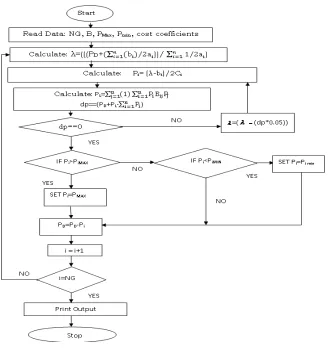
FIGURE1. Flowchart for UC using Priority List Method
IV. LAMBDA ITERATIVE METHOD FOR ECONOMIC DISPATCH [2]
It is one of the most frequently used classical methods for Economic Dispatch. The method is simple and requires the cost function to be modeled as quadratic for better convergence. The method is an iterative method based on Lagrangian relaxation Technique. The flowchart for Lambda Iterative Method for ED including losses is given in Fig. 2. In the flow chart ‘dp’ is the error in the equality constraint. Acceleration factor of 0.05 is taken, which dictates the speed of convergence.
V. PARTICLE SWARM OPTIMIZATION FOR UNIT COMMITMENT
Particle Swarm optimization is a swarm based optimization technique. Lately, PSO is gaining reputation for its better convergence characteristics than the Genetic Algorithm based techniques [13]. Researchers have successfully used PSO Technique to solve Unit commitment problem [10][11]. A new objective function is formulated which combines the UC and ED problem. This can be solved using PSO technique [11].
, ,
1 1
(
) *
T NT i t i t t i
OC
F P
U
OCT is the operating cost of the generation for the time ‘T’. is a binary bit indicating the unit ‘i’ is ON or
OFF at the instant time ‘t’. F(Pi,t) is the fuel cost of the generator unit ‘i’ at time ‘t’. Obviously the power balance
constraints are also modified as
, ,
1
N
i t i t D i
P U
P
Unit Commitment & Economic Dispatch By Particle Swarm Optimization Technique 386
FIGURE 2. Flowchart for ED using Lambda iterative method
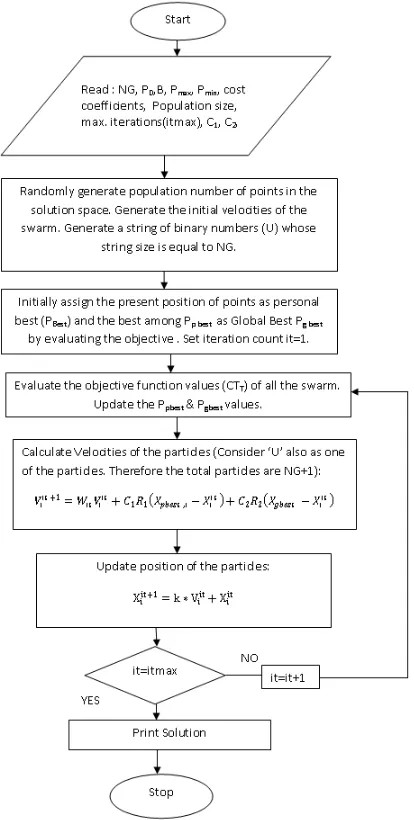
The Particle Swarm Optimization Technique is based upon the schooling of fishes and swarming of birds [18]. Each individual in the flock of birds or school of fish modifies its course, depending upon its personal experience and the swarm’s leader. This searching technique in the nature can be simulated on a computer with a group of points. Population of points in the solution space can also be made to behave like a swarm to find the optimal solution in the solution space. The flowchart for PSO to solve Unit Commitment problem is given in Fig. 3.
The velocity equation in the flow chart is critical in the PSO technique. It has three parts. The first one is the inertia weight component which pulls the particle towards its previous velocity direction. The inertia weight is made to decreases linearly each iteration. This is done to improve the convergence characteristics of PSO.
Wmax and Wmin is ten percent of Xmax and Xmin respectively. ‘Itermax’ is the maximum number of iterations allowed
and ‘it’ is the current iteration number.
The second component of the velocity equation pulls the particle randomly towards its previous personal best position. The third component of the velocity equation pulls the particle towards the leader of the swarm or global best particle of the swarm [18]. Therefore the particles of the swarm will simulate the natural swarming behavior of the animals to reach the optimal solution. The position of the particle is updated using ‘k’ is a constant (=1), having units of time so that the above equation is dimensionally correct.
FIGURE 3. Flowchart for UC& ED using Particle Swarm Optimization Method
TABLE 3, UC & ED Solution for the six unit system with load of 700MW PRIORITY LIST
METHOD
Priority List For UC + Lambda
Iterative Method For ED PSO METHOD
P1(MW) 0 0 0
P2(MW) 0 0 0
P3(MW) 60 161.7767 159.239
P4(MW) 0 0 0
P5(MW) 325 287.019 287.924
P6(MW) 315 273.910 275.607
PL(MW) 24.1625 22.70688 21.4264
COST ($/h) 36918 35332 35332
Unit Commitment & Economic Dispatch By Particle Swarm Optimization Technique 388
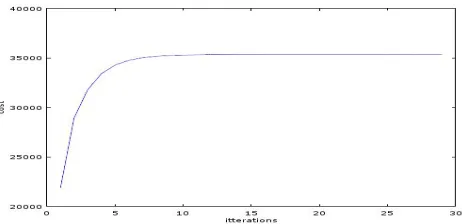
FIGURE 4, Convergence characteristics of PSO program for the six unit system.
FIGURE 5. Convergence characteristics of Priority list method and λ iterative method program for the six unit system.
TABLE 4, UC & ED Solution for the six unit system with load of 400MW PRIORITY LIST
METHOD Priority list for UC + lambda
iterative method for ED PSO METHOD
P1(MW) 0 0 0
P2(MW) 0 0 0
P3(MW) 0 0 0
P4(MW) 0 0 0
P5(MW) 85 215.790 215.79
P6(MW) 315 193.2670 193.28
PL(MW) 10.6462 9.057067 9.07
COST($/h) 23579 19905.7219 19905.52
EXECUTION TIME(S)
0.002 4.180 130
TABLE 5, Three unit system Cost Coefficients & Generator Limits
Units P Max P Min Fuel cost component (MW) (MW)
ai bi ci
($/ MW2h) ($/MWh) ($/h)
1 210 35 0.03456 38.30553 1243.5311
2 325 130 0.2111 36.32782 1658.5696
TABLE 6, Three unit system loss coefficients
B 1 2 3
1 0.000071 0.000030 0.000025
2 0.000030 0.000069 0.000032
3 0.000025 0.000032 0.000080
TABLE 7, UC & ED Solution for the three unit system with load of 400MW PRIORITY LIST
METHOD
Priority list for UC + lambda iterative method for ED
PSO METHOD
P1(MW) 0 0 0
P2(MW) 85 144.1877 214.7407
P3(MW) 315 265.3271 194.123
PL(MW) 10.150 9.5148 8.865
COST ($/h) 21339 20268.660 19896.944
EXECUTION
TIME(S) 0.0001 0.197 265.33
VI. CONCLUSIONS
The solutions obtained for six unit system for 700MW and 400MW loading clearly show that both the classical methods and PSO Technique gave the same optimal solution which is much better than the Priority list method used alone. This indicates that both the approached give global optimal solution. However for the three unit system the solution obtained by PSO is better for 400MW loading, which indicate the consistency and robustness of PSO Technique in obtaining the global optimal solution.
In this paper, flowcharts are developed for UC & ED by PSO & Classical Techniques. Solution obtained for six units and three units system for various loadings using afore mentioned methods are presented. The solutions clearly show the robustness of the PSO technique in solving the UC & ED problem for the considered test systems for various loadings. The complexity of the PSO Technique can also be observed from the execution time. The study clearly shows the dominance of the PSO technique in obtaining the global optimal solution at the expense of computational burden.
REFERENCES
[1]. Wood A. J. And Wollenberg B. F., “Power generation, operation and control”, John Wiley & Sons, New York, 1984.
[2]. D.P.Kothari, J S Dillion, “ Power system Optimization” PHI learning Pvt., Limited.
[3]. Klyanmoy Deb, “Optimization For Engineering Design: Algorithms And Examples”,2nd Edition PHI. [4]. Eberhart R. C. and Kennedy J., “A new optimizer using particle swarm theory”, Proceedings of the
6th. International Symposium on Micro Machine and Human Science, Nagoya, Japan, pp. 39-43, 1995. [5]. K.hara, M.kimura and N.Honda,”a model for economic unit commitment and maintainence of thermal
power systems” ieee transaction on power apparatus and systems PAS -85, no.5,pp.422-426,may 1966. [6]. A. Muckstadt and S. A. Koenig, "An application of Lagrangian relaxation to scheduling in
power-generation systems", Operation Research, vol. 25, no. 3, pp. 387-403, 1977
Unit Commitment & Economic Dispatch By Particle Swarm Optimization Technique 390
[8]. M.S.Krishnarayalu, “Unit Commitment With Economic Dispatch”, International Electrical Engineering Journal (IEEJ) Vol-6 (2015).
[9]. N. P. Padhy, "Unit commitment - a bibliographical survey", IEEE Trans. on Power Systems, vol. 19, no. 2, pp. 1196-1205, 2004.
[10]. Vinod Puri, Nitin Narang, Jain S.K, Chauhan Y.K., “Unit Commitment Using Particle Swarm Optimization” bioinfo computational optimization, march 2012.
[11]. P.V.Ramakrishna, G.Poornachandra Rao, Dr.Sukhdeo Sao, “Particle Swarm Optimization Technique To Solve Unit Commitment Problem” International Journal Of Advanced Computer Research, Dec 2013. [12]. S. K. Tong, S. M. Shahidehpour, and Z. Ouyang, "A heuristic short-term unit commitment", IEEE Trans.
on Power Systems, vol. 6, no. 3, pp. 1210-1216, 1991.
[13]. G. Navven Kumar, K.Srikanth, “Fuzzified multi objective PSO for Optimizing the cost, emission, losses with Voltage Stability constraints”, IJAIEM, vol:2 Issue:10, Oct 2013.
[14]. Praveen.J, B.Srinivasa Rao, “Single objective optimization using PSO with Interline Power Flow Controller”, International Electrical Engineering Journal (IEEJ), Vol. 5 (2014) N0. 12, pp. 1659-1664. [15]. B.Srinivasa Rao, K. Vaisakh, “Multi-Objective Optimization Methods for Solving the Economic Emission
Dispatch Problem”, Computational Intelligence Applications in Smart Grids: Enabling Methodologies for Proactive and Self-Organizing Power Systems, February 2015, Pages 77-111 (Imperial College Press). [16]. K.S.Linga Murthy, K.M. Rao, K.Srikanth, “Emission Constrained Optimal powerflow Using Binary and
real coded genetic algorithms” Journal of the Institution of Engineers (India), vol 92, Sep 2011, pp3-8. [17]. Reddy AS, Vaisakh K., “Shuffled differential evolution for economic dispatch with valve point loading
effects”. International Journal of Electrical Power & Energy Systems 2013;46(0):342 –52