DTMF based Surveillance Robot
Ravi Teja Ch.V
Assistant professorDepartment of Electronics and Communication Engineering Anurag college of engineering, hyderabad, Telangana, India
J. Akhil Kumar
B.Tech. StudentDepartment of Electronics and Communication Engineering Anurag college of engineering, hyderabad, Telangana, India
D. Shilpa
B.Tech. StudentDepartment of Electronics and Communication Engineering Anurag college of engineering, hyderabad, Telangana, India
G. Pragathi Reddy
B.Tech. StudentDepartment of Electronics and Communication Engineering Anurag college of engineering, hyderabad, Telangana, India
V.Bhargavi
B.Tech. StudentDepartment of Electronics and Communication Engineering Anurag college of engineering, hyderabad, Telangana, India
Abstract: The “DTMF based robot” is controlled by a mobile phone that makes a call to another mobile phone attached to the robot. In the course of a call, if any button is pressed, a tone corresponding to the button pressed is heard at the other end of the call. This tone is called “Dual Tone Multiple-Frequency” (DTMF) tone. The robot perceives this DTMF tone with the help of the phone stacked on the robot. The received tone is processed by the microcontroller with the help of a decoder IC. The microcontroller then transmits the signal to the motor driver ICs to operate the motors. Since this robot is controlled by dialing a call so we can also call it as DTMF controlled robot. The transmitted section consists of a laptop linked with a smart phone through an apps call VNC server and client along with DTMF tone generator. Using the laptop linked to mobile phone we can generate DTMF tones which will be received by other mobile phone mounted on robot after call connection. The mobile phone on robot is connected to the Arduino controller and the output or arduino is connected to the motor driver which helps the robot to move wireless. As we are using internet the robot can be operated from any part of the world so, we need to see where the robot is moving, for which we are using Airdroid app for monitoring through camera inbuilt in smart phone mounted on robot.
Keywords: Arduino microcontroller, L293D Motor driver,motors,DTMF decoder,VNCserver/viewer,Airdroid.
I. INTRODUCTION
The working of the project can be explained in the following steps: Step 1: Initially power supply is given to the DTMF robot.
Step 2: Call is made from laptop using VNC viewer. Step 3: Call is picked by the robot operator manually.
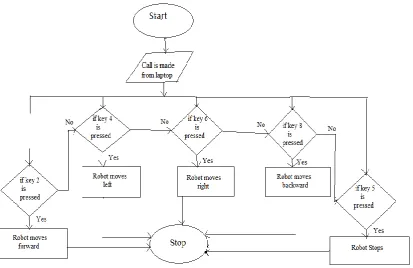
Step 4: Directions are given by the operator using laptop from VNC viewer. Step 5: When key 2 is pressed in VNC viewer, robot moves forward. Step 6: When key 8 is pressed in VNC viewer, robot moves backward. Step 7: When key 4 is pressed in VNC viewer, robot moves left. Step 8: When key 6 is pressed in VNC viewer, robot moves right. Step 9: When key 5 is pressed in VNC viewer, robot moves stop.
Step 10: Surveillance can be done through camera present in smart phone connected to DTMF robot. Step 11: Video streaming from the laptop using AIRDROID app.
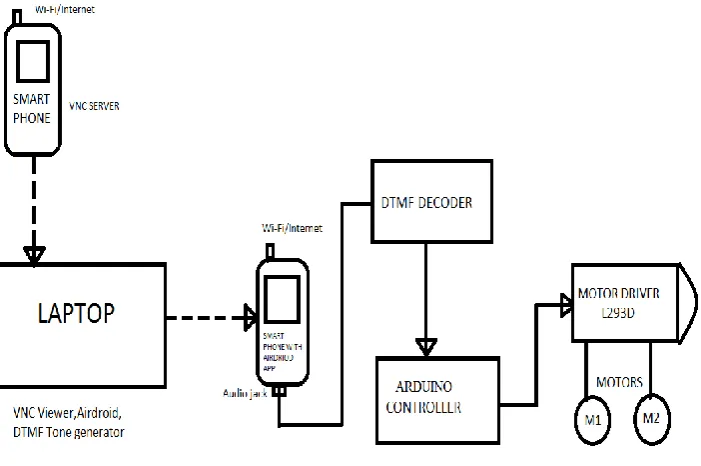
Figure 1 DTMF based surveillance robot block diagram
Figure 2 DTMF based surveillance robot flow chart
D. Hardware Implementation
Power supply
9v or 12v battery is used for giving power supply for DTMF decoder, controller and motor driver. 7805 regulator IC is used to give constant dc 5v output which is given as operating voltage for the DTMF decoder, controller and motor driver.
DTMF decoder
DTMF decoder is used here to train the commands for the robot. DTMF decoder consists of 4 output pins D0-D3.Whenever a command is given, the binary value of the address is given to the output pins D0-D3. The key tone commands as shown below:
Command Address DTMF module output (D0-D3)
Forward
Backward
Left
Right
Stop
02
08
04
06
05
0010
1000
0100
0110
0101
Table 3.3.6(a) Commands
Left 04 0100
Right 06 0110
Stop 05 0101
1001
0110
0000
Table 3.3.6(b) Motor outputs
III. EXPERIMENT AND RESULTS
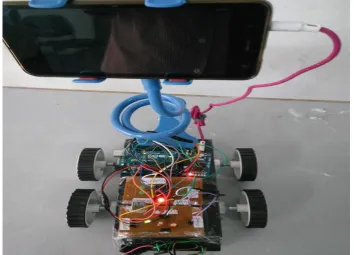
Figure 3: DTMF based surveillance robot
(a)
(b)
(d)
(e)
(a) When key 2 is pressed robot moves FORWARD direction. (b) When key 4 is pressed robot moves LEFT direction. (c) When key 6 is pressed robot moves RIGHT direction. (d) When key 8 is pressed robot moves BACKWARD direction. (e) When key 5 is pressed robot STOPS.
IV. CONCLUSION
The paper has been successfully designed and tested. It has been mainly designed to make aware of new place using robots through internet. Many existing systems have discussed about the robots and have proposed many for reducing these efforts. But, still there is difficulty in moving robots using different signals. In order to avoid the difficulty, instead of controlling the robots manually using RF, GSM, Bluetooth technologies our project succeeded in moving the robot using DTMF module. When the commands given by the disabled person sitting in one place, according to that commands the motors will move which in turn moves the robot.
REFERENCES
[1] Vishveshwar ramanathan Subramanian “Applicationns of DTMF technology and sensing in autonomous robotic navigation”, IJRET (International journal of research in engineering and technology), eISSN:2319-1163.
[2] C.K.Das “Development of a cell phone based remote control system”, IJECS (International journal of electrical and computer science), vol-9, no-10.
[3] Abdiweli abdillahi soufi “Remote control system through mobile and DTMF”, IJCER (International journal of computational engineering research), vol-3, issue-8.
[4] Sagarika pal “Remote control system of stepper motor using DTMF technology”, International journal of control and automation, vol-4, no-2, june 2011.
[5] Sabuj das gupta “Design and implementation of mobile operated toy car using DTMF”, International journal of scientific and research publications, vol-3, no-1, january2013.
[6] K.S.Roy “GSM based arial photography using remote controlled flying robot”, IJETT (International journal of engineering trends and technology”, vol-4, issue-5,may 2013.
[8] Prathyusha.K “Design and development of RFID based mobile robot”, IJESAT (International journal of engineering science and advanced technology, vol-1, issue-1.
[9] A.K.Dubey “Line follower robot using radio frequency(RF) technology”, IOSR journal of mechanical and civil engineering, ISSN(e); 2278 1684.
[10] Bisma shah “DTMF based smart notice board system”, International journal of scientific and research publications, vol-3, issue-11, November 2013.