R E S E A R C H A R T I C L E
Open Access
Feasibility and impact of a computerised
clinical decision support system on
investigation and initial management of new
onset chest pain: a mixed methods study
Rachel Johnson
1*, Maggie Evans
1, Helen Cramer
1, Kristina Bennert
1, Richard Morris
2,3, Sandra Eldridge
4,
Katy Juttner
5, Mohammed J Zaman
6, Harry Hemingway
7, Spiros Denaxas
7, Adam Timmis
8and Gene Feder
1Abstract
Background:Clinical decision support systems (CDSS) can modify clinician behaviour, yet the factors influencing their effect remain poorly understood. This study assesses the feasibility and acceptability of a CDSS supporting diagnostic and treatment decisions for patients with suspected stable angina.
Methods:InterventionThe Optimising Management of Angina (OMA) programme includes a CDSS guiding investigation and medication decisions for clinicians managing patients with new onset stable angina, based on
English national guidelines, introduced through an educational intervention.Design and participantsA mixed
methods studyi.A study of outcomes among patients presenting with suspected angina in three chest pain clinics
in England before and after introduction of the OMA programme. ii. Observations of clinic processes, interviews and
a focus group with health professionals at two chest pain clinics after delivery of the OMA programme.Outcomes.
Medication and cardiovascular imaging investigations undertaken within six months of presentation, and
concordance of these with the recommendations of the CDSS. Thematic analysis of qualitative data to understand how the CDSS was used.
Results:Data were analysed for 285 patients attending chest pain clinics: 106 before and 179 after delivery of the OMA programme. 40 consultations were observed, 5 clinicians interviewed, and a focus group held after the intervention. The proportion of patients appropriate for diagnostic investigation who received one was 50 %
(95 CI 34–66 %) of those before OMA and 59 % (95 CI 48–70 %) of those after OMA. Despite high use of the CDSS
(84 % of consultations), observations and interviews revealed difficulty with data entry into the CDSS, and structural and practical barriers to its use. In the majority of cases the CDSS was not used to guide real-time decision making, only being consulted after the patient had left the room.
Conclusions:The OMA CDSS for the management of chest pain is not feasible in its current form. The CDSS was not used to support decisions about the care of individual patients. A range of barriers to the use of the CDSS were identified, some are easily removed, such as insufficient capture of cardiovascular risk, while others are more deeply embedded in current practice, such as unavailability of some investigations or no prescribing privileges for nurses.
Keywords:Chest pain, Angina, Diagnosis, Computerised decision support system, Qualitative, Mixed methods, Clinical guideline
* Correspondence:[email protected]
1
Centre for Academic Primary Care, School of Social and Community Medicine, University of Bristol, Bristol, UK
Full list of author information is available at the end of the article
Background
Clinicians need to use the best available evidence to inform patient management decisions. Clinical decision support systems (CDSSs) generate patient-specific assessments or recommendations to aid clinical decision making. CDSSs can improve practitioner performance and health care pro-cesses in a range of clinical scenarios including disease management, drug-dosing, prescribing and preventive care [1–3]. The effect of CDSSs on clinical outcomes is less fre-quently studied. In a systematic review of 148 randomised controlled trials of CDSSs implemented in clinical settings only 29 assessed clinical outcomes [1]. There was moderate evidence in support of an effect of CDSSs on morbidity from 16 studies; evidence for other clinical outcomes was of low quality.
Few studies have sought rigorous evidence to determine what factors contribute to the effectiveness of decision sup-port systems [4]. A recent meta-regression of computerised CDSSs found sufficient quality evidence for the assessment of only six factors. Of these, success of CDSSs was posi-tively associated with systems developed by the investiga-tors of the primary studies, systems providing advice to patients and practitioners, and systems requiring a reason for overriding advice [5]. It has been argued that research based on randomised controlled trials is not sufficient to allow rigorous assessment of the factors that make CDSSs successful, and that qualitative contextual evaluation and observation are needed [4].
In the United Kingdom (UK), initial specialist assessment of suspected angina is undertaken in chest pain clinics. Chest pain clinics may incorrectly diagnose some patients, and may not initiate secondary prevention in those with angina. In a cohort of 8762 patients followed for three years after attending a chest pain clinic, 33 % of all cardiovascular events occurred in patients with a diagnosis of non-cardiac chest pain [6]. This study reported under-prescription of effective secondary prevention: of those diagnosed with angina only 28 % were taking a statin [7].
Our Optimising the Management of Angina (OMA) programme includes a web-based computerised CDSS to support investigation and medication decisions for patients with new onset stable chest pain. We hypothesised that appropriate investigation, leading to accurate diagnosis and effective secondary prevention, would lead to a reduction in cardiovascular events. Here we present a mixed methods study that aimed to understand the factors influencing the feasibility of the OMA CDSS in clinical practice, and the impact of the CDSS on investigation and prescribing behav-iour, to inform potential progression to a cluster rando-mised trial of the intervention.
Methods
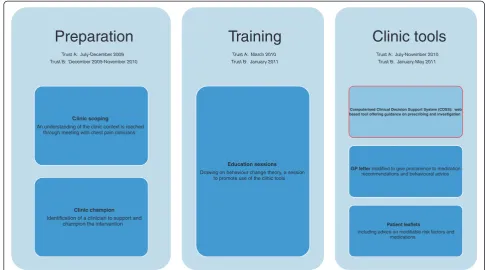
The OMA programme is a complex intervention delivered at the level of the clinic. The programme has 3 stages:
preparation, trainingandclinic tools(Fig. 1). The
prepar-ationandtrainingstages facilitate use of the OMA CDSS.
The components of the intervention were developed using behavioural change domains identified by Michie and colleagues [8].
Design
We used mixed methods, combining a before-and-after study of chest pain clinic investigation and treatment deci-sions with observations of clinical practice, interviews and a focus group. In this paper we report on data collected directly following incorporation of the CDSS into the clinics.
Setting and study population
Two hospital trusts (Trust A and Trust B) in a provincial city recruited chest pain clinic patients both before and after delivery of the OMA programme. Clinicians with responsibility for the chest pain clinics in each trust were identified and approached by members of the research team. With their agreement a meeting was arranged with cardiology clinicians and managers to explain the planned study and obtain agreement to participate. A clinic cham-pion (senior clinician who agreed to support the interven-tion) was identified at each trust, and all clinicians working regularly within the clinic were invited to take part in the study. Patients were eligible for the study if they had been referred to the chest pain clinic by their general practi-tioner. We excluded patients who had a previous history of cardiovascular disease, and those who did not speak English. Dates of delivery of the OMA programme are given in Fig. 1, and study recruitment is summarised in Fig. 3.
All clinicians working regularly in the chest pain clinics gave written informed consent to participate in the qualitative study. Consecutive patients attending the clinic after incorporation of the CDSS were invited to give written, informed consent to their consultations being observed and audio-recorded, and to their medical records being accessed. All participating patients gave written informed consent.
The OMA CDSS
The OMA CDSS guides investigation and prescribing decisions for patients with new onset chest pain. The CDSS was developed by the research team during 2009/10, and was funded by an NIHR programme grant (RP-PG-0407-19314). During development of the CDSS, researchers sought to understand clinicians’work practices and decision making within both trusts (Preparation stage). This process included researchers meeting with the clinic champion, semi-structured interviews with all regular chest pain clinicians, and qualitative observation of clinic prac-tices. Following this, at Trust A the prototype CDSS was
presented to clinicians, allowing user testing of the CDSS in hypothetical scenarios. Insights from these processes were used to modify the CDSS in line with working practices, and to inform a training session for the finalised CDSS. Initially planned as a CDSS based on expert panel consen-sus, the CDSS was modified in March 2010 to incorporate newly published UK guidance from the National Institute for Health and Care Excellence (NICE CG95) [9]. This modified CDSS was again discussed with clinicians and feedback sought in a clinician focus group, before final modifications and subsequent testing within the pilot study presented here. Prior to its use in practice, in a training ses-sion at each site (training stage) we described the rationale for the CDSS and CDSS recommendations were developed, and facilitated discussion of how to use the tool in practice using case scenarios. Clinicians were invited by email to attend the training session. Publicity for the OMA CDSS was limited to the stages described in this section.
The CDSS was designed for use by any clinician assessing and managing patients in the chest pain clinic setting. In our study settings clinicians included cardiology specialist nurses, cardiologists and cardiac physiologists. CDSS use was optional for the physicians with no incentives for its use. We were unable to integrate the CDSS with existing electronic systems; clinicians entered data about each patient manually. Clinicians enter clinical information required to calculate a patient’s pre-test probability for coronary heart disease [10], on which investigation and medication recommendations are based (Fig. 2). For
individuals with a pre-test probability of coronary disease of <90 % investigation recommendations were based on NICE guidance [9]. The NICE guidelines do not give investigation recommendations for individuals with a pre-test probability of coronary disease of >90 %. A panel of 12 cardiac clinicians agreed that these patients should all have angiography unless there were contraindications to further treatment. CDSS medication recommendations were provided by the panel, and included recommenda-tions for up to three drug classes: anti-platelets, statins and beta-blockers. After receiving recommendations from the CDSS, clinicians were prompted to record their agree-ment or disagreeagree-ment with the recommendations and the reasons for these.
Quantitative data collection and analysis
The following data were extracted from the clinic record at presentation to the clinic: age, sex, cardiovascular risk factors, resting ECG and typicality of chest pain. These data were collected from the CDSS when it had been used, and from the clinic record for all other patients. When the CDSS was not used, two members of the research team (AT and MJZ) labelled the chest pain as typical, atypical or non-cardiac based on the hospital record. Medications (anti-platelets, beta-blockers and statins) current at the clinic date were extracted from the primary care electronic record.
Participants were followed up for six months. Prescrip-tions of anti-platelet medication, beta-blockers and statins
Preparation
Trust A: July-December 2009 Trust B: December 2009-November 2010Clinic scoping
An understanding of the clinic context is reached through meeting with chest pain clinicians
Clinic champion
Identification of a clinician to support and champion the intervention
Training
Trust A: March 2010 Trust B: January 2011Education sessions
Drawing on behaviour change theory, a session to promote use of the clinic tools
Clinic tools
Trust A: July-November 2010Trust B: January-May 2011
Computerised Clinical Decision Support System (CDSS): web based tool offering guidance on prescribing and investigation
GP letter modified to give prominence to medication recommendations and behavioural advice
Patient leaflets
including advice on modifiable risk factors and medications
current at six months after the clinic were extracted from the electronic primary care record. Cardiac investigations (computerised tomography, calcium scoring, coronary angi-ography, stress echocardiangi-ography, myocardial perfusion scanning, angiography/angioplasty, cardiac MRI) performed in the six months after the chest pain clinic were collected from the hospital records.
Participants were analysed in two groups: patients seen
before delivery of the OMA programme (Before OMA)
and patients seen after delivery of the OMA programme
(After OMA). Concordance with the CDSS
recommen-dation of investigations done within six months and medications prescribed at six months was determined
for the After OMA group. For patients for whom the
CDSS was not available (Before OMA) or not used (After
OMA), we used data from the clinic record to generate CDSS recommendations, in order to determine whether the investigations done and medications prescribed were in line with what the CDSS would have recommended. If we assume that CDSS recommendations would be followed for 75 % of patients even without the use of OMA, and that this percentage would increase to 85 % when OMA was used, we would be required to study 354 patients with and without use of OMA (708 in all) to detect this difference as statistically significant at 5 % level, with 90 % power. As this was a feasibility study, our sample size was based on pragmatic considerations: the number of patients consulting at the chest pain clinic over the course of the data collection phase of the
study. We report only descriptive statistics, with 95 % con-fidence intervals to convey the precision of estimates.
Qualitative data collection and analysis
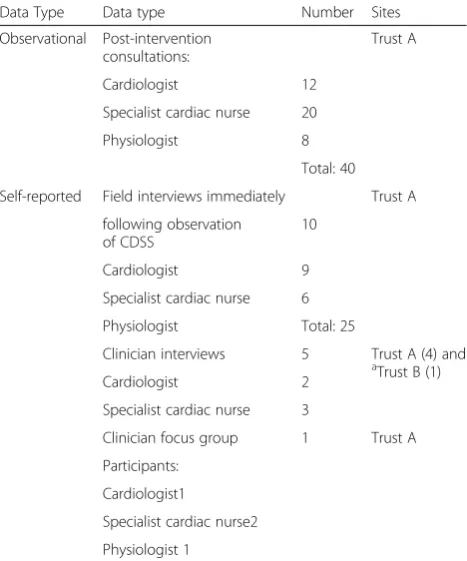
We conducted a qualitative study in Trust A during the four months following delivery of the OMA programme. This included chest pain clinic observations, followed by face-to-face interviews with clinicians, and a focus group with clinicians after the CDSS had been in use for three months. Observation enabled systematic inquiry into the nature and quality of observable behaviours, in particu-lar how the CDSS was incorporated into clinic practice. Brief interviews with clinicians immediately after each consultation encouraged reflection of the use and rele-vance of the CDSS for individual cases. Longer inter-views with clinicians following regular use of the CDSS aimed to explore their overall views of the usefulness of the tool. The observation data provided a means of con-firming the accuracy of recall at interview. The focus group allowed for discussion and exchange of views amongst clinicians about the day-do-day benefits and difficulties of using the CDSS and its potential imple-mentation in practice. Purposive sampling was used for clinic observations, to gain a maximum variation sample across all clinicians, who worked on different days of the week. Post-consultation field interviews were conducted where feasible in between appointments.
Qualitative data were collected between July and November 2010, and are summarised in Table 1. Trust B Fig. 2Screenshot of the OMA CDSS clinical data entry page
runs two separate chest pain clinics. We were unable to integrate the CDSS at the first of these clinics due to lack of internet facilities within the clinic. As a result the CDSS was only used in the second chest pain clinic. The resultant delay meant that the qualitative researchers were no longer able to observe the introduction of the chest pain clinic in Trust B.
Detailed field-notes and audio-recordings were made of all observed consultations, including brief field inter-views conducted at the end of consultations. All clinician interviews and the focus group were audio-recorded. Interview and consultation transcripts and observa-tional field-notes were imported into qualitative data analysis software (atlas.ti and Nvivo), coded and ana-lysed thematically [11]. Four of the investigators (KB, ME, RJ, HC) contributed to the identification of emer-gent themes.
We linked transcripts and field notes for the observed consultations to clinical information from patients’ med-ical records and to the recommendations of the CDSS. Insights from the case-by-case analysis of clinicians’ use of the CDSS were synthesised with themes emerging from the analysis of interview and focus group data. Staff are numbered consecutively [S1, S2]. Data collected by interview are indicated by [I]; data collected by observa-tion are indicated by [OB]; field interview by [FI] and
focus group by [FG]. . Verbatim quotes are marked with quotation marks.
This study has ethics approval (London-City Road and Hampstead REC and Riverside Research Ethics Commit-tee reference number 08/H0709/85), and research gov-ernance approval (from NHS sites).
Results
Before and after study
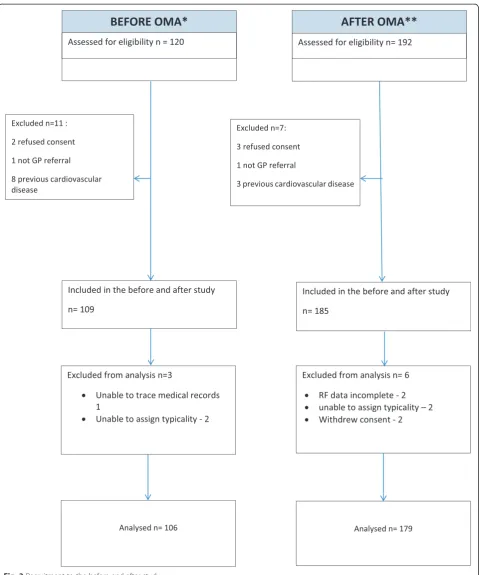
294 patients were recruited to the quantitative study be-tween November 2009 and May 2011; 285 were included in the analysis at six months (Fig. 3): 106 patients seen in a clinic that had not received the OMA programme
(Before OMA) and 179 patients seen in a clinic that had
received the OMA programme (After OMA).
Character-istics at baseline (chest pain clinic consultation) includ-ing cardiovascular risk factors and current medications are shown in Table 2. Clinicians seeing patients in the Before OMA group were cardiologists (3), specialist cardiology nurses (2) and a cardiac physiologist (1), and in the After OMA group were cardiologists (4), specialist cardiology nurses (3) and a cardiac physiologist (1). The
CDSS was used for 86 % (154/179 95 CI 81–91 %) of
patients in theAfter OMA group. CDSS was used for 81
out of 100 patients (81 %) in Trust A, and 73 out of 79 patients (92 %) in Trust B (difference 11, 95 CI 2–21 %).
The CDSS recommended investigation in 34 % (95
CI 25–43 %) of patients Before OMA and 41 % (95 CI
34–48 %) of patients After OMA. Table 3 shows the
number of patients having any investigation done within six months, by CDSS recommendation. The proportion of patients for whom the CDSS
recommen-dation was followed was 74 % (95 CI 65–82 %) in the
Before OMA group and 75 % (95 CI 69–81 %) in the
After OMA group. The proportion of patients for
which the CDSS recommended no investigation that did not have one was the same before and after the OMA intervention. Where the CDSS recommended an investigation, the proportion receiving an investigation
was 50 % [CI 34–66 %] in theBefore OMA group and
59 % [95 CI 48–70 %] in the After OMA group. The
CDSS recommended an increase in the number of medi-cation classes for 25 patients (24, 95 CI 16–32 %)Before
OMA. Of these, eight (32, 95 CI 14–50 %) patients
received at least one additional medication class, two (8 95 CI−3–19 %) received fewer medication classes and 15
(60, 95 CI 41–79 %) had no change. In the After OMA
group, the CDSS recommended an increase in the number of medication classes for 34 (19, 95 CI 13–25 %) partici-pants. Of these, 17 (50, 95 CI 33–67 %) were prescribed at least 1 additional medication class, 7 (21, 95 CI 7–35 %) were prescribed at least 1 fewer medication classes and 10 (29, 95 CI 14–44 %) were unchanged.
Table 1Qualitative data gathered after delivery of the OMA programme
Data Type Data type Number Sites
Observational Post-intervention consultations:
Trust A
Cardiologist 12
Specialist cardiac nurse 20
Physiologist 8
Total: 40
Self-reported Field interviews immediately Trust A
following observation of CDSS
10
Cardiologist 9
Specialist cardiac nurse 6
Physiologist Total: 25
Clinician interviews 5 Trust A (4) and a
Trust B (1)
Cardiologist 2
Specialist cardiac nurse 3
Clinician focus group 1 Trust A
Participants:
Cardiologist1
Specialist cardiac nurse2
Physiologist 1
a
Qualitative study
Although CDSS use was high, we found that
clini-cians used the CDSS differently than originally
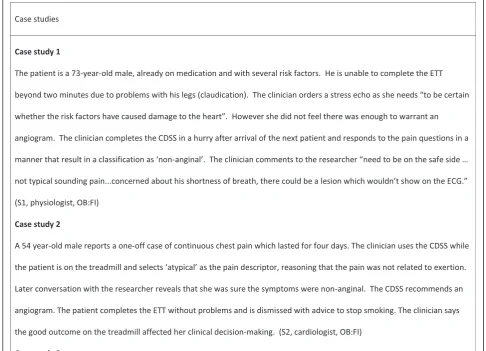
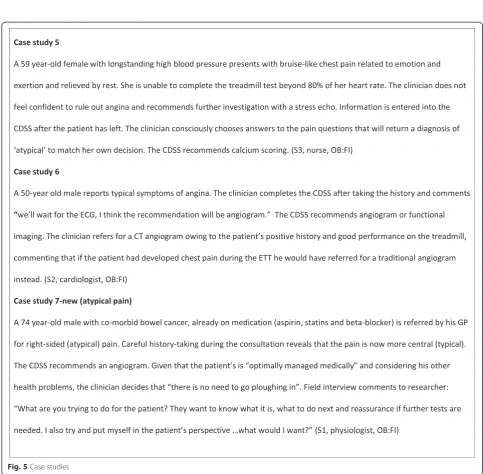
intended. Case studies draw on observational and interview data to illustrate the themes identified and are found in Figs. 4 and 5.
Fig. 3Recruitment to the before and after study
Problems with the entry of patient information into the CDSS Problems with initial pain categorisation
In the NICE guideline chest pain is labelled as ‘typical’,
‘atypical’ or ‘non-anginal’ depending on the answers to three questions (Fig. 6) [9]. However, through observa-tion it became clear that clinicians viewed translating patient reported symptoms into these three categories as problematic (see Figs. 4, 5, 7, 8 and 9). Use of the pain labels required a change to their usual practice, and the use of the label‘atypical’was frequently problematic. For example, one nurse described how she felt most of the chest pain clinicians used the term‘atypical’where pain was not thought to be cardiac but there was uncertainty. Others described a reluctance to use the term ‘ non-an-ginal’ because of its diagnostic certainty, and there were
examples of clinicians entering the description ‘atypical’ while saying that they were sure that the pain was non-cardiac. Although one nurse said that in responding to the questions he would try and stick closely to the pa-tient’s report of their symptoms regardless of his own hunches, researchers also observed clinicians consciously answering the pain quality questions in a particular way to match their clinical judgment or to manipulate a par-ticular CDSS response. In some cases, patients’ stories changed during the consultation. Further, clinicians de-scribed the skill required in eliciting‘the whole story’of chest pain from a patient, of which the three diagnostic questions represented only a part.
Dissatisfaction with entering risk factors as binary information
Clinicians expressed concern that the CDSS did not allow them to grade information about patients’ cardiovascular risk factors, as they felt entering these factors in binary form (present or absent) omitted important details they had available to them. For example, patients with particu-larly high cholesterol levels were considered to be at higher risk, yet this level of detail was not captured by the CDSS. Although the clinicians understood that the algorithm underlying the CDSS was based on diagnostic and prognos-tic research evidence, this did not reflect the way in which they understood and weighted risk factors in practice. For example, clinicians expressed frustration that risk factors that they routinely used in clinical practice, in particular family history, did not affect the CDSS recommendations.
Inability to discount available information: the exercise electrocardiogram
During the study, the treadmill exercise electrocardiogram (exercise tolerance test, ETT) was still used to assess most patients. However, in line with NICE guidance, the CDSS algorithm did not incorporate the results of the ETT. Clini-cians were unwilling to ignore additional information from the ETT and one clinician explained that she would use the CDSS only after she had interpreted the ETT so as to not
‘cloud her judgment’. At the same time, they acknowledged the limitations of the ETT’s diagnostic value. Case studies 3 and 4 provide examples of clinicians’interpretations of the patient history changing during the course of the consult-ation. Case studies 2, 5 and 6 are examples where patients’ ETT performance contributed to clinicians’ decision to deviate from CDSS recommendations.
Structural and practical barriers to using the CDSS as intended
Structural barriers to implementing the CDSS recommen-dations included inability of clinicians other than doctors to prescribe medication, and the unavailability of specific im-aging methods at the hospital site. Authorised prescribers Table 2Baseline characteristics at date of chest pain clinic
consultation
BEFORE OMA AFTER OMA
N = 106 N = 179
Age Mean (SD) 59.4 (11.0) 59.0 (11.6)
Sex
Male 52 (49 %) 97 (54 %)
Female 54 (51 %) 82 (46 %)
Risk factors:
Smoking 43 (41 %) 59 (33 %)
Diabetes 9 (8 %) 20 (11 %)
Hyperlipidaemia 34(32 %) 62 (35 %)
Medicationscurrent at chest pain clinic:
Anti-platelet 23 (22 %) 34 (19 %)
Beta-blocker 5 (5 %) 17 (9 %)
Statin 26 (25 %) 37 (21 %)
Typicality of chest pain:
Typical 20 (19 %) 46 (26 %)
Atypical 17 (16 %) 28 (16 %)
Non-cardiac 69 (65 %) 105 (59 %)
Table 3Agreement of investigations with CDSS recommendations
Investigation done
Before OMA CDSS recommendation (investigation or no investigation) followed in 78 out of 106 cases (74, 95 CI 65–82 %)
CDSS recommends:- n Done % done (95 % CI)
Investigation 36 18 50 (34–66)
No investigation 70 10 14 (6–22)
After OMA CDSS recommendation (investigation or no investigation) followed in 134 out of 179 cases (75, 95 CI 69–81 %)
CDSS
recommends:-Investigation 74 44 59 (48–70)
Fig. 4Case studies
rarely made use of the available facility for direct issuing of medication from the hospital pharmacy. Reasons cited for this were clinicians not being in the habit of prescribing (it was their usual practice to issue recommendations to the patient’s GP), GPs having a better grasp of how medication fitted with patients’ existing drug regimen and additional cost to the hospital trust. Clinicians chose readily access-ible investigations over those with limited availability (CT angiography) or longer waiting times (stress echocardiog-raphy) at the time of the study; this often led to choosing different investigations to those recommended by the CDSS. Clinicians also had to complete separate electronic records with similar information to that requested by the CDSS, which posed a competing demand and felt like du-plication of effort.
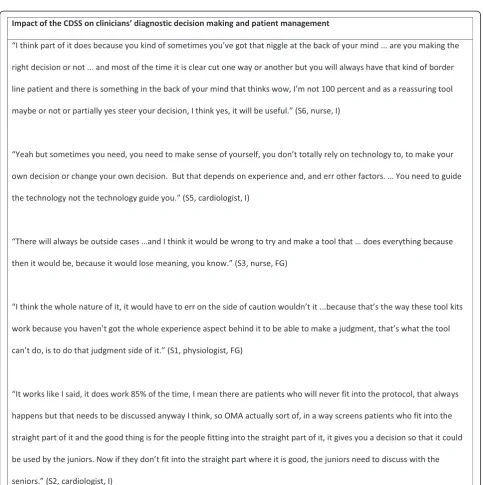
Impact of the CDSS on clinicians’diagnostic decision– making and patient management
final arbiters of any decisions to be implemented. They described the possible benefits to themselves of using the CDSS mainly in terms of providing reassurance and sup-porting a systematic approach to conducting consulta-tions. This orientation towards the CDSS as ‘decision feedback’rather than‘decision support’was also reflected in the timing of clinicians’engagement with the CDSS. In two thirds of the observed cases, clinicians used the CDSS
afterthey had communicated their decision to the patient
and the patient had left the room.
Clinicians were most likely to agree with the CDSS guidance when pain was categorised as ‘non-anginal’, resulting in a recommendation of ‘no further investiga-tion’. For some typical case presentations of angina symptoms clinicians also expressed agreement with CDSS recommendations in theory, though in practice they‘downgraded’the recommended methods of investi-gation in a few cases where they felt that a more aggres-sive approach was not in the patient’s best interest or clinically unwarranted (see Case studies 6 and 7 for examples). Clinicians were most likely to disagree with the CDSS when they had categorised the patient’s pain as ‘atypical’. In several of these cases the clinician had expressed certainty that the pain was ‘non-anginal’ but had entered it as atypical, leading to a recommendation for further investigation. Often clinicians were swayed by the presence of marked risk factors to investigate patients in the face of recommendations not to do so. In many cases the results of the exercise test were observed to influence the decision to investigate further. Case stud-ies 1,2,3, and 5 provide examples of such instances of dis-agreement. Clinicians regarded CDSS recommendations as most reliable and trustworthy - but probably also least needed - when case histories were clearly typical for an-gina or clearly non-anan-ginal.
Discussion
Our study contributes new findings to the understanding of how a CDSS is used in the initial management of a common symptom. Despite use of the OMA CDSS in 86 % of consultations for which it was available, there was
little evidence of impact on medication prescribing or on investigation choice. Through qualitative data analysis we gained an in-depth understanding of the reasons for this discrepancy. We identified problems in entering patient data into the CDSS. These included difficulties in classifi-cation of symptoms and risk factors, and in the incorpor-ation of all available clinical informincorpor-ation emerging during the consultation. In the majority of observed cases, the CDSS was used after the patient had left the room. Struc-tural and practical barriers to the use of the CDSS in-cluded the availability of investigations and the prescribing competencies of the clinicians. Analysis of observational data revealed how clinicians privileged their clinical expertise over CDSS advice, responding to CDSS recom-mendations as ‘decision feedback’ rather than ‘decision support’. There was most disagreement with CDSS rec-ommendations for patients whose pain was categorised as atypical, the group for which mapping patient symptoms to the CDSS had proved most challenging. Chest pain cli-nicians were rarely observed prescribing medication from the clinic. Taken together these data indicate little chance of the OMA CDSS influencing clinical outcomes, and as such we will not proceed to a cluster randomized con-trolled trial of the OMA CDSS.
Observing consultations in a chest pain clinic, Somerville and colleagues [12] found that doctors were engaged in practical interpretive work, actively restructuring patient narratives to meet an accepted diagnostic classification. Pain narratives were sometimes unstable and changing, and symptoms outside the canon were investigated less frequently. We have observed clinicians engaged in this interpretive work, but also struggling to use a classifica-tion that was sometimes at odds with their usual way of working, despite our efforts during CDSS development to understand clincians’ working practices. Our clinicians worked creatively with the constraints of the tool, in line with Berg’s description of how protocols for care can be circumvented, tinkered with and interpreted in many different ways [13]. We observed clinicians developing
‘workarounds’to enable the system to be used, introdu-cing the potential for unintended consequences of CDSS use [14]. Previous qualitative studies have identified CDSSs having little impact on decisions either through non-use of the CDSS [15], or use after the consultation has been completed [16]. A study of nurses using CDSS identified how they were primarily used to confirm decisions that had already been made [17].
The OMA CDSS delivered a national clinical guideline through patient specific recommendations. The constrain-ing effects of guidelines have been previously articulated, including ignoring data that cannot easily be measured, and failing to allow the tailoring of advice to individual patients [18, 19]. A major limitation of guidelines is their poor fit to complex clinical problems, particularly in the presence of Fig. 6Classification of chest pain. Source: NICE CG95 [9]
multi-morbidity, being more suited to relatively straightfor-ward clinical decisions, [20]. From our findings, this limita-tion extends to CDSSs.
A strength of our study lies in its mixed methods ap-proach. Although the quantitative data suggested that the CDSS was used, the qualitative data were essential in developing a more complete understanding of how it was
months after the chest pain clinic visit, as a proxy for suc-cessful commencement or recommendation of long term secondary prevention medication at the time of the clinic. There are many other factors affecting whether medica-tion is continued at six months, such as emergent indica-tions for medication. Although CDSS use in both trusts
was high, it appeared to be significantly different between Trust A and B. A limitation of the qualitative study is that were unable to observe Trust B after the introduction of the CDSS.
The OMA CDSS was introduced at a time of transition for chest pain services, the NICE guidance on which it was Fig. 8Problems with entry of patient information into the CDSS
based having been published four months earlier. At this time, the ETT test played a central role in chest pain clinic routines, and our main qualitative study site did not routinely use computerised tomography or computer tom-ography coronary angitom-ography for the diagnosis of angina. The NICE guidance advised against the use of the ETT, and recommended increased numbers of non-invasive tests including computerised tomography investigations. We found that the failure of the guidance to incorporate a test that was an entrenched part of chest pain clinic practice [21] added to the difficulties of the clinicians in using the CDSS. It is possible that the CDSS would have been more able to impact upon clinic processes when chest pain clinics were more able to follow the guidance. We have reported
how often clinicians’choice to investigate agreed with the CDSS recommendations (concordance). Although it might be assumed that concordance with NICE guidance reflects appropriate management, we acknowledge the limitations of concordance in the assessment of CDSS. Concordance may be affected by many and diverse things, for example the structural and practical barriers identified in this study, or the perceived appropriateness of the underpinning guid-ance for a specific clinical scenario.
Conclusions
to be categorised in a way that did not fit with clinicians’ ways of working. This, in combination with a belief on the part of participating clinicians that clinical decision making should not be driven by technology, meant that the CDSS did not substantially inform individual patient management. Qualitative methods, proved essential in deepening our understanding of the factors affecting CDSS use. Use of the CDSS may have been improved by the provision of guidance for both practitioners and patients [5] and a more
intensive training and monitoring programme [22]. CDSSs for the assessment and management of new onset chest pain may be more successful if they reflect more closely the ways in which clinicians assess chest pain. Our study has ar-ticulated barriers to CDSS use that need to be addressed in the design of future interventions.
Abbreviations
CDSS:clinical decision support system; OMA: Optimising the management of angina; NICE: National Institute for Health and Care Excellence.
Fig. 10Impact of the CDSS on diagnostic decision-making and patient management
Competing interests
The authors declare that they have no competing interests.
Authors’contributions
RJ coordinated the study, participated in data collection and analysis and drafted the manuscript. ME led qualitative data collection, participated in analysis and helped to draft the manuscript. HC participated in qualitative data collection and analysis and helped to draft the manuscript. KB led the qualitative analysis and helped to draft the manuscript. RM and SE contributed to decisions about the analyses to perform and to the quantitative analysis. KJ participated in data collection. JZ participated in the design of the study. HH participated in the design of the study. SD participated in the design of the study and constructed the CDSS. AT participated in the design of the study. GF had the original idea for the study, led its design, contributed to analysis and helped to draft the manuscript. All authors contributed to earlier drafts of the manuscript, and read and approved the final version.
Acknowledgements
We thank the following for participation in the membership of the expert panel: Bob McNamara, Mark Hamilton, Mel Lobo, Andrew Webb, Anna Herrey, Mike Rubens, Alison Pottle, Juan-Carlos Kaski. We also thank Jenny Tagney for support in setting up the study, and Katie Ruffles for her help in setting up the study and in data collection.
This work is supported by the National Institute for Health Research (NIHR) programme grant reference RP-PG-0407-10314 (NIHR, Room 132, Richmond House, 79 Whitehall, London SW1A 2NS, UK). The NIHR had no involvement in the research process or writing of this article.
Rachel Johnson has been supported by National Institute for Health Research (NIHR) fellowships during the course of this study.
Harry Hemingway is additionally supported by the Welcome Trust (086091/ Z/08/Z; http://www.wellcome.ac.uk/) and by awards establishing the Farr Institute of Health Informatics Research, London, from the MRC, in partnership with Arthritis Research UK, the British Heart Foundation, Cancer Research UK, the Economic and Social Research Council, the Engineering and Physical Sciences Research Council, the National Institute of Health Research, the National Institute for Social Care and Health Research (Welsh Assembly Government), the Chief Scientist Office (Scottish Government Health Directorates) and the Wellcome Trust (MR/K006584/1).
Spiros Denaxas is supported from a UCL Provost’s Strategic Development Fund Fellowship
Author details
1
Centre for Academic Primary Care, School of Social and Community Medicine, University of Bristol, Bristol, UK.2School of Social and Community Medicine, University of Bristol, Bristol, UK.3Department of Primary Care & Population Health, University College London, London, UK.4Centre for Primary Care and Public Health Queen Mary, University of London, London, UK.5Bedminster Family Practice, Bristol, UK.6James Paget University Hospital, Norfolk, UK.7Farr Institute of Health Informatics Research London, Institute of Health Informatics, University College London, London, UK.8NIHR
Cardiovascular Biomedical Research Unit, Barts Health NHS Trust, London, UK.
Received: 20 February 2015 Accepted: 21 July 2015
References
1. Bright TJ, Wong A, Dhurjati R, Bristow E, Bastian L, Coeytaux RR, et al. Effect of clinical decision-support systems: a systematic review. Ann Intern Med. 2012;157(1):29–43. doi:10.7326/0003-4819-157-1-201207030-00450. 2. Kawamoto K, Houlihan CA, Balas EA, Lobach DF. Improving clinical practice
using clinical decision support systems: a systematic review of trials to identify features critical to success. BMJ. 2005;330(7494):765. doi:10.1136/ bmj.38398.500764.8F.
3. Hunt DL, Haynes RB, Hanna SE, Smith K. Effects of computer-based clinical decision support systems on physician performance and patient outcomes: a systematic review. Jama. 1998;280(15):1339–46.
4. Lobach DF. The road to effective clinical decision support: are we there yet? BMJ. 2013;346:f1616. doi:10.1136/bmj.f1616.
5. Roshanov PS, Fernandes N, Wilczynski JM, Hemens BJ, You JJ, Handler SM, et al. Features of effective computerised clinical decision support systems:
meta-regression of 162 randomised trials. BMJ. 2013;346:f657. doi:10.1136/ bmj.f657.
6. Sekhri N, Feder GS, Junghans C, Hemingway H, Timmis AD. How effective are rapid access chest pain clinics? Prognosis of incident angina and non-cardiac chest pain in 8762 consecutive patients. Heart (British Cardiac Society). 2007;93(4):458–63. doi:10.1136/hrt.2006.090894.
7. Sekhri N. Rapid Acchess Chest Pain Clinics: Characteristics and outcomes of patients from six centres. London: Queen Mary University of London; 2009. 8. Michie S, Johnston M, Abraham C, Lawton R, Parker D, Walker A. Making
psychological theory useful for implementing evidence based practice: a consensus approach. Qual Saf Health Care. 2005;14(1):26–33. doi:10.1136/ qshc.2004.011155.
9. Conditions NCGCfAaC. Chest Pain of Recent Onset: Assessment and Diagnosis of Recent Onset Chest Pain or Discomfort of Suspected Cardiac Origin. London: NICE; 2010.
10. Pryor DB, Shaw L, McCants CB, Lee KL, Mark DB, Harrell Jr FE, et al. Value of the history and physical in identifying patients at increased risk for coronary artery disease. Ann Intern Med. 1993;118(2):81–90.
11. Braun V, Clarke V. Using thematic analysis in psychology. Qual Res Psychol. 2006;3(2):77–101. doi:10.1191/1478088706qp063oa.
12. Somerville C, Featherstone K, Hemingway H, Timmis A, Feder GS. Performing stable angina pectoris: an ethnographic study. Soc Sci Med. 2008;66(7):1497–508. doi:10.1016/j.socscimed.2007.12.010.
13. Berg M. Problems and promises of the protoco. Soc Sci Med. 1997;44(8):1081–8.
14. Ash JS, Berg M, Coiera E. Some unintended consequences of information technology in health care: the nature of patient care information system-related errors. Journal of the American Medical Informatics Association : JAMIA. 2004;11(2):104–12. doi:10.1197/jamia.M1471. 15. Eccles M, McColl E, Steen N, Rousseau N, Grimshaw J, Parkin D, et al. Effect
of computerised evidence based guidelines on management of asthma and angina in adults in primary care: cluster randomised controlled trial. BMJ. 2002;325(7370):941.
16. Lomotan EA, Hoeksema LJ, Edmonds DE, Ramirez-Garnica G, Shiffman RN, Horwitz LI. Evaluating the use of a computerized clinical decision support system for asthma by pediatric pulmonologists. Int J Med Inform. 2012;81(3):157–65. doi:10.1016/j.ijmedinf.2011.11.004.
17. Dowding D, Mitchell N, Randell R, Foster R, Lattimer V, Thompson C. Nurses' use of computerised clinical decision support systems: a case site analysis. J Clin Nurs. 2009;18(8):1159–67. doi:10.1111/j.1365-2702.2008.02607.x. 18. Rashidian A, Eccles MP, Russell I. Falling on stony ground? A qualitative
study of implementation of clinical guidelines' prescribing recommendations in primary care. Health Policy. 2008;85(2):148–61. doi:10.1016/j.healthpol.2007.07.011.
19. McCormack JL, Ash JS. Clinician perspectives on the quality of patient data used for clinical decision support: a qualitative study. AMIA Annual Symposium proceedings/AMIA Symposium AMIA Symposium. 2012;2012:1302–9.
20. Guthrie B, Payne K, Alderson P, McMurdo ME, Mercer SW. Adapting clinical guidelines to take account of multimorbidity. BMJ. 2012;345:e6341. doi:10.1136/bmj.e6341.
21. Cramer H, Evans M, Featherstone K, Johnson R, Zaman MJ, Timmis AD, et al. Treading carefully: a qualitative ethnographic study of the clinical, social and educational uses of exercise ECG in evaluating stable chest pain. BMJ Open. 2012;2:e000508. doi:10.1136/bmjopen-2011-000508.


![Fig. 6 Classification of chest pain. Source: NICE CG95 [9]](https://thumb-us.123doks.com/thumbv2/123dok_us/554296.1550293/10.595.56.293.87.226/fig-classification-chest-pain-source-nice-cg.webp)