Iranian Rehabilitation Journal, Vol. 13, Issue 3, Autumn 2015
Original Article
Acceleration of Upper Trunk Coordination in Young Versus old
Adults During Walking on the Level and Irregular Floor Surface
Using MTx Sensor
Manijeh Soleimanifar; Zahra Mosallanezhad
University of Social Welfare and Rehabilitation Sciences, Tehran, Iran
Morteza asgari
Sharif University of Technology, Tehran, Iran
Mahyar Salavati* ; Reza Fadayevatan; Marzie Shirazikhah
University of Social Welfare and Rehabilitation Sciences, Tehran, Iran
Mohamad Parnianpour
Sharif University of Technology, Tehran, Iran
Objectives: To evaluate the reliability of head and trunk acceleration measured by MTx sensors during
walking on Level and Irregular surfaces and to compare the differences between healthy young and old adults.
Methods: Participants were 20 young female university students and 20 non-faller elderly women in Iran,
2013. Two MTX sensors were used to measure head and trunk accelerations in the vertical (VT), anterior-posterior (AP), and medial-lateral (ML) directions while participants walked on a 7-meter walkway.
Results: ICC values in young group were higher as compared to non- faller elderly group; ICC was
greater than 0.7 for 89.47% (34/38) of variables in young group and for 60.52% (23/38) in non- faller. Intersession reliability for upper trunk coordination indices in regular surface and in young group showed highest values as compared with other conditions in both groups, whereas the lowest intersession reliability was found in irregular floor surface indices in non-faller elderly group.
Discussion: The calculated ICC, SEM, CV%, MDC values suggest that the MTX sensors provide precise
recordings and detect small changes in upper trunk accelerometric parameters. ICC values were influenced by the age and the floor condition. In healthy young, all ICC values in regular surface were higher than 0.7. Floor condition effect was noticeable in elderly especially in ML direction. During walking on irregular surface, ML acceleration, velocity and harmonic ratio in elderly showed lower repeatability.
Key words: Reliability, Upper Trunk Coordination, Walking, MTx Sensor, elderly
Submitted: 12 June 2015 Accepted: 10 August 2015
Introduction
Rhythmic movements of lower extremity which cause head, trunk and pelvic sway result in human walking [1]. Walking is a complex activity which composites of four sub-tasks; initiation and termination of locomotion, generation of continuous goal directed movement, maintenance of balance along the pathway and adaptability to the changes in the environment [2]. Two thirds of body weight including COM is in the two thirds of the body height. Maintaining this heavy structure during
visual system, gaze control and preserving visual acuity [4].
Human activities in daily life require moving in challenging environments and walking on changing types of floor surfaces in travel path [5-6], which need to continuously adapt to this complex condition. Any age related deterioration in sensory and motor function induce greater difficulty to accommodate in this situation [6]. Most of fall accidents in older people occur during walking and approximately half of them are due to tripping and slipping especially when walking on irregular terrain [7]. Despite this, few studies have examined older people gait characteristics while walking on irregular floor surfaces [7]. Uneven floor surface adversely affects gait characteristics, such as speed, especially among the people who are at risk of falling [5]. Uneven surface also causes variability which not simply interpreted just by assessing movement pattern of lower extremity [1].
Instrumental human movement analysis is usually conducted in equipped gait laboratories with force plate and gait motion analysis system as standard methods for measuring ground reaction force [5,8]. Traditional gait analysis with optoelectronic systems is expensive, hardly portable and restricted to predefined pathways. So, few strides are recorded in artificial and unfamiliar environments found in laboratories. These conditions may not accurately indicate real functional ability of participants in their daily life [9-11]. Additionally, the measurement of body accelerations should be deliberated when assessing walking patterns [2]. During the recent two decades, in an attempt to solve these practical problems, a potential alternative way, based on inertial wearable sensors has been emerged. These portable body-fixed sensors are low-cost and suitable for use in clinical settings outside the laboratory environment [8]. A range of body-fixed sensors such as foot switches, accelerometers and gyroscopes have been used to measure various aspects of human locomotion [8-9].
Nowadays, synchronized use of accelerometers and gyroscopes as an acceptable alternative has a great prospect [12]. Recent advances in miniaturization and cost benefit of the sensors has resulted a new commercial available product [11]. Xsens is a leading developer and global supplier of 3D motion tracking products, based upon miniature (MEMS) inertial sensor technology which opens new perspectives for the measurement of gait kinematics. The MTx is a small, portable and accurate 3DOF
inertial Orientation Tracker. Each MTx integrates 3D accelerometer, gyroscope and magnetometer to measure the 3D orientation of human body segments and allow the user to collect a great number of continuous gait cycles during automatic walking in real life environments [11,13]. Skin motion artifact, muscle activation and anatomical location of the attached sensors especially by an inexpert examiner make drift on the output signal [14]. So, like other clinical instruments, first and foremost the reliability and accuracy of data recorded to assess upper body coordination by MTx sensors needs to be documented. Reliability is the degree to which a measurement is consistent and free from error. Test-retest reliability shows that the measurement of a variable is consistent over time [15]. Few studies have reported the reliability of upper trunk coordination with body worn sensors while walking on uneven surfaces. Moe-Nilssen (1998) and Henriksen et al. (2004) reported good test–retest reliability of triaxial accelerometer for the measurement of lower trunk accelerations during walking [1,16]. Also Menz et al. (2003) reported ICCs ranging from 0.84 to 0.97 for patterns of head and trunk RMS accelerations during level walking [2]. Many of the studies, which focused on the reliability of upper trunk acceleration using 3D accelerometer, have targeted the gait characteristics of young individuals on even floor surfaces. However, reliability is not a fixed property and is affected by the study population and testing conditions [17].
Therefore, the purpose of present study was to evaluate relative and absolute test–retest reliability of head and trunk acceleration measured by MTx sensors during walking on even and uneven surface and to compare the differences in healthy young and old adults.
Methods
functional disorder. The Ethical committee of the University of Social Welfare and Rehabilitation Sciences approved the experimental protocol and written informed consent was obtained from all subjects prior to participation.
Apparatus - Gait was evaluated in a walkway with 7 m long by 1.5 m wide, using Inertial and Magnetic Measurement Systems (IMMSs) (Figure 1). The evaluating system included sensing units (SUs)
which were light weight boxes. Each SU integrated one 3D accelerometer, gyroscope and magnetometer. The data supplied by these sensors were combined with the measures of 3D orientation (but not the position) of the SU’s coordinate system (CS) with respect to a global, earth-based CS. Signals were digitized at a sampling rate of 100 Hz by a light portable data logger and stored for off-line analysis on a memory card [13].
X box 5X sense MTx master (data logger)
Fig 1. MTx- Miniature inertial 3DOF Orientation tracker
Procedure - Two X sense were used to measure head and trunk accelerations in the vertical (VT), anteroposterior (AP), and mediolateral (ML) directions during each walking trial. For data collection, one X sense was attached to the top of the head by a firm elastic headband, and another sensor firmly strapped over the sacrum with a rigid belt. Walking trials were performed on regular and irregular floor surface conditions. Prior to data collection, each X sense was statically calibrated on a flat horizontal surface. All participants wore their own comfortable clothing and the same thick stuck during tests [16]. Each participant was instructed to walk on the straight line; irregular and regular floor surface at their normal comfortable speed while focusing on a target set at their eye level. For each condition, three trials
were performed in a randomized order. Participants walked the whole of 7 m for each trial. The first and last two steps were excluded from the recording. Assessments were made by the same rater, in the same place at 2 sessions, 3 to 5 days apart. During the experiments, an overhead fall arresting harness system was used to avoid participants from a probably trip that may cause falling and fall-related injuries. The harness cords were adjusted to prevent the knees from coming into contact with the floor when the subject hung unsupported. The irregular walkway was made of Wooden Pieces (Figure 2) which were randomly oriented beneath a dark carpet surface, thereby reducing visual feedback of surface irregularities.
Results
A test-retest design was used to evaluate the stability of the measurement between days. In order to assess intersession reliability, the mean of extracted parameters from three trials of walking task in each condition was used for statistical analysis. Paired t-tests on the mean scores of test and retest sessions were used to check systematic bias. Two-way random model (absolute agreement definition) ICCs described by Shrout and Fleiss were calculated to estimate relative intersession reliability. For each ICC, a 95% confidence interval (CI) was reported to indicate the sampling variation. ICC values were interpreted according to Munro’s classification of reliability to describe the degree of reliability: 0.26-0.49 reflects low correlation; 0.5 to 0.69 reflects moderate correlation; 0.7-0.89 reflects high correlation; 0.9-1.00 indicates very high correlation [17].
To assess absolute reliability, standard errors of measurement (SEMs) were calculated as the square root of the mean square error term derived from
analysis of variance. SEM is directly related to the reliability of a test; that is, the larger the SEM, the lower the reliability of the test. The Minimal Detectable Change (MDC) was calculated as 1.96(CI 95%)*√2*SEM. MDC is defined as the minimal change that falls outside the measurement error in the score of an instrument used to measure a symptom [18]. In addition, coefficient of variation (CV) which is another measure of expressing the within-subject variation was determined for comparison of absolute reliability ((SD/mean)×100). This was achieved by calculating the mean CV from individual CVs.
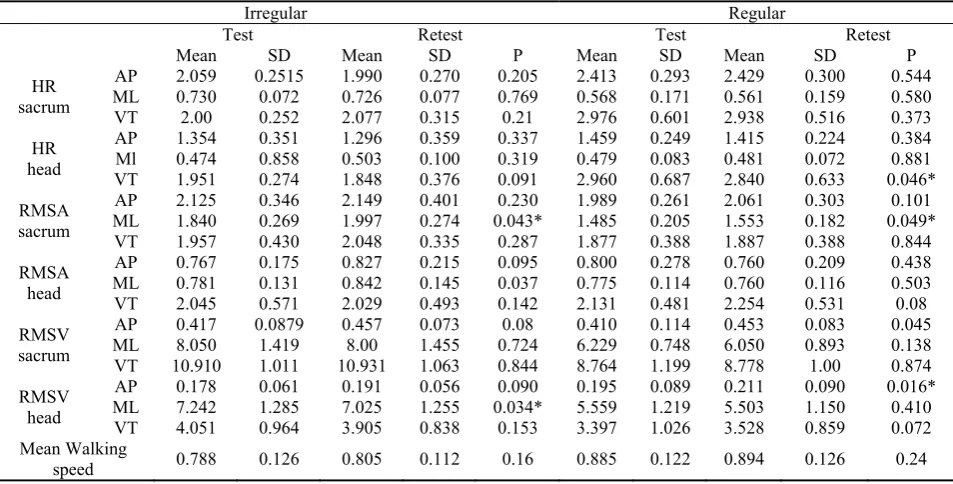
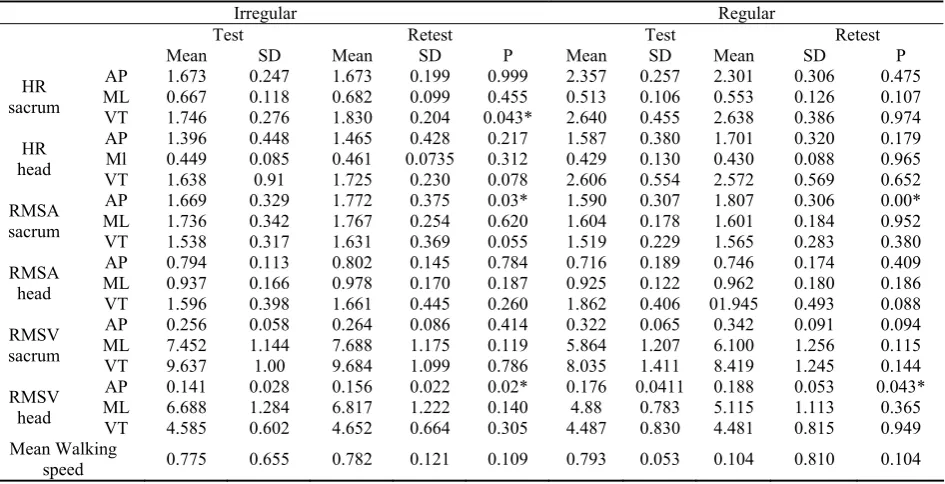
Tables (1) and (2) show the mean and SD of harmonic ratio, acceleration and velocity measures for test and retest sessions in young and elderly participants, respectively. Mean values of upper trunk coordination indices were not significantly different between test and retest sessions in most of the conditions (32/38 indices) indicating the absence of systematic bias in most of the observations.
Table 1. Mean, SD, Paired t test of upper trunk coordination indices during test, Retest walking in Irregular and Regular floor surface
for young group
Irregular Regular
Test Retest Test Retest
Mean SD Mean SD P Mean SD Mean SD P
AP 2.059 0.2515 1.990 0.270 0.205 2.413 0.293 2.429 0.300 0.544
ML 0.730 0.072 0.726 0.077 0.769 0.568 0.171 0.561 0.159 0.580
HR
sacrum VT 2.00 0.252 2.077 0.315 0.21 2.976 0.601 2.938 0.516 0.373
AP 1.354 0.351 1.296 0.359 0.337 1.459 0.249 1.415 0.224 0.384
Ml 0.474 0.858 0.503 0.100 0.319 0.479 0.083 0.481 0.072 0.881
HR
head VT 1.951 0.274 1.848 0.376 0.091 2.960 0.687 2.840 0.633 0.046*
AP 2.125 0.346 2.149 0.401 0.230 1.989 0.261 2.061 0.303 0.101
ML 1.840 0.269 1.997 0.274 0.043* 1.485 0.205 1.553 0.182 0.049*
RMSA
sacrum VT 1.957 0.430 2.048 0.335 0.287 1.877 0.388 1.887 0.388 0.844
AP 0.767 0.175 0.827 0.215 0.095 0.800 0.278 0.760 0.209 0.438
ML 0.781 0.131 0.842 0.145 0.037 0.775 0.114 0.760 0.116 0.503
RMSA
head VT 2.045 0.571 2.029 0.493 0.142 2.131 0.481 2.254 0.531 0.08
AP 0.417 0.0879 0.457 0.073 0.08 0.410 0.114 0.453 0.083 0.045
ML 8.050 1.419 8.00 1.455 0.724 6.229 0.748 6.050 0.893 0.138
RMSV
sacrum VT 10.910 1.011 10.931 1.063 0.844 8.764 1.199 8.778 1.00 0.874
AP 0.178 0.061 0.191 0.056 0.090 0.195 0.089 0.211 0.090 0.016*
ML 7.242 1.285 7.025 1.255 0.034* 5.559 1.219 5.503 1.150 0.410
RMSV
head VT 4.051 0.964 3.905 0.838 0.153 3.397 1.026 3.528 0.859 0.072
Mean Walking
speed 0.788 0.126 0.805 0.112 0.16 0.885 0.122 0.894 0.126 0.24
*P values refer to statistical significance of paired t tests used to compare differences between test and retest scores.
*AP: Anteroposterior, Ml: Mediolateral, VT: Vertical, HR: Harmonic Ratio, RMSA: Root Mean square of acceleration, RMSV: Root Mean Square of Velocity, Irreg: Irregular floor surface, Reg : Regular floor surface.
Table 2. Mean, SD, Paired t test of upper trunk coordination indices during test, Retest walking in Irreg and Reg floor surface for
non faller old group
Irregular Regular
Test Retest Test Retest
Mean SD Mean SD P Mean SD Mean SD P
AP 1.673 0.247 1.673 0.199 0.999 2.357 0.257 2.301 0.306 0.475
ML 0.667 0.118 0.682 0.099 0.455 0.513 0.106 0.553 0.126 0.107
HR
sacrum VT 1.746 0.276 1.830 0.204 0.043* 2.640 0.455 2.638 0.386 0.974
AP 1.396 0.448 1.465 0.428 0.217 1.587 0.380 1.701 0.320 0.179
Ml 0.449 0.085 0.461 0.0735 0.312 0.429 0.130 0.430 0.088 0.965
HR
head VT 1.638 0.91 1.725 0.230 0.078 2.606 0.554 2.572 0.569 0.652
AP 1.669 0.329 1.772 0.375 0.03* 1.590 0.307 1.807 0.306 0.00*
ML 1.736 0.342 1.767 0.254 0.620 1.604 0.178 1.601 0.184 0.952
RMSA
sacrum VT 1.538 0.317 1.631 0.369 0.055 1.519 0.229 1.565 0.283 0.380
AP 0.794 0.113 0.802 0.145 0.784 0.716 0.189 0.746 0.174 0.409
ML 0.937 0.166 0.978 0.170 0.187 0.925 0.122 0.962 0.180 0.186
RMSA
head VT 1.596 0.398 1.661 0.445 0.260 1.862 0.406 01.945 0.493 0.088
AP 0.256 0.058 0.264 0.086 0.414 0.322 0.065 0.342 0.091 0.094
ML 7.452 1.144 7.688 1.175 0.119 5.864 1.207 6.100 1.256 0.115
RMSV
sacrum VT 9.637 1.00 9.684 1.099 0.786 8.035 1.411 8.419 1.245 0.144
AP 0.141 0.028 0.156 0.022 0.02* 0.176 0.0411 0.188 0.053 0.043*
ML 6.688 1.284 6.817 1.222 0.140 4.88 0.783 5.115 1.113 0.365
RMSV
head VT 4.585 0.602 4.652 0.664 0.305 4.487 0.830 4.481 0.815 0.949
Mean Walking
speed 0.775 0.655 0.782 0.121 0.109 0.793 0.053 0.104 0.810 0.104
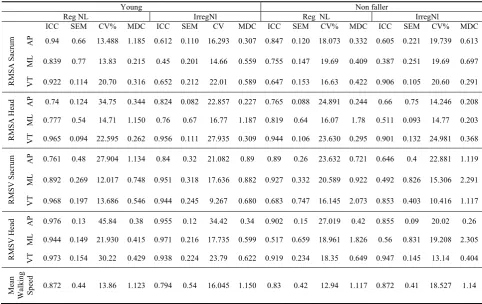
Tables (3) and (4) present ICCs, SEMs, MDCs and CVs. ICC values in the young group were higher than those of non-faller elderly group. ICC was greater than 0.7 for 89.47% (34/38) of the variables in young group and 60.52% (23/38) in non- faller elderly group. Reliability also varied with walking floor surface condition. For walking on regular floor surface, intersession reliability reached a high level (ICC>0.7) in 100% (19/19) of indices in young group and 73.68% (14/19) in non-faller elderly group. However, for walking on irregular surface, these values were obtained from 78.94% (15/19) of
young and 52.63% (10/19) of non- faller elderly group. Generally, evaluation of intersession reliability for upper trunk coordination indices in regular floor surface and in young group showed highest levels as compared with other conditions in both groups, with 67.85% (11/19) of scores having higher ICC values and 42.10% (8/19) having high values (Tables 3). The lowest intersession reliabilities were observed during walking on irregular floor surface in non-faller elderly group, with 52.63% (10/19) of scores showing low and moderate ICCs.
Table 3. Intrer session reliability of Head and sacrum Harmonic ratio while walking on Regular/Irregular floor surface for young and
non faller old group
Young Non faller
Reg NL Irreg Nl Reg NL Irreg Nl
ICC SEM CV% MDC ICC SEM CV MDC ICC SEM CV% MDC ICC SEM CV% MDC AP 0.962 0.57 12.16 0.160 0.754 0.131 12.21 0.365 0.686 0.180 12.09 0.522 0.653 0.123 14.77 0.341
ML 0.974 0.26 30.21 0.73 0.781 0.35 9.98 0.97 0.797 0.79 21.76 0.221 0.526 0.49 17.76 1.36
HR Sacru
m
VT 0.971 0.095 20.21 0.263 0.843 0.67 12.59 1.187 0.854 0.160 15.95 0.445 0.856 0.091 15.81 0.253
AP 0.723 0.124 17.05 0.345 0.845 0.139 25.92 0.387 0.652 0.206 21.32 0.573 0.617 0.304 32.12 0.844
ML 0.808 0.34 17.40 0.94 0.442 0.086 18.07 0.239 0.82 0.46 25.44 1.12 0.513 0.55 18.96 1.153
Table 4. Inter session reliability of Head and sacrum acceleration, velocity RMS and mean walking speed while walking on
Regular/Irregular floor surface for young and non faller group
Young Non faller
Reg NL IrregNl Reg NL IrregNl
ICC SEM CV% MDC ICC SEM CV MDC ICC SEM CV% MDC ICC SEM CV% MDC
AP 0.94 0.66 13.488 1.185 0.612 0.110 16.293 0.307 0.847 0.120 18.073 0.332 0.605 0.221 19.739 0.613
ML 0.839 0.77 13.83 0.215 0.45 0.201 14.66 0.559 0.755 0.147 19.69 0.409 0.387 0.251 19.69 0.697
RMSA S
acru
m
VT 0.922 0.114 20.70 0.316 0.652 0.212 22.01 0.589 0.647 0.153 16.63 0.422 0.906 0.105 20.60 0.291
AP 0.74 0.124 34.75 0.344 0.824 0.082 22.857 0.227 0.765 0.088 24.891 0.244 0.66 0.75 14.246 0.208
ML 0.777 0.54 14.71 1.150 0.76 0.67 16.77 1.187 0.819 0.64 16.07 1.78 0.511 0.093 14.77 0.203
RMSA Head VT 0.965 0.094 22.595 0.262 0.956 0.111 27.935 0.309 0.944 0.106 23.630 0.295 0.901 0.132 24.981 0.368
AP 0.761 0.48 27.904 1.134 0.84 0.32 21.082 0.89 0.89 0.26 23.632 0.721 0.646 0.4 22.881 1.119
ML 0.892 0.269 12.017 0.748 0.951 0.318 17.636 0.882 0.927 0.332 20.589 0.922 0.492 0.826 15.306 2.291
RMSV S
acru
m
VT 0.968 0.197 13.686 0.546 0.944 0.245 9.267 0.680 0.683 0.747 16.145 2.073 0.853 0.403 10.416 1.117
AP 0.976 0.13 45.84 0.38 0.955 0.12 34.42 0.34 0.902 0.15 27.019 0.42 0.855 0.09 20.02 0.26
ML 0.944 0.149 21.930 0.415 0.971 0.216 17.735 0.599 0.517 0.659 18.961 1.826 0.56 0.831 19.208 2.305
RMSV Head VT 0.973 0.154 30.22 0.429 0.938 0.224 23.79 0.622 0.919 0.234 18.35 0.649 0.947 0.145 13.14 0.404
Mean Walking Speed 0.872 0.44 13.86 1.123 0.794 0.54 16.045 1.150 0.83 0.42 12.94 1.117 0.872 0.41 18.527 1.14
The ranges of CV% for upper trunk coordination in the young group were from 12.16 to 45.84 for regular and from 9.26 to 34.42 for irregular floor surface conditions. This measure in non-faller elderly group ranged from 12.09 to 27.09 for regular and from 10.41 to 32.12 for irregular floor surface conditions. Finally, the ranges of MDC for upper trunk coordination in the young group were from 0.16 to 1.18 for regular and from 0.22 to 1.18 for irregular floor surface conditions. This measure in non-faller elderly group ranged from 0.22 to 1.82 for regular and from 0.20 to 2.291 for irregular floor surface conditions.
Discussion
Overall, the results showed that the reliability of coordination parameters was better when based on the mean of three trials of walking. To our knowledge, this is one of the first studies investigating the reliability of upper trunk coordination features obtained by 3D-MTX sensor involving healthy young and elderly subjects while walking on varied floor surfaces. Most investigators using 3D-accelerometry reported reliability of acceleration measurements in young healthy subjects
on a level surface, but Allet et al. evaluated the reliability of gait parameters measured by miniature gyroscope in diabetic patients while walking over various surfaces [5]. Present results is comparable somehow with those studies using 3D-accelerometry performed on a level surface and also with the findings of Allet et al. in diabetic patients walking on irregular terrain.
harmonic ratio in elderly group showed lower repeatability. Previous reports regarding the directional dependent control mechanisms hypothesized that AP movements from step to step were passively stable, while ML stability was more challenging and required active control strategies [19-20]. Moe-Nilssen, who investigated test-retest reliability of trunk acceleration by triaxial accelerometers, showed that walking on uneven ground decreased reliability more in ML direction as compared to other directions [1].
Our findings show that generally, elderly people tend to walk slower than the young group. The difference was more obvious in irregular floor surface conditions. Also, in both groups, the mean walking speed decreased while walking on irregular as compared with regular surface. This highlighted the effect of aging and challenging floor surface condition on walking pattern [6]. Our inter-visit ICC values for mean walking speed in both groups on regular/irregular surface were lower than those recorded in diabetic patients while walking on different surfaces (e.g. tar: 0.909, grass: 0.899, and stones: 0.918). The conflict can partly be attributed to the length of our walking pathway which was shorter (7 m) than those of Allet (50 m). Short walkways require the subject to start and brake frequently which has effect on the walking pattern and its measures.
Limitation and suggestions for future studies - In
present study, to estimate the steady state of walking speed in gait analysis, one similar method was considered for both groups of healthy young and elderly participants. Previous studies have indicated that steady state walking speed can be obtained within the first few steps for young individuals but Lindemann recommended that to achieve steady state walking in older people, gait analysis should commence after at least 2.5 m of walking [21]. Controversies in this field, highlights the need to compare the estimation of the steady state of
walking between young and older adults groups for future research.
Conclusion
The reliability was higher when the measures of trunk acceleration were calculated based on the mean of three trials of walking. The ICC, SEM, CV%, and MDC values obtained in the present study showed that MTX sensor is a precise system for the measurement of upper trunk accelerometric parameters based gait analysis. ICC values were influenced by the age and the floor surface condition. In healthy young group and on regular surface, all ICCs were higher than 0.7. Floor condition effect was considerable in elderly group, especially in ML direction. During walking on irregular surface, ML acceleration, velocity and harmonic ratio in elderly group showed lower repeatability levels. Present study supports using MTX sensors in order to precisely record and detection of small changes in upper trunk accelerometric parameters based gait analysis. It could therefore be considered as an appropriate tool for coordination assessment in gait analysis in young and elderly people under real environments.
Conflict of interest - Authors have no conflict of
interest.
Acknowledgements
The authors thanks the University of Social Welfare and Rehabilitation (USWR) for financial and Sharif university for theoretical and technical support. Also, helps by the Departments of Physiotherapy and Iranian Research Centre on Aging, USWR are appreciated. Special thank to Dr. Marzie Shirazikhah (the head), and the staff of Yas geriatric rehabilitation center for providing the place and help for study implementation.
References
1. Moe-Nilssen, R., Test-retest reliability of trunk
accelerometry during standing and walking. Archives of physical medicine and rehabilitation, 1998. 79(11): p. 1377-1385.
2. Menz, H.B., S.R. Lord, and R.C. Fitzpatrick, Acceleration patterns of the head and pelvis when walking on level and irregular surfaces. Gait Posture, 2003. 18(1): p. 35-46. 3. Kavanagh, J.J. and H.B. Maenz, Accelerometry: a technique
for quantifying movement patterns during walking. Gait and posture, 2008. 28(1): p. 1-15.
4. Pecoraro, F., et al., Reliability of the intrinsic and extrinsic patterns of level walking in older women. Gait & posture, 2007. 26(3): p. 386-392.
5. Allet, L., et al., Gait alterations of diabetic patients while walking on different surfaces. Gait & posture, 2009. 29(3): p. 488-493.
6. Marigold, D.S. and A.E. Patla, Age-related changes in gait for multi-surface terrain. Gait & posture, 2008. 27(4): p. 689-696.
during gait::: A study in healthy young and older women. Gait & posture, 2005. 22(1): p. 26-31.
8. Tao, w., et al., Gaitanalysis using wearablesensors.Sensors (Basel). Sensors, 2012. 12(22): p. 55-83.
9. Mathie, M.J., et al., Accelerometry: providing an integrated, practical method for long-term, ambulatory monitoring of human movement. Physiological measurement, 2004. 25: p. R1.
10.Schepers, H.M., Ambulatory assessment of human body kinematics and kinetics. 2009.
11.Cutti, A.G., et al., ‘Outwalk’: a protocol for clinical gait analysis based on inertial and magnetic sensors. Medical and Biological Engineering and Computing. 48(1): p. 17-25. 12.González, R.C., et al., Real-time gait event detection for
normal subjects from lower trunk accelerations. Gait & posture, 2010. 31(3): p. 322-325.
13.www.Xsens.com. 2013/8/22].
14.Kavanagh, J.J., et al., Reliability of segmental accelerations measured using a new wireless gait analysis system. Journal of Biomechanics, 2006. 39(15): p. 2863-2872.
15.Barker, S., Craik, R., Freedman, W., Herrmann,
N.,Hillstrom H, Accuracy, reliability, and validity of a spatiotemporal gait analysis system. Med Eng Phys, 2006. 28(5): p. 460-7.
16.Henriksen, M., et al., Test–retest reliability of trunk
accelerometric gait analysis. Gait & posture, 2004. 19(3): p. 288-297.
17.Salavati, M., Hadian, M.R., Mazaheri, M., Negahban, H., Ebrahimi, I., Talebian, S., Jafari, A.H., Sanjari, M.A., Sohani, S.M., Parnianpour, M., Test-retest reliability [corrected] of center of pressuremeasures of posturalstability during quiet standing in a group with musculoskeletal disorders consisting of low back pain, anterior cruciate ligament injury and functional ankle instability. Gait Posture, 2009. 29(3): p. 460-4.
18.Kovacs, F.M., et al., Minimum detectable and minimal clinically important changes for pain in patients with nonspecific neck pain. BMC musculoskeletal disorders, 2008. 9(1): p. 43.
19.Chatterjee, S.A., Mediolateral stability during gait in people with Parkinson's disease. 2010.
20.Latt, M.D., Menz, H.B., Fung, V.S. &Lord SR., Acceleration patterns of the head and pelvis during gait in older people with Parkinson's disease: a comparison of fallers and nonfallers. J Gerontol A BiolSci Med Sci, 2009. 64(6): p. 700-6.