T E C H N I C A L A D V A N C E
Open Access
Precursor-induced conditional random
fields: connecting separate entities by
induction for improved clinical named
entity recognition
Wangjin Lee
1and Jinwook Choi
1,2,3*Abstract
Background:This paper presents a conditional random fields (CRF) method that enables the capture of specific high-order label transition factors to improve clinical named entity recognition performance. Consecutive clinical entities in a sentence are usually separated from each other, and the textual descriptions in clinical narrative documents frequently indicate causal or posterior relationships that can be used to facilitate clinical named entity recognition. However, the CRF that is generally used for named entity recognition is a first-order model that constrains label transition dependency of adjoining labels under the Markov assumption.
Methods: Based on the first-order structure, our proposed model utilizes non-entity tokens between separated entities as an information transmission medium by applying a label induction method. The model is referred to as precursor-induced CRF because its non-entity state memorizes precursor entity information, and the model’s structure allows the precursor entity information to propagate forward through the label sequence.
Results:We compared the proposed model with both first- and second-order CRFs in terms of their F1-scores, using two clinical named entity recognition corpora (the i2b2 2012 challenge and the Seoul National University Hospital electronic health record). The proposed model demonstrated better entity recognition performance than both the first- and second-order CRFs and was also more efficient than the higher-order model.
Conclusion:The proposed precursor-induced CRF which uses non-entity labels as label transition information
improves entity recognition F1score by exploiting long-distance transition factors without exponentially increasing the computational time. In contrast, a conventional second-order CRF model that uses longer distance transition factors showed even worse results than the first-order model and required the longest computation time. Thus, the proposed model could offer a considerable performance improvement over current clinical named entity recognition methods based on the CRF models.
Keywords:Clinical named entity recognition, Conditional random fields, High-order dependency, Clinical natural language processing, Induction method
© The Author(s). 2019Open AccessThis article is distributed under the terms of the Creative Commons Attribution 4.0 International License (http://creativecommons.org/licenses/by/4.0/), which permits unrestricted use, distribution, and reproduction in any medium, provided you give appropriate credit to the original author(s) and the source, provide a link to the Creative Commons license, and indicate if changes were made. The Creative Commons Public Domain Dedication waiver (http://creativecommons.org/publicdomain/zero/1.0/) applies to the data made available in this article, unless otherwise stated.
* Correspondence:[email protected] 1
Interdisciplinary Program for Bioengineering, Graduate School, Seoul National University, 103 Daehak-ro, Jongno-gu, Seoul 03080, South Korea 2Department of Biomedical Engineering, Seoul National University College of
Background
With the recent application of artificial intelligence to the medical field, health information systems are expected to handle medical data in the form of unstructured text. The unstructured clinical text conveys descriptions of patients’ health information, including their histories of illness and hospital treatment. Salient concepts that express a patient’s health status are represented by named entities (NEs) in the text. The identifying textual mentions of health-related concepts, termed clinical named entity recognition (NER), is a sub-problem in the field of clinical natural language processing (NLP) [1]. The health information that requires identification can range from a single entity to an elaborate description containing many entities. Heterogeneous clas-ses of clinical entities have been employed in recent stud-ies; these are strongly related to clinical activities, such as medical examination, medication, and diagnosis [2–7].
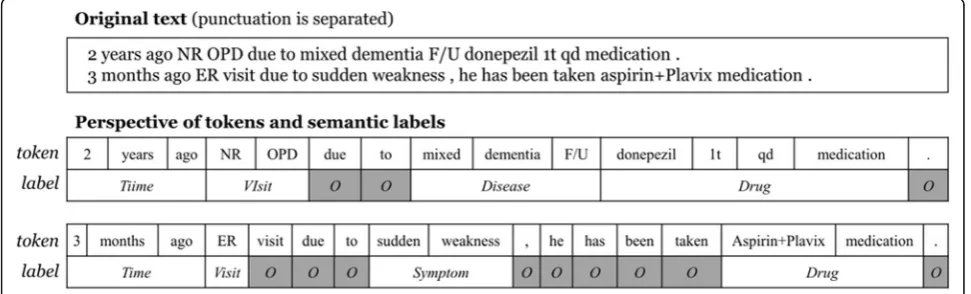
The NER problem consists of identifying spans of entities and attaching labels indicating the appropriate semantic class, as shown in Fig.1. In the NER task, the text can be seen as a word (or token) sequence, and the most advanced NER models are therefore based on sequence labeling ap-proaches that use machine learning methods [3, 4, 8, 9]. The concept of conditional random fields (CRFs) [10] has demonstrated promising results in many sequence labeling problems, including NER [3, 10–14], as well as a deep learning architecture applied to the NER task [15,16]. CRF models are particularly effective for text processing because they learn transition factors between labels of single tokens, assuming that the current label is conditioned on both current observations and the immediately preceding label. The first-order constraint is applied in order to reduce computational complexity and to maintain the model’s simplicity.
However, the constraint on the labels’ adjacency pre-vents the model from expressing transition dependency between entities separated by a long distance. NEs tend to be separated by non-entity words in NER problems, and this innate attribute inhibits the first-order CRF
model’s ability to capture dependencies between NE la-bels when the two entities are separated by non-entities that are outside tokens [17]. Therefore, CRF models using the first-order transition factor have difficulty in capturing higher-order interdependencies of NEs.
More specifically, we assumed that 1) named entities are prevalent in clinical texts, 2) the entities in clinical texts are semantically related, thus the information of preceding entity’s label would be an important feature for an NER model’s prediction of a certain label (at a time step), 3) the labeling mechanism of the CRF model that uses label transition information as one important feature would be suitable for clinical NER. However, according to the study published by Dan Roth’s group (CoNLL 2009), it is limited to use the transition infor-mation, especially for NER in the first- or second-order model based on Markov assumption because the named entities are generally separated each other in a text.
Previous NER studies have focused on methods of exploring long-distance dependencies in NER while main-taining computational tractability. Conventional high-order CRFs is known to be intractable in practice because they multiply the feature space and require more training data to prevent the data sparseness problem [18]. Sarawagi and Cohen proposed a semi-Markov CRF [19] that treated the same consecutive labels as a segment and used the label transition between adjoining segments. Subsequent studies have proposed using pre-defined label patterns to implement high-order CRFs [20–22]. However, these methods suffer from limitations associated with the management of entity transitions within non-entity labels of arbitrary length.
This study focuses on using the interdependency of NEs separated by an arbitrary number of non-entity to-kens, a condition that is predominant in clinical texts but rarely captured by first-order CRF models. In order to minimize the increase in the model’s computational complexity associated with the extraction of long-distance label transition information, this study proposes
an induction method that allows information to propa-gate from one state to state between two entities through non-entity sequence within a single instance.
Concentrating on the CRF model study rather than the medical NER, this paper would briefly introduce re-cent studies in medical NER. Deep-learning based methods for clinical concept identification are actively studied especially based on recurrent neural network structures [16, 23–28]. In the long short-term memory and CRF architecture, the CRF is still used for labeling of a sequence because the CRF model can jointly use neighboring tags in its output decision [15]. In order to automate medical NER a research [29] has been pro-posed to incorporate active learning. Once named en-tities are extracted, the identified terms can be utilized in order to derive more information beyond textual data, such as temporal information extraction [3, 30], drug-disease relationship recognition from large scale medical literature [31], and identification of risk factors related to a particular disease [32]. In order to support re-searchers requiring NER modules, off-the-shelf medical NER programs are recently published such as CLAMP [33] and MetaMap Lite [34].
The remainder of this paper is organized as follows. The Methods section details the proposed CRF model and the model evaluation method. The Results section presents the evaluation results, and the Discussion sec-tion considers several observasec-tions related to the use of the proposed model in clinical NER. The Conclusion section summarizes the study’s main findings.
Methods
Conditional random fields
In the conventional CRF model applied to NER, a textual instance (i.e., sentence) can be represented as a pair (x,y) wherex is an observed feature sequence including one or more words (tokens) andyis the feature sequence’s corre-sponding label sequence. Because the text is a linear sequence of tokens, the CRF for NER takes the form of a linear chain. The length ofx is the number of tokens, and the sequence yhas the same length as x. The label is hid-den, and a hidden state value set consists of the target entity labels and a single non-entity label for non-entity tokens. The CRF model then represents the conditional distribu-tionP(y|x) as an equation of feature functions as follows:
pð Þ ¼yjx 1 Z xð Þ∙
YT
t¼1 exp
XK
k¼1θkfkðyt;yt−1;xtÞ
n o
;
ð1Þ
where fk is a kth arbitrary feature function having the
corresponding weight θk, K is the number of feature
functions,t is the time step,T is the number of tokens in an instance of x, and Z(x) is a partition function
summing the numerator for all possible y sequences [35]. The learning objective is to find the weight set that maximizes the conditional distribution. The functionfk is
a binary indicator function that has a value of 1 only if the function matches the target condition, and is otherwise 0. Dependencies between random variables are presented in the form of feature function fk in the CRF; the feature functions are either transition factors or observation factor functions. The transition factors in the CRF model take the form offkij(y,y’,x) =1{y = i}1{y’= j}whereiandjare cer-tain label symbols having transition relationship according to this function. The observation factors takes the form as Eq. (2) whereiandoare certain symbols having an expli-cit relationship according to this function:
fkioðy;y’;xÞ ¼1fy¼ig1fx¼og:: ð2Þ
Based on this definition of the feature function, the CRF model explicitly represents not only observation informa-tion but also label transiinforma-tion informainforma-tion for sequence labeling. For instance, presume a set {A,B,O} as the label symbol set; assignAorBto NEs, assign a label symbolO
to non-entity tokens, and presume a label sequence of length 4, [A,B,O,B], where the first occurrence of entityB
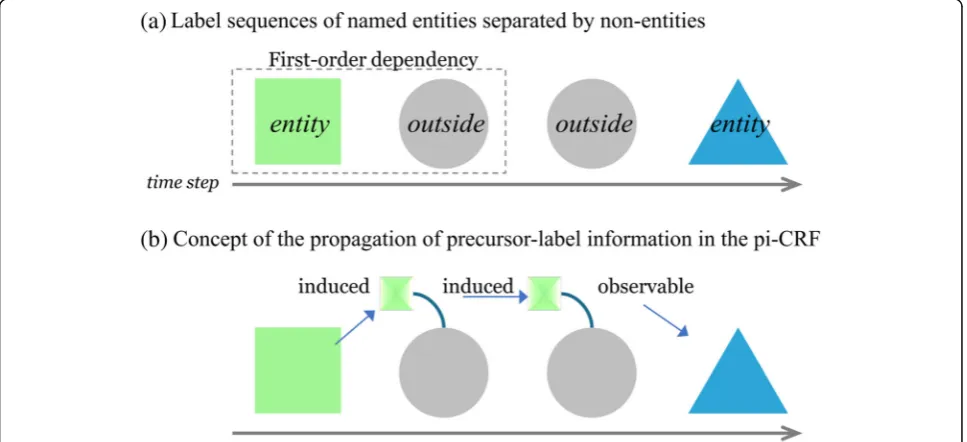
follows entity A, and a single non-entity token exists between the two entityBs. The first-order CRF models only those label transitions between adjoining state labels, that is, the label transition data {(A,B), (B,O), (O,B)}, in which the transition between labels A and B is explicitly expressed. Presume another label sequence [A, O,…O,B] where entityAprecedes entityBby some distance and an arbitrary length of consecutive non-entity tokens are be-tween the two NEs. The first-order CRF model learns only the label transitions {(A,O), (O,O), (O,B)} from the data, in which the dependency (A, B) is not explicitly cap-tured by the model and the fact that entity A pre-cedes entity B is not learned during the training time. Because the CRF model treats single observation to-kens as single time steps in a sequence, the gap size between two separate entities is broadened by the number of intermediary non-entities, as shown in Fig. 2.
Precursor-induced conditional random fields
In order to improve the CRF model for NER applica-tions, this study introduces a precursor-induced CRF (pi-CRF) model to capture specific long-distance transi-tion dependencies between two NEs separated by mul-tiple non-entities. The pi-CRF model:
Uses non-entity labels to propagate transition infor-mation between separated NEs;
Retains the first-order model structure to reduce the model’s computational complexity than the second-order or higher-second-order CRF;
Focuses on label subsequences with the [entity,
outside+,entity] pattern, as shown in Fig.3(a), where theoutside+notation denotes one or successive non-entity label symbols;
Adds a memory element to the hidden state variables to represent those states labeled as non-entities, such that the initial outside label in a non-entity subsequence propagates its explicit first-order dependency on its adjacent entity to
the next outside label, which in turn propagates the information to the next outside label, as shown in Fig. 3 (b); and
Uses an induction process to transmit the information from the firstentitythrough multiple
outsidelabel sequence to the secondentitystate, even though the model uses the first-order depend-ency (Fig.3(b)).
Modifies the observation feature functions of the CRF in order to share observation symbols among
outsidelabel symbols (Eq.4).
Label induction
In the pi-CRF, a state with anoutsidelabel binds with an additional memory element and behaves as an informa-tion transmission medium, delivering informainforma-tion about the presence or absence of the preceding entity forward, which requires the expansion of the hidden state value set (label symbols). The entity label symbols are col-lected from the training data, and the expanded state value set is eventually derived by a concatenation of
Fig. 2Example of entities separated by non-entity words in the CRF model (S: symptom;D:drug;O:non-entity)
entity label symbol and the outside label symbol. The concatenated outside label symbols thus indicate that the outside label follows a specific entity label. As a naming convention, we use label[O]+ to implicitly indi-cate that the sequence of O (outside) labels follows the concatenated label series. In the example, the symbol
A[O]+ is one outsidelabel symbol that indicates that an entity A precedes itself, and O[O]+ is one fragmented
outside label symbol indicating that no entity has occurred before this non-entity state. The CRF models distinguish the features for observation symbols and the label symbols. Thus, any types of label symbols do not violate the token symbols, and any label naming conven-tion can be used.
The form of the pi-CRF is derived from Eq. (1), and the conditional probability distribution of the CRF model extension takes the form of feature functions as follows:
pðy;ajxÞ ¼ 1 Z xð Þ∙
YT t¼1exp
XK
k¼1θkfkðyt;yt−1;xt;at;at−1Þ
n o
;
ð3Þ
where the variableastores the induced label informa-tion, and the value ofatis activated by the value ofat-1 and yt. The conjoined variables a and y are eventually used to derive a newly induced label sequence: onceatis activated,attransmutes the value of yt(see the Code 1). Based on this model, the dependency of label transition
is engaged within only adjacent tokens (i.e., ytand yt-1) because this model is designated to keep the first-order structure. Thus, the information exists flows forward with the induced outside label by the first-order transi-tion. This structure makes the conveyed information flows forward regardless of the distance.
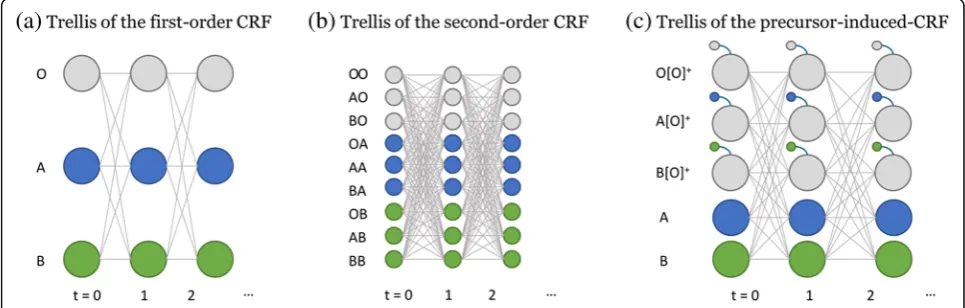
This induction process subsequently expands the ori-ginal label symbol set inside the model, producing newly induced and multiple outside label symbols instead of the singleoutsidelabel symbol. For example, the process modifies an original label sequence [A,O,⋯O,B] to [A,
A[O]+,⋯A[O]+,B] according to Code 1. This transform-ation helps the model learn long-distance transitions be-tween successive NEs even in the first-order form: from the modified example sequence, the model can learn label transition data {(A[O]+,B)} where the entity B de-pends on the non-entitytakingentity Aas its precursor. This process also generates a trellis structure (Fig.4(c)) that is slightly more complex than the trellis generated by the conventional first-order CRF model (Fig. 4 (a)), but simpler than the trellis generated by a conventional second-order CRF model (Fig. 4 (b)). The CRF models generally have as many hidden state options (represented by the nodes in Fig.4) as there are variables at each time step, and each combination of hidden states denotes a path forward. IfN is the number of hidden states in the original first-order CRF model, the pi-CRF model intro-duces N additional new states; however, this increase in computational complexity is relatively moderate com-pared to the increase induced by second- or higher-order CRF models. In addition, if the IOB2 tagging scheme [36] is applied to the pi-CRF model, the increase in the num-ber of newly induced hidden states is halved.
One of the main factors determining the CRF model’s complexity is the model’s graphical structure. The struc-ture can be presented in the form of a tuple. Thus, the structures of the first-order CRF can be presented in
(yt-1, y t, xt). Because the relationship between ys is re-lated to transition, the number of transition pair (yt-1,yt) can beN2. It means that at leastN2calculations are re-quired for each time step of a sequence in both of the training and testing time. In the same way, the graphical structure of the second-order CRF can be presented in (yt-2,yt-1,yt,xt) and the transition pair (yt-2,yt-1,y t) de-rives at least N4 (=N2 times N2) calculations for each time step in training and testing the second-order model. According to the formulation of the pi-CRF (Eq.
2), the variable a does not act as a hidden variable but interacts with the variable yin order to expand the pos-sible values of the variabley.This system allows the pi-CRF to operate in the first-order structure and it keeps the model’s complexity feasible.
Observation symbol sharing
It is worth addressing one of the attributes of the pi-CRF. The model uses modified observation feature func-tions. The observation feature function fkio (Eq. 2) dir-ectly implies that a certain label i has ‘one-to-one’ relationship with a certain observation symbol o. If a label symbol does not have a relationship with a particu-lar observation symbol, its relationship is not trained.
The label induction process makes multiple outside label symbols (i.e.,‘label[O]+’symbols), instead of using one single outside symbol (i.e.,‘O’symbol for the outside label). This induction process would interrupt an outside label symbol to have relationships with whole observa-tion symbols related to non-entities.
Finally, each outside label symbol has relationships with only a portion of observation symbols. For the same training data, it is generally known that machine learn-ing models with more hidden states are more likely to experience data sparseness problems because of their in-creased feature dimensions [37]. Likewise, in our devel-opment period, we observed that the first-order CRF performs worse if the conventional model was trained with the induced label pattern.
In order to prevent the performance decrease, the multiple outsidesymbols are allowed to share an obser-vation symbol each other in the pi-CRF model, accord-ing to the followaccord-ing observation feature function:
fkio y;y
0
;x
¼1fx¼og∙1fi∈¬outside and y¼igþ1fi∈outside and y∈outsideg ð4Þ
The second and the third indicator terms in the right-hand side determine whether the y value is an outside label symbol or not. If the i (the corresponding label symbol of the function fk) is not outside symbol, then this equation tests whether theyvalue is equal toi. Con-trary, if theiis an outside symbol, then the third indica-tor term has value 1 as long as the value of the y is an
outside symbol. Unlike the feature functions in the con-ventional CRF constrain ‘one-to-one’ relationship be-tween a label symbol and an observation symbol in a feature function, the third indicator term allows ‘ many-to-one’relationship between whole outside label symbols and one observation symbol.
In the pi-CRF, the model used the Eq. (4) for its obser-vation feature function instead of using the Eq. (2) that is used in the conventional CRF. By way of illustration, presume a token, “doctor,” occurred with three outside label symbols (O[O]+, A[O]+, and B[O]+) in the training set. According to the definition of the observational feature function constraining one-to-one relationship, a first-order CRF has three distinct feature functions
faio(x= doctor,y= O[O]+),fbio(x= doctor,y= A[O]+), and
fcio(x= doctor, y= B[O]+). Although the original CRF treats the three feature functions independently, the pi-CRF has one single feature function for the observation symbol and the outside label symbols, for instance,
fkio(x= doctor,y=outside symbol).
Model implementation
Both the original and the pi-CRF models were imple-mented using Java. The basic CRF structure and algo-rithms were implemented in MALLET [38]. The pi-CRF model was trained using the original linear chain CRF al-gorithms without modification because the graphical architecture of the pi-CRF model is fixed as a template for each time step in the same manner as in the original CRF model. In order to train the pi-CRF model, the L-BFGS optimization method [12] andl2-regularization [39] were used to exploit the conventional CRF model’s most advan-tageous features [35]. Furthermore, the Viterbi algorithm was used for inferences from unlabeled sequences. The executable files are available online.1
Parameter tuning
In order to train both models properly, the model pa-rameters were regularized during the development phase. In both the original and the pi-CRF models, l 2-regularization [39] was used in order to avoid overfitting, and the form of regularization is as that in Eq.5:
−XKk¼1 θ2k
2σ2; ð5Þ
where K is the number of feature functions and θk is
the weight of the kth feature function fk, and σ is the hyper-parameter for the regularization that adjusts the amount of penalty. The regularization term is applied to a log-likelihood form of the CRF models and penalizes large weights.
During the model development process, the training data were split by 8:2 for each training and development set and the parameter σwas chosen to provide the best F1-score for the development set. The parameter tuning was independently performed on each data set, and the third feature set was used during the tuning process.
Results
Dataset description
All the experiments were performed on the NER sets in clinical and general domains: English clinical texts (i2b2 2012 NLP shared task data [3]), rheumatism patients’ dis-charge summaries obtained from Seoul National University Hospital (SNUH) [40], and the CoNLL-2003 NER shared task corpus [41]. The documents in the SNUH set were written using English and Korean. The discharge summar-ies were annotated using the IOB2 tagging scheme [36].
Although the original annotation in the i2b2 2012 data contains more semantic classes, this evaluation was con-ducted using the problem, test, and treatment entities. For the SNUH corpus, the entities of symptom, disease,
clinical lab test, medication, and procedure/operation
were used. We are interested in identifying clinical events related to a patient’s clinical events. Thus, we used the clinical semantic classes listed above in our evaluation. For the CoNLL-2003 data, the entities of
location, person, organization, and miscellaneous were annotated from the general domain news articles.
Tables1and2show the data and annotation statistics for each data set. The training and testing sets in the i2b2 2012 and the CoNLL-2003 NER sets were divided following the official distribution set by the data source administrators.
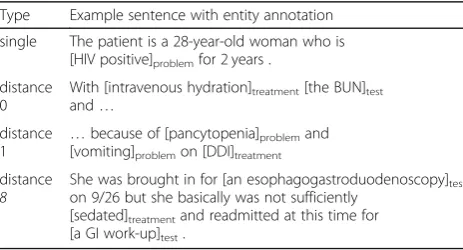
As we assumed that a significant portion of the NEs is separated in sentences, we measured the word distance between the entities in the data sets. The distance de-pendency was measured within each instance. Table 3
shows examples of the distances between entities in the i2b2 corpus and Fig. 5 shows the distributions of dis-tances between entities in the entire data set for each corpus. The median distance value between entities was 3 and the mean values were within the range of from 3 to 5, indicating that the NEs in the data sets tended to be separated by 3 to 5 non-entity tokens. The data also indicates that the number of entities within the
first-order range is less than the number of entities within the second- or higher-order ranges. In addition, the ra-tios of the number of entities having transition depend-ency to the total number of entities were 0.85, 0.73, and 0.78 for i2b2 2012, SNUH, and CoNLL2003 data sets, respectively. These values indicate that in most cases, entities tend to be interrelated in an instance, rather than being present as single entities.
Feature settings
Three types of feature settings were investigated in this evaluation, as summarized in Table 4. The setting #1 is the simplest available, and the setting #2 is the configur-ation in which character-wise prefixes and suffixes could be exploited. Although these two settings use only simple features, these configurations reduce the potential bias that the features could exert on the performance compari-son. The setting #3 implemented features used in previous evaluations of NER methods for each data set [17,40,42]; some particular features that are easy to implement were selected for use here. Also,“Token”and“n-gram”are typ-ical features used in NER. The morphologic information used included character-wise affixes (i.e., the first two characters of a token), capitalization patterns (e.g., all
Table 1Data specification
Corpus Domain Set Article Sentence Token Entity
i2b2 2012 Clinical Train 190 7,258 94,836 11,239
Test 120 5,547 78,564 9,623
SNUH Clinical Train 196 11,669 116,402 18,383
Test 193 11,042 107,666 17,125
CoNLL 2003 General Train 946 14,987 203,621 23,499
Test 231 3,684 46,435 5,629
Table 2Annotation statistics
a) i2b2 2012
Set Problem Test Treatment
Train 4,962 2,558 3,719
Test 4,270 2,140 3,213
b) SNUH
Set Symptom Test Disease Medication Procedure
Train 3,923 4,559 5,084 3,642 1,175
Test 3,737 3,917 4,828 3,496 1,147
c) CoNLL 2003
Set Location Person Organization Miscellaneous
Train 7,140 6,600 6,321 3,438
Test 1,656 1,617 1,662 694
Table 3Example sentences of the entity distances (single: entity not having a precursor)
Type Example sentence with entity annotation
single The patient is a 28-year-old woman who is [HIV positive]problemfor 2 years .
distance 0
With [intravenous hydration]treatment[the BUN]test
and…
distance
1 …
because of [pancytopenia]problemand [vomiting]problemon [DDI]treatment
distance
8 She was brought in for [an esophagogastroduodenoscopy]teston 9/26 but she basically was not sufficiently [sedated]treatmentand readmitted at this time for
capitalized or capitalization at the word beginning) [17]. Matching indicates whether a token matches a controlled vocabulary, e.g., the previous token is an obvious modifier of the current token, or a token is matched to a list consist-ing of the first entity tokens in the trainconsist-ing data (fre-quency > 10) as performed by Li, et al. [43].
Performance evaluation
We used the three NER datasets to compare the proposed model structure with the first- and the second-order linear chain CRFs, and semi-Markov CRF [19], high-order CRF [18] that are variants of the CRF leveraging higher-order label transition dependency.
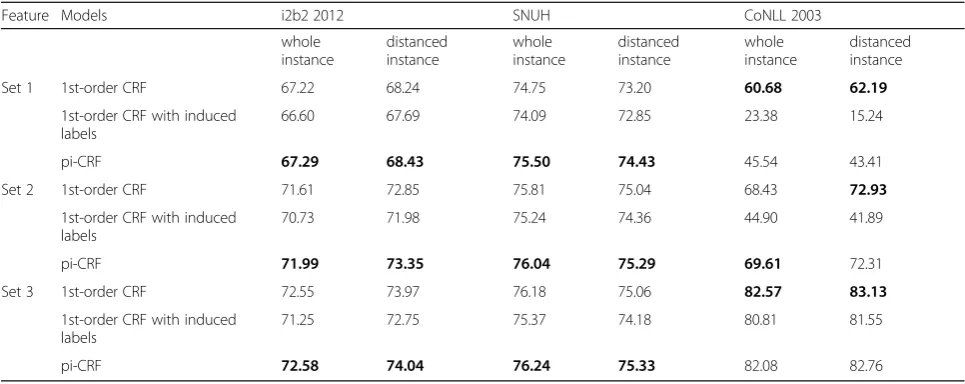
At first, we compared the pi-CRF with the first-order models. Table 5 shows the F1 scores of the first-order CRF, the first-order CRF trained with the induced labels, and the pi-CRF for each test set. F1 score is harmonic mean of the precision and recall scores. We first tested the models on all instances in each data set, and then tested the models on only those instances having two or more entities. The table shows that the proposed model structure offers a demonstrable improvement over the first-order models. The pi-CRF showed higher F1scores
for all feature settings on both the i2b2 2012 and the SNUH data sets.
In addition, the first-order CRF with induced labels shows the worst performance than others. Even though the in-duced label patterns can be easily obtained in the first-order model, we can see that the use of the label induction without the ‘observation symbol sharing’ in the conven-tional model rather negatively affects its performance.
We also evaluated higher-order CRF models such as the conventional second-order CRF, semi-Markov CRF [19] and the high-order CRF [18,20] implemented by A Allam and M Krauthammer [44]. The semi-Markov CRF and the high-order CRF are CRF variants using higher-order transition dependencies. The two CRF variants were trained with the stochastic gradient descent for 50 epochs. The results are reported in Table6. As shown in the table, the pi-CRF shows a bit better performance than the other models in several settings and the pi-CRF also shows similar performance with the variants in a complex feature set.
In addition, we may observe the performance of the higher-order models including the pi-CRF were de-creased in the general domain set (CoNLL 2003) in the simple feature settings. When we compare this result
Fig. 5Histograms of distances between named entities in each corpus. The number‘n’on the x-axis means n non-entities exist within the two entities
Table 4Summary of the feature settings. (The w denotes the window size. If the value is absent, only feature of the current token is
used. The n denotes the n of the n-gram. The‘len’denotes the length of affixes. The matching features denote the result of
controlled vocabulary matching)
Set Token Norm-token n-gram character affix capitalization POS/Chunk Matching
#1-context w = 3 w = 3
#2-morph w = 3 w = 3 len= 2~3
w = 3
#3-i2b2 w = 5 w = 5 n = 2
w = 5
len = 2~7 w = 3
w = 1
#3-snuh w = 5 w = 3 n = 2
w = 5
len = 2~3 modifier /control
#3-conll w = 5 len = 3~4
w = 5
with the corresponding tests in Table5, the pi-CRF per-forms worse than the conventional models for the CoNLL data, though, we may interpret the performance decrease of the higher-order models in naïve feature set-ting might be expected.
Table7compares the proposed model’s training and in-ference times using the feature setting #3 with the conven-tional models. The table shows the numbers of parameters, states, elapsed training time, training time per iteration, and elapsed inference time. These values indicate that the pi-CRF design was slightly more complicated than the first-order CRF, although the proposed design was less complicated than the second-order CRF while still
exploiting the transition information between NEs sepa-rated by long and arbitrary distances.
Result analysis
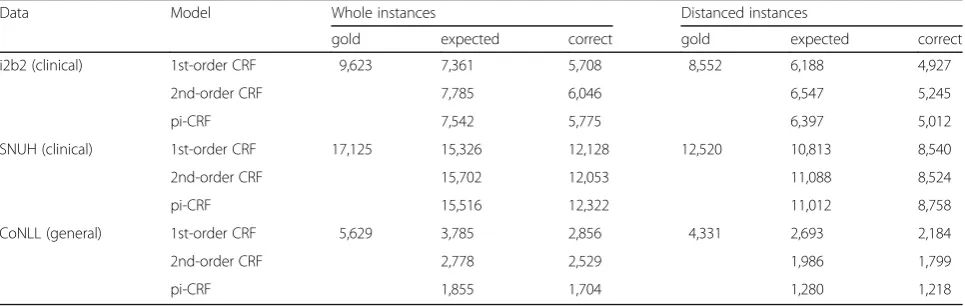
We also examined the model’s behavior on the test data set. Table8shows the numbers of predicted entities and correct predictions on each held-out data set, using feature setting #1. For the clinical data sets, the models that used long-distance transition dependency (i.e., the second-order and pi-CRF) tended to predict more entities than the first-order model, and the pi-CRF model correctly predicted more en-tities than both the first- and second-order CRF models, resulting in an improvement in recall performance: + 0.7 Table 5F1scores of the first-order models and the pi-CRF for each corpora. The first value (‘whole instance’) is F1score with whole
test set and the second value (‘distanced instance’) is F1score evaluated only with instances having transition dependency between
NEs. (bold: best performance, shaded: pi-CRF)
Feature Models i2b2 2012 SNUH CoNLL 2003
whole instance
distanced instance
whole instance
distanced instance
whole instance
distanced instance
Set 1 1st-order CRF 67.22 68.24 74.75 73.20 60.68 62.19
1st-order CRF with induced labels
66.60 67.69 74.09 72.85 23.38 15.24
pi-CRF 67.29 68.43 75.50 74.43 45.54 43.41
Set 2 1st-order CRF 71.61 72.85 75.81 75.04 68.43 72.93
1st-order CRF with induced labels
70.73 71.98 75.24 74.36 44.90 41.89
pi-CRF 71.99 73.35 76.04 75.29 69.61 72.31
Set 3 1st-order CRF 72.55 73.97 76.18 75.06 82.57 83.13
1st-order CRF with induced labels
71.25 72.75 75.37 74.18 80.81 81.55
pi-CRF 72.58 74.04 76.24 75.33 82.08 82.76
Table 6F1scores of higher-order CRF models and pi-CRF for each corpora. The first value (‘whole instance’) is F1score with whole
test set and the second value (‘distanced instance’) is F1score evaluated only with instanced having transition dependency between
NEs. (bold: best performance, shaded: pi-CRF)
Feature Models i2b2 2012 SNUH CoNLL 2003
whole instance distanced instance whole instance distanced instance whole instance distanced instance
Set 1 2nd-order CRF 69.46 70.88 73.43 72.21 58.34 54.52
semi-Markov CRF 67.87 68.91 73.44 71.61 37.31 34.13
high-order CRF 68.38 69.52 73.50 71.69 36.97 33.87
pi-CRF 67.29 68.43 75.50 74.43 45.54 43.41
Set 2 2nd-order CRF 70.99 72.31 74.31 73.27 73.21 72.26
semi-Markov CRF 72.19 73.54 76.01 74.87 63.19 63.32
high-order CRF 71.50 72.74 76.11 74.97 63.56 63.76
pi-CRF 72.30 73.61 76.20 75.47 69.61 72.31
Set 3 2nd-order CRF 71.75 73.01 75.17 74.05 83.13 83.96
semi-Markov CRF 69.30 70.73 76.70 75.79 82.47 83.29
high-order CRF 69.26 70.64 76.73 75.91 82.18 82.80
and + 1.13 for the i2b2 and SNUH, respectively. The final F1-score of the pi-CRF was improved than the first-order model, and we may indicate that the improvement of the re-call consequently affects the improvement of the F1-score of the pi-CRF. However, the models that used long-distance transition dependency (the second-order and the pi-CRF) showed the opposite behavior on the general data set, pre-dicting noticeably fewer entities than the first-order model, although most of the higher-order models’predictions were correct. Thus, the precision performance of the pi-CRF showed an improvement of + 16.4 for the CoNLL set, even though the recall performance was relatively low.
The models’ expectation performance were add-itionally analyzed along the distances from the
pre-ceding entities. Trying to analyze the models
according to the distance between the entities, we in-evitably used the recall. Because this evaluation of the models with recall alone has its limitations, so this result was presented as an auxiliary indicator. The initial recall scores were calculated only for the en-tities not having precursors, and then the recall scores were updated sequentially by adding entities
along the distances from 0 to the maximum distance for each data set. Figure 6 shows the analysis result. The graph of the models moved similarly along with the distance between entities: according to this figure, we can observe the recall scores of the CRF decrease as distance increases. The CRF models seem to miss the entities following when two entities are consecu-tive. We could not observe a significant performance
improvement of the pi-CRF compared to other
models. However, the pi-CRF shows better results in this result when this model was compared with the first-order CRF that uses a similar graphical structure with the pi-CRF. Especially, the performance of the first-order model, which was trained with induced la-bels, was remarkably decreased according to the dis-tance. The use of the induced label is easy in the conventional model, but, it would not guarantee the performance improvement in the model without the observation symbol sharing. The models’ recall scores have risen sharply at the points where distance is 1 in the i2b2 2012 and CoNLL. There is a small num-ber of the entities having gap (order) value as 0 in Table 7Efficiency test results. The numbers of parameters and states indicate the model’s size. The elapsed training/inference times
indicate the model’s speed. (shaded: pi-CRF)
Data Model Parameter State Elapsed training time (sec) Training time per iteration (sec) Elapsed
inference time (sec)
i2b2 1st-order CRF 442,705 8 1,550 12.5 1.7
2nd-order CRF 581,604 64 6,819 55.4 5.7
pi-CRF 442,768 11 3,751 17.0 2.1
SNUH 1st-order CRF 396,245 12 2,946 19.5 1.9
2nd-order CRF 495,772 144 27,388 139.7 9.3
pi-CRF 396,400 17 6,231 23.6 2.1
CoNLL 1st-order CRF 313,672 10 4,031 19.1 0.6
2nd-order CRF 431,044 100 24,828 173.6 2.6
pi-CRF 313,776 14 13,512 29.4 0.7
Table 8The numbers of the models’expectation and the correct on each held-out set. (shaded: pi-CRF)
Data Model Whole instances Distanced instances
gold expected correct gold expected correct
i2b2 (clinical) 1st-order CRF 9,623 7,361 5,708 8,552 6,188 4,927
2nd-order CRF 7,785 6,046 6,547 5,245
pi-CRF 7,542 5,775 6,397 5,012
SNUH (clinical) 1st-order CRF 17,125 15,326 12,128 12,520 10,813 8,540
2nd-order CRF 15,702 12,053 11,088 8,524
pi-CRF 15,516 12,322 11,012 8,758
CoNLL (general) 1st-order CRF 5,629 3,785 2,856 4,331 2,693 2,184
2nd-order CRF 2,778 2,529 1,986 1,799
both data collections: the numbers of entities having gap value as zero are 50, 30, and 707 in the i2b2, CoNLL, and SNUH data respectively.
Discussion
In this study, we investigated the performance of the pi-CRF model which is a newly proposed variant of the CRF model designed particularly for extracting clinical NEs: the proposed model utilizes long-distance depend-ency relationships between the NEs separated by mul-tiple non-entities in the CRF. The model fragments the non-entity state into fine-grained non-entity states and treats them as an information transmission medium based on the first-order linear chain CRF structure. The evaluation results showed that the proposed pi-CRF model is more effective at clinical NER. Although the pi-CRF model was slower than the first-order pi-CRF, it was significantly faster than the second-order CRF model even while expressing higher-order transition dependen-cies between NEs.
Higher-order transitions are expressed as fixed-size label transitions in the conventional CRF model. Because the NEs tend to be separated by arbitrary distances, the conventional higher-order CRF model using a fixed-size state transition dependency has limited ability to express the desired information. One study of a semi-Markov CRF [19] proposed that consecutive units with the same label can be presented as a group although the model could not convey the information from the separated NEs. Based on this idea, we developed an induction method to present consecutive non-entity labels grouped by their precursor information. Besides, the mathemat-ical formula (Eq. 3) used to express the proposed CRF
model was derived from a CRF model that used virtual evidence [45], which incorporates prior knowledge of prototypes to make the model prefer to label consecutive values for a subsequence that matches a predefined pattern.
In contrast, our model used the formula to extend the hidden variables by joining two variables, y and a. The two hidden variables are conjoined in Eq. 3: the variables are multiplied, and they are merged into a new hidden variable instead of using two hidden vari-ables in the mathematics form. Because the variable a
has values only if the value of the corresponding y is the non-entity state, the multiplication implies that the newly derived hidden variable y’ has multiplied non-entity hidden states and the total number of the hidden states is expanded compared to the conven-tional CRF.
The design of the pi-CRF model improves the CRF model’s expressive power according to the evaluation re-sults. The transition information is implemented as fea-ture functions, and thus the transition information ultimately affects the model as one of many features. Le-veraging the high-order label transition information, the pi-CRF shows better performance than other higher-order CRF models in many evaluation settings. It could be the model’s advantageous attribute that the proposed model preserves relatively compact model complexity than other higher-order models.
Avoiding the data sparseness problem was another sig-nificant concern in the model design. We expected the data sparseness problem to occur because the induction algorithm divides a single non-entity state into multiple states, and thus the frequency of observation features
related to the outside label symbols was divided. In the model development phase, we observed that the model’s performance was inferior without the feature sharing im-plemented by Eq. (4). For the clinical NER tasks, the re-sults showed that the pi-CRF design increased the F1 score compared with the first- and second-order CRF models while reducing the model’s speed loss. Further im-provement could be achieved by testing models trained with more sophisticated features on various data sets, or porting the model onto the state-of-the-art neural NER architecture with long short-term memory [15].
Conclusion
This study proposed a variant of the CRF model to im-prove the model’s expressive power for clinical NER problems, in which NEs tend to be separated from non-entities. The proposed pi-CRF utilizes non-entity labels between NEs as an information transmission medium that delivers the preceding entity information forward to the following entity. Our evaluation results showed that the proposed model improves clinical NER performance and reduces the computational complexity of the second-order CRF. Despite some inherent limitations, the results suggest that the utilization of non-entity la-bels could enable higher-order CRF model implementa-tion while limiting the model’s complexity growth. We plan to test the model on various NER datasets and also to port the model onto a neural NER architecture [15] to further advance the clinical NER field.
Abbreviations
CoNLL:Conference on Natural Language Learning; CRF: Conditional Random Field; EHR: Electronic Health Record; i2b2: Information for Integrating Biology and the Bedsides; NE: Named Entity; NER: Named Entity Recognition; NLP: Natural Language Processing; pi-CRF: Precursor-Induced Conditional Random Fields; POS: Part-of-Speech; SNUH: Seoul National University Hospital
Acknowledgments
The de-identified English clinical documents were provided by the i2b2 pro-ject (US government propro-ject: U54LM008748) designed for the NLP Shared Tasks. The authors would like to thank Dr. Sungbin Choi, Jong Won Lim, and Ha Young Jo who actively participated in the generation of Korean clinical NER data.
Authors’contributions
Both authors contributed to the design of the study, analysis and interpretation of the data, drafting of the article, and final approval for submission. WL contributed to the conception of the study; carried out data collection, model implementation, and analysis; and drafted the manuscript, with significant contributions from JC. WL and JC performed data interpretation. Both authors read and approved the final manuscript.
Funding
This work was supported by the Basic Science Research Program through the National Research Foundation of Korea (NRF) funded by the Ministry of Education [No. NRF-2015R1D1A1A01058075]; and also supported by a grant of the Korea Health Technology R&D Project through the Korea Health Indus-try Development Institute (KHIDI), funded by the MinisIndus-try of Health &Welfare, Republic of Korea [grant number HI14C1277].
Availability of data and materials
The executable Java file is available at the GitHub repositoryhttps://github. com/jinsamdol/precursor-induced_CRF. However, all data were extracted from the medical record of patients who had been admitted at SNUH, so the clinical data cannot be shared with other research groups without permission.
Ethics approval and consent to participate
This study was approved by the Institutional Review Board (IRB) of Seoul National University Hospital (IRB No.1612–086-815). Informed consent was waived due to the retrospective nature of this study.
Consent for publication
Not applicable.
Competing interests
The authors declare that they have no competing interests.
Author details
1Interdisciplinary Program for Bioengineering, Graduate School, Seoul
National University, 103 Daehak-ro, Jongno-gu, Seoul 03080, South Korea. 2
Department of Biomedical Engineering, Seoul National University College of Medicine, 103 Daehak-ro, Jongno-gu, Seoul 03080, South Korea.3Institute of Medical and Biological Engineering, Medical Research Center, Seoul National University, 101 Daehak-ro, Jongno-gu, Seoul 03080, South Korea.
Received: 24 August 2018 Accepted: 3 July 2019
References
1. Doan S, Conway M, Phuong TM, Ohno-Machado L. Natural language processing in biomedicine: a unified system architecture overview. Clin Bioinformatics, Methods Mol Biol. 2014;1168:275–94.https://doi.org/10.1007/ 978-1-4939-0847-9.
2. Patrick J, Li M. High accuracy information extraction of medication information from clinical notes: 2009 i2b2 medication extraction challenge. J Am Med Inform Assoc. 2010;17:524–7.https://doi.org/10.1136/jamia.2010.003939. 3. Sun W, Rumshisky A, Uzuner O. Evaluating temporal relations in clinical text:
2012 i2b2 challenge. J Am Med Inform Assoc. 2013:1–8.https://doi.org/1 0.1136/amiajnl-2013-001628.
4. Uzuner Ö, South BR, Shen S, DuVall SL. 2010 i2b2/VA challenge on concepts, assertions, and relations in clinical text. J Am Med Inform Assoc. 2011;18:552–6.https://doi.org/10.1136/amiajnl-2011-000203.
5. Zhang Y, Zhang O, Wu Y, Lee H-J, Xu J, Xu H, et al. Psychiatric symptom recognition without labeled data using distributional representations of phrases and on-line knowledge. J Biomed Inform. 2017;75S:S129–37. 6. Jiang M, Chen Y, Liu M, Rosenbloom ST, Mani S, Denny JC, et al. A study of
machine-learning-based approaches to extract clinical entities and their assertions from discharge summaries. J Am Med Inform Assoc. 2011;18:601– 6.https://doi.org/10.1136/amiajnl-2011-000163.
7. Murff HJ, FitzHenry F, Matheny ME, Gentry N, Kotter KL, Crimin K, et al. Automated identification of postoperative complications within an electronic medical record using natural language processing. JAMA - J Am Med Assoc. 2011;306:848–55.https://doi.org/10.1001/jama.2011.1204.
8. Nadkarni PM, Ohno-Machado L, Chapman WW. Natural language processing: an introduction. J Am Med Inform Assoc. 2011;18:544–51.
https://doi.org/10.1136/amiajnl-2011-000464.
9. Yeh A, Morgan A, Colosimo M, Hirschman L. BioCreAtIvE task 1A: gene mention finding evaluation. BMC Bioinformatics. 2005;6(Suppl 1):S2.https:// doi.org/10.1186/1471-2105-6-S1-S2.
10. Lafferty J, McCallum A, Pereira F. Conditional random Fields : probabilistic models for segmenting and labeling sequence data. In: Proceedings of the 18th international conference on machine learning, vol. 2001; 2001. p. 282–9. 11. McCallum A, Li W. Early results for named entity recognition with
conditional random fields , feature induction and web-enhanced lexicons. In: Proceeding of CoNLL, vol. 2003; 2003. p. 188–91.
13. McDonald R, Pereira F. Identifying gene and protein mentions in text using conditional random fields. BMC Bioinformatics. 2005;6(Suppl 1):S6.https:// doi.org/10.1186/1471-2105-6-S1-S6.
14. Bethard S, Savova G, Chen W-T, Derczynski L, Pustejovsky J, Verhagen M. SemEval-2016 Task 12: Clinical TempEval. Proc 10th Int Conf Semant Eval (SemEval 2016); 2016. p. 1052–62.https://doi.org/10.18653/v1/S16-1165. 15. Lample G, Ballesteros M, Subramanian S, Kawakami K, Dyer C. Neural
architectures for named entity recognition. In: Proceedings of NAACL-HLT 2016; 2016. p. 260–70.
16. Liu Z, Yang M, Wang X, Chen Q, Tang B, Wang Z, et al. Entity recognition from clinical texts via recurrent neural network. BMC Med Inform Decis Mak. 2017;17(Suppl 2):53–60.
17. Ratinov L, Roth D. Design challenges and misconceptions in named entity recognition. In: Proceedings of the thirteenth conference on computational natural language learning; 2009. p. 147–55.
18. Ye N, Lee WS, Chieu HL, Wu D. Conditional random fields with high-order features for sequence labeling. In: Advances in neural information processing systems; 2009. p. 2196–204.
19. Sarawagi S, Cohen WW. Semi-Markov conditional random fields for information extraction. In: Advances in neural information processing systems; 2005. p. 1185–92.
20. Cuong NV, Ye N, Lee WS, Chieu HL. Conditional random field with high-order dependencies for sequence labeling and segmentation. ACM JMLR. 2014;15:981–1009.
21. Fersini E, Messina E, Felici G, Roth D. Soft-constrained inference for named entity recognition. Inf Process Manag. 2014;50:807–19.https://doi.org/10.1 016/j.ipm.2014.04.005.
22. Li X, Wang Y-Y, Acero A. Extracting structured information from user queries with semi-supervised conditional random fields. In: Proc 32nd Int ACM SIGIR Conf res dev Inf Retr - SIGIR‘09; 2009. p. 572.https://doi.org/10.1145/1571 941.1572039.
23. Li L, Jin L, Jiang Z, Song D, Huang D. Biomedical named entity recognition based on extended Recurrent Neural Networks. In: Proc - 2015 IEEE Int Conf Bioinforma biomed BIBM 2015; 2015. p. 649–52.
24. Chalapathy R, Borzeshi EZ, Piccardi M. Bidirectional LSTM-CRF for clinical concept extraction. In: Proceedings of the clinical natural language processing workshop; 2016. p. 7–12.http://arxiv.org/abs/1611.08373. 25. Dernoncourt F, Lee JY, Uzuner O, Szolovits P. De-identification of patient notes
with recurrent neural networks. J Am Med Informatics Assoc. 2017;24:596–606. 26. Jauregi Unanue I, Zare Borzeshi E, Piccardi M, et al. J Biomed Inform. 2017;
76:102–9.https://doi.org/10.1016/j.jbi.2017.11.007.
27. Jagannatha A, Yu H. Bidirectional recurrent neural networks for medical event detection in electronic health records. In: NAACL-HLT; 2016. p. 473– 82.http://arxiv.org/abs/1606.07953.
28. Sahu SK, Anand A. Recurrent neural network models for disease name recognition using domain invariant features. In: Proceedings of the 54th annual meeting of the Association for Computational Linguistics; 2016. p. 2216–25.http://arxiv.org/abs/1606.09371.
29. Kholghi M, Sitbon L, Zuccon G, Nguyen A. Active learning: a step towards automating medical concept extraction. J Am Med Informatics Assoc. 2016;23: 289–96.
30. Hao T, Pan X, Gu Z, Qu Y, Weng H. A pattern learning-based method for temporal expression extraction and normalization from multi-lingual heterogeneous clinical texts. BMC Med Inform Decis Mak. 2018;18(Suppl 1):22. 31. Wang P, Hao T, Yan J, Jin L. Large-scale extraction of drug–disease pairs
from the medical literature. J Assoc Inf Sci Technol. 2017;68:2649–61. 32. Stubbs A, Kotfila C, Xu H, Uzuner Ö. Identifying risk factors for heart disease
over time: overview of 2014 i2b2/UTHealth shared task track 2. J Biomed Inform. 2015;58:S67–77.
33. Soysal E, Wang J, Jiang M, Wu Y, Pakhomov S, Liu H, et al. CLAMP - a toolkit for efficiently building customized clinical natural language processing pipelines. J Am Med Informatics Assoc. 2018;25:331–6.
34. Demner-Fushman D, Rogers WJ, Aronson AR. MetaMap lite: an evaluation of a new Java implementation of MetaMap. J Am Med Informatics Assoc. 2017;24:841–4.
35. Sutton C, McCallum A. An introduction to conditional random fields. Found Trends Mach Learn. 2011;4:267–373.
36. Tjong EF, Sang K. Representing text chunks; 1995. p. 173–9.
37. Freitag D, McCallum A. Information extraction with HMM structures learned by stochastic optimization. In: AAAI; 2000.
38. Andrew Kachites McCallum. MALLET: a machine learning for language toolkit. 2002.http://mallet.cs.umass.edu. Accessed 27 Mar 2013.
39. Ng AY. Feature selection, L1 vs. L2 regularization, and rotational invariance. In: ICML 2004; 2004.
40. Lee W, Kim K, Lee EY, Choi J. Conditional random fields for clinical named entity recognition: a comparative study using Korean clinical texts. Comput Biol Med. 2018;101:7–14.
41. Tjong EF, Sang K, De MF. Introduction to the CoNLL-2003 shared Task : language-independent named entity recognition. In: Proceedings of the seventh conference on natural language learning at HLT-NAACL 2003; 2003. p. 142–7. 42. Xu Y, Wang Y, Liu T, Tsujii J, EI-C C. An end-to-end system to identify
temporal relation in discharge summaries: 2012 i2b2 challenge. J Am Med Inform Assoc. 2013;20:849–58.https://doi.org/10.1136/amiajnl-2012-001607. 43. Li L, Zhou R, Huang D. Two-phase biomedical named entity recognition
using CRFs. Comput Biol Chem. 2009;33:334–8.
44. Allam A, Krauthammer M. PySeqLab an open source Python package for sequence labeling and segmentation.https://pyseqlab.readthedocs.io. 45. Li X. On the Use of Virtual Evidence in Conditional Random Fields; 2009. p.
1289–97.
Publisher’s Note