Low-Resource Named Entity Recognition with Cross-Lingual,
Character-Level Neural Conditional Random Fields
Ryan Cotterell and Kevin Duh
Department of Computer Science Johns Hopkins University
Baltimore, MD 21218
Abstract
Low-resource named entity recognition is still an open problem in NLP. Most state-of-the-art systems require tens of thou-sands of annotated sentences in order to obtain high performance. However, for most of the world’s languages it is unfea-sible to obtain such annotation. In this pa-per, we present a transfer learning scheme, whereby we train character-level neural CRFs to predict named entities for both high-resource languages and low-resource languages jointly. Learning character rep-resentations for multiple related languages allows transfer among the languages, im-provingF1by up to 9.8 points over a log-linear CRF baseline.
1 Introduction
Named entity recognition (NER) presents a chal-lenge for modern machine learning, wherein a learner must deduce which word tokens refer to people, locations and organizations (along with other possible entity types). The task demands that the learner generalizefrom limited training data andtonovel entities, often in new domains. Tradi-tionally, state-of-the-art NER models have relied on hand-crafted features that pick up on distribu-tional cues as well as portions of the word forms themselves. In the past few years, however, neu-ral approaches that jointly learn their own features have surpassed the feature-based approaches in per-formance. Despite their empirical success, neural networks have remarkably high sample complexity and still only outperform hand-engineered feature approaches when enough supervised training data is available, leaving effective training of neural net-works in the low-resource case a challenge.
For most of the world’s languages, there is a very
Sandra works for Google in Manhattan, New York. B-PER O O B-ORG O B-LOC I-LOC I-LOC
Figure 1: Example of an English sentence annotated with its typed named entities.
limited amount of training data for NER; CoNLL— the standard dataset in the field—only provides an-notations for 4 languages (Tjong Kim Sang,2002;
Tjong Kim Sang and De Meulder, 2003). Cre-ating similarly sized datasets for other languages has a prohibitive annotation cost, making the low-resource case an important scenario. To get around this barrier, we develop a cross-lingual solution: given a low-resource target language, we addition-ally offer large amounts of annotated data in a guage that is genetically related to the target lan-guage. We show empirically that this improves the quality of the resulting model.
In terms of neural modeling, we introduce a novel neural conditional random field (CRF) for cross-lingual NER that allows for cross-lingual transfer by extracting character-level features using recurrent neural networks, shared among multiple languages and; this tying of parameters enables cross-lingual abstraction. With experiments on 15 languages, we confirm that feature-based CRFs out-perform the neural methods consistently in the low-resource training scenario. However, with the ad-dition of cross-lingual information, the tables turn and the neural methods are again on top, demon-strating that cross-lingual supervision is a viable method to reduce the training data state-of-the-art neural approaches require.
2 Neural Conditional Random Fields
Named entity recognition is typically framed as a sequence labeling task using the BIO scheme (Ramshaw and Marcus,1995;Baldwin,2009), i.e., given an input sentence, the goal is to assign a label
to each token: Bif the token is thebeginning of an entity, orI if the token isinside an entity, orOif the token isoutside an entity (see Fig.1). Follow-ing convention, we focus on person (per), location (loc), organization (org), and miscellaneous (misc) entity types, resulting in 9 tags: {B-ORG,I-ORG, B-PER,I-PER,B-LOC,I-LOC,B-MISC,I-MISC}.
Conditional Random Fields (CRFs), first intro-duced inLafferty et al.(2001), generalize the classi-cal maximum entropy models (Berger et al.,1996) to distributions over structured objects, and are an effective tool for sequence labeling tasks like NER. We briefly overview the formalism here and then discuss its neural parameterization.
2.1 CRFs: A Cursory Overview
We start with two discrete alphabetsΣand∆. In the case of sentence-level sequence tagging,Σis a set of words (potentially infinite) and∆is a set of tags (generally finite; in our case|∆|= 9). Given
t = t1· · ·tn ∈ ∆n and w = w1· · ·wn ∈ Σn, wherenis the sentence length. A CRF is a globally normalized conditional probability distribution,
pθ(t|w) = Z 1 θ(w)
n Y
i=1
ψ(ti−1, ti,w;θ), (1)
where ψ(ti−1, ti,w;θ) ≥ 0 is an arbitrary non-negative potential function1 that we take to be a parametric function of the parametersθ and the partition functionZθ(w)is the sum over all
tag-gings of lengthn.
So how do we choose ψ(ti−1, ti,w;θ)? We discuss two alternatives, which we will compare experimentally in§5.
2.2 Log-Linear Parameterization
Traditionally, computational linguists have stuck to a simple log-linear parameterization, i.e.,
ψ(ti−1, ti,w;θ) = exp
η>f(t
i−1, ti,w)
, (2) whereη∈Rdand the user defines a feature func-tionf : Σ×Σ×∆n→Rdthat extracts relevant information from the adjacent tagsti−1andtiand the sentencew. In this case, the model’s parame-ters areθ={η}. Common binary features include word form features, e.g., does the word at theith
po-sition end in-ation?, and contextual features, e.g., is the word next to(i−1)thwordthe? These binary
1We slightly abuse notation and uset
0as a distinguished beginning-of-sentence symbol.
features are conjoined with other indicator features, e.g., is theith tag I-LOC? We refer the reader to Sha and Pereira(2003) for standard CRF feature functions employed in NER, which we use in this work. The log-linear parameterization yields a con-vex objective and is extremely efficient to compute as it only involves a sparse dot product, but the representational power of model depends fully on the quality of the features the user selects.
2.3 (Recurrent) Neural Parameterization Modern CRFs, however, try to obviate the hand-selection of features through deep, non-linear pa-rameterizations ofψ(ti−1, ti,w;θ). This idea is far from novel and there have been numerous at-tempts in the literature over the past decade to find effective non-linear parameterizations (Peng et al.,
2009;Do and Arti`eres,2010;Collobert et al.,2011;
Vinel et al., 2011; Fujii et al., 2012). Until re-cently, however, it was not clear that these non-linear parameterizations of CRFs were worth the non-convexity and the extra computational cost. In-deed, on neural CRFs,Wang and Manning(2013) find that “a nonlinear architecture offers no benefits in a high-dimensional discrete feature space.”
However, recently with the application of long short-term memory (LSTM) (Hochreiter and Schmidhuber, 1997) recurrent neural networks (RNNs) (Elman, 1990) to CRFs, it has become clear that neural feature extractors are superior to the hand-crafted approaches (Huang et al.,2015;
Lample et al.,2016;Ma and Hovy,2016). As our starting point, we build upon the architecture of
Lample et al.(2016), which is currently competi-tive with the state of the art for NER.
ψ(ti−1, ti,w;θ) = (3)
expa(ti−1, ti)+o(ti)>W s(w)i
,
wherea(ti−1, ti)is the weight of transitioning from t−1totando(ti),s(w)i ∈Rrare the output tag and word embedding for theithword, respectively.
We define sentence’s embeddings as the concate-nation of an LSTM run forward and backward2
s(w) =h−−−−→LSTMθ(ω);←−−−−LSTMθ(ω)
i . (4)
Note that the embedding for the ith word in
this sentence is s(w)i. The input vector ω =
[ω1, . . . , ω|w|]to this BiLSTM is a vector of em-beddings: we define
ωi =LSTMθ c1· · ·c|wi|
;e(wi), (5) wherec1· · ·c|wi|are the characters in wordwi. In other words, we run an LSTM over the character stream and concatenate it with a word embedding for each type. Now, the parametersθare the set of all the LSTM parameters and other embeddings.
3 Cross-Lingual Extensions
One of the most striking features of neural net-works is their ability to abstract general represen-tations across many words. Our question is: can neural feature-extractors abstract the notion of a named entity across similar languages? For exam-ple, if we train a character-level neural CRF on several of the highly related Romance languages, can our network learn a general representation enti-ties in these languages?
3.1 Cross-Lingual Architecture
We now describe our novel cross-lingual architec-ture. Given a language label`, we want to create a language-specific CRFpθ(t|w, `)with potential:
ψ(ti−1, ti,w, `;θ) = exp (a(ti−1, ti)+ (6)
u>tanh(W[s(w)i;l(`) ] +b)), where l(`) ∈ Rr is an embedding of the lan-guage ID, itself. Importantly, we share some parameters across languages: the transitions be-tween tagsa()and the character-level neural net-works that discover what a form looks like. Re-call s(w) is defined in Eq. 4 and Eq. 5. The part LSTMθ c1· · ·c|wi|
is shared cross-lingually whilee(wi)is language-specific.
Now, given a low-resource target languageτand a source languageσ (potentially, a set ofm high-resource source languages{σi}m
i=1). We consider the following training objective
L(θ) = X
(t,w)∈Dτ
logpθ(t|w, τ) + (7)
µ·X
(t,w)∈Dσ
logpθ(t|w, σ),
whereµis a trade-off parameter,Dτ is the set of training examples for the target language andDσ is the set of training data for the source languageσ. In the case of multiple source languages, we add a summand to the set of source languages used, in which case set have multiple training setsDσi.
[image:3.595.326.505.62.244.2]Language Code Family Branch Galician gl Indo-European Romance Catalan cl Indo-European Romance French fr Indo-European Romance Italian it Indo-European Romance Romanian ro Indo-European Romance Spanish es Indo-European Romance West Frisian fy Indo-European Germanic Dutch nl Indo-European Germanic Tagalog tl Austronesian Philippine Cebuano ceb Austronesian Philippine Ukranian uk Indo-European Slavic Russian ru Indo-European Slavic Marathi mr Indo-European Indo-Aryan Hindi hi Indo-European Indo-Aryan Urdu ur Indo-European Indo-Aryan
Table 1: List of the languages used in our experiments with their ISO 639-1 codes, family and the branch in that family.
In the case of the log-linear parameterization, we simply add a language-specific atomic fea-ture for the language-id, drawing inspiration from
Daum´e III(2007)’s approach for domain adaption. We then conjoin this new atomic feature with the existing feature templates, doubling the number of feature templates: the original and the new feature template conjoined with the language ID.
4 Related Work
We divide the discussion of related work topically. Character-Level Neural Networks. In recent years, many authors have incorporated character-level information into taggers using neural net-works, e.g.,dos Santos and Zadrozny(2014) em-ployed a convolutional network for part-of-speech tagging in morphologically rich languages and
Ling et al. (2015) a LSTM for a myriad of dif-ferent tasks. Relatedly,Chiu and Nichols(2016) approached NER with character-level LSTMs, but without using a CRF. Our work firmly builds upon on this in that we, too, compactly summarize the word form with a recurrent neural component. Neural Transfer Schemes. Previous work has also performed transfer learning using neural net-works. The novelty of our work lies in the cross-lingual transfer. For example, Peng and Dredze
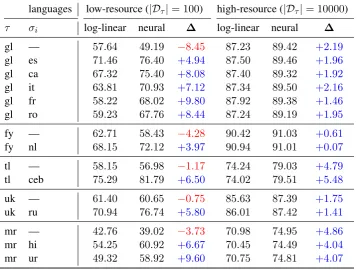
languages low-resource (|Dτ|= 100) high-resource (|Dτ|= 10000) τ σi log-linear neural ∆ log-linear neural ∆ gl — 57.64 49.19 −8.45 87.23 89.42 +2.19 gl es 71.46 76.40 +4.94 87.50 89.46 +1.96 gl ca 67.32 75.40 +8.08 87.40 89.32 +1.92 gl it 63.81 70.93 +7.12 87.34 89.50 +2.16 gl fr 58.22 68.02 +9.80 87.92 89.38 +1.46 gl ro 59.23 67.76 +8.44 87.24 89.19 +1.95 fy — 62.71 58.43 −4.28 90.42 91.03 +0.61 fy nl 68.15 72.12 +3.97 90.94 91.01 +0.07 tl — 58.15 56.98 −1.17 74.24 79.03 +4.79 tl ceb 75.29 81.79 +6.50 74.02 79.51 +5.48 uk — 61.40 60.65 −0.75 85.63 87.39 +1.75 uk ru 70.94 76.74 +5.80 86.01 87.42 +1.41 mr — 42.76 39.02 −3.73 70.98 74.95 +4.86 mr hi 54.25 60.92 +6.67 70.45 74.49 +4.04 mr ur 49.32 58.92 +9.60 70.75 74.81 +4.07
Table 2: Results comparing the log-linear and neural CRFs in various settings. We compare the log-linear linear and the neural CRF in the low-resource transfer setting. The difference (∆) is blue when positive and red when negative.
between domains.
Projection-based Transfer Schemes. Projec-tion is a common approach to tag low-resource languages. The strategy involves annotating one side of bitext with a tagger for a high-resource language and then project the annotation the over the bilingual alignments obtained through unsu-pervised learning (Och and Ney, 2003). Using these projected annotations as weak supervision, one then trains a tagger in the target language. This line of research has a rich history, starting with Yarowsky and Ngai (2001). For a recent take, seeWang and Manning(2014) for project-ing NER from English to Chinese. We emphasize that projection-based approaches areincomparable to our proposed methodas they make an additional bitext assumption, which is generally not present in the case of low-resource languages.
5 Experiments
Fundamentally, we want to show that character-level neural CRFs are capable of generalizing the notion of an entity across related languages. To get at this, we compare a linear CRF (see §2.2) with standard feature templates for the task and a neural CRF (see§2.3). We further compare three training set-ups: low-resource, high-resource and
low-resource with additional cross-lingual data for transfer. Given past results in the literature, we expect linear CRF to dominate in the low-resource settings, the neural CRF to dominate in the high-resource setting. The novelty of our paper lies in the consideration of the low-resource with transfer case: we show that neural CRFs are better at trans-ferring entity-level abstractions cross-linguistically.
5.1 Data
We experiment on 15 languages from the cross-lingual named entity dataset described inPan et al.
(2017). We focus on 5 typologically diverse3 tar-get languages: Galician, West Frisian, Ukranian, Marathi and Tagalog. As related source languages, we consider Spanish, Catalan, Italian, French, Ro-manian, Dutch, Russian, Cebuano, Hindi and Urdu. For the language code abbreviations and linguistic families, see Tab. 1. For each of the target lan-guages, we emulate a truly low-resource condition, creating a 100 sentence split for training. We then create a 10000 sentence superset to be able to com-pare to a high-resource condition in those same
languages. For the source languages, we only cre-ated a 10000 sentence split. We also create disjoint validation and test splits, of 1000 sentences each.
5.2 Results
The linear CRF is trained using L-BFGS until con-vergence using the CRF suite toolkit.4 We train our neural CRF for 100 epochs using ADADELTA (Zeiler,2012) with a learning rate of1.0. The re-sults are reported in Tab. 2. To understand the table, take the target language (τ) Galician. In terms ofF1, while the neural CRF outperforms the log-linear CRF the high-resource setting (89.42vs.
87.23), it performs poorly in the low-resource set-ting (49.19vs.56.64); when we add in a source lan-guage (σi) such as Spanish,F1increases to76.40
for the neural CRF and 71.46 for the log-linear CRF. The trend is similar for other source lan-guages, such as Catalan (75.40) and Italian (70.93). Overall, we observe three general trends. i) In the monolingual high-resource case, the neu-ral CRF outperforms the log-linear CRF. ii) In the low-resource case, the log-linear CRF outperforms the neural CRF. iii) In the transfer case, the neural CRF wins, however, indicating that our character-level neural approach is truly better at generalizing cross-linguistically in the low-resource case (when we have little target language data), as we hoped. In the high-resource case (when we have a lot of target language data), the transfer learning has little to no effect. We conclude that our cross-lingual neural CRF is a viable method for the transfer of NER. However, there is a still a sizable gap between the neural CRF trained on 10000 target sentences and the transfer case (100 target and 10000 source), indicating there is still room for improvement.
6 Conclusion
We have investigated the task of cross-lingual trans-fer in low-resource named entity recognition using neural CRFs with experiments on 15 typologically diverse languages. Overall, we show that direct cross-lingual transfer is an option for reducing sam-ple comsam-plexity for state-of-the-art architectures. In the future, we plan to investigate how exactly the networks manage to induce a cross-lingual entity abstraction.
4http://www.chokkan.org/software/crfsuite/
Acknowledgments
We are grateful to Heng Ji and Xiaoman Pan for sharing their dataset and providing support.
References
Breck Baldwin. 2009. Coding chunkers as tag-gers: IO, BIO, BMEWO, and BMEWO+. http://bit.ly/2xRo8Ni.
Adam L. Berger, Vincent J. Della Pietra, and Stephen A. Della Pietra. 1996. A maximum entropy ap-proach to natural language processing. Computa-tional Linguistics, 22(1):39–71.
Jason Chiu and Eric Nichols. 2016. Named entity recognition with bidirectional LSTM-CNNs. Trans-actions of the Association of Computational Linguis-tics, 4:357–370.
Ronan Collobert, Jason Weston, L´eon Bottou, Michael Karlen, Koray Kavukcuoglu, and Pavel Kuksa. 2011. Natural language processing (almost) from scratch. Journal of Machine Learning Research, 12(Aug):2493–2537.
Hal Daum´e III. 2007. Frustratingly easy domain adap-tation. InProceedings of the 45th Annual Meeting of the Association of Computational Linguistics, pages 256–263, Prague, Czech Republic. Association for Computational Linguistics.
Trinh-Minh-Tri Do and Thierry Arti`eres. 2010. Neu-ral conditional random fields. InProceedings of the Thirteenth International Conference on Artificial In-telligence and Statistics, pages 177–184.
Jeffrey L. Elman. 1990. Finding structure in time. Cog-nitive Science, 14(2):179–211.
Yasuhisa Fujii, Kazumasa Yamamoto, and Seiichi Nak-agawa. 2012. Deep-hidden conditional neural fields for continuous phoneme speech recognition. In Pro-ceedings of the International Workshop of Statistical Machine Learning for Speech Processing (IWSML). Sepp Hochreiter and J¨urgen Schmidhuber. 1997.
Long short-term memory. Neural Computation, 9(8):1735–1780.
Zhiheng Huang, Wei Xu, and Kai Yu. 2015. Bidi-rectional LSTM-CRF models for sequence tagging.
arXiv preprint arXiv:1508.01991.
John D. Lafferty, Andrew McCallum, and Fernando C. N. Pereira. 2001. Conditional random fields: Probabilistic models for segmenting and labeling se-quence data. InProceedings of the Eighteenth Inter-national Conference on Machine Learning (ICML), pages 282–289.
Guillaume Lample, Miguel Ballesteros, Sandeep Sub-ramanian, Kazuya Kawakami, and Chris Dyer. 2016.
InProceedings of the 2016 Conference of the North American Chapter of the Association for Computa-tional Linguistics: Human Language Technologies, pages 260–270, San Diego, California. Association for Computational Linguistics.
Wang Ling, Chris Dyer, Alan W. Black, Isabel Tran-coso, Ramon Fermandez, Silvio Amir, Luis Marujo, and Tiago Luis. 2015. Finding function in form: Compositional character models for open vocabu-lary word representation. InProceedings of the 2015 Conference on Empirical Methods in Natural Lan-guage Processing, pages 1520–1530, Lisbon, Portu-gal. Association for Computational Linguistics. Xuezhe Ma and Eduard Hovy. 2016. End-to-end
sequence labeling via bi-directional LSTM-CNNs-CRF. InProceedings of the 54th Annual Meeting of the Association for Computational Linguistics (Vol-ume 1: Long Papers), pages 1064–1074. Associa-tion for ComputaAssocia-tional Linguistics.
Franz Josef Och and Hermann Ney. 2003. A systematic comparison of various statistical alignment models.
Computational Linguistics, 29(1):19–51.
Xiaoman Pan, Boliang Zhang, Jonathan May, Joel Nothman, Kevin Knight, and Heng Ji. 2017. Cross-lingual name tagging and linking for 282 languages. InProceedings of the 55th Annual Meeting of the As-sociation for Computational Linguistics (Volume 1: Long Papers), Vancouver, Canada. Association for Computational Linguistics.
Jian Peng, Liefeng Bo, and Jinbo Xu. 2009. Condi-tional neural fields. InAdvances in Neural Informa-tion Processing Systems (NIPS), pages 1419–1427. Nanyun Peng and Mark Dredze. 2017. Multi-task
do-main adaptation for sequence tagging. In Proceed-ings of the 2nd Workshop on Representation Learn-ing for NLP, Vancouver, Canada. Association for Computational Linguistics.
Lance A. Ramshaw and Mitchell P. Marcus. 1995.Text chunking using transformation-based learning. In
Proceedings of the 3rd ACL Workshop on Very Large Corpora, pages 82–94. Association for Computa-tional Linguistics.
Cicero Nogueira dos Santos and Bianca Zadrozny. 2014. Learning character-level representations for part-of-speech tagging. InInternational Conference on Machine Learning (ICML), volume 32, pages 1818–1826.
Fei Sha and Fernando C. N. Pereira. 2003. Shal-low parsing with conditional random fields. In Hu-man Language Technology Conference of the North American Chapter of the Association for Computa-tional Linguistics, HLT-NAACL 2003.
Erik F. Tjong Kim Sang. 2002. Introduction to the CoNLL-2002 shared task: Language-independent named entity recognition. August, 31:1–4.
Erik F. Tjong Kim Sang and Fien De Meulder. 2003. Introduction to the CoNLL-2003 shared task: Language-independent named entity recognition. In
Proceedings of the Seventh Conference on Natu-ral Language Learning at HLT-NAACL 2003, pages 142–147.
Antoine Vinel, Trinh-Minh-Tri Do, and Thierry Arti`eres. 2011. Joint optimization of hidden condi-tional random fields and non linear feature extrac-tion. In2011 International Conference on Docu-ment Analysis and Recognition (ICDAR), pages 513– 517. IEEE.
Mengqiu Wang and Christopher D. Manning. 2013. Ef-fect of non-linear deep architecture in sequence la-beling. In Proceedings of the Sixth International Joint Conference on Natural Language Processing, pages 1285–1291, Nagoya, Japan. Asian Federation of Natural Language Processing.
Mengqiu Wang and Christopher D. Manning. 2014.
Cross-lingual pseudo-projected expectation regular-ization for weakly supervised learning. Transac-tions of the Association for Computational Linguis-tics.
Zhilin Yang, Ruslan Salakhutdinov, and William W3. Cohen. 2017. Transfer learning for sequence tag-ging with hierarchical recurrent networks. In Inter-national Conference on Learning Representations (ICLR).
David Yarowsky and Grace Ngai. 2001. Inducing mul-tilingual POS taggers and NP brackets via robust projection across aligned corpora. InHuman Lan-guage Technology Conference of the North Ameri-can Chapter of the Association for Computational Linguistics, HLT-NAACL 2001.