9
Connecting Distant Entities with Induction through Conditional
Random Fields for Named Entity Recognition: Precursor-Induced
CRF
Wangjin Lee
1and
Jinwook Choi
1,2,3*
1
Interdisciplinary Program for Bioengineering, Seoul National University, South Korea
2Department of Biomedical Engineering, College of Medicine, Seoul National University,
South Korea
3
Institute of Medical and Biological Engineering, Medical Research Center, Seoul National
University, South Korea
{jinsamdol,jinchoi}@snu.ac.kr
Abstract
This paper presents a method of designing specific high-order dependency factor on the linear chain conditional random fields (CRFs) for named entity recognition (NER). Named entities tend to be separated from each other by multiple outside tokens in a text, and thus the first-order CRF, as well as the second-order CRF, may innately lose transition information between distant named entities. The proposed design uses outside label in NER as a transmission me-dium of precedent entity information on the CRF. Then, empirical results apparently demonstrate that it is possible to exploit long-distance label dependency in the orig-inal first-order linear chain CRF structure upon NER while reducing computational loss rather than in the second-order CRF.
1
Introduction
The concept of conditional random fields (CRFs) (John Lafferty, Andrew McCallum, & Fernando Pereira, 2001) has been successfully adapted in many sequence labeling problems (Andrew McCallum & Wei Li, 2003; Fei Sha & Fernando Pereira, 2003; John Lafferty et al., 2001; McDonald & Pereira, 2005). Even in deep-learn-ing architecture, CRF has been used as a funda-mental element in named entity recognition (Lample, Ballesteros, Subramanian, Kawakami, & Dyer, 2016; Liu, Tang, Wang, & Chen, 2017).
One of the primary advantages of applying the CRF to language processing is that it learns transi-tion factors between hidden variables correspond-ing to the label of scorrespond-ingle word. The fundamental assumption of the model is that the current hidden state is conditioned on present observation as well
as the previous state. For example, a part-of-speech (POS) tag depends on the word itself, as well as the POS tag transitions from the previous word. In the problem, the POS tags are adjacent to each other in a text forming a tag sequence; there-fore, the sequence labeling model can fully capture dependencies between labels.
In contrast, a CRF in named entity recognition (NER) cannot fully capture dependencies between named entity (NE) labels. According to Ratinov & Roth (2009), named entities in a text are separated by successive “outside tokens” (i.e., words that are non-named entities syntactically linking two NEs) and considerable number of NEs have a tendency to exist at a distance from each other. Therefore, high-order interdependencies of named entities be-tween successive outside tokens are not captured by first-order or second-order transition factors.
One major issue in previous studies was con-cerned with the way in which to explore long-dis-tance dependencies in NER. Only dependencies between neighbor labels are generally used in practice because conventional high-order CRFs are known to be intractable in NER (Ye, Lee, Chieu, & Wu, 2009). Previous studies have demonstrated that implementation of the higher-order CRF exploiting pre-defined label patterns leads to slight performance improvement in the conventional CRF in NER (Cuong, Ye, Lee, & Chieu, 2014; Fersini, Messina, Felici, & Roth, 2014; Sarawagi & Cohen, 2005; Ye et al., 2009). However, there are certain drawbacks associated with handling named entity transitions within arbi-trary length outside tokens.
to-kens, this study explores the method which modi-fies the first-order linear-chain CRF by using the induction method.
2
Precursor-induced CRF
Prior to introducing the new model formulation, the following information presents the general con-cept of CRF. As a sequence labeling model, the conventional CRF models the conditional distribu-tion 𝑃(𝒚|𝒙) in which x is the input (e.g., token, word) sequence and y is the label sequence of x. A hidden state value set consists of target entity labels and a single outside label. By way of illustration, presume a set {𝐴, 𝐵, 𝑂} as the hidden state value set; assign 𝐴 or 𝐵 to NEs, likewise, assign 𝑂 to outside words. From the hidden state set, a label sequence is formed in a linear chain in NER; for example, a sequence 〈𝐴, 𝑂, ⋯ 𝑂, 𝐵〉 in which successive out-side words are between the two NE words. Because the first-order model assumes that state transition dependencies exist only between proximate two la-bels to prevent an increase in computational com-plexity, the first-order CRF learns bigram label
transitions from the subsequence;
{(𝐴, 𝑂), (𝑂, 𝑂), (𝑂, 𝐵)} that is,
label
transition data learnt from the example sequence. In the ex-ample, dependency (𝐴 , 𝐵) is not captured in the model.The main purpose of the precursor-induced CRF model, introduced in this study, is to capture spe-cific high-order named entity dependency that is an outside word sequence between two NEs. The main idea can be explained in the following man-ner:
It mainly focuses on beneficial use of outside label as a medium delivering dependency be-tween separated NEs.
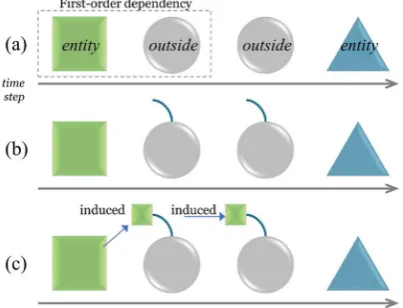
Focuses on label subsequence hav-ing〈𝑒𝑛𝑡𝑖𝑡𝑦, 𝑜𝑢𝑡𝑠𝑖𝑑𝑒 , 𝑒𝑛𝑡𝑖𝑡𝑦〉 pattern. (Fig-ure 1 (a))
Adds memory element to the hidden varia-bles for the outside states (Figure 1(b)).
The first outside label in an outside subse-quence explicitly has a first-order depend-ency with its adjacent entity. If the first out-side label tosses the information to the next, the information possibly flows forward.
By induction process, the information of the first entity can flow through multiple outside labels to the second entity state (Figure 1(c)).
In the pre-induced CRF, the outside state with a memory element behaves as if an information transmission medium is delivering information about the presence or absence of the preceding en-tity forward. It is required to expand state set. States are collected and only entity states are selected. Multiplied outside state set is derived by multipli-cation of entity states and outside state. Expanded state set is consequently derived as a union of entity states and multiplied outside states.
Turning to the formulation, the conditional prob-ability distribution of a label sequence y, given an observation x in the CRF has a form as Eq.(1),
p(𝑦|𝑥) =
( )∙
∏ 𝑒𝑥𝑝 ∑ 𝜃 𝑓 (𝑦 , 𝑦 , 𝑥 ) (1)
where fk is an arbitrary feature function having
cor-responding weight 𝜃 , the 𝒵(𝒙) is a partition func-tion, and t is time step (Sutton & McCallum, 2011). The feature function fk is generally indicator
func-tion that has value 1 only if the funcfunc-tion is matched to a certain condition, otherwise 0. Transition fac-tor in CRF has a form of function fij(y, y',
x)=1{y=i}1{y'=j}, and observation factor has a form of a function fio(y, y', x)=1{y=i}1{x=o}. Derived from
Eq.(1), conditional probability distribution of the precursor-induced CRF takes a form as Eq.(2), p(𝑦|𝑥, 𝑎) = ( , )∙
∏ 𝑒𝑥𝑝 ∑ 𝜃 𝑓 (𝑦 , 𝑦 , 𝑥 , 𝑎 , 𝑎 ) (2)
[image:2.595.82.284.544.698.2]where the variable a is to store the induced state Figure 1: Transformation from conventional
information, and the value of "at" is activated by the value of "at-1" and "yt" Once the "at" is activated, the "at" eventually transmutes the value of "yt."
This induction process eventually expands the original label value set. It produces newly induced outside states instead of the single outside state; for example, the process modifies an original label se-quence 〈𝐴, 𝑂, ⋯ 𝑂, 𝐵〉 to 〈𝐴, 𝐴[𝑂] , ⋯ 𝐴[𝑂] , 𝐵〉 . This transformation helps the CRF learn long-dis-tance named entity transitions, even in the first-or-der form; from the modified example sequence, the model can learn label transition data {(𝐴[𝑂] , 𝐵)} where entity 𝐵 depends on entity 𝐴 preceding itself. In terms of the number of newly produced states, when N=|States| in the original first-order CRF (a state set consists of NE states and one outside state), this procedure introduces 𝑁 new states. (if the IOB2 tagging scheme (Tjong & Sang, 1995) is ap-plied, (𝑁 − 1) 2⁄ + 1 new states are introduced).
To train the precursor-induced CRF, L-BFGS optimization method (Fei Sha & Fernando Pereira, 2003) and l2-regularization (Ng, 2004) are used as conventional first-order CRF exploits (Sutton & McCallum, 2011). Furthermore, the Viterbi algo-rithm is used for inference.
During training and inference, it is also required to treat the fragmented outside states as a single outside label in practice. First, a weight of an ob-servation feature fio depends on the frequency of an observation as well as co-occurrence label data. Fragmenting a single outside state into multiple states may cause data-sparseness problems espe-cially for observation features occurring within the fine-grained outside states in training time. To pre-vent the data sparseness problem derived by the precursor-induced CRF, observation factor fio(y,y',x) is customized as (1{i∈⌐Outside, y=i} + 1{i∈Outside}) 1{x=o}1{y'=1}. Second, the expected label alphabets in inference time are required to be matched to the la-bel alphabets of given annotation. Therefore, the fragmented outside state reverts to the original out-side label.
3
Experiments
All the experiments were performed by imple-menting both the original and precursor-induced CRF1. The activity refers to CRF implemented in
MALLET (Andrew Kachites McCallum, 2002). To compare precursor-induced CRF with the original CRF in NER on the real-world clinical documents and biomedical literatures, three annotated NER corpus were used; i2b2 2012 NLP shared task data
1 https://github.com/jinsamdol/precursor-induced_CRF
(Sun, Rumshisky, & Uzuner, 2013), discharge sum-maries of rheumatism patients at Seoul National University Hospital (SNUH), and JNLPBA 2004 Bio-Entity Recognition shared task data (Kim, Ohta, Tsuruoka, Tateisi, & Collier, 2004). The dis-charge summary of rheumatism patient corpus is built for this evaluation. This corpus consists of 200 electronic clinical documents where English and Korean words are jointly used for recording patient history. We used the division of training and test set provided by the i2b2 2012 and JNLPBA corpus in this evaluation. For the SNUH corpus, 10-fold cross validation was used.
Annotated named entities involved in the clini-cal NER evaluation are related to mentions describ-ing the patient’s history. In the i2b2 2012 corpus, problem, test, and treatment named entity classes are used. In the SNUH corpus, symptom, test, diag-nosis, medication,and procedure-operation classes are used. The named entity classes in the biomedi-cal NER evaluation are DNA, RNA, protein, cell line,and cell type.
In the i2b2 2012 training data, 9,942 entities have outside state precedence, and approximately 63.8% cases of them take a pattern 〈𝑒𝑛𝑡𝑖𝑡𝑦, 𝑜𝑢𝑡𝑠𝑖𝑑𝑒 , 𝑒𝑛𝑡𝑖𝑡𝑦〉 . Likewise, in SNUH corpus, 58.9% cases of NEs having outside prece-dence have a preceding named entity. Median value of the distance between consecutive entities tend to be within 3-4 in the datasets. The long distance de-pendency is restricted within a single instance (i.e., a sentence).
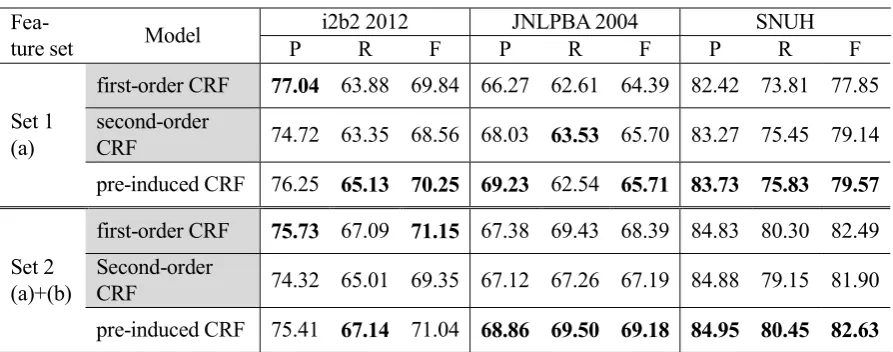
To perform NER evaluation, two types of feature families are used: (a) token itself and neighbor to-kens in window size 3. In addition, morphologi-cally normalized tokens are used together. (b) mor-phology features such as character prefix and suffix of length 2–4. Our feature setting 1 uses the single feature family (a) and feature setting 2 simultane-ously uses both of the feature family (a) and (b). The reason for setting these simple feature config-urations is for the purpose of reducing bias that the feature will affect the performance comparison of the models.
The performance comparison result is shown in the Table 1. The result shows a tendency that pre-cursor-induced (pre-induced) CRF leads to a slight performance improvement compared to both the first-order and second-order CRFs in most cases. However, the overall improvement is small.
Table 2 compares the elapsed time per iteration in parameter training for each model. The result shows that the second-order CRF takes quite more time than the first-order CRF to compute one train-ing iteration. The pre-induced CRF takes 1.7 times more computation time than the first-order CRF in average. The pre-induced CRF takes significantly less time than the second-order CRF while the pre-induced CRF exploits longer label transition de-pendency than the second-order CRF.
These results indicate that the precursor-induced CRF, where long-distance dependency is intro-duced in CRF by label induction, slightly improves the effectiveness in clinical and biomedical NER while also significantly reducing computational cost rather than building second- or higher-order CRFs.
4
Conclusion
The requirement utilizing high-order dependen-cies often holds in sequence labeling problems; however, second-order or higher-order models are
considered computationally infeasible. Therefore, this study focuses on beneficial use of single out-side label as a medium delivering long-distance de-pendency. The design of the precursor-induced CRF apparently allows precedent named entity in-formation to pass through outside labels by induc-tion, even when the model maintains a first-order template. Although the performance improvement is small in both the clinical and biomedical NER evaluations, this study has shown that the proposed design enables reduced computational cost in uti-lizing long-distance label dependency compared to the second-order CRF.
Evidence from this study suggests that the utili-zation of outside labels as precedent NE infor-mation transmission medium presumably can en-hance the expressiveness of the CRF while keeping the first-order template. Considerable work is re-quired to validate the model. For example, the val-idation of the precursor-induced CRF in deep neu-ral architecture for NER, such as the LSTM-CRF neural architecture (Lample et al., 2016), will be worth performing in the future. In addition, valida-tion of the model in various problems, such as NER in general domain (Tjong, Sang, & Meulder, 2003) and de-identification problem of personal health in-formation in clinical natural language processing (Stubbs, Filannino, & Uzuner, 2017; Stubbs, Kotfila, & Uzuner, 2015), will be performed in the future study.
Acknowledgements
This work was supported by the Basic Science Re-search Program through the National ReRe-search Foundation of Korea (NRF) funded by the Ministry of Education (No. NRF-2015R1D1A1A01058075),
Model i2b2 JNLPBA SNUH
first-order 3.97 39.39 5.44
second-order 30.34 497.15 87.49
pre-induced 6.55 69.78 9.08
Table 2: Elapsed training time (s/iteration)
Fea-ture set Model
i2b2 2012 JNLPBA 2004 SNUH
P R F P R F P R F
Set 1 (a)
first-order CRF 77.04 63.88 69.84 66.27 62.61 64.39 82.42 73.81 77.85 second-order
CRF 74.72 63.35 68.56 68.03 63.53 65.70 83.27 75.45 79.14 pre-induced CRF 76.25 65.13 70.25 69.23 62.54 65.71 83.73 75.83 79.57
Set 2 (a)+(b)
first-order CRF 75.73 67.09 71.15 67.38 69.43 68.39 84.83 80.30 82.49 Second-order
[image:4.595.76.523.71.247.2]CRF 74.32 65.01 69.35 67.12 67.26 67.19 84.88 79.15 81.90 pre-induced CRF 75.41 67.14 71.04 68.86 69.50 69.18 84.95 80.45 82.63
and also supported by a grant of the Korea Health Technology R&D Project through the Korea Health Industry Development Institute (KHIDI), funded by the Ministry of Health & Welfare, Republic of Korea (grant number : HI14C1277). Deidentified English clinical records used in this research were provided by the i2b2 National Center for Biomedi-cal Computing funded by U54LM008748 and were originally prepared for the Shared Tasks for Chal-lenges in NLP for Clinical Data organized by Dr. Ozlem Uzuner, i2b2 and SUNY.
References
Andrew Kachites McCallum. (2002). MALLET: A Machine Learning for Language Toolkit. Retrieved March 27, 2013, from http://mallet.cs.umass.edu Andrew McCallum, & Wei Li. (2003). Early Results
for Named Entity Recognition with Conditional Random Fields , Feature Induction and Web-Enhanced Lexicons. In Proceeding of CoNLL 2003
(pp. 188–191).
Cuong, N. V., Ye, N., Lee, W. S., & Chieu, H. L. (2014). Conditional Random Field with High-order Dependencies for Sequence Labeling and Segmentation. ACM JMLR, 15, 981–1009.
Fei Sha, & Fernando Pereira. (2003). Shallow Parsing with Conditional Random Fields. In Proceedings of the 2003 Conference of the North American Chapter of the Association for Computational Linguistics on Human Language Technology (pp. 134–141). Fersini, E., Messina, E., Felici, G., & Roth, D. (2014).
Soft-constrained inference for Named Entity
Recognition. Information Processing and
Management, 50(5), 807–819.
John Lafferty, Andrew McCallum, & Fernando Pereira. (2001). Conditional Random Fields : Probabilistic Models for Segmenting and Labeling Sequence Data. In Proceedings of the 18th International Conference on Machine Learning 2001 (pp. 282– 289).
Kim, J.-D., Ohta, T., Tsuruoka, Y., Tateisi, Y., & Collier, N. (2004). Introduction to the bio-entity recognition task at JNLPBA. Proceedings of the International Joint Workshop on Natural Language Processing in Biomedicine and Its Applications - JNLPBA ’04, 70.
Lample, G., Ballesteros, M., Subramanian, S., Kawakami, K., & Dyer, C. (2016). Neural Architectures for Named Entity Recognition. In
Proceedings of NAACL-HLT 2016 (pp. 260–270). Liu, Z., Tang, B., Wang, X., & Chen, Q. (2017).
De-identification of clinical notes via recurrent neural
network and conditional random field. Journal of Biomedical Informatics.
McDonald, R., & Pereira, F. (2005). Identifying gene and protein mentions in text using conditional random fields. BMC Bioinformatics, 6 Suppl 1, S6. https://doi.org/10.1186/1471-2105-6-S1-S6 Ng, A. Y. (2004). Feature selection, L1 vs. L2
regularization, and rotational invariance. In ICML 2004.
Ratinov, L., & Roth, D. (2009). Design challenges and misconceptions in named entity recognition. In
Proceedings of the Thirteenth Conference on Computational Natural Language Learning (pp. 147–155).
Sarawagi, S., & Cohen, W. W. (2005). Semi-Markov Conditional Random Fields for Information Extraction. In Advances in neural information processing systems (pp. 1185–1192).
Stubbs, A., Filannino, M., & Uzuner, Ö. (2017). De-identification of psychiatric intake records: Overview of 2016 CEGS N-GRID shared tasks Track 1. Journal of Biomedical Informatics, 75, S4– S18.
Stubbs, A., Kotfila, C., & Uzuner, Ö. (2015). Automated systems for the de-identification of longitudinal clinical narratives: Overview of 2014 i2b2/UTHealth shared task Track 1. Journal of Biomedical Informatics, 58, S11–S19.
Sun, W., Rumshisky, A., & Uzuner, O. (2013). Evaluating temporal relations in clinical text: 2012 i2b2 Challenge. Journal of the American Medical Informatics Association : JAMIA, 1–8.
Sutton, C., & McCallum, A. (2011). An Introduction to Conditional Random Fields. Foundations and Trends in Machine Learning, 4(4), 267–373. https://doi.org/10.1561/2200000013
Tjong, E. F., & Sang, K. (1995). Representing Text Chunks, 173–179.
Tjong, E. F., Sang, K., & Meulder, F. De. (2003). Introduction to the CoNLL-2003 Shared Task : Language-Independent Named Entity Recognition. In Proceedings of the seventh conference on Natural language learning at HLT-NAACL 2003 (pp. 142– 147).