Research Article
CODEN: IJPNL6
DEVELOPMENT AND COMPARATIVE EVALUATION OF THEOPHYLLINE
LOADED EXTENDED RELEASE CAPSULE
Mehmet Ali Ege, Tamer Güneri
Ege University, Faculty of Pharmacy, Department of Pharmaceutical Technology, 35100, Izmir,
Turkey
*Corresponding author e-mail: [email protected]
Abstract
The aim of the present study was to develop a new theophylline hard gelatin capsule drug delivery formulation. The formulation have been prepared to enhance its dissolution which could provide better oral absorption of theophylline. Therefore, the effects of the component nature and their proportion in the release rate were investigated. Extended release capsules of theophylline were prepared by physical mixing using HPMC and cellulose acetate phthalate (CAP) at various drug-polymer ratios. Hydroxy propyl methyl cellulose (HPMC-E50) ratio was changed the release profile of theophyline. The optimum CAP % was selected as 75 % according to in vitro release studies. Flow properties of the F8 physical mixtures were evaluated by calculation of the Carr’s index, angle of repose and Hausner ratio.The results of the study indicate that new extended release hard gelatin capsules can be promising alternative for the other oral formulations of theophylline.
Keywords: Theophylline, drug release, kinetic evaluation, hard gelatin capsule, stability
Introduction
It is now recognized that exacerbation frequency is an important outcome in chronic obstructive pulmonary disease (COPD) as patients prone to frequent exacerbations have impaired health status, reduced physical activity, increased lower airway bacterial
colonization and a faster decline in lung
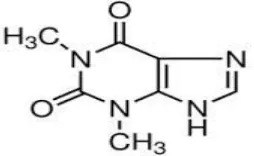
function[1,2].COPD is a major cause of chronic morbidity and mortality throughout the world. Many people suffer from this disease for years and die prematurely of it or its complications [3]. Xanthines such as theophylline have been used in the treatment of respiratory diseases such as asthma and COPD since the 1930s although their popularity has declined due to the introduction of other classes of drugs, particularly the inhaled long acting b2-adrenoceptor agonists and glucocorticosteroids[4]. Theophylline is a good candidate to be encapsulated in slow-release capsules, since the treatment of obstructive chronic pulmonary disease and night crisis depend on keeping serious levels of the drug constant [5,6]. Theophylline (Figure 1) has been show to inhibit the
activity of a cyclic 3’, 5’ nucleotide
phosphodiesterase with a Ki of 100 mM and this
activity has been suggested to contribute to its ability to promote suppressor cell activity in lymphocytes and its beneficial anti-inflammatory actions in patients with asthma and COPD [7-9].
Figure 1: Molecular structure of theophylline
Oral route of administration has been received more attention in the pharmaceutical field and it is one of
the most commonly-used routes for drug
administration because of the more flexibility in the designing of dosage form than drug delivery design for other routes[10]. In addition, it’s non-invasive nature and the fact that it avoids the pain and discomfort associated with injections, as well as eliminating contamination [11,12].
Solid dosage forms are important for oral administration because their stability is pretty good
International Journal of Pharmacy
their application is easy and they have a high-metering accuracy. Drug–polymer solid dispersion can improve the dissolution rate of drugs and lead to higher bioavailability [13]. In this way, a capsule formulation often is in the industry the first dosage form for early clinical studies. Furthermore, capsules improve drug stability because the content is tightly enclosed by the capsule shell and thus protected from oxygen, humidity and light [14,15].Moreover, hard gelatin capsules are effective containers for various of fill materials ranging from solids to semi-solids. Furthermore solubility and dissolution behavior of a drug is one of the key determinants of its oral bioability. In latest years, the number of poorly soluble drug candidates has improved enormously. The formulation of poorly soluble drugs for oral delivery offers a challenge to the formulation researchers[16]. Based on this information; USP has some restrictions on extended release theophylline preparations relating the in vitro drug release about time.
The purpose of the present study was to develop a new extended release capsules of theophylline for oral delivery treatment of COPD. Hard gelatin capsules were contained cellulose acetate phthalate (CAP) and hydroxy propyl methyl cellulose (HPMC-E50)in order to increase the theophylline oral
bioavailability. The physico-chemical
characterizations, in-vitro release of these
formulations were evaluated.
MATERIALS AND METHODS Materials
Theophylline anhydrous was supplied by Dolder, Switzerland.Cellulose acetate phthalate(CAP) was obtained Röhm Pharma,USA. Hydroxy propyl methyl cellulose (E50) was kindly donated by Colorcon, USA. All other chemicals and solvents were of analytical grade. Ultrapure water was obtained from Sartorius 61316 pro VF, Germany.
Preparation of Extended Release Capsules Physical Mixture
A series of extended release capsules of theophylline were prepared fixed concentration of theophylline (10 g) and varying concentrations of HPMC (E50) were mixed and then CAP solution (CAP 15 %) was added and mixed.The mixture was dried at 50 °C in a oven. The same process was repeated 4 times to obtain 60% CAP concentration. The above procedure was repeated 5 times to obtain 75% CAP concentration and last repeated six times matrix granules to obtain 90% CAP concentration. The composition of the
theophyline loaded capsules were shown in Table 1. Sieving the granules are combined in three different particle size in sieve systems separated.The resultant granules were passed through various sieves. The prepared mixtures were sealed and stored in desiccator until used for further studies. All samples, which were used in dissolution studies, were analysed for drug content. Before the dissolution studies, these powders were hand filled into zero-size hard gelatin capsules using capsule filling apparatus.
In vitro Drug Release Studies
In-vitro drug release experiments were performed over 12 h. The dissolution rates of the extended release capsules of theophyline were measured by using USP XXII apparatus I (rotating pallet). The system was held at body temperature (37 ± 2 °C) and stirred continuously with magnetic stirrer at 50 rpm. pH 1.2 gastric medium and artificial intestinal medium pH 6.8 solutions were used as the release media. Samples of 2 mL were withdrawn at specified time intervals and analyzed spectrophotometerically at 272 nm using Shimadzu 160-A spectrometer, the samples withdrawn were replaced by fresh buffer solution. The samples were collected at every hour until 12 hour. Each dissolution study was carried out in six times and mean values were calculated. Gastric medium consisted of 8.3 mL HCl (37%) in 1 L of ultrapure water. The pH value of the medium was checked and adjusted as pH 1.2 ± 0.05.Artificial intestinal medium consisted of KH2PO4 (6.805 g), NaOH (0.896 g) in 1 L of ultrapure water. The pH value of the dissolution medium was checked and adjusted as pH 6.8 ± 0.05.
Determination of flow properties of the physical mixtures
Carr’s index: A pre-weighed quantity of dry powder
was diposed in a measured 10 mL cylinder. The apparent volume occupied by the powder was then detected before and after the application of 1250 taps to the cylinder using a tap density tester (Varian, Inc. USA).
Carr’s index formulas are calculated according to [17,18]
.
Eq. (1)
Angle of repose: The angle of repose can be defined
... Eq. (2)
where, h = height of the pile, r = radius.
Hausner ratio: The process is to determine the
unsettled apparent volume, V0 and the final tap volume,
Vf, of the powder tapping the material until no further volume changes happen. The Hausner
ratio was calculated accoding to Eq. (3) [17].
---Eq. (3)
Kinetic evaluation and determination of release
mechanism: Kinetic evaluations of theophylline
release from formulations were estimated using a computer based kinetic programme [22]. Zero-order, First-order and Higuchi kinetic models were used for evaluation and determination of the release mechanism [23,24].
Determination of theophylline release from capsules were estimated Eq. (4) [25].
Mt / M∞ = Ktn---Eq. (4)
Mt/M∞; the fraction of drug released, t; released time, k; release rate constant and n is the release exponent. The n value is used to characterize different release mechanisms as given in Table 2[26].
Statistical Analysis: Statistical analysis were conducted by one-way ANOVA using target significance levels of 0.05 (P<0.05).
RESULTS AND DISCUSSION Drug Release Studies
In vitro drug release was determined using the USP pallet method. Release profiles of the extended release capsules (F1-F9) containing theophyllinewere showed in Figure 2, Figure 3 and Figure 4. In the release studies theophylline capsules did not show a burst release in stomach environment for 4 h.
The additional HPMC (E-50) ratio change the release profile. Highest CAP ratio of formulations was determined to be better release than other formulations. In addition when CAP (%) was compared the optimum % was selected as 75 %. These findings suggest that formulation F8 capsule could be good candidates for oral sustained drug delivery systems, especially for poorly soluble drugs as theophylline. Lin et al. developed tablets containing cellulose acetate phthalate as an additive or enteric-coating material. The developed granules show release patterns that are sustained[27]. It can be concluded that CAP was most effective agent for
slowed release of drugs. In addition CAP was used common for oral formulations [27,28].
Determination of flow properties of the physical mixtures: Flow properties of F8theophylline capsule formulation are shown in Table 3.The flow propertie of F8 formulation was determined optimum porosity, carr’s index and hausner ratio for oral delivery of theophylline.
Kinetic evaluation: The mathematical parameters of
F8 formulation were presented in Table 4. The model that gave higher ‘r’ value was considered as best fit model.According to the analysis of all mathematical models, it is clearly seen that Higuchi square-root of time model show obviously a better fit for theophylline capsules [29](Table 4). The release of theophylline followed Higuchi kinetics as its correlation coefficient (r=0.9979) predominated over zero-order kinetics (r=0.9846). The Higuchi square root equation describes that the rate of drug release from systems is related to the rate of drug diffusion [24,30]
. This data confirms that the theophylline capsule formulations have been generated in a Higuchian diffusion fashion, which is statistically proven by the release curves in comparison with their correlation coefficients. The "n" value of F8 formulation has been found to be more than 1. This result indicates that the drug release from the polymer matrix formulations suggests super Case II transport, that is the mechanism of drug release has been administered by both diffusion and polymer relaxation [31].
CONCLUSION
Acknowledgements: Financial support from University of Ege, Faculty of Pharmacy, Department of Pharmaceutical Technology.
Declaration of Interest: The authors declare no conflict of interest in the research paper.
Figure 2: In vitro release of theophylline capsules (F1, F2 and F3)
Figure 3: In vitro release of theophylline capsules (F4, F5 and F6)
Table 1: Capsule formulations of Theophylline Theophylline:
HPMC ratio CAP (%) Theophylline (g) HPMC E50 (g)
F1
1:0
60 10 0
F2 75 10 0
F3 90 10 0
F4
1:0.25
60 10 2.5
F5 75 10 2.5
F6 90 10 2.5
F7
1:0.5
60 10 5.0
F8 75 10 5.0
F9 90 10 5.0
Table 2:Diffusion exponent and solute release mechanism for cylindrical shape Diffusion exponent (n) Diffusion mechanism
0.45 Fickian diffusion
0.45 < n < 0.89 Anomalous (non-Fickian) diffusion
0.89 Case-II transport
n > 0.89 Super case-II transport
Table 3:Flow properties of extend release theophylline capsule (F8) parameters F8capsule
Porozity (g/ml) 1.042
Angle of Repose 17.89
Carr’s Index %9.288
Hausner Ratio 1.093
Table 4: Mathematical models of F8 capsule of theophylline obtained after fitting the drug release data. Kinetic Model First Order Higuchi Zero Order Peppas
parameters r2 K r2 K r2 K r2 n
F8 0.9974 6.6539 0.9979 5.5227 0.9846 496.219 0.7292 3.3455
REFERENCES
1. Hirschmann JV. Chest, 2000;118:193–203.
2. Cazzola M, Rogliani P, Curradi G. Respir Med, 2008; 102:321–27.
3. Rabe KF, Hurd S, Anzueto A, Barnes PJ, Buist SA, Calverley P, Fukuchi Y, Jenkins C, Rodriguez-Roisin R,
van Weel C, Zielinski J.Am J Respir Crit Care Med, 2007; 176: 532-55.
4. Tee AK, Koh MS, Gibson PG, Lasserson TJ, Wilson AJ, Irving LB. Cochrane Database Syst Rev, 2007; 18: 1281.
6. Pinheiro VA, Kaneko TM, Velasco MVR., Consiglier VO. Braz J Pharm Sci, 2007; 43: 253-61.
7. O’Shaughnessy MJ, Chen ZM, Gramaglia I, Taylor PA, Panoskaltsis-Mortari A, Vogtenhuber C, Palmer E, Grader-Beck T, Boussiotis VA, Blazar BR. Biol Blood Marrow Transpl, 2007; 13:530-42.
8. Rennard SI. Lancet, 2004; 364:791-802.
9. Page CP, Spina D. Curr Opin Pharmacol, 2012; 12:275–28.
10. Kaur, G., Chandel, P., Harikumar, S.L. Pharmacophore, 2013; 4: 120-33.
11. Kagan L, Hoffman A. Expert Opin Drug Delivery, 2008; 5: 681-92.
12. Martin-Banderas L, Duran-Lobato M, Munoz-Rubio I, Alvarez-Fuentes J. Mini-Rev Med Chem, 2013; 13:
1-12.
13. Lin D, Huang Y. Int J Pharm, 2010; 399: 109-115.
14. Fahrig W, Hofer U. Advances in cellulose ester performance and application. Prog. Polym. Sci. Die Kapsel, Wiss. Verlagsges. GmbH, Stuttgart, Germany 26: 1998;1605–88.
15. Karasulu E, Karasulu HY, Ertan G, Kirilmaz L, Guneri T. Eur J Pharm Sci,2003; 19:99-104.
16. Dehghan MH, Jafar M. Iran J Pharm Res, 2006; 4: 231-38.
17. Khan MN, Suresh J, Hemant Yadav KS, Ahuja J. Der Pharmacia Sinica,2012; 3: 177-84.
18. Lachman L, Lieberman HA, Kanig JL. The Theory and Practice of Industrial Pharmacy, 3rd ed., Varghese Publishing House, Bombay, 1991.
19. Rios M. Pharm Technol, 2006; 30:38-49.
20. Abdullah EC, Geldart D. Powder Technol, 1999; 102: 151-65.
21. Carr R. Chem Eng,1965; 72: 163-68.
22. Ege MA, Karasulu HY, Karasulu E, Ertan G. A computer program designed for in vitro dissolution kinetics, in
vitro-in vivo kinetic correlations and routine application, 4th Central European Symposium on Pharmaceutical Technology, Scientia Pharmaceutica Supplement 1 Band 69, Vienna, 2001, pp. 127-8.
23. Koester LS, Ortega GG, Mayorga P, Bassani VL. Eur J Pharm Bio, 2004; 58: 177-9.
24. Ertan G, Karasulu HY, Karasulu E, Ege MA, Köse T, Güneri T. Drug Dev, Industrial Pharm, 2000; 26: 737-43.
25. Ritger PL, Peppas NA. J Control Release, 1987; 5: 37-42.
26. Basak SC, Kumar KS, Ramalingam M. Braz J Pharm Sci, 2008; 44: 477-83.
27. Lin SY, Kawashima Y. Pharm Res, 1987; 4:70-4.
28. Ganguly K, Tejraj M, Anandrao A, Kulkarni R. Ind Eng Chem Res, 2011; 50: 11797–807
29. Orelli JV, Leuenberger H. Int J Pharm,2004; 287:135-45.
30. Iravani S, Fitchett CS, Georget MR. Carbohydr Polym,2011; 85:201-7.