94 | P a g e
DETERMINATION OF BIOACTIVE COMPOUNDS
FROM Bacopa monneria Linn. BY USING GC-MS
ANALYSIS
N.K.Parameswaran
1, T.Selvamohan
2, G.Uma Maheswari
3,
P. Nagendra Prasad
41, 3 Department of Biotechnology, Manonmaniam Sundaranar University,
Tiruneleli-12, Tamilnadu, India
2 Department of Zoology, Rani Anna Government College for Women, Tirunelveli-8
4 Department of Biomedical Sciences and Technology, Noorul Islam Centre for Higher Education,
Kumaracoil, Thuckalay, Tamilnadu, India
ABSTRACT
Memory is a process of retaining, storing and recalling experiences, and it is closely associated with learning. Though learning knowledge is acquired and through memory this knowledge is made available. Memory is the ability of an individual to record sensory stimuli, information retain them over short or long periods of time and recall the same at later date when needed. Poor Memory, lower retention and slow recall and are common problems in today's stressful and competitive world. Age stress, emotions are conditions that may lead to memory loss, amnesia, anxiety, high blood pressure, dementia, to more ominous threat like schizophrenia and Alzheimer's diseases. The nature provides a new opportunity to regain one's full mental capacity. A number of herbs traditionally employed in the Indian System of Medicine. Bacopa monneria has been used to promote memory enhancing activity, treatment psychoneurological disorders and as a rejuvenator. The most important bioactive constituents of this plant is alkaloids, tannins, flavonoids and phenolic compound. The plant Bacopa monneria is one of the most useful traditional medicinal plants in India. The plant is commonly used for the role of memory enhancement due to the presence of bioactive components. In the Present study the GC-MS analysis of Bacopa monneria was carried out to detect the active principle present in the plant.
95 | P a g e
I.INTRODUCTION
Bacopa monneria is a creaping herb belongs to the family Scophulariaceae [1]. It is a native to the wetlands of southern India, Australia, Europe, Africa, Asia, North and South America. Bacopa is a medicinal
herb used in Ayurveda, where it is also known as "Brahmi," after Brahma, the creator God of the Hindu
pantheon [2]. Bacopa monneria is an Indian herb commonly given to infants where it is observed to boost
memory power intelligence, and mental health [3,4]. Bacopa monneria for memory enhancement goes back 3000
years or more in India, when it was cited for its medicinal properties, especially the memory-enhancing
capacity, in the Vedic texts "Athar-Ved Samhita" (3:1) of 800 B.C and in Ayurveda [5,6]. Bacosides is the major
phytochemical constituents in Bacopa monneria, help to repair damaged neurons by enhancing proteins
involved in the regeneration of neural-cell synapses [7,]. Thus Bacopa monneria can be viewed as a neural
nourished, restoring depleted synaptic activity and leading to enhance memory function [8].
The leaves of this plant are succulent, oblong and 4–6 mm (0.16–0.24 in) thick. Leaves
are oblanceolate and are arranged oppositely on the stem. The flowers are small and white, with four or five
petals. Its ability to grow in water makes it a popular aquarium plant. It can even grow in
slightly brackish conditions. Propagation is often achieved through cuttings. It is commonly grown
throughout India, Nepal, Srilanka, China, Pakistan, Taiwan and Vietnam. It is also found in Florida, Hawaii and
other southern states of the United States where it can be grown in damp conditions by a pond or bog garden [9].
The whole parts of the plant is used to treat various human ailments. It is a cardiac and nervine tonic, leaves and
stalks are diuretic and aperients[10, 11]. The crude Alcoholic extract of the plant showed a sedative effect, it also
exerted cardiotonic, vaso constrictor, and neuromuscular blocking action. It has been used in traditional
Ayurvedic treatment for epilepsy and asthma [12]. It is also used for ulcers, tumors, ascites, enlarged spleen,
indigestion, inflammations, leprosy, anemia, and biliousness. Bacopa monneria have antioxidant properties which support cardiovascular diseases [13, 14]. In order to ascertain the active principle present in the plant,
GC-MS study was carried out and documented in the present study.
II.MATERIALS AND METHODS
Collection of plant material
The plant material was collected from the damp and marshy areas of River basin of Paraliyaru, Thiruvattar, Kanyakumari District, Tamilnadu, India.
Preparation Leaf Powder
Fresh leaves of the plant Bacopa monneria were collected and washed thoroughly under running tap water to be freed fully from foreign particles. Then the leaves were cut into small pieces and shade dried. The dried
leaves were then pulverized to powder using a mechanical grinder and the powdered leaves were preserved in an
96 | P a g e
GC-MS ANALYSIS
Sample preparation for GC-MS analysis
The powdered leaves of the plant were used for GC-MS analysis. For the Identification of bioactive components in plants, the extract was subjected to GC-MS analysis. The GC-MS is capable of injecting various
kinds of samples such as microliter volumes of liquids, vapor from a headspace vial, or chemicals adsorbed on a
Solid Phase Micro Extraction (SPME) fiber but only headspace analysis will be discussed since all other
methods will not be used during this analytical class. There are a few guidelines on how a sample should be
prepared for headspace GC-MS. All compounds must be volatile enough to pass through the chromatographic
column when heated to 300°C. Non-polar compounds with up to 500 g/mol molecular weight and polar
compounds with up to 300 g/mol molecular weight should make it through.
RESULT
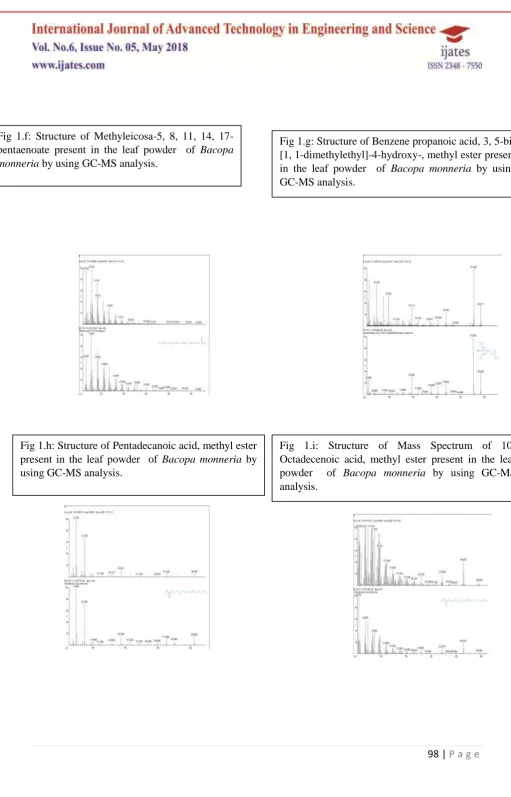
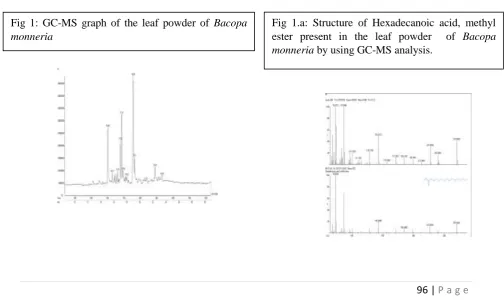
Gas chromatography and mass spectroscopy analysis of compounds was carried out in leaf extract of Bacopa monneria. The GC-MS graph of the plant Bacopa monneria is shown in Figures1. It showed the presence of 11 major components corresponding to the peaks were determined in the figure (1.a – 1.k).
.The results pertaining to GC-MS analysis of the leaf powder of Bacopa monneria lead to the identified number
of bioactive compounds. On comparison of the mass spectra of the constituents with the NIST library the 11
phytochemical constituents were characterized and identified Table1.
Fig 1.a: Structure of Hexadecanoic acid, methyl
ester present in the leaf powder of
Bacopa
monneria
by using GC-MS analysis.
Fig 1: GC-MS graph of the leaf powder of
Bacopa
97 | P a g e
Fig 1.b: Structure of Z, E-2-methyl-3,
13-octadecadien-1-ol present in the leaf powder of
Bacopa monneria
by using GC-MS analysis.
Fig 1.e Structure of 9-hexadecenoic acid, methyl
ester [Z] - present in the leaf powder of
Bacopa
monneria
by using GC-MS analysis.
Fig1.d: Structure of methyl tetradecanoate present in
the leaf powder of Bacopa monniera by using
GC-MS analysis
Fig 1.c: Structure of Heneicosanoic acid present in
the leaf powder of
Bacopa monneria
by using
98 | P a g e
Fig 1.f: Structure of Methyleicosa-5, 8, 11, 14,
17-pentaenoate present in the leaf powder of
Bacopa
monneria
by using GC-MS analysis.
Fig 1.g: Structure of Benzene propanoic acid, 3, 5-bis
[1, 1-dimethylethyl]-4-hydroxy-, methyl ester present
in the leaf powder of
Bacopa monneria
by using
GC-MS analysis.
Fig 1.h: Structure of Pentadecanoic acid, methyl ester
present in the leaf powder of
Bacopa monneria
by
using GC-MS analysis.
Fig 1.i: Structure of Mass Spectrum of
10-Octadecenoic acid, methyl ester present in the leaf
powder of
Bacopa monneria
by using GC-MS
analysis.
99 | P a g e
Table 1. Phytochemical constituents of
Bacopa monneria
Sl no. Name of the Compounds Retention time
1. Methyl tetradecanoate 15.12
2. 9-Hexadecenoic acid, methyl ester, [Z] 17.02
3. Hexadecanoic acid, methyl ester 17.27
4. 10-Octadecenoic acid, methyl ester 19.03
5. Methyl eicosa-5,8,11,14,17- Pentaenoate 22.35
6. Pentadecanoic acid, methyl ester 15.77
7. Benzenepropanoic
acid,3,5-bis[1,1-dimethyl]-4-hydroxy-,methyl ester
17.45
8. Z,E-2-Methyl-3,13-Octadecadien-1-ol 18.02
9. Heneicosanoic acid 21.07
10. Heptadecanoic acid, 16-methyl, methyl ester 19.20
11. 2-Heptenoic acid,[6-[4-cyanophenyl]2-naphthyl] ester 23.43
Fig 1.j: Structure of Heptadecanoic acid, 16-methyl-,
methyl ester present in the leaf powder of
Bacopa
monneria
by using GC-MS analysis.
.
Fig 1.k: Structure of 2-Heptenoic acid,
[6-[4-cyanophenyl] 2-naphthyl ester present in the leaf
powder of
Bacopa monneria
by using GC-MS
100 | P a g e
III.DISCUSSION
The GC-MS spectrum confirmed the presence of various components with different retention times. The mass
spectrometer analyses the compounds eluted at different times to identify the nature and structure of the
compounds. The large no of compound fragments into small compounds giving rise to appearance of peaks at
different m/z ratios. These mass spectra are fingerprint of that compound which can be identified from the data
library. GC-MS is one of the best techniques to identify the constituents of volatile matter, long chain, branched
chain hydrocarbons, alcohols, acids, esters etc. The GC-MS analysis of Bacopa monneria leaves revealed the presence of five bioactive compounds and Bacopa monneria has eleven compounds that could contribute the medicinal quality of the plant. The bioactive compounds may be responsible for their usefulness in the
management and treatment of various diseases. In the present study, reported that the bioactive compounds in
both the plant Bacopa monneria by using GC-MS analysis, which is mostly needed for memory enhancement
activity.
IV.CONCLUSION
This study has revealed that the plant Bacopa monneria is found to have better level of memory enhancement
activity Bacopa monneria. Further GC-MS analysis of this sample has established the presence of eleven
bioactive components. The presence of various bioactive compounds justifies the use of Bacopa monneria for
various human ailments by traditional practitioners. Bacopa monneria decreases blood pressure to reduce
anxiety and stimulates production of neurotransmitter and Bacopa monneria generally increases mental
function. And also it is a right step in the direction of searching for novel and more effective Gas
chromatography and mass spectroscopy analysis which showed the existence of various compounds with
variable chemical structures. However, the isolation of individual phytochemical constituents and subjecting it
to biological activity will definitely give effective results. So it is recommended as a plant of
phytopharmaceutical importance. However, further studies will need to be undertaken to ascertain fully its
bioactivity, toxicity profile, effect on ecosystem and agriculture products.
V.
ACKNOWLEDGEMENTS
The authors are indebted to the Chancellor, Vice Chancellor and Department of Biotechnology, Manonmaniam
Sundaranar University, Tirunelveli and Noorul Islam Centre For Higher Education, Kumaracoil for their
valuable guidance, constant encouragement and providing basic facilities throughout the study.
REFERENCES
1. Sunil Kumar Singh. Phytochemical analysis of leaf callus of Bacopa monneria L. International Journal
101 | P a g e
2. Harsahay Meena, Hemant Kumar Pandey, Pankaj Pandey, Mahesh Chand Arya, Zakwan Ahmed.
Evaluation of antioxidant activity of two important memory enhancing medicinal plants Bacopa monneria and Centella asiatica. Indian J of Pharmocology. 2012, 44(1): 114-117.
3. Venkatakrishnan Kamesh, Thangarajan Sumathi. Antihypercholesterolemic effect of Bacopa monniera
linn. on high cholesterol diet induced hypercholesterolemia in rats. Asian Pacific Journal of Tropical
Medicine. 5(12)2012,949-955.
4. Subashri B, Dr Y.Justin Koilpillai. Phytochemical analysis and invitro antioxidant activity from the
extract of Bacopa monneria (L) Pennel-A multipurpose medicinal plant, International Journal of
Pharma and BioScience;3(2), 2012, 698.
5. Srinivasa Rao Bammidi, Sharan Suresh Volluri, Seema Chaitanya Chippada, Sumanjali Avanigadda,
Meena Vangalapati. A Review on Pharmacological Studies of Bacopa monniera .J. Chem. Bio. Phy.
Sci; 1(2), 2011,250 – 259.
6. Somoday Hazra, Ritabrata Banerjee1, Biplab K. Das, Anup K. Ghosh, Tarit K. Banerjee, Uday
S.Hazra, Susanta K. Biswas, Amal C. Mondal. Evaluation of Antidepressant activity of Bacopa
monneria in rat: A study in Animal Model of Depression. Drug discovery;2(4), 2012, 8-13.
7. Gohil KJ, Patel JA. A review on Bacopa monniera: Current research and future prospects. Int J Green
Pharm; 4(1),2010,19-21.
8. Ravikumar S, Nazar S,Nuralshiefa A, Abideen S. Antibacterial activity of traditional therapeutic
coastal medicinal plants against some pathogens. Journal of Environmental Biology;26(12),
2005,383-386.
9. Ling Peng, Yun Zhou, De Yun Kong, Wei Dong Zhang. Antitumor activities of Dammarane triterpene
saponins from Bacopa monniera. Phytotheraphy Research; 24, 2010,864-868.
10. Okem A, Finnie JF, Van taden J. Pharmacological, genotoxic and phytochemical properties of selected
South African medicinal plants used in treating stomach-related ailments.J Ethnopharmacol;139(3),
2010,712-720.
11. Karou SD, Tchacondo T, Ouattara L, Anani K, Savadogo A, Agbonon A, Attaia MB, de Souza C,
Sakly M, Simpore J. Antimicrobial, antiplasmodial, haemolytic and antioxidant activities of crude
extracts from three selected medicinal plants. Asian Pac J Trop Med;4(10),2011,808-813.
12. Shabana Channa, Ahsana Dar, Shazia Anjum, Muhammad Yaqoob, Atta-ur-Rahman.
Anti-inflammatory activity of Bacopa monneria in rodents. Journal of Ethnopharmacology;104(1),
2006,286-289.
13. A.V.Badarinath, K. Mallikarjuna Rao, C.Madhu Sudhana Chetty, S. Ramkanth, T.V.S Rajan,
K.Gnanaprakash, 2010. A Review on Invitro Antioxidant Methods: Comparisions, Correlations and
Considerations. Int J of Pharm Tech Research; 2(2),2010,1276-1285.
14. Md. Nur Alam,Tania Binte Wahed, Farhana Sultana, Jamiuddin Ahmed, Moynul Hasan. In
![Fig 1.e Structure of 9-hexadecenoic acid, methyl ester [Z] - present in the leaf powder of Bacopa monneria by using GC-MS analysis](https://thumb-us.123doks.com/thumbv2/123dok_us/9312480.1466120/4.595.49.549.24.821/structure-hexadecenoic-methyl-present-powder-bacopa-monneria-analysis.webp)