M Phil Town Planning (Day Release)
University College London
Environmental Protection;
ProQuest Number: 10042970
All rights reserved
INFORMATION TO ALL USERS
The quality of this reproduction is dependent upon the quality of the copy submitted. In the unlikely event that the author did not send a complete manuscript and there are missing pages, these will be noted. Also, if material had to be removed,
a note will indicate the deletion.
uest.
ProQuest 10042970
Published by ProQuest LLC(2016). Copyright of the Dissertation is held by the Author. All rights reserved.
This work is protected against unauthorized copying under Title 17, United States Code. Microform Edition © ProQuest LLC.
ProQuest LLC
789 East Eisenhower Parkway P.O. Box 1346
I, the undersigned, declare that this project is my own original work, and I give permission that it may be photocopied and made available for inter-hbrary loan.
Signed:
ACKNOWLEDGEMENTS
I would like to record my appreciation for the efforts and allowances - temporal and financial - from University College and my employers, West Sussex County Council which made the completion of this thesis possible. In addition I would like to thank Mike Collins for his tutorial input and Dr Steve Merret who consented to extra time to help straighten out the complexities of European and UK Environmental law. The granting of personal interviews by Glenys Parry, Donald Harris and Elizabeth Street is warmly acknowledged.
TABLE OF CONTENTS
Page
A CK NO W LED G EM EN TS... 3
A B ST R A C T ... 4
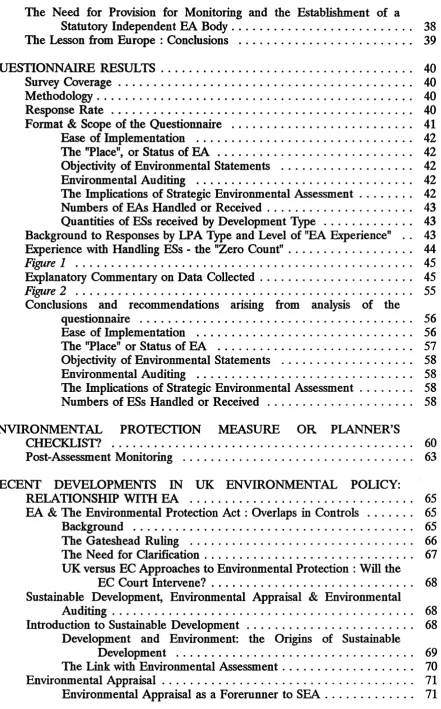
TABLE OF CONTENTS ... 5
IN T R O D U C T IO N ... 8
SUMMARY OF RESEARCH M ETH O D O LO G Y ... 10
Primary S o u r c e s ... 10
Policy Documents and Guidance ... 10
Personal Communication and Interview s... 10
Q uestionnaire... 11
Secondary Sources ... 11
Acronyms Used in the D ocum ent... 12
1 TH E ORIGINS & EVOLUTION OF THE D IR E C T IV E ... 13
Protecting the Community’s Environment: Early Initiatives ... 14
The Environmental Action Programmes I - I I I ... 16
The Legal Basis of E A P s ... 16
The First and Second EAPs. A "Cure for P ollution"... 17
The 1987 Single European Act & its Significance to Environmental P o h c y ... 18
2 THE TERMS OF THE 1985 EIA DIRECTIVE & ITS TRANSLATION INTO UK LEG ISLA TIO N ... 20
F a c to rs... 21
T h re sh o ld s... 21
Scoping ... 22
Provision of In fo rm a tio n ... 22
Annex I and Annex II : Project Types Subject to A ssessm ent... 24
Background to British Objections to the Proposed EIA D irec tiv e ... 25
Pre-Directive Experience of EA in the U K ... 26
The Substance of the British Argument against the D irectiv e... 28
From Directive to Regulation : the Transposition of EIA ... 31
The Transposition of Directive into UK Planning L a w ... 32
The Timing of the translation of Directive into R egulations... 33
3 TH E IMPLEMENTATION OF EA IN TH E EUROPEAN COMMUNITY ... 35
In te g ra tio n ... 35
Implementation ... 36
Interpretation : The "Threshold" P ro b le m ... 36
The Need for Provision for Monitoring and the Establishment of a
Statutory Independent EA B ody... 38
The Lesson from Europe : Conclusions ... 39
4 QUESTIONNAIRE R E S U L T S ... 40
Survey C o v erag e... 40
M ethodology... 40
Response R a t e ... 40
Format & Scope of the Questionnaire ... 41
Ease of Implementation ... 42
The "Place", or Status of E A ... 42
Objectivily of Environmental Statements ... 42
Environmental Auditing ... 42
The Implications of Strategic Environmental A ssessm ent... 42
Numbers of EAs Handled or R eceived... 43
Quantities of ESs received by Development T y p e ... 43
Background to Responses by LPA Type and Level of "EA Experience" . . 43
Experience with Handling ESs - the "Zero C o u n t"... 44
Figure 1 ... 45
Explanatory Commentary on Data C ollected... 45
Figure 2 ... 55
Conclusions and recommendations arising from analysis of the questionnaire ... 56
Ease of Implementation ... 56
The "Place" or Status of EA ... 57
Objectivity of Environmental Statements ... 58
Environmental Auditing ... 58
The Imphcations of Strategic Environmental A ssessm ent... 58
Numbers of ESs Handled or R e c e iv e d ... 58
5 ENVIRONMENTAL PROTECTION MEASURE O R PLANNER’S CHECKLIST? ... 60
Post-Assessment Monitoring ... 63
6 RECENT DEVELOPMENTS IN UK ENVIRONMENTAL POLICY: RELATIONSHIP WITH EA ... 65
EA & The Environmental Protection Act : Overlaps in C o n tro ls ... 65
Background ... 65
The Gateshead Ruling ... 66
The Need for Clarification... 67
UK versus EC Approaches to Environmental Protection : Will the EC Court Intervene?... 68
Sustainable Development, Environmental Appraisal & Environmental A u d itin g ... 68
Introduction to Sustainable D evelopm ent... 68
Development and Environment: the Origins of Sustainable Development ... 69
The Link with Environmental Assessm ent... 70
Environmental A p p raisal... 71
Environmental Audits (E A U s)... 72
The Status of E A U ... 72
C o n clu sio n ... 73
"THE NEXT BIG T H IN G "... 73
CONCLUSIONS & PRESCRIPTIONS FOR THE F U T U R E ... 75
APPENDIX A ... 77
APPENDIX B ... 82
APPENDIX C ... 84
Environmental Protection:
Implementing the EIA Directive
INTRODUCTION
Environmental Assessment, EA, is the systemisation of procedures we have endeavoured to follow since the beginning of formal town planning in the UK. During the six turbulent years since the European Commission outlined the procedures its Member States should follow in Directive} 85/337, the debate has continued as to the best way to interpret the spirit of the "official" guidelines (from tier to tier of implementation). The initial reaction of the Department of the Environment and subsequently the Planning Profession could be described as trepidation. Academics could not agree how to categorise this startlingly modem planning instrument and few could predict how it would affect either planners or the decisions they made.
This dissent and confusion still persists in some quarters because, although there has been a greater number of Environmental Statements (ESs) accompanying applications than the UK Government anticipated would be generated by their EA Regulations, the spread of authorities who have experienced EA has been very patchy indeed. The "shock of the new" was hardly lessened by the inadequacy of incisive advice on EA procedures and the persistent lack of an official library where existing Environmental Statements could be used for comparison and monitoring.
The UK is not the only European country to have experienced difficulties with the interpretation and implementation of the EA Directive. It is instructive to compare the experiences of the other member states to see where Britain might improve its practices. There was and still is a need to rationalise and synthesise these varied experiences, so that EA can be accepted everywhere, yet powerful procedure in development control.
Introduction
plan stage, this debate focused on whether the EA process could be judged as an environmental protection measure. Now time has moved on and sustainable development, a more pragmatic ideal than protection of the environment per se has become the benchmark by which the end result of EA and other planning environmental legislation could be measured. Whilst the original association with environmental problems still needs to be explored, the need to relate EA to the concept of sustainable development, and to the new legislation, is possibly more pressing. The impending Strategic Environmental Assessment Directive (the application of EA techniques to development plans and policies) and the four year old Environmental Protection Act could be said to provide respectively an opportunity and a threat to the continued effectiveness of EA in decision-making on apphcations.
SUMMARY OF RESEARCH METHODOLOGY
This is an evaluative analysis of the aims and provisions of the Environmental Assessment Directive and its place amongst other environmental measures. It draws upon:
I Primary Sources
a) Policv Documents and Guidance
Chiefly:
a European Community Directive No.85/337 on the assessment of the effects of certain pubhc and private projects on the Environment, Brussels 1988: referred to as "the Directive" or "the EA Directive".
n The Town and Country Planning (Assessment of Environmental Effects) Regulations, 1988 (SI 1988 No. 1199): referred to as "the Regulations".
□ Circular No 15/88 on the Town and Country Planning (Assessment of Environmental Effects) Regulations 1988, DoE: referred to as "the Circular".
a Report from the Commission on the Implementation of Directive 85/337/EEC (COM(93)28 Vol 12), Brussels, 2 April 1993: referred to as " the 5-year review".
b) Personal Communication and Interviews
Research Methodology
a Interview by telephone with Donald Harris, retired Assistant Chief Planning Inspector, now Senior Planning Inspector, Planning Inspectorate, Bristol, 28th October 1993.
D Interview with Dr Elizabeth Street, Principal Planning Officer, Kent County Council (the LPA which has received the highest number - over 70 - of ESs in the UK) December 1992.
c) Ouestionnaire
a Sent to 58 LPAs in the South East Region in March 1993.
II Secondary Sources
a Key texts on European Environmental Law which provided a background to pohcy formation (Kramer, Sallar and Johnson and Corcelle were particularly useful).
o Notes from presentations on EA to Conferences and Seminars, notably those by Thompson, Thérivel and Minter.
o Journals. These were particularly useful for gathering information on the experiences of other member states in implementing EA.
Research Methodology
Acronyms Used in the Document
CEP Communily Environmental Policy CPOS County Planning Officers* Society
DC Development Control
DoE Department of the Environment
EA Environmental Assessment EAP Environmental Action Pohcy EAU Environmental Audit(ing)
EC European Community (now European Union)
EIA Enviromnental Impact Assessment (interchangeable in meaning with EA (above). Found in European pohcy documents and some older UK hterature.
ES Environmental Statement
LA Local Authority
LPA Local Planning Authority
Sc Schedule (Directive)
CHAPTER ONE
THE ORIGINS & EVOLUTION OF THE DIRECTIVE
1.1. Formal environmental impact assessment (EIA) as we know it originates from the USA, where an increase in pubhc awareness of the harmful economic and social effects of development in the 1960s prompted the passing of the United States National Environmental Protection Act 1970. "NEPA" required the proponents of a development to submit an environmental impact statement (EIS), describing in detail the environmental impacts arising from a development, and where possible exploring the alternatives available.
1.2. NEPA’s stated purpose was the promotion of
^productive and enjoyable harmony between man and his environment through an understanding of the ecological systems and natural resources important to the Nation''
This increased concern for the environment was not confined to the US but occurred independently in most industrialised countries. In Canada, for example, there were serious reservations about the exploitation of the wüdemess areas of the northern Territories, leading to pubhc demonstrations. In Australia, "green bans" on environmentaUy damaging projects were imposed by trade unions (Clark et al 1980). In the UK concern was expressed over the proposal for a third London Airport and, later, the Windscale Inquiry. The fierce controversy over the analysis of alternative sites for the airport, which rehed heavily on cost benefit analysis, may have helped prepare the way for a new type of assessment. As Hah (1978) said, there were "gyave doubts about the wisdom of trying to reduce every kind of impact to pounds and pence".
The Origin & Evolution of the Directive Chapter One
before long be the basis for the adoption of an EIA framework along the lines of the much-admired American NEPA model.
1.4. There were several reasons, in addition to this new environmental awareness of the potential for development to cause environmental damage, why the EC decided to act. There was the problem of trans-border pollution: one member state’s pollution could affect another country yet both were supposed to have equal rights to protection under the Treaty of Rome. It was thought that in many cases environmental pollution could be best tackled through community-wide mechanisms or at least the co-ordination of member states’ environmental legislation. Ways were sought to maintain, protect and improve the environment in the whole community - the "EEC ecosystem" as Kramer (1990) called it.
1.5. A further impetus to harmonise environmental protection measures was the fear of competitive disadvantage for countries within the "Common Market" who had higher environmental standards (through their own self-regulation) compared with those neighbours whose attitude was more laissez-faire.
Protecting the Community's Environment; Early Initiatives
The Origin & Evolution of the Directive Chapter One
1.7. The fact that these initiatives were achieved without the benefit of central legislation, policies, and a regular forum for discussion is tribute to the pioneering efforts of some of its constituent members. For example, Kirkwood (1992) notes that Germany’s advanced programme of promoting lead-free petrol prompted the EC to introduce a directive. Moreover, France, Belgium and Greece had passed national EIA legislation prior to Directive 85/337 on EIA (See Chapter! 3 on European Implementation).
1.8. It was the lobbying efforts of two particularly environmentally progressive member states at a 1972 United Nations meeting that was responsible for the setting up of a much-needed communhy-wide action-programme on the environment. That was the beginning of the commission’s efforts to join the world stage as environmental policy maker - a stage which had been completely dominated by America. Community Environmental policy thus began slowly to take shape.
1.9. If Community Environmental Policy (CEP) was the vehicle for change, then the Community Environmental Action Programme (EAP) was the driving force behind it. The EAP is an important forum at which initiatives or research into environmental protection or amelioration can be discussed, and perhaps compared with existing legislation of member states. The way in which this "Charter of Reference", as Johnson and Corcelle (1989) describe the EAP, actually translates decisions into actions is complex, employing a "kaleidoscope pattern of agreements, alliances and compromises"
involving a number of policy instruments: regulations. Notes, Directives (Kirkwood, 1992). Directives have been used most frequently for translating EC policy into member state legislation because of their flexibility (however some critics argue that this flexibility dilutes the power of the directive and makes it too easy to avoid implementing (Briggs, 1991, Kirkwood, 1992).
The Origin & Evolution of the Directive Chapter One
environmental management protection measures related to EIA which have been initiated by successive programmes (the IV^ and EAPs) will be brought into the discussion at a later stage.
The Environmental Action Programmes I - III
1.11. The Seminal UN Stockholm Meeting of 1972 was witness to the first real call for urgent co-operation on conservation and development across all member states. The two countries who whipped up the debate as well as pollution fears, were Germany and the Netherlands. Unlike self-contained Britain (soon to join the EC), these two countries were acutely aware of the problems of cross-boundary pollution because of the great river that they shared, which conveyed pollution from Germany’s industrial heartland through heavily populated settlements. This call for action gave rise to
^'vigorous debate^' over the question of whether environmental matters were most effectively managed using community-level inter-govemmental agreements or through co-ordination of national environmental policies (Kramer, 1990). Political co-operation triumphed and at the EC Heads of State and Government Summit in Paris in 1972 plumped for a Community Environmental Policy. They issued a Declaration that.
Hhe Heads of State and Government stressed the value of a Community Environment Policy. They are therefore requesting the Community Institutions to draw up an Action Programme with a precise schedule before 31st July 197T
The 1st Summit Conference of the Enlarged Community Bull, EC, No 10, 1972
1.12. Ahead of schedule, the commission responded with proposals for a Community Environmental Plan and 8 months after this, in November 1973, it formally adopted the
1st Environmental Action Programme (EAP).
The Legal Basis of EAPs
The Origin & Evolution of the Directive Chapter One
place them in an overall context. When new approaches to environmental management come to light, and a new point of reference is established, a new programme is launched. Each is therefore a policy framework.
1.14. The dates of the five programmes are listed below.
Number Period Covered Date Approved Journal Reference
1st 1973 - 76 22/11/73 C l12 20.12.73 2nd 1977 - 81 17/05/77 C139 13.06.77 3rd 1982 - 86 07/02/83 C46 17.02.83 4th 1987- 92 19/10/87 C328 7.12.87 5th 1993 - 2000
EAPs have been a prolific source of environmental measures. Since the launch of the 1st EAP, the Community has adopted about 180 Directives, Regulations, Resolutions and Decisions, according to the latest estimate by Kirkwood (1992).
The First and Second EAPs» A "Cure for Pollution"
1.15. The First EAP introduced its objectives with 11 principles for a communily environmental policy. Those still underpin the objectives of CEP today. Two principles refer directly to planning, i.e.:
□ ensuring that more account is taken of environments aspects in town planning and land use.
□ that environmental effects should be taken into account and the earliest possible stage of technical planning and decision making.
The Origin & Evolution of the Directive Chapter One
"... action must be taken at the appropriate level whether national community or international Actions more likely to be effective at Community level should be so concentrated}'
C112 20.12.73
1.17. The approach of the 1st EAP (and the 2nd EAP too) was to "cure" existing pollution, or the causes of it. The programme vowed:
a. To reduce pollution and nuisances.
b. To amehorate the natural and built environment.
c. To promote awareness of environmental problems caused by depletion of natural resources.
It was during the 2nd EAP period that environmental impact assessment for projects was first drafted.
1.18. The third EAP marked a turning point of CEP with a shift of emphasis towards a preventative approach to pollution. The period it covered (1982-86) witnessed an acceleration in the adoption of measures, including the Directive for EIA 85/337. (Though as already noted it was drafted during the 2nd EAP period for the most part). This Directive was revolutionary in its breadth and potential impact on the decision making process of land use planners across the EC. That was the most prominent of a new breed of general legal instruments applicable to all environmental media and sectors.
The 1987 Single European Act & its Significance to Environmental Policv
The Origin & Evolution of the Directive Chapter One
in every effective environmental policy since it allows action to be taken to protect the environment at an earlier stage ... clearly the past action by the commission in many fields failed to take account of the preventative approach. Indeed, at times it even ran counter to
this principle" (Kramer, 1990)
1.20. Article 130R set out a further two objectives beyond the protection, preservation and improvement of the environment. It said that environmental measures should
"contribute towards protecting human health, and ensure a prudent and rational utilisation of natural resources".
CHAPTER TWO
THE TERMS OF THE| 1985 EIA DIRECTIVE
& ITS TRANSLATION INTO UK LEGISLATION
2.1. Directive 85/337/EEC is designed to ensure that environmental impact assessment is undertaken of certain development projects - mostty large scale industrial or infrastructure projects - and that this assessment is taken into account before those projects are approved and implemented. Haigh (1990) summarises this as being the embodiment of the preventative approach to environmental protection.
2.2. The Directive comprises 14 Articles and 3 Annexes - a relatively short legal instrument. It does not have the status of EC legislation but is more akin to a framework law. It established basic assessment principles and procedural requirements and then allows member states discretion over how they transport them into national legislation, provided these basics are respected (COM (93) 281 Vol 12). Flexibility of application across national legislation and planning regimes is a special characteristic of Directives which makes them, according to Haigh, the instrument most commonly used to pass environmental measures.
2.3. The following is a summary of the main provisions of the Articles based upon the original 1985 text of the Directive, and sub-section 2.2 of Com (93) 28 Volume 12, which is the delayed 5-year report by the Commission on "The Implementation of the Directive". Examples of areas or points of implementation where the Directive gives interpretive discretion to member states are pin-pointed, for such areas of ambiguity are the root cause of some of the difficulties in interpretation, and the variety of complex legislative arrangements adopted.
2.4. The Directive obliges member states to adopt all measures necessary to ensure that projects "likely to have significant effects on the environment by virtue inter alia, of their nature, size or location, are made subject to an assessment" (Article 2(2)). There is no further guidance as to what a "significant effect" is, but the likelihood of significant
Terms of the 1985 EIA Directive & Translation into UK Legislation Chapter Two
impact remains the fundamental test of the need for EIA to be applied in each case. Existing procedures may be employed for the EIA s; failing this new procedures may be established in order to comply with the Directive (2(2)). Member states may, in exceptional cases, exempt a specific project from the Directive’s provisions but only with prior notification to the pubhc and the Commission of its reasons (2(b) and (c)). National defence projects (1(4)) and those adopted through a specific act of national legislation are also exempt (1(5)).
Factors
2.5. Article 3 states that the EIA ''Will identify, prescribe and assess ... the direct and indirect effects of a project on the following factors:
a. human beings, fauna and flora
b. soil, water, air, climate and the landscape c. the interaction between a. and b. above d. material assets and the cultural heritage."
Thresholds
2.6. All projects hsted in Annex I are subject to assessment, and those hsted in Annex II are subject "where member states consider that this characteristics so require" (Article 4); to this end member states may specify certain types of projects as being subject to an assessment or may establish the criteria and/or thresholds necessary to determine which Annex II projects should be subject to EIA (4(3)). These thresholds may be legally binding (an option chosen by the majority of member states) or they may be advisory (as in the UK^ and Wallonia, Belgium).
2.7. The number of ESs generated in a country is linked to the level at which Annex II thresholds are set, for if the thresholds are generally low (as in France) there wiU be
Terms of the 1985 EIA Directive & Translation into UK Legislation Chapter Two
more, smaller projects which have to be assessed. On the other hand, where a member state has restricted the number of Annex II categories to be subject to EIA, and yet set the threshold relatively high (e.g. the Netherlands) then the number of Annex II projects requiring an assessment will be smaller than the EC average. Though the question of thresholds, and their effects on the number of ESs generated, across different member states will be discussed at greater length later, it is interesting to note that Britain’s unique approach - relatively high thresholds but a wide coverage of projects - has had the consequence of producing the average total amount of ESs within the Community. The level at which a member state fixes its thresholds, and the categories it chooses to subject to impact assessment by virtue of the number of assessments generated, may well have had some influence on the ability of development control systems to implement Directives effectively: an excessive load to applications with an ES attached and it becomes difficult to determine applications within the set time limit.
Scoping
2.8. It is left to member states to determine the scope of each assessment, because the Directive recognises that each case, or project, is different and therefore the actual coverage (or scope) of impacts will have to be assessed individually.
Provision of Information
2.9. Information to be included in an assessment is specified in Annex III. The form in which it is to be supplied is not clear in the Directive, but in practice it accompanies the information normally required by the member state development control (DC) regulations. The document containing the EIA information has become known as the "environmental statement" (ES) in the UK. The ES should include a description of the project and the environment likely to be affected, alternatives to the project, significant effects, mitigation measures and, crucially, a non-technical summary.
Terms of the 1985 EIA Directive & Translation into UK Legislation Chapter Two
data which is pertinent to the application site or lype of development. They must supply the developer with all his or her information needs. The developer may supply more than the minimum information if he believes it to help his case, or if the Local Authority requests it.
2.11. It should be noted that information on matters other than environmental are normally supplied as part of the requirements of the existing DC regimes of individual member states; as Clark (1988) notes, "the EA is not necessarily the only, or determining factor, in reading a decision". This fact is important for it puts EA firmly in the role of additional, rather than replacement information to that information which is already required. Put another way, the ES is one of a variety of material considerations which must be taken account of when determining planning applications - in the UK at lezist.
2.12. In the final (implemented) draft of the Directive, the responsibility for preparing each ES rests with the project proponent, in conformity with the "polluter pays" principle. This is a less unwieldy arrangement than that envisaged in the 1980 Sdît
which would effectively have required 2 assessments per project: the first forming part of the information provided and pubhshed by the developer, and a second prepared and made pubhc by the competent authority (Haigh, 1990). The "belt and braces" approach to the presentation of likely impacts to the pubhc might have the advantage of a more balanced presentation of the facts - or predicted impacts. However, to produce two assessments would probably have taken twice the effort, and cost, and delayed the decision making process unacceptably. Also, in HaU’s (1978) argument, it would still leave the problem of "deciding whether consideration "a" is worth more than consideration "b"".
2.13. The Directive provides for the EIS to be made available to designated environmental authorities, the pubhc and (in specified circumstances) other member states as a basis for consultation (6(1)). Article 6(2) confirms that "the public concerned
[should be] given the opportunity to express an opinion before the project is initiated"
Terms of the 1985 EIA Directive & Translation into UK Legislation Chapter Two
provision in the Directive to assess whether any environmental impacts predicted occur to the magnitude predicted, whether mitigation strategies worked, whether unforeseen impacts occur.
Annex I and Annex II ; Project Types Subject to Assessment
2.14. Projects which must be made subject to EIA, unless exempted, fall under nine headings in Annex I. In summary they are:
oil refineries
large thermal power stations and nuclear power stations and reactors installations for storage or disposal of radioactive waste
iron and steel works
installations for extracting and processing asbestos integrated chemical installations
construction of motorways, express roads, railway lines and airports trading ports and inland waterways
installations for incineration, treatment and landfill of hazardous waste
This list of Projects has been incorporated almost verbatim into the Schedule I Regulations which implement the Directive in the UK. The main difference is that the latter omitted nuclear power stations because their provision is covered by other, non planning procedures.
Terms of the 1985 EIA Directive & Translation into UK Legislation Chapter Two
2.16. However, an analysis of this interpretation, and also the actual implementation of the Directive cannot be undertaken without prior reference to the way the UK Government viewed the Directive, and influenced its redrafting from the end of the 1970s up to the twenty-first draft, and the subsequently adopted version.
Background to British Objections to the Proposed EIA Directive
2.17. The UK Government has not in the past been at all positive towards Community Environment Pohcy (CEP), especially when it is translated into Directives which impinge upon UK legislation. The UK joined the European Economic Community in 1973 and straight away felt at odds with the nascent CEP and the interference it threatened to long-estabhshed planning and pollution control legislation in the UK. There was a feeling that the British tradition of discretionary local decision making and a DC system based on pragmatism set it apart from continental Europe (Davis, 1992). The geographical advzintages of being an island with ample coastline (better for absorbing pollutants), no frontiers, a rainy climate and so on reinforced the UK government’s view that it would manage its own environmental affairs without having to subscribe to the same rules as the rest of Europe.
Terms of the 1985 EIA Directive & Translation into UK Legislation Chapter Two
Pre-Directive Experience of EA in the UK
2.19. Perhaps the most important catalyst to the development of EA^ methods in the UK was the discovery of North Sea oil and gas reserves at the beginning of the 1970s. Planning authorities in Scotland began to receive large numbers of planning applications for platform sites in environmentally sensitive locations settled by small traditional communities which were vulnerable to change. The response to this was a 1973 advice note to Local Authorities entitled "Appraisal of the Impact of Oil Related Development" by the Scottish Development Department.
2.20. According to Clarke’s estimate (1988) energy-related EAs totalled approximately 100 between 1973 and 1987 in the UK. In addition, 150 more environmental statements had been included with proposals for a wide range of other developments - reservoirs, mining excavation, major roads, ski ing facilities and more. This amounts to a not inconsiderable body of experience, considering that only 626 had been received and published across all the Regulations implementing the EIA Directive in Britain between July 1988 and July 1991 (Coles & Tarhng, 1992 p.3)
2.21. The Department of the Environment was aware of the need by Local Authorities for guidance in handling these sensitive applications in such a way that the effects on the environment could be incorporated more explicitly - and publicly - in the decision- making process. Public and sometimes professional disquiet over the dominance of cost- benefit analysis for large developments ( vide Roskill Commission exercise in 1970 on finding sites for the 3rd London Airport (Hall, 1978)), meant that the philosophy and procedures of EA began to be taken seriously.
1
Terms of the 1985 EIA Directive & Translation into UK Legislation Chapter Two
2.22. To this end the DoE commissioned research reports on EA including the seminal one by Catlow and Thirwell in 1977. This proffered 13 recommendations which are worth detailing in part because of their historical interest and apportionment of responsibilities between proponent and decision-makers, which differ significantly from the situation we have now that the Directive has been implemented. Catlow and Thirwell recommended (para 5 ii) that if a Local Authority decides EA is required, a steering committee should be appointed to pubhsh a statement of the key issues of the development, and prepare a brief for the analysis and appoint a team to carry it out. Possible alternatives and/or modifications were to be considered (para 6) and in recognition of the time this would take, 12 months rather than the statutory 8 weeks was recommended to complete the process (para 12 v). Finally, 12 vi contains the sensible, if radical, recommendation (from the perspective of today’s cash-strapped Local Authorities anyway) that the additional costs attributable to an analysis should be shared between the developer and the planning authority. This last concept also shows httle allowance for the "polluter pays" principle which had been enshrined in Community Environmental Pohcy since 1973 (1st EAP).
2.23. These ideas complemented a manual of procedures to be incorporated into the existing DC system (though they were not mandatory and only carried the DoE’s endorsement) pubhshed in 1976. The next major pubhcation of government guidance on EA followed some years later in 1981, and was a revision by Clark , Chapman et al
of the 1976 manual.
2.24. In addition to research and guidance emanating from the DoE, there was a small but growing body of hterature in the 1970s - mid 1980s which researched and advised on the role of EIA in the UK. Major works include Pearce, 1976; O’Riordan and Hey,
1976; Thorbum and Clark, 1978; and Clarke et al, 1984.
Terms of the 1985 EIA Directive & Translation into UK Legislation Chapter Two
local amenities, was a consideration already provided for by the Town and Country Planning Acts. So it was with some indignation, and a lot of scepticism, that the UK government (and no doubt some town planners too) faced consultation over EIA measures which were prescribed for all member states alike by the EC.
The Substance of the British Argument against the Directive
2.26. The core of the objection to EIA did not concern the principle of EIA, as the Select Committee of the House of Lords was keen to point out in its introduction to its
1981 report on E IA \
"without exception, all those who submitted oral and written evidence recognised that the assessment of potential environmental effects of development projects was an important component of the decision-making process"
2.27. The crux of the matter was that, as in the DoE’s words, EIA was already "implicit in the Town and Country Planning System in this country". There was a sense of British strengths being sacrificed to the altar of European conformity and this lowering standards - a feeling expressed in the following rather arrogant tones by the representative for the Association of County Councils, at the Select Committee inquiry:
"I am not convinced that the British people will welcome a directive if it is only to put the affairs of Europe right. Europe must leam to join us."
It is interesting to compare the aissertions of thirteen years ago that EIA constituted an unnecessary addition to the British planning system with the results of the author’s 1993 survey questions which revealed that 27.5% of Local Planning Officers strongly disagreed, and 45% disagreed with this view. Possible reasons for this change (remembering that that last quote was from a local government officer too) include increasing confidence over time in the advantages of EIA, or a more pro-environmental, pro-European stance amongst the planning profession, will be explored.
Terms of the 1985 EIA Directive & Translation into UK Legislation Chapter Two
2.28. Anxiety about losing sovereignty over the development control regime aside, there were three further objections which surfaced at the Select Committee enquiry. The first was over the use of lists of projects, the Annexes were thought too prescriptive and inflexible. The DoE said that there would be risks in drawing up lists of projects to be subject to EA, since ”it is very difficult to latch on to a list of things for which you are absolutely certain you need studies and you run the risk of omitting things that do need studies..."
2.29. Secondly, there were warnings of unacceptably great costs and delays. The Directive was proposed at a time of deregulation and a general loosening of the UK planning system, and was seen as an added layer of bureaucracy the cost of which "could lead to considerable extra costs being imposed on developers and Local Authorities by requiring assessments to be carried out where they are not necessary ..." (DoE, Select Committee Report 1981).
2.30. Finally, on a practical point, the DoE queried the viability of setting thresholds (Article 4). The Department asked, "would a project costing £1 million necessarily have more environmental impact than one costing £900,000? How can a developer be prevented from avoiding assessment by constructing a project in stages, each one falling below the relevant threshold?" This was a pertinent point, which was obviously taken into consideration by the EC as Article 4 of the Adopted Directive did not fix a price hmit on projects to be assessed, nor did it ask this of member states. British Regulations require redevelopments and further applications on existing sites to carry an Environmental Statement to avoid as much as possible the latter scenario of developers fragmenting development applications to remain below the threshold for assessment.
Terms of the 1985 EIA Directive & Translation into UK Legislation Chapter Two
2.32. Some of these objectives were re-iterated in the debate in a standing committee of the House of Commons (9 June 1981). In the Lords’ debate all nine speakers, except the Minister, favoured the Directive. By contrast, there was much opposition to the Directive in the Commons’ debate, based mostly it seems on a desire to avoid changes to UK legislation which might be necessary if the Directive was adopted. Also, fears were voiced over the opportunities for delay and litigation over failure to follow some procedure in the Directive (grounds for appeal).
2.33. However, these fears were largely overcome by amendment. The Select Committee and Commons debate had been commenting on the eighteenth draft; there were to be three more drafts until the 21st was formally proposed in 1980 and a further three years of negotiation until Britain - which had become isolated in its opposition - withdrew its remaining objections.
2.34. Thus the Directive took this final shape (as taken from Haigh’s 1990 account)
□ Annex I is much shorter than in the proposal, and exemptions may be made by member states without recourse to the Commission.
□ A large measure of discretion over the type and scope of the information supplied by the developer was given to Local Authorities; this would reduce the risk of litigation considerably.
□ The developer would not always have to describe the main alternatives studied or the reason for his or her choice. Nor does the proponent need to provide a description of the relationship between the proposed project and existing environmental and land-use plans.
Terms of the 1985 EIA Directive & Translation into UK Legislation Chapter Two
2.35. The UK as we have seen consistent^ opposed the principle of an assessment on environmental assessment (although the Danes were responsible for a year-long "eleventh-hour" delay over a sovereignly dispute). This Government might not have acceded to it at all ^'had the Lords^ debate been as hostile as that in the Commons'^ (Haigh, Ch 10). The Lords had partly been swayed by the conviction (acting on advice) that
'^primary legislation would not be essential to implement the Directive" (Select Committee) and that only changes to subordinate legislation, i.e. at Regulation and Circular level, would be necessary. This reading was correct - although not predicting quite how much subordinate legislation would be needed - and crucial to persuading the Commons* sceptics not to oppose the Directive’s progress any further.
2.36. The Directive was notified to the member states (not "passed" since it is not technically legislation) on 27th June 1985. Its terms established that during the following three years, members states were to put in place the appropriate legislative or regulatory measures to implement it, with a deadhne of 27th June 1988.
From Directive to Regulation ; the Transposition of ELV
2.37. The DoE established a working parly as early as 1984 to work out how best to implement the Directive. Representatives from local government, planning profession representatives, environmental groups, industrialists and other environmental departments met together to consider how the project classes which came under planning control - the majority of Annex I & II projects - should be regulated. Certain projects such as afforestation, trunk roads and nuclear power stations were discussed by other government department committees as they were, and are, covered by separate legislation of their own (which is not the focus of this research).
Terms of the 1985 EIA Directive & Translation into UK Legislation Chapter Two
carried out in any particular case”. Implicit in this was the intention that an assessment would rarely be asked for. Put another way, British Regulations would effectively only apply to Annex I projects.
2.39. In Clark 's | words (1988, p22) the Commission was "most unhappy" over this and made it clear that Article 4(2) must be read not alone, but in conjunction with Article
2 which declares that all projects likelv to have significant effects on the environment by virtue inter alia of their nature, size or location are to be made subject to an assessment. The extent of member states' discretion is therefore strictly limited to deciding only whether the characteristics of particular projects are such that they are or are not likely to have significant effects.
2.40. This is where the thresholds and indicative criteria concept mentioned in 4(2) come into play. These thresholds are set individually by member states with the aim on helping competent authorities decide (if they were not sure that significant environmental effects were Hkely from a particular development) whether an Annex II project should be required to have an ES submitted.
The Transposition of Directive into UK Planning Law
Terms of the 1985 EIA Directive & Translation into UK Legislation Chapter Two
2.42. By far the most important Regulation in terms of volume of environmental statements generated is the Town and Country Planning (Assessment of Environmental Effects) Regulations 1988 (SI 1199) - England. This is the main reference point of this thesis, and is referred to hereafter as "the Regulations" (the document itself comprising a series of regulations each prescribing different parts of the same process. Fuller, Coles and Tarling of the Institute of Environmental Assessment (lEA, the research and advice body for British Practitioners of EA) have the most up-to-date tally of the quantity and relative proportions of statements to be generated by each Regulation. Their research shows that 63%, or 985 out of the total of 1564 ESs pubhshed in the UK from July 1988 - March 1993 related to SI 1199 (lEA Conference, Oxford, 1993).
The Timing of the translation of Directive into Regulations
2.43. The EA Directive should have been implemented in the UK by June 27th, 1988. In fact, the regulations implementing the Directive were implemented 12 days later than that date. The period in between famously saw the announcement by the Government that a route for the Winchester Bypass had been agreed. This major road development, which affected a number of designated sites - SSSIs, Ancient Monument - an Area of Outstanding Natural Beauty - was consented to without reference to an environmental statement which the Department of Transport should have prepared under the Directive’s guidance. However, by arguing that its own Regulations were implemented very soon after development consent had been given and Community law did not have direct effect on UK Regulations, the Government after a great deal of protest and threats of formal proceedings from the Commissioner for the Environment, managed to get away with this transgression, and six others.
Terms of the 1985 EIA Directive & Translation into UK Legislation Chapter Two
detail into the many minor omissions and divergences from the Directive - which are in fact less heinous than those committed by many of the other Member States, its conclusions are on balance quite positive. The Review’s overall assessment (p.97) of the effectiveness of the translation and implementation of the Directive is as follows:
”A number, but not all, of respondents consider that the formal provisions made by the UK broadly implement the requirements of Directive 85I337IEEC.”
CHAPTER THREE
THE IMPLEMENTATION OF EA
IN THE EUROPEAN COMMUNITY
A Selective Critique and Comparison of Progress
with Implementation in the UK
3.1. The starting point for the divergence in implementation by individued member states of the Directive is the considerable amount of discretion allowed in the transposition of it into national legislation. This chapter explores the extent of both formal/legal and (more importantly) practical compliance with the Directive.
3.2. No assessment of the European experience of implementation is complete without a dissection of the problem of thresholds. These are chosen by individual member states and the result is a bewildering variety of sizes and quantities of developments which must be subjected to environmental assessment (if planners consider it necessary). The question, "does it matter that we all do things differently?" is pertinent to the future shape and survival of EC-wide environmental policy, especially now that subsidiary may be "invoked" by a member state as justification for choosing not to alter policies to suit its own circumstances.
Integration
Implementation of EA in the European Community Chapter Three
Implementation
3.4. If we look at the track record for implementation of Community Directives, from the legal viewpoint, we can see that not only is this less than perfect, but also very variable between member states. Renger and Nathanson (1992) have compiled a "table of comphance" as at March 1992 which puts Denmark at the top of the league with a 99% implementation rate and Luxembourg the worst at 89.8%. The UK is vindicated in its diligent approach towards implementing Directives of all kinds - 3rd place in the league. However, the authors note that for the UK ^'the implementation rate applicable to the environment is poorer than for the implementation of Directives generally". With specific reference to Environmental Assessment, the UK transposed the Directive into national legislation two weeks late, but this does not seem so bad (save for the let-out it gave the Government over failing to provide an ES for the controversial Twyford Downs/Winchester Bypass Scheme^) compared with some other member states. Germany was two years late in its implementation and Luxembourg in 1992 was still on the brink of comphance. There is an absence of national EIA data in Belgium (Devuyst & Hens, 1991), which confusingly allows its different regions to enact their own EA legislation.
Interpretation : The "Threshold" Problem
3.5. Wide variations of "minimum size" thresholds of projects needing EA are apparent. Jones, speaking at a UCL conference in December 1992, demonstrated this and the links between thresholds, "scope" or coverage and the quantities of ESs generated per member state. Taking the example of Annex 2^ project category, pig rearing, she said that the minimum threshold requirement ranged from 20 pigs in Greece, through 1500 in the Netherlands, to 5000 in the UK. However, she went on to compare these differences with those over scope of coverage Annex 2 projects: some countries are more generous with the types and range of developments they admit to
^ Salter, March 1992.
Implementation of EA in the European Community Chapter Three
this version of Annex 2. Thus in Denmark there are low thresholds and narrow scopes (producing fewest - six - ESs in one year (1991)); the UK has high thresholds and wide coverage, which evens out at the average annual tally of ESs for member states - 321 (see also 5-year Review, p39). The other extreme is France, which has low thresholds and wide coverage, and handled 5500 ESs in 1991 (see also 5-year Review, p39 Table 4.1 for a wider exposition of this pattern).
3.6. On the one hand the UK’s choice of thresholds would seem to be rather high and therefore allowing sizeable projects to shp through the "EA net" which would have elsewhere been subject to assessment for Environmental impact - hardly a boon for environmental protection. On the other hand by virtue of a broad coverage of Annex II projects the UK has managed to keep its generation of ESs to manageable and sensible proportions^ (to the benefit of the implementers in LPAs). Hence an interesting "play-off* between potential for environmental protection, or at least the formal inclusion of environmental impacts in the decision-making process, and ease of implementation.
3.7. It should be noted that a variation in thresholds is directly attributable to what is perhaps the single most confusing aspect of the EA process as prescribed by the Directive: the interpretation of "significant environmental impact" which is the criteria for inclusion of a project category in Annex/Schedule 2.
Comparison of Public Access to ESs
3.8. The UK emerges with honour compared to some of its European neighbours over the openness of EA procedures, statements and decision making to scrutiny of the pubhc. By contrast the Southern EC countries in particular have not made sufficient provision for consultation by the pubhc, or even the right to obtain copies of statements
^ France, by contrast, is having to consider raising its thresholds to reduce the great weight of ESs generated - it hopes to "eliminate about 500 - 700 EASs each year"
Implementation of EA in the European Community Chapter Three
for consultation. In Greece the ES is in general only presented by reading it to interested parties.
The Need for Provision for Monitoring and the Establishment of a Statutory Independent EA Body
3.9. One major area where the UK could leam from the good practices of other member states is in the arrangements for central collection of ESs and the establishment of an independent statutory body to sçt and maintain standards relating to scoping, the determination of significant impacts, and monitoring of ESs for quality and objectivity/accuracy. Most Member States have arrangements for central collection of ESs which are working weU, and Belgium and the Netherlands have appointed an independent statutory body. The scant and patchy coverage of research into EA in this country can be directly attributed, in the author’s firm opinion, to the DoE refusal, so far, to invest time and money in such a repository. Accurate sequential research is lacking; and it is impossible for even the most diligent research group to obtain totally accurate counts of ESs while there is no statutory central repository for them. Wood and Jones were made acutely aware of this in their 1991 research and made recommendations - which have not been heeded - to remedy this (Section 5, Monitoring EA and Planning, 1991).
Implementation of EA in the European Communily Chapter Three
The Lesson from Europe ; Conclusions
3.11. In the meantime, in the UK would be prudent to train a weather eye on the developments and improvements in implementing the Directive achieved by its fellow Member States. By continuing^ to rationalise its interpretation of the Directive as portrayed in the Regulations, the Government wiU be making a virtue of the Directive’s flexibüily, not perpetuating the initial inconsistencies this created.
CHAPTER FOUR
QUESTIONNAIRE RESULTS
Survey Coverage
4.1. In March 1993, a 10-question survey on attitudes towards and experiences of processing environmental data - through EA and environmental auditing - was sent out to all Local Planning Authorities (LPAs) in part of the SERPLAN^ area. The scope of the survey, comprising a total of 58 authorities from Surrey, East and West Sussex, Kent, Hampshire and the Isle of Wight, was chosen for its compactness for research purposes and cohesion as a regional planning unit. The survey was intended as the first to give 100% coverage - the whole population - of LPAs in the South East Region, on the subject of EA and related fields.
Methodology
4.2. Following a pilot survey to LPAs in West Sussex, 58 questionnaires were forwarded to the most appropriate (i.e. EA-experienced) planning officer. A follow-up by letter and/or telephone was carried out in order to maximise the number of returns and foUow up incomplete answers. A copies of the questionnaire and covering letter are reproduced in Appendices B and C.
Response Rate
4.3. 40 of the 58 authorities returned a completed survey form: a response rate of 69%. This is not as high as the 100% coverage rate achieved by Thérivel at Oxford Brooke University (for the completion of the Annual EA Directory). Other surveys (Coles & Tarling 1993, Wood & Jones 1991, Thérivel 1994, for example) have used a sample of up to 40 LPAs. Thus the conclusions of other surveys are based on
Questionnaire Results Chapter Four
information collected from the same number of LPAs nationally as this survey has used from one region. This could be said to reinforce the latter’s statistical vahdity.
4.4. There were three main contributory factors why the author’s survey (despite follow-up efforts) did not achieve 100% response rate.
° Lack of familiarity among professionals at time of survey with the issues surrounding EA, SEA and environmental auditing. The most usual number, or modal frequency, of ESs handled was zero. Half the respondents had handled one or no ESs. It may be that some officers who did not return a form were discouraged from answering questions because they did not have the experience - and perhaps interest - in environmental assessment.
a Time constraints on Local Government Officer workload was the apology appended to four uncompleted forms. As someone employed in a Local Authority Planning Department herself, the author is reasonably sympathetic to this lack of time for "peripheries", when targets for determination and so-called productivity have to be met first.
a Lack of "leverage" associated with solo student surveys (related to previous point), compared with surveys undertaken, for example, by the University of Manchester on behalf of the DoE (Wood & Jones 1991).
Format & Scope of the Questionnaire
Questionnaire Results Chapter Four
The survey form was divided into two parts - half for establishing opinions and progress, and the remainder for the collection of statistics on quantities of EAs handled. A brief listing of issues chosen for analysis under which questions were assembled, is as follows:
a. Ease of Implementation
□ in determining the need for EA. □ clarity of Government guidance.
b. The "Place", or Status of EA
a in the decision-making process.
□ as an environmental protection measure.
a its vahdity as an addition to the established British planning regime.
c. Objectivity of Environmental Statements
o should statements be prepared under statute by LPAs or a Neutral Agency (as in Holland) or by a combination of both?
d. Environmental Auditing
□ progress, if at all, so far, by the LPA. □ type of audit.
e. The Imphcations of Strategic Environmental Assessment
a on LPA technical resources.
a on practicabihty of implementation.
Questionnaire Results Chapter Four
4.7. Respondents were asked to quantify:
f. Numbers of EAs Handled or Received
n since the Regulations were activated in July 1988
□ over the year preceding the survey (actually 15 months starting from January 1992)
4.8. The inclusion of two concurrent time periods was designed to establish what proportion of all ESs produced over a five year period had arrived in the latest year of the Regulations. This was evidently a difficult question to answer; one reason may be that the determination period of an application with ES attached can stretch for months (Coles & Tmling, 1993, found that the average span was 43V2 weeks). This complicates the authorities’ ability to keep an accurate annual tally. Nevertheless it was essential to ask both "totals" questions for comparison with other surveys.
g. Quantities of ESs received bv Development Tvpe a proportion covered by Schedule 1 and 2.
□ refusal of application on strength of lack of information supplied in ES. □ whether those refused applications went to appeal, and if so, what the
outcome was.
Background to Responses bv LPA Type and Level of "EA Experience"
Questionnaire Results Chapter Four
interesting picture. 51% of ESs handled over the survey period (July 1988 - March 193) were handled by districts / boroughs / cities, and 49% by counties.
4.10. Comparing these figures with those collected in 1991 by Wood and Jones for the D oE there would appear to be a rise in the involvement of counties in the determination of EA apphcations. Their research revealed that there was a proportional ratio of 25% to 75% for counties to districts^. This may be linked to the nature of ES-lype application: large and by definition with "significant effects" on the environment. Since counties are consulted and often employ in-house environmental (e.g. ecological, archaeological) specialists they are likely to be sent the majority of non-county matters ES apphcations by the districts in this area. In any case, these new findings could be an indicator or guide to the need for adequate resources and technical abilities in the assessment field to be secured for county councils. This is even more a requirement for the rigours of carrying strategic environmental assessment of development plan pohcies.
Experience with Handling ESs - the "Zero Count"
4.11. A t the time of this survey twelve out of forty (30%) of ah LPAs had not received or been consulted on an EA. This represents a substantial gap in the collective experience of South East authorities, which is intensified by the "skew" effect of a small number of authorities having a very large number of ESs. There was httle correlation between the actual level of experience and the grade given in the survey for ease of implementation of the Directive or opinion of Government guidance. It is difficult, therefore, to be sure that ah answers are equally vahd in as far as they are based on knowledge acquired "on the job".
1 5% of the total of ESs handled was accounted for by Urban Development
Questionnaire Results Chapter Four
4.12. This 30% figure, when inserted in a chronology of other surveys, shows that the number of LPAs without EA experience is continuing to fall at steady rate. This is illustrated below.
Fimre 1 Proportion of "Zero Count" LPAs (no experience of applications with ES since 1988)
YEAR LPAs with zero EAs
REFERENCE/ RESEARCHERS
1990 69% Coles & Fuller 1990 1991 57% Tarling 1991
1992 41% TEA Survey 1992
1993 (early) 30% YORKE
1993 20% Healey & Thérivel 1993 1994 (projection) <15% Thérivel 1993
Explanatory Commentary on Data Collected
Questionnaire results are reproduced in table form in Appendix B.
Question 1 In implementing the 1988 Environmental Assessment Regulations, how easy has it been in practice to distinguish between applications for which EA must be requested and those which do not?
Questionnaire Results Chapter Four
(of which the majorily had had no experience of EA) and more than a third (37.5%) said it was quite easy. Finally, 20% of respondents said making the distinction was "no problem".
4.14. It must be concluded that with over half of the sample recording a "quite easy" or "no problem" response there is evidence of confidence in implementing the basics of the Regulation. Further more, it can be shown that this confidence has increased over time. Wood and Jones (1992) found that in a sample of 34 LPAs "just over of officers found the Circular to be helpful in identifying those Schedule 2 projects which should be subject to EA. Just over V5 had found them unhelpful". Naturally, change over time can only be expected as officers become familiar with the decision-making process.
Question 2 How far would you agree with the following statements?
a) "Guidance too vague"
4.15. 50% of respondents agreed with this and a further 5% strongly agreed with this statement. This is shghtly less encouraging than the conclusions reached about interpretation of the Regulations in the question above. The lack of guidance in the UK was also criticised in the 5-year EC Report on the Directive which said:
"More specific guidance should be issued to reduce any ambiguity in the interpretation of the indicative criteria and thresholds for Annex IIprojects ..."
COM(93)28 VOl 12, Annex for the United Kingdom, April 1993.
Questionnaire Results Chapter Four
b) "Other material considerations come first"
4.16. Planners seem to have the pragmatic opinion that the power of EA is not unlimited: a conclusive 67.5% of authorities agreed and a further 17.5% strongly agreed that when the different factors affecting individual applications come to be weighed up, the EA was certainly not the only - nor always the most - important material consideration in their decision. Further research into what other material consideration the planners were putting first would clarify this finding; presumably the conformity with the development plan would be first (especially with the Environment emphaisis on the primacy of the development plan, pace PPG 12,1992). Notwithstanding this, the Circular is firm in stating that:
"planning permission shall not be granted for projects of this kind (Schedule I and II projects) unless the authority granting the permission has first taken the environmental information into consideration"
Circular No. 15/88, para 4-558 (Author's emphasis).
The Planning inspectorate does not give any further guidance in this respect to its inspectors. According to a Senior Planning Inspector,
"the evidence in the environmental statement as far as the inspectorate is concerned more or less gets swallowed up in the body of evidence as a whole"
Harris 1993, Personal Communications
c) "EA can be seen as an environmental protection measure"
4.17. As we have seen earher in Chapter 3, many expert commentators are rather sceptical about EA being an environmental protection measure. On the whole it is regarded, in the words of Clark and Herrington, 1988 along the lines of "a tool to aid planning decision taking rather than an environmental protection measure per se".