University of Pennsylvania
ScholarlyCommons
Publicly Accessible Penn Dissertations
2018
Opinion Broadcasting Model
Chenchao Chen
University of Pennsylvania, [email protected]
Follow this and additional works at:https://repository.upenn.edu/edissertations Part of theMathematics Commons
This paper is posted at ScholarlyCommons.https://repository.upenn.edu/edissertations/3062
For more information, please [email protected]. Recommended Citation
Chen, Chenchao, "Opinion Broadcasting Model" (2018).Publicly Accessible Penn Dissertations. 3062.
Opinion Broadcasting Model
Abstract
Stochastic approximation methods have been widely used in random processes with reinforcement. Applications include root approximation algorithm, interacting urn models, and continuous reinforced processes. Emphasis is on the establishment of a so-called opinion broadcasting model, with the proof of an asymptotic result for such process using the idea of some stochastic approximation method.
Degree Type
Dissertation
Degree Name
Doctor of Philosophy (PhD)
Graduate Group
Mathematics
First Advisor
Robin Pemantle
Subject Categories
OPINION BROADCASTING MODEL
Chenchao Chen
A DISSERTATION
in
Mathematics
Presented to the Faculties of the University of Pennsylvania in Partial
Fulfillment of the Requirements for the Degree of Doctor of Philosophy
2018
Supervisor of Dissertation
Robin Pemantle, Professor of Mathematics
Graduate Group Chairperson
Wolfgang Ziller, Professor of Mathematics
Dissertation Committee:
Robin Pemantle, Professor of Mathematics
J. Michael Steele, Professor of Statistics
Acknowledgments
Firstly, I would like to express my sincere gratitude to my advisor Prof. Robin
Pemantle for the continuous support of my Ph.D study and related research, for
his patience, motivation, and immense knowledge. His guidance helped me in all
the time of research and writing of this thesis. I could not have imagined having a
better advisor and mentor for my Ph.D study.
Besides my advisor, I would like to thank the rest of my thesis committee:
Prof. J. Michael Steele and Prof. Greta Panova, for their insightful comments
and encouragement, but also for the hard question which incented me to widen my
research from various perspectives.
I thank my fellow Ph.D colleague Konstantinos Karatapanis for the stimulating
discussions, for very careful review of my draft papers, and for all the valuable ideas
and suggestions on my project. Also I thank my friends in math department for
the time I spent here.
Last but not the least, I would like to thank my parents for supporting me
ABSTRACT
OPINION BROADCASTING MODEL
Chenchao Chen
Robin Pemantle
Stochastic approximation methods have been widely used in random processes with
reinforcement. Applications include root approximation algorithm, interacting urn
models and continuous reinforced processes. Emphasis is on the establishment of
a so-called opinion broadcasting model, with the proof of an asymptotic result for
Contents
1 Introduction 1
2 Background 3
2.1 Root approximation model . . . 4
2.2 Urn models . . . 6
2.3 Dynamic systems . . . 8
3 Opinion propagation model 11
3.1 Main results . . . 12
3.2 Further conjectures . . . 14
4 Proof of theorem 3.1.3 16
4.1 Basic Construction and Proof Outline . . . 16
4.2 Proof of I . . . 22
Chapter 1
Introduction
The Random process with Reinforcement has grown substantially within the past
twenty years. In some sense, it is still a collection of disjoint techniques. The few
difficult open problems that have been solved have not led to broad theoretical
advances. On the other hand, some nontrivial mathematics is being put to use in a
fairly coherent way by communities of social and biological scientists. As a result,
several useful techniques are introduced, among which, the stochastic approximation
/ dynamical system approach and the multitype branching process approach could
be called theories which contain their own terminology, constructions, fundamental
results, compelling open problems and so forth. However, the later one pioneered
by Athreya and Karlin has been taken pretty much to completion by the work of
S. Janson.
reinforce-ment in continuous time and space. Continuous reinforcereinforce-ment processes are to
reinforced random walks what Brownian motion is to simple random walk, that is
to say, there are new layers of complexity. There are several self-interacting
dif-fusions and more general continuous-time processes that open up mathematics of
some depth and practical relevance.
Opinion propagation model is a particular example fit into the catagory of
ran-dom process with reinforcement, which originally comes from one of Elchanan
Mos-sel’s former students. This resulting paper will study a special case of this model
using stochastic approximation / dynamic system via martingale methods. There
are some potential open questions relavant to this model which either requires more
delicate analysis or encounters new form of stochastic approximation.
The organization of the rest of the paper is as follows. Chapter 2 provides
an overview of stochastic approximation methods, dynamic system approach and
their applications. Chapter 3 introduces the opinion broadcasting model and its
motivation, listing the main result and further conjectures. Chapter 4 is devoted
Chapter 2
Background
The purpose of this chapter is to introduce the stochastic approximation process,
dynamic system approach and several of their applications. Because of the way
research has developed, the existing theoretical results are very much tailored to
speific applications and are not easily discussed abstractly. We start with the root
approximation model in chapter 2.1 where the stochastic approximation method
first introduced. We further look at its applications in urn models in chapter 2.2.
Finally, chapter 2.3 is about the dynamical systems and their stochastic
2.1
Root approximation model
In [RM51], the stochastic approximation process was first introduced by Herbert
Robbins and Sutton Monro. They used this to approximate the root of an unknown
function in the setting where evaluation queries may be made but the answers are
noisy.
To be more specific, let M(x) be a given function and α a given constant such
that the equation
M(x) = α (2.1.1)
has unique root x = θ. There are many methods for determining the value of θ
by successive approximation (root-finding algorithm). With any such method we
begin by choosing one or more values x1,· · · , xr more or less arbitrarily, and then
successively obtain new values xn as certain functions of the previously obtained
x1,· · · , xn−1, the values M(x1),· · · , M(xn−1) and possibly those of the derivatives
M0(x1),· · · , M 0
(xn−1), etc. If
lim
n→∞xn=θ, (2.1.2)
irrespective of the arbitrary initial values x1,· · · , xr, then the method is effective
for the particular function M(x) and value α.
The stochastic generalization of the above problem in which the nature of the
variable Y =Y(x) with distributionP(Y(x)≤y) =H(y|x) such that
M(x) =
Z ∞
−∞
ydH(y|x)
is the expected value ofY for the givenx. NeitherH(y|x) nor M(x) is known here,
but it is assumed that equation (2.1.1) has a unique root θ, and it is desired to
estimate θ by making successive observations on Y at levels x1, x2,· · · determined
sequentially in accordance with some definite experimental procedure. [RM51] gives
a particular procedure for estimatingθ which is consistent under certain restrictions
on the nature of H(y|x) where the consistency is in the sense that (2.1.2) holds in
probability irrespective of any arbitrary initial values x1,· · · , xr.
In the proofs, they defined a fixed sequence{an}of positive constants such that
0<X
n
a2n=A <∞.
Furthermore, they defined a Markov chain {xn} by taking x1 to be an arbitrary
constant and defining
xn+1−xn =an(α−yn), (2.1.3)
where yn is a random variable such that
P(yn≤y|xn) =H(y|xn).
A natural candidate for an can be an= n1, then (2.1.3) becomes
xn+1−xn=
1
where yn∈ Fn. (2.1.4) is an example of a stochastic approximation process.
More generally, let {Xn :n ≥0} be a stochastic process in the euclidean space
Rd and adapted to a filtration{F
n}. Suppose thatXn satisfies
Xn+1−Xn=
1
n(F(Xn) +ξn+1+Rn) (2.1.5)
where F is a vector field on Rd, E(ξ
n+1|Fn) = 0 and the remainder terms Rn∈ Fn
go to zero and satisfy P∞
n=1n
−1|R
n| < ∞ almost surely. Such a process is known
as a stochastic approximation process.
2.2
Urn models
The original P´olya urn model which first appeared in [EP23] has an urn that begins
with one red ball and one black ball. At each time step, a ball is chosen at random
and put back in the urn along with one extra ball of the color drawn, this process
being repeated infinitely many times. We construct this recursively: let R0 = a
and B0 = b for some constants a, b > 0; for n ≥ 1, let Rn+1 = Rn +1Un+1≤Xn
and Bn+1 = Bn+1Un+1>Xn, where Xn := Rn/(Rn+Bn). We interpret Rn as the
number of red balls in the urn at time n and Bn as the number of black balls at
time n. Uniform drawing corresponds to drawing a red ball with probability Xn
independent of the past; this probability is generated by oursource of randomness
via the random variable Un+1, with the event {Un+1 ≤ Xn} being the event of
Later, P´olya’s urn has been generalized by taking the number of colors to be
any integer k ≥ 2. The number of balls of color j at time n will be denoted Rnj.
Secondly, fix real numbers {Aij : 1 ≤ i, j ≤ k} satisfying Aij ≥ −δij where δij
is the Kronecker delta function. When a ball of color i is drawn, it is replaced
in the urn along with Aij balls of color j for 1 ≤ j ≤ k. The reason to allow
Aii ∈ [−1,0] is that we may think of not replacing (or not entirely replacing) the
ball that is drawn. Formally, the evolution of the vector Rn is defined by letting
Xn := Rn/
Pk
j=1Rnj and setting Rn+1,j = Rnj +Aij for the unique i satisfying
P
t<iXnt < Un+1 ≤
P
t≤iXnt. This guarantees that Rn+1,j = Rnj + Aij with
probability Xni for eachi. We call this model generalized P´olya urn scheme (GPU)
where the reinforcement is Aij.
To relate between stochastic approximations and urn processes, we denote by
Qn, the probability distributions governing the color of the next ball chosen which
are typically defined to depend on the content vector Rn only via its normalization
Xn. Ifb new balls are added toN existing balls, the resulting incrementXn+1−Xn
is exactly b
b+N(Yn−Xn) where Yn is the normalizedvector of added balls. Since b
is of constant order and N is of ordern, the mean increment is
E(Xn+1−Xn|Fn) =
1
n(F((Xn) +O(n
−1))
where F(Xn) =b·(E(Yn|Fn)−Xn). Defining ξn+1 to be the martingale increment
Xn+1−E(Xn+1|Fn) recovers (2.1.5).
nonconvergence to unstable equilibria [Pem88] are based on this stochastic
approx-imation form of GPU.
2.3
Dynamic systems
In terms of [Ben99], Bena¨ım and collaborators have formulated an approach to
stochastic approximations based on notions of stability for the approximating ODE.
Here we briefly describe the dynamical system approach.
For processes in any dimension obeying the stochastic approximation equation
(2.1.5), there are two natural heuristics. Sending the noise and remainder terms
to zero yields a difference equation Xn+1 −Xn = n−1F(Xn) and approximating
Pn
k=1k
−1 by continous variable logt yields the differential equation
dX
dt =F(X). (2.3.1)
The first heuristic is that trajectories of the stochastic approximation {Xn} should
approximate trajectories of the ODE {X(t)}. The second is that stable trajectories
of the ODE should show up in the stochastic system, but unstable trajectories
should not.
The whole rigorous theory hugely relied on some pure topological concepts which
I will omit here. Instead, I will include those results related to probabilistic analysis
from [Ben99].
[BH96], is the asymptotic pseudotrajectory.
Definition 2.3.1 (asymptotic pseudotrajectories). Let (t, x)7→Φt(x) be a flow on
a metric space M. For a continuous trajectory X :R+ →M, let
dΦ,t,T := sup 0≤h≤T
d(X(t+h),Φh(X(t)))
denote the greatest divergence over the time interval [t, t+T] between X and the
flow Φ started from X(t). The trajectory X is an asymptotic pseudotrajectory for
Φ if
lim
t→∞dΦ,t,T(X) = 0
for all T >0.
Turning to the first convergence heuristic, from [Ben99] Proposition 4.4 and
Theorem 7.3, we have:
Theorem 2.3.2 (stochastic approximations are asymptotic pseudotrajectories).
Let {Xn}be a stochastic approximation process, that is, a process satisfying(2.1.5),
and assumeF is Lipschitz. Let {X(t) :=Xn+(t−n)(Xn+1−Xn) for n≤t < n+1}
linearly interpolate X at nonintegral times. Assume bounded noise: |ξn| ≤K. Then
{X(t)} is almost surely an asymptotic pseudotrajectory for the flow Φ of integral
curves of F.
Theorem 2.3.3 (convergence to an attractor). Let A be an attractor for the flow
approximation X := {Xn}. Then either (i) there is a t for which {Xt+s : s ≥ 0}
almost surely avoids some neighborhood of A or (ii) there is a positive probability
that L(X)⊆A.
For the nonconvergence heuristic, most known results are proved under linear
instability. This is a stronger hypothesis than topological instability, requiring that
at least one eigenvalue ofdF have strictly positive real part. From [Ben99] Theorem
9.1, we have:
Theorem 2.3.4(nonconvergence under linear instability). Let{Xn}be a stochastic
approximation process on a compact manifold M with bounded noise |ξn| ≤ K for
alln andC2 vector field F. LetΓbe a linearly unstable equilibrium or periodic orbit
for the flow induced by F. Then
P( lim
Chapter 3
Opinion propagation model
The opinion propagation model is a general model on any graph that originally
comes from one of Elchanan Mossel’s former students. Let G be a finite
con-nected graph; the nodes represent people and the edges represent that they interact.
Choose an integer k ≥ 2, the set [k] is interpreted as a set of k different opinions,
say possible names for a baby, on which it is desired to form a consensus. The
states of the system are maps ξ : V(G) → 2[k], in other words every person
sub-scribes to some subset of all possible opinions. Maps for whichξ(v) is empty set for
some v are not allowed. The problem is to study after exchanging information for
how many times (or how long in the continuous version) will the state terminates
in consensus. in order words after how much time of discussion will every person
agrees of a certain name for the baby.
one of their opinions, and independently chooses a uniform neighbor w. Suppose
j ∈ [k] and w ∈ V(G) are chosen. If j /∈ ξ(w) then the new state ξ0 agrees with ξ
away from w but has ξ0(w) =ξ(w)∪ {j}. If alreadyj ∈ξ(w) thenξ0 agrees with ξ
except at the two sites v and w, resetting ξ0(v) =ξ0(w) ={j}. The interpretation
is: if you hear a new name you add it to your list; if you hear one you already have
in mind, then immediately you and the person you heard it from coordinate on the
new name and forget all other names.
3.1
Main results
There is only one thing known for this model:
Theorem 3.1.1. If G = KN, the complete graph on N vertices, and k = 2 (two
possible opinions), then starting from any configuration, the state terminates in
consensus in Θ(NlogN) steps.
In the rest of the paper, we will improve the result of the above theorem by
replacing Θ(·) with deterministic coefficients for the leading terms. Before listing
the main result, we need some notations, basic constructions of them, and some
definitions as preparation.
When k = 2, we denote the two opinions as opinion A and opinion B. Hence
at any time there are at most three types of opinions: {A}, {B}, and {A, B}. We
and {A, B} respectively at time t. Obviously we have XN
t +YtN +ZtN = 1 for all
t ≥0.
Next, we give the following definitions with respect to the area spanned by
(X, Y, Z)t’s:
Definition 3.1.2. We denote T :={(X, Y, Z) : 0≤X, Y, Z ≤1, X +Y +Z = 1},
and we specify the subset our initial configuration locates as SInter := {(X, Y, Z) :
X, Y, Z ≥20,|X−Y| ≥ 20, X+Y +Z = 1} for arbitrary small constant 0 >0.
Furthermore, we define Slog−dist := {(X, Y, Z) : Y2 +Z2 ≤ log
−2
N, Y2 +Z2/4 >
1/N2, X +Y +Z = 1} ∪ {(X, Y, Z) : X2+Z2 ≤log−2
N, X2+Z2/4>1/N2, X +
Y +Z = 1} and SD := {(X, Y, Z) : (1,0,0),(1− N1,N1,0),(1− N1,0,N1),(N1,1−
1
N,0),(0,1− 1 N,
1
N),(1− 2 N,0,
2
N),(0,1− 2 N,
2
N),(0,1,0)} which will be used in later
proof.
(1,0,0) X SInter
(0,0,1) Z (0,1,0)
Y
Barycentric Coordinate
Slog
log
S
Inter
S SD
SD
Now we are ready to state our main theorem:
Theorem 3.1.3. If G = KN, and k = 2, let τ := inf{t : (XN, YN, ZN)t =
(1,0,0)or (0,1,0)}. Then, for any starting point (XN, YN, ZN)0 ∈ SInter, τ =
logN + log logN +o(log logN) in probability as N → ∞.
3.2
Further conjectures
Here we list two conjectures which may worth further discussions.
• Theorem 3.1.3 claims that τ is logN + log logN +o(log logN), while we
fur-ther conjecture the exact asymptotic form is possibly logN+ log logN+O(1)
• In theorem 3.1.3, we gave an asymptotic expression of the stopping time with
initial configuration restricted to SInter. Further work may be focusing on the
initials (1) near the boundary: (x0, y0, z0)→ ∂T, in such case we conjecture
the time is of the form logN+O(1) without the log logN term; (2) near the
center: |x0−y0| → 0, where we conjecture the form c∗logN +o(logN) with
Chapter 4
Proof of theorem 3.1.3
4.1
Basic Construction and Proof Outline
First, following [Fox16], we give definitions for drift and variance for general pure
jump markov process.
Definition 4.1.1. Let{X}t be a pure jump markov process defined on some
com-pact set K ⊂ Rd adapted to filtration {F
t : t ≥ 0}. The total jump rate at time
t is denoted as qt which we assume is uniformly bounded. Then, there exists a
probability measure νt on K s.t.
lim
h→0P(Xt has a jump in [t, t+h] by vector in A|Ft)·h
−1 =q
We define the jump forX to be ∆Xt :=Xt−Xt− at timet, then define
µt(X) = qt
Z
∆Xtdνt(∆Xt)
Σt(X) = qt
Z
∆Xt·∆XTtdνt(∆Xt),
to be the drift vector and covariance matrix for {X}t respectively.
Now using the notations we mentioned in the previous section, we construct
the formulas for both drift and coordinate variance for the (XN, YN, ZN)
t process.
Here the coordinate variance is just three variance terms in ΣNt , i.e. (ΣN11,ΣN22,ΣN33)T
which we denote as σN2
t for convenience. For the rest covariance terms, we will see
that ΣN
12 = ΣN21 is the only one needed in the later proofs, so we will derive the
formula for it as well.
First, we note the jump rate for broadcasting one opinion for the whole
sys-tem {XN, YN, ZN}
t equals to N for any t ≥ 0 since each person independently
broadcasts an opinion at rate 1.
For the drift, according to the assumption of the rules for broadcasting, we have
{A} {B} {A, B}
{A} ({A}, {A}) ({A}, {A,B}) ({A}, {A})
{B} ({B}, {A, B}) ({B}, {B}) ({B}, {B})
{A, B} 1
2({A},{A}) 1
2({A, B},{A, B}) 1
2({A},{A})
{A, B} 1
2({A, B},{A, B}) 1
2({B},{B}) 1
2({B},{B})
Table 4.1: Possible Changes of Opinions after Broadcasting
where the first column represents the opinion state for the person who is to broadcast
his opinion, while the first row represents the opinion state for the person who is
to receive opinion. Furthermore, the fourth row represents the resulting opinon set
of both deliverer and receiver given the deliverer choosing to broadcast opinion A,
while choosing to broadcast B in the fifth row. The 12 factor in the last two rows
means half-and-half probability for the resulting opinion set given the deliverer
holding {A, B}.
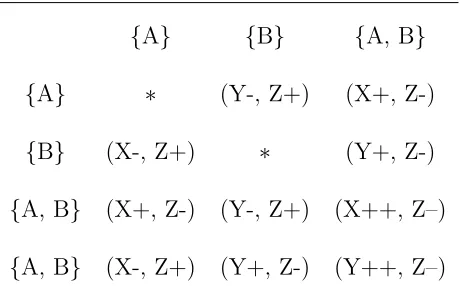
We can transfer table 4.1 into the table of changes of (XN, YN, ZN)t:
{A} {B} {A, B}
{A} ∗ (Y-, Z+) (X+, Z-)
{B} (X-, Z+) ∗ (Y+, Z-)
{A, B} (X+, Z-) (Y-, Z+) (X++, Z–)
{A, B} (X-, Z+) (Y+, Z-) (Y++, Z–)
where∗means no change, ·+ = ·+N1,·−=· − 1
N,·+ + =·+ 2
N, and· − −=· −
2 N.
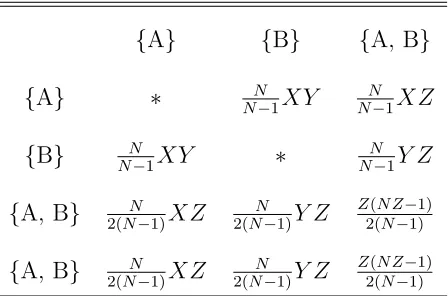
Next, we compute the probability for all possibilities of the changes in (XN, YN, ZN),
and it follows table 4.3 as below:
{A} {B} {A, B}
{A} ∗ N
N−1XY N N−1XZ
{B} N
N−1XY ∗
N N−1Y Z
{A, B} N
2(N−1)XZ N 2(N−1)Y Z
Z(N Z−1) 2(N−1)
{A, B} N
2(N−1)XZ N 2(N−1)Y Z
Z(N Z−1) 2(N−1)
Table 4.3: Probability for all Possible Changes
For example, the probability that deliverer holds {A}, and the receiver holds {B}
has probability X · N Y
N−1 = N
N−1XY given the current proportion vector being
{X, Y, Z}. The rest probabilities can be similarly derived in table 4.3.
Therefore, according to definition 4.1.1, the drift for XN
t equals to
N · 1
N ·( N
N −1(XZ−XY +Z
2)− Z
N −1) =
N
N −1(XZ −XY +Z
2)− Z
N −1,
which asymptotically equals to (XNZN −XNYN +ZN2)t asN → ∞. Here in the
first expression, the N term is the rate for broadcasting of the system, the N1 term
is the unit change of XN
t , and the rest is the probability of different changes ofXtN.
drift vector µN
t for (XN, YN, ZN)t equals to:
(XZ −XY +Z2, Y Z−XY +Z2,2XY −XZ−Y Z−2Z2)·(1 +O(1
N)).
(4.1.1)
Secondly, we can also compute the coordinate variance according to definition
4.1.1, table 4.2, and table 4.3. In particular, the variance for XN
t equals to
N· 1 N2((
N
N −1(XZ+XY+XZ+2Z
2)− 2Z
N −1) =
1
N −1(XY+2XZ+2Z
2)− 2Z
N(N −1),
where in the first expression theN term again represents the time rate for changing,
the N12 is the square of unit change ofXtN, and the rest is the probability of different
changes of XN
t .
Similarly, we have formulas of coordinate variances for YtN and ZtN, whence we
have the coordinate variance vector σN2
t for (XN, YN, ZN)t equals to:
1
N(XY + 2XZ + 2Z
2, XY + 2Y Z+ 2Z2,2XY + 2Y Z+ 2XZ+Z2)·(1 +O(1
N)).
(4.1.2)
Finally, we come to the covariance for XtN and YtN. Since we observe that it is
impossible for both X and Y to change values at the same time, so the covariance
for them equals to 0, i.e. ΣN
12 = 0.
According to [Kur77], the pure jump markov process (XN, YN, ZN)t converges
satisfying
d(X, Y, Z)t =µt(X, Y, Z)dt,
µt(X, Y, Z) = (XZ−XY +Z2, Y Z −XY +Z2,2XY −XZ −Y Z −2Z2)t.
(4.1.3)
Furthermore, [Kur77] also showed in probability that
sup
t≤T
|(XN, YN, ZN)t−(X, Y, Z)t| ≤(|(XN, YN, ZN)0−(X, Y, Z)0|+
C1
√ N)e
C2T
(4.1.4)
for some constants C1, C2 >0 independent ofN and arbitraryT > 0, which we will
be using repeatedly in chapter 4.2.
Therefore, our idea is to approximate this pure jump markov process by this
de-terministic model when the process is away from the two termination states (1,0,0)
and (0,1,0), whereas instead of diffusion, we will use Poisson process and
stochas-tic approximation via martingale methods to estimate the time when the process is
approaching the termination points.
We prove theorem 3.1.3 by seperating the procedure into two parts. Note that
X and Y are symmetric in terms of termination, WLOG, we assume the starting
point is in the half region wherex0 > y0 insideSInterfor the rest sections.The outline
of the proof is as follows:
I Given the starting point v0 ∈ SInter, denote τIenter := inf{t : (XN, YN, ZN)t ∈
II Given the starting pointv0 ∈∂Slog−dist, denoteτlog := inf{t: (XN, YN, ZN)t∈
SD}, then τlog = logN +o(log logN) in probability;
III It takes O(1) for any pointv0 ∈SD to reach absorbing point.
In particular, we will prove I in chapter 4.2; prove II and III as well as completion
of proof for the theorem in chapter 4.3.
4.2
Proof of I
First, before proving I, recall that we obtain the drift vector (4.1.3) for the
corre-sponding determinisitc model in chapter 4.1, since here we focus ourselves to the
case where x0 −y0 ≥ 20 which is straightforwardly depending on the process for
{YtN, ZtN}, basically we will be using both terms forYtN and ZtN. Furthermore, we
can rewrite them in terms of Y, Z using the equationX+Y +Z = 1. Namely,
µt(Y, Z) = (Y Z−XY +Z2,2XY −XZ−Y Z −2Z2)t
= (Y Z−(1−Y −Z)Y +Z2,(1−Y −Z)(2Y −Z)−Y Z −2Z2)t
= (−Y + (Y +Z)2,2Y −Z−Y2 −(Y +Z)2)t, (4.2.1)
we will be using drift in either form (4.1.3) or (4.2.1) when necessary.
In order to show τInter = log logN +o(log logN) in probability, it is equivalent to
show that: ∀δ >0, we have
The outline to verify the above inequalities is as following:
1. ∃L(δ), 1(δ), 2(δ) > 0 such that YLN ≤ 2δZ N
L and 1(δ) ≤ YLN, ZLN ≤ 2(δ) in
probability;
2. YN
t ≤δZtN in probability for L≤t≤τInter, and we derive (4.2.2).
We verify the first statement using lemma 4.2.1-4.2.2.
Lemma 4.2.1. Suppose we start at (x0, y0, z0) ∈ SInter satisfying x0 −y0 ≥ 20,
then ∃L(∗) s.t.
P(∗∗≤YLN, ZLN ≤∗)→1 as N → ∞,
for arbitrary ∗ >0 and ∗∗>0 depending on ∗.
Proof. It is sufficient to show for some L(∗)
∗∗≤YL, ZL≤∗
for the corresponding deterministic process due to (4.1.4) and (X0, Y0, Z0) = (x0, y0, z0).
First, we define Ut=Xt−Yt. Then U0 ≥20.
According to (4.1.3), the drift ofUtequals toZtUtwhich is non-negative.
Second, letVt= (2 +0)Yt+Zt, according to (4.2.1), we have
µ(Vt) = −(2 +0)Yt+ (2 +0)(Yt+Zt)2+ 2Yt−Zt−Yt2−(Yt+Zt)2
=−0Yt+0Yt2 −Zt(1−2(1 +0)Yt−(1 +0)Zt)
=−0Yt(1−Yt)−Zt(Xt−Yt−0(1−Xt+Yt))
≤ −(1
2+0)0Yt−0Zt
≤ −0
4Vt.
On the other hand, solving the following differential equation:
dV0 =−0 4V
0
dt, V00 =V0 = (2 +0)y0+z0
gives us
Vt0 =V0e−
0t
4 .
Therefore, by letting t0 = 4−01(logV0−log∗), we have
Vt00 =∗
which indicates
Vt0 ≤
∗
.
Note that Vt0 = (2 +0)Yt0 +Zt0 ≤
∗ implies bothY
t0 and Zt0 are smaller than
∗.
Third, we complete the proof by showing both Yt0 and Zt0 are greater than
In terms of (4.2.1), we have the following inequalities for µ(Y) and µ(Z):
µ(Y)≥ −Y;
µ(Z)≥ −2Z.
Therefore, the two following ODE’s
dY0 =−Y0dt, Y00 =y0;
dZ0 =−2Z0dt, Z00 =z0
derives Yt0 =y0e−t and Z 0
t =z0e−2t.
If we let ∗∗= 20e−2t0, then
Yt0 ≥
∗∗
,
Zt0 ≥
∗∗
,
here we use the assumption that Y0, Z0 ≥20.
In sum, letL(∗) =t0, we conclude
∗∗≤YL, ZL≤∗
for arbitrary ∗ >0, whence
P(∗∗ ≤YLN, ZLN ≤∗)→1 as N → ∞,
we are done.
Lemma 4.2.2. Suppose we start at (x0, y0, z0) such that ∗∗(δ) ≤ y0, z0 ≤ ∗(δ),
then ∃L, T(δ), L≤T(δ) s.t.
YLN ≤ δ 2Z
N
where ∗ = 16(1+2δ /δ)2 and
∗∗ depends on ∗ in terms of lemma 4.2.1.
Proof. As similar to lemma 4.2.1, it is sufficient to show
YL ≤
δ
2ZL for some L≤T(δ)
for the corresponding deterministic model because of (4.1.4) andT(δ) not depending
on N.
First, from the proof in lemma 4.2.1, we seeVt = (2+0)Yt+Ztis non-increasing.
Therefore, Vt≤V0 ≤4∗ which implies Yt, Zt≤4∗ for all t.
Second, we define τ := inf{t : δ2Zt−Yt ≥ 0}. If y0 ≤ δ2z0, then we are done.
Otherwise, we have y0 > δ2z0. Therefore, ∀t < τ, we have
µ(Y)≤ −Y + (1 + 2/δ)2Y2
≤ −(1−4(1 + 2/δ)2∗)Y;
µ(Z)≥δZ −Z−(δ2/4 + (1 +δ/2)2)Z2
≥ −(1−δ+ 4(δ2/4 + (1 +δ/2)2)∗)Z.
Furthermore, if we plug in ∗ = 16(1+2δ/δ)2, we deduce
µ(Y)≤ −(1−δ/4)Y;
µ(Z)≥ −(1−δ/2)Z.
Therefore, we have the following inequalities:
Yt≤y0e−(1−δ/4)t;
Let t0 = 4δlog ∗
δ∗∗, then we have Yt0 ≤
δ 2Zt0.
Finally, let T(δ) =t0, we haveτ ≤T(δ). Thus, we are done with the proof.
Next, we verify the second statement using lemma 4.2.3-4.2.4. Before we go
ahead, from lemma 4.2.2, we see that ∃Lindependent of N (in fact,L≤ 4
δlog ∗ δ∗∗)
such thatYL≤ δ2ZL, and bothYLandZLare bounded between two positive numbers
independent of N (in fact, the one candidate for upper bound is 4∗ = 4(1+2δ/δ)2).
We denote 3 and 4 as the lower and upper bounds for YL and ZL respectively for
the later proof.
Lemma 4.2.3. Suppose we start at (x0, y0, z0)such that y0 ≤ δ2z0 and 3 ≤y0, z0 ≤
4, then
YtN ≤δZtN ∀t <2 log logN in probability.
Proof. First, let T = 2 log logN in (4.1.4), we have
sup
t≤2 log logN
|(XN, YN, ZN)t−(X, Y, Z)t| ≤
C1
√
Ne
C2log logN
= C1log
C2N
√ N
log−1N in probability. (4.2.3)
We will be using (4.2.3) later in this proof.
Second, from lemma 4.2.2, we see 2Yt+Zt ≤ 44 for all t. let Wt = δZt−Yt,
then W0 =δz0−y0 ≥y0 ≥3.
We claim: ∃θ(δ)>0 s.t.
which is equivalent to
−δZ + (1 + 2δ)Y −δY2−(1 +δ)(Y +Z)2 ≥ −(1 +θ)(δZ −Y)
⇔ θδZ+ (2δ−θ)Y −δY2−(1 +δ)(Y +Z)2 >0
⇐ (θδ−4(1 +δ)4)Z+ (2δ−θ−4δ4−4(1 +δ)4)Y >0
⇐ θδ >4(1 +δ)4, 2δ > θ+ 4δ4+ 4(1 +δ)4
⇔ 1 +δ
(1 + 2/δ)2 <2δ−
δ+ 2δ2
(1 + 2/δ)2
⇔ 1 + 2δ+ 2δ2 <8/δ+ 8 + 2δ,
which is true for small δ. Here, we use 4 = 4(1+2δ/δ)2 for the above inequalities.
Therefore, we have Wt≥W0e−(1+θ)t for all t.
Finally, if we restrictt ∈[0,2 log logN], applying (4.2.3) provides us:
inf
t≤2 log logNδZ N
t −YtN = inf
t≤2 log logNδ(Z N
t −Zt)−(YtN −Yt) +δZt−Yt
≥ inf
t≤2 log logNδZt−Yt−t≤2 log logsup N|(X N
, YN, ZN)t−(X, Y, Z)t|
≥W0e−2(1+θ) log logN −
C1log√C2N
N
≥3log−2(1+θ)N −
C1log√ C2N
N
≥0 as N → ∞,
which completes the proof of this lemma.
Finally, we complete this section by proving:
y0, z0 ≤4, then
(1−δ) log logN ≤τInter≤(1 +δ) log logN in probability.
Proof. First, due to (4.2.3), it is sufficient to show
(1−δ) log logN ≤τ∗ ≤(1 +δ) log logN
where τ∗ = inf{t:Y2
t +Zt2 ≤log
−2N}for the corresponding deterministic model.
According to lemma 4.2.3, we know that Yt ≤ δZt and Yt, Zt ≤ 44 for t ≤
2 log logN. We restrict the time interval to be [0,2 log logN] in the rest of the
proof.
Second, we consider the process Ut = 3Yt+Zt. The drift has the following
bounds:
µ(U) =−U + 2Y −Y2+ 2(Y +Z)2
≥ −U;
µ(U) =−U + 2Y −Y2+ 2(Y +Z)2
≤ −U+ 2
3 + 1/δU + 164U
≤ −(1− δ
2)U
for sufficiently small δ.
Thus we derive the bounds for Ut:
U0e−t≤Ut≤U0e−(1−
δ
which indicates (1−δ) log logN ≤τ∗ ≤(1 +δ) log logN because
U0log−1−δ/2+δ
2/2
N log−1N U0log−1+δN
Therefore, we have
(1−δ) log logN ≤τInter≤(1 +δ) log logN in probability,
we are done.
To sum up, lemma 4.2.1-4.2.4 implies the total amount of time from SInter to
reachingSlog−dist isO(1) +O(1) + log logN+o(log logN) = log logN+o(log logN)
which completes the proof of I.
4.3
Proof of II and III
In this chapter, the main idea is to construct some martingale arguments to prove II.
In particular, lemma 4.3.4, 5, 7, 8 will deduce some geometric properties for some
process we construct; lemma 4.3.9 will study the original (XN, YN, ZN)
t process
through some random walk estimation when the process is within Slog−dist; lemma
4.3.11 illustrates the core estimation using all previous lemmas. Eventually, we
complete our proof for theorem 3.1.3 at the end of this chapter.
Definition 4.3.1. We define the 2-dimensional flow as follows:
F(y, z) = (−y,2y−z);
Φ(y, z, t) satisfies:
∂
∂tΦ(y, z, t) =F(Φ(y, z, t)),
Φ(y, z,0) = (y, z),
where F(y, z) is the linear aproximation for (4.2.1).
Furthermore, we introduce the hitting time function
Ψ(y, z) = inf{t: Φ(y, z, t)∈∂E},
where E ={(y, z) :y2 +z2
4 ≤ 1
N2}. And we let
H(y, z) =
∂yyΨ ∂yzΨ
∂yzΨ ∂zzΨ
denote the Hessian matrix for Ψ.
By definition, we have
τlog = inf{t: (YtN, ZtN)∈E}.
Remark 4.3.2. For all the following notations and calculations, we use the
conven-tions for rows versus columns as follows:
Vector valued functions such asF and Φ are written as row vectors;
Coordinates of a derivative occupy columns. Thus, the gradient of a scalar
function is a column vector. However, the derivative of gradient, i.e., Hessian is
Moreover we will usehu, vifor the product of a row vectoruand a column vector
v, so that the notation makes clear that the quantity is a scalar. The Hessian of a
scalar function such as G is denoted
H(G) :=
∂2G
∂xi∂xj
i,j
.
Definition 4.3.3. We define
Wt:= Ψ(YtN, ZtN) +t,
where {YN
t , ZtN} is the stochastic process of opinion broadcasting model at time t.
Lemma 4.3.4. ∀v0 = (y0, z0)∈Slog−dist, we have:
max{1
6,log |v0|N
2 } ≤Ψ(v0)≤logN + 1.
Furthermore, if v0 = (y0, z0)∈∂Slog−dist, i.e. |v0|= log−1N, then
logN −o(log logN)≤Ψ(v0).
Proof. First, we can solve the flow Φ in terms of F as follows:
yt =y0e−t;
zt = (2y0t+z0)e−t.
Then,
Ψ(v0) = inf t {y
2 t +
z2 t
4 =
Notice that v0 is outside ofE and ify0, z0 takes only integer values when multiplied
by N, we have |v0| ≥
√
2
N . Therefore, lett1 = 1
6, we have
yt21 + z
2 t1
4 = (y
2 0 +
1 4(
1
3y0+z0)
2)e−1/3
≥ 13
9e1/3 ·
1 N2
≥ 1
N2,
whence Ψ(v0)≥ 16.
Furthermore, if |v0| ≥ N2, let t1 = log (|v0|N/2), then t1 ≥0 and
yt2
1 +
z2 t1
4 = (y
2 0t
2
1+y0z0t1+ (y20 +
z2 0
4))e
−2t1
= 4
|v0|2N2
·(y02t21+y0z0t1+y02+
z2 0
4)
≥ 4y
2 0+z02
|v0|2N2
≥ 1
N2,
whence Ψ(v0)≥log (|v0|N/2).
Let t2 = logN + 1, then
yt2
2 +
z2 t2
4 = (y
2 0t
2
2+y0z0t2+ (y20 +
z2 0
4))e
−2t2
= 1
e2N2 ·(y 2
0(logN + 1) 2+y
0z0(logN + 1) +y02+
z2 0
4)
≤ 1
e2N2 ·(1 +
4 logN)
≤ 1
N2,
provided that |v0| ≤log−1N. Therefore,
Finally, if |v0|= log−1N, then according to chapter 4.2, we notice that
y0 ≥e−log logN−ω
= 1
logN ·eω,
where ω =o(log logN), eω =o(logN).
Thus if we let t3 = logN −2ω, we have
y2t3 + z
2 t3
4 = (y
2 0t
2
3+y0z0t3+ (y02+
z2 0
4))e
−2t3
≥y02t23e−2t3
= 1
N2 ·
(logN −2ω)2·e4ω log2N ·e2ω
≥ 1
N2,
whence Ψ(v0)≥logN −2ω = logN −o(log logN), we are done.
Lemma 4.3.5. We can write both the gradient and Hessian ofΨ in terms of Φ, F,
and B:
∇Ψ(v0) =−
dΦ(·, t0)T(v0)∇B(v1)
hF(v1),∇B(v1)i
; (4.3.1)
H(Ψ)(v0) =∇Ψ1(v0)· H(Φ1)(v0) +∇Ψ2(v0)· H(Φ2)(v0) (4.3.2)
+dΦ(·, t0)T(v0)
dF∇B∇BT
hF,∇Bi2 (v1)·dΦ(·, t0)(v0)
−dΦ(·, t0)T(v0)
I− ∇BF
hF,∇Bi
H
(B)
hF,∇Bi(v1)·dΦ(·, t0)(v0)
+dΦ(·, t0)T(v0)
∇B∇BT
hF,∇Bi2
I− ∇BF
hF,∇Bi
dF(v1)·dΦ(·, t0)(v0),
wheret0 = Ψ(v0),v1 = Φ(v0, t0); Φ = (Φ1,Φ2), and∇Ψ = (∇Ψ1,∇Ψ2)T; B(y, z) =
y2+z2 4 −
1
Proof. We first tackle the special case where t0 = 0, that is where the initial point
v0 already satisfies B(v0) = 0. In this case the time t map Φ(·, t) is the identity,
therefore dΦ =I and H(Φ) = 0. Thus (4.3.1) and (4.3.2) reduce to
∇Ψ =− ∇B
hF,∇Bi (4.3.3)
H(Ψ) = dF∇B∇B
T
hF,∇Bi2 −
I − ∇BF
hF,∇Bi
H
(B)
hF,∇Bi (4.3.4)
+∇B∇B
T
hF,∇Bi
I− ∇BF
hF,∇Bi
dF hF,∇Bi,
where we omit the point at which the functions are valued since in this special case
v0 =v1, so no confusions should be there.
In order to verify these two equations above, we consider calculating the gradient
and Hessian forB(Φ(v, η(v))) whereηis anyC2function withvsatisfyingη(v) = 0.
Applying basic calculus and chain rules, we have
∇B(Φ(v, η(v))) =∇(v) +∇η(v)· hF(v),∇B(v)i; (4.3.5)
H(B(Φ(v, η(v)))) =dF∇η∇B(v) + [I+∇ηF]H(B)(v) (4.3.6)
+H(η)F∇B(v) +∇η∇BT [I+∇ηF]dF(v).
Now notice the function Ψ satisfies B(Φ(v,Ψ(v))) ≡ 0, therefore the gradient
and Hessian vanish. Also, Ψ(v0) = 0 sinceB(v0) = 0. Lettingη = Ψ in (4.3.5) and
(4.3.6), and setting the right-hand sides equal to zero, we may solve for ∇Ψ and
H(Ψ) to obtain (4.3.3) and (4.3.4) respectively.
The general case relies on the following explicit chain rule for any composition of
Remark 4.3.6. Let Φ : Rm → Rn and Ψ : Rn → R be any twice continuously
differentiable maps. Then
∇[Ψ◦Φ] =dΦ∇Ψ,
H[Ψ◦Φ] =
n
X
i=1
∇ΨiH(Φi) +dΦTH(Ψ)dΦ,
where Φ = (Φ1,Φ2,· · ·,Φn),∇Ψ = (∇Ψ1,∇Ψ2,· · · ,∇Ψn)T.
With this in mind, observe that for fixed s, the quantity Ψ ◦ Φ(·, s) differs
from Ψ by the constant s. Letting s=t0 := Ψ(v0), and recalling the notationv1 =
Φ(v0, t0), we see that∇Ψ(v0) =∇[Ψ◦Φ(·, t0)] atv0 andH(Ψ)(v0) =H[Ψ◦Φ(·, t0)]
at v0. In both cases, the derivatives of Ψ are evaluated only where B vanishes.
Therefore, we may use remark 4.3.6 along with (4.3.3) and (4.3.4) to obtain (4.3.1)
and (4.3.2) respectively.
Lemma 4.3.7.
k∇Ψ(v0)k ≤C1·log|v0|N· kv0k−1
for v0 = (y0, z0)∈Slog−dist.
Proof. We follow the same notations we used in lemma 4.3.5. Then lemma 4.3.5
implies:
∇Ψ(v0) =−
dΦ(·, t0)T(v0)∇B(v1)
hF(v1),∇B(v1)i
Therefore,
k∇Ψ(v)0k ≤
√
10kdΦ(·, t0)(v0)k · k∇B(v1)k
kF(v1)k · k∇B(v1)k · |cosθ|
= √
10kdΦ(·, t0)(v0)k
kF(v1)k · |cosθ|
,
where the matrix norm is defined to be k · k∞, the maximum absolute value of all
elements in the matrix; θ is the angle between the vectors F and ∇B.
In particular, notice that
hF(v1),∇B(v1)i=h(−y1,2y1−z1),(2y1,
z1
2)i
=−2y21+y1z1−
z12 2
=−1
2(y1−z1)
2− 3
2y
2 1
<0,
hence cosθis uniformly up-bounded by some negative constant, i.e. |cosθ|> M1 >
0.
Next, since v1 satisfiesB(v1) = 0,
kF(v1)k> M2·
1 N,
for some constant M2 >0. Moreover, we have
According to lemma 4.3.4, if |v0| ≥ 2Ne, then
2t0·e−t0 ≤4 log
|v0|N
2
,
|v0|N
≤M3·
log|v0|N
|v0|N
;
otherwise if
√
2
N ≤ |v0|< 2e N,
2t0·e−t0 ≤
2 e
≤ 4
√ 2 elog 2 ·
log|v0|N
|v0|N
.
Summing up the above inequalities, we proved the lemma.
Lemma 4.3.8.
kH(Ψ)(v0)k ≤C2·log2|v0|N · kv0k−2,
for v0 = (y0, z0)∈Slog−dist.
Proof. Again lemma 4.3.5 states:
H(Ψ)(v0) =∇Ψ1(v0)· H(Φ1)(v0) +∇Ψ2(v0)· H(Φ2)(v0)
+dΦ(·, t0)T(v0)
dF∇B∇BT
hF,∇Bi2 (v1)·dΦ(·, t0)(v0)
−dΦ(·, t0)T(v0)
I− ∇BF
hF,∇Bi
H
(B)
hF,∇Bi(v1)·dΦ(·, t0)(v0)
+dΦ(·, t0)T(v0)
∇B∇BT
hF,∇Bi2
I− ∇BF
hF,∇Bi
dF(v1)·dΦ(·, t0)(v0),
where Φ = (Φ1,Φ2), and ∇Ψ = (∇Ψ1,∇Ψ2)T. We can further write ∇Ψ in terms
In order to estimate the norm for H(v0), it is sufficient to estimate the norm of
each term in the above expression, and the dominant term will determine the entire
one. Before estimation, we do some calculation for preparation:
Φ1(v0, t0) =y0e−t0
⇒ H(Φ1)(v0) =0
Φ2(v0, t0) = (2y0t−z0)e−t0
⇒ H(Φ2)(v0) =0,
thus the first two terms disappeared.
kdΦ(·, t0)(v0)k ≤
M1log|v0|N
|v0|N
kI− ∇BF
hF,∇Bik ≤M3
kF(v1)k> M2·
1 N
kdF(v1)k= 2
k∇B(v1)k> M4·
1 N
kH(B)(v1)k= 2,
for some constants M1, M2, M3, M4 >0.
Therefore, we see that each of the rest term has the same order. In particular, each
term is up-bounded by
M0 ·
log2|v0|N
|v0|2N2
whence the norm of H(Ψ)(v0) is bounded by
C2·log2|v0|N · kv0k−2.
Now that we have completed the lemmas on geometric properties for process
{Wt}, we move on to study some properties for the original process (XN, YN, ZN)t
within Slog−dist (lemma 4.3.9). Eventually we will combine them to deduce lemma
4.3.11.
Lemma 4.3.9. Suppose the process is inside Slog−dist, define the set of time stripes
Ti ={s : 2−i−1 ≤ kvsk<2−i},
where dlog2logNe ≤i≤ blog2Nc −1, kvsk2 =YsN2 +ZsN2.
Then we have max|Ti| is O(1) in probability.
Proof. We consider the process UN
t = 3YtN +ZtN, which has negative drift which
is upper bounded by UtN/6. UtN is a pure jump markov process with jump rate
N. Let N(t) be the number of jumps between [0, t], then N(t) ∼ P ois(N t).
Fur-thermore, we define VnN be the discrete random walk embedded in UtN. Namely,
UtN = VNN(t),∀t. Before stating the proof in detail, note that we have the relation
between UN
t and kvtk:
which indicates that instead of studying {Ti}, we can equivalently estimate the
probability for max|Ti0| greater than some big constant, where
Ti0 ={s: 2−i−1 ≤UtN <2−i}, dlog2logNe ≤i≤ blog2Nc −1.
Therefore, WLOG, we prove max|Ti0|is O(1) in probability. Let τi = inf{t :UtN ≤
2−i}, di =τi+1−τi,dlog2logNe ≤i≤ blog2Nc −1. The idea is to show
• maxdi is O(1) in probability;
• maxisupτi≤t≤τi+1U
N t /2
−i is O(1) in probability.
Then, the result follows since each Ti can cover at most constant number of time
intervals [τi, τi+1] and all di’s are constant. We seperate the proof into four parts.
First, we show the following inequality:
P(τV > CN)≤e−αCN A, for some constant α >0 (4.3.7)
where τV = inf{k:VkN ≤ A2}, and V N
0 =A for A between N−1 and log
−1
N.
DefineVN
k =V0N +
Pk
i=1Mi, where Mi corresponds to each jump.
According to table 4.2 and table 4.3 in chapter 4.1, we know that Mi has the
following distribtution given current position (X, Y, Z)i−1:
• −2
N with probability (XY +
Y Z 2 +
Z2
2 )·(1 +O( 1
N)) :=p−2;
• −1
N with probability
3
2XZ·(1 +O( 1
N)) :=p−1;
• 1
N with probability (XY +
1
2XZ)·(1 +O( 1
• 2
N with probability
3
2Y Z·(1 +O( 1
N)) :=p2;
• 4
N with probability
1 2Z
2·(1 +O(1
N)) :=p4;
• 0 otherwise := p0.
We claim: ∃θ > 0 such that:
E(eθMi|VN i−1 >
A
2)≤1−
A
M0 for some constantM
0
uniformly with respect to i.
By definition, we have
E(eθMi|VN i−1 >
A
2) =p−2e
−2θ/N +p
−1e−θ/N +p0+p1eθ/N +p2e2θ/N +p4e4θ/N
= 1 +θE(Mi|ViN−1 >
A
2) +O(θ
2E(M2 i|V
N i−1 >
A 2))
≤1− θ
6nV
N i−1+O(
θ2
N2V N i−1)
≤1− θ
12NA+O(
θ2 N2A).
Here, the first inequality follows from the fact that UN
t ’s drift is upper bounded by
−1 6U
N
t , and the second inequality follows from the condition ViN−1 > A2.
Therefore, if we letθ = MN for some large constantM, then sinceMi ∼ N1,θMi ∼ M1
is small. Furthermore,
E(eθMi|VN
i−1)≤1−
A
12M +O(
A
M2)≤1−
A M0,
Therefore, if we pick such θ, we have that
P(τV > CN) = P(VkN >
A
2,∀k ≤CN)
=P(VCNN ·
CN−1
Y
k=0
1{VN
k >A/2} >
A 2)
=P(
CN
X
i=1
Mi· CN−1
Y
k=0
1{VN
k >A/2} >−
A 2)
=P(eθPCNi=1Mi· CN−1
Y
k=0
1{VN
k >A/2} > e −θA
2)
≤E(eθPCNi=1Mi · CN−1
Y
k=0
1{VN
k >A/2})·e θA2
=E(eθPCNi=1−1Mi· CN−2
Y
k=0
1{VN
k >A/2}E(e
θMCN|VN CN−1 >
A 2))·e
1 2M
≤E(eθPCNi=1−1Mi · CN−2
Y
k=0
1{VN
k >A/2})·(1−
A M0)·e
1 2M
≤ · · · ·
≤(1− A
M0)
CN ·
e21M
=Ke−CN AM0 ,
which completes our proof of (4.3.7)
Second, we convert VN
i toUtN according to the relation UtN =VNN(t).
According to Chernoff bound argument, for any Possion random variable X ∼
P ois(ν), we have the bound for tail probability:
P(X ≤x)≤ e
−ν(eν)x
Letν =N t, x=ν/2, we obtain for UN t ,
P(# jumps < N t/2 between [0, t])≤e−ν ·(2e)x
= 2 e x .
Therefore, P(# jumps ≥N t/2)≥1− 2
e
N t/2
.
Combining the first two parts, we have
P(di <2C) =P( inf τi<t<τi+2C
UtN ≤ A 2)
≥P(τV ≤CN|# jumps ≥CN)·P(# jumps ≥CN)
≥(1−e−αCN A)· 1−
2 e
CN!
,
where A= 2−i,i=dlog
2logNe, . . .blog2Nc −1.
Third, we show
P( max
i:N−1≤2−i≤log−1Ndi < C)≥e
−2e−2αC
.
We do the calculation as follows:
P( max
i:N−1≤2−i≤log−1Ndi < C) =
Y
i
P(di < C)
≥Y i " 1− 2 e
CN/2!
·(1−e−αCN/2i)
#
. (4.3.8)
Taking logarithm of (4.3.8), we obtain
X
i
"
log 1−
2 e
CN/2!
+ log (1−e−αCN/2i)
#
∼ −X
i " 2 e CN/2
−e−αCN/2i
#
≥ −logN ·
2 e
CN/2
− e
−2αC
1−e−2αC
which completes the proof for the third part.
Finally, we show
P( sup
τi≤t≤τi+1
UtN ≤(CM + 1)·2−i,∀i=dlog2logNe, . . .blog2Nc −1)≥e−2e−2C.
Notice that from the first part of the proof we can pick θ = MN such that eθUtN
is a non-negative supermartingale due to UN
t has negative drift, we apply Doob’s
maximal inequality to eθUN
t within each time interval [τi, τi+1], we obtain
P( sup
τi≤t≤τi+1
UtN >(CM + 1)·2−i) =P( sup
τi≤t≤τi+1
eθUtN > eθ(CM+1)·2−i)
≤ E(e
θUN τi)
eθ(CM+1)·2−i
≤e−θCM2−i
=e−CN2−i.
Therefore,
P( sup
τi≤t≤τi+1
UtN ≤(CM + 1)·2−i,∀i=dlog2logNe, . . .blog2Nc −1)
=Y
i
P( sup
τi≤t≤τi+1
UtN ≤(CM + 1)·2−i)
≥Y
i
(1−e−CN2−i) (4.3.9)
Taking logarithm of (4.3.9), we have
X
dlog2logNe≤i≤blog2Nc−1
log (1−e−CN2−i)∼ −X
i
e−CN2−i
≥ − e
−2C
1−e−2C
which completes the proof for the last part.
To sum up, we reach our conclusion that max|Ti| isO(1) in probability.
Remark 4.3.10 (III). When the process enters SD, we verify that it takes O(1) time
to reach (1,0,0).
Inside SD, the possible value set for U0N is {N1,N2,N3}. Following exactly the
same arguemts in lemma 4.3.9, we see that, in probability, it takes O(1) time for
the pure jump process to reach U0N
4 ≤ 1
N. Since each jump step is a multiple of 1/N,
we see that when the process goes below U0N
4 , it reaches termination.
It is time to add up all the above 5 lemmas to verify statement II as below:
Lemma 4.3.11 (II). Wτlog = logN +O(1) in probability given the starting point
(x0, y0, z0)∈∂Slog−dist.
Proof. First, for convenience, we denote vt = (YtN, ZtN). Note that vt is a pure
jump markov process, by definition 4.1.1, we can write
vt(ω) =v0(ω) +
X
jump happens ats(ω)< t
∆(vs(ω)),
then for Ψ(·),
Ψ(vt(ω)) = Ψ(v0(ω)) +
X
jump happens ats(ω)< t
∆Ψ(vs(ω)),
where ∆Ψ(vs(ω)) = Ψ(vs(ω))−Ψ(vs−(ω)). In the below, we will use notations
We writeWt=Mt+At, whereAt=
Rt
0 N·
R
(Ψ(vs+ ∆(vs))−Ψ(vs))dνs(∆(vs))
ds+
t. Recall the N term in the formula for At is the transition rate for the original
process. Notice that
E(Mt|Fs) = E(Wt−At|Fs)
=E(Ψ(vt)−
Z t 0
N ·
Z
(Ψ(vr+ ∆(vr))−Ψ(vr))dνr(∆(vr))
dr|Fs)
=E(Ψ(vt)|Fs)−N
Z t s + Z s 0 E Z
(Ψ(vr+ ∆(vr))−Ψ(vr))dνr(∆(vr))|Fs
dr
= Ψ(vs)−N
Z s
0
Z
(Ψ(vr+ ∆(vr))−Ψ(vr))dνr(∆(vr))
dr
=Ws−As
=Ms.
So {Mt} is a local martingale.
Next, we calculate and estimate At by seperating the process in terms of which
strip the current position is located. In particular, we consider the time stripes as
defined in lemma 4.3.9:
Ti ={s: 2−i ≤ kvsk<2−i+1}, N−1 ≤2−i ≤log−1N.
Then,
At=
Z t 0
N ·
Z
(Ψ(vs+ ∆(vs))−Ψ(vs))dνs(∆(vs))
ds+t
=X i N Z Ti Z
(Ψ(vs+ ∆(vs))−Ψ(vs))dνs(∆(vs))
Within Ti, according to Taylor expansion, we have:
N
Z
Ti
Z
(Ψ(vs+ ∆(vs))−Ψ(vs))dνs(∆(vs))
ds+|Ti|
=N
Z
Ti
Z
(∇Ψ(vs)·∆(vs) +Rs)dνs(∆(vs))
ds+ Z Ti ds = Z Ti
(∇Ψ(vs)·µs(vs) + 1)ds+N
Z
Ti
Z
Rsdνs(∆(vs))
ds
=
Z
Ti
(∇Ψ(vs)·F(vs) + 1 +∇Ψ(vs)·(µs−F)(vs))ds+N
Z
Ti
Z
Rsdνs(∆(vs))
ds,
(4.3.10)
where by (4.2.1),
(µs−F)(vs) = ((Y +Z)2,−Y2−(Y +Z)2)s·(1 +O(
1 N));
and
Rs := Ψ(vs+ ∆(vs))−Ψ(vs)− ∇Ψ(vs)·∆(vs)
is the residual part in the Taylor expansion beyond the linear term.
We claim: ∇Ψ(vs)·F(vs) + 1 = 0, ∀s.
By lemma 4.3.5, we have
∇Ψ(vs) =−
dΦ(·, ts)T(vs)∇B(v1)
hF(v1),∇B(v1)i
=−
e−ts 2t se−ts
0 e−ts
(2y1,
z1
2)
t/(−y
1,2y1−z1)·(2y1,
z1
2)
t
= (2y1e−ts +z1tse−ts,
z1e−ts
2 )
t/(2y2
1 −y1z1+
z12 2).
z1ets −2y1tsets. Therefore,
∇Ψ(vs)·F(vs) = (−ys,2ys−zs)·(2y1e−ts +z1tse−ts,
z1e−ts
2 )
t
/(2y12−y1z1+
z12 2)
= −2y1yse
−ts −y
stse−tsz1+yse−tsz1−zse−tsz1/2
2y2
1 −y1z1+z21/2
= −2y
2
1 +y1z1−z12/2
2y2
1 −y1z1 +z12/2
=−1,
we proved the claim. Thus (4.3.10) becomes
Z
Ti
∇Ψ(vs)·(µs−F)(vs)ds+N
Z
Ti
Z
Rsdνs(∆(vs))
ds. (4.3.11)
For the first part of (4.3.11), lemma 4.3.7 indicates:
Z
Ti
∇Ψ(vs)·(µs−F)(vs)ds ≤sup t∈Ti
k∇Ψ(vt)k · |(µt−F)(vs)| · |Ti|
≤sup
t∈Ti
5C1·log|vt|N · kvtk−1· kvtk2· |Ti|
≤5C1logN ·2−i+1· |Ti|. (4.3.12)
For the second part of (4.3.11), according to Taylor inequality, we have
N
Z
Ti
Z
Rsdνs(∆(vs))
ds
≤ 1
2t∈Ti−sup1,Ti,Ti+1
kH(Ψ)(vt)k ·N ·
Z
Ti
E((∆YsN)2+ 2∆YsN∆ZsN + (∆ZsN)2|Fs)ds
≤ sup
t∈Ti−1,Ti,Ti+1
kH(Ψ)(vt)k ·N ·
Z
Ti
E((∆YsN)2 + (∆ZsN)2|Fs)ds
= sup
t∈Ti−1,Ti,Ti+1
kH(Ψ)(vt)k
Z
Ti
where the right-hand-side of the first inequality is due to the fact that the norm of
the position after one jump from vt such that 2−i ≤ kvtk < 2−i+1 will be within
[2−i−1,2−i+2). The reason is that one jump can at most change the norm by 1
N
which is smaller than any of 2−i, i=blog
2logNc,· · · blog2Nc.
Recall from (4.1.2), we have:
σsN2(Y, Z) = 1
N(XY + 2Y Z+ 2Z
2,2XY + 2Y Z + 2XZ+Z2)
s+O(
1 N2).
If we write it in terms of Y and Z using the equation X+Y +Z = 1, we obtain:
σsN2(Y, Z) = 1
N(Y −Y
2
+Y Z+ 2Z2,2Y + 2Z−2Y2−2Y Z−Z2)s+O(
1 N2),
which implies
σ2(YsN) +σ2(ZsN)≤ 1 N ·4·2
−i+2
within Ti; and lemma 4.3.8 indicates:
sup
t∈Ti−1,Ti,Ti+1
kH(Ψ)(vt)k ≤ sup
t∈Ti−1,Ti,Ti+1
C2·log2|vt|N·kvtk−2 ≤C2·log22−i+2N·22i+2.
Therefore,
N
Z
Ti
Z
Rsdνs(∆(vs))
ds≤64C2·
2i
N ·log
22−i+2N· |T
i|. (4.3.13)
By lemma 4.3.9, we know that the time for {YN
t , ZtN} staying in Ti for any i is
O(1) in probability, and notice that we only need Ti’s for 2−i ≥ N1 because we only
an upper bound for At as follows:
At≤C
X
i:N−1≤2−i≤log−1N
2−ilogN + 2
i
N ·log
2
2−i+2N
≤2C+4C
N
X
i:2−i≥2
N
2i·(logN −ilog 2)2 (4.3.14)
where C is some constant, and 0≤t≤τlog.
Denote k= log2N, then log 2·k = logN. We claim that
k−1
X
i=0
2i(logN −ilog 2)2
is up-bounded by C0 ·N, for some constantC0, which is sufficient to verify (4.3.14)
being bounded by some constant.
We have
k−1
X
i=0
2i(logN −ilog 2)2
=
k−1
X
i=0
2i·log2N −2 log 2 logN
k−1
X
i=0
i·2i+ log22
k−1
X
i=0
i2 ·2i
= (2k−1) log2N −2 log 2 logN((k−2)2k+ 2) + log22((k2−4k+ 6)2k−6)
=−log2N −4 log 2 logN + 6 log22·2k−6 log22
= 6 log22·N −log2N −4 log 2 logN −6 log22
≤C0N. (4.3.15)
Thus, we have shown At=O(1). Therefore, Aτlog =O(1) in probablity.
According to [Fox16], we have
hMit =
Z t
0
σs2(M)ds, and σt2(M) =N ·E[∆2t(M)|Ft].
We calculate σ2
t(M) first, for t in some Ti. Notice that process At contains no
jumps, we have the following:
σ2t(M) = N·E[∆2t(M)|Ft]
=N·E[∆2t(Ψ)|Ft]
≤ sup
t∈Ti−1,Ti,Ti+1
k∇Ψ(vt)k2·N ·E[(∆YtN + ∆Z N t )
2|F t]
≤ sup
t∈Ti−1,Ti,Ti+1
k∇Ψ(vt)k2·2N ·E[(∆YtN)
2 + (∆ZN
t ) 2|F
t]
= sup
t∈Ti−1,Ti,Ti+1
k∇Ψ(vt)k2·2·(σ2(YsN) +σ2(ZsN))
≤ sup
t∈Ti−1,Ti,Ti+1
C1·log2|vt|N · kvtk−2·2·
1 N ·4·2
−i+2
≤128C1·log22−i+2N·
2i
N, (4.3.16)
where the first inequality follows the same reason as the estimation for residual Rt
Next, using (4.3.16), we obtain the upper bound onhMit:
hMit =
Z t
0
σ2s(M)ds
= X
i:2−i≥1
N
Z
Ti
σs2(M)ds
≤ C
N
X
i:2−i≥1
N
2i·log22−i+2N
=O(1), (4.3.17)
where the last equation comes from (4.3.15), using which we verified At=O(1) as
well.
Finally, lett=τlog, sincehMiτlog =O(1) implies bounded variance, i.e. E(Mτlog−
M0)2 < C∗ for some constant C∗ > 0, applying Doob’s maximal inequality, we
ob-tain
P(|Mτlog −M0|> L)≤P( sup
0≤t≤τlog
|Mt−M0|> L)≤
C∗
L2. (4.3.18)
Therefore, ∀ >0, let L=
q
C∗
, (4.3.18) implies
P(|Mτlog −M0|> L)≤, (4.3.19)
namely, |Mτlog −M0|=O(1) in probability. Thus we have
Wτlog =Mτlog +Aτlog =M0+O(1) = logN +o(log logN) in probability,
where the first equality is by definition; the second one is from (4.3.15) and (4.3.19);
So far, remark 4.3.10 plus lemma 4.3.11 completes the arguments for II and III.
Finally, combining with chapter 4.2, we have proved I, II, III, whence we
Bibliography
[Ben99] M. Bena¨ım. Dynamics of stochastic approximation algorithms. Seminaires
de Probabilit´es XXXIII, volume 1709 of Lecture notes in mathematics, 1999.
[BH96] M. Bena¨ım and M. Hirsch. Asymptotic pseudotrajectories and
chain-recurrent flows, with applications. J. Dynam. Differential Equations, 1996.
[EP23] F. Eggenberger and G. P´olya. Uber die Statistik vorketter vorg¨¨ ange. Zeit.
Angew. Math. Mech., 1923.
[Fox16] Eric Foxall. Stochastic calculus and sample path estimation for jump
pro-cesses. Math.PR, 2016.
[HLS80] B. Hill, D. Lane, and W. Sudderth. A strong law for some generalized urn
processes. Ann. Probab., 1980.
[Kur77] T.G. Kurtz. Strong approximation theorems for density dependent markov
[Pem88] R. Pemantle.Random processes with reinforcement. Doctoral Dissertation.
M.I.T., 1988.
[RM51] H. Robbins and S. Monro.A stochastic approximation method. Ann. Math.
Statist., 22:400407, 1951.
[RW00] L.C.G.Rogers and David Williams.Diffusions, Markov Processes, and