51 |
P a g e
GREEN COMPUTING AN EMERGING TREND
B.V.Hemalatha
1, R.Vijayalatha
21
Assistant Professor, Theni Kammavar College of Arts & Science, Theni(India)
2Research Scholar, Manonmaniam University, Tirunelveli (India)
ABSTRACT
Green computing has been an active research area which studies an efficient use of computing resources. It is a growing import subject that creates an urgent need to train next generation computer scientists or practitioners to think “green”. As the usages of computers are increasing day by day, the energy consumption is growing rapidly
which in turns increase the carbon content in atmosphere. Mainly, IT industries are responsible for 3% of the world‟s energy consumption with an increase of 20% per year. In this era green computing is a most emerging topic today. It is responsible for use of computers and related resources. It includes the implementation of energy-efficient CPU, Servers and Peripherals as well as reduced resource consumption and proper disposal of electronic waste. Green computing refers to the practice of using computing resources more efficiently while maintaining or increasing overall performance. Saving energy or reduction of carbon footprints is one of the aspects of Green Computing. The main goal of Green computing is to increase the efficiency of the IT products during its lifecycle and endorse the recycling of useless goods and factory waste. This paper introduces some energy efficient techniques of green computing and their use in future.
Keywords: Green Computing, Energy consumption, Recycle.
I. INTRODUCTION
The concept of green computing has begun to spread in the past few years, gaining increasing popularity. Besides the widespread sensitivity to ecological issues, such interest also stems from economic needs, since both energy costs and electrical requirements of IT industry around the world show a continuously growing trend. Green Computing is practice of designing manufacturing, using and disposing of computer server and associated sub system such as monitors, printer‟s storage devices networking and communication system efficiently and
effectively with no impact on environment [1].
The term „Green Computing‟ is the study and practices of designing IT equipment and their safe disposal
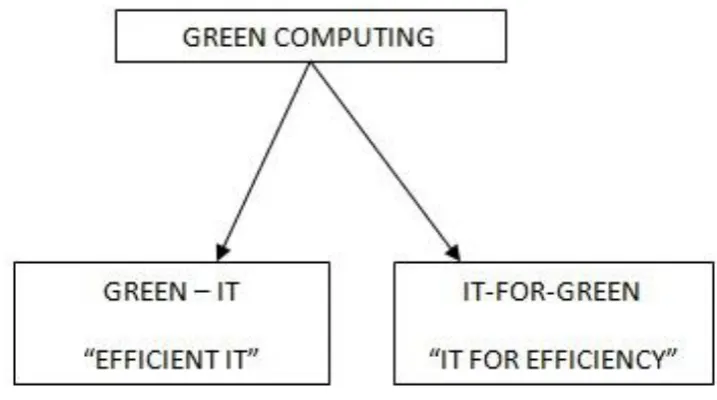
efficiently and effectively with negligible or no impact on the environment. Figure 1.1 shows the classification of green computing. It has two factors “Green-IT” means well organized IT and “IT-for Green” means use of IT
52 |
P a g e
FIGURE 1.1 CLASSIFICATION OF GREEN COMPUTING
The 5 core green computing technologies advocated by GCI are Green Data Center, Virtualization, Cloud Computing, Power Optimization and Grid Computing. Company like Via Technology offer green PC„s that are
affordable, non- toxic and ultra low wattage. It takes responsibility of their outdated products by offering a PC recycling service.
Green computing can also develop solutions that offer benefits by "aligning all IT processes and practices with the core principles of sustainability, which are to reduce, reuse, and recycle; and finding innovative ways to use IT in business processes to deliver sustainability benefits across the enterprise and beyond". The goals of green computing are quite similar to green chemistry which are to reduce the use of hazardous materials, maximize energy efficiency during the product's lifetime, and promote the recyclability or biodegradability of non-operational products and factory waste [1].
Main goals of green computing are to reduce the use of toxic and hazards materials and improve the energy efficiency, recycling of factory waste. Such practice includes the efficient implementation of server and peripherals as well as reduces the power consumption[2].
This technology is beneficial as it:-
a) Reduce energy consumption of computing resources during peak operation. b) Save energy during idle operation.
c) Use eco-friendly sources of energy.
53 |
P a g e
II. FRAMEWORK OF GREEN COMPUTING
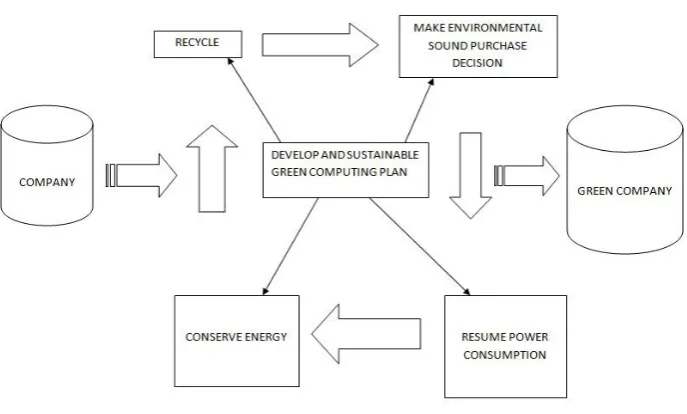
FIGURE 2.1 FRAMEWORK OF GREEN COMPUTING
These benefits of Green computing can only be achieved by keeping the following points in mind. All points help for reducing energy consumption of computer resources.
a) By using energy star qualified products help a lot in energy conservation.
b) Instead of using regular monitors organic LED should be used.
c) When the computers are turned off, the green computing provides the benefit to cut off the power of peripheral devices.
d) Donation of old computers and other peripherals reduces the rate of generation of e-waste which in terns reduces environmental pollution.
e) Use of computers greatly reduces the use of papers, because a huge amount of data can be stored in Hard Disk of computers and avoids the placing record on papers.
f) To have the record stored in computers in the form of papers, printers can be used but to reduce the paper waste, we should think 3 to 4 times before using printers.
g) Due to rapid development in IT, the games which were stored in a disk are now available on internet, which reduces the problem of using disks and boxes that were required a lot of resources.
h) Use of local cooling software always monitors the activity of CPU and when it sits idle it immediately put it into sleep mode and also manages power consumption [1].
III. NEEDS OF GREEN COMPUTING
Use of computer system and IT services had made one‟s life easier and more comfortable. It increases the
54 |
P a g e
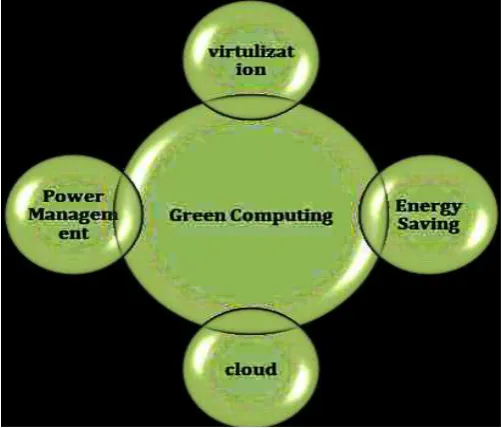
because data centres needed lots of power and matching cooling capacity, when it is not available then it causes environmental pollution. Green computing deals with the concept of reducing energy consumption, recycling eliminate hazardous elements but it also deals with reduce in the business travel sharing the resources (cloud computing) and optimization. There are lots of fundamental steps that can be taken to significantly decrease the power consumption and impact on environment. Figure 3.1 shows the aspects of green computing which are discussed below.
i) Energy Consumption
According to environmental protection agency around 30% to 40% of computers are kept ON during the weekends and even after office hours and around 90% of these computers remain idle. If we develop any application in green computing environment it will use optimal physical resources.
FIGURE 3.1 FUNDAMENTAL TECHNIQUES OF GREEN COMPUTING
ii) E-Waste Recycling
55 |
P a g e
iii) Virtualization
With virtualization, a system administrator could combine several physical systems into virtual machines on one single server to run multiple operating systems and make it more powerful. Energy-efficiency can be achieved with less physical equipment plugged in, which reduces power and consume less electricity. Several commercial companies and open-source projects now offer software packages to enable a transition to virtual computing. It is the fact that virtualization alone doesn't maximize energy and resource efficiencies. So, combined with the right skills and operational and architectural standards, automation minimizes the need of physical infrastructure which in turn maximizes the energy and resource efficiencies from server virtualization.
iv) Cloud as a Green computing
Businesses are rapidly moving from traditional system to cloud based system because of its faster scale-up/scale-down capacity, pay-per-use and access to cloud-based services without buying and managing on-premises infrastructure. The pay-per-use facility of cloud infrastructure provides energy and resource efficiencies simultaneously and promote users to consume only those resources which are required.
An IT organization can achieve energy-efficiency and sustainability goals by moving the load from ordinary servers to cloud servers. But unfortunately IT industries are acquiring the 70 percent of their electricity from greenhouse-gas-emitting fossil fuels, like coal and leaving a significant amount of carbon footprint. If cloud providers want to make their services as a green, they must invest in renewable energy sources. This can be achieved by generating power from renewable sources of energy, like wind, solar, or hydroelectricity. Consolidation of resources can improve utilization and provide more space, power and cooling capacity within the same facility envelope.
IV. DEVELOPING A GREEN MACHINE
Power management feature in computer system saves energy and money. To make the computer environment friendly, SLEEP and HIBERNATE settings can be used. These functions can be activated either by manually or by power management settings of operating system.
Sleep Mode: When a computer system is inactive for sometime then system automatically switches to lower power state. This state is called sleep mode. This state preserves energy by cutting power, display, hard drive, and peripherals. When pressing any key from keyboard, sleep mode deactivate and system takes back to its previous state. This mode mainly conserves battery power in a laptop computer.
56 |
P a g e
V. ADVANTAGES OF GREEN COMPUTING
1. Reduced energy usage from green computing techniques translates into lower carbon dioxide emissions, stemming from a reduction in the fossil fuel used in power plants and transportation.
2. Conserving resources means less energy is required to produce, use, and dispose of products. 3. Saving energy and resources saves money.
4. Green computing even includes changing government policy to encourage recycling and lowering energy use by individuals and businesses.
5. Reduce the risk existing in the laptops such as chemical known to cause cancer, nerve damage and immune reactions in humans [7].
VI APPROACHES FOR GREEN COMPUTING
Study shows that most of data centres don‟t have sufficient cooling capacity this is the cause of environmental pollution. Green computing is deals with concepts reduce energy consumption, recycling eliminate hazardous elements but it also deals with reduce in the business travel sharing the resources (cloud computing) and optimization. There are a lot of fundamental steps that can be taken to significantly decrease the power consumption and impact on environment.
Lower Power hardware:
computer systems are made up of hardware i.e. processor onboard graphics, disk,fan etc these hardware should be consumed less power.
Virtualization:
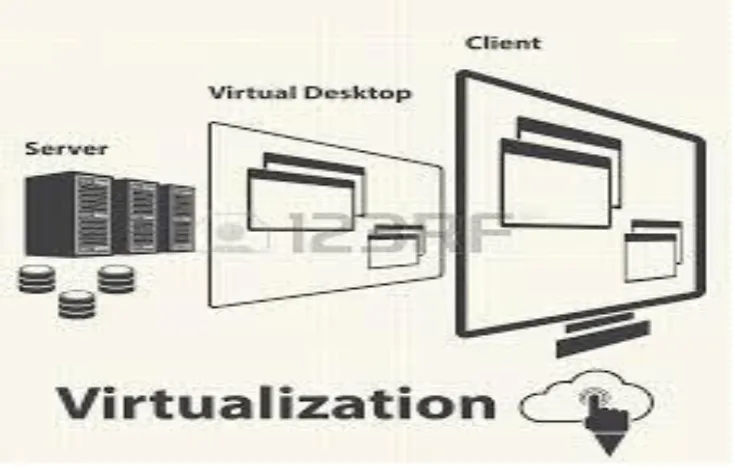
It is the use of software to simulate hardware. In the data center stand alone server systemreplaced with virtual server that run as software on a small number of larger computer via a virtualized server we can efficiently use computer resources.
Figure 5.1 Virtualization Environment
Cloud computing:
It has many benefits it enables anybody to obtain environmental benefits of virtualization57 |
P a g e
Wireless Network Sensor:
Sensor employed in different parts area in a data center to determine thetemperature of each area, this will tell which area need to be more cool and where to reduce cooling.
Recycle:
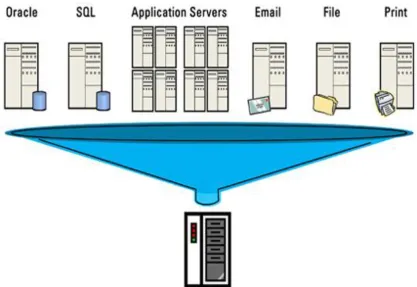
Through recycling the waste or equipment we can reduce the environmental pollution.Virtualization is the abstraction of an OS and applications running on it from the hardware. Physical resources can be split into a number of logical slices called Virtual Machines(VMs).Each VM can accommodate an individual OS creating for the user a view of a dedicated physical resource and ensuring performance and failure isolation between VMs sharing a single physical machine. The virtualization layer lies between the hardware and OS and; therefore, a Virtual Machine Monitor (VMM) tacks control over resources and has to be involved in the system‟s power management in order to provide efficient operation.
Figure 5.2 Virtualized Layer
Server Virtualization
(i) Server virtualization offers a way to consolidate servers by allowing you to run multiple different workloads on one physical host server. A "virtual server" is a software implementation that executes programs like a real server. Multiple virtual servers can work simultaneously on one physical host server. Therefore, instead of operating many servers at low utilization, virtualization combines the processing power onto fewer servers that operate at higher total utilization.
58 |
P a g e
(iii) Due to these benefits, virtualization has become commonplace in large data centers. A 2011 survey of over 500 large enterprise data centers found that 92% use virtualization to some degree.5Of those, the ratio of virtual servers to physical host server averaged 6.3 to 1 and 39% of all servers were virtual.
(iv) However, virtualization is less common in small data centers. A 2012 NRDC paper entitled Small Server
Rooms, Big Energy Savings6 included an informal survey of 30 small businesses (ranging from 3 to 750
employees) and found that only 37% used virtualization.
Figure 5.3 Server Virtualization In Data Centers
Cloud Computing:
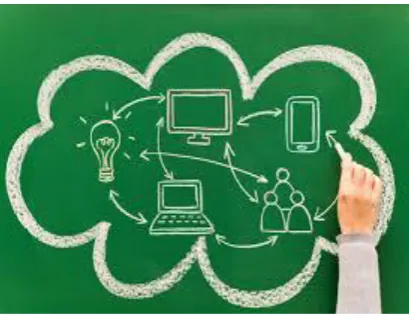
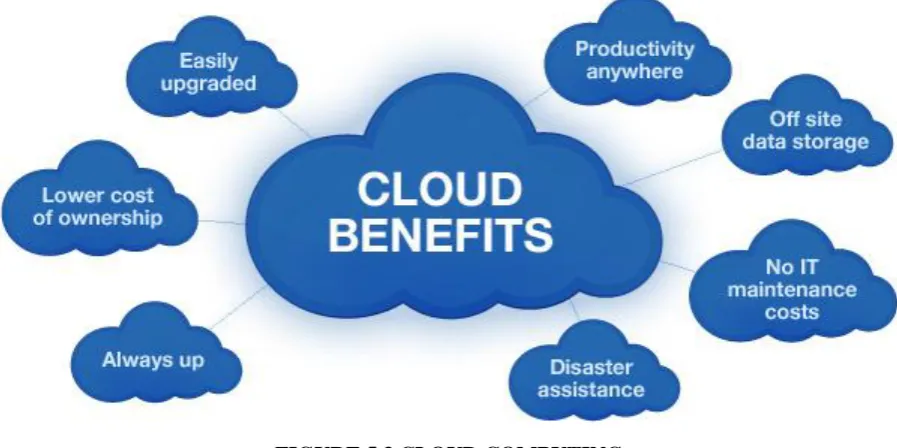
Cloud computing name comes from the cloud shaped symbol in which the complex infrastructure is hidden as it contain in its system diagram. Cloud computing delivered the computing resources as a service over the internet. Cloud computing provide user‟s data, software remotely End user can use the cloud services or cloud
59 |
P a g e
FIGURE 5.3 CLOUD COMPUTING
VI. CHALLENGES IN GREEN COMPUTING
According to researchers of Green Computing following are few prominent challenges that Green computing is facing today [8]:
Equipment power density / Power and cooling capacities;
Increase in energy requirements for Data Centers and growing energy cost;
Control on increasing requirements of heat removing equipment, which increases because of increase
in total power consumption by IT equipments;
Equipment Life cycle management – Cradle to Grave; and
Disposal of Electronic Wastes
VII. FUTURE TRENDS IN GREEN COMPUTING
The future of Green Computing is going to be based on efficiency, rather than reduction in consumption [2]. The primarily focus of Green IT is in the organization‟s self interest in energy cost reduction, at Data Centers and at
60 |
P a g e
A.Certifications
There are several organizations providing certificates to green technology. Vendors are based on their product quality, material, life of the product and recycling capabilities. In future such certifications together with recommendations and government regulations will put more pressure on vendors to use green technology and reduce impact on environment.
B. Cloud Computing
Cloud Computing has recently received significant attention, as a promising approach for delivering Information and Communication Technology services by improving the utilization of Data Center resources. In principle, cloud computing is energy-efficient technology for ICT provided that it‟s potential for significant energy savings that have so far focused on only hardware aspects, can be fully explored with respect to system operation and networking aspects also. Cloud Computing results in better resource utilization, which is good for the sustainability movement for green technology.
C. Product Longevity
As per Gartner and Fujitsu reports on product life cycle it is obvious that the product durability and/or longevity are one of the best approaches towards achieving Green Computing objectives. Long life of product will allow more utilization of products and it will put a control on unnecessary manufacturing of products. It is obvious that government regulations will push the products vendors to make more efforts to increase the product life.
D. Power Management Tools
Power management is proving to be one of the most valuable and clear-cut techniques in near future to decrease energy consumption. IT departments with focus on saving energy can decrease use with a centralized power management tool. Compiling data from Energy Star case studies for 7 deployments of 11,000 - 499,000 machines, it was found that sleep scheduling was able to save between $10.75 and $95 per computer per year. These deployments used a combination Windows built-in sleep function, group policies, different software systems, such as PC Power-down, EZ GPO, Tivoli systems, BigFix etc..
E. Leveraging Unused Computer Resource
61 |
P a g e
F. Data Compression
In enterprise, huge amount of data that is stored is someway or other duplicated information. Information System backups are true example of such duplicated data. Intelligent compression techniques can be used to compress the data and eliminate duplicates help in cutting the data storage requirements.
G. Applications
Green Computing is a diverse field and due to its nature and priority from all fields of life Green Computing has applications in every sector of computing as the goal is to save
the environment and ultimately the life. The current main applications of Green Computing are covering following computing sectors [5]:
Equipment design;
Equipment recycling;
Data Center optimization and consolidation;
Virtualization;
Paper free environment;
Application Architecture; and
Power Management
VIII. CONCLUSION
In recent years, companies in the computer industry have come to realize that going green is in their best interest, both in terms of public relations and reduced costs. This research paper shows the importance of Green computing. We should understand the need of Green computing. IT industry is putting efforts in all its sectors to achieve Green computing. Equipment recycling, reduction of paper usage, virtualization, cloud computing, power management, Green manufacturing are the key initiatives towards Green computing. Current challenges to achieve Green Computing are enormous and the impact is on computing performance.
To make the computer society completely green, one should do the following things. When computer components are not in our use then the components must be donated to those people who may not have those components. Instead of discarding computers, upgrade their parts in order to make them new. As some components used to build the motherboard of computer are very expensive and toxic then recycling of these components is a better option. Different wallpapers consumes a large amount of energy so instead of setting different wallpapers, set Blackle as home page. Because blackle is a website powered by google custom search whose screen is predominantly black and fonts are of gray color. This arrangement consumes very less energy. So, Go green is a concept which is used in few organizations but if everyone use its components then it could be beneficial for everyone. The benefits of green computing are clear. As the number of PCs approaches 2 Billion by 2015, the potential savings related to energy use, CO2 emissions and e-waste are undeniable. Hence proper implementation of Green computing will be helping hand in terms to save energy and remove the pollution.
62 |
P a g e
REFERENCES
1. Rina Mishra, Sonali Jain, Nirupama Kurmi, “ An Emerging Technology: Green Computing”, International Research Journal of Engineering and Technology (IRJET), Volume: 02, Issue: 02, May 2015.
2. Neha Tiwari, “Green Computing”, International Journal of Innovative Computer Science and Engineering
(IJICSE), Volume 2, Issue 1, March 2015.
3. Dr. Pardeep Mittal, Navdeep Kaur, “Green Computing – Need and Implementation”, International Journal of Advanced Research in Computer Engineering and Technology (IJARCET), Volume 2, Issuue 3, March 2013. 4. Gaurav Jindal, Manisha Gupta, “Green Computing “Futures of Computers””, International Journal of
Emerging Research in Management &Technology, December 2012.
5. Tariq Rahim Soomro, Muhammad Sarwar, “Green Computing: From Current to Future Trends”, International Journal of Social, Behavioral, Educational, Economic, Business and Industrial Engineering Volume:6, No:3, 2012.
6. http://greencomputingisgood.blogspot.in/2011/03/benifits-of-green-computing.html.
7. Sonu Choudhary / (IJCSIT) International Journal of Computer Science and Information Technologies, Vol. 5 (5) , 2014.