R E S E A R C H A R T I C L E
Open Access
Knowledge, attitudes, and practices of
Florida physicians regarding dengue before
and after an educational intervention
Susanne Doblecki-Lewis
1*, Aileen Chang
2, Renee Jiddou-Yaldoo
3, Kay M. Tomashek
4, Danielle Stanek
5,
Leena Anil
6and Paola Lichtenberger
7Abstract
Background:Failure to recognize and appropriately manage dengue early in the clinical course may result in late initiation of supportive treatment for severe disease. In Florida, travel-related and autochthonous dengue occur and are likely under-recognized. The objective of this study was to evaluate physician knowledge of dengue and its management before and after an educational intervention in Florida.
Methods:From 2012–13 we conducted 14 grand-rounds style lectures on dengue clinical management attended by 413 physicians, and analyzed data from the pre- and post-tests.
Results:Of those attending, 231 and 220 completed the pre-and post-tests, respectively. Overall, the mean pre-test score for knowledge-based questions was 74.3 and average post-test score was 94.2 %, indicating a mean increase of 19.9 % (P< 0.0001, 95 % CI 17.7–22.4). Reported confidence in dengue recognition and management also increased. Non-US trained physicians and those who had treated more than ten dengue cases performed significantly better in the pre-test. Post-test scores did not differ by subgroup.
Conclusions:The train-the-trainer approach with grand-rounds style presentations appear to be an effective intervention to improve knowledge of dengue among physicians.
Keywords:Dengue, Clinical practice, Physician training, Evaluation, Survey
Background
Dengue is a mosquito-transmitted viral disease that is endemic throughout the subtropics and tropics world-wide. Clinical manifestations range from a mild acute febrile illness to a severe life-threatening disease with a plasma leakage syndrome resulting in hypovolemic shock and hemorrhage [1]. Prior to 1940, dengue out-breaks occurred regularly in Florida including approxi-mately 15,000 cases from 1934–1935. Locally-acquired dengue was not reported again in Florida until 2009– 2010 when 88 cases were detected in Monroe County, Florida [2–4]. Since that time, a few sporadic locally-acquired dengue cases have been reported from other
Florida counties including an outbreak in Martin County in 2013 [5].
Florida is at risk for dengue outbreaks with locally acquired dengue cases because of its largely non-immune population, an abundance of the mosquito vectors,Aedes aegyptiandAedes albopictus, and import-ation of dengue virus via viremic tourists and residents returning from neighboring dengue-endemic areas in-cluding Mexico, Central and South American, and the Caribbean. In fact, the majority of dengue cases reported in Florida are travel-associated cases [3]. Florida is a leading reporter of travel-associated dengue cases among the U.S. states and in 2015, Florida was second only to California [6]. Travel-associated cases may result in sub-sequent autochthonous transmission [2, 5, 7].
While physicians in endemic areas are likely to con-sider dengue in the differential diagnosis of a patient presenting with an acute febrile illness [8], dengue may
* Correspondence:[email protected]
1Division of Infectious Diseases, Department of Medicine, University of Miami
Miller School of Medicine, 1120 NW 14th Street, #850 (R-21), Miami, FL 33155, USA
Full list of author information is available at the end of the article
not be considered in non-endemic areas, leading to under-diagnosis [9]. In the Key West 2009–2010 out-break, initial cases were attributed by local physicians to non-specific viral illness and the diagnosis of dengue was not considered [4]. Similarly, in a 1999 dengue out-break in Laredo, Texas, most patients identified as hav-ing a recent dengue infection by serologic diagnostic tests were initially given a clinical diagnosis of non-specific viral syndrome and not dengue [9].
Early recognition of dengue cases and timely initiation of appropriate supportive care is critical because it has been shown to reduce medical complications and mortality among patients with severe dengue [10–14]. As there is no licensed vaccine in the United States to prevent dengue or antiviral medication to prevent the development of severe disease manifestations, educating clinicians on the recognition and clinical management of dengue is an important public health strategy [7]. Educating physicians regarding standard clinical management protocols including how to iden-tify e severe dengue have been demonstrated to re-duce the case fatality rate associated with dengue hemorrhagic syndrome [14].
Train-the-trainer interventions, in which a small group of individuals receive in-depth training with the intent to further disseminate information to a broader audi-ence, have been used to train emergency room providers in management of sickle cell disease, improve recogni-tion and treatment of chronic fatigue syndrome, and educate physicians in Puerto Rico in response to a den-gue outbreak in 2010 [8, 15, 16]. These interventions allow rapid scale-up of training initiatives and offer promise for rapid dissemination of expert-level content delivered in a local context by physicians within the area.
In response to an increase in travel-associated dengue cases and two outbreaks with several locally acquired dengue cases, the Florida Department of Health (FDOH) in collaboration with University of Miami and the Centers for Disease Control and Prevention (CDC) Dengue Branch developed a train-the-trainer initiative to offer grand rounds-style presentations with con-tinuing medical education (CME) credit for Florida physicians with the goal of increasing early recogni-tion and standardizing treatment of dengue cases. This paper describes the initiative and results from the pre- and post-training evaluation of attendees’ know-ledge of dengue.
Methods
Study design
This study involved an evaluation of physician know-ledge, attitudes, and practices regarding dengue before and after the educational intervention.
Train-the-trainer symposium
CDC training materials that were used to train physician master trainers in Puerto Rico in 2010 were adapted [8, 17], and used to conduct a one-day, intensive training symposium hosted at the University of Miami. Symposium attendees included a select group of ten phy-sicians from four counties in southern Florida who had prior clinical experience and interest in dengue. The symposium included presentations on the epidemiology, clinical presentation, laboratory diagnosis, reporting re-quirements, and clinical management of dengue.
Educational intervention
Following the symposium, a one-hour grand-rounds style presentation was developed using the CDC training materials. The presentation offered an overview of dengue clinical characteristics, diagnosis, monitoring, reporting, and treatment. The physicians attending the training symposium delivered the presentations as part of weekly grand rounds activities at venues within major hospital networks and practices throughout Florida. Par-ticipants in the grand rounds sessions were self-selected. One CME credit was offered to attendees of the grand-rounds presentations.
Evaluation of physician knowledge, attitudes, and practices
To assess physician knowledge and attitudes and prac-tices regarding dengue, a two page, 20-item question-naire was administered before each presentation and identical questions were repeated after the presentation. The questionnaire assessed participant’s knowledge of dengue virus and its transmission and the epidemiology, diagnosis, reporting, and clinical management of dengue. Questions regarding knowledge and practice were mul-tiple choice questions. The instrument also asked partic-ipants for their opinion on the relevance of dengue in their medical practice and confidence in their ability to diagnose and treat dengue patients. These were assessed on a zero to ten scale with zero indicating “no confi-dence or relevance at all” and ten “very confident/very relevant.” Demographic information including age, years in practice, medical specialty, and location of medical school training was obtained in the pre-test. To preserve confidentiality, pre- and post-tests were not linked. Only those completing the pre-test were asked to complete the post-test.
Ethics and informed consent
presentation and attendees were informed that comple-tion of the survey was construed as consent to partici-pate. All attendees were offered the option of not participating.
Analysis
We conducted a descriptive analysis of participant demographics characteristics, and compared pre- and post-tests findings overall and by demographic groups. The mean percentage of questions correctly answered in the pre- and post-tests were compared using the un-paired student’s t-test. For individual items of interest, pre- and post-test responses were compared using the z-test for comparison of proportion of respondents correctly answering the question and the student’s t-test with Sat-terthwaite method for unequal variances for continuous scale responses. Statistical differences in baseline (pre-test) scores were tested using analysis of variance and Tukey’s post-hoc test. The relationship between continuous vari-ables was calculated using Pearson correlation coefficient. Paper questionnaires were completed in-person. Data ana-lysis was conducted using SAS (v. 9.3; SAS Institute Inc., Cary, North Carolina) and graphs were produced in Microsoft Excel (Microsoft Corp., Redmond, WA).
Results
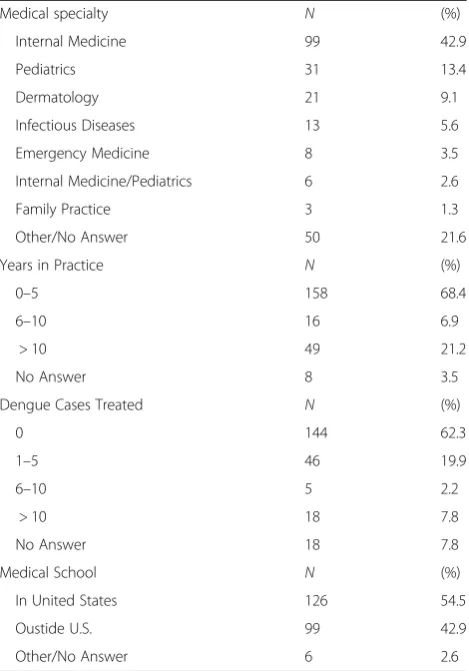
A total of 413 physicians attended 14 dengue grand-rounds presentations offered in Florida between January 2012 and October 2013. Of these, 231 (55.9 %) com-pleted the pre-test and 220 (53.3 %) also comcom-pleted the post-test assessment. More than half of all ptest re-spondents were reportedly Internal Medicine physicians (42.9 %) or Pediatricians (13.4 %) (Table 1). The majority (68.4 %) of respondents were in practice for 0–5 years while 21.2 % were in practice for more than 10 years. Slightly more than half (54.5 %) of respondents reportedly attended medical school in the United States (U.S.) while 43 % attended medical school in Central America, South Amer-ica, or the Caribbean. Most (62.3 %) respondents indicated they had never diagnosed a case of dengue; however, nearly one-third of respondents had diagnosed at least one dengue case. Non-U.S. educated physicians were significantly more likely to report having diagnosed at least one dengue case in their career (p< 0.0001).
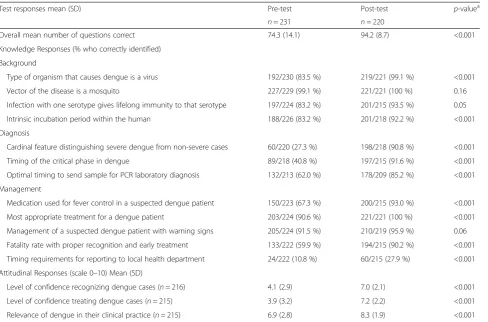
Overall, the mean pre-test score for the knowledge-based questions was 74.3 % and the average post-test score was 94.2 %, indicating a mean increase of 19.9 % (P< 0.0001, 95 % CI 17.7–22.4) (Table 2). The lowest scoring questions in the pre-test involved identification of clinically significant plasma leakage as the cardinal feature distinguishing severe dengue from dengue (27.3 % correct) and identification of the 1–2 day period
after defervescence as the critical phase for development of severe manifestations (40.8 %). High scoring questions included identification of mosquitoes as the vector (98.7 %) and correct management of a patient with warning signs for severe dengue during the critical phase (91.5 %). Scores for all knowledge questions increased from pre-test to post-test assessment.
Reported self-confidence in ability to recognize dengue cases increased significantly from pre- to post-test as-sessment from a mean of score of 4.1 to 7.0, respectively (Table 2). Similarly, confidence in ability to treat dengue cases increased from a mean of 3.9 in the pre-test to 7.2 in the post-test. The assessment of the course relevance to the respondent’s practice increased from 6.9 to 8.3 from pre- to post-test. Greater confidence in recognition and treatment of dengue prior to the presentation were signifi-cantly associated with better performance on the pre-test (r= 0.34, p< 0.001 for recognition; r= 0.35, p< 0.001 for treatment). Perceived relevance to their own medical prac-tice also demonstrated a weak but significant correlation with pre-test scores (r= 0.18,p< 0.007).
Table 1Demographic characteristics of physicians completing pre-test dengue surveys (n= 231)
Medical specialty N (%) Internal Medicine 99 42.9 Pediatrics 31 13.4 Dermatology 21 9.1 Infectious Diseases 13 5.6 Emergency Medicine 8 3.5 Internal Medicine/Pediatrics 6 2.6 Family Practice 3 1.3 Other/No Answer 50 21.6 Years in Practice N (%)
0–5 158 68.4
6–10 16 6.9
> 10 49 21.2 No Answer 8 3.5 Dengue Cases Treated N (%)
0 144 62.3
1–5 46 19.9
6–10 5 2.2
> 10 18 7.8
Average test scores varied by respondent demographic characteristics. Respondents trained at a non-U.S. med-ical school had higher pre-test scores compared with those educated in the U.S. (76.7 % vs. 72.7 %;p= 0.036). Similarly, those who reported diagnosing more than 10 cases of dengue had higher pre-test scores than those who reported having never diagnosed a dengue case (83.8 % vs. 72.0 %;p= 0.0003). Respondents who report-edly had never diagnosed a patient with dengue had a significantly greater increase in test score from pre-to post-test compared with those who had diagnosed the most cases (+23.0 % vs. +6.8 %; p< 0.0001); post-test scores were not significantly different by number of den-gue cases diagnosed. Pre-test and post-test scores did not significantly differ by years in practice.
Discussion
In our assessment of Florida physicians attending a grand-rounds style presentation on dengue, we found wide variability in baseline knowledge and confidence regarding dengue diagnosis and management. For ex-ample, physicians trained at non-U.S. medical schools, in areas where dengue is endemic, reportedly had more
experience diagnosing dengue and scored significantly higher on the pre-test than U.S. medical school gradu-ates and those who had never diagnosed a case of dengue. Physician pre-test confidence regarding dengue diagnosis and treatment was also low at baseline, how-ever those with higher pre- test scores tended to report higher levels of confidence.
Knowledge presented in this format appeared to be at a level accessible to practicing physicians with or without prior experience with the disease, and was successful in increasing knowledge and confidence re-garding the essential features of diagnosis and treat-ment of dengue. For example, despite lower baseline knowledge, physicians with no clinical experience with dengue patients and those educated in U.S. medical schools made significantly greater gains from pre-test to post-test than more experienced physicians trained in non U.S. medical schools. In fact, post-test scores did not differ by demographic characteristics and overall test scores were high. In addition, perceived relevance to practice and confidence regarding dengue diagnosis and treatment demonstrated significant gains following the presentation indicating an improved Table 2Physician survey test results before and after attending training
Test responses mean (SD) Pre-test Post-test p-valuea
n= 231 n= 220
Overall mean number of questions correct 74.3 (14.1) 94.2 (8.7) <0.001 Knowledge Responses (% who correctly identified)
Background
Type of organism that causes dengue is a virus 192/230 (83.5 %) 219/221 (99.1 %) <0.001 Vector of the disease is a mosquito 227/229 (99.1 %) 221/221 (100 %) 0.16 Infection with one serotype gives lifelong immunity to that serotype 197/224 (83.2 %) 201/215 (93.5 %) 0.05 Intrinsic incubation period within the human 188/226 (83.2 %) 201/218 (92.2 %) <0.001 Diagnosis
Cardinal feature distinguishing severe dengue from non-severe cases 60/220 (27.3 %) 198/218 (90.8 %) <0.001 Timing of the critical phase in dengue 89/218 (40.8 %) 197/215 (91.6 %) <0.001 Optimal timing to send sample for PCR laboratory diagnosis 132/213 (62.0 %) 178/209 (85.2 %) <0.001 Management
Medication used for fever control in a suspected dengue patient 150/223 (67.3 %) 200/215 (93.0 %) <0.001 Most appropriate treatment for a dengue patient 203/224 (90.6 %) 221/221 (100 %) <0.001 Management of a suspected dengue patient with warning signs 205/224 (91.5 %) 210/219 (95.9 %) 0.06 Fatality rate with proper recognition and early treatment 133/222 (59.9 %) 194/215 (90.2 %) <0.001 Timing requirements for reporting to local health department 24/222 (10.8 %) 60/215 (27.9 %) <0.001 Attitudinal Responses (scale 0–10) Mean (SD)
Level of confidence recognizing dengue cases (n= 216) 4.1 (2.9) 7.0 (2.1) <0.001 Level of confidence treating dengue cases (n= 215) 3.9 (3.2) 7.2 (2.2) <0.001 Relevance of dengue in their clinical practice (n= 215) 6.9 (2.8) 8.3 (1.9) <0.001
a
recognition of the importance of dengue among Florida physician attendees.
The finding of differences in dengue knowledge by lo-cation of medical school is not unexpected given the small number of dengue cases likely to be encountered by a U.S. medical student during their clinical rotations and the lack of consistent inclusion of tropical medicine education in U.S. medical school curricula [18]. How-ever, physician surveys in areas where dengue is endemic and commonly diagnosed have also demonstrated lack of concordance of practice with available guidelines, lack of recognition of the critical phase of illness, and sub-optimal compliance with Department of Health case reporting requirements [8, 19, 20]. Of concern, the rec-ognition of the critical phase of infection in which symp-toms may dramatically worsen and correct identification of warning signs were content areas frequently missed in our baseline survey as well as in a recent physician sur-vey conducted in Puerto Rico [8]. Early identification of the warning signs for development of severe dengue can result in more appropriate monitoring and intensive supportive care for more severe symptoms, interventions that have been demonstrated to decrease morbidity and mortality [10–14].
Limitations of this study include non-completion of surveys from some attendees and lack of long-term follow-up to determine retention of knowledge gained. Additionally, while only those participating in the pre-intervention survey were asked to complete the post-intervention survey, the pre- and post-post-intervention surveys were not individually linked and demographic information was collected only in the pre-intervention survey. Thus, there is the possibility that the individuals completing the post-intervention survey may have dif-fered from those completing the pre-intervention survey. In addition, our study did not investigate if the increase in knowledge and change in attitude demonstrated by respondents led to a change in clinical practice, improved case recognition, or increased testing of suspected cases among attendees. Nevertheless, this assessment and edu-cational program was successful in assessing baseline knowledge of Florida physicians and in disseminating in-formation regarding a locally important disease to many physicians over a short period of time.
Conclusions
Within the continental United States, Florida is one of the states with both a significant number of imported cases of dengue as well as autochthonous transmission [2]. Early recognition and timely, appropriate treatment of dengue is the cornerstone of public health efforts to mitigate local transmission and optimize patients’clinical outcomes [7]. Ensuring that Florida physicians know how to recognize potential dengue cases, order appropriate
diagnostic tests, and notify public health officials is there-fore a priority for any dengue response plan. Further, clin-ician awareness of the clinical course of dengue including the timing of the critical phase is necessary to offer correct anticipatory guidance for dengue patients and make timely referrals for patients demonstrating warning signs of severe dengue. With increasing international travel and resultant globalization of communicable diseases, there is a need for expanded training for U.S. physicians in the management of tropical diseases [21]. Expanding the traditional medical school curricula to address common emerging tropical diseases affecting travelers and new im-migrants may be warranted [22–24]. The train-the-trainer approach and grand-rounds style presentations appear to be an effective intervention to improve knowledge, confi-dence, and awareness of the importance of tropical dis-eases that affect Floridians.
Ethics approval and consent to participate
The study protocol was reviewed and approved by the University of Miami Institutional Review Board (study #20120015). Verbal consent was obtained from each participant prior to survey completion. A waiver of written informed consent was granted by the Institutional Review Board.
Consent for publication
Not Applicable.
Availability of data
De-identified data available upon request.
Abbreviations
CDC:Centers for Disease Control and Prevention; CME: Continuing Medical Education; FDOH: Florida department of health; U.S.: United States.
Competing interests
The authors declare that they have no competing interests.
Authors’contributions
SD-L and PL conceived of the study, participated in the design of the survey instruments, analyzed the data, and wrote the manuscript. AC participated in study design, survey implementation, and data analysis. RJ-Y participated in study design including instrument development, survey implementation, and analysis. KT participated in the design of the training sessions, data analysis and manuscript revisions. DS participated in the design of the training sessions and development of survey instruments. LA participated in the study design and design of training sessions. All authors read and approved the final manuscript.
Acknowledgments
We thank all the staff at CDC Dengue Branch who developed the training materials, as well as the master physician trainers who reviewed and pilot tested the materials. Special thanks to Dr. Eduardo Ochoa for his assistance in training the Florida master trainers. Finally, we acknowledge the participating hospital staff and administrators, especially the physicians who participated in the trainings.
Author details
1Division of Infectious Diseases, Department of Medicine, University of Miami
Miller School of Medicine, 1120 NW 14th Street, #850 (R-21), Miami, FL 33155, USA.2Division of General Internal Medicine, George Washington University School of Medicine and Health Sciences, 2150 Pennsylvania Ave NW Room 5-419, Washington, DC 20037, USA.3Division of Infectious Diseases,
Department of Medicine, Oakland University William Beaumont School of Medicine, Beaumont Health Grosse Pointe, 468 Cadieux Rd, Grosse Pointe, MI 48230, USA.4Dengue Branch, Division of Vector-borne Diseases, National
Center for Emerging and Zoonotic Infectious Diseases, United States Centers for Disease Control and Prevention, 1600 Clifton Rd, Atlanta, GA 30333, USA.
5
Florida Department of Health, Division of Disease Control and Health Protection, Zoonotic and Vectorborne Disease, 4052 Bald Cypress Way, Bin A12, Tallahassee, FL 32399-1712, USA.6Division of Infectious Disease
Epidemiology, Bureau for Public Health, West Virginia Department of Health & Human Resources, 350 Capitol St. Rm. 125, Charleston, WV 25301, USA.
7Division of Infectious Diseases, Department of Medicine, University of Miami
Miller School of Medicine, 1120 NW 14th Street, #864 (R-21), Miami, FL 33155, USA.
Received: 13 November 2015 Accepted: 20 April 2016
References
1. Simmons CP, Farrar JJ, Nguyen VV, Wills B. Dengue. N Engl J Med. 2012;366(15):1423–32.
2. Radke EG, Gregory CJ, Kintziger KW, Sauber-Schatz EK, Hunsperger EA, Gallagher GR, et al. Dengue outbreak in Key West, Florida, USA, 2009. Emerg Infect Dis. 2012;18(1):135–7.
3. Dengue Occurrence in Florida. http://www.floridahealth.gov/diseases-and-conditions/dengue/. Accessed 20 Jan 2015.
4. Graham AS, Pruszynski CA, Hribar LJ, DeMay DJ, Tambasco AN, Hartley AE, et al. Mosquito-associated dengue virus, Key West, Florida, USA, 2010. Emerg Infect Dis. 2011;17(11):2074–5.
5. Teets FD, Ramgopal MN, Sweeney KD, Graham AS, Michael SF, Isern S. Origin of the dengue virus outbreak in Martin County, Florida, USA 2013. Virol Rep. 2014;1–2:2–8.
6. Florida Arbovirus Surveillance Week 52: December 27, 2015-January 2, 2016. http://www.floridahealth.gov/diseases-and-conditions/mosquito-borne-diseases/surveillance.html. Accessed 27 Jan 2016.
7. Adalja AA, Sell TK, Bouri N, Franco C. Lessons learned during dengue outbreaks in the United States, 2001–2011. Emerg Infect Dis. 2012;18(4):608–14. 8. Tomashek KM, Biggerstaff BJ, Ramos MM, Perez-Guerra CL, Garcia Rivera EJ,
Sun W. Physician survey to determine how dengue is diagnosed, treated and reported in Puerto Rico. PLoS Negl Trop Dis. 2014;8(10):e3192. 9. Centers for Disease Control and Prevention. Underdiagnosis of dengue–
Laredo, Texas, 1999. MMWR Morb Mortal Wkly Rep. 2001;50(4):57–9. 10. World Health Organization. Dengue: Guidelines for Diagnosis, Treatment,
Prevention and Control - New Edition. Geneva: World Health Organization; 2009.
11. Kalayanarooj S. Clinical Manifestations and Management of Dengue/DHF/ DSS. Trop Med Health. 2011;39(4 Suppl):83–7.
12. Lam PK, Tam DT, Diet TV, Tam CT, Tien NT, Kieu NT, et al. Clinical characteristics of Dengue shock syndrome in Vietnamese children: a 10-year prospective study in a single hospital. Clin Infect Dis. 2013;57(11):1577–86.
13. Rocha C, Silva S, Gordon A, Hammond SN, Elizondo D, Balmaseda A, et al. Improvement in hospital indicators after changes in dengue case management in Nicaragua. Am J Trop Med Hyg. 2009;81(2):287–92. 14. Mayurasakorn S, Suttipun N. The impact of a program for strengthening
dengue hemorrhagic fever case management on the clinical outcome of dengue hemorrhagic fever patients. Southeast Asian J Trop Med Public Health. 2010;41(4):858–63.
15. Tanabe P, Stevenson A, DeCastro L, Drawhorn L, Lanzkron S, Molokie RE, et al. Evaluation of a train-the-trainer workshop on sickle cell disease for ED providers. J Emerg Nurs. 2013;39(6):539–46.
16. Brimmer DJ, McCleary KK, Lupton TA, Faryna KM, Hynes K, Reeves WC. A train-the-trainer education and promotion program: chronic fatigue syndrome–a diagnostic and management challenge. BMC Med Educ. 2008; 8:49.
17. Dengue Clinical Case Management course (DCCM). http://www.cdc.gov/ dengue/training/cme/ccm/index.html. Accessed 10 Jan 2015.
18. Khan OA, Guerrant R, Sanders J, Carpenter C, Spottswood M, Jones DS, et al. Global health education in U.S. medical schools. BMC Med Educ. 2013;13:3. 19. Kularatne SA. Survey on the management of dengue infection in Sri Lanka: opinions of physicians and pediatricians. Southeast Asian J Trop Med Public Health. 2005;36(5):1198–200.
20. Ho TS, Huang MC, Wang SM, Hsu HC, Liu CC. Knowledge, attitude, and practice of dengue disease among healthcare professionals in southern Taiwan. J Formos Med Assoc. 2013;112(1):18–23.
21. Drain PK, Primack A, Hunt DD, Fawzi WW, Holmes KK, Gardner P. Global health in medical education: a call for more training and opportunities. Acad Med. 2007;82(3):226–30.
22. Bissonette R, Route C. The educational effect of clinical rotations in nonindustrialized countries. Fam Med. 1994;26(4):226–31.
23. Einterz RM, Dittus RS, Mamlin JJ. General internal medicine and technologically less developed countries. J Gen Intern Med. 1990;5(5):427–30.
24. Haq C, Rothenberg D, Gjerde C, Bobula J, Wilson C, Bickley L, et al. New world views: preparing physicians in training for global health work. Fam Med. 2000;32(8):566–72.
• We accept pre-submission inquiries
• Our selector tool helps you to find the most relevant journal
• We provide round the clock customer support
• Convenient online submission
• Thorough peer review
• Inclusion in PubMed and all major indexing services
• Maximum visibility for your research
Submit your manuscript at www.biomedcentral.com/submit