Evaluation Of User Experience And Its Economics
In E-Commerce
Praneeth Kumar Baru, Roopasri Vemula
Abstract: User Experience pertains to designing, studying and evaluating experiences that users have while using or interacting with the system with a specific context. UX is seen as a field of study, a phenomenon and as a practice as well. To understand it with an analogy; justice as a phenomenon, law as a field of study and a lawyer’s work as a practice. Evaluating the user’s experience can help quantify or measure to the extent to which the system is being understood or perceived the way it is supposed to be. Evaluation methods can take various forms and are categorized in this paper. Essentials of the user experience are elaborated and furthermore, some quantified data is presented that discusses the role user experience in e-commerce website and also the future prospects of the e-commerce domain are briefly described.
Keywords: User experience, UX, time span, period, visual design, information architecture, e-commerce
————————————————————
I.
INTRODUCTION
The term user experience refers to the response to the stimulus pertaining to the time that the user has spent with the system and even prior to it and beyond it as well. It encapsulates the experience that maps the users journey prior to, while and after interacting with the system. It can reflect the experience of a single individual or a group of individuals. According to the ISO definition, user experience includes all the users' emotions, beliefs, preferences, perceptions, physical and psychological responses, behaviors and accomplishments that occur before, during and after use. The three factors that influence user experience are system, user and the context of use. The system refers to the application that is in operation, the user who initiates necessary operations so as to meet specific needs, and the context establishes the relation between the user’s actions on the system to accomplish specific tasks. Depending on the domain of work, appropriate evaluation methods are adopted in order to quantify the extent to which the users are able to efficiently perform a task.
II. USER EXPERIENCE - OVERVIEW
The evolution of technology has taken a swifter pace in the past decade that has demanded the technology not only to be efficient but also surreal and visually appealing. Organizations have been providing good content and services to their client so as to satisfy their business needs. But gradually, there was also significant demand in not only how a system works but also the experience it gives the user which is predicated on several other factors as mentioned already. But the user experience primarily consists of five essentials, each of which has its own specific importance in composing a well-defined user experience.
III. ESSENTIALS OF USER EXPERIENCE
User experience in this era of technology holds serious significance and it generally encapsulates the following essentials that constitutes a well-defined user experience.
A. Visual Design
What catches the eye of the user is what he is attracted to in the first sight. Visual appearance has been enhanced through UI design and graphic design. Considering the human psychology, we are more likely to choose an attractive application with images, graphics, text and all the visual effects that are aesthetically pleasing. What helps UX practitioners to enhance the user experience is to understand the choices of the users and associate those choices to usability and create visual designs strategically with the right images, colors, fonts and many such other elements. Visual design draws the users’ attention to the right functionality and prioritize the tasks by presenting them in an appropriate size, color, through the use of white spaces and the visual cues. Visual designs work better when they are not distracted by the trends and follow what is actually needed to present. Excess addition of visual elements might deviate from what is supposed to be conveyed. The basic principles of visual design are as follows:
• Visual weight, contrast and depth • Color
• Repetition and pattern breaking • Line tension and edge tension • Alignment and proximity • Visual concept
B. Information Architecture
In a large pool of information or data helping or guiding the user to get a clear understanding of what he wants is information architecture. It is creating a structure for the application or website such that a user will have a clear picture of where he is located and to know where his required information is located at by categorizing the data, creating sitemaps, navigation and establishing hierarchies. By organizing and grouping the data accordingly would help the user to access required information with ease. For example, a designer designing a top-level menu to help the user locate where he is on the website is information architecture. When doing the information architecture, it is important to understand the following details:
• How the information is presented to the user? ____________________________
• Praneeth Kumar Baru, Computer Science and Engineering Sreenidhi Institute of Science and
Technology Hyderabad, India
• Roopasri Vemula, Computer Science and Engineering Sreenidhi Institute of Science and
Technology Hyderabad, India
381
• Is the presented information helpful to the user? • How is the flow of the users through the site?
Another important field of study which helps in information architecture is cognitive psychology. By studying how the mind works and the mental processes the information architecture and the interaction design is influenced. Elements of cognitive psychology that matters are:
a. Cognitive load: A user has a limited capacity to which he can understand or process any information. That amount of information which a user can process at any time is the cognitive load. This helps to prevent overloading the user with information beyond what is necessary.
b. Mental models: To know what’s going on in the user’s brain along with the constraints and the opportunities in the technology. For example, if a customer wishes to buy a mobile phone, he would be having a basic idea of what he wants from a mobile, like the memory requirement, RAM, Touch, Appearance, color, model and many such aspects. If the designer of the mobile phone considers these requirements from the user point of view and design the mobile, the chances of user buying the mobile increases.
c. Decision making: Information architecture helps to provide right information at the right time to help to make a choice and helps in the decision making.
C. Market Research
Market research deals with what people want to buy. It usually occurs in two phases of the project i.e., strategy, planning and validating the designs phase. Strategizing an input mechanism in the initial stages is critical. The research is usually conducted to identify the target customers for any new product and if the product can be accepted and sustained in the market. The research focuses on large samples of data collected which need to be statistically balanced to give confidence to the decision makers during decision making process. Best results can be obtained by applying sophisticated statistical techniques from the survey. While market research is mainly used for market sizing, analyzing the competition for the product and to get idea about the trends and products that the people are interested in, user experience research is to dig deep into one focus area to get a complete insight into it. For example, the role of the market research if a customer wants to buy a washing machine would be to know the price ranges that would be acceptable of the product in certain geographical regions. While user experience research focuses on small samples and dig deep into what problems user can face and help to create an optimal solution using ethnographic methods. Market researchers help to identify a strong market for the washing machines opposed to other products. It helps the organization to focus on a specific area or a product line which could be profitable to the organization. Market research might not always be done directly through user interaction as it is not possible to directly interview 10000 customers. Market research can also be carried out by a survey either online or manual. Q &A sessions and online feedback serves the purpose of retrieving required information for analysis.
D. Interaction Design
Interaction design is to create a structure of an interactive application and to establish a meaningful relation between the user and the application to enable easy interaction of the application by the user. The goal is to help user achieve what he expected of an application with ease. However, interaction of the users with the product involves emotion, space, sound, aesthetics and many more. The five dimensions of interaction design:
1. 1-D words: Too little information is insufficient but too much of information is confusing and difficult to understand. Therefore, to communicate with the user the words should be simple and meaningful so that the users have a clear understanding and make sure that they would not be flooded with useless information. 2. 2-D visual representations: Words alone cannot convey
the meaning to the fullest. To complement to the words, the use of images, typography and icons would help to communicate the intention to the users in a better way. 3. 3D-Physical objects and space: Physical objects are
the means through which users communicate with the system. For example, Laptops, Touch pads, Stylus, Mouse, smartphone, touch with the fingers. The design of these objects should be made such that they provide easy interaction between system and the users despite any situation like in a crowded place or alone on a bench. The object is supposed to function well at any time.
4. 4D-Time: Time is an important dimension to the interaction design as it refers to the media and sounds that are involved in an application and which changes with time. Sound and media play
5. an important role apart from words and images. The chances of user spending more time on an application presenting audio and video form of information would me more than reading plain text. Any aspect frustrating the user would lead to abandoning the application. 6. 5D-Behaviour: It explains the behavior of the system
and the actions it performs to certain interactions. It deals with how the user can operate any product with ease. It also includes emotional responses of the user.
IV. USABILITY
A. Usabilty
While we discussed many essentials to design an application to provide good user experience, the main element to deliver an impressive and delightful experience to the user would be usability. Usability is how useful an application can be to the user keeping in mind the requirements of the user and how it is designed. A good design grabs the attention of the user and gets him immersed in the design of the application. How easily a product can be used by the user is a measure of usability. There are set of requirements for usability:
• The user should get familiar with the interface on his first contact with it. The sequence of actions that the user wants to perform should be made easy to him without any confusion. The flow of the actions should be obvious.
• Recalling the user interface and using it on subsequent visits should be made easy. That means once the user uses a site for the first time it should be easy to perform actions just as easily and quickly.
Throughout the development process, usability can be measured right from producing wireframes to designing prototypes to delivering the final product.
B. Usabilty Goals
Everything a user said he needs can be a usability goal. These goals can be related to five characteristics:
• Effective: Effectiveness depends on how fast and how correctly an action can be performed by the user. What is supposed to be done should be done correctly. • Efficient: Efficiency can be considered as the quickness
along with accuracy with which a user can use the product. It also includes how many total resources are used in the task like the total number of key strokes required for any action.
• Engaging: Engaging the user with the product is important as retaining the user and winning the
• loyalty is key for a usable application. User would be most engaged with an intuitive design including images, graphics, colors and creative interfaces that hold the attention of the user throughout his interaction with the application.
• Error tolerant: What a user expects is an error free application to help him achieve his objective. While it happens that some unexpected errors occur during the user interaction with the application, it is important to take preventive actions to avoid such errors. There are many reasons why errors occur in an application like when the designer fails to incorporate every way a user can interact with that system or application.
• Easy to learn: When the design of the system doesn’t motivate the user to use it for long time and retain the user then that would be a one of the important fear to Usability. Systems undergo changes which might be complex to understand, in such times the application should direct the user to access to new functionality, expand the scope of the work and change the process or the workflow adapting to the new workflows and processes should be made easy to learn and adapt.
V. EVALUATION OF USER EXPERIENCE
User experience can be evaluated based on several factors such as the type of research conducted, the type of evaluators, time restriction factors and period of experience. Well, the period of experience can map the user’s interactivity pattern and then an overall assessment over the user experience can be measured.
Period of Experience
The time that the user actually interacts is the prime factors that governs the impression of justifying the experience but nonetheless other indirect factors also play an important role in affecting the behavior of the user towards the application. The informal encounter with the application can take the form of advertisements, demonstrations, presentations or experiences shared by existing users of the application.
Time Span Of User Experience
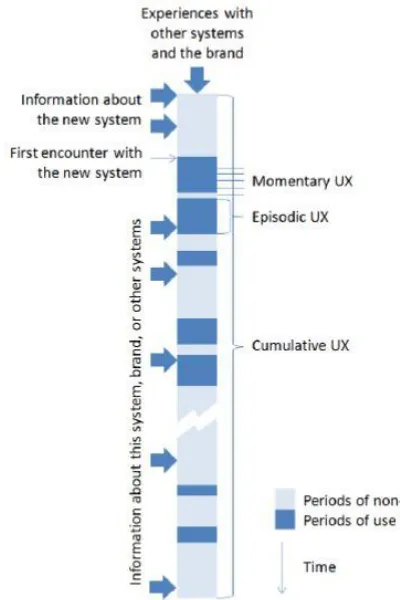
The time span of the user experience is divided as shown in the Fig.1 below The inception of the experience starts from being subjected to content that brings awareness about the application through media and other external sources already mentioned above. This accounts as an indirect experience as the user is not directly interacting with the system/application. The first time the user interacts with the system that brings in a specific change in the user’s feeling during the interaction is called Momentary UX. The time span of interaction where in the user is able to finish a specific task or an episode is called Episodic UX. The user may further encounter or use the application based on the previous experiences and sporadically and that cumulatively accounts for the overall experience of the user with the application is called Cumulative UX.
Fig. 1. Diagram to illustratrate period of experience
VI. ROLE OF USER EXPERIENCE IN
E-COMMERCE
383
wants to get their work done as soon as possible, every minute the users spend on the website they expect to get some value for the time. As amazon website had compulsory login and register requirements for the user to checkout, many users felt the process tiring which resulted in abandoning the purchases midway. What was more surprising is that the designers had no clue as to what is leading to the user’s abandonment of the purchases. According to the designers it was just a form asking for user to log on or log in to their account for making purchases. What is more disturbing is that the users left the site without purchasing after filling the cart with their desired items and when it came to check-out the website asked for compulsory registration to proceed for payment. The registration concept though was mainly to make the purchases easy for the users on subsequent purchases once they register for the first time. Tests were conducted by the design team to understand the cause of the problem. In that process, they provided resources for the user to make a purchase. All the user need to do was to complete the purchase. Here the designers understood that even the first-time shoppers resented to register. Their resentment was because they visited the website to buy items but not to create a relation. Also, the customers had the fear of being spammed with marketing messages by the e-commerce company or fear of invasion of privacy. Though the registration was to make subsequent purchases easy, the tests prove that even the second-time customers had an issue with it. There was no issue with people who could recall their ID and passwords but for the ones who could not had to reset their credentials or repeat the process all over again. This process required patience and took time to complete for which the users felt frustrated and left the purchases mid-way. Designers never imagined that a registration or the register button could affect so much on the profits of their company. The solution designers came up with a simple solution of removing the register button and substituting with the continue button to proceed with the checkout and payment process. Alternatively, choice was provided for the users to register in case they wished to make their future purchases easier and faster. This simple solution had boosted up the percentage of purchases for amazon by 45 which resulted in a 15$ million profit the first month and followed by an addition $300,000,00 for the first year after implementing the solution. Therefore, better UX is not only about including high visually appealing content but even to consider the smallest of the smallest problems the user encounter during their interaction with the application and coming up with the best and a simple solution. Here in the case of amazon all they did was to JUST change a button. Apart from increased sales, the solution amazon implemented increased their productivity, customer satisfaction and loyalty. The CEO of amazon felt that once a customer is satisfied he would talk to another customer about it and that a word of mouth is more powerful and spreads faster than any marketing.
VII. FUTURE OF USER EXPERIENCE IN
E-COMMERCE
With the evolution of technology day-in and day-out, the face of E-commerce is set to evolve with time that incorporates various features and perspectives and views
that makes the users’ online shopping experience much more smooth and comfortable. In the upcoming years, The E-commerce websites or application like amazon require us to install the app or login through website, but that procedure can further be simplified by deploying chatbots whose functionality is precisely confined to e-commerce where in the user can request for any product and through machine learning, the user’s message could be understood and relevant products with supporting thumbnail image and product details can be displayed. Facebook Messenger serves as one of the suitable platforms to deploy such chatbots as 85%* of the time, users use messaging apps and therefore enabling a shopping experience via messaging can attract more users and also the users are free from the hassle of installing the app or looking them up in the internet. There are other platforms as well that support the deployment of chatbots and are: Slack, Discord, Telegram, Twitter and Kik. Tommy Hilfiger for example has deployed it’s chatbot and has garnered good attention from the users. Not only is it easy to select but also simple to share it with friends as well that can blossom more viewership that would affect the sales of the products. Furthermore, a conversation would more likely engage the user than just to display standard data to every user. Using artificial intelligence, the users’ shopping patterns can be formulated to provide a much tailored and customized view for every user than enhances the user experience. Another step further in the domain to enhance user experience is Augmented Reality and Virtual Reality where in the users can preview the product in a three dimension and make a much more informed decision while making the purchase. This allows the user to visualize the product in the real-time environment that further reduces the return rates of Amazon that ranges from 5-15% because the one of the major reasons of return is that the product seems to look different with respect to dimension or texture than what is displayed in the website. Example: Purchasing furniture or clothing can be made more precise with the help of the appropriate visuals out put into the real-world environment with regard to dimensions. In conclusion, the user experience stands as a strong point when it comes to be leading in the E-commerce domain and as the time progresses new evaluation methodologies will be implemented to improve the performance and stability to maintain a sustainable and ever-growing customer bandwidth and the sales likewise.
REFERENCES
[1] Donald Norman, Jim Miller, Austin Henderson, “What You See, Some of What's in the Future, And How We Go About Doing It”
[2] Dan Saffer, “Design for Interaction: Creating Innovative Application and Design”
[3] Jared.M.Spool, “The $300 Million Button”, [Online] Available:
https://articles.uie.com/three_hund_million_button/
[4] David Gilmore, “User Experience White Paper”, 2011
https://humaan.com/blog/the-importance-of-ux-in-e-commerce/
[6] Usability In Wikipedia. Retrieved August 08th 2017, from http://en.wikipedia.org/wiki/Usabilty.
[7] User Experience In Wikipedia. Retrieved August 10th 2017, from http://en.wikipedia.org/wiki/Usabilty_goals
[8] Teo Siang. (2017, August 04). “What is Interaction Design?” [Online] Available: https://www.interaction-design.org/literature/article/what-is-interaction-design
[9] Josse Torre. (2017, June 09). “10 basic principles of Visual Design” [Online] Available: https://blog.prototypr.io/10-basic-principles-of-visual-design-55b86b9f7241
[10]Susan Weinschenk, Ph.D. (2011, October 8) “The secret to designing intuitive UX” [Online] Available: https://uxmag.com/articles/the-secret-to-designing-an-intuitive-user-experience
[11]Maan. (2013, July 28). “How to become a UX-Designer infographic” [Online] Available: https://www.downgraf.com/inspiration/how-to-become-a-ux-designer-infographic/
[12]User Experience In Wikipedia. Retrieved August 10th
2017, from
http://en.wikipedia.org/wiki/User_experience.
[13]Robby Punk. (2013, June 12). Retrieved August 12th 2017. UX 101: What Is User Experience? Visual.ly
[Online] Available:
https://visual.ly/community/infographic/computers/ux-101-what-user-experience