Prototype Applications Of Blended Learning On
The Lessons Of Project Management Information
System (MPSI) In College
RiswanAbstract: This research is further than the initial research has been done on the lessons of project management information system (MPSI). Included in the seminar of the International Conference on Technical and Vocation Education and Training, High on a hill on the 16th-17th-October 2015, organized by the State University of Padang (UNP). As well as on The 2016 Jambi International Seminars on Education (JISE) in Jambi, Indonesia, 3-4 April 2016. The results of initial research showed, that the quality of the teaching model of face-to-face with MPSI (konvensioanal) are on enough categories, so that needs to be developed a Blended Learning model that is merging model of face-to-face with e-learning model, in order to improve the quality of teaching for the better. The results of a pretest data analysis on a class of experiments and classroom control, showed results not much different, 12.32 for classes experiments, and 11.12 for the classroom control. Test of normality that is done for the second class also shows a normal distribution. Where r count for a class experiment = 0,0060 < 0,1772 = r tables, and r count for class control = 0,0572 < 0,1772 = r tables. Now this research has already come to the stage of prototype application design blended learning, will be in validation by an expert of computer design.
Keywords: Model of face-to-face, E-Learning, Blended Learning, Pretest, MPSI, Prototype
————————————————————
1.
INTRODUCTION
Designing e-learning that is part of a blended learning model of learning, of course need to be supported with the against the model needs analysis, applications used, web form and content that will be designed, so that applications are designed not impressed just move the subject matter into the form of manual degital (e-learning). From the needs analysis process has produced a prototype e-learning applications, as part of a blended learning model for information systems project management lessons (MPSI). This application is designed using PHP application, MySQL database, Wondershare Quiz Creator. Prototype of this application has two functions, i.e. admin and users. Admin is used by professors of the teaching material to manage tuition MPSI, users are students who will be utilizing the web application in the lesson MPSI online. The prototype of this model named Blended Learning Center (BLC).
2.
THE CONVENSIONAL MODEL OF
LEARNING, E-LEARNING, BLENDED
LEARNING
2.1 Conventional Learning Model
Conventional meaning by Convention (Agreement) General (such as custom, habit), traditional. In relation to the improvement of the quality of education, the conventional approach is an effort to improve the quality of education that is based on the paradigm of rigidly input – process – autput. Something to do with the process of teaching and learning, learning approach as already commonly used in the learning activities in the classroom are called conventional learning approach [5].
Conventional learning approach is an approach which is done by combining a variety of learning methods.In practice this method is centered on the teacher (teacher centered), teachers are more dominating in the learning activities. Method of learning is done in the form of methods lectures, granting and faqs. The conventional approach is the approach to learning that many implemented in current school which uses a sequence of activities, awarding examples and descriptions of exercises[1]. This learning approach is thus closer to methods lectures. Lecturer becomes a deciding the course of the process of learning or a source of information. While passive students with listening to the lecture carefully and take note of things that are considered important. Lecture method is a method of delivering learning materials with oral communication. This method is an economical and effective to convey information and understanding. However in the learning of students with this method tends to be passive, it puts the teacher as the final authority, setting the pace in classical determined by faculty, so that this method is less suitable for the formation of the skills and attitudes of college students[9]. The method of questioning used in the learning process very large role, as with the questions formulated in Nice, with the appropriate filing technique, it will be able to:
a) Increase the participation of students in the teaching and learning activities.
b) Aroused interest and curiosity students to problems that are being tried.
c) Develop mindsets and learn active students. d) Directs the process of thinking, because good
questions help students to determine good replies. e) Focused the attention of students to problems being
discussed. [10]
Metode granting task in the term a day day referred to by homework. In fact this metode wider than homework, because students learn not at home but maybe in laboratorium, in the library or in certain other places [8]. The ______________________
Riswan
232 implementation consists on three fase:-old lecturer gives
students working on a task, and is responsible to the-old lecturer what has been learned, worked, generally fulfillment in the form of FAQ, discussion or a writing test. Based on the above explanation can be concluded that the approach of learning conventional observations this is learning approach combining metode talks, FAQ, and the granting of a task in the process of learning in class. This conventional approach had the characteristics of among other things: Based on the above explanation can be deduced that the conventional approach in the review of this is learning approach combining metode talks, FAQ, and the granting of a task in the process of studying in class.. This conventional approach had characteristics among others: a) Lecturer considers the ability of the students of the same, b) Use the class as the only place to learn, c) teach more speaking engagements, d) Separation of subjects is apparent. e) provide activies that do not variation, f) one-way comunication, g) learning emphasizes the achievement of the effect of interaksional based on the orientation of the Group, h) Teaching using only the books and the information only from the lecturer, i) only assess the results of the study. The advantages of conventional learning approaches as follows: a) save time and costs, b) Students can organize better questions and free up the subject matter taught, c) students who have the ability to understand the material more quickly can help her friend who was slow, so there is no need to find a concept independently, d) Teacher easier understand the ability of college students and its characteristics. The conventional approach to learning is a weakness: a) student experience depends greatly on the knowledge and experience of lecturers, b) lectures active to transfer knowledge, student only receive from lectures, c)the spread of intrusional does not allow students to learn actively, let alone experienced a process of profound truth level assessment.
2.2 E-Learning Model
E-Learning is a word that is often used for all educational activities that use computer or internet media. There is a terminology that has a meaning similar to the e-learning, web based learning, online learning, computer-based learning/training, distance learning, computer-aide instruction. E-learning is basically has two types namely synchronous (same time) and asynchronous (not at the same time). With advantages: (1) costs, (2) Flexibility of time, (3). The flexibility of the site, (4). The flexibility of learning speed, (5). The standardization of teaching, teaching Effectiveness (6), (7) the speed distribution (8). The availability of On-Demand, (8) process automation of administration. And weaknesses are (1) culture, (2). Investment, (3). Technology, (4). Infrastructure, (5). Material [7]. E-learning as a form of information technologies appied in education in the form of a virtual school, or as a process of teaching and learning in digital form via the internet [11]. Lectures online by using the internet facilities, can be done in the form of: A Fully online course, lessons with content ranging from 80-100% online with web-based terknologi support, no face-to-face lectures. A blended or hybrid course, lessons with content ranging from 30-80% of lectures online, using the web-based technology, and reduce the number of face-to-face meetings in the class. A web-enhanced course, technology based lesson content, ranging from 1 to 29% of
face-to-face lectures [4]. Many design e-learning lessons are not appropriate, generally still shaped text books and a little animation. Not all learning can be done with e-learning (Web), so this research produces new innovations in teaching that is mixing the web and face-to-face learning, known as blended learning [2]. Based on this encouraging researchers do initial research towards teaching MPSI. The results of this research became reference in developing model BL
2.3 Blended Learning Model
Blended learning is a combination of learning experiences face-to-face and online. The basic principle is direct communication face-to-face and written communication online [8]. Blended learning also was defined as:
• Integration of face-to-face and online learning to help improve learning experiences in classrooms and expand knowledge through the use of information and communication technology. Blended strategy improve student involvement in learning through online activities, and increase the effectiveness and efficiency of the time in college.
• A learning that combines online and face-to-face. The proportion of content that is delivered online, typically using the online discussion, and some face-to-face meetings. "The Sloan Consortium blended program defines conducted between 30 per cent and 79 per cent of the content is delivered online, the rest of the learning content delivered by teachers/lecturers through face-to-face or other web-based methods of non, such as textbooks.
• Combination of multiple approaches to learning. Blended learning can be achieved through the use of resources "blended", virtual and physical resources] 15].
Another definition of blended learning in the journal portalgaruda.org is:
1. Thorne (2003), Blended learning is a combination of multimedia technology, CD ROM, video streaming, virtual classroom, voicemail, email and phone conference, animated text online. All of this combined with traditional forms of training in the classroom. 2. Harding, Kaczynski and Wood (2005), Blended learning
is an approach to learning that integrates the learning of traditional face-to-face and distance learning that uses online learning resources and a wide selection of communication that can be used by teachers and students.
3. Wilson & Smilanich (2005) concluded that blended learning is the use of the most effective training solutions, applied in a coordinated manner to achieve the desired learning objectives.
4. MacDonald (2008), the term blended learning is usually associated with incorporating online media on learning programs, while at the same time retaining contacts face-to-face and other traditional approaches to support students. The term is also used in asynchronous media such as email, forums, blogs or wikis coupled with technology, text or audio sinkronus [12].
1. A shift from a model of learning TCL to SCL, where students become active and interactive.
2. Increased interaction between the student-instructor, students, student content, and external resources. 3. The assessment mechanism of formative and
summative integrated for students, lecturers and teachers [6]
From some of the blended learning defenisi and description of the etymology can be interpreted as that, the process of learning with a blended learning not to instead of traditional learning, but rather to improve the quality of the learning process by making use of a wide range of approaches, utilizing a wide range of media and technology.
2.3.1 Blended Learning Model Web Centric Course (BLWCC)
Development of Blended Learning Model built in categories including on MPSI lecture Learning Management System (LMS), Web-Centric Couser with several advantages: (a) Increase the level of interaction between students learning with the teacher or instructor (enhance interactivity), (b) allow the occurrence of interaction of learning where and when (time and place flexibility), (c) reach learners a broad in coverage (potential to reach a global audience) , (d) facilitate the completion and retention of learning material (easy updating of content as well as archivable capabilities) [11]. Five keys to developing models of blended learning: 1) a Live Event, 2) Self-Paced Learning, Collaboration, 3) 4) 5) Performance Assessment Support Materials [3]. As well as the three models (Web Course, Web-Centric Course, Enhenced Web Course) and five models (Suplemental, Replecement, Emporium, Fully Online and Buffet) be an option in the development of model BL [14] A blended learning model that was designed in the shape of this research model replacement/Web Centric Course under the name BLWCC, where this model will compress the meeting in the classroom with online with a percentage of meeting online is greater than the meeting in the classroom that is, eight times online (66,67%) and face-to-face four times (33,33%) for the meeting to 1, 3rd meeting, meeting and meeting of the 7th to the 12th.
3. RESEARCH METHODOLOGY
Do need analysis as the initial research to look at the quality, effectiveness, and the question of conventional learning lecture lecture on MPSI. Try to fix the issue and find out the cause. The spread of the now instrument is performed to measure the quality of learning, now grouped into four dimensions of the dispersion in grating instrument (organizing strategy delivery strategy, learning, learning, learning management strategies, the evaluation study). Data on sports and on analysis using SPSS application and fishbone diagram. The initial results of the study will be used as a source for developing learning models BL with Borg and Gall.
4.
RESEARCH RESULTS
The output of the research results are published in this journal is divided into two parts, namely the results of conventional perkuliah the initial research, design development and model BL MPSI.
4.1 Convensionla Lecture
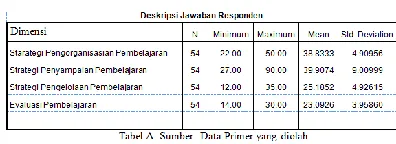
Processed data from SPSS application research and analysis of fishbone diagrams, obtained the description answers questions posed to 54 students as follows:
Tablel 1. Description of Respondent Answer
From the description of the response calculated actual mean of each grating instrument (Anwar, 2003) with the results of calculations put the quality of teaching MPSI are in the category enough.
4.2 Prototype Aplikasi Blended Learning (BLC)
The design of Blended Learning on lecture MPSI named BLMPSI stands for the model to be built that is Blended Learning Management Information System Project, with a design as follows.
Figure.1 Prototype Blended Learning (BLC)
To be able to use this BLC, students must register itself as a participant in College MPSI, then they will have access to login to memamfaatkan all material that has been provided. As a lecturer and Manager of this web material will also get a login.
4.2.1. Lecturer as Admin BLC
There are some facilities provided for faculty as the manager of this website, namely:
A. Admin Login Menu
Figure 2. Admin Login Menu
234 B. Admin Blenden Learning
Figure 3. Admin Management Menu
Lecturers can manage this website, by selecting the menu provided, each grouped according to their function. The menu contains a Web Completeness class, user, articles, and announcements.
C. Web Complementary Menu
Figure 4. Web Complementary Menu
If you want to manage the classroom, teachers can choose the content classes, look like the following:
a. Tampilan Kelas
Figure 5. Clas Display Menu
And so are the other content will menyedia management facility for lecturers as admin.
4.2.2. Students as Users
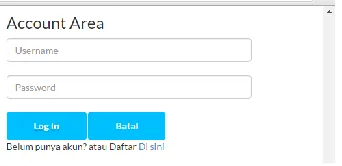
To take advantage of this web, students should log in first.
Figure 6. Menu Login Mahasiswa
Setelah username dan password di entrikan, mahasiswa dapat memanfaatkan semua fasilitas belajar yang telah disediakan, diantaranya:
Figure 7. Display Menu Lecture MPSI
A. Menu Lecture Materials MPSI
This menu contains the syllabus, Sap and modules Lectures. Students can choose the content they want. The display of the following:
Figure 8. Display Menu Lecture
If a student chooses the syllabus, syllabus display will appear, containing a summary and general purpose of the syllabus, and the syllabus can be downloaded by students.
Figure 9. Display Menu Syllabus
B. Material Improvement Class
This menu contains an interactive simulation, examples of additional material, the problem and the solution, discussion groups, online chat rooms, interactive tests online. The display of the following:
If a student chooses test interactive, interactive test list menu appears as follows:
Figure 11. Interactive tes overview
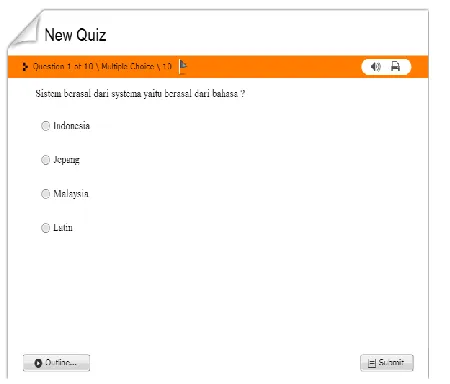
Test title lyrics, menu descriptions and the action that the student can do to start doing tests against the understanding of the material that has been pelajarinya, the test is done online. It looks as follows:
Figure 12. Interactive test overview
Quiz is filled by way of cheque klis at the correct answer, then submit it, it will pop up the next question. The application of blended learning prototype already contains all of the content, and in this journal researchers shows only in part only, it shows a picture of a model of BLC built for MPSI lecture
5.
CONCLUSIONBlended learning model application prototype is only a miniature of the application to be applied on the lecture MPSI. This prototype will be final after the model validation by the validator, and fully tested cobakan on lectures MPSI. The results of the response of the model to this end will be published in the next journal.
6.
ACKNOWLEDGEMENTS
Researchers would like to thank Prof. Jalius Jama, M.Ed, Ph.D. and Prof. Ganefri, Ph.D who has led researchers on research Dissertation for learning blended learning model courses on MPSI.
7.
REFERENCES
[1] Basuki Wibowo dan Farida Mukti, Media Pengajaran. Jakarta, Depdikbud, 1992
[2] Bersin, Josh, The Four Strages of E-Learning. A. Maturity Model For Online Corporate Training. 2005
[3] Carman, Jarel M, “Blended Learning Design: Five Key Ingredients”, President Agilant Learning
[4] Crawley, Anita, Supporting Online Students, A Guide to Planing Implementing, and Evaluating Service. USA, Jossey-Bass
[5] Depdiknas, Manajemen Peningkatan Mutu Pendidikan Berbasis Sekolah. Jakarta, Depdikbud, 2001, Buku 1
[6] Dziuban, et.al, “Blended Learning, Educause Center For Applied Research, Research Bulletin, Valume 2004:3, issu 7
[7] Effendi dan Zhuang, E-Learning, Konsep dan Aplikasi. Yogyakarta, Andi, 2005: 6
[8] Garriso dan Vaughan, Blended Learning in Higher Education, Framework, Principles, and Guidelines. San Francisco, Jossey-Bass, 2008
[9] Hassibuan, JJ, dan Mudjiono, Proses Belajar Mengajar. Bandung, Remaja Rosdakarya, 2002
[10] Purbo, Onno W, Teknologi E-Learning Berbasis PHP dan MySQL, Jakarta, PT. Gramedia, 2002
[11] Prasetio, Murdiono Purbo, “Perancangan dan Implementasi Conten Pembelajaran Online dengan Metode Blended Learning”. 2008, http//download.portalgaruda.org/article.php? article, 22-2-2015
[12] Santoso, Leo Willyanto, “Evaluasi Sistem Informasi Pendidikan: Pembuatan Template e-learning untuk Pendidikan Tinggi”. Sistem Informasi, hlm 16-20.
[13] Twigg, Carol A, “Improving Learning And Reducing Costs:Ne For Online Learning”. Educause review, September 2003