Soft Competency Models For Officer Of
Commitment Maker In Land Acquisition For
Public Interest
Deny Bayu Prawesto, Suryanto, Bintoro Wardiyanto
Abstract: This study aims to determine a soft competency model and its development for the Committment–Maker Officer in land acquisition for public interest. From the result of data analysis it is indicated that the soft competency model of Committment–Maker Officer in land acquisition for public interest consists of 3 (three) criteria namely self concept, individual traits and motives. Meanwhile the development pattern of soft competency model of Committment–Maker Officer in land acquisition for public interest is based on suitability of Committment–Maker Officers. The used method in this research is a qualitative approach in the form of case studies. The research objects are matters relating to land acquisition for the construction of Peterongan Irrigation Networks in Jombang Residence. In this case the researchers act as instruments as well as data collectors. Thus the status of the researchers is known by the subjects or the informants. The applied type of research is a descriptive qualitative to study existing problems and applicable work procedures. Informants in this study consist of 5 (five) persons from the authorized institution in land acquisition as informants of the subject, plus 7 (seven) persons as significant other informants. Data collection techniques were conducted through Focus Goup Discussion (FGD) interviews, observation and documentation. The result of data analysis indicates that the soft competency model of Committment–Maker Officer in land acquisition consists of 3 (three) criteria namely self concept, individual traits and motives. Meanwhile the pattern of developing soft competency model of Committment–Maker Officer in land acquisition for public interest is based on the suitability of the three factors. Based on the results of this study, the Committment–Maker Officer in the land acquisition for the public interest should continue to apply and to develop the soft competency model in the land acquisition process for the construction of Peterongan Irrigation Network. Consequently the development program that has been going on for tens of years can be completed immediately.
Index Terms: soft competency models, commitment maker officer, land acquisition.
————————————————————
1
I
NTRODUCTIONDevelopment essentially means a systematic and planned attempt by each and all component(s) of the nation to turn a situation into a better state by utilizing a variety of available resources optimally, efficiently, effectively, and accountably, with the ultimate goal to improve the quality of human life and society in a sustainable way. In order to implement the development, the Indonesian Goverment has a development program brought by President Joko Widodo which is contained in Nawa Cita consisting of 9 (nine) priority work program agendas. The Development Program is stated into Presidential Regulation No. 2 of 2015 on National Medium Term Development Plan. One of the programs contained in the Nawa Cita Jokowi and Jusuf Kalla governance in the agricultural sector is to increase farmer ownership over agricultural land to an average of 2 hectares (currently still below 0.75 hectares), and increase self-sufficiency in the context of food security. Furthermore, the implementation of land acquisition for public interest is regulated by Law Number 2 Year 2012 concerning Land Acquisition for Public Interest and its implementation regulations, among others;
Presidential Regulation No. 71 Year 2012 on the Implementation of Land Acquisition for Public Development, Presidential Decree No. 40 of 2012 on the amendment of Presidential Decree No. 71 Year 2012, the Presidential Decree Number 99 Year 2014 regarding the Second Amendment of Presidential Decree No. 71 Year 2012 and Presidential Instruction No. 30 2015 on the Third Amendment of Presidential Regulation No. 71 of 2012, Presidential Regulation No. 148 of 2015 on the Fourth Amendment of Presidential Regulation No. 71 of 2012, Regulation of Head of National Land Agency Number 5 Year 2012 on Technical Guidance on Implementation of Land Acquisition. The Law regulates the procedure of providing compensation for landowners. But the limited amount of land and the amount of development causes friction. On one hand development requires land as its main means, while on the other hand most of society also need land as a place of settlement and a place to earn their living. The Committment–Maker Officer (Pejabat Pembuat Komitment/PPK) of Land Acquisition for Public Interest is the person who has the most influence in the success or failure of a land acquisition activity. This is because PPK is an authorized official in technical and non–technical matters in deciding issues related to land acquisition for the public interest. Therefore, it is required a Committment–Maker Officer (PPK) who has competency in handling it. The competencies needed are not only hard competency that is in the form of skill and knowledge but there is another thing that is invisible underlying it, that is; soft competency. There is a difference between soft competency and soft skill. Skill is part of the competence, while soft competency is a competency that is closely related to the ability to manage the work process, the relationship between humans and to build interaction with others, e.g. leadership, communication, interpersonal relationships, and others. In other words soft competency is part of hidden competencies in a person and has a strong influence on the characteristics of an officer in carrying out his/her duties. As described by Spencer and ______________________________
Deny Bayu Prawesto, Master of Human Resources Development Airlangga University, [email protected]
Spencer soft competency consists of 3 (three) criteria that include motives which are things that someone is consistently thought out or desirable then drive him to an action, physical and also emotional individual traits or characteristics (consistent reactions to situation and information) and self concept. Therefore, it can be explained that those soft competencies become the reference as the soft competency model of Commitment–Maker Officer (PPK) in land acquisition for the development of public interest. Charles E. Johnson divides competencies into 3 (three) models: 1) personal competence, i.e. competencies related to personality development; 2) professional competence, i.e. competence or ability related to the completion of certain tasks; and 3) social competence, that is competence related to social interest. While in Kunandar this competency is divided into 5 (five) models, namely:
1. Intellectual competence, namely the various knowledge devices that exist in the individual self needed to support performance.
2. Physical competence, i.e. the physical capability device required for the performance of the task.
3. Personal competence, which is a behavioral device related to the individual's ability to manifest him/her (self), self-transformation, self-identity and self-understanding.
4. Social competence, which is a certain behavioral device that is the basis of self-understanding as an integral part of the social environment.
5. Spiritual competence, namely understanding, appreciation, and the implementation of religious principles.
Covey, Roger and Rebecca Merrill (1994) state that the competency model includes:
1) Technical competence: knowledge and expertise to achieve agreed outcomes, ability to think about issues and seek new alternatives.
2) Conceptual competence: the ability to see large images, test various modes and perspective modifiers.
3) Life competence: a competence in the interdependence of capabilities effectively with others, including the ability to listen, communicate, get a third alternative, create win-win agreements, and strive toward the third alternative solution, the ability to see and operate effectively within an organization or a complete system.
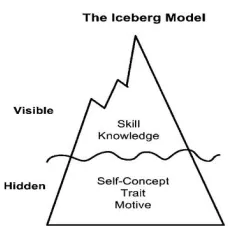
In McClelland’s observations as quoted by Rudana, competences can be analogous as "iceberg" where the skills and knowledge form peaks above the water. The underneath of the water is invisible to the eyes, but it becomes the foundation and has an effect on the shape of the part above the water. Social roles and self-image are in the "conscious" part of a person, whereas one's motives are in the "subconscious" part. Meanwhile Spencer and Spencer divide competence into hard competency and soft competency. In the Iceberg Model diagram it is illustrated that hard competency includes visible (seen) skills and knowledge, and soft competency includes self-concept, invisible (unseen) habits and motives. The division of competence derived from the explanations of the two scholars above, can be seen in details in Competence at Work by Spencer and Spencer (1993) as shown in the following figure:
Figure 2.1: Iceberg Model Diagram
Source: Spencer & Spencer, Competence at Work, 1993, p. 11.
As seen in Figure 2.1 above, Spencer and Spencer state that the competency model contains a list that is commonly found in workers with maximum performance. The list of competencies is usually classified into different groups. The development of the competency model should be tailored to the work needs of the organization / company in which the model will be applied. In an organization / company a model of competence is used for various purposes, in which the main purposes of making a competence model are :
1) To provide a means to apply competence concepts in accordance with the needs of the organization.
2) To understand the variables determining performance and correlation among the variables.
3) To be able to disseminate competence appropriately in an organization.
Related to explanation above, the research aims to describe the soft competency model and its development for the Commitment-Maker Officer in land acquisition for the development of the public interest.
2
RESEARCH METHODE3
RESULTS AND DISCUSSION3.1. Soft Competency Model
Soft competency is a competency that is closely related to the ability to manage the work process, the relationship between humans and to build interaction with others, e.g. leadership, communication, interpersonal relationships, and others. In other words soft competency is part of hidden competencies in a person and has a strong influence on the characteristics of an officer in carrying out his/her duties. As described by Spencer and Spencer soft competency consists of 3 (three) criteria that include motives which are things that someone is consistently thought out or desirable then drive him to an action, physical and also emotional individual traits or characteristics (consistent reactions to situation and information) and self concept. Therefore, it can be explained that those soft competencies become the reference as the soft competency model of Commitment–Maker Officer (PPK) in land acquisition for the development of public interest.
3.1.1 Self-Concept
The meaning of Self-concept as the first model of soft competency is a fundamental thing that must be understood by an officer in carrying out his/her duties. Because through a strong self-concept, it makes an officercan freely organize his/her personality when faced with a delicate and complicated work areas. Self-concept is one's values and attitudes. If an officer has positive values and attitudes then he/she will have the ability to manage the problems encountered, so that any form and variety of problems that exist can be controlled quickly and carefully. The result of interviews related to land acquisition for the construction of Peterongan Irrigation Network, with one of the officers of Land Acquisition Authority who is 40 years old with a S-2 (Masters of Engineering) degree, revealed a view that the self-concept applied in the land acquisition process always adheres to the rules of Government related to land acquisition. So anything that will happen to a Commitment-Maker Officer in land acquisition will be strictly follwing the written rules without abandoning the norms in society. This kind of understanding of self-concept should be the responsibility of Commitment-Maker Officers of the Land Acquisition in Balai Besar Wilayah Sungai (BBWS) Brantas in land acquisition process of Peterongan Irrigation Process. This is because it is very likely that a Commitment-Maker Officer will be dealing with various obstacles accompanying him. The harmony of attitudes and actions played by Commitment-Maker Officers of Land Acquisition in completing the land acquisition process for the long delayed construction of the Peterongan Irrigation Network. This harmony of course cannot be separated from the existence of self-concept awareness which is properly applied in every task. Akob Kadir stated that there are various methods to measure soft competency, from simple and practical one to the complex one. A practical method is to ask your boss, coworkers and perhaps subordinates to assess a certain level of employee competency, using some sort of competency questionnaire. Meanwhile another method which is more complex is to use a technique called the Competency Assessment Center. In this method, employees are asked to perform various tasks such as performing role simulation, solving a case or also setting the priority scale of work.1 The result of an interview with a Commitment-Maker Officer (PPK) states that the awareness of a Commitment-Maker Officerof
his/her own concept of self, in turn, also has a positive impact on the agency and related parties in the process of land acquisition for the public interest. The positive response from the awareness of such self-concept can also be felt through the statement given by 2 (two) officials of the National Land Agency, explaining that the role, duties and functions of land acquisition Commitment-Maker Officers (PPK) for Land Acquisition have been running maximally and there is no significant constraints in the process of land acquisition, as stated in the following interviews: Roles, duties and functions by (PPK) officers run maximally based on the valid rules. (They have done) coordination and approach to the village apparatus and the people affected by the land acquisition. If you refer to the previous years, there were many problems appearing in the field. But this year it seems that all these problems can be handled properly. So it seems, there are no more significant obstacles in the process of land acquisition. Not only that, even the Village Heads, including the landowners whose land are affected by the construction of Peterongan Irrigation Network, also feel the good and responsive attitudes applied by Commitment-Maker Officers of the Land Acquisition. This can be read from the following statements: The PPK land acquisition efforts regarding the outcome of our negotiations are responded promptly and in coordination with the Land Acquisition Committee of Jombang Regency to run immediately in accordance with the procedures and rules that apply. The soft competency model needed by a Commitment-Maker Officer (PPK) based on interviews with Satiwan, Head of Sub Division of HRD at Balai Besar Wilayah Sungai Brantas which has the task of fostering and developing employees in Balai Besar Wilayah Sungai Brantas is as follows: I think the soft competency required by a Commitment-Maker Officer (PPK) in land acquisition related to 3 categories namely; Self-Concept, Characters, and Motive, among others; The self-concept that a PPK should have in the land acquisition is a positive self-concept, namely:
- (Feeling) confident in the ability to solve problems and not to escape from problems and believe that every problem has its way out.
- Feeling equal with others, this is necessary when it comes to dealing with people who need a special approach.
- (Feeling) sensitive to the feelings of others, this is necessary in maintaining good relations with all parties involved in land acquisition.
- Is able to self-introspect, with the ability to introspect themselves then Commitment-Maker Officers (PPK) will be able to change themselves to be better and accepted in the society.
3.1.2 Traits (Characters)
Commitment-Maker Officers. Consciously realized or not, essentially every human being who is born is equipped with innate traits that will continue to grow in accordance with his/her abilities. This kind of innate trait which is then called the individual characteristics (traits) in the history of science. Therefore, when a Commitment-Maker Officer is able to recognize the individual characteristics inherent in him, it will be easy for him to understand the individual characteristics that are also present in others. Here comes the inner sensitivity of every situation at hand. For an official assigned to a vulnerable work area such as land acquisition, an understanding of individual characteristics (traits) as one of the soft competency models, is an integral part of both strategy and expertise in managing a job. The combination of managerial expertise with the understanding of individual characteristics in duty must not only be applied during the period of duty but also can be developed in all circumstances and the environment of the surrounding community. Thus, the public will be more aware that a Commitment-Maker Officer should indeed be more responsive to the circumstances that surround it. Based on the observation results analyzed in the field, it was found that in carrying out the land acquisition process for public purposes, the Commitment-Maker Officers (PPK) of Land Acquisition seeks to best integrate managerial expertise and individual characteristics to affected villagers, local government agencies and other relevant parties. This combination is, of course, a manifestation of an officer's awareness of individual characteristics (traits) that must be applied concomitantly with managerial skills in duty.2. The flexibility of the attitude of a land acquisition PPK in the process of land acquisition for the public interest from the stages of land acquisition implementation, also researchers get from a variety of positive responses of affected village heads. Given the good response to the existence and performance of PPK officers of Land Acquisition, it can be said that the application of individual characteristics of Commitment-Maker Officers into good ammunition in carrying out the work. This fact cannot be separated from the readiness of the Commitment-Maker Officers (PPK) of Land Acquisition in optimizing the understanding of individual characteristics (traits) as part of their soft competency model.
3.1.3 Motives
Motives are things that a person is consistently always thought or desired which then encourages him to perform an action. To quote the soft competency phrase proposed by Philip Carter, that people who have soft competency, often called Emotional Intelligence, which is often measured as Emotional Intelligent Quotient (EQ), is the ability to realize the emotions of oneself and the emotions of others. Thus, the concept of emotional intelligence means having self-awareness that allows one to recognize feelings and manage his own emotions; and it involves self-motivation and being able to focus on a goal rather than demanding immediate fulfillment. A person with a high EQ is also able to understand the feelings of others and better in dealing with his relationship with his fellow human beings around him. Motives are the impulses in humanity that arise because of the needs that want to be fulfilled by the human. The motive comes from the Latin word movere which means to move. Therefore the motive is defined as the strength contained within the organism that encourages to do or driving force. Motives as a driver are strongly bound by other factors, called motivation. Motivation is a state within the
individual or organism that drives behavior toward goals. Thus the motivation has three aspects in namely: A state driven in an organism (a drive state), namely the readiness to move because of physical needs, environmental conditions, or mental states such as thinking and memory. Behavior that arises and is directed by this state becoming the goal or "goal" that the behavior leads to. The activity of thinking and acting for each person is an indivisible entity. By thinking then people will be led to perform an action from the results of their mind, just like the existence of an action that is always preceded by thinking activities. For a person who does not base his actions with the mind, he often leads to unsatisfactory results for himself. In fact, it is often that an action without accompanied by the process of thinking will be bad, not only for the doer (him) but also for others who are around him. In the process of thinking to do the action, one must also prioritize motives underlying his mind in action. That is why the motives of thinking and acting that exist within a person serve as parts of soft competency in the environment where people gather to perform their respective duties. So the motives can make a person has a backrest in carrying out the mission and vision of the organization given to him. Based on the above view, in the process of land acquisition for the public interest, it is proper that a Commitment-Maker Officer better understands the importance of a motive in thinking and acting, with the aim to avoid the slightest mistake of its form. Meanwhile, related motives are something that underly someone to think or act that should be the criteria of a Commitment-Maker Officer, Indah, who prefers her way to straighten her intention in carrying out tasks to set the land free.
3.2. Development of Soft Competency Model
The soft competency model is a set of competencies that are essential for the superior performance of a job or group of work. The process of formulating a soft competency model should be aligned with the organization's strategy, goals, objectives and values. In this research, the researchers have interviewed several informants to gather information about various stages that can be done in the process of developing soft competency model among Commitment-Maker Officers. Based on the observations that researchers did in the field, almost in every interaction with the affected villagers, the Commitment-Maker Officers always showed good faith towards the citizens. Thus the citizens were no longer suspicious and anxious when handled by the Commitment-Maker Officers of land acquisition for the public interest. This kind of harmonious view is of course part of the Commitment-Maker Officers’ strategy that successfully utilizes all the soft competency elements that they have. Not only that, the importance of developing soft competency of Commitment-Maker Officers must also be made as a personal and institutional agenda. That way, more and more emerging competent officers will be experts technically, be skillful, scientifically discipline in managing the problems and obstacles that occur in the work environment, especially if the work relates to sensitive matters such as the task of land acquisition for the public interest.
4
C
ONLUSION ANDS
UGGESTION4.1. Conclusion
Discussion (FGD), documentation and observation of the proposed problem formulation, such as:
1. The soft competency model is a set of competencies that are essential for the superior performance of a job or group of work. The process of formulating a soft competency model should be aligned with the organization's strategy, goals, objectives and values. In land acquisition, the required soft competency model is self-concept, traits or special characteristics that are physical and emotional, and motives or things that make a person consistently perform an action,
2. Self concept is a person's values and attitudes. In the case of land acquisition the concept of self is necessary and should be linked to compliance with the prevailing laws and regulations so that no deviations will occur in their implementation. The concepts of self needed by a Commitment-Maker Officer in land acquisition are:
- (Feeling) confident in the ability to solve problems and not to escape from problems and believe that every problem has its way out.
- Feeling equal with others, this is necessary when it comes to dealing with people who need a special approach.
- (Feeling) sensitive to the feelings of others, this is necessary in maintaining good relations with all parties involved in land acquisition.
- Is able to self-introspect, with the ability to introspect themselves then Commitment-Maker Officers (PPK) will be able to change themselves to be better and accepted in the society.
3. Traits are characteristics possessed by a person. And in the acquisition of land it is needed people who have characters who will coordinate, communicate in a flexible manner and really pay attention to every activity of land acquisition. The land acquisition requires a Commitment-Maker Officer (PPK) who has a character that is calm, energetic, firm and able to innovate when there are difficulties to be solved.
4. Motives are things underlying a person in thinking and acting. In land acquisition, a Commitment-Maker Officer (PPK) must align his or her intentions and fully devote all his or her energy and mind to the state and society in the process of land acquisition. A Commitment-Maker Officer (PPK) in land acquisition must have a good motive in carrying out his/her duties by not just pursuing financial progress or absorbing financial budget alone, but also should pay attention to his duties as a civil servant who must serve the country and society.
The steps of developing the soft competency model of the Commitment-Maker Officer (PPK) in the land acquisition process is to map the competency first, then focus on 3 (three) criteria of the Soft competency model consisting of Self-concept, individual characteristics (traits) and motives. Then the development is done by providing character building and activities that can increase the motivation of Commitment-Maker Officer (PPK) in carrying out his or her duties.
4.2. Suggestion
Based the results of research and conclusions of the soft competency model of Commitment-Maker Officers in land acquisition, the researchers suggest some of the following suggestions:
1. Suggestions for Government
Land acquisition is the most crucial issue in the community, especially if in the process, all stakeholders at the same time rely on the authority of those who tend to create agrarian conflicts. Therefore, based on this research, it is hoped that the government, especially the related institutions that want to hold a development project in order to pay attention to the various possibilities that developed, that is by debriefing Commitment-Maker Officers to apply soft competency owned by each individual official, in order to overcome various problems growing in the community.
2. Suggestions for Commitment-Maker Officers (PPK) of Land Acquisition
Soft competency model is a significant study in the official environment, so it is desirable to the leader of Commitment-Maker Officers (PPK) of Land Acquisition to participate in the implementation and development of the soft competency model for Commitment-Maker Officers (PPK). The participation can be like a special training on soft competency and awards for officials who are able to optimize the soft competency model, so that the development programs that have been going on for tens of years can be completed by Commitment-Maker Officers (PPK).
3. Suggestions for Commitment-Maker Officers (PPK) of Land Acquisition
The study of soft competency model that includes self-concept, individual characteristics (trait) and motives has made the land acquisition officers more confident, easy to accept other people who have different characteristics and enjoy and straightforwardness in thinking and acting when dealing with affected villagers. So it is hoped that the Commitment-Maker Officers (PPK) will always maintain a harmonious relationship, rely on inner sensitivity and hold on to the motives of thinking before acting to all parties involved in the land acquisition process for the construction of the Peterongan Irrigation Network.
4. Suggestions for Further Researchers
The development of the soft competency model for Commitment-Maker Officers (PPK) is a continuous cycle in daily life and will not end when studied continuously. Based on this, it is advisable for future researchers to conduct research on the location, elements, system and methods that have not been touched by current researchers, so the study of soft competency is increasingly diverse to serve as a reference in the science development.
R
EFERENCES[1] Armstrong, Michael. Armstrong’s Essential Huan Resource Management Practice: A Guide to People Management. London: Kogan Page Limited. 2010W.-K. Chen, Linear Networks and Systems. Belmont, Calif.: Wadsworth, pp. 123-135, 1993. (Book style)
[2] Carter, Philip. Terj. Verawaty Pakpahan, Soft Competencies Self-Test: Ketahui dan Tingkatkan Soft Competency Anda. Jakarta: PPM. 2010
[4] Moleong, Lexy J. Metode Penelitian Kualitatif., Bandung: PT. Remaja Rosdakaya. 2009. (Book Style)
[5] Morgan, D.L. and Kruger, R.A. When to Use Focus Group and Why, ed. D.L. Morgan Successful Focus Groups. 1993. (Book Style)
[6] Palan, R. Terj. Octa Melia Jalal. Competency Management: Teknik Mengimplementasikan Manajemen SDM Berbasis Kompetensi untuk Meningkatkan Daya Saing Organisasi. Jakarta: PPM. 2007. (Book Style)
[7] Sanghi, Seema. The Handbook of Competency Mapping. London: Sage Publication Ltd. 2007. (Book Style)
[8] Spencer, Lyle M. Jr. and Spencer, Signe M. Competence at Work: Models for Superior Performance. New Jersey: John Wiley & Sons Inc. 1993. (Book Style)
[9] Arief, Muhammad. ―Analisis Competency Pegawai dalam Penerapan Teknologi Informasi di Mahkamah Konstitusi‖. Tesis. Jakarta: FISIF Universitas Indonesia. 2010. (Thesis or dissertation)