482 |
P a g e
CLUSTER FORMATION ALGORITHM FOR LIFE
TIME MAXIMIZATION IN HETEROGENEOUS
WIRELESS SENSOR NETWORKS
Dinesh Kumar Kotary
1, Satish kumar
21,2
Department of Electronics and Communication Engineering, IEC University, Baddi H.P (India)
ABSTRACT
Typically, a wireless sensor network (WSN) is a new technology about acquiring and processing information from
environment. Wireless sensor network contains an important number of inexpensive power constrained sensors,
which collect data from the environment and transmit them towards the base station. Sensor networks have limited
and non-rechargeable energy resources. Saving energy and therefore, extending the wireless sensor networks
lifetime, imposes a great challenge. The clustering technique is a kind of key technique used to reduce energy
consumption. Many clustering protocols had designed for the characteristic of heterogeneous wireless sensor
networks. In this paper we propose energy efficient cluster formation algorithm for heterogeneous wireless sensor
network. Our technique differs from DEEC protocol in cluster formation phase. In our technique the member node
join that cluster head which has minimum distance between member node to cluster head and minimum distance
between cluster head to base station. Simulation result shows that our technique will increase the network lifetime
around 25% and number of packet sent up to 10%.
Index Terms
:
Base Station, Clustering, Heterogeneous Wireless Sensor Network.
I.
INTRODUCTION
Sensor nodes are often left unattended e.g., in unapproachable environments, which makes it difficult or impossible
to re-charge or replace their batteries. This necessitates devising novel energy-efficient solutions to some of the
conventional wireless networking problems, such as medium access control, routing, self-organization, so as to
prolong the network lifetime. Since, sensor nodes are power-constrained devices, frequent and long-distance
transmissions should be kept to minimum in order to prolong the network lifetime [1], [2]. Thus, direct
communications between nodes and the base station are not encouraged. One effective approach is to divide the
network into several clusters, each electing one node as its cluster head [3]. The cluster head (CH) collects data from
sensors in the cluster which will be fused and transmitted to the base station. Thus, only some nodes are required to
transmit data over a long distance and the rest of the nodes will need to do only short-distance transmission. Then,
483 |
P a g e
Adaptive Clustering can be done in two types of networks, homogeneous and heterogeneous networks on the basis
of energy. Homogeneous are those in which nodes have same in terms of initial energy, memory and link. While
heterogeneous networks are those in which nodes have different initial energy, memory and link. In this paper the
discussion is to be done only energy heterogeneity. Many Clustering algorithms have been proposed for
homogeneous wireless sensor networks such as LEACH [3], PEGASIS [7], and HEED [6] which does not perform
well in heterogeneous networks. SEP [9] uses two types of nodes normal and advanced nodes. Advanced nodes have
more energy than normal ones. It prolongs the stability period of the network lifetime. The main problem in SEP is
that it does not fit for networks having more than two types of energy.
DEEC [11] is clustering-based algorithm in which cluster head is selected on the basis of probability of ratio of
residual energy and average energy of the network. In this algorithm, node having more energy has more chances to
be a cluster head. It prolongs the lifetime of the network. Our proposed protocol follows the same concept of DEEC
but differ in cluster formation phase in our protocol clusters are form on the criteria of cluster head distance to base
station and node distance to cluster head. Simulation result shows that our protocol improves the performance of
network.
II RELATED WORK
For homogeneous wireless sensor networks Heinzelman, et. al. [3] introduced a hierarchical clustering algorithm
for sensor networks, called Low Energy Adaptive Clustering Hierarchy (LEACH). LEACH is a cluster-based
protocol, which includes distributed cluster formation. LEACH randomly selects a few sensor nodes as cluster heads
(CHs) and rotates this role to evenly distribute the energy load among the sensors in the network [3]. PEGASIS [7]
is a chain based protocol which avoids cluster formation and uses only one node in a chain to transmit to the BS
instead of using multiple nodes. PEGASIS and LEACH are designed for homogeneous Wireless Sensor Networks.
In homogeneous WSN, all nodes are same type. But in heterogeneous WSN includes different types of sensor nodes.
When we apply LEACH or PEGASIS to heterogeneous WSN, they not perform well. Because in heterogeneous
WSN nodes having different type of energy so low energy node will die more quickly.
SEP [9] uses two types of nodes normal and advanced nodes. Advanced nodes have more energy than normal ones.
It prolongs the stability period of the network. SEP performs poorly in multi-level heterogeneous networks and
when heterogeneity is a result of operation of the sensor network
To improve the SEP performance, the DEEC (Distributed Energy-Efficient Clustering)[11] algorithm was designed
for multi level heterogeneous WSN. In DEEC cluster head is selected on the basis of probability of ratio of residual
energy and average energy of the network.
Our Energy Efficient cluster formation algorithm scheme is based on DEEC. The difference between DEEC and
our protocol is mainly in cluster formation phase in our protocol the member node join that cluster head which has
484 |
P a g e
III Energy Efficient Cluster formation Algorithm
Our algorithm is based on DEEC scheme, where all nodes use the initial and residual energy level to define the
cluster heads. To avoid that each node needs to have the global knowledge of the networks, DEEC and MDEEC
estimate the ideal value of network lifetime, which is use to compute the reference energy that each node should
expend during each round.
3.1 Network model
In this section, we consider a network with N nodes, which are uniformly dispersed within an M×M square region.
The node always has data to transmit to a base station, which is often far from the sensing area. The network is
organized into a clustering hierarchy and the cluster-heads (CHs) do aggregation function to reduce correlated data
produced by the sensor nodes within the clusters. The cluster-heads transmit the aggregated data to the base station
directly. To avoid the frequent change of the topology, we assume that the nodes are micro mobile or stationary.
We consider the multi-level heterogeneous networks for our protocol operation. In multi-level heterogeneous
networks; initial energy of sensor nodes is randomly distributed over the close set [E0 , E0(1 am a x) ] , where
0
E the lower bound is and am a xdetermines the value of the maximal energy. Initially, the node ni is equipped with
initial energy of E0(1 ai) which is ai times more energy than the lower bound E0 The total initial energy of the
multi-level heterogeneous networks is given by:
0 0
1 1
(1 ) ( )
N
N
t o t a l i i i
i
E E a E N a
(1)3.2 Radio Model
We use similar energy model and analysis as proposed in [3]. According to the radio energy dissipation model [3] in
order to achieve an acceptable Signal-to-Noise Ratio (SNR) in transmitting an l-bit message over a distance d, the
energy expended by the radio is given by:
2
0 4
0
* * * ( )
( , )
( )
* * *
e le c fs
tx
e le c m p
l E l E d if d d
E l d
if d d
l E l E d
(2)
e l e c
E is the energy dissipated per bit to run the transmitter circuit. Here both the free space ( 2
d power loss) and the
multipath fading (d4power loss) channel models were used, depending on the distance between the transmitter and
485 |
P a g e
0 f s
m p E d
E
(3)
Energy spend in receiver circuit is given by
Er x Ee l e c*l (4)
3.3 Cluster Head Selection Method
Our protocol uses the initial and residual energy level of the nodes to select the cluster-heads same as DEEC. To
avoid that each node needs to know the global knowledge of the networks, our algorithm estimates the ideal value of
network life-time, which is use to compute the reference energy that each node should expend during a round.the
probability of cluster head selection for normal mode and advance mode is as follows.
(5)
DB S
=
1
1 N
B S i
i D
N
This means that the nodes with more energy will have more chances to be the cluster-heads than the nodes with less
energy. Thus the energy of network is well distributed in the evolving process.
Threshold for cluster head selection in our protocol calculated as:
' ( )
( )
1
1 ( ) * m o d
( )
( )
0
n r m
n r m
n r m n r m
n r m
p i
i f S G
p i r
T S
p i
o t h e r w i s e (6) ( ) ( ) *
1 * ( )
o p t i B S
n o r m a l
B S i
p E r D
P i
m E r D
( )
( ) (1 ) *
1 * ( )
o p t i B S
a d v a n c e
B S i
p E r D
P i
m E r D
486 |
P a g e
'' ( )
( )
1
1 ( ) * m o d
( )
( )
0
a d v
a d v
a d v a d v
a d v
p i
i f S G
p i r
T S
p i
o t h e r w i s e
Our technique implements the same strategy for estimating the average energy in the network as proposed in DEEC
[6]. Since the probabilities calculated depend on the average energy of the network at round r, hence this is to be
calculated. This average energy is estimated as
E r( ) 1 Eto ta l(1 r )
N R
(7)
Where R denotes the total rounds of the network lifetime can be calculated as:
t o t a l
r o u n d E R
E
(8)
r o u n d
E is the energy dissipated in the network in a round.
The total energy dissipated Er o u n d is given by
Eto ta l l( 2N EelecN ED AkEm pd4to B S N E dfs 2to C H) (9)
Where k is the number of clusters, N nodes are distributed uniformly in an M ×M region ED A is the data
aggregation cost expended in the cluster-heads. dt o C H is the average distance between the cluster members and the
cluster-head. dt o B Sis the average distance between the cluster-head and the base station.
2
t o C H M d
k
, t o B S 0 .7 6 5 2
M
d (11)
By calculating the derivative of with respectEt o t a l to k to zero we get optimal number of clusters as
2 2
f s
o p t
m p t o B S
E
N M
k
E d
(12)
487 |
P a g e
3.4 Cluster formation method
After election of cluster head, each HEAD node broadcasts the HEAD_AD_MSG across the network, this message
consists head ID and energy of that cluster head. All normal nodes receive that message and calculate the cost
function according to following formula
* (1 / )
j i j
C o s t E D
IV RESULT
AND
DISCUSSION
We evaluate the performance of our proposed protocol and DEEC protocol using MATLAB. Both methods
simulated in multi level heterogeneous network. The basic simulation parameters for our model are mentioned in
Table 1. The environment consists of 100 nodes; randomly deployed a field with dimensions 100×100.The sink is
located at position. The energy of each node is distributed between [E0 2E0]
where
E0=0.5
In WSNs, there are a lot of parameters to evaluate a clustering algorithm. In this paper, the number of nodes alive
and number of data packet sent is chosen to compare the performance of our algorithm with DEEC. Without
considering other external factors, if a node's energy is less than zero, we define it as a dead node.
Fig.1Shows the results of the case with m = 0.1 and a = 2, and It is obvious that the stable time proposed method is
prolonged compared to that of SEP and LEACH. Because in our proposed method the node which have more
residual energy and less distance to base station have more chances to become cluster head. And normal node joins
that cluster head which has more energy and less distance to base station. The performance of SEP protocol is
better than LEACH because in SEP protocol advance node becomes cluster head more frequently. We also observe
that the first node die of LEACH when m=0 and a=0 and LEACH m=0.1 and a=2 almost same time this shows that
LEACH cannot able to take advantage of heterogeneity. The reason of this is in LEACH the cluster head election is
random so normal node die more frequently and
advance nod dies very slowly
member join to cluster havingminimum distance between member node to cluster head and distance between cluster head to base station distribute
the load , so that makes network clustering more reasonable, saves energy, effectively prolongs the life cycle of the
entire network.
Fig. 2
Figure 5.4 shows that rounds first node dead and half node dead of our protocol, LEACH and SEP .We seethat the first node dead in our protocol is 1443 rounds is highest. Means in our protocol the network is full connected
till 1443 rounds..SEP has FND at 1171 which is greater than LEACH. Because in SEP the cluster head election
probability is according to initial energy of nodes. Thus advance nodes become cluster head more number of times
than normal nodes. the FND of LEACH with m=0 and a=2 is almost same because in LEACH there is no criteria
that advance node becomes cluster head frequently in LEACH the cluster head election is random. So LEACH
cannot take advantage of energy heterogeneity
Similarly the half node dead (HND) of our protocol is 1539 which is greater than LEACH and SEP.SEP has HND at
1373 which is greater than LEACH.LEACH m=0,a=0 and LEACH m=0.1 ,a=2 has almost same HND at 1158 and
488 |
P a g e
0 500 1000 1500 2000 2500 3000 3500 4000 4500 5000 0 10 20 30 40 50 60 70 80 90 100
No of rounds
N o o f a liv e n o d e s
LEACH m=0 a=0 LEACH m=0.1 a=2 SEP m=0.1 a=2 Proposed m=0.1 a=2
FND HND 0 200 400 600 800 1000 1200 1400 1600 N o o f r o u n d s Dead nodes
LEACH m=0 a=0 LEACH m=0.1 a=2 SEP m=0.1 a=2 Proposed m=0.1 a=2
Fig.1 number of node alive vs. number of rounds. (m=0.1) Fig.2 FND and HND when m=0.1
0 500 1000 1500 2000 2500 3000 3500 4000 4500 5000 -0.1 0 0.1 0.2 0.3 0.4 0.5 0.6 0.7
No of rounds
A ve ra ge re si du al e ne rg y
LEACH m=0.1 a=2 proposed m=0.1 a=2 LEACH m=0 a=0
Fig.3 Average residual energy in LEACH and proposed when m=0.1
0 500 1000 1500 2000 2500 3000 3500 4000 4500 5000 0 10 20 30 40 50 60 70 80 90 100
No of rounds
N o of a liv e no de s
LEACH m=0 a=0 LEACH m=0.1 a=2 SEP m=0.1 a=2 Proposed m=0.1 a=2
FND HND 0 200 400 600 800 1000 1200 1400 1600 1800 N o o f ro u n d s r o u n d s Dead nodes LEACH m=0 a=0
LEACH =0.2 a=2 SEP m=0.2 a=2 Proposed 0.2 a=2
Fig.4 Alive nodes vs. rounds when m=0.2 Fig. 5 FND and HND of LEACH, SEP and proposed
489 |
P a g e
0 500 1000 1500 2000 2500 3000 3500 4000 4500 5000
-0.1 0 0.1 0.2 0.3 0.4 0.5 0.6 0.7
No of rounds
A
v
e
ra
g
e
r
e
s
id
u
a
l
e
n
e
rg
y
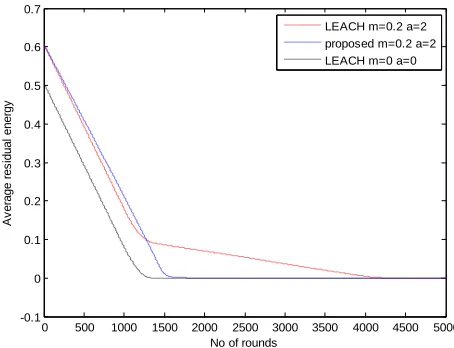
LEACH m=0.2 a=2 proposed m=0.2 a=2 LEACH m=0 a=0
Fig.6 Average residual energy in LEACH and proposed method when m=0.2
Fig.3 shows the average residual energy comparison of LEACH and proposed protocol when m=0.1 and
a=2.simulation result shows that our proposed method has more average residual energy at stable region as
comparison to LEACH. Fig.4 shows the results of the case with m = 0.2 and a = 2, and It is obvious that the stable
time (the first node die) in proposed method is prolonged compared to that of SEP and LEACH. Fig. 5 shows that
rounds first node dead and half node dead of our protocol, LEACH and SEP. when m = 0.2 and a = 2. Fig.6 shows
the average residual energy comparison of LEACH and proposed protocol when m=0.2 and a=2.simulation result
shows that our proposed method has more average residual energy at stable region as comparison to LEACH
TABLE 1
PARAMETERS VALUE
parameter Value
Network Field (100,100)
Base Station location (50,200)
n (No of sensor node) 100
p 0.1
f s
E 10nJ/bit/m2
m p
E 0.013 pJ/bit/m4
e l e c
E 50nJ/bit
D A
E (Data aggregation energy) 5nJ/bit/signal
490 |
P a g e
V
CONCLUSIONS
In this paper, the modified method for lifetime maximization for heterogeneous WSNs is proposed. In the proposed
method every node select itself as a cluster head based on initial energy, residual energy and distance to base station.
The epochs of being cluster-heads for nodes are different according to their initial and residual energy and distance
to base station. Means nodes which have more residual energy and less distance to base station has more chances to
become cluster head.
Also in our proposed scheme the cluster formation takes place using a cost function. That cost function includes
energy of cluster head and distance from normal node to cluster heads. Means normal node joins that cluster head
which has more energy and less distance.
The simulation result shows that in our proposed schemes the round when first node die is more that region is
known as stable region. In the proposed scheme the network is full connected more number of rounds than LEACH
and SEP. And the average residual energy is more in our proposed scheme
.
REFERENCES
[1] F. Akyidiz, Y. Sankarasubramaniam W. Su, and E. Cayirci,A Survey on Sensor Networks, IEEE Commun,
August 2002.
[2] J. N. Al-Karaki and A. E. Kamal, Routing techniques in Wireless Sensor Networks: a Survey,IEEE Wireless
Communications, vol. 11, no. 6, pp. 6-28,Dec. 2004
[3] W.R. Heinzelman, A.P. Chandrakasan, H. Balakrishnan, An application- specific Protocol architecture for
Wireless Microsensor Networks, IEEE Transactions on Wireless Communications 1 (4) 660–670,2002.
[4] Handy M, Haase M, Timmermann D.,Low Energy Adaptive Clustering Hierarchy with Deterministic
Cluster-Head Selection In: Proc. Of the 4th IEEE Conf. on Mobile and Wireless Communications Networks, pp.
368-372,2002
[5] E.J. Duarte-Melo and Liu Mingyan, Analysis of Energy Consumption and lifetime of Heterogeneous Wireless
Sensor Networks,Global Telecommunications Conference, 2002. GLOBECOM ’02. IEEE, vol.1, no.,17-21,
Nov. 2002
[6] O. Younis, S. Fahmy, HEED: A Hybrid, Energy-Efficient, Distributed Clustering Approach for ad hoc sensor
networks, IEEE Transactions on Mobile Computing 3 (4) , 660–66,200
[7] S. Lindsey, C.S. Raghavenda, PEGASIS: Power Efficient Gathering in Sensor Information Systems, in:
Proceeding of the IEEAerospace Conference, Big Sky, Montana, March 2002
[8] M. Ye, C. Li, G. Chen, J. Wu, EECS: an Energy Efficient Cluster Scheme in Wireless Sensor Networks, in:
IEEE International Workshop on Strategies for Energy Efficiency in Ad Hoc and Sensor Networks (IEEE
491 |
P a g e
[9] G. Smaragdakis, I. Matta, A. Bestavros, SEP: A Stable Election Protocol for Clustered Heterogeneous WirelessSensor Networks, in:Second International Workshop on Sensor and Actor Network Protocols and Applications
(SANPA 2004), 2004
[10] P. Krishna, N.H. Vaidya, M. Chatterjee, D. Pradhan, A Cluster-based Approach for Routing in Dynamic
Networks, ACM SIGCOMMComputer Communication Review 27 (2) ,49–65,1997.
[11] L. Qing, Q. Zhu, M. Wang, Design of a Distributed Energy-Efficient Clustering Algorithm for Heterogeneous