INTRODUCTION
Amino acids are the building units of all
proteins and enzymes1 and associated with metal
ions in biological system2. These acids are being
converted to acid hydrazide having two amino groups, these diamine are able to form Schiff bases with condensation of aromatic aldehydes. Metal complexes prepared from Schiff bases of derivative
of amino acids posses biological activities3.
Coordination behavior of this ligand with several metal ions is found in biological systems.
Synthesis, Characterization, Spectral & Antimicrobial
Studies of Fe(III), Co(II), Zn(II), Cd(II), Y(III), and In(III)
Complexes of Schiff Base Derived from L-Tryptophan
M.H. SALUNKE¹, Z.A. FILMWALA*, S.B. DHARAP¹ and A.D.KAMBLE¹
*N.S. Research Laboratory, St. Xavier’s College, Mumbai - 400 001 (India). ¹Bhausaheb Nene ASC College, Pen, Raigad (India).
(Received: June 20, 2011; Accepted: August 30, 2011)
ABSTRACT
In the present study 2-Amino-3-(1H-indol-3-yl)-propionic acid hydrazide (AIPAH) (1) has been prepared by reacting earlier reported compound 2-Amino-3-(1H-indol-3-yl)-propionic acid ethyl ester (AIPAEE) with hydrazine hydrate. Schiff base 3-(1H-Indol-3-yl)-2 [(4-methoxy-bezylidene)-amino]-propionic acid(4-methoxy-benzylidene)-hydrazide(IMBAPAMBH) (2) has been synthesized by reacting (1) with 4-methoxy benzaldehyde and its metal complexes with Fe(III), Co(II), Zn(II), Cd(II), Y(III), and In(III) have been prepared. The ligand and metal complexes were characterized on the basis of elemental analysis, IR, NMR spectral data, molar conductance, magnetic susceptibility measurement, thermal analysis (TGA/DTA). Fe(III), Co(II), Y(III), In (III) complexes possesses octahedral and Zn(II), Cd(II) complexes possesses tetrahedral geometry. In vitro antibacterial and antifungal activities of all compounds were tested.
Key words: Synthesis, Schiff base, Fe(III), Co(II), Zn(II), Cd(II), Y(III), and In (III) complexes, Antibacterial and antifungal activities.
Preparation of heterocyclic ligands containing Carbonyl and azomethine groups with potential binding ability has drawn a lot of attention because
of their antibacterial as well as fungicidal 4-6,
herbicidal7, and anti-inflammatory8 properties.
In the present work, synthesis, character ization of asymmetric Schiff base (IMBAPAMBH)(2)der ived from derivative of tryptophan and its metal complexes with some paramagnetic, diamagnetic and rare earth metal
ions, their elemental analysis, IR, 1HNMR spectral
www.orientjchem.org
CODEN: OJCHEG 2011, Vol. 27, No. (3): Pg. 1185-1191 An International Open Free Access, Peer Reviewed Research Journal
data, molar conductance, magnetic susceptibility measurement, thermal analysis (TGA / DTA) is described. The Schiff base (IMBAPAMBH) (2) is prepared by refluxing 4-methoxy-benzaldehyde with Synthesis of 2-Amino-3-(1H-indol-3-yl)-proponic acid hydrazide (AIPAH) (1) in 2:1 molar ratio in ethanol. Metal complexes of Fe(III), Co(II), Zn(II), Cd(II), Y(III), and In(III) are prepared by condensation with (IMBAPAMBH)(2). The Schiff base and their metal complexes were screened for their antibactrial activity against staphylococcus aureus, Pseudomonas aeruginosa, Bacillus subtilis, Escherichina Coli bacteria and Aspergillus niger, Aspergillus flavus fungi. The Schiff base ligand, Zn(II), Cd(II), In(III) complexes were found to be more active and Fe(III), Co(II), Y(III) complexes were found to be moderately active against these bacteria. Schiff base ligand, Co(II), Zn(II), Cd(II), Y(III) complexes were found to be more antifungal whereas Fe(III),In(III) complexes were not shows antifungal activity against these fungi.
EXPERIMENTAL Material and method
All chemicals and solvents used in present investigation were of EMerck, Sigma -Aldrich Company and solutions were prepared in doubled distilled water, all the metal salts were used as chlorides. The melting points were recorded by capillary tube method using Toshniwal melting point apparatus and are uncorrected. The molar conductance of ligand and metal complexes was measured by digital conductometer model no.
Eq-660A in DMF, 10-3mol at 25°C. The magnetic
susceptibility of these complexes were measured by Gouy’s method at room temperature using Hg
[Co (NCS)4] as Celibrant. The elemental analysis
were carried out on a vario EL III Elementar Carlo-Erba 1108. IR spectra were recorded using KBr disks on Perkin Elmer Spectrum RX-1 FT-IR
spectrometer, in the range of 4000-400 cm-1 at
Institute of Chemical Technology, Matunga, Mumbai. Ther mal analysis (TGA /DTA) were carried out in nitrogen atmosphere with a heating
rate of 100C/ min., using Rijaku Thermo plus
TG-8120 ther moanalyser. 1HNMR spectra were
recorded in DMSO-d6 using TMS as internal
standard on a Jeol Japan 300 MHz FT NMR at Institute Of Science Mumbai. Purity of compounds
was checked by TLC on silica gel plates (60F254) and visualized under UV light. Antibacterial and antifungal activities were screened at St. Xavier’s College Mumbai.
Synthesis of ligand (Schiff base)
2-Amino-3-(1H-indol-3-yl)-propionic acid
ethyl ester was prepared by earlier reported method9
and purity of compound was checked by TLC.
Synthesis of 2-Amino-3-(1H-indol-3-yl)-proponic acid hydrazide (AIPAH) (1)
Dissolved 2-Amino-3-(1H-indol-3-yl)-propionic acid ethyl ester (0.1 mol) was refluxed on water bath with excess of hydrazine hydrate ( 0.2 mol, 99% ) in 25ml of ethanol for 8h. The resulting product was poured in ice-cold water and kept
overnight, brown solid was crystallized out10. The
product washed with 25 ml ice-cold alcohol and dried in air. The yield of almost pure tryptophan hydrazide was 74%, m.p. 246-248°C
Synthesis of 3-(1H-Indol-3-yl)-2 [(4methoxybezylidene)amino]propionic acid(4methoxy -benzylidene) - hydrazide (IMBAPAMBH)
(2)3(1HIndol3yl)2 [4 ethoxy bezylidene) amino] propionic acid (4 methoxy -benzylidene )-hydrazide(IMBAPAMBH) (2)was prepared by mixing an ethanoic solution (50 ml) of (1) (0.01 mol) with 4-methoxy benzaldehyde (0.02
mol) and catalytic amount of conc. H2SO4 in the
same volume of ethanol, then the mixture was refluxed with stirring for 5-6 h. The obtained precipitate was collected by filtration through Buchner funnel, washed and recrystallized from absolute ethanol then dried at room temperature in desicator over anhydrous calcium chloride, yield was 82%, m.p. 292°C.
Preparation of complexes (3-a to 3-e) with Schiff base
filtered and washed with water (15 ml x 3) & ethanol (25 ml x 3) to remove any unreactive ligand & metal ions, after that complexes dried in vacuum over
anhydrous calcium chloride in a desicator. These complexes were used for further study.
H2N CHC CH2
NH O
HN
NH2
HN N CHC
CH2 NH O
N HC
H3CO
CH OCH3
(AIPAH) (1)
(IMBAPAMBH) (2)
RESULTS AND DISCUSSION Physical properties
These complexes are air stable, colored,
solids which decompose above >295oC. They are
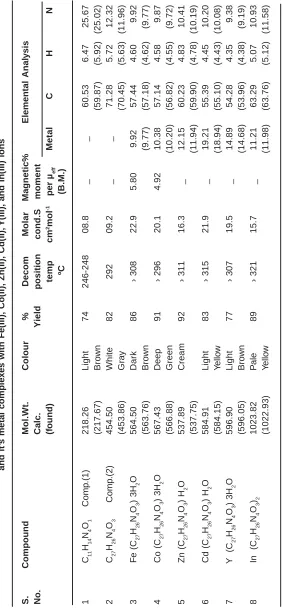
insoluble in common organic solvents but soluble in ethanol, DMSO, DMF. The molar conductance of ligand and complexes dissolved in DMF fall into the
range 8-23 S cm2mol-1 of 10-3 mol dm-3 solution
indicating their non electrolytic nature11 in DMF. The
analytical data and magnetic moments of complexes are presented in Table -1. The magnetic moment of Fe (III) complex has value 5.80 B.M. indicating good agreement with that reported for high spin complex
with d5 system (t
2g
3 eg2) and octahedral geometry12.
The magnetic moment value for the Co (II) complex
is 4.92B.M.expected for octahedral geometry13 with
high spin paramagnetic d7 system (t
2g
5eg2) and 3
unpaired electrons. Zn(II) and Cd(II) complexes have not ligand field stabilization effect owing to complete d-sub shell, therefore Zn(II) and Cd(II) complexes should be diamagnetic spin free
tetrahedral complexes14 with d10 system. Y(III) and
In(III) are also diamagnetic with d10 system and
octahedral stereochemistry15-16. The elemental
analysis of carbon, hydrogen, nitrogen and gravimetric percentage estimation of metals indicated that Fe (III) Zn(II) Cd (II) and Y(III) complexes are 1:1 metal-ligand stoichiometry where as In(III) has 1:2 metal-ligand stoichiometry.
Infrared spectra
IR spectral data IR(KBr) (cm-1), Compound (AIPAH) (1)
3406.93 ν(>NH indole), 3360 ν(NH2 of
-NH-NH2) 3042.19 ν(-N-H strech ), 1669.30 ν
(-CONH-), 1606.90 ν(Benzene ring stretch),1570 ν
(Aromatic ring conjugation), 1565 ν(-C-H Aromatic
), 1480 ν(N-N Stretch ), 1229.11n( C-N Stretch),
743.66 ν (Ar-ring).
Compound (IMBAPAMBH) (2)
3429.11 ν ( >NH indole), 3240 ν (N-H
Amide Stretch, Symmetric, asymmetric stretching
vibration, 3005.49 ν(Ar -H), 2850 ν (-OCH3),
1662.98 ν (-CO-NH Sec. amine),1604.95 ν
(-C=N-) azomethine, 1590 n(C6H5 -conj.) ,3240 ν(-N-H)
Amide Stretch [ Sym / asymm. Str. vib], 1363.53 ν
(-CH2) , 1249.95 ν (C-N) Str., 838.15 ν (P-Sub C6H5).
The IR spectr um of the ligand (IMBAPAMBH) shows a band of medium intensity
at 1604.95 cm-1 which can be assigned to ν
(-CH=N-)17-18, In the spectra of complexes this band shows
a negative shift 20-64cm-1 and appeared in the
region 1540-1585 cm-1 indicating the coordination
of nitrogen atom of azomethine group19 to metal ion.
The coordination through azomethine nitrogen is further confirmed by the appearance of a band at
460-482 cm-1 in complex may be assignable20 to
ν(M-N). Other significant IR band of ligand appears
at 1662.98 cm-1, this band is sharp and strong may
be assigned to ν( >C=O) 21-22.The position of this
band in all complexes shows a negative shift 15-45
cm-1 and appeared at the region 1618-1648 cm-1,
this shift is due to coordination of oxygen atom of a carbonyl group to the metal ion. The coordination through oxygen atom is further confirmed by the
appearance of the band at 525-609 cm-1 in the
T a ble 1: Anal ytical Data, Molar conductance,
magnetic moment of MB
APP
AMBH
and it’
s metal comple
x
es with Fe(III),
Co(II),
Zn(II),
Cd(II),
Y(III),
and In(III) ions
S . Compound Mol.Wt. Colour % Decom Molar M a gnetic % Elemental Anal ysis No. Calc. Yield position cond.S moment (f ound) temp cm 2mol -1 per µ eff Metal C H N º C (B.M.)
1 C
11 H14 N4 O1 Comp .(1) 218.26 Light 7 4 246-248 08.8 _ _ 60.53 6.47 25.67 (217.67) B ro w n (59.87) (5.92) (25.02)
2 C
27 H26 N4 O3 Comp .(2) 454.50 White 8 2 292 09.2 _ _ 71.28 5.72 12.32 (453.86) G ra y (70.45) (5.63) (11.96)
3 F
e ( C27 H26 N4 O3 ) 3H 2 O 564.50 Dar k 8 6 › 3 0 8 22.9 5.80 9.92 57.44 4.60 9.92 (563.76) B ro w n (9.77) (57.18) (4.62) (9.77) 4 Co (C 27 H26 N4 O3 ) 3H 2 O 567.43 Deep 91 › 2 9 6 20.1 4.92 10.38 57.14 4.58 9.87 (566.88) Green (10.20) (56.82) (4.55) (9.72) 5 Zn (C 27 H26 N4 O3 ) H 2 O 537.89 Cream 92 › 3 1 1 16.3 _ 12.15 60.23 4.83 10.41 (537.75) (11.94) (59.90) (4.78) (10.19) 6 Cd (C 27 H26 N4 O3 ) H 2 O 584.91 Light 83 › 3 1 5 21.9 _ 19.21 55.39 4.45 10.20 (584.15) Y ello w (18.94) (55.10) (4.43) (10.08) 7
Y (C
27 H26 N4 O3 ) 3H 2 O 596.90 Light 77 › 3 0 7 19.5 _ 14.89 54.28 4.35 9.38 (596.05) B ro w n (14.68) (53.96) (4.38) (9.19) 8
In (C
27 H26 N4 O3 )2 1023.82 P a le 89 › 3 2 1 15.7 _ 11.21 63.29 5.07 10.93 (1022.93) Y ello w (11.98) (63.76) (5.12) (11.58)
Compound (1) - 2-Amino-3-(1H-indol-3-yl)-proponic acid h
ydrazide
. (AIP
A
H
)
Compound (2) - 3-(1H-indol-3-yl)-2[(4-metho
T
a
b
le 2:
Antimicr
obial activity of ligand-(IMB
AP
AMBH) and its comple
x
e
s
Compound
Antibacterial activity
Antifungal activity
Gram P
ositive bacteria
Gram
negative bacteria
Asper
gillus
Candida
Staph
ylococcus
Pseudomonas
Bacillus
Esc
heric
h
ia
nig
e
r
albicans
aureus
aeruginosa
substilis
Coli
2.0 mg
4.0 mg
2.0 mg
4.0 mg
2.0 mg
4.0 mg
2.0 mg
4.0 mg
2.0 mg
4.0 mg
2.0 mg
4.0 mg
[IMBAP
AMBH]
-[F
e(IMBAP
AMBH )(H
2
O)
3
]
+
+
-++
++
++
[Co (IMBAP
AMBH)(H
2
O)
3
]
+
+
-++
++
-[Zn IMBAP
AMBH ) H
2
O
]
-[Cd (IMBAP
AMBH ) H
2
O
]
-[Y (IMBAP
AMBH)(H
2
O)
3
]
+
+
-+
+
-[In (IMBAP
AMBH )
2
]
-+
+
+
+
- -
V
e
ry
Activ
e - Moder
ately activ
e + Not activ
in 3000-3300 cm-1 region in Fe(III),Co(II), Zn(II), Cd(II) and Y(III) complexes attributed to the
presence of coordinated water molecules24, this
have also been confirmed by TGA/DTA analysis . The IR spectra of these complexes exhibited a new band in range of 3500-3550 which may be attributed
to ν(OH) vibrations of coordinated water. The
appearance of band around 860 (cm-1) due to
wagging and rocking modes of vibrations of
coordinated water molecules25.
NMR spectral data
1HNMR(DMSO,300MHz, δδδδδppm), Compound (AIPAH) (1)
2.03(d,4H of –NH2 ), 2.98(d, 2H of –CH2),
3.85(t, 1H of –CH), 6.86 (s,1H of aryl), 7.23(d, 4H of aryl), 8.00 (s, 1H of –NH), 10.11(s,1H of indole).
Compound (IMBAPAMBH) (2)
2.95(d,2H of–CH2), 3.72(s, 6H of –OCH3),
3.95(t, 1H of –CH), 6.86-8.081 (m,13 Ar-H), 8.05 (s, 1N of –NH), 8.46(s,2H of –CH).
Biological evaluation
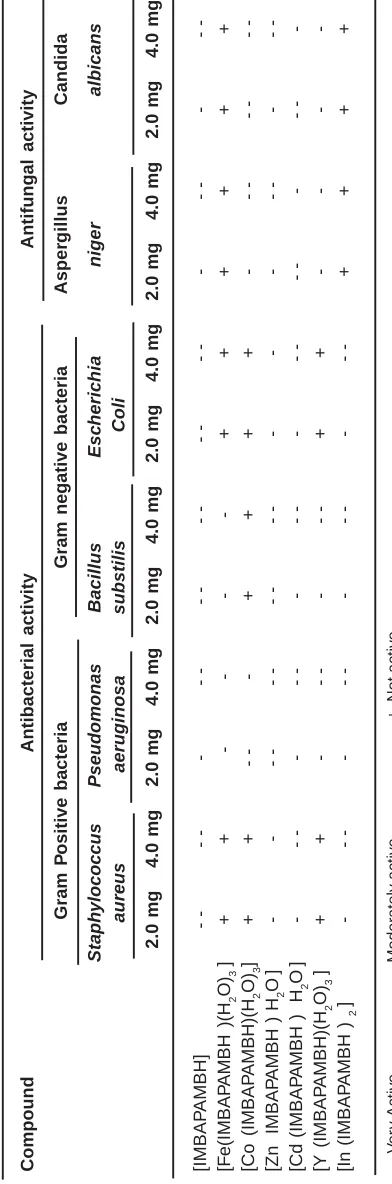
Antibacterial and antifungal activities of the ligand and its complexes were carried out against staphylococcus aureus, Pseudomonas aeruginosa, Bacillus subtilis, Escherichia Coli bacteria and Aspergillus niger, Candida albicans fungi by ditch plate method. 10-15 ml nutr ient agar and
sabouraud’s dextrose agar is used as medium for
antibacterial and antifungal activities respectively. The antimicrobial activity was estimated on the basis of size of inhibition zone and the results are shown in table-2. Antibacterial studies shows that the ligand (IMBAPAMBH), Zn(II), Cd(II), In(III) complexes were found to be more active and Fe(III), Co(II), Y(III) complexes were found to be moderately active
against these bacteria. Schiff base ligand , Co(II), Zn(II), Cd(II), Y(III) complexes were found to be more antifungal whereas Fe(III),In(III) complexes did not exhibit any remarkable antifungal activity against these fungi.
CONCLUSION
On the basis of above studies it may be concluded that Schiff base (IMBAPAMBH)(2) has asymmetric. Fe(III), Co(II), Y(III) complexes has octahedral geometr y with 1:1 metal-ligand stoichiometry,Zn(II) and Cd (II) complexes has tetrahedral stereochemistry with 1:1 metal-ligand stoichiometry and anhydrated In (III) complex has octahedral geometr y with 1:1 metal-ligand stoichiometry. Antibacterial studies shows that the ligand (IMBAPAMBH), Zn(II), Cd(II), In(III) complexes were found to be more active and Fe(III), Co(II), Y(III) complexes were found to be moderately active against these bacteria. Schiff base ligand (IMBAPAMBH),Co(II), Zn(II), Cd(II), Y(III) complexes were found to be more antifungal whereas Fe(III),In(III) complexes did not exhibit any remarkable antifungal activity against these fungi.
ACKNOWLEDGEMENTS
The authors are grateful to the principal, St. Xavier’s College, Mumbai for laboratory facilities. The authors are also grateful to Mumbai University for financial support by sanctioning M.R.P. The authors are also thankful to Mr. G.G.Joshi Liberian of Bhausaheb Nene College Pen,Raigad for providing inter net and librar y facility and Prof.Y.S.Malge, Mr.Anirudh Patil, Shailesh Narkar , Mr. Milind More for determinations of TGA/DTA, I.R., N.M.R. spectra.
REFERENCES
1. Francis A. Cary, Organic Chem. Uni. of
Verginia, P- 1109-1114; Tata McGraw Hill, (2003).
2. P. R. Mandlik, S. G. Bhendange and A. S.
Aswar, J. Indian Council Chem., 19: 80(2002).
3. P.G. Cozzi. Chem.Soc. Rev., 33 : 410 (2004).
4. Abdel-Wahab, B.F., Abdel-Aziz,H.A.;Ahmed,
E.M.;Eur.J.Med. Chem. 44 :2632 (2009).
5. Singh, S.P.;Sehgal, S.; Tarar, L.S.;Dhawan,
A.N.,Ind.J.Chem.29B: 310 (1990).
6. Dawane,B.S.;Konda,S.G.;Mandawad,G.
G.;Shaikh, B.M.,Eur.J. Med.Chem. 45: 387(2010).
7. J. Hosler, C. Tschanz C.E. Hignite and D.L.
Azarnoff. J. Invert Dermatole 74: 15 (1986).
J. Chem., 16: 96 (2004).
9. Canel,Esin; Journal of Solution Chemistry
V-35(1): 5-19 (2006).
10. L.F. Audrieth, E.S.Scott and P.S.Kippur,
J.org.Chem.,19: 733 (1954).
11. Sing Charanjit, Parwana H.K. et.al. Asian J.
Chem., 1 (2000).
12. Reddy, K.H., Indian J. Chem., 29A: 497
(1990).
13. M. Vrbova, P. Baran, R. Boca, H.Fuess, I.
Svoboda, W. Liner t, U. Schuber t, and P.Wiede, Polyhedron, 19 2195-2201 (2000).
14. Figgis, B. N., Lewis, J. Modern Co-ordination
Chem. Edi by J. Lewis and R. G. Wilkin (I.P.N.Y.) 427, (1960).
15. M.G. ABD EL-Wahed, et.al. Bull. Mater. Sci.,
V 32, No. 2: PP 205-214, April 2009.
16. F.M. Shen and S.F. Lush; Acta cryst., E 66:
m 1260. (2010).
17. Agrwal, R.K. and Arora, K. Pol. J.chem. 67:
219 (1993).
18. Shanker, G., Kumar, R.R. Prem, R. and
Ramalingham, S. Polyhedron,5:991(1986).
19. N.K. Singh and S.B. Singh, Indian J.Chem.,
Sect. A, 40:1763(2004).
20. S.N. Chaube, J.P. Shreevastava and L.K.
Mishra, Inorg. Chem. Acta, 23.1 : (1977).
21. A.M.El-Roudi, Bull. Fac. Sci Assiut University,
18: 77(1989).
22. B. Chatterjee, Coord. Chem. Rov., Acta, 7:
493(1973).
23. P.P. Singh and U.P. Shukla, Inorg. Chem.
Acta.7: 493 (1973).
24. A. Syamal and M.R. Maurya, Indian J.Chem.
Sct, A.24 : 836 (1985).
25. J Fujita A.E. Martell and K. Nakamoto, J.