A System-of-Systems Framework for Improved Human, Ecologic and Economic Well-Being
Ash M. Genaidy 1,*, Ronald L. Huston 2, Dion D. Dionysiou 3 and Waldemar Karwowski 4
1 Worldtek Inc., Cincinnati, OH 45249, USA
2 Mechanical Engineering Program, University of Cincinnati, Cincinnati, OH 45221,
USA; [email protected]
3 Environmental Engineering & Science Program, University of Cincinnati, Cincinnati,
OH 45221, USA; [email protected]
4 Department of Industrial Engineering, University of Central Florida, Orlando,
FL 32816, USA; [email protected]
* Correspondence: [email protected]
It is postulated in this research that the paradox of “advances in technology and management not keeping pace with the ever-increasing urban problems” is due to the poor understanding of person-focused governance of societal, environmental and economic entities. Therefore, the objective of this paper is to present an adaptive institutional model of person-driven effectiveness and ineffectiveness. The model proposes that human, ecologic and economic outcomes are heavily influenced by a complex system of systems, spanning from individually unique “non-physical influencers” to a broader set of social and environmental influencers that have a common impact on the larger society-environment-economy (SEE) system. At the heart of the model is an analytic formulation that explains the phenomena of non-physical blocker, enhancer and indifferent that are responsible for the adaptation and maladaptation of social agents, and accordingly for the sustainability and unsustainability of SEE systems. Examples are provided to illustrate the model applications: (a) the non-physical and maladaptive syndromes as antecedents of multi-morbidity and (b) the broadened and narrowed minds as sources of sustainability and unsustainability at the SEE system level within the context of emerging technologies such as engineered nanomaterials.
Keywords:
Acronyms:
ENM Engineered nanomaterials
MAS Maladaptive syndrome
MMP Multimorbid patient
NPB Nonphysical blocker
NPE Nonphysical enhancer
NPI Nonphysical indifferent (an intermediary of NPB and NPE)
NPS Nonphysical syndrome
PFA Person focused architecture
SEE society, environment, economy
Major Factors:
A Rational, reasonable and logical factor
N Energy producing factor
K Decision making factor, based upon input from all other factors
M Positive influencing factor (Compare with factor S)
1. Introduction
In today's world and in the foreseeable future, we will be confronted with
unprecedented diverse global problems such as (a) increased world population, (b)
rapid consumption of diminishing natural resources, (c) increased cost of healthcare
accompanied with poorer health, and (d) increasing environmental pollution, all
combined with growing urbanization in all parts of the world. Moreover, in the absence
of major changes, these problems will become more and more acute and, if not
seriously addressed eventually, they will transform into chronic events for those
affected in human populations and ecosystems. At the same time, however, the world
is becoming smaller in the sense that unprecedented advancements in communication
technologies are connecting diverse parts of the world into a kind of small village and
emerging technologies are promising to solve the global problems. But there is a
paradox in that the profound technical advances cannot seem to be applied to
effectively reduce the world's problems. This paradox has its roots in social,
environmental, technical, and political issues that are currently converting local entities
and communities into unsustainable systems — systems that cannot keep pace with
the basic and higher needs and wants of human populations and ecosystems.
Other researchers raised similar arguments from different perspectives (Fiskel et
al. 2009; Williams et al. 2012; Depledge et al. 2011). Therefore, it has been suggested
that it is time to launch a new dialogue on science and the environment with a focused
effort on simultaneously improving human, ecologic and economic well-being (Fiskel et
al. 2009). Our thesis is that many of the aforementioned issues are due, in part, to our
limited understanding for the person focused architecture (PFA) and leader-driven
and environmental entities. It is believed that, in addition to the physical-chemical
factors impacting the diverse societies, environments and economies on the planet,
intangible and intrinsic human factors play a major role in the aforementioned changes.
The research reported herein deals with the above subject, with the ultimate goal
of finding solutions to the aforementioned diverse global problems simultaneously
impacting environmental, social and economic entities. We present the phenomena of
non-physical blocker (i.e., the negative forces in a person’s inner milieu dominate the
positive forces), enhancer (i.e., the positive forces in a person’s inner milieu are ahead
of the negative forces) and indifferent (i.e., both positive and negative forces in a
person’s inner milieu are in balance and hence neutralize each other) as major
influencers of the adaptability and mal-adaptability of society-environment-economy
(SEE) systems at both the individual and system levels. It is maintained in this research
that sources of sustainability and un-sustainability are largely drawn from these
phenomena due to their influence on human actions and inactions. With this in mind,
we define sustainable systems as entities jointly leading to value-added benefits with
minimal or no risks to all constituents of the larger SEE system within a defined time
period.
1.1 Overview of Prior Models
This research is motivated by a diverse set of problems. Thus, in the foregoing we
present examples of prior models. One dominant class of models has been concerned
with rational behavior in economic decision-making. These models were set forth by
Simon (1995, 1967) in attempts to correct the notion that "an economic man" is also a
"rational" human. As the name implies, this class of models is deterministic in nature
controls" as termed in the psychological literature. We should point out that rational
behavior, as will be elaborated in this research, is the product of not only the rational
component, but also other components in the system. This issue was evaluated under
the auspices of emotional controls as jointly interacting with cognitive controls, but it
was not formally documented in this class of models (Simon, 1967). Furthermore, the
economic perspective should also integrate the societal and ecologic viewpoints.
Another class of models characterizes human behavior in a given specific
instance as a stochastic process. Here, the analysis is formulated in terms of an
iterative solution of a set of governing equations (Barabasi 2005; Pentland and Liu
1999; Karwowski 2012). This class of models assumes that people behave at a digital
level, thus simplifying the complexity of human thought and consequently ignoring the
innate personality and biases of individuals. To remedy these difficulties, researchers
have developed increasingly complex models attempting to account for the complex
structure of human thought (Bonabeau 2002; Homer and Hirsch, 2006). These
advanced models have been applied with human reaction to environmental and
ecological issues (Janssen et al. 2000; Jager et al. 2000).
It is our belief that factors influencing human behavior are central to the
aforementioned paradox. Our thesis is that these influencing factors must be
considered in order to transform unsustainable systems into sustainable ones. By
examining the influencing factors of human behavior, we can address motivation
leading to decision-making by institution leaders. In our model we use a dynamic
structure of the components forming the basis for a person's reaction to his/her
environment and resulting decisions. To the best of our knowledge such an attempt has
1.2 Study Goal
The goal of our research is to model a person-focused system that describes the
nonphysical influencing factors for individuals and their environmental interactions.
These factors and interactions are manifested by a person's direction of action items. A
person-focused "architecture" is defined as the underlying basis for communication and
interaction in urban communities and the larger SEE system. We explain the
phenomena of non-physical blocker, enhancer and indifferent as the driving forces for
the adaptability and non-adaptability of social agents and hence the influencers of SEE
systems towards a path of sustainability or unsustainability. We provide applications to
illustrate the concepts from individual and SEE perspectives.
2. Person-Focused Architecture
2.1 Background
The concepts of non-physical blocker, enhancer and indifferent are traced back to the
old debate about the mind-body dichotomy since the time of Descartes due to the
hidden (invisible) and intangible nature of the mind as opposed to the visible and
tangible nature of the human body (Sperry 1980; Shilling and Mellor 1996). This debate
has had great implications from science standpoint. For example, this paradox has led
to the development of the biomedical model of medicine that focuses solely on
biological and bodily factors; consequently, it does not take into account the “mind”
factors (Borrell-Carrio et al. 2004; Alonso 2004). In response attempts have been made
to account for the non-bodily factors in the biomedical model of medicine such as the
treatment purposes (Engel 1977). Further attempts have considered uniting the mind
and body as integral parts of living systems (Brown 1989; Engel 1989).
An example is in order here to explain the implications of not considering the
mind as an integral part of living systems from sustainability perspective. Consider two
identical twins having developed type II diabetes at about the same time, living in the
same household and treated by the same physicians (i.e., primary care physician
and/or specialists). With all these similarities, however, one of the twins is affected with
an added number of acute complications than the other. A question may then arise as
to why the cost of care of one sibling is double relative to the other (assuming
everything is the same). The obvious answer is the non-bodily factors that greatly
influence lifestyle factors and hence the body in feed-forward and feedback fashion as
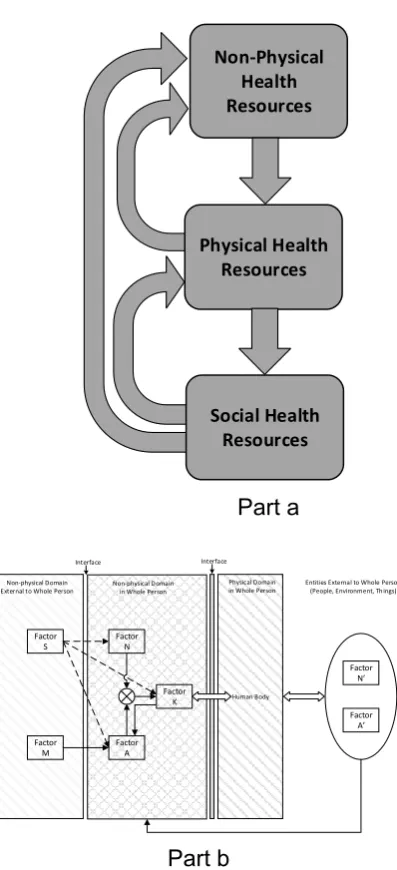
depicted in Figure 1 (a). In this diagram, social entities are added in order to provide
the minimum structure for person-focused functioning in a larger system and generalize
the views of mind-body entities at an SEE level. All in all, if these factors are not
accounted for, the US healthcare system will remain on a path toward unsustainability
(Greene et al. 2013, 2014).
To address these issues, we built the PFA architecture based upon research in
the scientific, philosophical, and even spiritual literature. Specifically, the components
of the PFA and their interrelationships were initially inspired by accounts in ancient
writings (including those in the Bible and the Koran) together with the logic of common
sense, civil discourse, and conventional wisdom. From this broad background the PFA
was built upon the acquired knowledge and experience of the authors in engineering,
human factors, and environmental sciences, including earlier writings of the authors
2.2 Model Description
The person-focused architecture (PFA) of an individual is discussed with reference to a
"community" consisting of people and other living beings (e.g., animals and birds in an
ecosystem) and non-living entities (e.g., buildings), some of which are visible and
obvious to an individual and others which may be less obvious and intangible but still
have significant influence on the person (e.g., the health of an individual is influenced
by the health of those with whom he/she interacts). An analogy may be gravity: it can’t
be seen but it can be measured, hence, one can determine its influence on physical
items. Other less obvious examples may be unknown and undetectable pollutants, high
frequency vibrations, and background noise.
The PFA Model maintains that a person consists of two layers: physical or outer
(i.e., visible or human body, physical environment, etc.) and nonphysical or inner (i.e.,
“hidden” such as developmental, cellular, chromosomal, etc.). We know much about the
physical human body via scientific discoveries because it is obviously tangible. On the
other hand, we have a limited understanding of the complex interactions of the many
nonphysical influencers, some of which are less tangible (e.g., how does childhood
stress result in permanent chromosomal telomere changes which then influence a
person’s health for their entire life?).
The internal complex system of systems (SOS) is a collection of collaborative
systems bonded together under defined rules and regulations with the goal of exhibiting
the complex properties of living systems (Boardman et al., 2006; Gorod et al., 2008; Di
Mario et al., 2009). In this context, each individual, has a component structure of a “1”
or “0” decision nodes which lead to action/inaction which in turn exerts its resultant
poorer or better human outcomes. For purposes of this discussion, this internal SOS is
described in general terms in order to then describe the structure and function use and
relate it in the next section to examples on human and ecological health.
The inner layer of PFA consists of three components, (a) factor “A”, (b) factor
“N”, and (c) factor “K” (Figure 1 (b)) and makes up the non-physical resources for the
person. These three components are influenced by two external invisible inputs, factor
“S” and factor “M”, with unipolar forces (i.e., one force is only negative “S” and the other
is purely positive “M”). The net output of the interactions of these factors is what we
believe drives individual actions/inactions resulting in net human outcomes (e.g.,
overall health status both physical and mental). A brief definition is given below for
each component followed by a discussion of their roles and their relationships in the
person-focused architecture:
(a) Factor A is a rational component that is powered by the voice of reason and logic. It
is modeled as a bipolar force (i.e., cognitive force) assuming that the power of logic and
reason is modeled as a positive phenomenon and the power of illogic and unreason is
regarded as a negative phenomenon.
(b) Factor N is the source of energy for the person but with limited logic and reason
capabilities (i.e., impulsive energy). This source of energy can be positive (i.e.,
enhancing the person's capability) or negative (i.e., diminishing the person's capability).
(c) Factors A and N are in constant interaction with the resultant value providing an
input to factor K.
(d) Factor K is the recipient and integrator of information from the internal milieu via
factors A and N as well as factors S and M (see below). Structurally it combines
extra sensory capabilities connecting it with the external environment for receipt of
information input via two mechanisms: (1) directly via the channels of communication of
the body (e.g., visual; auditory) and (2) indirectly via other means unknown to us.
Information from the external environment is passed via factor K without any further
processing to factor A for storage in its internal memory. This information is also
temporarily stored in the memory of factor K for later usage in a decision making
process in a given situation. Collectively, factor K renders the final decision on the
basis of information from the internal and external milieus for action item orders to the
outer layer. After it is made, information on the final decision is passed to factor A
where it is stored in the long term memory residing as part of its cumulative experience
amassed over the diverse situations and scenarios (A note of clarification is warranted
on the unknown route of information input to factor K. This mechanism can be activated
for example in extreme circumstances such as emergency situations or near death
experiences).
(e) Factor M is a positive phenomenon and provides consultative reason and logic to
factor A via a one-to-one relationship. This unipolar positive phenomenon has also
direct input to factor K particularly in times when the internal milieu is in a great state of
turbulence.
(f) Factor S is a negative complex phenomenon and interacts with factors N, A and K
via one-to-many relationship. Its goal is to augment the power of unreason and to
diminish the power of reason via continuous monitoring of the inner layer in the PFA.
The state of factor N (i.e., output) can be described in terms of two-dimensional
variables, that is, level of activation and energy type. Factor N may reside in one of four
low-negative. A person may reside anywhere in the spectrum of those four general
states, with his/her position determined by the relative balance of the influencing
factors (Figure 2 (a)). An example of a high-positive energy source is hope (or
optimism). This state is a major source of personal energy. Alternatively, despair (or
pessimism) is a low state of negative energy source that is the opposite of hope and
acts as a barrier for constructive human actions, often by leading to inaction. The
low-positive energy source, such as peace and tranquility, leads to steady human actions in
the most efficient and effective ways. Contrary to that, a high-energy negative source,
such as anger and distress, results in a suboptimal source of energy, though it may be
an essential component for survivability.
The state of factor A can also be described in terms of two parameters: (a)
thinking mode - positive and negative and (b) force magnitude – low and high (Figure 2
(b)). Both parameters are influenced by the stored personal experiences, interaction
with factor N, and inputs from factors S and M. At birth, the default value for factor A is
positioned in the positive domain. As people get older, they navigate across the full
spectrum of positive and negative thinking with the resultant at any given time
depending on the aforementioned influencers. Of particular interest here is the
interaction between factors A and N.
When factor A is in a state of positive thinking and factor N is in a state of
positive energy, the role of factor N can be regarded as an amplifier for the positive
thinking mode of factor A. In this instance, the power of positive irrationality has a major
impact on human actions allowing a person to behave in an exhilarated style. We
maintain here that rational productive behavior is the product of the positive thinking
salesperson with great enthusiasm and belief in his/her product and with energy level.
This is likely to lead to high sales. Alternatively, when factor N behaves in a state of
negative energy source, it can act as a de-amplifier to factor A and steer it toward a
state of negative thinking if it can exceed the level of positive thinking for factor A. As
expected, this will lead to irrational unproductive human behavior. If the above
salesperson has doubts about the value or quality of his/her product and is tired with
low energy level, sales are likely to be low.
When operating in a negative thinking mode, factor A is more likely than not
synchronized with the negative domain of factor N. Under these circumstances, the
negative thinking process is operating in a destructive (i.e., negative) mode from a base
of negative experiences. In a "low" negative thinking mode, the person acts in a
suboptimal fashion, but yet is still functional. "High" negative thinking makes the person
move toward the path of negative irrational behavior that is detrimental to the
community. An example is a disgruntled employee.
To enhance the negative phenomenon in the internal milieu of a person, factor S
provides ideas and support on a constant basis to factor N in order to influence factor A
towards the mode of negative thinking. Because of its destructive nature, factor S is
capable of creating a barrage of negative concepts over time in the internal milieu. That
is, it can be modeled as a train of negative impulses during the course of time, with
each impulse being short lived and different from others in the train. Factor N, on the
other hand, may persist with one negative thought and promotes it on a continuous
basis; therefore, it can be modeled as a finite step function simulating the "all" or
The role of factor S in influencing factor A is focused on limiting its functional
capabilities via two routes: (1) distracting and confusing the positive thinking
capabilities; and (2) enhancing the negative thinking model. Inhibiting the positive
thinking capabilities of factor A may be accomplished in several ways. The first way can
be accomplished via "false" positive signal that attempts to portray the negative
phenomena in life as a pseudo-positive experience to factor A to promote the
performance of such actions. Another way is via a "false" negative signal. An example
is to paint the picture of a person who contributes to charity, as becoming poor if he/she
continues to do good deeds to others or make actions that may benefit nature at large.
A third way is to block the memory channels for the positive thinking mode;
consequently, factor A cannot carry out its own function. To enhance the negative
thinking capability for factor A, factor S works on replacing the stored experience for
making good decisions by false information leading to bad decisions. It can additionally
act to disturb the existing stored experiences.
In view of the above, a person must be able to distinguish between the "true" and
"false" signals obtained in the internal milieu to make rational and positive decisions.
The false signal is indeed inputted as discussed from factor S and the "true" signal is
obtained from factor M as well as the indirect mechanism unknown to us. In this regard
one may, for example, be able to distinguish it as follows: if it is too good to be true or it
is too depressing, then the signal is stemming from factor S, otherwise it emanates
from factor M or the indirect mechanism unknown to us.
Finally, the components of the internal milieu inside the person may be
influenced by feedback from other persons in a community (e.g., factors A' and N' in
with the person can have a major impact on the decision-making capability of the
person. That is, there are two types of feedback signals that are channeled to factors A
and N of a person. The positive ideas are enhanced via the rational component of
factor A and the irrational positive mode of factor N. On the other hand, the negative
ideas are fed to the negative thinking mode of factor A and the irrational negative mode
of factor N. This may be best exemplified by the classic example of the advice of good
parents to their kids to avoid hanging around "bad kids" and to stick to "good" ones.
Therefore, one may need to exercise caution with respect to the "true" and "false"
signals and cues received from others.
2.3 Supporting Evidence for Model Components
Factors A and N are consistent with the psychological literature on the cognitive and
emotional resources available for many years (see for example, Dember et al., 1984;
Cohen, 1987; Hancock, 1987).
Factors M and S are analogous to “good” and “evil” in the philosophical sense.
Beyond these characterizations, however, are external entities, but without tangible
external manifestation, and yet frequently accepted internally.
Alternatively, factor K has no explicit psychological nor philosophical bias.
Nevertheless, in everyday conversation, but without firm evidence, factor K is regarded
like a person with a “good heart” or like a “wicked person”.
2.4 Analytic Perspective of Component Interactions
The influence of the internal milieu for a person on his/her external environment can be
sensed in terms of his/her cognitive and emotional enhancement or block that reflect
upon his/her (a) human behavior which acts as the mediating factor between the inner
the ill of the inner milieu of the person may be represented in terms of the differential of
negative/positive cognitive and emotional states in one of three general outputs: (a)
nonphysical blocker (NPB) – the ill of the internal milieu outweigh that of the good; (b)
nonphysical enhancer (NPE) – the good of the internal milieu outweigh that of the ill;
and (c) nonphysical indifferent (NPI) – the good of the internal milieu is balanced with
that of the ill.
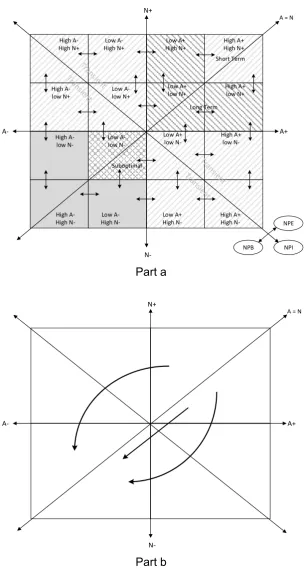
Figure 3 (a) depicts an analytic perspective of the aforementioned states
reflecting the resultant of the interaction of factors A and N. The resultant may reside in
one of four quadrants (left and right top and bottom; each quadrant consists of four
zones). Four possible states are evident for such interaction, namely, (a) preferred
mode of operation in the presence of positive attributes of factors A and N (A+,N+), that
is, steady NPE (long-term zones in top right quadrant in Figure 3 (a)); (b) sub-optimal
mode of operation in the unsteady state of negative zone (A-,N-), that is, unsteady NPB
(top right zone in bottom left quadrant in Figure 3 (a)); (c) transient ((A-,N+); (A+,N-)),
that is, transient NPE or NPB (top left and bottom right quadrants) and represents a
changing state between the steady and unsteady states; and (d) balance between
factors A and N (|A+| ~ |N-|; |A-| ~ |N+|), that is, NPI.
The positive mode of operation (that is, A+,N+) allows one to work in a steady
state by being more efficient and effective, and integrates the rational component of
factor A and the positive impulse of factor N. It should be noted that the short-term
steady state zone could not be sustained for a long period, with the person moving in
and out of it to the long- term steady state operation. Alternatively, the suboptimal
mode of operation emanates from the union of “low” negative thinking of factor A and
person in this zone is “vulnerable” to life and stress events and cannot sustain it for a
long period of time. The person is also considered vulnerable in the remainder of this
quadrant due to the impact of high A- or high N- and may be a threat for human health.
The transient states for NPB or NPE are situated in the top left and bottom right
quadrants in Figure 3 (a). As depicted in the figure, one can only be transiently located
in one zone and possible shift to a neighboring zone may occur. To further clarify,
factor S is capable, because of its one-to-many relationships, of additionally
overcharging the negative intensity via a direct link to factor K hence changing its state
occasionally depending on the interaction of factors A and N (Figure 3 (b)). An example
would be to instill a general state of intense "false" fear so as not to carry on the final
decision decided upon by factor K. Another example is to generate an intense "false"
state of overjoy, beyond the normal, which may influence the occurrence of future good
decisions. This may occur when factor S observes that factor K is in a state of peace
and tranquility; consequently it intends to change the internal milieu via false
excitement by shifting the state of affairs into a high positive energy source and a false,
negative cognitive signal that can eventually turn into a high negative energy source.
It should be noted that a comparison of Figures 2 and 3 illustrates the versatility
of the analytic model. Each region of Figure 3 can be further divided into four smaller
regions. This in turn provides a more precise version of a system state. In the same
way each smaller region can be divided into four regions and so on. This division of the
regions allows our model to be as discrete as needed for any given system. For
example, for slowly changing systems, a very discrete model can represent the system
change in quantitative terms. Then if we know the timing of the change, we can
observe that for passive systems, the natural tendency is to move down and to the left.
That is, without growth and/or positive stimulation, the system will stagnate and move
toward more negative configurations. Finally, with successive discretization following
the pattern of Figure 3, we can develop a system rating according to position along and
away from the lower left/upper right diagonal.
The aforementioned analytic formulation describing component interactions
requires information gathering from social agents in the form of surveys designed to
capture the different states of factors A and N. In so doing, we can be guided by virtue
of analogy the theory of stress for different types of engineered materials. Although we
are dealing with the intangibles of the aforementioned non-physical properties, we can
however extract its projections on human behavior and action in exposure to various
life events and accordingly develop a specialized instrument designed to record the
challenges and opportunities to which humans are exposed. Accordingly, an algorithm
can be built with inputs from these surveys to determine the inner states of the person
and develop norms for human populations.
3. Model Applications
3.1 Nonphysical Syndrome
A subset of NPB may be coined as nonphysical syndrome (NPS) representing acute
and chronic maladaptive coping and traverse the interface into the physical domain
(Figure 1 (b)). It can present itself in the form of pathologic conditions impacting human
health under the general rubric of maladaptive syndrome (MAS). It is hypothesized that
the NPS phenomenon may lead to maladaptation for not only the person, but also, for
impacting ecosystem health and the natural environments. For example, at the
individual level, a person may experience traumatic experiences during childhood, with
the end result being a feedback from the physical domain to the non-physical domain
as shown in Figure 1a. During the course of life events, the person may tune up or
down his/her adaptive and maladaptive responses and MAS may transpire as a general
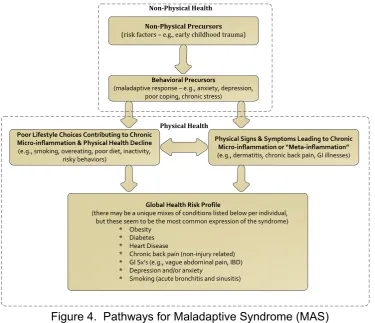
pathologic condition leading to different chronic and acute conditions with an end result
of poorer health (Figure 4). In essence, MAS is a multi-system disease and usually
affects a number of physiologic systems, organs and tissues during its course
(Jakovljevic and Ostojic 2013).
For further clarification, figure 4b depicts the mapping of NPB and its elements
from the non-physical domain into the maladaptive response and its constituents in the
physical domain. There is usually a time lag between the NPB and maladaptive
response. In addition, the NPS (clinical phase of NPB) maps into the MAS (clinical
phase of maladaptive response). In addition, MAS may consist of both medically
explained symptoms and medically unexplained symptoms. Thus, NPS contributes to
the theory of diseases in two ways. First, NPS can act together with the genetic
component as modifiers for the random stochastic processes of bodily diseases.
Second, NPS may contribute on its own, through non-random processes, as the main
root cause of other bodily diseases.
3.2 Broadened Minds
The concept of NPE can be instrumental as an integral part of developing value-added
attributes for sustainable systems. It can be formulated in such tangible terms as the
sustainability axiom of “Doing Good Is Good Business”. This axiom can be used to
can be instituted as a device to prevent and mitigate the ills of system unsustainability.
One must keep in mind that, although such an approach is the optimal path for
sustainable systems, its time frame is intended for the longer term making gains in
incremental and sure ways as opposed to non-optimal approaches which may result in
significant gains in the short run, yet, it may lead to long term disastrous outcomes.
Within the context of this research, a “sustainability axiom” is a universal
steady-state actionable plan with the intent to satisfy the needs and wants of all SEE
stakeholders during an agreed-upon period of time, without creating conflicts and
incompatibility among those needs and wants. “Doing Good And Not Doing Bad” Is
“Good Business” is an example of one of the very few sustainability axioms available
that may implement the spirit of the NPE. This axiom embodies a complex action plan
into its meanings.
a) “Doing Good” signifies the necessity of satisfying the needs and wants of all
stakeholders without exception. As one can imagine, this axiom carries a
long-term time span into it (as opposed to short fixes). It is not designed to be a
disruptive action. Indeed, the action plan will consist of an inventory of solutions
designed to incrementally and steadily improve system performance for all
stakeholders at the same time. “Doing Good” enriches the SEE stakeholders by
exploiting all potential positive energy and attributes of the system in a way to
activate the “Non-physical Enrichers” for all social agents.
b) “Not Doing Bad” is the other side of the coin for “Doing Good” with the intent to
prevent and filter out bad and wicked actions from finding entry into the SEE
system. It stipulates the criticality of avoiding conflicts and incompatibility among
and minimization of the “Non-Physical Blockers” for all social agents
representing the SEE system.
c) “Doing Good” or “Not Doing Bad” is a necessary condition but not sufficient on its
own to induce the outcome of “Good Business”. Both components are necessary
and sufficient to produce the steady and incremental outcomes of “Doing Good”.
This is essential both to activate and promote the system’s adaptive properties
and to deactivate and dampen the system’s maladaptive properties.
As an example, the above strategy may provide a balancing act for sustainable
emerging technologies such as engineered nanomaterials (ENMs) in the 21st Century,
enabling a major boost to global economic activities, while preserving and enriching
human, ecologic and economic wellbeing. For ENMs to be sustainable across the SEE
lifecycle trajectory, mental resources should be directed towards higher and diminished
states of NPE and NPB, respectively, together with a balanced state of NPI, not
impeding the harmonization of values among multiple stakeholders.
To illustrate this, it is common practice that venture capitalists in a start-up nano
company to put extreme pressure on its nano-scientists and engineers to quickly
design and manufacture ENM materials and nano-enabled products. This pressure
produced from the venture capitalists acts as feedback loops to the mental resources of
the nano-scientists and the engineers. This tends to narrow the perspective of
scientists and engineers leading to system behavior and actions, with a focus on fewer
stakeholders in the SEE system such as emphasizing human needs at the expense of
other biological species (e.g., nanomaterials may prove to be detrimental to other
species along the particle lifecycle trajectory). As a result, the perspective of other
view is required whenever a product is manufactured for human use – particularly a
consumer product. Moreover, the design of the product must be consistent with the
SSE and its trajectory.
The NPE strategy is in line with the “broaden-and-built” theory of positive
emotions which advocates that positive emotions broaden an individual’s instantaneous
thought-action reservoir (that is, interest sparks the urge to explore); and broadening an
individual’s thought-action reservoir, positive emotions promote discovery of novel and
creative actions, which in turn build the individual’s personal resources ranging from
physical and intellectual to social and psychological resources (Fredrickson 2001).
From the aforementioned discussion, one can deduce many corollaries that can
assist in the production of a detailed actionable action plan with the most appropriate
outcomes for the SEE system at hand. Currently, there is a gap in our knowledge in
regards to the sustainability axioms and their derived corollaries with the intent to
enhance the sustainability of SEE systems and to reduce vulnerabilities to sources of
unsustainability. This area deserves future research with respect to three issues: (a)
assessment of existing frameworks geared towards the sustainability of SEE systems;
(b) deduction of sustainability axioms and their derived corollaries; and, (c)
demonstration of their applicability to case studies across the different domains of SEE
to draw the lessons learned as a guide for further innovations within the sustainability
sciences.
4. Discussion and Concluding Remarks
Over the past several decades, there have been significant advances in science and
constituents of the larger SEE system are not achieving the expected improvements in
different domains (e.g., human and ecologic health) consistent with these
advancements nor with the related cost increases. This paradox may be understood in
large part due to an absence of a model that adequately describes the root causes of
sustainability/unsustainability (both positive and negative) embodied in the intrinsic and
intangible nature of human and system behavior and action. Therefore, there are still
gaps in knowledge that have not been elucidated.
These issues may be explained by a number of parameters with origin in social,
environmental, technical, geographical, and political issues that result in unsustainable
systems — systems that cannot keep pace with their basic needs, let alone the higher
needs of human populations and other constituents of the larger SEE system. Other
root causes may include, for example, a Western medicine perspective that has
traditionally compartmentalized its view of health by separating not only mental from
physical factors, but also, by further segmenting individual people into “index diseases”
rather than focusing on the whole person. This is due, in part, to the trend of medical
“specialization” that has occurred over the past 50 years or so, resulting in an
inadequate and counterproductive health management approach.
It is our view that the above approach is going in a direction away from achieving
optimum human, ecologic and economic outcomes by focusing too much on technology
and specialization as the answer for all ills. Therefore, this is limiting the ability to
adequately improve the well-being of human populations and ecosystems in a
longitudinal fashion. The work presented in this paper is foundational via its offerings of
First, the PFA model implies that human outcomes and actions, regardless of
geo-political circumstances, are determined by a number of influencers, including
“non-physical”, physical and social influencers, acting in a complex SOS to influence each
person. Though the geo-socio-economic influencers can vary, it is felt that the
pathway(s) to how these influencers impact individual outcomes and actions is
universal to all mankind.
Second, an analytic formulation has been derived from the component
interactions in the PFA architecture that explains the phenomena of a non-physical
blocker (i.e., a system behaving in a negative mode), of an enhancer (i.e., a system
behaving in a positive mode), and an indifference (or neutral system) that are
responsible for the adaptation and maladaptation of social agents, and accordingly for
the sustainability and unsustainability of SEE systems. As pointed out, additional
research is warranted to build instruments for information gathering purposes from
social agents and algorithms designed to capture the inner states of NPB, NPE and
NPI with proxy from projections on human behavior, actions and outcomes. It should be
kept in mind that the linguistic analytics presented in Figure 3a should not be construed
as a linear system when projected at the digital level. Rather, it is a non-linear system
with the linguistic processing as a device intended to manage the complexities of
non-linear relationships at the digital level.
Third, examples were presented to illustrate the model applications at the
individual level such as the non-physical and maladaptive syndromes. It has been
hypothesized that NPB can contribute to the theory of diseases in two ways as (a) a
modifier for bodily medical conditions and (b) a root cause for non-random bodily
intent to determine how to alter these responses with appropriate intervention
strategies to improve human wellbeing. It is maintained that these interventions can
divert an individual from, for example, poor health to good health if the imbalance of
influencing factors leading to the negative patterns of MAS can be recognized in time
early enough to impact its progression. Another important application is the utilization
of the NPE phenomenon in the creation of value-added benefits for emerging
technologies (e.g., ENMs) for all stakeholders of the larger SEE system. This step is
essential at the predesign stage to ensure that adequate measures have been put in
place to avoid disastrous consequences of large-scale technological artifacts. In such
situations, a sociotechnical approach is required with customization for the application
at hand.
In conclusion, if a broader view of what influences human outcomes and actions
is not considered and there remains a focus only on technology, the related expenses
will result in non-sustainable systems with negative outcomes impacting human
populations and constituents of the larger SEE system. The model of “SOS” for human
outcomes and actions, acknowledging both physical and non-physical influencers, can
serve as a roadmap for defining and executing interventions that can induce positive
change and minimize negative behavior for all stakeholders of society’s many systems.
References
Alonso, Y. 2004. “The Biopsychosocial Model in Medical Research: The Evolution of the
Health Concept Over the Last Two Decades.” Patient Education and Counseling 53:
Barabasi, A. L. 2005. “The Origin of Bursts and Heavy Tails in Human Dynamics.” Nature
435: 207-211.
Boardman, J., and B. Sauser. 2006. “System of Systems – The meaning of Of.” In
Proceedings of IEEE International Conference on System of Systems Engineering,
pp. 118-123. Los Angeles, CA.
Bonabeau, E. 2002. “Agent-Based Modeling: Methods and Techniques for Simulating
Human Systems.” Proceedings of National Academy of Sciences, USA 99:
7280-7287.
Borrell-Carrio, F., A. L. Suchman, and R. M. Epstein. 2004. “The Biopsychosocial Model
25 Years Later: Principles, Practice and Scientific Enquiry.” Annals of Family
Medicine 2: 576-582.
Brown, T. M. 1989. “Cartesian Dualism and Psychosomatics.” Psychosomatics 30(3):
322-331.
Cohen, A. 1987. “Heat, Stress, and Workload in an Era of Workplace Change”,
Ergonomics and Human Factors, Edited by L. S. Mark, J. S. Warm, and R. L.
Huston, Springer-Verlag, New York, pp. 155-169.
Dember, W. N., J. J. Jenkins, and T. J. Teyler. 1984. “The Group: Social Roles and
Social Impact”, Chapter 18, General Psychology, Second Edition, Wm. C. Brown,
Dubuque, IA, pp. 731-739.
Dember, W. N., J. J. Jenkins, and T. J. Teyler. 1984. “The Group: Social Interaction”,
Chapter 19, General Psychology, Second Edition, Wm. C. Brown, Dubuque, IA,
Depledge, M. H., R. J. Stone, and W. J. Bird. 2011. “Can Natural and Virtual Environments
Be Used to Promote Improved Human Health and Wellbeing?” Environmental
Science and Technology 45: 4660-4665.
DiMario, M. J., J. T. Boardman, and B. J. Sauser. 2009. “System of Systems Collaborative
Formation.” IEEE Systems Journal 3: 360-368.
Engel, G. L. 1977. “The Need for a New Medical Model: A Challenge for Biomedicine."
Science 196 (4286): 129-136.
Engel, G. L. 1992. “How Much Longer Must Medicine's Science Be Bound by a
Seventeenth Century World View?” Psychotherapy and Psychosomatics 57: 3-16.
Fiksel, T., A. D. Graedel, D. Hecht, D. Rejeski, G. S. Sayer, P. M. Senge, D. L.
Swackhamer, and T. L. Theis. 2009. “EPA at 40: Bringing Environmental Protection
into the 21st Century.” Environmental Science and Technology 43: 8716-8720.
Fredrickson BL (2001) The role of positive emotions in positive psychology: The broaden-and-build theory of positive emotions. Am. Psychol. 56, 218.
Genaidy, A., Karwowski, W. and Shoaf, C, 2002, The Fundamentals of Work System
Compatibility Theory: An Integrated Approach to Optimize Human Performance
at Work, Theoretical Issues in Ergonomics Science, 3 (4), 346-368.
Genaidy, A., Salem, W., Karwowski, W., Paez, O., Tuncel, S., 2007, The Work
Compatibility Improvement Framework: An Integrated Perspective of The
Human-At-Work System, Ergonomics, 50 (1), 3-25.
Gorod, A., B. Sauser, and J. Boardman. 2008. “System-of-Systems Engineering
Management: A Review of Modern History and a Path Forward.” IEEE Systems
Journal 2: 484-499.
the United States: Insights for a Sustainable Health Care System and Building
Healthier Lives.” Population Health Management 16: 381-389.
Greene, R. A., E. Dasso, S. Ho, and A. M. Genaidy. 2014. “A Person-Focused Model of
Care for the Twenty-First Century: A System-of-Systems Perspective.” Population
Health Management 17: 166-671.
Hancock, P. A. 1987. “Arousal Theory, Stress and Performance: Problems of
Incorporating Energetic Aspects of Behavior into Human-Machine Systems
Function”, Ergonomics and Human Factors, Edited by L. S. Mark, J. S. Warm,
and R. L. Huston, Springer-Verlag, New York, pp. 170-179.
Homer, J. B., and G. B. Hirsch. 2006. “System Dynamics Modeling for Public Health:
Background and Opportunities.” American Journal of Public Health 96: 452-458.
Janssen, M. A., B. H. Walker, J. Langridge, and N. Abel. 2000. “An Adaptive Agent Model
for Analyzing Co-evolution of Management and Policies in a Complex Rangeland
System.” Ecological Modelling 131: 249-268.
Jager, W., M. A. Janssen, H. J. M. De Vries, J. De Greef, and C. A. J. Vlek. 2000.
“Behavior in Commons Dilemmas: Homo Economicus and Homo Psychologicus in
an Ecological-Economic Model.” Ecological Economics 35: 357-379.
Jakovljevic, M., and L. Ostojic. 2013. “Comorbidity and Multimorbidity in Medicine Today:
Challenges and Opportunities for Bringing Separated Branches of Medicine Closer
to Each Other.” Psychiatra Danubina 25(1): 18-28.
Karwowski, W. 2012. “A Review of Human Factors Challenges of Complex Adaptive
Systems Discovering and Understanding Chaos in Human Performance.” Human
Organization for Economic Co-operation and Development (OECD). 2012. Important
Issues on Risk Assessment of Manufactured Nanomaterials. Paris: OECD
Environment, Health and Safety Publication Series on the Safety of Manufactured
Nanomaterials Report No. 33.
Pentland, A., and A. Liu. 1999. “Modeling and Prediction of Human Behavior.” Neural
Computations 11, pp. 229-242.
Shilling, C., and P. A. Mellor. 1996. “Embodiment, Structuration Theory and Modernity:
Mind/Body Dualism and the Repression of Sensuality.” Body and Society 2(4): 1-15.
Simon, H. A. 1995. “A Behavioral Model of Rational Choice.” Quarterly Journal of
Economics 69: 99-118.
Simon, H. A. 1956. “Rational Choice and the Structure of the Environment.” Psychological
Reviews 63: 129-138.
Simon, H. A. 1967. “Motivational and Emotional Controls of Cognition.” Psychological
Reviews 74: 29-39.
Sperry, R. W. 1980. “Mind-Brain Interaction: Mentalism, Yes; Dualism, No.” Neuroscience
5: 195-206.
Starfield B. Is patient care the same as person-focused care? Permanente J 2011;
15(2):63-69.
Tolaymat, T., A. El Badawy, R. Sequeira and A. Genaidy. 2015. “A System-of-Systems
Approach as a Broad and Integrated Paradigm for Sustainable Engineered
Nanomaterials.” Science of Total Environment 511: 595-607.
Williams, P. R. D., G. S. Dotson, and A. Maier. 2012. “Cumulative Risk Assessment
(CRA): Transforming the Way We Assess Health Risks.” Environmental Science
Non-Physical Health Resources
Physical Health Resources
Social Health Resources
Part a
Factor N
Factor A
Factor K
Factor M Factor
S
Factor A’ Factor
N’
Human Body Non-physical Domain
in Whole Person
Physical Domain in Whole Person Interface
Non-physical Domain External to Whole Person
Entities External to Whole Person (People, Environment, Th ings) Interface
Part b
e.g., Distress e.g., Hope
e.g., Despair e.g., Tranquility Level of Activation
Type of Energy Low
High
High Negative High Positive
Low Negative Low Positive
Positive Negative
Part a
Force Magnitude
Thinking mode Low
High
High Negative High Positive
Low Negative Low Positive
Positive Negative
Part b
Vulnerable
A = N
Suboptimal N+ N-A- A+ Long Term Short Term High A-High N+ Low A-High N+ Low A+ High N+ High A+ High N+ High A-low N+ Low A-low N+ Low A+ low N+ High A+ low N+ High A-low N-Low A-low N-Low A+ low N-High A+ low N-High A-High N-Low A-High N-Low A+ High N-High A+
High N- NPE
NPB NPI
Part a
A = N N+
N-A- A+
Part b
Figure 3. Analytic perspective of component interactions. (a) Interaction of factors A and N. (b) Influence of factor S on factor K (i.e., effect on state of factor K after the
Non-PhysicalPrecursors (risk factors – e.g., early childhood trauma)
Behavioral Precursors
(maladaptive response – e.g., anxiety, depression, poor coping, chronic stress)
Poor Lifestyle Choices Contributing to Chronic
Micro‐inflammation & Physical Health Decline
(e.g., smoking, overeating, poor diet, inactivity, risky behaviors)
Physical Signs & Symptoms Leading to Chronic
Micro‐inflammation or “Meta‐inflammation”
(e.g., dermatitis, chronic back pain, GI illnesses)
Global Health Risk Profile
(there may be a unique mixes of conditions listed below per individual, but these seem to be the most common expression of the syndrome)
* Obesity * Diabetes * Heart Disease
* Chronic back pain (non‐injury related) * GI Sx’s (e.g., vague abdominal pain, IBD) * Depression and/or anxiety
* Smoking (acute bronchitis and sinusitis) Non-PhysicalHealth
PhysicalHealth
Figure 4. Pathways for Maladaptive Syndrome (MAS)