IMPLEMENTATION OF PERVASIVE
COMPUTING BASED HIGH-SECURE
SMART HOME SYSTEM
Ventylees Raj.S,
ME-Pervasive Computing Technologies, Kings College of Engg, Punalkulam. Pudukkottai,India,[email protected]
Abstract:
In recent year, the home environment has seen a rapid introduction of wireless communication network enabled advance computing technologies. In this paper I mainly focus on the monitoring of smart home remotely and providing security when user is away from the home. The proposed security algorithm is combining of Biometrics, public key encryption and SMS based security alarm system. In the proposed security algorithm offered only Authenticate person monitoring home appliances via wireless networks. In the proposed pervasive monitoring system it provides security against intrusion as well as it automates various home appliances using SMS. Zigbee IEEE 802.15.4 based Sensor Network, GSM and Wi-Fi wireless networks are embedded through a standard Home gateway. This home gateway controls the overall wireless communication of smart home systems. The pervasive computing environment created by the smart Sensors, wireless networks and context-aware routing protocol for wireless sensor networks. Each smart Sensor node should have multipath routing protocol to automatically establish the wireless networks between Smart Nodes. To develop a new on-demand context-aware routing protocol for the smart home system, here this paper introduces the pervasive computing based smart home monitoring system’s design that provides secure smart services to users, and demonstrates its implementation using a real time environment.
Keywords: Smart Home, GSM, WI-Fi, Zigbee, context-aware, Smart Sensor, and Pervasive Computing.
1. INTRODUCTION
In recent years the environment devices can be converted into smart devices using by computing technologies. Pervasive computing vision is environments that are getting saturated with computing and communication capability, yet gracefully integrated with human users. The objective of this paper is to provide a cost effective solution that will provide security and controlling of Home appliances remotely. Security is considered a major issue when it comes to the smart home system. In the recent years a number of pervasive systems and algorithms were implemented and proposed for security measurements based on wired networks. In many papers, researchers suggested a number of security systems based on new technologies such as GSM (Global System for Mobile Communication), GPRS (General Packet Radio Service), Internet, Ubiquitous sensor networks and Microcontroller unit.
1.1. Analysis of the Existing Systems
Many definitions exist for smart home system available in the literature. [1] Explains the home automation system using GSM, Internet and speech recognition. In this system the home gateway is taken as the internet which requires a personal computer (PC). However, it's hard to manage PC and keep it ON all the time. Also it consumes large amounts of energy. The system presented in. [2] Describes a Java equipped mobile based home automation system. Although the research proposes an embedded home server but still it requires internet connectivity for GPRS. Moreover, in all these systems wired sensors are connected to processors those are not only hard to install and difficult to move once installed but also increase cost and labors. [3] In this referred paper it introduced a Bluetooth based home automation system, which consists of a primary controller with few numbers of Bluetooth controllers. Each home device is physically connected to a local Bluetooth sub-controller. The home devices communicate with their corresponding sub-controller using wired communications. From this sub-controller all communications are sent to the primary controller with the help of wireless communications. It is essential for each home device to have a dedicated Bluetooth module.
gateway and virtual home. This checking process involves communication with the home network coordinator, which is integrated with the database of the home’s device and it contains the status of all the connected devices. Once checked the communications are sent to the home automation system and the respective device. Additionally, a local ZigBee based remote control mechanism can be used to directly control all other devices connected. [6] Describes home automation as the introducing the technologies within the home to enhance the quality of life of its inhabitants, through the availability of different services such as SMS, multimedia entertainment and power conservation.
1.2. Features of the proposed System
The system presented in this paper is a combination of Zigbee, BAN (Body Area Network), GSM and Wi-Fi (Internet). Zigbee offers wireless connection of the sensors with control panel while GSM provides wide coverage as GSM association estimates 92% of the global mobile market using the GSM standard. The proposed system provides reliable security, effortless installation and anywhere access. Sensors and actuators use wireless Zigbee communication for sending information to control panel which makes the system easy to install. Control panel, which is acting as a home gateway, controls the operation of the automation system. In this work neither computer nor internet connection is required, once programmed, thus ensuring easy installation and portability. In my model proposed uses the wireless controlling methods which are possible via,
GSM Networks
Internet
Zigbee Sensor Network
The offerings of our projects are as follows, First, to suggest a more Zigbee based on wireless sensor networks and design it to be more adaptive with a network service component based approach. Secondly, to gain adaptive control of smart sensors and sensing infra developing a new sensor routing protocol. Third, newly design control unit using by embedded technology and show how read smart home system operate and are implemented successfully in our proposed systems.
2. SYSTEM ARCHITECTURE
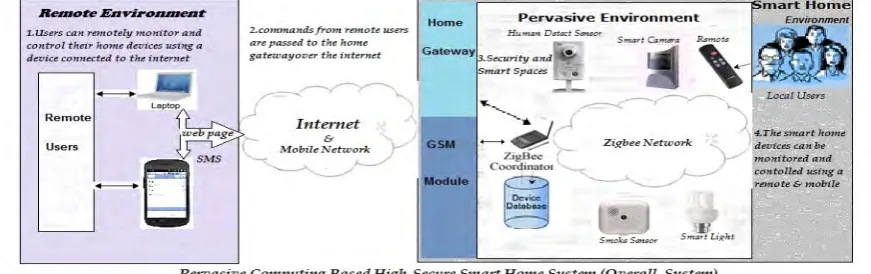
This section elaborates the conceptual design of a flexible and low cost Smart Home infrastructure (see Figure overall system). The home’s low data rate, control and monitoring needs are deployed using Zigbee. The home’s high data rate requirements, such as multimedia applications, are met by the Wi-Fi (IEEE 802.11g) and GSM standard. A home gateway is established to provide interoperability between the heterogeneous Zigbee and Wi-Fi networks, and provides local and remote control and monitoring over the home’s devices. Remote users can access the system using the Internet. The remote users’ communications pass over the internet until they reach the home network. They are then wirelessly transmitted using the homes Wi-Fi network to the Home Gateway.
The Home Gateway is integrated with a home server. These communications are checked and processed by the home gateway and GSM Module. This checking process involves communication with the home network coordinator, which is integrated with the home’s device database and contains the occasion of all connected devices. Once checked the communications are sent to the computing based smart home and also to the appropriate device.
2.1Pervasive Environment
Pervasive computing is the upcoming technique which embeds the microprocessors in everyday objects so they can communicate information. The terms pervasive and ubiquitous mean "existing everywhere." Pervasive computing devices are completely connected and constantly available. The ultimate aim of the researchers working in pervasive computing is to create smart products that communicate modestly. The products are connected to the Internet and the data the data’s generated by it are easily available.
3. SYSTEM IMPLEMENTATION
The proposed system implementation is illustrated in Figure 1. As depicted, a Pervasive computing based smart home system is implemented for the perceiving and control of household devices. To cater for the household’s high data rate requirements, such as multimedia entertainment, a Wi-Fi network is implemented. A home gateway has been developed to provide interoperability between these networks. The home gateway contains a unified interface for users to locally and remotely access home networks. The security and safety of the smart home network are realized through the development of the earlier described pervasive environment on the Home Gateway. To demonstrate the feasibility and effectiveness of the proposed system for smart devices, a light switch, smart fan, smart sensors, GSM networks and ZigBee remote control system have been developed and integrated with the smart home automation system.
3.1. Communication units
3.1.1. Zigbee Technology
ZigBee is a radio frequency (RF) communications standard based on IEEE 802.15.4. Fig2 depicts the general architecture of a Zigbee based home network. The Zigbee coordinator is responsible for formulating and maintain the network. The ZigBee home automation network consists of a coordinator, routers for the purpose of routing in communication and several end devices. The coordinator is responsible for starting the ZigBee network. During the network initialization phase, the coordinator scans the available radio channels to find the relevant one. Usually, this will be the channel with the least number of active channels, in order to reduce the level of interference. It is possible to limit the channels scanned, for example excluding that frequency ranges used by the Wi-Fi network included in the proposed architecture.
The ZigBee devices developed for the home network, as mentioned, includes a light switch, safety sensor and ZigBee remote control. A ZigBee end node has been integrated with these devices. As the devices are started, during their respective initialization stage, the node scans for available channels to identify the network it wishes to join. There may be multiple networks in the same channel; these networks are normally distinguished by their PAN ID. The node selects which network to join based on the PANID. The node sends a request to the network coordinator to join the network. The request is sent to the coordinator directly or through a neighboring router on the desired network with which the node shares the best signal. On receipt of the request the coordinator judges whether the requesting device is permitted to connect to the smart home network.
3.1.2. Wi-Fi Technology
The homes Wi-Fi network was implemented through a standard Wireless (802.11b and 802.11g) ADSL Modem Router, with a 4 port switch. The modem provides two primary functions. Firstly, the modem provides the connection between the Internet and local Wi-Fi network; hence extending access to the Wi-Fi enabled home gateway to any location with Internet access. Secondly, any local Wi-Fi enabled device within range of the home’s Wi-Fi network can directly access the home gateway. This provides a low cost communication method with the home network, reduced infrastructure costs where Wi-Fi devices are already in use. Moreover, homeowners can monitor and control the smart home network, using familiar technology and devices.
3.1.3. GSM Technology
(Attention) commands. Sending and receiving SMS messages are all performed in the PDU (Protocol Description Unit) mode since the text mode may not be available on all GSM modules. For the mobile most part, interactive software has been developed in J2ME [8]. This software can be used on any mobile phone that supports Java. By using this software, the user can interact with the smart home simply by selecting the correct commands from the mobile’s menus.
3.2. Security Units
The privacy and security are very less in the existing home automation system. So I took it as a challenge for my proposed smart home. This paper implemented new Smart Secure algorithm for Smart Home System using by pervasive computing technologies.
3.2.1. Smart Secure Algorithm
Security is considered a major issue when it comes to a smart home system with the computing environment. Our proposed new security algorithms named as “SSA” (Smart Secure Algorithm) in use Smart home system. It works as next follows,
Step1: press to start button in the digital smart door lock system
Step2: get the thump fingerprint image from the secure person and sense the finger by Smart Sensor Step3: the fingerprint image will check and match the image in the database engine
Step4: If the image match in the database, the next step will be preceded else error message will display Step5: If the above step is cleared, then get four digit secret number from secure person
Step6: from the four digit secret number, the database engine will combine that fingerprint image and the four Digit password into a single encrypted data by MD5 and Biometrics security algorithms
Step7: there process will do in database engine and check the final image in this database using by queries. If it matches means digital door will open else error message displayed.
Step8: if the door opens, all smart sensors and gsm module will be activated and the human defect sensor will identify the secure person
Step9: after the door open and smart sensor activated, a message will be sent to all secure users of the database registered users. For eg:-“venty is open the door at 10.10 am”
Step10: If the not secure person inside the home, the hidden camera activated by human detect sensors and captured MMS image sent to the database users. The secure user will lock the door remotely by using SMS service.
After the door open, the secure person will be entered. He will be getting an advantage by different pervasive environment. It will be seem to be as follows,
The human detects sensors will detect the body temperature of secure person and the AC will activate automatically. If the friends of a security person can’t use this facility
The special facilities of this smart home are smoke sensor to detect the gas leakage. If the gas leak in presence of secure person, the alarm will be activated. If he will not present an SMS will indicate to the secure users.
All smart home appliances are controlled by the pervasive environment of the smart control system with human needs
3.3. Control units
The control unit contains the software component such as the smart home device control system through which the appliances are supervised. Microcontroller being the primary module has smart home device control system installed on it. Fig. 3 shows the block diagram of control unit having Zigbee connected to the smart home appliances to be controlled.
3.3.1. Smart Context-Aware Routing Protocol
Smart Sensors controlling appliances and electrical devices in the Smart Home. Smart Sensors are Human detection sensor, Temperature sensor, Gas detection sensor etc... The pervasive computing environment created by the smart Sensors, wireless networks and context-aware routing protocol for wireless sensor networks. Each smart Sensor node should have multipath routing protocol to automatically establish the wireless networks between Smart Nodes. Wireless sensor networks promise to deliver resilient connectivity between network nodes, allowing data to be relayed seamlessly between mobile clients and infrastructure. Routing is a vital process in achieving self-configuration, self-healing and, to some degree, self-optimization. However, the heterogeneity of network nodes and highly dynamic network topologies create new challenges for developing efficient and adaptive routing solutions. The increasing amount and complexity of information that routing solutions have to consider, in order coping with the changing network situation and/or user requirements, is a key challenge.
Each sensor node should have a multipath context-aware routing protocol to remotely establish the wireless communication between smart nodes. To develop a new on-demand routing protocol named as “SCAR “(Smart Context-Aware Routing Protocol)”. Our proposed routing protocols are difficult to adapt dynamic topology fluctuations and to interact with our smart home control system. To design a new routing protocol specifically for home networks. Our proposed SCAR protocol establishes the wireless networks, based on the Kruskal's algorithm [9] value measured from the RF radio. This thought of using the measure for the routing purpose has been established in the ZigBee PAN standard as well, but it is different from our SCAR protocol in that an on-demand approach is used there to build a wireless communication routing path and therefore many control packets are frequently demanded. However, these smart devices have not been integrated into computer systems supporting automatic smart device control and must be manually traveled through different points in place. Kruskal's algorithm is a graph theory algorithm that detects a minimum spanning tree for a connected weighted graph. This means it finds a subset of the smart node that makes a network that includes every smart device, where the full energy level of all the smart nodes in the Zigbee network is minimized. If the Zigbee network is not connected, then it finds a minimum spanning network (a minimum spanning tree for each connected nodes). Fig.4 illustrates a proposed SCAR in use Smart home system.
Users can easily see the sensor network topology established in the smart home, since each data packet contains its forwarded routing path list in the packet header. Using this routing path list our smart home system can discern the routing path from the system for each smart node. We utilize the B-MAC protocol for shared data access, and a special narrow-band Radiofrequency device that supports the Kruskal’s algorithm value, based on the IEEE 802.15.4 WPAN standard. We also develop a new topology spectator program to show the established smart node topology in our smart home system
3.3.2. Home Gateway
The home gateway is charged with providing interoperability between different connecting wireless networks. The home gateway provides two main functions for the proposed smart home architecture. Firstly, the home gateway renders data communication services between the Internet and ZigBee network technologies. Secondly, the home gateway provides a standardized user interface for smart devices connecting to the Smart home network, locally using the Wi-Fi network or remotely using the Internet services. The home gateway does not provide a standardized interface for the local ZigBee remote control (See Fig overall system).
4. CONCLUSION
5. REFERENCES
[1] Bares Yuksekkaya, M. Bilgehan Tosun, M. Kaan Ozcan and Ali Ziya Alkar. "A GSM, Internet and Speech Controlled Wireless Interactive Home Automation System" IEEE Transactions on Consumer Electronics, Vol.52 No. 3, pp: 837-843, 2006.
[2] M. Van Der Werff, X. GUI and W.L. Xu. "A Mobile-Based Home Automation System" 2nd International conference on mobile technology, Applications and systems. Pp 1-5,2005.
[3] N. Sriskanthan, F. Tan and A. Karande, "Bluetooth based home automation system", Microprocessors and Microsystems, Vol. 26, no. 6, pp. 281-289, 2002.
[4] H. Ardam and I. Coskun, "A remote control for home and office appliances by telephone", IEEE Transactions on Consumer Electronics, Vol. 44, no. 4, pp. 1291-1297, 1998.
[5] Khusvinder Gill, Shuang-Hua Yang, Fang Yao, and Xin Lu,”A ZigBee Based Home Automation System”, IEEE Transactions on Consumer Electronics, Vol. 55, No. 2, MAY 2009
[6] Minal S.Khandare,Anjali Mahajan " Mobile Monitoring System For Smart Home",3rd International conference on Emerging Trends in Engineering and Technology.IEEE 2010
[7] INKA research group. INKA research group "Information and Communication Systems". [Online]. http://inka.htw-berlin.de/ [8] http://oracle.com/Java APIs (2012).
[9] Joseph. B. Kruskal,”On the Shortest Spanning Subtree of a Graph and the Traveling Salesman Problem,” In Proceeding of the American Mathematical Society, Vol. 7, no. 1, pp. 48–50, Feb.1956.