http://www.pharmacophorejournal.com 158
Pharmacophore
(An International Research Journal)
Available online at http://www.pharmacophorejournal.com/
Original Research Paper
STABILITY INDICATING RP-HPLC METHOD FOR ESTIMATION OF
VOGLIBOSE IN BULK AND TABLET DOSAGE FORM
Shubhangi C. Daswadkar
1*, Sanjay G. Walode
2and Mahendra Kumar CB
3 1Dept of Pharmaceutical Chemistry, Padm. Dr. D. Y. Patil College of Pharmacy,
Akurdi, Pune-411044, Maharashtra, India
2
Dept of Pharmaceutical Chemistry, Sinhgad Institute of Pharmaceutical Sciences,
Kusgaon (Bk), Lonavala, Pune- 410 401, Maharashtra, India
3
Dept of Pharmaceutical Chemistry, St. Mary’s College of Pharmacy, H.No.9-1-248,
St. Francis Street, Secunderabad-500025, Andhrapradesh, India
ABSTRACT
A simple, economic, selective, precise, and stability-indicating HPLC method has been developed and validated for analysis of voglibose both in bulk drug and tablet dosage form. The drug was separated using a mobile phase acetonitrile: water, (20:80 v/v) on an Agilent, TC C18 (250 × 4.6 mm) 5μm column at flow
rate of 1.0 ml/min at ambient temperature and detection was performed at 272 nm. The retention time was 3.17 ± 0.01 min for voglibose. The detector linearity was established in concentrations ranging from 10-70µg/ml, the regression coefficient was 0.9992. For stability study, the drug was exposed to the stress conditions such as acid, base, oxidation, neutral and sunlight as per the recommendations of ICH guidelines. The results of the analysis were validated in terms of specificity, limit of detection, limit of quantification, linearity, precision and accuracy As per ICH guidelines and were found to be satisfactory. The high recovery and low relative standard deviation confirm the suitability of these methods can be employed for the routine analysis of tablet containing voglibose.
Keywords:
Voglibose, RP-HPLC, Acetonitrile, Stability indicating, ICH, Validation.INTRODUCTION
Voglibose (figure 1), 3, 4-Dideoxy-4-[2-hydroxy-1-(hydroxyl methyl) ethyl] amino-2-c (hydroxyl methyl)-D-epiinositol, a new potent α-glucosidase inhibitor used for type- 2 diabetes, has shown strong anti-obesity and anti-diabetic activity. Alpha-glucosidase inhibitors are agents that delay the glucose absorption at the intestinal level and thereby prevent sudden surge of glucose after a meal. Voglibose is the safest and most effective drug of its class.1-3 Voglibose obtained from organic synthesis processes is similar to structurally related carbohydrates found
http://www.pharmacophorejournal.com 159
RP-HPLC method for the estimation of voglibose in bulk drug and tablet. The method was further optimized and validated in accordance with guidelines suggested by International Conference on Harmonization (ICH).18,19
MATERIALS AND METHODS
Authenticate voglibose sample was a kind gift from Ranbaxy Research Laboratory, Gurgaon, India. HPLC grade water and acetonitrile (Merck Ltd, Mumbai, India) was used as solvent. All the aqueous reagents were prepared using carbon dioxide free distilled water.
Instrumentation
The HPLC system, Agilent 1120 compact with manual Rheodyne injector facility operates at 20 μL capacity per injection was used. The column used was Agilent TC C18 (250 X 4.6 mm) 5μm and
the detector consisted of UV/VIS operated at 272 nm. The instrumentation was controlled by use of EZChrom Elite Compact software.
Chromatographic Conditions
Optimization of chromatographic conditions was carried out using water: acetonitrile (80:20 v/v) as mobile phase. Prior to deliver into the system, mobile phase was filtered through 0.45 μm filter and sonicate for 10 min. The samples were introduced by injector with a 20 μL sample loop. The analysis was carried out under gradient conditions using flow rate 1.0 mL/min at 18 0C and chromatograms were recorded at 272 nm.
Standard Solutions
Preparation of standard stock solution
Weighed accurately 10 mg of voglibose and transferred to 100 ml volumetric flask, add 25 mL of mobile phase and sonicate for 15 min and volume was made up to mark with mobile phase (100 µg/mL).
Preparation of standard solution
From the standard stock solution 1mL solution was pipetted out in 10 mL volumetric flask and volume was made up to the mark with mobile phase to get a final concentration 10 µg/mL.
Preparation of Sample Solutions
Twenty tablets of voglibose were weighed, triturated, mixed thoroughly and average weight of
tablet was calculated. Accurately weighed quantity of tablet powder equivalent to 0.3 mg of voglibose (label claim) was transferred to 10 mL volumetric flask, added 5 mL of mobile phase and sonicate for 10 min. The resultant solution was filtered through 0.45μ membrane filter, diluted to volume with mobile phase and injected to HPLC system. The amount of drug present in the sample solutions were determined using calibrated curves of standard voglibose (table 1).
Method Validation
http://www.pharmacophorejournal.com 160
a measure of the performance of a method when small and deliberate changes are made to the conditions of method. Robustness was determined by changing the mobile phase flow rate to 0.8 and 1.2 mL min−1 and the concentration of acetonitrile in the mobile phase to 18 and 22%.
Force Degradation Studies
Specificity is the ability of method to measure the analyte response in the presence of degradation products. Forced degradation studies were performed on for voglibose bulk drugs. The specificity of the method was determined by exposing a solution of the sample to acidic (0.1 M HCl), basic (0.1 M NaOH), oxidizing (3% H2O2),
UV light and dry heat stress conditions to determine the ability of the proposed method to separate voglibose from degradation products generated during forced decomposition studies. The resulting solutions were then analyzed and the analyte peak was evaluated both for peak purity and for resolution from the nearest eluting peak. For UV studies, study period was 7 days where as for acid, base, dry heat and oxidation it was 24 hrs. Peak purity test was carried out on the stressed samples by using PDA.
RESULTS AND DISCUSSIONS
Optimization of Chromatographic Method
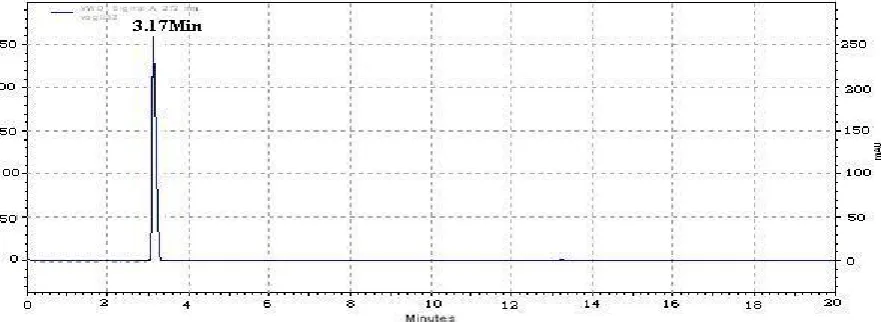
Figure 2shows an LC elution of voglibose. During the development phase, the mobile phase containing methanol water resulted in broad and asymmetric peak with a greater tailing factor (>2). The successful use of acetonitrile and water resulted in drastic reduction of peak tailing, which was found to be within the acceptable limit (1.11) resulting good peak symmetry and resolution. The mobile phase optimized contained water and acetonitrile (80: 20) at 1.0 mL/min flow rate. The retention time was found to be 3.17 min for voglibose. There were no interferences at drug retention time. Voglibose was determined using high performance liquid chromatography with UV detector and found to be well suited technique for the analysis.
Method Validation
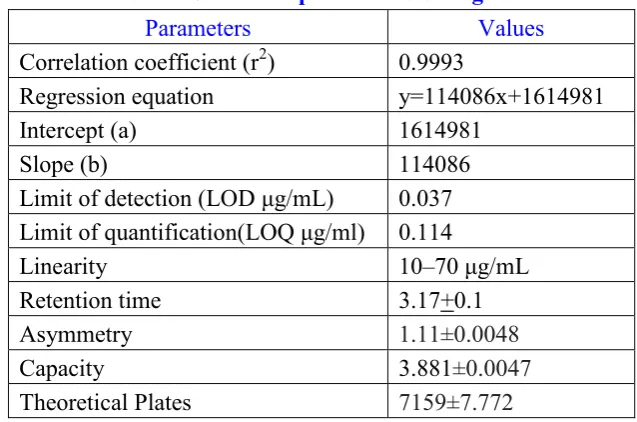
The retention time of voglibose was 3.17+0.1 min., asymmetry 1.11, Capacity factor 3.881 and
theoretical plates 7159. The mobile phase is water: acetonitrile (80:20) was selected as optimized mobile phase, because of the high purity, asymmetry, proper tailing, high area and low Rt value at same concentration as compared to other trail mobile phase. Voglibose showed a good linear relationship over the concentrations level ranging from 10-70 μg/mL as summarized in (figure 3) and (table 2) The limit of detection (LOD) and the limit of quantification (LOQ) of voglibose were found to be 0.037 and 0.114 μg/ml indicates that method is sensitive (table 2) by scanning the solution of voglibose having different lower concentrations. Inter‐day as well as intra‐day replicates of voglibose, gave an R.S.D. below 0.770 revealed that the proposed method is highly precise. Accuracy and precision calculated during the intra‐ and inter‐day run are given in (table 3). Extraction efficiency was performed to verify the effectiveness of the extraction step and the accuracy of the proposed method. The extraction efficiency of voglibose from formulation samples was satisfactorily ranged from 98.89 to 100.30 % (R.S.D. was less than 1.13) at all three concentration levels, which confirm no interference effects due to formulation excipients (table 4). The method was found to be robust with respect to flow rate and change in mobile phase composition without any changes in system suitability parameters (table 5).The proposed RP-HPLC method was accurate, precise, sensitive and rapid. The method also can be extended for the routine analysis of voglibose in tablet dosage form.
Force Degradation Study
The specificity of the method was determined by exposing a solution of voglibose to stress conditions, i.e. 0.1 M HCl, 0.1 M NaOH, 3% H2O2, UV light and dry heat. There was no
degradation of VGB in the presence of 3% H2O2,
http://www.pharmacophorejournal.com 161
treatment with 0.1 M HCl and 0.1 M NaOH is shown in (figure 4 and figure 5). A degradation products (peak 1 of figure 4) eluted with a retention time of 1.59 ± 0.03 min and (peak 2 of figure 5) eluted with a retention time of 3.95 ± 0.06 min. Undegraded voglibose (peak 1, Rt 3.17 min in figure 4 and peak 2 figure 5) were compared and found to be similar with regard to appearance. This indicated the specificity of the method. The results from stress testing, including separation of the degradation product and
quantification of voglibose after exposure to stress conditions show the method is stability-indicating.
CONCLUSION
The proposed method is highly sensitive, reproducible, specific and rapid. The method was completely validated showing satisfactory data for all the method validation parameters tested. As the method able to separate the parent drug from degradation products it can be employed as a stability indicating method for voglibose.
Table 1: Assay data of marketed formulation
Table 2: Statistical parameters of voglibose
Parameters Values
Correlation coefficient (r2) 0.9993
Regression equation y=114086x+1614981
Intercept (a) 1614981
Slope (b) 114086
Limit of detection (LOD μg/mL) 0.037 Limit of quantification(LOQ μg/ml) 0.114
Linearity 10–70 μg/mL
Retention time 3.17+0.1
Asymmetry 1.11±0.0048
Capacity 3.881±0.0047
Theoretical Plates 7159±7.772
Note: r2 is correlation coefficient, LOD is the limit of detection and LOQ is limit of quantification
Table 3: Precision and accuracy data for voglibose
* indicates mean of three replicates, SD is standard deviation. RSD is Relative standard deviation
Formulation Amount present (mg)
Amount found (mg) %Amount found %RSD Average %RSD
Volix
0.3 0.301 100.33 0.66
0.65
0.3 0.299 99.67 0.57
0.3 0.303 101.00 0.73
Parameters % Estimated S.D. % RSD
Intra-day*
100.20 0.031 0.309
100.19 0.060 0.085
100.01 0.077 0.770
Inter-day*
99.90 0.046 0.46
100.15 0.073 0.182
http://www.pharmacophorejournal.com 162
Table 4: Recovery study data
Table 5: Robustness data for Voglibose
Parameters % Recovery S.D. % RSD
Change in flow rate (10 ± 0.2 mL/ min )
99.87 0.009 0.09
Mobile Phase Composition (80:20) ±2 of Each Phase
100.03 0.013 0.13
Table 6: Summary of forced degradation of Voglibose
HO
OH HO
HO
OH
N H
OH
OH
Figure 1: Structure of voglibose
Figure 2: Chromatogram of Voglibose
Level of standard addition (%)
Amount of tablet powder (mg)
Amount of pure drug added (mg)
Amount of pure drug recovered (mg)
% Recovery
% RSD
80 0.3 0.24 0.534 98.89 1.1236%
100 0.3 0.3 0.601 100.16 0.8486%
120 0.3 0.36 0.662 100.30 0.4531%
Stress conditions
Voglibose Retention
time
Degradants Retention
time
Voglibose remaining (μg/mL)
Amount recovered (%)
0.1 M HCl 3.17 1.59 8.38 83.8
0.1 M NaOH 3.17 3.95 7.10 71.0
3% H2O2 3.17 --- 10.02 100.2
UV Light 3.17 --- 9.95 99.50
http://www.pharmacophorejournal.com 163
Figure 3: Calibration Curve of Voglibose
Figure 4: Chromatogram obtained in the presence of 0.1M HCl (peak 1, Rt 1.59min; peak 2,
Rt3.17min
Figure 5: Chromatogram obtained in the presence of 0.1M NaOH (peak 1, Rt3.17min; peak 2,
Rt3.95min)
REFERENCES
1. Hayaishi-Okano, R; Hori, M; Kajimoto, Y; Katakami, N; Kosugi, K; Matsuhisa, M and Yamasaki, Y (2005), “α-Glucosidase inhibitor reduces the progression of carotid intima-media thickness”, Diabetes Res. Clin. Pract., Vol.67 (3), 204-210.
http://www.pharmacophorejournal.com 164
(1,5AG) level” , J. Diabetes Complicat, Vol.18(3), 183-186.
3. Ploybutr, S; Tunlakit, M; Vichayanrat, A and Watanakejorn, P (2002), “Efficacy and safety of voglibose in comparison with acarbose in type 2 diabetic patients”, Diabetes Res. Clin.
Pract.,Vol.55 (2), 99-103.
4. Ding, LS; Ishurd, O; Pan, YJ; Sun, CR and Zhang, H (2004), “Determination of the structures of four new isomeric cyclitols”,
Carbohydr. Res., Vol.339 (11), 2027-2030.
5. Chen, X; Shen, Y and Zheng, Y (2006), “Voglibose (Basen, AO-128), one of the most important alpha-glucosidase inhibitors”, Curr.
Med. Chem., Vol.13 (1), 109-116.
6. Bagyalakshmi, J; Rao, NM and Ravi TK (2010), “Development and validation of spectrofluorimetric method for the estimation of voglibose in bulk and pharmaceutical dosage form”, International Journal of
Pharmaceutical Sciences and Research,
Vol.1 (6), 95-102.
7. Bagyalakshmi, J; Kumar, KR; Mogili, R; Rao, NM and Ravi TK (2010), “RP-HPLC method development and validation for estimation of Voglibose in bulk and tablet dosage forms”, Int. J. Res. Pharm. Sci., Vol.1 (2), 190-194.
8. Prasad, AVSS; Ramakrishna, K; Raman, NVVSS and Reddy, KR (2009), “Development and validation of LC methods with visible detection using pre-column derivatization and mass detection for the assay of voglibose”, Talanta, Vol.77, 1869-1872.
9. Ryu, JK and Woo, JS (2006), “Quantitative determination of voglibose in pharmaceutical tablets using high-performance liquid chromatography–fluorescence detection with post-column derivatization and mass spectrometric detection”, J Pharm Biomed
Analysis, Vol. 42, 328–333.
10.Karunanidhi, L and Tirumala, R (2010), “Determination of voglibose in pharmaceutical formulations by high performance liquid chromatography using
refractive index detection”, Eur J Chem, Vol.1 (4), 262‐265.
11.Aggarwal, M; Dahiya, M; Kalra, K; Khandal, RK; Kumari, P and Rajput, M (2011), “Method Development and Validation for Determination of Voglibose in Tablet Formulation Using LC-MS/MS”, E-Journal
of Chemistry, Vol. 8 (4), 1770-1783.
12.Nerkar, S; Ofitserova, M and Pickering, M (2008), “Analysis of Voglibose in Pharmaceutical Formulations by HPLC with Post-Column Derivatization”, Pickering
Laboratories,Method Abstract 327.
13.Babu, EN, Chakravarthy, TK; Jitendrakumar, P; Kishore VS; Naik, SV and Reddy, MH (2013), “Development and Validation of RP-HPLC method for Quantitative analysis voglibose in pure and Pharmaceutical formulations”, International Journal of Pharmaceutical, Chemical and Biological
Sciences, Vol.3 (2), 336-341.
14.Bagyalakshmi, J; Konda, RK; Rao, NM and Ravi, TK (2010), “Development and Validation of a Stability Indicating HPTLC Method for the Estimation of Voglibose In Bulk And Tablet Dosage Forms”, Int J
Pharma World Res, Vol1 (2), 1-19.
15.Bagyalakshmi, J; Rao, NM and Ravi, TK (2010), “Development and validation of UV- Spectroscopic method for estimation of Voglibose in bulk and tablets”, J. Chem.
Pharm. Res., Vol. 2 (2), 350-356.
16.Kabra, P; Kimbahune, R; Nargund, LVG; Nargund, R; Patel, A and Raj, N (2011), “Simultaneous quantification of voglibose and metformin by Validated analytical method in tablet dosage form”, International Journal of
Institutional Pharmacy and Life Sciences,
Vol.1(3), 58-63.
17.Khan, N; Raj, A and Sharma, S (2011),
“UPLC-ELSD Analysis”, LAP LAMBERT
Academic Publishing, Germany, 112.
18.(1994), ICH Harmonized Tripartite
Guideline Q2A”, Text on validation of
http://www.pharmacophorejournal.com 165
19.(1996), “ICH Harmonized Tripartite
Guideline Q2B”, Validation of analytical
methods: definition and terminology, Step-4.
Correspondence Author:
Shubhangi C. Daswadkar
Dept of Pharmaceutical Chemistry, Padm. Dr. D. Y. Patil College of Pharmacy, Akurdi, Pune-411044, Maharashtra, India