Original Research Article
A study on milk adulteration of Savar Upazila in Bangladesh
M. Sabrina Moonajilin
1*, M. Saiful Islam
1, Ratna Paul
2INTRODUCTION
Milk is one of the most precious natural food and has been a basic component of human diet.1 Due to increasing demand of milk; milk adulteration is a common phenomenon especially in certain areas of the world.2 The adulteration is an act internationally debasing the quality of food offered for sale either by admixture or substitution of inferior substances or by the removal of some valuable ingredients.3 Milk adulteration leads to economic losses, deterioration of the quality of end products and a risk to consumers safety.4 Therefore, it is
important task for the milk authorities to confirm the quality of raw milk supplied in dairy shops and markets. Melamine is being examples of illegally added substances to the milk for contribute the nitrogen and thus increase milk SNF. Milk is an indispensable food for human being from infancy to old age. It contains all the nutrients necessary for health in almost ideal proportion. So, it is considered as nature’s single most complete food.
Milk is the essential food needed by growing children. It contains both the basic and additional requirements
ABSTRACT
Background: Milk adulteration has become a serious concern. Some of the adulterants in milk have serious adverse health effects. This study was designed to assess consumer awareness about milk and determine formalin and melamine in milk.
Methods: The study involved a laboratory-based investigation and a survey was conducted to assess consumer awareness about milk adulteration from January 2018 to June 2018. Total 10 samples were collected from local market purposively. 2 adulteration tests were conducted to detect formalin and melamine in samples. 10 brands of milk from 8 companies were collected from different markets of Savar and tested at BCSIR as per Bangladesh Standards. On the other hand; a survey was conducted to assess consumer awareness about milk adulteration. A pre tested semi structured questionnaire, was used to collect the information. Statistical analysis was done by using Excel.
Results: We found the concentration of formaldehyde and melamine in all 10 analyzed products below the level of detection. The majority (55.9%) of the respondents knew that there is a law in the country that deals with milk adulteration; among them 41.7% thought that the reduced mobile court activity is reason for unchanged milk adulteration situation and insufficient penalty is also a major factor (45%). Only (55.9%) respondents consider water is main milk adulterant and 31.8% know about Chemicals. The majority of the respondents 87.8% strongly agreed that milk adulteration has harmful effects on health.
Conclusions: These findings may be helpful for the concerned government regulatory bodies to monitor the quality of the commercial milk in the market.
Keywords: Milk, Adulteration, Formalin, Melamin
1
Department ofPublic Health and Informatics, Jahangirnagar University, Savar, Dhaka, Bangladesh
2
Department ofGynaecology and Obstetrics, Dhaka Medical College, Bangladesh
Received: 19 July 2018
Revised: 05 October 2018
Accepted: 06 October 2018
*Correspondence:
Dr. M. Sabrina Moonajilin, E-mail: [email protected]
Copyright: © the author(s), publisher and licensee Medip Academy. This is an open-access article distributed under the terms of the Creative Commons Attribution Non-Commercial License, which permits unrestricted non-commercial use, distribution, and reproduction in any medium, provided the original work is properly cited.
needed by children especially during their developmental years. BSTI has made a list of 155 Products which is brought under mandatory certification marks scheme.
Recently milk adulteration has become a serious concern. Milk powder is the second most likely food item being in the risk of adulteration after olive oil.5 Some of the major adulterants in milk having serious adverse health effect are urea, formalin, detergents, ammonium sulphate, boric acid, caustic soda, benzoic acid, salicylic acid, hydrogen peroxide, sugars and melamine. Common parameters that are checked to evaluate milk quality are- fat percentage, SNF (solid-not-fat) percentage, protein content and freezing point. Adulterants are added in milk to increase these parameters, thereby increasing the milk quality in dishonest way. For example, cane sugar, starch, sulfate salts, urea and common salts are added to increase SNF. Urea, being a natural constituent of raw milk, thus hazardous chemical quality assessment is vital. Melamine is added into milk to increase the protein count at less cost.
The hazardous chemicals used to adulterate the milk have some detrimental effects on health. Unfortunately, some of the adulterants have severe health impact, sometimes in the long run. The ingestion of melamine at levels above the safety limit can induce renal failure and death in infants.
Formalin is used as an antiseptic, disinfectant and preservative. It is used as an adulterant in milk to increase the shelf life for long distance transportation of milk without refrigeration, saving the supplier a neat packet by cutting electricity costs. It is highly toxic causes liver and kidney damages. It is a potent carcinogen.6 an elevated dose of formalin can cause diarrhea, vomiting and abdominal pain. It may also disturb the optic nerves and may because blindness.7 It is obvious that potentially injurious substances like formalin are being added to milk. Despite food legislation, adulteration remains uncontrolled. In order to increase the shelf life for long distance transportation of milk, formalin is added as an adulterant to milk. That is highly toxic causes liver and kidney damages. In Bangladesh, formaldehyde has repeatedly been used unscrupulously in different foods especially in milk products.8 The mobile courts in their drives across Bangladesh destroyed huge amount of milk.9
The purpose of this assessment was to evaluate the chemical quality of different sample of pasteurized milk and powder milk available in Savar area. In this perspective, this study would explore the real scenario in our country.
METHODS
The study was conducted in Savar Upazilla located 24 km northeast of the capital city of Bangladesh, Dhaka.
The area of Savar Upazila is 280.13 square kilometers, located in between 23.8583°N and 90.2667°E. It has 66,956 units of household and a total area of (108.16 sq mi). The study period was from January 2018 to June 2018.
The study involved a laboratory-based investigation aimed to assess the quality of milk marketed in savar town. Total 10 samples were collected from local market purposively. 10 milk samples was collected (5 liquids and 5 powders). 5 powder milk samples and 5 pasteurized milk samples were collected from different sites in Savar Upazilla purposively. Subsequently, samples were labeled and immediately kept in an ice box. Then immediately the samples were transported to laboratory to analyze. These samples examined for the presence of formalin and melamine. 2 adulteration tests were conducted to detect formalin and melamine in milk samples collected from Savar Upazilla. 10 brands of milk from 8 companies were collected from different markets of Savar and tested at Bangladesh Council of Scientific and Industrial Research (BCSIR) as per Bangladesh Standards. To know the presence of formalin in milk a qualitative test was done. Total 10 samples were tested (5 liquid and 5 powders). Method is non-destructive, cheap, no need of much sample preparation and having sensitivity level less than 2% level of formalin adulteration. 5 ml of milk sample in a test tube was taken and 2 drop of formaldehyde reagent-1 was added and mixed. Then 1 ml of formaldehyde reagent-2 was added very slowly and carefully along the side of the test tube a violet color ring at the junction of the milk and reagent indicates the presence of formaldehyde in milk. Normal milk gives a light brown color ring at the junction.
To know the presence melamine in milk a quantitative test was done. Total 02 samples were tested (01 liquid and 01 powder). The Method was HPLC.
On the other hand, a survey was conducted to assess consumer awareness about milk adulteration. The Survey was conducted through a semi structured questionnaire in Savar area. For survey, sample size was 91. We administered a standardized questionnaire outside the
markets. We collected information on socio
demographics and milk adulteration-related knowledge, attitude, and practices. Data was analyzed using Microsoft Office Excel.
RESULTS
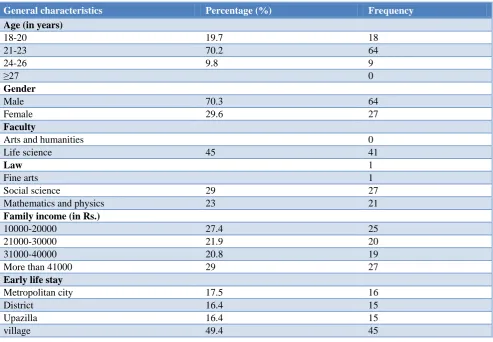
Consumer awareness (knowledge, attitude, and practice): The majority of the respondents were male (73%) (Table 3). The majority (55.9%) of the respondents knew that there is a law in the country that deals with milk adulteration; among them 41.7% thought that the reduced mobile court activity is reason for unchanged milk adulteration situation and insufficient penalty is also a major factor (45%). 54.9% respondents opined that public awareness can reduced milk adulteration. Only (55.9%) respondents consider water is main milk
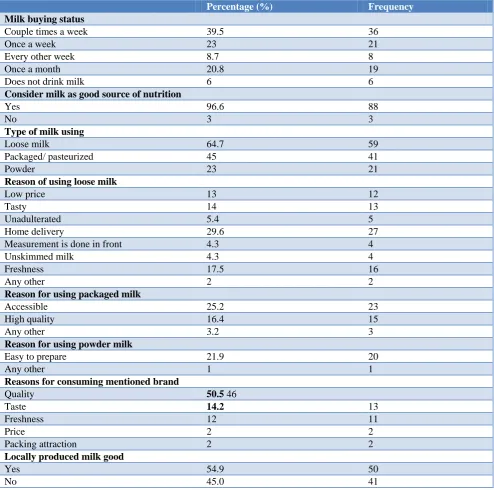
adulterant and 31.8% know about chemicals for enhancing nutrition value (melamine powder, urea) in milk. The majority of the respondents 87.8% strongly agreed that milk adulteration has harmful effects on health. Though 96.6% respondents knew that milk is good source of nutrition among them only 39.5% buy milk couple times a week (Table 4). Although food adulteration received considerable media attention, the consumers in our study lacked knowledge on what comprises adulteration, the adulterants used.
Table 1: Adulteration of milk samples by Formalin.
Sl. No Adulterants Packed powder milk UHT packed milk Pasteurized packed milk
1 Formalin (no. of samples positive) ……….. --- ---
2 Formalin (no. of samples negative) 5 4 1
Table 2: Adulteration of milk samples by Melamine.
Sl. No Adulterants Packed powder milk UHT packed milk Pasteurized packed milk
1 Melamine (no. of samples positive) --- ---
2 Melamine (no. of samples negative) 01 01
Table 3: General characteristics of the study population.
General characteristics Percentage (%) Frequency
Age (in years)
18-20 19.7 18
21-23 70.2 64
24-26 9.8 9
≥27 0
Gender
Male 70.3 64
Female 29.6 27
Faculty
Arts and humanities 0
Life science 45 41
Law 1
Fine arts 1
Social science 29 27
Mathematics and physics 23 21
Family income (in Rs.)
10000-20000 27.4 25
21000-30000 21.9 20
31000-40000 20.8 19
More than 41000 29 27
Early life stay
Metropolitan city 17.5 16
District 16.4 15
Upazilla 16.4 15
Table 4: Milk consumption status.
Percentage (%) Frequency
Milk buying status
Couple times a week 39.5 36
Once a week 23 21
Every other week 8.7 8
Once a month 20.8 19
Does not drink milk 6 6
Consider milk as good source of nutrition
Yes 96.6 88
No 3 3
Type of milk using
Loose milk 64.7 59
Packaged/ pasteurized 45 41
Powder 23 21
Reason of using loose milk
Low price 13 12
Tasty 14 13
Unadulterated 5.4 5
Home delivery 29.6 27
Measurement is done in front 4.3 4
Unskimmed milk 4.3 4
Freshness 17.5 16
Any other 2 2
Reason for using packaged milk
Accessible 25.2 23
High quality 16.4 15
Any other 3.2 3
Reason for using powder milk
Easy to prepare 21.9 20
Any other 1 1
Reasons for consuming mentioned brand
Quality 50.5 46
Taste 14.2 13
Freshness 12 11
Price 2 2
Packing attraction 2 2
Locally produced milk good
Yes 54.9 50
No 45.0 41
Table 5: Knowledge about milk adulteration.
Percentage (%) Frequency
Aware of milk adulteration
Yes 81.2 74
No 18.6 17
Common milk adulterants
Water 55.9 51
Chemicals for preservation (formalin) 29.6 27
Chemicals for enhancing nutrition value
(melamine powder, urea) 31.8 29
Extracting ingredients (cream) 14.2 13
Heavy metal 10.9 10
Percentage (%) Frequency
Has adverse health effects
Yes 87.8 80
No 12 11
Food adulteration-related law in the country
Yes 55.9 53
No 7.6 7
Did not know 34 31
Reason for unchanged milk adulteration situation
Reduced mobile court activity 41.7 38
Insufficient penalty 45 41
Political influence 14.2 13
Others 10.9 10
Opinion about preventing milk adulteration
Law properly enforced 34 31
Adequate punishment 27.4 25
Public awareness 54.9 50
Others 3.2 3
DISCUSSION
The obtained result is very relieving despite the current alarming situation in food sectors of Bangladesh. However, our suggestion is that market products investigation should be done by the concerned authorities as well as independent research groups at a regular interval across the country. This finding is not similar to a study, in which formalin and melamine level was above permissible level.2 Another study also showed such positive results.10 Pasteurized milk is one among the 64 items of food and agricultural products of BSTI list (pasteurized milk-BDS 1702:2002).11
Some study emphasized that key investigation should be on nutrients parameter of milk. Considerable gaps were found in the knowledge and practices regarding milk adulteration and consumption which was consistent with the findings of a study based on similar study area.12 Media can play an important role to increase awareness among people. BSTI should be trained adequately about the available adulteration control services. Concerned authorities should implement existing law to ensure quality food products.
CONCLUSION
The study will create awareness among community or consumers in the town. These findings may be helpful for the concerned government body regulatory bodies to monitor the quality of the commercial milk in the market.
Limitations
This study has several limitations. The magnitude of food adulteration is huge. Results from a single laboratory were reviewed for reasons of accessibility and time constraints. The survey on consumer awareness was
conducted in Savar area. As a result, the knowledge, attitude, and practice of the consumers interviewed may not represent that of Bangladesh and need further large-scale survey. Many local and foreign commercial milk brands are available in the market. But sample size was too small.
Funding: Jahangirnagar University Conflict of interest: None declared
Ethical approval: The study was approved by the Institutional Ethics Committee of Jahangirnagar University, Bangladesh
REFERENCES
1. Fazal M, Javid H, Al N, Abdullah G, Saima F, Zakira N, et al. Detection and Quantification of Formalin Adulteration in Cow Milk Using Near Infrared Spectroscopy Combined with Multivariate Analysis. J Adv Dairy Res. 2017;5:1.
2. Brindha N, Chitra P, Janarthanan R, Murali A. A Study on Detection of Adulteration in Milk Samples from Different Regions of Thuraiyur District in Tamil Nadu, India. Int J Curr Microbiol App Sci. 2017;6(12):3303-10.
3. Singuluri H, Sukumaran MK. Milk Adulteration in Hyderabad, India – A Comparative Study on the Levels of Different Adulterants Present in Milk. J Chromatograph Separat Techniq. 2014;5:1
4. Shrishti N, Rakesh P, Nishant R. Analysis Of Milk Quality, Adulteration And Mastitis In Milk Samples Collected From Different Regions Of Dehradun. Int J Pharm Tech Res. 2013;5(2):359-64.
5. Ghulam SB, Muhammad K. Extent of extraneous
water and detection of various adulterants in market milk at Mirpurkhas, Pakistan. IOSR J Agriculture Veterinary Sci. 2014;7(3):83-9.
6. Park K. Preventive Medicine in Obstetrics,
Preventive and Social Medicine. Banarasi Das Bhanot Publishers. 23rd edition. 2015: 558.
7. Kandpal SD, Srivastava AK, Negi KS. Estimation of quality of raw milk (open & branded) by milk adulteration testing kit. Ind J Community Health. 2012;3:188-92.
8. Mohammed A, Musa S, Shuming Y. Common Milk
Adulteration in Developing Countries Cases Study in China and Sudan: A Review. J Adv Dairy Res. 2017;5:4.
9. Ali A, Mahmood MS, Hussain L, Akhtar M.
Adulteration and Microbiological Quality of Milk (A Review). Pak J Nutr. 2011;12:1195-202.
10. Swathi JK, Naazia K. A study on adulteration of milk and milk products from local vendors. Int J Biomed Adv Res. 2015;6(9):678-81.
11. BSTI (Bangladesh Standards and Testing
Institution).
12. Sharifa N, Tahmeed A. Food Adulteration and
Consumer Awareness in Dhaka City.1995-2011.
Available at: https://www.researchgate.net/
publication/265466568_Food_Adulteration_and_Co nsumer_Awareness_in_Dhaka_City_1995-2011. Accessed on 22 May 2018.